Half the world aged under 25: UN State of the World Report

With almost half the world’s seven billion people aged under 25, and 1.2 billion aged 10-19, investment and education in the young has never been more important.

That was one stand-out finding of the UN’s State of the World Population Report for 2011, unveiled in the Maldives today during a ceremony in the UN’s headquarters in Male’.

Rather than preach population reduction measures, the report acknowledges seven billion as testimony to the success of humanity, and advocates “planning and the right investments in people now – to empower them to make choices that are not only good for themselves but for our global commons.”

Space, a video promo by National Geographic for the report noted, was not the problem. Rather, it was a question of balance.

“Our world of seven billion can have thriving, sustainable cities, productive labour forces that can fuel economic growth, youth populations that contribute to the well-being of economies and societies, and a generation of older people who are healthy and actively engaged in the social and economic affairs of their communities,” noted Executive Director of the UNFPA, Babatunde Osotimehin, in the report’s introduction.

“People are living longer, healthier lives. But not everyone has benefited from his achievement or the higher quality of life that this implies. Great disparities exist between and within countries. Disparities in rights and opportunities also exist between men and women, girls and boys,” Osotimehin wrote. “Governments that are serious about eradicating poverty should also be serious about providing the services, supplies, information that women need to exercise their reproductive rights.”

Many of the issues to do with providing opportunities for youth outlined in the report have strong parallels in the Maldives, where a quarter of the population is aged between 15-24.

Speaking at the report’s launch in Male’, Vice President of the Maldives Dr Mohamed Waheed Hassan observed the migration of young people to Male’, and the need to create more job opportunities in the atolls.

Currently, a quarter of all young men and half of all young women in the atolls are unemployed. Anecdotally, many youth in Male’ are voluntarily unemployed.

Dr Waheed acknowledged the problem: “As important as access to jobs are better wages. People make calculations on whether it is worth working. If the pay is so low [they are unable to afford rent], they will stay at home and remain dependent on their parents,” he noted.

“It is also important to look at jobs not just in terms of salaries, but work satisfaction,” Dr Waheed said, noting that teachers in the Maldives frequently claimed this as their highest concern.
It was also important to ensure growing the number of jobs – an estimated 21,000 were needed each year – also included women, he added.

Deputy Minister of Finance Haifa Naeem suggested the Maldives needed to “diversify jobs to attract the youth market, in fields such as arts and culture.”

“Social investments in youth people’s education, health and employment can enable countries to beuild a storng economic base, thereby reveersing intergenerational poverty. Enhancing young people’s capacties can yield larger returns during the course of their economically productive lives,” the report noted.

Read the report

World at a glance:

  • People under 25 make up 43 percent of the world’s population, and 60 percent of the population of developing countries
  • Seven billion people would fit shoulder-to-shoulder in Los Angeles
  • 27.3 percent of young women in South Asia are employed, compared to 47.7 percent in developed countries. In the Middle east, the figure is 21.5 percent.
  • Half the population of the world live in cities
  • Asia currently accounts for 60 percent of the world’s population, while Africa is expected to triple to 3.6 billion by 2100
  • The average fertility rate is 2.5 children
  • The population growth rate for developed regions is 0.4 percent. For least developed regions, 2.2 percent
  • The population grew by one billion in just 12 years

Maldives at a glance:

  • The Maldives’ population in 2011 is 325,125, not including 70,259 foreign workers
  • Male’s population in 2011 was 110,000. In 1911 it was 5236, and in 1970, it was 14,037
  • 40 percent of the population are aged 15-24, and half of the country’s young people live in Male’
  • 1 in 4 people in the country are expatriate workers
  • Life expectancy has increased by 20 years since the 1980s
  • Every day, 20 people are born and three people die
  • The average annual income in Male’ is US$7217. In the atolls, it is US$647 – eight percent
  • One in three Maldivian women experience physical or sexual violence in their lifetimes
  • 42 percent of working-age women are unemployed
  • In the atolls, 50 percent of young women and 25 percent of young men are unemployed
  • The average woman is married at 19, and has her first child at 20
  • The Maldives spends 15 percent of its GDP importing fossil fuels, over US$200 million a year
Likes(1)Dislikes(0)

ACC forwards cases against senior officials of Thilafushi Corporation for prosecution

The Anti-Corruption Commission (ACC) has concluded its investigation into alleged corruption committed by the Thilafushi Corporation Ltd (TCL) in awarding a land reclamation project to Heavy Load Maldives – a family business of ruling Maldivian Democratic Party (MDP) Chairman ‘Reeko’ Moosa Manik – and sent cases against three senior TCL officials for prosecution.

The three members of the bid evaluation committee facing corruption charges are Managing Director Mohamed Wafir, Director Mohamed Adhil Rasheed and former Acting Manager Ibrahim Riyaz.

A statement put out by the ACC yesterday noted that the US$21 million project was not awarded with the advice of the TCL board and in violation of the government-owned company’s operating procedures.

The ACC investigation found that TCL provided US$3 million to Heavy Load as a mobilisation payment without the approval of either the engineer or the board’s majority.

Moreover, TCL accepted three vessels worth US$1.8 million as advance payment security without a valuation of the vessels. The security document was signed by a director of Heavy Load Maldives while a board resolution from the company authorising the director to sell or mortgage assets was not submitted.

Based on its finding, the ACC concluded that the three evaluation committee members tried to “illegally benefit a particular party” in the awarding of the project.

In addition, the ACC found that TCL was in the process of revising the project and replacing its engineer, Abdulla Ziyad, as the contractor appeared unlikely to complete the project on time.

The dredging was part of TCL’s development of a new port catering to 15,000 ton cargo ships and container terminal, on 3.8 million square foot of land. The industrial zone development project is partly intended to free up land currently occupied by the port in Male’, one of the most densely populated cities in the world at over 100,000 people per square kilometre.

Meanwhile, in a second statement put out today, the ACC revealed that it had also requested the Prosecutor General’s Office (PGO) to prosecute TCL’s Corporate and Legal Affairs Manager Mohamed Latheef as he had failed to provide a copy of a board resolution approving the decision to sue the ACC after it ordered the project to be halted.

Latheef had assured the ACC on August 21 that he would send a copy to the commission, the statement noted.

TCL sued the ACC on April 21 claiming the commission’s order to stop work on the US$21 million Thilafushi reclamation project was not legally justifiable.

In April, TCL lawyer Mazlan Rasheed argued at the Civil Court that the ACC did not have legal authority to order the government corporation to scrap the project, which was was both “irresponsible” and “unlawful” as the order was made before the commission completed its investigation process.

TCL therefore requested that the Civil Court declare the ACC order unlawful, he said.

ACC lawyer Areef Ahmed Naseer however denied the claims, insisting that the commission acted within legal bounds.

Heavy Load Maldives was awarded the US$21 million project on September 30 last year, and inaugurated the project on February 4, 2011.

MP Moosa Manik told Minivan News in February this year that the commission’s order was politically motivated, claiming that “there is a part of the ACC that is not free and fair.”

“PA’s Deputy Leader [Ahmed] Nazim is very close with one of the commission members, [Abdulla] Hilmy, which needs closer investigation,” Moosa claimed. “I am a strong part of this government and I think this is a political trick. I haven’t even been into the Heavy Load office in one and a half months because of my campaigning [in the local council elections]. It is run by my family, my children.”

In an audio clip of a leaked phone call between Nazim and MP Abdulla Yameen that emerged in July 2010, the Deputy Speaker is heard to say that he has “given warnings” to ACC members to issue a press release, presumably regarding dismissed Auditor General Ibrahim Naeem.

Likes(0)Dislikes(0)

Former Deputy Police Commissioner denies PIC allegations

Former Deputy Commissioner of Police Mohamed Rishwan has denied findings of a Police Integrity Commission (PIC) investigation that he ordered police officers to forcibly cut the hair of several persons that were arrested during a special operation, conducted in July last year when he was in police force.

In a press statement issued to the media, Rishwan said that he had never committed a criminal offence during his time as Deputy Commissioner, and that he had only sought to be accountable for the actions of police as he was in charge of the operations conducted across the country.

Rishwan said he had served the nation for 18 years and that he had a right to defend his status and protect his reputation.

Rishwan denied giving the order to cut the hair of the detained suspects and insisted that he had cooperated with the investigation into the incident after he had learned of it.

The PIC launched an investigation into allegations made by several persons that were arrested during the special operation that they were mistreated and their hair was forcibly cut without their consent.

After the investigation, the commission publicised the investigation report which said that Rishwan was the person bearing responsibility for the action, as he had confessed to the PIC that he gave orders to cut the hair of arrested persons.

The PIC also alleged that Rishwan had violated the Police Act and said that the case had now been sent to the Prosecutor General to press criminal charges against Rishwan.

Rishwan resigned from his position in July this year. Speaking to local media about the decision at the time, Rishwan said his resignation was based solely on wanting to spend more time with his family.

Back in February, Rishwan was reported to have been temporarily suspended from his duties after allegedly failing to follow orders regarding a dispute over taking control of the Thulusdhoo Atoll Council’s office without a court warrant.

In July last year, police and the Maldives National Defense Force (MNDF) arrested almost 60 people, including children, in a joint special operation launched to curb the rise in gang violence.

Many arrested at the time claimed that their mobile phones and personal belongings were confiscated and not returned when they were released.

Almost everyone arrested in the operation was released without any charges.

A number of those arrested claimed they were mistreated and abused in custody, including being forced to remove their clothes, blindfolded and beaten.

Likes(0)Dislikes(0)

Police to release 11 suspects in light of Criminal Court ruling

The Maldives Police Service has decided it would no longer detain suspects arrested without a warrant on suspicion of having committed an offence after Criminal Court Chief Judge Abdulla Mohamed ruled Monday night that the arrest of Gassan Maumoon violated article 46 of the constitution.

Article 46 states, “No person shall be arrested or detained for an offence unless the arresting officer observes the offence being committed, or has reasonable and probable grounds or evidence to believe the person has committed an offence or is about to commit an offence, or under the authority of an arrest warrant issued by the court.”

The legal team of the former President’s son argued at court that a Supreme Court ruling (page 11 point 11) on July 11, 2010 – which overturned a High Court ruling extending the arrest of MPs Abdulla Yameen and Gasim Ibrahim for alleged bribery – established a precedent for interpreting article 46.

Gassan’s lawyers contended that his arrest did not fall under the exceptions provided for in article 46 where a suspect could be taken into custody without an arrest warrant.

Responding to the legal argument at court, Police Superintendent Mohamed Jinah insisted that the arrest was lawful as police had reasonable grounds to suspect Gassan had committed a crime and were prepared to submit early evidence.

In a press statement released today, police noted that before Monday night’s ruling the Criminal Court had not followed the criminal justice procedure established by the Supreme Court ruling for suspects taken before the court since July 2010.

Article 48 of the constitution states that suspects must be brought within twenty-four hours before a judge, “who has power to determine the validity of the detention, to release the person with or without conditions, or to order the continued detention of the accused.”

Police therefore decided to only detain suspects arrested from the scene of the crime or after the arresting officer observed the offence being committed.

“Eleven suspects in police custody have now been released,” the statement revealed. “However they do not include people detained from the scene of the crime or while committing the crime. The [police] service has done this in order to enforce court verdicts with fairness and equality and to ensure that such an incident is not repeated before the constitutional problem is resolved.”

Police were consulting with the relevant authorities to resolve the constitutional dispute, it added.

Meanwhile, the Criminal Court issued a court order today demanding that police answer to the release of two Maldivian Democratic Party (MDP) activists released from custody after the court extended their detention.

The activists were arrested for their part in disturbances outside the former President’s residence, Maafanu Endherimaage, which resulted in damage to private property.

Police Sub-Inspector Ahmed Shiyam told Minivan News today that police did not wish to comment on the matter or clarify whether the police appeared at the Criminal Court in accordance with the court order.

Local media however reported that police sent a letter in response to the court order explaining that it had the authority to release suspects after interrogation, notwithstanding an extension of detention. The letter reportedly noted that a number of suspects had been similarly released in the past.

In a statement put out today, the Criminal Court said an individual had sent a letter requesting the court take action against Police Commissioner Ahmed Faseeh as the police spokesperson Sub-Inspector Shiyam’s statements in the media claiming police were considering the release of over 300 suspects amounted to contempt of court.

Chief Judge Abdulla Mohamed was not available for comment at the time of press.

Likes(0)Dislikes(0)

MDP appeals for international assistance over “intolerable situation” of judiciary

The ruling Maldivian Democratic Party (MDP) has appealed for assistance from the international community over the “increasingly blatant collusion between politicians loyal to the former autocratic President, Maumoon Abdul Gayoom, and senior members of the judiciary – most of whom were appointed by Gayoom during his thirty years of power.”

In a statement by the MDP forwarded to diplomatic missions and United Nations offices by the Foreign Ministry concerning the events of October 20, the ruling party explained that a protest was launched against “an ongoing, highly-politicised Supreme Court case” contesting the eligibility of MP Mohamed Musthafa for the May 2009 parliamentary elections.

“The Supreme Court case is the latest installment of an ongoing attempt by Gayoom to secure a parliamentary seat for his son, Gassan Maumoon,” the statement alleged, noting that Gassan was defeated by the MDP MP for Thimarafushi constituency.

The High Court however ordered a re-vote after Gassan challenged the result, which was won again by Musthafa.

“Having lost two votes – both recognised as free and fair by the independent Elections Commission (EC) – the Gayoom family again turned to the courts for help,” the statement continues.

“Umar Naseer, a senior member of Gayoom’s political party [Progressive Party of Maldives (PPM)], lodged a case at the Supreme Court claiming that Musthafa had not been eligible to run for parliament because of an outstanding debt owed to the Bank of Credit and Commerce International (BCCI) – a bank which became insolvent and had its loans and debts taken over by the Maldives Monetary Authority (MMA).”

Musthafa at Supreme Court

After the MMA clarified to Musthafa that he did not have an outstanding debt, the EC decided that he was eligible to stand for the Thimarafushi seat.

However, Umar Naseer told Minivan News in May 2010 that Musthafa “has to pay US$31,231.66 (Rf401,326.83)” to the MMA and that the Civil Court ruled on August 28, 1997 that the debt should be paid by MP Musthafa and his company Seafood International Private Limited.

“We raised the issue at the Elections Commission (EC) during the parliamentary elections and the former president of EC said that there was no debt which should be paid by Mustafa,” Umar said.”That’s why I took it to the Supreme Court.”

Before Musthafa was summoned to court last Thursday – which prompted the MDP national council to pass a resolution to launch a protest – the Supreme Court last conducted a hearing on the case on March 17 this year.

At last Thursday’s hearing, Chief Justice Ahmed Faiz said the apex court wished to “clarify a few points after reviewing the case.”

The Supreme Court Justices asked Musthafa a number of questions regarding the case, including if he had issued a personal guarantee for the loan.

Musthafa said he had not given any personal guarantee and insisted that the loan was issued to Seafood International Pvt Ltd.

“Politicised”

Following the MDP’s protest alleging that the judiciary and the Judicial Services Commission (JSC) were subject to political manipulation by the opposition and members of the former government, opposition parties accused the ruling party of attempting to exert undue influence over the judiciary by “intimidating judges,” warning of “dangerous” consequences for the nation.

The MDP statement meanwhile contended that Musthafa’s case “fits a pattern whereby cases filed against MDP supporters and those who sympathise with the MDP are fast-tracked while more serious cases against family and friends of Gayoom never reach court.”

On August 29, Independent MP Ismail Abdul Hameed was abruptly summoned to the Criminal Court and sentenced to one year and six months banishment about 30 minutes before a crucial vote on the government’s Goods and Services Tax (GST) legislation. The Kaashidhoo MP had been voting with the ruling party on the economic reform bills.

The statement also referred to the corruption trial of Deputy Speaker of Parliament Ahmed Nazim, charged with multiple counts of defrauding the former Atolls Ministry, which remains “indefinitely delayed.”

In the statement, MDP Chairman ‘Reeko’ Moosa Manik accused senior judges of being “intent on defending the political and economic interests of their erstwhile friends and former paymasters from the regime of Maumoon Abdul Gayoom.”

In May this year, the JSC, the watchdog body charged with overseeing the judiciary, abolished its Complaints Committee citing “efficiency”, with complaints against judges subsequently forwarded for review by the legal section and Chair Adam Mohamed Abdulla, a Supreme Court Justice.

Last year the JSC received 143 complaints concerning the conduct of judges. By its own statistics none were tabled in the commission, and only five were ever replied to. Chair of the former complaints commission, Aishath Velezinee, was meanwhile stabbed in the street in January this year.

The JSC also failed to table or even acknowledge receipt of a report on the judiciary produced by the International Commission of Jurists (ICJ), which questioned whether the JSC’s possessed the technical ability and knowledge to investigate complaints and hold the judiciary accountable, as well as its independence.

Moosa went on to accuse the judiciary of “using the sanctity of judicial independence to protect the status quo and to remain unreformed. Nearly every judge appointed by Gayoom has retained his place on the bench – despite the fact that many of them have no legal qualifications whatsover.”

“We therefore look to our friends in the international community to help us address this difficult situation, and to support efforts to secure that which we all want – a strong, independent, professional judiciary, responsible to the needs of the society it serves,” the statement concludes.

Meanwhile in a statement released yesterday, the party revealed that its Councillor AbuBakr Fulhu “was unexpectedly called to the High Court for sentencing in a case originally brought in 2009 under Article 88(a) which contended that he had encouraged his brother to argue with a magistrate.

“The Criminal Court originally acquitted him, however, the local MP (an ally of Gayoom) has been pressing for a review by the High Court. Today, two years after the last hearing on the case, the High Court has suddenly summoned Aboo Bakr Fulhu for sentencing.”

The ruling party contended that the move was “clearly part of a concerted campaign, and we thus call on the international community to be vigilant. For example, senior members of Gayoom’s party, such as Umar Naseer, are informing the public about the outcome of cases against MDP supporters – before the verdicts have even been handed down, and are publicly predicting that many more MDP MPs will be brought before the courts and will be stripped of their seats”.

Likes(0)Dislikes(0)

Maldives rebranded as ‘always natural’

The Maldives has been officially rebranded with a new marketing slogan, ‘always natural’, and a fingerprint logo consisting of islands, corals, turtles, sharks and herons that transitions from blue to green.

The objective, said CEO David Keen of agency Quo, was to create a brand “in which Maldivians around the world can be proud.”

Speaking at the unveiling of the rebranding at the The Maldives Marketing and PR Corporation (MMPRC) today, Keen said the brand “should talk to the Maldivian people, about industry, sustainability and environmental challenges and successes the Maldives has had.”

“The slogan ‘always natural’ emphasises the huge influence the natural world has on the Maldives,” Keen added.

The new logo and slogan replace the Maldives’ existing 11 year-old branding, ‘The Sunny Side of Life’.

“The old tag line was more targeted towards the tourism industry,” said State Minister for Tourism, Thoyyib Mohamed Waheed, explaining that the new branding broadened the brand to attract investment in industries such as energy and fisheries.

The former national branding targeted tourism

“The last slogan was great for the European market,” added Managing Director of the MMPRC, Simon Hawkins, as visitors from countries such as the UK considered the sun a key drawcard. “But the number one market is now the Chinese, who don’t like the sun [as much]. We have to adapt to the market.”

Keen noted that the broader national branding would allow cross-marketing opportunities, such as stamping the logo on Maldivian products such as tins of tuna.

“A can of Maldivian tuna sold in Marks&Spencer or Waitrose is reaching exactly the market we need to reach for tourism,” added Hawkins.

The new branding was approved by the Cabinet today.

The Tourism Ministry has meanwhile published figures revealing an almost 15 percent increase in tourist arrivals in September 2011, compared to the previous year, and a 17.7 percent increase in arrivals for the first nine months of the year.

Tourist arrivals from traditional European tourism markets for the Maldives dropped in September, including the UK (10.3 percent) and Italty (16.6 percent). Chinese arrivals meanwhile increase 54 percent.

Visitors stayed an average seven nights in the country’s 24,480 beds, while the average occupancy rate was 71.5 percent across the country.

Likes(0)Dislikes(0)

Police considering legality of 300 arrests in wake of Criminal Court’s release of Gassan

The Maldives Police Service is reviewing the legality of a number of arrests made under article 46 of the constitution, after the Criminal Court ruled last night that the arrest of Gassan Maumoon, son of former President Maumoon Abdul Gayoom, was unlawful.

Police Sub-Inspector Ahmed Shiyam explained that police were studying the cases to determine whether the arrests were lawful in light of the Criminal Court precedent, and considering releasing the suspects.

Chief Judge Abdulla Mohamed ruled last night that Gassan was arrested in violation of article 46 of the constitution and a Supreme Court precedent establishing criminal justice procedures.

Article 46 states, “No person shall be arrested or detained for an offence unless the arresting officer observes the offence being committed, or has reasonable and probable grounds or evidence to believe the person has committed an offence or is about to commit an offence, or under the authority of an arrest warrant issued by the court.”

Gassan’s lawyers argued at court that as the former President’s son was taken into custody without an arrest warrant after he was summoned for questioning, the circumstances of his arrest does not fit the exceptions provided for in the constitution where suspects could be arrested without a court order.

Sub-Inspector Shiyam however said there were “dangerous criminals we have arrested following the same procedure for committing offences such as child molestation, drugs and assault and battery.”

Police were currently reviewing the cases of “over 300” suspects to determine if their arrests were constitutional, he said.

Responding to the legal arguments from Gassan’s lawyers at the Criminal Court hearing yesterday, Police Superintendent Mohamed Jinah said if Gassan’s arrest was unlawful, “every one police have arrested and brought before the court [for extension of detention] was arrested in violation of the constitution.”

Jinah insisted that the arrest was lawful as police had reasonable grounds to suspect Gassan had committed a crime and were prepared to submit early evidence for an extension of detention.

Speaking to Minivan News today, Progressive Party of Maldives (PPM) Spokesperson MP Ahmed Mahlouf said the police statement was intended to “put the lid on Gassan’s arrest,” which he said had drawn public anger towards the government.

Mahlouf noted that only the Criminal Court, High Court or Supreme Court could order the release of suspects held in remand detention and “not the President’s Office or Home Ministry.”

“And the only way to change a Criminal Court ruling is to appeal it at the High Court,” he said, adding that the Supreme Court precedent in July 2010 established that only the Prosecutor General could file such appeals.

The PPM also filed three complaints at the Police Integrity Commission (PIC) regarding Thursday’s disturbances, Mahlouf said, which involved the police reaction to the MDP protest outside the Supreme Court and police failure to intercede when MDP activists damaged the property of the former President.

The party also filed a complaint about the summons chit sent to Gassan Maumoon, he continued, which he argued was “unlawful” as the former President’s son had exercised his right to remain silent when he was first summoned on Saturday.

The PIC had invited PPM members for a meeting regarding the complaints at 12:00pm tomorrow, he said, adding that the commission had formed three committees to investigate the matter.

Two activists of the ruling Maldivian Democratic Party (MDP) arrested for their involvement in disturbances outside the former President’s residence, Endherimaage, last Thursday were meanwhile released from custody today.

The Criminal Court yesterday approved a five-day extension of detention for MDP activist Ilham. Following his release last night, Ilham’s lawyer Abdulla Haseen said Gassan was arrested on suspicion of endangering a person’s life while Ilham was arrested on suspicion of damaging personal property during Thursday’s protest.

But, said Haseen, while Ilham was handcuffed and had his detention extended by the court, Gassan was treated very differently.

Supporters of the former PPM attacked Housing Ministry’s State Minister Dr Mohamed Shareef yesterday when he arrived from a conference in Bandos while PPM activists were demonstrating outside the police headquarters.

Sub-Inspector Shiyam said today that no arrests had been made yet in connection with the attack, footage of which was shown on Villa Television yesterday. The PPM supporters also stormed into the Home Ministry and met with senior officials to complain of Gassan’s arrest.

No-confidence

President’s Office Press Secretary Mohamed Zuhair meanwhile told Minivan News that in the wake of yesterday’s Criminal Court ruling, “all the arrests made in the past using the same procedure will be unlawful.”

Zuhair revealed that a team of senior police officers met with Prosecutor General (PG) Ahmed Muiz today to discuss the implication of last night’s precedent.

“He did not speak on the issue and rather questioned the police about some past incidents that he asked police to investigate and told the police to leave the PG Office immediately,” Zuhair said.

Following the actions of the PG, said Zuhair, the executive believed the government could no longer work with him.

“We will file a no-confidence motion against him [in parliament] very soon,” he said.

PG Muiz was unavailable for comment today.

PPM Spokesperson Mahlouf said the party would do “everything we can to save the PG” and such targeting of independent institutions the government was displeased with was “unacceptable.”

Likes(1)Dislikes(0)

Parliament cancelled over convicted MPs’ attendance

Parliament was adjourned 15 minutes into the sitting yesterday after opposition MPs protested the presence of Independent MP for Kaashidhoo Ismail Abdul Hameed, who was convicted of corruption on August 29 and sentenced to one year and six months banishment.

Hameed had since appealed the Criminal Court verdict at the High Court, which held a first hearing yesterday.

Responding to points of order raised by MPs Ilham Ahmed, Ali Arif and Ahmed Mahlouf objecting to his presence in the chamber, Hameed said he was “on holiday” from October 2 to November 22.

“I don’t believe there is any legal obstacle to my attending the Majlis,” he said.

Speaker Abdulla Shahid said parliament had not informed the Kaashidhoo MP that he could not attend sittings, noting that Hameed had the right to appeal the Criminal Court verdict.

After a series of consecutive points of order from both opposition and ruling party MPs, Shahid adjourned the sitting to discuss the issue with parliamentary group leaders.

Parliament Secretary General Ahmed Mohamed confirmed to Minivan News that MPs were informed that today’s sitting was cancelled to allow the Speaker to resolve the dispute through dialogue with the Majority Leader and Minority Leader.

A decision had not yet been made on going ahead with tomorrow’s sitting, he said.

Under article 73(c)(3) of the constitution, MPs found guilty of a criminal offence “and sentenced to a term of more than twelve months” would be stripped of their seat.

Article 78 of the constitution meanwhile states that “whenever there is a vacancy among the members of The People’s Majlis, an election shall be held within sixty days from the date of the vacancy. A by-election shall not be held within six months prior to a general election.”

Brawl in committee room

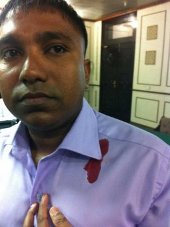
MP Ilham AhmedMeanwhile, a brawl broke out between MPs of the ruling Maldivian Democratic Party (MDP) and opposition Progressive Party of Maldives (PPM) MPs at an Economic Committee meeting yesterday.

PPM Media Coordinator and MP for Vili-Male’ Ahmed Nihan told Minivan News that MDP MP Ibrahim Rasheed threw a glass at MP Ilham.

“Bonda hit Ilham with the glass when he said that the [committee] meeting will unlawful if it was continued with MP Abdul Hameed,” Nihan said. ”He was injured and was admitted to ADK hospital after his chest was continuously bleeding.”

MP for Maafanu South Ibrahim Rasheed however denied the allegations and accused Ilham of “misleading the public.”

”He made that up and it is a big lie,” Rasheed said. ”I did not hit him.”

Speaking to private broadcaster Villa TV from ADK hospital yesterday, Ilham said yesterday’s sitting became heated over the convicted MP’s presence and the matter of a motion without notice submitted by opposition MPs regarding the MDP protest outside the Supreme Court not being tabled in the agenda.

“After the sitting was adjourned, we went to the committee,” he explained. “Even though we’re not members of the Economic Committee, we do attend meetings and speak there. We can speak even though we’re not members. We just can’t participate in voting. I said this is unlawful [with Hameed in attendance] and committee meetings could only take place after this is solved.”

Ilham said his remarks led to acrimonious verbal sparring between MPs, during which Bonda got up and threw the glass at him.

Secretary General Ahmed Mohamed told Minivan News today that a police forensic team arrived at parliament shortly after the incident and commenced an investigation.

Likes(0)Dislikes(0)

Expat nurse working in Gulhi raped

Police have arrested two men and a minor on suspicion of raping an Indian nurse working in the island of Gulhi in Kaafu Atoll.

Deputy Chair of the Gulhi Island Council, Abdulla Shiham, told Minivan News that the incident occurred last Friday night.

“That night a council member was phoned and informed about the incident at 12:30am in the morning,” he explained. “I myself went to the house where the nurse was staying and we reported it to the police right away. Police arrived the next morning because the weather was bad and no speedboat was available at the time.”

Police started their investigation the following morning, said Shiham, and arrested a 19 year-old, a 24 year-old and a minor.

“The nurse has worked for the island for almost five years and she has helped the islanders in many ways,” he continued. “We condemn this action with the strongest possible terms and we call on police and judiciary to give them the harshest penalty possible, even to the minor.”

Islanders were all frustrated and sad about the incident, the council chair said.

“When the doctor in the island health centre goes for vacation the nurse will not let us feel the absence of the doctor, she cares for the islanders very well, even if we asked she would open the health centre at midnight,” he added.

While the nurse wanted to come back to work for the island, Shiham said her husband did not want her to stay there any longer and she left the next day.

Police Sub-Inspector Ahmed Shiyam confirmed the arrests were made and said the investigation was underway.

Likes(0)Dislikes(0)