Maldives director of Amana Takaful resigns weeks before IPO

Director of the Maldives branch of Amana Takaful, Hassan Ali Manik, has resigned his post scarely a week after the company announced the launch of a landmark IPO on the local stock exchange.

Manik’s resignation will take effect from the 21st of September. In a statement, Amana Takaful said Manik was tendered his resignation “citing business and personal commitments”.

The company did not announce a replacement.

Sharia-compliant insurance company Amana Takaful will issue 800,000 shares in an initial public offering (IPO) on the Maldives Stock Exchange (MSE).

In a first for the country, 20 percent of the shares will be made available to expatriates and 15 percent to overseas applicants. The remaining 65 percent will be offered to Maldivians.

The Sri Lanka-based company hopes to generate Rf16 million (US$1.4 million) in proceeds through the IPO, by selling shares at a low issue price of Rf20 (bundled in packages of 25).

CEO of Amana Takaful Maldives, Hareez Sulaiman, said the IPO would “change the way the Maldivian Stock Exchange operates as this will be the first time that Maldivians, expatriates and foreigners will be able to purchase securities in a Maldivian listed company.”

The decision to price the shares low “at a price affordable to any average Maldivian” also promised to “be a kick starter for an active stock market which may benefit the entire economy at large,” the company said in an accompanying statement.

Likes(0)Dislikes(0)

Convict released under “Second Chance Programme” arrested for drug dealing

An inmate released under the “Second Chance Programme” to be reintegrated into society was arrested on Tuesday on suspicion of dealing drugs.

Haveeru reports State Minister for Health Lubna Zahir Hussein as saying in a press conference last night that the convict would be returned to jail if he was found guilty.

Lubna stressed that the government planned to share details of the ongoing programme with the media, including cases of convicts relapsing into crime.

Five convicts released under the programme were previously apprehended after testing positive for drug use. While three of them are to be sent to detoxification centres, clinical assessments were pending for the remaining two.

State Minister for Home Affairs Mohamed ‘Monaza’ Naeem said last week that the 134 convicts released so far under the programme are being monitored under a special mechanism.

Likes(0)Dislikes(0)

President inaugurates first training course of “skills programme”

President Mohamed Nasheed has inaugurated the first course of the government’s Rf360 million national “skills programme” intended to train 8,500 youth for skilled employment.

Speaking at a ceremony at the Post Office workshop area this morning, Nasheed observed that the main impediment for employment or job creation in the Maldives was the lack of skilled workers.

There were 12,000 expatriate workers with some skills earning between Rf90,000 and Rf100,000 a month, said Nasheed, adding that 30 percent of working age youth in the Maldives could not find jobs.

The first course under the programme is being conducted by the Centre for Career and Technical Education (CCTE) to train 100 youth in heavy load vehicle operations. In addition to 60 participants to be trained in Male’, the course will also be conducted in Haa Dhaal Kulhudhufushi in the north and Gaaf Alif Villigili in the south with 20 participants each.

Participants in the various training programmes for youth would meanwhile be paid a monthly allowance of Rf2,000.

Earlier this week, the government contracted five parties to conduct training programmes for 645 youth.

Likes(0)Dislikes(0)

Maldives one of seven most important countries on UN Human Rights Council: Human Rights Watch

The Maldives has been identified as one of the seven most important countries on the UN Human Rights Council, in a report by the Human Rights Watch organisation.

The Maldives, together with Argentina, Brazil, Chile, Mexico, the United States and Zambia were identified has making “a critical difference” during the period of the report, “working both collectively and in parallel to ensure that the Council’s mandate to address and prevent situations of violations was fulfilled more rigorously, recognising the Council’s inaction of the past”.

Negative influences identified on the Council included China, Cuba and Russia, the report noted, which “systematically voted to reject any action of the Council that they deemed too critical of a state, or that was not supported by the state in question. They argued that the Council should be a forum where states meet to discuss human rights issues cooperatively without what they considered to be interfering in the domestic affairs of others.”

In particular, the Maldives was praised for its energetic engagement with the council and its solid voting record.

“Despite having a small delegation, [the Maldives] commitment to human rights and democracy has motivated it to be a part of, or to take leadership on, a significant number of initiatives over the last year. The Maldives was among the first group of signatories calling for the special sessions on Côte d’Ivoire and Libya. The Maldives also cosponsored the resolutions on Iran, Tunisia, Côte d’Ivoire, Libya, and Kyrgyzstan,” the report said.

However it identified as “regrettable” the Maldives position on whether to launch an international investigation into war crimes in the final days of the Sri Lankan civil war, “particularly on the question of accountability.”

“The Maldives has been uncharacteristically reluctant to endorse the calls of the High Commissioner and the Secretary-General’s panel for the creation of an independent international mechanism to investigate the final months of the conflict. Its close bilateral relationship with Sri Lanka, rather than the credible allegations coming from the ground, has prompted this position,” the report noted.

“The Maldives should revisit its approach on Sri Lanka in order to bring it in line with its otherwise principled approach to human rights at the Council.”

The report also noted that despite its strong record of positive engagement on many issues at the Council, “the Maldives supported the resolution on traditional values and voted with the Organisation of the Islamic Conference (OIC) against the resolution on human rights, sexual orientation, and gender identity.”

Foreign Minister Ahmed Naseem meanwhile said the Maldives was proud that the country was now “internationally-respected for its commitment to human rights and for its influence on the global stage”

“At the time, many people doubted the Government’s decision to put forward the Maldives’ candidature for the UN Human Rights Council, saying we are too small to make a difference. Human Rights Watch’s new report shows unequivocally that such doubts were misplaced. Not only has the Maldives played a central role at the Council, we have also helped make the Council far more effective as the pre-eminent global body responsible for protecting human rights,” Naseem said.

Read the full report (English)

Likes(0)Dislikes(0)

“Falsehoods” reported in media, claims EC

The Elections Commission (EC) has accused local media outlets Sun Online, Villa TV and DhiTV of reporting “falsehoods” in their coverage of the Progressive Party of Maldives (PPM) submitting registration forms to the commission this week.

In a press statement yesterday, the EC said that the media outlets did not contact the commission for their side of the story and “brought the news very irresponsibly in a way that could lead to loss of public confidence in the commission.”

The private media outlets had reported that the PPM founding members were made to wait at the commission when they arrived to submit the forms and none of the EC members were present to receive the delegation, led by former President Maumoon Abdul Gayoom’s son Farish Maumoon.

The EC statement noted that the commission had never conducted special ceremonies to receive registration forms.

Likes(0)Dislikes(0)

Two year-old boy survives three-story fall

A two year-old boy fell from a third-storey balconey in an apartment in Male’ today and survived without serious injuries, according to Haveeru.

A family member said Jaisham Mohamed fell to the road from Maafanu Westside around 8.30am this morning while people were still asleep.

“Jaisham often tries to climb onto the balcony but everyone would prevent him from doing so. Jaisham fell after he climbed on a chair on the balcony while everyone was asleep,” she said. “His mother went to the hospital and informed us that he didn’t receive any serious injury. Only some parts of his body were bruised.”

Likes(0)Dislikes(0)

“We don’t want Israelis to invest in our island”: Filadhoo islanders

Islanders on Filadhoo in Haa Alifu Atoll have reacted with outrage to news of an Israeli agricultural delegation scheduled to arrive on the island next Saturday, warning that the visitors from Teshuva Agricultural Products “will go no further than the island jetty.”

On its website the company claims its advanced agricultural methods “allow for fresh culinary herbs to be grown in soil-less hydroponic systems.”

Filadhoo islander Mohamed Hamidh told Minivan News that the majority of the island’s 550-strong population were against the visit by the Israeli company.

Hamidh said that when the islanders first received information about the delegation, they prepared a petition signed by 100 islanders and submitted it to the island council.

“That night the Island Council called the islanders for a meeting and 83 islanders attended the meeting. Councilors called for a vote and 82 out of the present 83 citizens voted that they do not want to let the Israeli delegation step on the island,” Hamidh said.

Local media reported that the petition signed by the 100 citizens claimed the Israeli delegation intended to preach Christianity on the island and conduct un-Islamic activities, although they came under the banner of an agricultural delegation.

An earlier press release by the Deputy Leader of the Adhaalath Party accused the agricultural delegation of being agents from Mossad, the Israeli secret service.

Hamidh meanwhile said the islanders would not welcome the delegation because Israelis “have been mistreating the Muslims in Palestine” and have “killed so many Palestinian men and left many Palestinian women widowed.”

“We have reports that although the islanders oppose their presence, they will still head towards our island. They are supposed to be arriving on Saturday morning around 8:30am, so we will keep an eye on the jetty and will not let them enter this island,” he said.

Island Council Member Mohamed Vijan told Minivan News that the council was “left with no other choice” but to support the will of the citizens.

“Last Monday the Atoll Council informed the Island Council that this delegation from Israel will visit Filadhoo on Saturday,” he said.

He said the council will be “with the citizens” whether they were in favour or opposed to the visiting delegation.

Earlier this month Deputy Leader of the Adhaalath Party Dr Mauroof Hussein called for alarm after alleging that a delegation from Teshuva Agricultural Products was due to arrive in the Maldives to assess the country’s agricultural potential.

The last time an Israeli delegation visited the Maldives – a team of volunteer eye surgeons – protests erupted across Male’ that saw the burning of Israeli flags and calls to “ban all Israeli medical teams” from practicing in the Maldives.

Likes(1)Dislikes(0)

DRP requests six month delay for general GST

Main opposition Dhivehi Rayyithunge Party (DRP) Leader Ahmed Thasmeen Ali has sent a letter to the President requesting a six-month delay to the introduction of a 3.5 percent Goods and Services Tax (GST) approved by parliament last month.

In his letter, the minority leader noted that according to parliamentary rules of procedure, only the government could submit tax legislation. He urged the government to delay the implementation of the GST to allow businesses enough time to prepare. The General GST is due to come into force on October 2.

Thasmeen argued that a number of citizens could be subject to legal penalties specified in the legislation if they were not provided sufficient information about registering and paying the new direct tax.

In a booklet handed out to media last month titled “DRP’s response to the government’s economic nuisance package,” the party noted that the General GST would affect small businesses such as cornershops, cafes and teashops.

The businesses would “need a lot of preparation” to maintain accounts, install “modern computer systems and hire accountants” as well as provide customer’s statements showing the GST percentage.

Morever, taxing “total value of business transactions” would not be possible with GST at zero percent for some items.

Considering the potential “administrative confusion” and the country’s heavy reliance on imports, the DRP argued that levying a customs duty at the entry point to the country was more effective.

President’s Press Secretary Mohamed Zuhair told Minivan News today that the government viewed the DRP as the main opposition party and “gives a high priority to their concerns.”

“But the President has been advised by financial experts that all taxes should be part of one network and it is not sensible to omit one tax for the whole system to work,” he said.

Zuhair noted that “people wanted to delay the introduction of political parties” in the past, adding that “we have lost 30 years without a tax system.”

In May, the International Monetary Fund (IMF) approved a three-year support programme after the government agreed to “a package of policy reforms that will help stabilise and strengthen the Maldives’ economy.”

Under the IMF programme, the government committed to:

  • Raise import duties on pork, tobacco, alcohol and plastic products by August 2011 (requires Majlis approval);
  • Introduce a general goods and services tax (GST) of 5 percent applicable to all sectors other than tourism, electricity, health and water (requires Majlis approval);
  • Raise the Tourism Goods and Services Tax (TGST) from 3.5 percent to 6 percent from January 2012, and to 10 percent in January 2013 (requires Majlis approval);
  • Pass an income tax bill in the Majlis by no later than January 2012;
  • Ensure existing bed tax of US$8 dollars a night remains until end of 2013;
  • Reduce import duties on certain products from January 2011;
  • Freeze public sector wages and allowances until end of 2012;
  • Lower capital spending by 5 percent
Likes(0)Dislikes(0)

Islamic Foundation files court case seeking repeal of Religious Unity Regulations

Religious NGO Islamic Foundation of the Maldives (IFM) has filed a case at the High Court requesting the court rule that the Religious Unity Regulations are inconsistent with the constitution.

Controversial new religious unity regulations were published in the government’s gazette last week, cracking down on extremist and unlicensed preaching of Islam in the Maldives.

Local media reported that prominent religious scholar Sheikh Ibrahim Fareed, who currently faces charges for allegedly violating the Religious Unity Act, filed the case in the High Court and spoke to the media outside the court.

Media reported Sheikh Fareed as stating that the regulation was inconsistent with the constitution as well as the Quran.

Fareed was quoted as saying that romantic thoughts, social talks and religious speeches were part of the fundamental right of freedom of speech as stated in the constitution.

Meanwhile, religious NGO Jamiyyathul Salaf and the religious council of the Adhaalath Party voiced opposition to the regulations.

Sheikh Fareed today told Minivan News that the regulation was “very” inconsistent with the Quran and the constitution.

“By God’s will next week I will request the High Court issue a court order to delay the implementation of the regulation until the court reaches to a conclusion on the issue,” Sheikh Fareed said. “The regulation was drafted by the Islamic Ministry and it pressured the government to publish it in the gazette.”

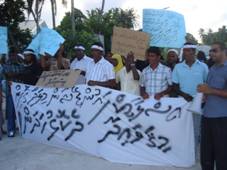
Islamic Foundation protestHe said islanders of Miladhoo in Noonu Atoll have been protesting outside on the streets of the island today calling for the religious unity regulation to be amended.

Media Coordinator of the protest and Chairman of Miladhoo Island Council Hassan Gassan told Minivan News that the protest started at 4:15pm today.

“The protest is organised by the IFM Miladhoo Wing and a huge majority of the islanders have joined the protest,” he said. “We walked around the main streets of the island and stopped at the island harbor.”

He said protesters were calling for the resignation of Islamic Minister Dr Abdul Majeed Abdul Bari, and to amend the Religious Unity Regulations.

New religious unity regulations were published in the government’s gazette last week, cracking down on extremist and unlicensed preaching of Islam in the Maldives.

The regulations reflect the enforcement of the Religious Unity Act of 1994 and were originally put forward by the Islamic Ministry, but have undergone numerous drafts and revisions over the past year. The penalty for violating the regulations under the Act is 2-5 years imprisonment, banishment or house arrest.

Likes(0)Dislikes(0)