RaajjeTV condemns newly formed PPM for barring journalist from press conference

Private broadcasting television RaajjeTV has condemned the newly formed Progressive Party of Maldives (PPM), led by former President Maumoon Abdul Gayoom, after senior officials of the party denied entrance to  a journalist from RaajjeTV to a press conference held by the party yesterday.

In a statement, RaajjeTV said that the action of PPM senior officials was undemocratic and uncivilised, and claimed that the PPM has boycotted the TV channel.

‘’To date, Raajje TV was never invited to any event organised by PPM, and has constantly refused to provide any information to us,’’ the statement said. ‘’It is questionable whether a party formed for the benefit of the citizens would do something that would destroy democracy while it is still in its infant stage.’’

RaajjeTV said that it would try to bring “true news” to the citizens of the Maldives, despite the situation.

The TV channel also called on the former President and his family to share information to the media equally and to be consistent in its words and deeds.

MP Ahmed Nihan, who is the current Media Coordinator of PPM, today told Minivan News that he knew about the incident last night and said that it was regrettable.

‘’We do not have any issues with the TV channel, but there might be some individuals in the party that have issues with it,’’ Nihan said. ‘’We have not made any decision to boycott RaajjeTV.’’

Nihan said he personally had given two live interviews to RaajjeTV and has been sharing information equally.

‘’We give very high priority to the media because it is the fourth pillar of democracy,’’ he said adding that the reports broadcasted on RaajjeTV were “usually against former President Gayoom”.

‘’Although they air such reports, we do not have any issue with that as long as they keep to the laws,’’ Nihan said.

Spokesperson of PPM Ahmed Mahlouf did not respond to Minivan News at time of press.

Likes(0)Dislikes(0)

Transparency asks authorities to investigate MPs for bribery over committee allowance justifications

Transparency Maldives has strongly condemned remarks by MPs justifying their newly inflated allowances by claiming that large portions of their salaries were spent on meeting demands from constituents.

MPs from both major parties have previously admitted that a large, usually undisclosed proportion of their salaries is spent on medical treatment, education and other requests from their electorate – a symptom of an enduring culture of patronage that persists in the Maldives – and confessed that ignoring these demands in such a culture of expectation is extremely difficult.

However, “Transparency Maldives believes such actions fall under article 3 of of the anti-corruption law and article 13 of the Anti-Corruption Commission Act regarding bribery,” Transparency said. “If such acts have taken place Transparency Maldives calls upon the relevant authorities to conduct investigations and take legal measures.”

The statement notes that 16 MPs have so far informed parliament’s secretary-general that they did not wish to take the Rf 20,000 (US$1300) allowance.

Today a group of citizens concerned about parliament’s committee allowances gathered in front of the Finance Ministry and presented a petition signed by more than 1000 people to the ministry, later intercepting President Nasheed as he left the Ministry.

The President spoke with the gathered activists and was requested to sign the petition himself, but asked why he should sign a petition that was to be presented to him anyway.

President Nasheed reportedly told the group that the government had no other choice but to issue the funds for the committee allowances as it had been already approved by parliament. The Rf20,000 allowance was initially approved on December 28, 2010 as part of a pay scale recommended by parliament’s Public Accounts Committee.

Nasheed explained that it was not a matter of whether he supported the allowance, but that “when parliament makes it legally binding the government does not have any discretion [to overrule the parliament’s decision].”

Project Cordinator of Transparency Maldives Aiman Rasheed told Minivan News that the campaign against the committee allowance will continue and there was hope for success.

”Today we presented the Finance Ministry 1365 letters signed by concerned citizens and eight cabinet members, plus high-profile people across the country,” he said.

”We have made plans to continue the letter campaign and to make the citizens aware of the impacts of this committee allowance.”

MP salaries have increased 18-fold since 2004, according to a graph released by the NGO.

The committee allowance was Rf18 million, Rasheed said. ”In comparison, the budget to combat drugs is Rf 14 million, the budget subsiding the fishing industry is Rf12 million, medical services Rf18 million and the budget for small and medium businesses is Rf16 million,” he said, adding that these areas would be impacted by the increased expenditure on MPs.

Opposition Dhivehi Rayithunge Party (DRP) MP Dr Abdulla Mausoom on his Facebook page said receiving the allowance made him feel like “Robin Hood”. Responding to criticism that such a justification would taint future elections by making them unfair for political challengers, he replied that “when the President appoints ‘directors’ for paper-companies and pays millions in public money to promote MDP…. that’s very unfair too. Why don’t we see any protest on that? This is my way of ‘protest’ for irresponsible ‘politically aligned’ spending of the government.”

The government has previously contested that expenditure on the 244 political appointees in the executive branch represented only two percent of the state’s wage bill, or Rf99 million (US$6.4 million) a year, a figure DR Mausoom has previously claimed represents “the tip of the iceberg”.

“The whole country was corporatised,” he explained. “There’s a roads corporation and all sorts of corporations. The people appointed to the boards of these corporations are all purely political appointees. They were appointed directly by the President to promote a political agenda.”

Dr Mausoom told Minivan News today that the moment he received the allowance he would start spending the same amount on his constituency for social projects.

“There is no benefit for the people in keeping the money in the government’s treasury because they will spend it all on political appointees,” he said.

“The real issue is that one institution has too much power. Parliament should not have the power to set their own salaries.”

Likes(0)Dislikes(0)

Gayoom’s new party to be called Progressive Party of Maldives

Former President Maumoon Abdul Gayoom announced today that the new party formed under his leadership is to be called the Progressive Party of Maldives (PPM).

Speaking at a live press conference at private broadcaster DhiTV, Gayoom revealed that the party’s charter has been drafted and registration forms would be submitted to the Elections Commission (EC) today.

“We are forming a new political party to achieve very important national purposes,” he said. “That is to strengthen Islam in the country and maintain Islam as a religion that we all love and respect, to fully protect our independence and sovereignty, to establish a strong democratic system in the Maldives, ensure happiness and prosperity to the people, to reform the country to make it a place where people would want to live, uphold public order, peace and stability, and facilitate equality opportunity for everyone to advance.”

Gayoom explained that he resigned as ‘Honorary Leader’ (Zaeem) of the main opposition Dhivehi Rayyithunge Party (DRP) yesterday because his efforts to reform the party over the past several months were unsuccessful.

Gayoom invited experienced politicians, “capable and educated youth” and skilled professionals to join the party. The former President expressed gratitude to those who assisted and supported the formation of the Progressive Party.

Asked repeatedly by reporters if he intended to contest in the party’s presidential primary, Gayoom stressed that he had not made a decision and would do so “when the time comes.”

“My answer is that the time [for a primary] has not come and we’ll know when it does,” he said, refusing to rule out a possible bid for the presidency in 2013.

On whether his role as leader of the new party contradicted an announcement in February 2010 that he was retiring from active politics, Gayoom said he made the decision based on the assurance that the DRP would function “according to certain principles.”

“At the time and even up till yesterday, I was at the most senior post of one of the largest political parties in the country,” he said. “So how can it be said that the person in the highest post of a political party is not involved in politics? Up till yesterday I was in politics. Today I am forced to create a new party because of the state of the nation and because it has become necessary to find another way for the country.”

As “a lot of citizens” had pleaded with him to form a new party, said Gayoom, he made the decision as “a national obligation.”

In his letter of resignation submitted yesterday, Gayoom said he was “forced” to leave the party he had formed on July 21, 2005 because the DRP had become “politically toothless” and DRP Leader Ahmed Thasmeen Ali was “acting dictatorially” and violating the party’s charter and democratic principles.

“And you [Thasmeen] keep saying clearly in the media that you do not need my counsel,” reads the letter shared with local media. “The consequence of that was the loss of hope citizens had in this party. And DRP getting the bad name of the party that gives way to the government while remaining in name a responsible opposition party.”

DRP Leader Ahmed Thasmeen Ali however dismissed the main points raised in Gayoom’s letter yesterday as “baseless claims” offered to defend his decision to resign.

The Zaeem-faction’s activities hampered DRP’s efforts to hold the government accountable, Thasmeen wrote in response, and would be “written in Maldivian political history as a shameful [episode].”

Thasmeen asserted that Gayoom decided to leave the party because he could not influence the party’s day-to-day management and functions in his ‘honorary’ role.

“Since the party’s charter does not give you that role, the fact that you tried to get your way together with a few people within the party regardless of what happened to the party is evident for all to see,” Thasmeen’s rebuttal reads.

The minority leader of parliament noted that three former DRP deputy leaders – former Attorney General Hassan Saeed, former Finance Minister Gasim Ibrahim and current Independent MP Ahmed ‘Sun Travel’ Shiyam along with other cabinet ministers – left the party to form new parties and compete against Gayoom in the 2008 presidential election.

Gayoom meanwhile said today that he had not received the letter and could not comment on its contents: “There are no personal problems between me and Ahmed Thasmeen Ali,” he insisted.

Likes(0)Dislikes(0)

Government plans to sell alcohol at Fuvahmulah city hotel, claims Adhaalath

The government has declared two areas of Fuvahmulah uninhabited islands for airport and tourism development in order to allow the sale of alcohol at a city hotel, yet to be opened on the island, the religiously conservative Adhaalath party has alleged.

President Mohamed Nasheed signed decrees on Friday declaring the “Bilhifeyshi” and “Thoon’du” areas of Fuvahmulah – two strips on opposite ends of the island – as uninhabited islands to be utilised for tourism purposes.

At a press conference yesterday, Sheikh Mohamed Shaheem Ali Saeed, Adhaalath Party spokesperson, said that the decrees were part of a “Satanic plot” to sidestep legal prohibitions to selling alcohol in inhabited islands.

“We are not opposed at all to building a city hotel for the development of Fuvahmulah,” he said. “But you don’t have to sell alcohol at every city hotel. Adhaalath party sees the declaration of uninhabited islands within Fuvahmulah as an absurd move, as an act of madness.”

The decision was “disrespectful” in light of the public’s opposition to the sale of alcohol in inhabited islands, Shaheem continued, referring to a large demonstration in February 2010 that forced the government to withdraw controversial new regulations that would have allowed sale of alcohol to non-Muslims from city hotels.

Fuvahmulah“If the government wants us to let them hear the voice of the people again, we are ready to do it,” Shaheem said, calling on citizens of Fuvahmulah and the public to “raise your voices against this decision by the government.”

President’s Press Secretary Mohamed Zuhair however dismissed Adhaalath’s allegations today as intended to “seek political recognition and cast the government in a bad light.”

Zuhair said the Adhaalath’s claims were “very insincere” as the party did not make any inquiries, request a meeting with the President to express concerns or “even sent a letter to relevant authorities before giving a press conference and making these claims in the media.”

The remarks by Adhaalath leaders were “regrettable,” Zuhair added, as the party remains a coalition partner of the ruling Maldivian Democratic Party (MDP) and its senior members included the Minister and State Minister for Islamic Affairs.

Meanwhile at yesterday’s press conference, Adhaalath Party Vice President Dr Mauroof Hussein claimed President Nasheed “pressured” Fuvahmulah councillors to approve a resolution for developing the city hotel.

Dr Mauroof argued that the President’s decree set a disturbing precedent: “Tomorrow they can announce that President Nasheed has decreed the inner walls of Holiday Inn [now Trader’s Hotel] is an uninhabited island. Or the plot west of the army headquarters is an uninhabited island and demolish the Islamic Centre to build a bar there,” he said.

The government was pursuing an agenda to “spread irreligious activities” in the Maldives, Dr Mauroof warned.

Economies of scale

Speaking at a function in Fuvahmulah on Friday, President Nasheed expressed confidence that the construction of an airport in the island would be completed by November 10.

Nasheed said that the government understood the people’s longstanding desire for an airport but insisted that the investment should be sustainable.

In addition to operating costs, said Nasheed, about Rf500,000 would have to be spent “on interest [payments] alone.”

“It is not clear to me that we can recover this money with about 30 people flying to Fuvahmulah from Male’ every week,” he explained. “With development, especially national development, we have to consider that every project has to be sustainable, well-rounded and feasible.”

In order to ensure financial sustainability for the airport, he continued, the government intends to build a tourist hotel in Fuvahmulah in collaboration with a business partner.

“We don’t want to criticise, meddle and try to profit [from the hotel] in Male’,” he said. “When the facilities are used for your development, the whole population of the Maldives will benefit from it. A number of things that can be done to ensure feasibility of the airport can be seen in the environment of Fuvahmulah, in its natural resources.”

President Nasheed said the decision to declare the two areas non-inhabited was made following deliberations by the cabinet and consultation with Fuvahmulah councillors.

Likes(0)Dislikes(0)

President awards Mark ‘Occy’ Occhilupo Four Seasons Maldives Surfing Champions Trophy

World Champion Surfer Mark Occhilupo has won all three divisions of the inaugural Four Seasons Maldives Surfing Champions Trophy, defeating longboard champion Josh Constable in the final and taking home US$19,000 in prize money.

President Mohamed Nasheed presented the trophy to Occy on board the Four Seasons Explorer, a luxury three-storey catamaran anchored near the Sultans surf break.

“We are people of the sea. We grow up with the elements around us, and the sea is never very far away. We are taught to swim from a tender age,” Nasheed said.

“44 percent of our workforce are fishermen, who spend more than half their lives on the sea, and many Maldivians looked up to famous surfers while growing up,” he said.

Nasheed dancing Bodu Beru with the surf champions

The relative seclusion of the country’s surf breaks compared to more famous surfing destinations such as Hawaii and Indonesia was not necessarily a bad thing, Nasheed said, “because we are not always clear about how to manage our resources. We have to use them wisely to benefit everyone.”

Nasheed told Occy that the Maldivian cabinet was not unfamiliar with the water, having conducted a cabinet meeting underwater in 2009. Occy asked if that was “the same as a cone of silence”.

Occy dedicated the champion’s trophy to Tony Hussain Hinde, the Australian-born surfer who pioneered modern surfing in the Maldives after becoming shipwrecked in the country, and who died in 2008.

Following the prize presentations, the six surfing legends, together with the President, Press Secretary Mohamed Zuhair, cabinet ministers and several MPs of the Maldivian Democratic Party (MDP) erupted into a spontaneous traditional Bodu Beru dance.

Final day of the competition

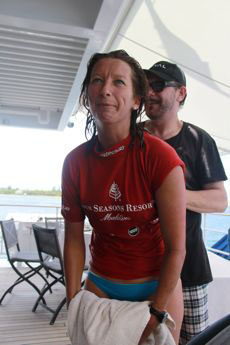
The six surfers, including two-time world champion Damien Hardman, four-time world champion Mark Richards, world longboard champion Josh Constable, 1966 world champion Nat Young and seven times female world champion Layne Beachley competed in one-, two- and three- fin divisions over the three days.

On the last day the Sultans reef break served up consistent four-foot right hand waves. During the final event, Occy required an 8.10 score to reclaim his lead, and waited patiently for a wave on which he delivered a 9 with full rail-to-rail maneuvers.

“I made a couple of mistakes, including losing priority, and I had to tell myself to just calm down,” Occy said of his performance.

“So I cleared my head and moved up the point where I needed to be and then a gem of a wave came through and I surfed it as good as I could and got that nine. I didn’t have one heat where I felt I was not under pressure. All those memories of being on tour came back and I had to rely on my instincts to win this event and now that I have, I am over the moon.”

Constable praised Occy as a “solid competitor”.

Reehan surfing with Layne Beachley

“I just couldn’t get him. He was on his game all week. I felt solid in the final and I had a good score but couldn’t get that back up so hats off to Occy.”

Sole female competitor Layne Beachley came close to taking the single fin division title from Occy in the final of the first day, and was only narrowly defeated.

“It’s been surreal competing against five male world champions and being a contender,” said Beachley, noting that such match-ups were rare in the surfing world due to the anatomical disadvantages women faced: “our hips get in the way.”

“I knew it was always going to be challenging but I stepped it up and gave them a run for their money,” she said.

Four-time world champion Mark Richards was forced to withdraw from the final day of the competition after suffering a hamstring injury, opening the way for Maldivian surfer Ali Reehan Mohamed to take to the water as a wildcard entry.

Grinning, the 18 year-old described that surf as “the best experience of my life.”

Confessing to an attack of nerves at being out among the world champions, Reehan said “I did my best to show them something.”

"Best experience of my life" - wildcard entry Reehan

“It was very friendly, we were sharing waves,” he said.

Reehan has been surfing for two years, after upgrading from “fighting the white water on a body board”. He has since made his hobby into his work, freelancing as a professional surf guide.

“I stopped my last trip just to come here – I gave it to someone else,” he said.

General Manager of the Kuda Huraa Four Seasons Resort, Sanjiv Hulugalle, said the HSBC, Billabong, Wataniya, Surfing World and Singapore Airlines-sponsored event would return next year.

“The aim was to showcase the Maldives as a world-class surfing destination,” Hulugalle said, “and the international media has broadcast it all over the world.”

Reehan agreed: “With the media here, Maldives surfing is only going to get bigger,” he said.

Likes(0)Dislikes(0)

President meets outgoing UNESCO director, Honorary Consul

President Mohamed Nasheed, Vice President Dr Mohamed Waheed and Chief of Staff Ahmed Mausoom yesterday met with Outgoing Director of UNESCO and Former Minister of Education of Mauritius, Amroogam Parsuramen, to discuss strengthening collaboration in the areas of higher education, trade and economic development.

During the meeting Parsuramen also congratulated the Maldives for its promotion of the values of democracy, human rights, and efforts to seek regional cooperation in an international arena.

Nasheed also met yesterday with the Salisbury-based Honourary Consul of the Maldives and Friends of Maldives founder David Hardingham, and discussed providing overseas volunteers to assist in areas of development and trade.

Likes(0)Dislikes(0)

JP asks Supreme Court to declare Kaashidhoo seat vacant

Jumhooree Party (JP) Youth Wing leader Moosa Anwar has filed a case in the Supreme Court of the Maldives requesting that the Kaashidhoo seat in parliament be declared vacant, and Elections Commission (EC) hold a by-election to reelect an MP for the seat.

The Criminal Court last week sentenced Independent MP for Kaashidhoo, Ismail Abdul Hameed, to one year and six months banishment after he was found guilty of abuse of authority for financial gain to a third party.

Under article 73(c)(3) of the constitution, MPs found guilty of a criminal offence “and sentenced to a term of more than twelve months” would be stripped of their seat.

Article 78 of the constitution meanwhile states that “whenever there is a vacancy among the members of The People’s Majlis, an election shall be held within sixty days from the date of the vacancy. A by-election shall not be held within six months prior to a general election.”

Moosa said that that the Supreme Court could determine whether Hameed should be given 90 days to appeal or if the seat should become vacant immediately following the lower court’s ruling.

“It is uncertain whether the seat is vacant. I believe that the seat is vacant following the Criminal Court ruling on 29 August and that the Elections Commission should have announced the by-election within five days as stated in the Parliamentary Elections Act,” he said. “But the commission has not, so the confusion over the vacant seat has to be cleared up by the Supreme Court.”

In other democratic countries, he noted, MPs would resign on their own when criminal charges were made against them with clear evidence, describing it as “best practice”.

The Prosecutor General pressed corruption charges against Hameed alleging that he had abused his authority as the former Director of Waste Management at the Male’ municipality to financially benefit a Singaporean company named Island Logistics in a deal to purchase a barge.

Deputy Elections Commissioner Hassan Fayaz told Minivan News at the time that the EC will begin preparations for the by-election when parliament officially informs the commission that a seat is vacant.

“I think it will take some time because he has the right appeal the verdict in superior courts,” he told Minivan News at the time.

Likes(1)Dislikes(0)

Gayoom, Z-faction MPs quit DRP to form new party

Former President Maumoon Abdul Gayoom, founder and ‘Honorary Leader’ (Zaeem) of the opposition Dhivehi Rayyithunge Party (DRP), resigned his post and left the party today followed by MPs of the DRP’s breakaway ‘Zaeem’ faction.

DRP Media Coordinator Ali Solih confirmed to Minivan News today that apart from Gayoom’s letter of resignation, the party has so far received letters from MPs Ahmed Mahlouf, Ahmed Nihan Hussein Manik and Ali Arif.

The Z-faction began collecting signatures to register a new party last night with Gayoom’s half-brother Abdulla Yameen becoming the first person to sign. Yameen has resigned as leader of minority opposition People’s Alliance (PA) and declared his intention to contest in the new party’s presidential primary.

Former DRP Deputy Leader Ilham Ahmed, who quit the party yesterday, was the second signatory after the MP for Mulaku.

After months of factional strife and a litany of grievances aired in the media, Gayoom withdrew his endorsement of DRP Leader Ahmed Thasmeen Ali in March this year, accusing his successor of “acting dictatorially” and violating the party’s charter in the controversial dismissal of Deputy Leader Umar Naseer.

Of the four deputy leaders elected in its third congress in March 2010, only Ibrahim ‘Mavota’ Shareef now remain. Deputy Leader Ali Waheed defected to the ruling Maldivian Democratic Party (MDP) in May.

In his letter of resignation submitted today, Gayoom said he was “forced” to leave the party he had formed on July 21, 2005 because the DRP had become “politically toothless.”

“And you [Thasmeen] keep saying clearly in the media that you do not need my counsel,” reads the letter shared with local media. “The consequence of that was the loss of hope citizens had in this party. And DRP getting the bad name of the party that gives way to the government while remaining in name a responsible opposition party.”

Vili-Maafanu MP Ahmed Nihan told Minivan News that he expects the registration forms to be submitted to the Elections Commission (EC) tomorrow.

“We decided to form this party because found out that we cannot work along with DRP Leader Ahmed Thasmeen Ali, and we had difficulties in working within the DRP parliamentary group,” Nihan said. “So the only way we can work in accordance of with our principles is to form a new party.’’

While the Z-faction has been functioning independently of the DRP council since April this year, Nihan added that supporters of former President Gayoom had met him on numerous occasions to request that he create a new party.

“We requested him to change his mind and to form this party many times, but then he did not wanted to form a new party, but we are very grateful that he has now changed his mind and decided to form this party,” he said.

Nihan said the main goal of the party was to return to government by defeating the MDP in the next presidential election.

“Many experienced politicians have expressed interest in this party and have singed to this party, and I was surprised that many MDP supporters as well as many citizens that have never joined a party has signed up,” he claimed.

“It is to be noted that we will go for a primary to elect our presidential candidate, and this is a party open for everyone, the ladders to climb up are open for everyone,” he said.

A name for the new party has not yet been finalised, Nihan said.

Z-faction spokesperson and Galolhu South MP Ahmed Mahlouf meanwhile reiterated that Thasmeen was “making deals with the government.”

Mahlouf called Thasmeen “incompetent and dictatorial,” adding that it was “not possible for anyone to work with him.”

“Thasmeen always put his interest and that of his family and associates above everything else,” he said.

DRP Media Cordinator Ali Solih said Thasmeen will publicly respond to the points raised in Gayoom’s letter.

Speaker of Parliament Abdulla Shahid, a member of the DRP council, meanwhile told local media yesterday that the Z-faction’s breakaway activities would see the party “cut up to little pieces.”

Meanwhile President Nasheed’s Press Secretary Mohamed Zuhair said at a press conference today that he doubted whether the former President would attract as much support as he expected.

“Maumoon won’t be able to gather as many members as he expects and I feel that he won’t get the support he expects either,” Zuhair predicted.

Likes(0)Dislikes(0)

Comment: Muslims deserve better

While watching NATO-backed rebels rummaging through fallen dictator Gaddafi’s abandoned belongings, a middle-aged Dhivehi lady exclaimed at the television ‘How the West conspires against Muslim leaders!’

The seemingly misguided remark, upon second thought, deserves further analysis.

Gaddafi himself, after all, has claimed to be a leader of Muslims – defending the Islamic nation against the rebels, whom he has referred to as ‘rats’, ‘cockroaches’ and ‘unbelievers’.

He would also call upon ‘Sheikhs’ and ‘Scholars’ in and around Tripoli to rise up and defend the faith from the godless rebels.

Gaddafi is by no means the first politician to imagine himself as a “leader of the Muslims”. Over the decades, several people have laid claim to this mantle.

Hosni Mubarak, the Iranian political clergy, the Muslim Brotherhood in Egypt, the Islamist parties of Pakistan and Bangladesh and – closer to home – former President Maumoon Abdul Gayoom, the Adhaalath party, and various individual “Sheikhs” have all modeled themselves as ‘Islamic leaders’, portraying an image of Islamic piety, and shouldering the unwieldy burden of the speaking for the entire Islamic faith.

And yet, despite these innumerable ‘leaders’, all whom assert they have the ultimate solution to Islam’s woes, the 1.5 billion strong Muslim community has consistently had a poor report card in all areas of human development in recent decades.

Golden Age

A cursory look at history shows a dramatically different picture.

It was during Ramadan just over 1400 years ago that an illiterate Prophet was first commanded to ‘Read!’.

Within a few short centuries, Islam would end up as the dominant force in the world, commanding a wealthy Empire that would be celebrated as the fountainhead of all learning, discovery and innovation.

A religion revealed to a barbaric, medieval tribe would transform them overnight into champions of knowledge and achievement, resulting in “the Golden Age of Islam” that produced intellectuals and polymaths of the caliber of Ibn Sina, Al Farabi and Ibn Rushd.

So why is that, a thousand years later, despite the advancements in technology and communications, Muslims no longer revel in that spirit of achievement?

A reasonable argument could be made that that following the decline of the Muslims, a large majority of the Muslim lands had been colonized, followed by extended periods of dictatorial regimes threatened only recently by the Arab spring.

Yet, former colonized states like China, India and South Africa are making all making giant strides using the best of modern Science and Technology, but Muslims in general appear to not yet have found that fire.

Muslims are largely missing from advanced fields like scientific research and the global business world, or are very severely under represented – whereas tyrants and gun-toting militants throughout the Islamic heartland have somehow gotten labeled ‘Muslim leaders’.

Perhaps it is time now to acknowledge that the Islamic community is facing a severe leadership crisis?

The Curse of the Leaders

To evaluate the cause, let us first glance at a list of the individuals all of whom have in recent decades appointed themselves captains of the ship.

Osama bin Laden. Mullah Omar. Ayatollah Khameni. Al Qardawi. Ibn Baz. At home, we have such luminaries as “Sheikh” Ibrahim Fareed, “Sheikh” Iliyaas and a disproportionately large number of other such eminent scholars to guide our tiny population.

The grand roadmap these “leaders” have for Muslims can be measured by the broad canvas of issues they usually occupy themselves with.

While one group’s idea of salvation for humanity lies in forbidding women from buying cucumbers and other phallic vegetables of potential sin, another invests endless time, money and resources into efforts to threaten, intimidate or harass women into wearing black middle-eastern style veils.

Some declare life-saving vaccines as haraam, while others are entirely outraged over the 3 year old kindergarteners studying together in co-ed schools.

When they’re not burning books, they can be found condemning yoga. When they’re not busy uncovering Zionist organ-harvesting rackets, they’re dissecting the heavy legal issues surrounding the permitted length and colour of a woman’s hair.

Even celebrated Sufi poet Ghalib once pondered over the Ulema’s disturbing preoccupation with the problems of menstruation and menstrual bleeding.

In the year 2011, there is still some disagreement over whether girls should indeed be sent to school.

More than a couple of these wise mullahs have issued fatwas against Tom & Jerry on National TV, while another has outright called for Mickey Mouse to be put to death.

And almost all of them are united in their common jihad against established, peer-reviewed Science.

And herein lies the diagnosis for our woes; Muslims today are plagued with “leaders” that, instead of boldly taking them to the future, have pledged to stay frozen in time – or even worse, insist on running the civilization race in the opposite direction as the rest of humanity.

Entire generations have been lost thanks to myopic mullahs, and tyrants whose foresight does not extend beyond the tip of their nose.

A culture once credited with keeping alive the flame of knowledge through the centuries is now known more for dogmatism and hostility to Science.

Political tool

Perhaps the biggest tragedy of Islam is that it has ended up as a tool of political convenience.

Self-declared “leaders”, who have no achievements to speak of, cloak themselves in religious garb and invoke the name of God as their only claim to legitimacy.

In their hands, religion ceases to be a moral code for the community’s common welfare – and instead becomes a stick to keep the masses under control.

In the wake of the recent Arab democratic uprisings, the Saudi Arabian government promptly issued ‘Islamic rulings’ against protesting against authority. (The jarring irony of it, coming from the Wahhabi-Saudi nexus that once rose in revolt against no less than the Islamic Caliph!)

When it suits these tyrants, the rules are carved in stone, and when necessary, the Qur’an might as well have been written on water.

Dr. Amir Hussain, prominent Professor of Theological studies said in an interview with Science and Spirit magazine, that tyrants “find it useful to espouse the rhetoric of faith, because people respect that language, are reluctant to oppose it”

Two days before abolishing the Islamic Caliphate in early March 1924, Mustafa Kemal Pasha, founder of modern Turkey, told his assembly:

“The religion of Islam will be elevated if it will cease to be a political instrument, as had been the case in the past…”

The Pied Pipers

Some of the greatest achievements of the Islamic Golden age were the grand libraries and Universities of Baghdad and Cordoba.

The great polymaths of that era kept alive the knowledge of the Ancient Greeks and the Indians – reviving ancient philosophy, number systems, algebra, chemistry and astronomy.

In President Obama’s words, it was Islam that taught the world navigation of the Seas, and the mastery of pens.

Today, Muslims around the world fare poorly in Education. The 2006 Sachar Committee Report commissioned by the Indian Prime Minister revealed that 25 percent of Muslim children in India under the age of 15 didn’t attend schools, or dropped out early.

There are no great Islamic Universities today – and troublingly enough, it is the so-called ‘leaders of Muslims’ themselves who are actively engaged in a campaign against ‘evil, Western education’.

The establishment in 2009 of $10 billion King Abdullah University of Science and Technology would ideally have been hailed as a tremendous opportunity to revive learning and research in the Muslim heartland.

Instead, the ‘religious leaders’ in Saudi Arabia reacted with fury over the larger, more pressing issue of the University being a co-ed institute.

Orthodox Islam has always opposed what the rest of humanity considered progress

Professor Dr. Amir Hussain once said, “Knowledge is highly prized in Islam, but fundamentalist Muslim rulers have hounded Islamic scholars for centuries.”  Great intellectuals like Ibn-Rushd thrived despite the pressures these anti-intellectual forces.

However, in recent years, modernism has all but disappeared from mainstream Islamic discourse, giving the anti-intellectuals a free run to propagate their views as ‘true Islam’.

Sir Syed Ahmed Khan was one of the modern Muslim pioneers who believed Islam would be greatly damaged if not shielded from the orthodox clergy.

Believing that a proper, Western-style scientific education was crucial for Muslims’ advancement, he founded the Muhammedan Ango-Oriental College in 1875 (It would later become the Aligarh Muslim University)

Former Pakistan Supreme Court Justice Javid Iqbal, son of celebrated Urdu poet-Philosopher Allama Iqbal, believes Islam’s revival is dependent on interpreting the religion in light of modern scientific thought which would ‘strengthen the faith of believers’.

Condemning the medievalisation of Pakistan, he recounted how his father had blamed conservative Mullahs for driving Muslims into the dark ages.

“My father’s advice was unequivocal: Muslims should not let themselves be exploited by the semi-literate Mullah…  Mohammed Iqbal went out of his way to expose the intellectual bankruptcy of the Mullahs — the same Mullahs who have once again taken the lead in Islam”

Shirin Ebadi, the first Muslim woman to win the Nobel Prize, also calls for an interpretation of Islam that is in harmony with equality and democracy, claiming that it is not that religion that binds women, but “the selective dictates of those who wish them cloistered.”

To bell the cat

The prevailing school of thought in the Maldives and many countries around the world is that Islam does not permit dissent or free opinion.

The original draft of the Religious Unity Regulations drawn up by the Ministry of Islamic Affairs in the Maldives, for instance, forbade ordinary citizens from expressing a personal opinion on religion in any form. Furthermore, it also criminalized the most basic democratic right of criticizing authority, instantly putting self-declared ‘religious scholars’ above all public scrutiny.

This clampdown on free thought throughout the Islamic world is perhaps the reason why Muslims have become afraid to think, afraid to speak, and afraid to pull themselves out of the age of Ignorance, as their cultural forefathers boldly did so many centuries ago.

Perhaps one of the greatest wasted opportunities in modern times is the pulpits around the world in front of which hundreds of millions of Muslims congregate in prayer.

There are forums that could conceivably be used to inspire Muslims to work harder, to educate themselves, to educate their children, to promote Science and to promote culture.

Instead, most of us walk away every Friday having heard for the umpteenth time, tired reiterations on the importance of praying five times a day or fasting in the month of Ramadan, and armed with even more evidence of the continued treachery of Jews and Christians.

Change of guard

The Muslim needs leaders who can go beyond petty sloganeering and asserting a hollow supremacy.

For instance, leaders like former President of India, Dr. A.P.J. Abdul Kalam, the nuclear scientist known for his humility and passion for youth, transcended the boundaries of race and religion, and inspired a larger community of nation builders.

Leaders like Gandhi, Tagore and Mohamed Ali Jinnah – inspired by 19th-century British liberalism – come across as intellectuals hostile to the idea of discrimination itself.

Today, more than ever, Muslims need leaders of such fierce intellect and industry, if they’re to rub shoulders with the rest of the world as responsible equals, instead of wallowing in eternal self pity.

We need leaders who understand that for a religion to retain its greatness, its principles need to be as dynamic as the human cultures and societies themselves.

Our mullahs have shown us how exceedingly easy it is to wallow in the darkness and blame everything on the West and the Jews.

What we need is a change of guard, and a new class of leaders who are not afraid to take the much harder route – one of accomplishment and progress; to create a world where a tyrant like Gaddafi or terrorist like Osama never again gets mistaken for a ‘Muslim leader’.

All comment pieces are the sole view of the author and do not reflect the editorial policy of Minivan News. If you would like to write an opinion piece, please send proposals to [email protected]

Likes(2)Dislikes(0)