Police reveal details of record drugs seizure

Police have released detailed information of the special operation conducted to seize 24kgs of heroin smuggled into the Maldives using an Iranian vessel last month.

A police officer implicated in the crime as well as the 11 Pakistani nationals on the Iranian vessel were among the 18 persons arrested in connection with the case.

In the statement the police said that officers involved in the operation experienced things that they had never experienced before, and it was noted that the police officers aboard the speedboat were not carrying any weapons.

Police said that officers involved in the operation first followed two Maldivians who went to Villimalé on March 4 where the Maldivian boat the ‘Violet’ was prepared to set sail to meet an Iranian vessel which had journeyed from Chahabar, Iran.

When the two Maldivians reached the boat docked in Villimalé harbour, the boat captain and three expats working on board had already made all preparations to set sail towards North Ari atoll at around 3:30pm.

Police officers were assigned to follow the ‘Violet’ on a gulf craft speedboat as it left Malé with intercepted communications revealing that the Maldivian boat planned to meet with the Iranian craft at 11pm that evening.

The boat reached North Ari atoll at 6:15pm, stopping in the ocean between Rasdhoo and Mathiveri, before making its first trip to meet the Iranian vessel at 3:30am in the morning.

According to police, the meeting point of the Iranian vessel and the ‘Violet’ was 30 nautical miles north of North Ari atoll. The Maldivian boat travelled outside the EEZ of the Maldives in heavy rain and rough seas with the police speedboat following throughout.

When the ‘Violet’ reached the meeting point, its crew was informed that the Iranian ship was still 450 miles away from the meeting point, and that they will take 56 hours to get there. The ‘Violet’ subsequently returned to North Ari atoll.

Police said the two men police originally followed subsequently returned to Malé, contacting their agent in Iran at 11:30pm to get details regarding the next attempted rendezvous.

The following day, as the ‘Violet’ refueled in preparation for its second trip to meet the Iranian vessel, the two Maldivians suspects attempted to transfer money to agents in Iran.

Police have revealed that the money was transferred by a member of the Maldives Police Service who has subsequently been arrested in connection with the case.

The next day ‘Violet’ travelled on the same route as before, again stopping between Ukulhas and Mathiveri, before being contacted at 12:45am by the Iranian ship which explained that it was 200 miles from the meeting point.

After receiving this news, the Maldivian boat travelled towards Baa Atoll – outside Maldivian territorial waters – and waited there until the Iranian vessel informed the crew that the drugs were hidden inside a small dingy in the Iranian vessel.

The following day (March 9) the Maldivian vessel reached the meeting point, but again had to wait for the Iranian vessel to get there the next morning.

When the two boats met the the Maldivian boat took a small dingy released by the Iranian vessel and began its trip back to Malé late in the afternoon of March 10, the police statement said.

Upon their arrival in Hulhumale’ that evening, all aboard ‘Violet’ were arrested and the drugs seized.

After collecting enough information to begin the operation, police assigned 16 officers to follow ‘Violet’: five intelligence officers were based in Mathiveri Island, a surveillance team consisting on seven officers was created.

Eight intelligence officers were assigned as a ground analysis team, and a further five were assigned as ground technical team. Three intelligence officers were assigned as covert team and two others were used to trace communications, the police statement revealed.

Likes(3)Dislikes(0)

MDP accuses government-aligned parties of corruption and bribery in Majlis election

The opposition Maldivian Democratic Party (MDP) has condemned alleged attempts by government-aligned parties to influence voting in the recently held parliamentary elections through coercion and threats.

“The MDP expresses concern and strongly condemns the actions of government-aligned political persons to buy votes, threaten people with losing their jobs, and instruct some voters to make a special marking on ballot papers – thereby compromising the confidentiality of votes cast,” a party statement read.

The party’s allegations are said to be based on what it calls “valid complaints” it has been receiving – actions it beleives constitutes corruption and bribery.

“Furthermore, it is also a breach of law to coerce the revealing of confidential votes, and to act upon such coercion,” the statement continued.

The MDP accused the ruling parties of threatening that individuals would lose their jobs, and requiring these people to specially mark their ballot paper in order for observers and party representatives to see how the vote was cast.

“The recently completed parliamentary elections is one which many citizens claim – and has been proven – to have been tainted by corruption, threats against job security, compromising of the Elections Commissions independence and legal mandate, large amounts of dirty money being used as bribery, and vast cases of vote buying.

The MDP will therefore further investigate these claims and take possible action against them. We further call on the Elections Commission and and other relevant state authorities to look into the matter,” the statement concluded.

The parliamentary elections held on March 22nd were observed by local NGO Transparency Maldives, as well as delegations from the European Union and the Commonwealth.

Following the conclusion of the election, Transparency Maldives stated that while it was well-administered and transparent, “wider issues of money politics threatens to hijack the democratic process”.

As well as previous suggestions of undue influence from the MDP, the Adhaalath Party has also blamed its poor showing on bribery and coercion – accusing both sides of such practices.

“We saw it both from the ruling party and opposition Maldivian Democratic Party but we really did not want to buy votes –  instead we tried to change the way people think,’’ party Spokesperson Ali Zahir told Minivan News last week.

Ruling Progressive Party of Maldives MP Ahmed Nihan and President’s Office Spokersperson Ibrahim Muaz Ali were not responding to calls at the time of press.

Likes(1)Dislikes(0)

Tree falls on students during anniversary assembly

Six students in Thinadhoo’s Ghaafu Dhaalu Atoll Education Centre have been injured by a falling tree during a celebration assembly this morning, local media has reported.

“The trunk hit six children and three of them have been admitted. No one suffered serious injuries,” school Principal Zeema Abdulla told Sun Online.

“They were hurt, and x-rays were taken. The children are in shock. They are being treated for the trauma, but there were no serious injuries.”

The principal explained that the incident happened at around 8:40am this morning during the school’s 30 year celebrations. She explained that the tree was decayed, though she noted that the weather had been calm this morning.

Likes(0)Dislikes(0)

High Commission in Dhaka closes due to “unprecedented fiscal problems”

The Maldives High Commission in Bangladesh has closed its operations, with acting high commissioner Ahmed Adil reportedly citing “unprecedented fiscal problems”.

“Even the foreign ministry’s budget has been slashed by 40 percent,” he told the Bangladeshi media. “It’s a very big cut.”

Adil stated that despite the closure, the excellent bilateral relations Maldives and Bangladesh would continue, and that an alternative arrangement would be sought to bridge the absence of a mission in Dhaka.

An unnamed source from the commission also told the Dhaka Tribune that severe budgetary constraints had prompted the shutdown, suggesting that diplomatic services would continue to be provided from New Delhi.

In a comment piece produced earlier this week, former Bangladeshi High Commissioner to the Maldives Professor Selina Mohsin described the decision as a “wrong move”.

“Diplomatic continuity is a necessity and reciprocity is essential to foster good relations with a friendly Saarc state. But countries are not always ruled by rational consideration of advantages, but often by unthinking foolhardiness.

High Commissioner between 2008 and 2010, Mohsin argued that the Dhaka mission played an important role in strengthening the bond between the island nation and Bangladesh.

“Bangladesh has over 70,000 migrant workers in the Maldives – more than from India or Sri Lanka. They face dubious recruitment procedures, their passports are seized by unscrupulous brokers on arrival, and often wages are withheld,” she argued.

Minivan News was awaiting a press release from the Ministry of Foreign Affairs, which failed to be published at the time of press.

A World Bank report produced late last year suggested that excessive state expenditure risked derailing the economy. Over seventy percent of the current budget is allocated for recurrent expenditure.

Similarly, the departing MMA governor urged the government to reduce expenditure. After proposing a record MVR17.95 billion budget in December last year – later passed – the MMA’s published response called for cuts that included a reduction in state apparatus to reflect the country’s size and income.

The Bangladeshi High Commission, opened in 2008, was one of the Maldives’ 13 overseas diplomatic missions. The country currently has embassies in China, Saudi Arabia, and Japan, with high commissions in Sri Lanka, Pakistan, India, Malaysia, Singapore, and the United Kingdom.

The country also has permanent missions representing the country in Brussels, Geneva, and New York.

Estimates of migrant workers currently in the Maldives range from 70,000 to as high as 110,000 with undocumented workers estimated to be as high as 44,000.

Employment trafficking scams and fraudulent recruitment it is nearly impossible to reach a conclusive number.

The Department of Immigration and Emigration recently revealed that, in an effort to curb the numbers of illegal workers, it is strengthening action taken against those who employ or provide housing for undocumented migrant individuals.

It was also revealed that a voluntary repatriation scheme for undocumented workers had seen 4,400 workers out of 5,134 that registered for the programme leaving the Maldives since December.

Likes(1)Dislikes(0)

State submits witness against second suspect in Dr Afrasheem murder trial

The Prosecutor General’s Office yesterday presented a witness against Ali Shan of Henveiru Hikost, the second suspect arrested and charged with the 2012 murder of religious scholar and Progressive Party of Maldives (PPM) MP Dr Afrasheem Ali.

Local media present at the court hearing reported that the witness gave evidence and answered the questions of Shan’s defense lawyer via a voice link.

The witness told the court that he met Hussain Humam – the main suspect sentenced to life for the murder – and Shan on the afternoon of October 1, 2012, at which time they told him there was a big mission and they could make a lot of money from it.

He said that later that day he again met with Human and Shan inside the park opposite to Usfasgandu area.

According to local media, the witness told the court he was waiting near the Children’s Park and he saw Humam entering Henveiru Funviluge [the residence of Dr Afrasheem].

A while later, the witness reported seeing a man carrying a pile of books in his hand entering Funviluge, was Shan went inside after him.

The witness said he didn’t realise it was Dr Afrasheem Ali that was carrying the books.

He said that a while later Shan called him and asked to come inside to help them, and when he went inside he saw Shan holding a bayonet knife in his hand while Humam was holding a machete in his hand. The witness also reported seeing Dr Afrasheem’s body lying on the floor.

In 2012, Commissioner of Police Abdulla Riyaz alleged that the murder of the Ungoofaaru MP constituency was a well-planned murder worth MVR4 million (US$260,000).

In a presentation shown during a press conference in 2012, Riyaz claimed that 11 suspects were initially arrested, however three had been quickly released. He added that about 200 items had been analysed as evidence, including forensic and digital evidence, which he claimed were enough to prosecute the prime suspects.

“Over 500 hours of CCTV footage have been analysed, more than a hundred people have been interviewed and about 13,000 phone call recordings have been analysed out of which 12,000 were from one single tower,” Riyaz said.

The commissioner claimed Afrasheem was last seen alive inside the premises of the state broadcaster, Television Maldives on the night of the murder. The presentation suggested that Afrasheem was seen leaving the premises in his car around 11:04pm, according to the nearby CCTV camera footage.

Afrasheem left the station after participating in a religious TV program called “Islamee Dhiriulhun” (Islamic Life), with Deputy Minister of Islamic Affairs Mohamed Qubad Aboobakuru.

In his last words, aired on the show, Afrasheem said that he was deeply saddened and asked for forgiveness from citizens if he had created a misconception in their minds due to his inability to express himself in the right manner.

On 16 January, 2014, the Criminal Court sentenced Humam to death. The Prosecutor General’s Office had also used Humam’s confession as evidence in Shan’s trial.

Other evidence presented against Shan includes two witnesses, audio recording and the script of a phone call, and Dr Afrasheem’s medico legal report and death certificate.

Shan had submitted evidences in his defense to prove that he was in Jalapeno Restaurant from 9:00pm on October 1 2012 until 1:00am the following morning.

Likes(3)Dislikes(0)

HRCM members summoned to Juvenile Court again over confidential report

With additional reporting by Ahmed Nazeer

Members of the Maldives Human Rights Commission (HRCM) refused to attend a Juvenile Court meeting yesterday (April 1), after having asked the Supreme Court to rule on the legitimacy of the court’s actions.

The commission has contended that the Juvenile Court is in violation of “the legal principles and procedures followed in contempt of court cases.”

A press statement from HRCM released yesterday evening noted that the Prosecutor General’s Office had not charged the commission with contempt of court because only the Supreme Court could initiate such cases of its own accord.

Deputy Prosecutor General Hussain Shameem has told Haveeru that the court does not have the authority to summon HRCM members over contempt of court charges.

The court has been requesting the meetings in order to question HRCM members about a confidential report concerning the sentencing of a 15 year old rape victim to flogging and house arrest in 2012.

”We are trying to summon the HRCM members regarding a report they sent to the Juvenile Court on 5 December 2013, in which the HRCM has included false information about the Juvenile Court and it also contained things that could be considered as an attempt to influence the court’s work,” Juvenile Court Spokesperson Zaima Nasheed told Minivan News today.

Zaima has argued previously that the constitution states no public officials can “interfere with and influence the functions of the courts”, instead they must “assist and protect the courts to ensure the independence, eminence, dignity, impartiality, accessibility and effectiveness of the courts.”

The HRCM press release added that the report referred to in the media was a confidential document, which had only been shared with relevant authorities or state institutions.

“We assure that the report does not include any false statements that hold the Juvenile Court in contempt,” the press release stated.

Previous meetings

After refusing to attend the meeting yesterday, the Juvenile Court sent an official court summons  for today (April 2) to each individual commission member, according to local media.

Following the official court summons, the HRCM members appeared before the court this morning at 10am and were told to respond in writing before 3pm.

The HRCM was first summoned to the Juvenile Court on March 12, with a further request to meet made on March 17 after members failed to accede to the previous requests – all five members of the HRCM subsequently attended on March 17.

The HRCM is reported to have agreed to cooperate at this meeting, on the condition that it was given a period of ten days after the parliamentary elections scheduled for March 22 before the first questioning session.

The 15-year-old rape victim from the island of Feydhoo in Shaviyani Atoll was convicted of premarital sex at the Juvenile Court and sentenced to 100 lashes and eight months of house arrest.

In June 2012, the girl gave birth to a baby that was discovered buried in the outdoor shower area of her home. Her stepfather was later charged with child sexual abuse, possession of pornographic materials and committing premeditated murder.

An official from the Prosecutor General’s Office told Minivan News in January last year that the fornication charges against the minor were related to a separate offence of premarital sex that emerged during the police investigation. The charges were filed on November 25, 2012.

In its verdict, the Juvenile Court ordered the state to transfer the girl to the Children’s Home in Villingili to enforce the sentence of eight months house arrest, according to local media reports.

Following the 15 year-old’s conviction, local NGO Advocating the Rights of Children (ARC) called on the Maldivian government to pass legislation concerning the treatment of sexual abuse victims.

ARC also previously called for reforms of the juvenile justice system and reform of the current protection mechanisms provided to minors who are kept in state run institutions, such as homes and foster programs.

Likes(1)Dislikes(0)

Ministry of Environment holds panel discussion to reflect on World Water Day 2014

The Ministry of Environment and Energy yesterday (April 1) held a panel discussion as well as a question and answer session to mark the occasion of the World Water Day 2013, which fell on March 22.

According to the press statement, the presentations covered a range of topics from water and energy, the history of water and sewerage systems in Maldives, the current plans and policies of the government including summary information on projects, meteorological aspects related to water security, water as a human right, issues related to water quality, and how water is related to climate change.

The event was held mainly for the students studying environmental management, journalism, and teaching at the Maldives National University (MNU). Their participation was intended to enrich their knowledge and to orient them towards environmental issues in Maldives, the ministry’s press release stated.

The event was held in association with the Faculty of Science at MNU, with a welcome address given by the Deputy Vice Chancellor for Academic Affairs Dr Ali Shareef, followed by the speech by the State Minister for Environment and Energy Hasan Shah.

Minister of State for Environment and Energy Abdul Matheen Mohamed has previously told Minivan News that the government is emphasising integrated systems in order to make the best use of the water resources currently available in the country.

Likes(0)Dislikes(0)

Comment: Juvenile crime – the consequences are anything but minor

This article was first published in the Police Life. Republished with permission.

Anyone below the legal age of 18 is seen as a minor in the eyes of the law in the Maldives. As such, their parents are their guardians and it is believed that they have certain leniencies afforded to them.

This is reflected in the increasing trend of juvenile crime in the Maldives. The underlying logic behind this trend seems to be that minors cannot be persecuted by the law and they would somehow avoid harmful consequences.

But this is a total misconception – while there are leniencies, they are not without limits, and are intended to offer a chance for the youth to redeem themselves or to turn their lives around at an early stage.

According to Maldivian law, any juvenile offender will only receive one third of the sentence – for example, a sentence of 15 years in prison maybe reduced to 5 years instead. Though this leniency exists, it is by no means a way to walk away without consequences. The individual will be monitored for a long period of time.

Another misunderstood leniency is one that is offered only to individuals committing their first offense. Depending on the nature of the crime, there is a delaying of carrying out the sentence for a set period of time. This is done to give the first offender a chance of redemption. But this leniency comes with certain terms and conditions.

One of the conditions is that if any additional crimes are committed during the set duration the sentence is delayed, the sentences for both crimes would be carried out together – for example, if a 5 year sentence for a crime was delayed from passing and the individual committed another crime that resulted in a 5 year sentence, they would get a 10 year sentence.

If the set duration passes without any criminal activity, the first offender is pardoned. But this is a leniency offered once and only once. Any further criminal activity from the same individual will not be afforded any such leniency.

Another thing to consider is that even if it is a first offense, the type of crime committed is also an important deciding factor. If it is a serious crime such as murder, the aforementioned leniency will not be afforded.

When talking about juvenile offenders, it is also important to shed some light on what is known as the “community conference”. It is a group of professionals and related individuals who come together to assess the progress of the minor to deem whether they are fit to continue being part of the society.

The conference contains the juvenile offender themselves, their parent/s, a judge, a prosecutor from the Prosecutor General’s Office, a representative of the FCPD (Family and Child Protection Department) of the Maldives Police Service and a representative from the Juvenile Justice Unit.

They come together to discuss the progress of the youth in terms of rehabilitation, trends in behaviour, risk factors and also to assist the youth in their re-entry and reintegration into society.

The ongoing misconception that because the youth of the nation are a protected and cherished group, they are exempt from consequences is a very harmful one. It results in many “at-risk” youth opting to delve into criminal behaviour and because it allows other, older individuals who are involved in criminal behaviour to exploit these minors for various criminal endeavors.

But the sad truth is that such thinking often results in many youth with untapped potential getting caught up in criminal or anti-social behaviour and paying a hefty price for it.

While there are leniencies to protect our youth, they are there to afford them chances of redemption and to give them the opportunity to better themselves while they still have time. Said leniencies are also not limitless and come with various terms and conditions that must be met. The goal is rehabilitation and crime prevention rather than simply punishment.

So it is important to always remember that even juvenile crime is not without consequence.

All comment pieces are the sole view of the author and do not reflect the editorial policy of Minivan News. If you would like to write an opinion piece, please send proposals to [email protected]

Likes(0)Dislikes(0)

Against the current – Turtle conservation in the Maldives

Collecting turtle eggs is still legal and will remain so until at least 2015, according to government regulations, despite recent scientific reports stating that the population of the majority of turtle species is declining.

“We have a moratorium that will end at 2015, then we will look at other measures that we have to take,” explained Minister of Fisheries and Agriculture Dr Mohamed Shainee.

With turtle population numbers declining and some species at serious risk of complete extinction, organisations are working hard to protect turtles from further degradation at the hand of both humans and the environment.

The biggest threat to turtles, according to Sam Hope – Marine Discovery Centre Manager at Four Seasons Kuda Huraa – is egg collection and trade.

“There is a ban on catching and killing turtles in the Maldives, and that has been in places since June 1995, however, there isn’t a ban on egg collection,” stated Hope.

According to the fisheries regulations, the” catching, fishing, collecting or killing” of sea turtles is illegal across the entire country. The collection of sea turtles and eggs is also illegal say the regulations, but this is only applicable to 14 islands out of a possible 1,192.

The continuing secret slaughter of turtles was demonstrated last year after photographic evidence the practice emerged, showing dozens of dead sea turtles loaded onto a dhoni.

More recently, an article by Dr Agnese Mancini – an expert on turtle conservation – reported a decline in the population of  the majority of turtle species found in the Maldives.

Published by the International Union for the Conservation of Nature (IUCN), the report established that while quantitative data on turtle numbers is scattered, the data collected recently from the entire Indian Ocean indicates negative trends in population numbers for all of the species, barring the Olive Ridley species.

Despite these findings, the laws governing the collection of turtle eggs remains the same and will do until at least 2015, stated Dr Shainee.

“Before that we will start planning for the next steps, and increasing our understanding – we will try and get stakeholders on board,” he said.

When asked if he thought the ban on egg collection should cover all islands of the Maldives, Shainee said that all islands would be protected, but that efforts needed to be focused.

“The rest of the islands we will do, but if they are not nesting islands there’s no point in unnecessarily restricting. For those areas that we know, we want to protect.”

Conservation efforts

Protecting endangered sea turtles is vital given the environmental pressures the Maldives already faces – pressures which themselves amplify threats to turtles.

In response to some of these threats, Four Seasons has teamed up with local environmental agency Seamarc to implement a number of valuable conservation programmes across the Maldives – based from their two on-site Marine Discovery Centres.

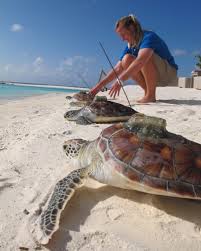
Among the pair’s successful projects is the ‘Head Start’ programme run from the Kuda Huraa resort – a fledgling project which has shown great potential to help increase the local turtle population.

The likelihood of turtle hatchlings surviving is estimated to be around 150:1, and so marine biologists have been hand-rearing a select few young turtles at the Marine Conservation Centre in order to give them a greater chance of survival.

“Where we do get a hatchling nest, we allow all of them to run down to the sea – because that’s very important for their development – but when they reach the sea we collect just two for our Head Start programme,” explained Hope.

Marine Biologists at the Marine Discovery Centre, Four Seasons

“The Head Start programme is aiming to provide a safe environment so those turtles can go through the early stages of development and avoid those early stages of danger.”

“Because turtles have got a pretty rough deal- anything from ants to rats, cats, seabirds, fish and sharks- its really tough when you’re only 4-5 inches long with no defence techniques at all -apart from looking incredibly cute.”

“So we bring them back here, place them into our pools where we do a weekly check up where we weigh and measure them. The weight is very important to their health, and we’re working hard to understand the sea turtle dietary requirements,” Hope continued.

“When the Head Start gets to 18cm – which takes about 13 months – we put a satellite tracker on their back and we send them out into the big blue. We download from the satellite every two days, and download the data into google maps.”

The tags are semi-permanent, meaning the researchers can see how far the turtles have travelled for up to 10 months.

To date, the Head Start programme has reared and released 37 turtles, with 16 tagged for satellite tracking.

There are a number of resorts which are contributing valuable work to environmental conservation, but in order to push this movement to the next level, Hope notes that the links between resorts and local communities need to be stronger.

“There needs to be more trust between resorts and local communities” he states. “What would really benefit the movement is a bottom up management, led by a greater amount of community work and community led projects.”

Regarding the laws against turtle egg collection, Hope said that it was unlikely all islands are being used for turtle nesting, but admitted there was a dearth of local knowledge which Seamarc was attempting to address with local surveys and community assessments.

“Turtles sometimes switch nesting beaches if the beach condition becomes degraded which means that they may start using unprotected islands in the future if they are not already. Before we can decide on scientific policy we require scientific fact on which we can base decisions.”

“It is our hope that our work will shed more light on the extent of turtle nesting activities in order to further protect these endangered species.”

Likes(2)Dislikes(0)