Alhan seeks to invalidate candidacy of MDP Feydhoo ticket winner

MP Alhan Fahmy will seek Civil Court assistance to invalidate the candidacy of Mohamed Nihad – winner of the opposition Maldivian Democratic Party’s (MDP) primary for the Feydhoo constituency, local media has reported.

“I asked for the primary to be annulled because the list used on polling day and the [eligible] voter list is different, and the focal point at the ballot box in Feydhoo has said the polls are not fair. And none of the candidates have signed the results,” Alhan told Haveeru Daily today.

The incumbent MP contends that the election in the Feydhoo constituency was fraudulent and that any candidate who won the MDP ticket through fraud cannot be a valid one.

Nihad competed against eight candidates, winning 316 votes. Alhan came in second with 154 votes.

Alhan called for a fresh vote in the constituency, claiming the voter list used at polling stations was outdated and did not afford 67 party members the right to vote.

The election committee has confirmed that 67 members were indeed missing from the list at the ballot box, but decided against holding a re-vote, arguing the primary outcome would not change even if the 67 members were allowed to vote.

Alhan was stabbed in public on February 1 and is currently receiving treatment at Colombo’s Central Hospital. He has announced he will contest March’s People’s Majlis election as an independent.

Likes(0)Dislikes(0)

Human Rights Commission concerned over delay in PG appointment

Read this article in Dhivehi

The Human Rights Commission of the Maldives (HRCM) has called on the People’s Majlis to expedite the appointment of a Prosecutor General (PG) stating the delay violates citizens right to justice.

The commission has said the delay in appointing a PG affects a citizen’s right to seek justice, especially criminal justice, and has called on all three branches of the state to uphold the Constitution.

Former PG Ahmed Muizz resigned from his post in November shortly before the parliament was due to vote on a no-confidence motion against him.

A month later, the Criminal Court suspended all ongoing cases and decided not to accept cases filed by the PG’s Office, claiming that the constitution stipulates a new PG must be appointed within 30 days of vacancy.

The Supreme Court ordered the Criminal Court to restart trials, but the court has refused to accept new cases, only resuming those already started. Deputy PG Hussein Shameem then sought a second Supreme Court order, with the Criminal Court again refusing to cooperate.

The lower court has argued that the order stated that cases must be accepted as per regulations – which it suggests would be breached by beginning trials in the absence of a new PG.

Shameem has responded to the court’s claims by pointing out that it had failed to specify which regulations the PG’s Office has violated.

“There is no such regulation. I have not seen a regulation that says so,” he told Minivan News.

He has argued that the Majlis’ delay in appointing a PG must not obstruct a citizen’s right to seek justice.

The backlog of cases pending at the PG office as a result of the Criminal Court’s refusal to accept cases has now reached 533, Shaheem has revealed – this figure includes 196 cases of suspects in pre-trial detention.

In December, President Abdulla Yameen nominated his nephew Maumoon Hameed for the position. Parliament broke for recess at the end of the year, however, after having forwarded the nominee for vetting by the independent institutions committee.

The committee’s chair, MP Ahmed Sameer – who recently defected from the opposition Maldivian Democratic Party (MDP) to the government-aligned Jumhooree Party – told newspaper Haveeru shortly after the Supreme Court issued its order that the vetting process was stalled due to lack of cooperation from political parties.

While one committee meeting, scheduled to take place during the ongoing recess to interview the nominee, was canceled upon request by pro-government MPs, Sameer said a second attempt to meet was unsuccessful as MDP MPs had opposed it.

Likes(1)Dislikes(0)

JSC to investigate whether judge’s bribery claims breached code of ethics

The Judicial Services Commission’s legal section will investigate whether Judge Aisha Shujoon Mohamed’s bribery claims breached the judges code of ethics.

Speaking on Maldives Broadcasting Corporation’s (MBC) ‘Heyyambo’ show last Friday (February 14) Judge Shujoon said there was some truth to the belief judges accepted bribes in the Maldives, revealing that she had been offered a US$5 million bribe herself.

“Now we are starting the investigation,” said Judicial Services Commission (JSC) Spokesman Hassan Zaheen. “We can research and after that we will know.”

The JSC’s code of conduct states in article 4.6 that “If a judge is known to have been involved or is involved in such an activity, all action must be taken to put a stop to this.”

The code also mandates that judges “exhibit high standards of judicial conduct in order to reinforce public confidence in the judiciary and refrain from activities that jeopardize the dignity, eminence and integrity of the Judiciary.”

Spokesman Zaheen was unable to give further details as to which aspect of the code Shujoon’s comments are suspected to have breached.

Commitment to the code of conduct is one of five criteria to be used in assessing the performance of judges as part of new JSC regulations, introduced last month.

The Anti-Corruption Commission (ACC) has already announced its decision to investigate Shujoon’s claims, with President Hassan Luthfy noting that judges must inform the ACC of bribe attempts immediately.

“Concealing bribe attempts is an offense, even by the code of conduct for judges. It is an offense not to inform this commission,” Luthfy said.

Expanding on the issue of bribery last Friday, Shujoon told her interviewer that she could not say whether judges had or had not accepted bribes, but that it may happen given the salaries allocated to judges.

“It [bribes] can be very appealing if its sets you up for life, given our pay and the amount of work we have to do. So I cannot say there is no truth to that. That is because something like that happened to me,” said the judge.

Shujoon became one of the country’s first female judges in 2007, though she told MBC that she was considering retirement.

According to a study conducted by governance NGO Transparency Maldives in December, the judiciary is perceived to be among the most corrupt institutions in the country.

Approximately 55 percent of those surveyed believed the judiciary to be most corrupt, while 60 percent and 57 percent believed the parliament and political parties to be most corrupt, respectively.

Likes(0)Dislikes(0)

Police arrest three foreigners for illicit sexual activity

The Maldives Police Service (MPS) has arrested three Bangladeshi nationals in the capital Malé last night for engaging ‘illicit sexual activity’.

Two men aged 32 and 34 years, along with a woman of 29 years, were arrested at around 7:30pm after information had been given to Maafannu Police station.

Following the arrest, police found videos of the suspects involved in similar activity.

Police confirmed that sexual activity between foreigners out of wedlock is considered a crime in the Maldives, noting that any reports of unlawful activity will be investigated.

Under Article 173 of the ‘Regulation on the Conduct of Court Proceedings 2003’, a wide range of activities are listed under ‘illicit sexual acts’ without any specific definitions of what comprises an ‘illicit’ sexual act.

It is commonly understood that most sexual acts out of wedlock are considered to be in this category.

The penalty under the article for ‘common’ illicit sexual acts carried out privately is 1 -2 month house arrest , and for ‘serious’ illicit sexual acts carried out privately the sentence is 7 -10 months banishment for men and 7 -10 month house arrest for women.

Homosexual acts and those with a married person, however, result in heavier penalties.

Ways in which a private illicit sexual act can be considered ‘serious’ include the participation of more than two people, photographing of the act, or committing the act in the presence of another person.

Article 190 of the regulation states that, with the exception of flogging, non-muslim foreigners shall be treated the same as Maldivians, while the penal code also makes no exception for foreigners who commit crimes within the jurisdiction of Maldives.

The common practice in cases where foreigners are investigated for illicit sexual acts, however,  is usually deportation without prosecution.

With around one million tourists visiting the Maldives each year, there are no known cases where tourists have been prosecuted for private ‘illicit sexual acts’. Marriage certificates are not a requirement for visiting honeymooners, which surveys suggest comprise nearly a quarter of visitors to the country.

Police have recently looked into such acts allegedly carried out by Maldivians at a Sri Lanka nightclub, while last month President Abdulla Yameen returned the sexual offenses bill to parliament, citing the inclusion of ‘unislamic’ provisions.

Likes(3)Dislikes(0)

Government announces new housing program

The government has announced two housing schemes under a new “Gedhoruverikuruvun” housing program, application forms for which will be available from the ministry starting from March 2.

The Social Housing Scheme will provide housing for Male’ city citizens via flats. The second scheme will provide financial assistance through the Islamic Finance Facility for construction of houses in the islands.

After launching the scheme,  the Ministry of Housing and Infrastructure and the Housing Development Finance Corporation (HDFC) signed an MOU.

Minister of Housing Dr. Mohamed Muiz said construction of 1100 flats under the scheme will begin within two months. He did not give details on how the scheme is to be financed.

Muiz said the government will spend MVR 100 million on the finance scheme for the atolls.

Vice President Dr. Mohamed Jameel Ahmed said many believe that lack of housing is the root cause of all social issues and the pledge to provide housing is ‘one of the most important’ pledges of President Abdulla Yameen Abdul Gayoom’s government.

The government’s housing policy is sustainable and will minimize hardships, Jameel said.

Jameel criticized all former housing schemes saying they did not give priority to the poorest families and said that the current government will not discriminate on the basis of political ideology in providing housing.

The  ‘Gedhoruverikurun’ program was part of the ruling Progressive Party of Maldives (PPM) presidential manifesto, while launching the schemes was included in the government’s road-map for the first hundred days in power.

Likes(0)Dislikes(0)

Maldives Olympic Committee to increase women’s participation in sports

The Maldives Olympic Committee (MOC) has decided to step up women’s participation in international sports by introducing guidelines to encourage sports associations to support female athletes and officials.

The MOC has informed all national sports associations that, while funds will be released based on their performance and training, the committee will now give priority to women.

The committee will set a target of 33 percent of games contingents to be women,  alongside a requirement that half of sports officials be female.

“We have noticed that when when women officials participate in international games, they are very involved in it afterwards. But there are very few officials currently, we want to encourage them,” said Secretary General of the committee Ahmed Marzooq.

At least one official for women’s individual sports and either the Chef De Mission or the Deputy Chef De Mission must also be a woman.

“Very few women’s sports have the opportunity to represent Maldives at international level. We want to give them equal opportunities,” said Marzook.

For the upcoming Asia Games – to be held in Incheon, South Korea from September 19 til October 4, 2014 – the committee will spend MVR1.89million on teams, based on this new policy.

With nearly two hundred members, the Asia Games contingent will be the biggest that has ever represented the Maldives at an international sports event.

The Commonwealth Games 2014 – to be held in Glasgow from July 23 to August 3 – will also be funded under these policies. While there, the Maldives committee is also planning for its athletes to join the Glasgow Muslim community in marking a women’s sports.

“In awarding a training scholarship we ensure there are at least two women for each sport, we want equal opportunities in the area as well,” Marzook added.

“We want people to know that even after retiring as an athlete, there are opportunities for women in coaching, as managers, referees, doctors.”

International women’s sports in Maldives

As a traditionally moderate Muslim nation, women’s participation in sports haven’t been restricted by law, or widely discouraged in the Maldives.

The 2012 Olympics marked the first time that countries like Brunei, Qatar and, Saudi Arabia sent female athletes, while other Muslim majority countries have tended to keep women’s participation to a minimal level.

Starting with just 2.2 percent in 1900, nearly 45 percent of athletes at the 2012 Olympic games were women. Since then, the International Olympic Committee (IOC) has also set goals such as a 20 percent female representation criteria for the executive boards of National Olympic Committees.

By 1992 there was a demand for the IOC to take more strict action against countries that banned female athletes from their teams after 34 of 169 competing countries had no female participants.

Barcelona was the Maldives’ second Olympic Games, marking the beginning of Maldivian women’s participation in the games. In the 2008 Beijing Olympic Games, the Maldives’ flag bearer was a teenage girl, Aminath Rouya Hussain.

According to the MOC, between 2010 and 2012 the Maldives participated in eleven international games, with a 42 percent female participation rate.

The current Minister of Youth & Sports Mohamed Maleeh Jamal said the government considers providing equal opportunities for women in sports to be a priority.

“We will focus on women’s sports in establishing a number of sports arenas around the country. We will include Bashi (a local sport played mainly by women) courts in these places and we will include aerobics centers too. Jogging tracks will also be created for women,” he said.

Opportunities for women athletes

In 2010 a women’s basketball team represented the Maldives for the first time internationally, the very next year bringing home a silver medal from the 3-on-3 basketball event at the South Asian Beach Games.

Shizna Rasheed – a member of that historic team – feels that there is a great future for women’s basketball in Maldives.

“It was a great achievement for Maldives, especially considering we didn’t get to practice much.”

Still in her twenties, Shizna started playing basket ball thirteen years ago is now volunteering as a member of the recently established women’s committee within the MOC. She was also the women’s basketball team’s assistant coach at the 2010 Asia Games.

Shizna said that, with the right opportunities, there is a future for women’s basketball in the Maldives and that there are also plans to introduce women’s handball at a national level.

“With increasing funds more opportunities are opening now. There should be equal opportunities for women, and I think these new measures [introduced by the committee] are very encouraging. It will provide more opportunities for women athletes,” she said.

Aishath Nazima, a volleyball player with twenty years of experience, expressed similar sentiments about the measures:

“As it is, only a few women’s sports have that opportunity [to participate in international sports], it is worse for team sports. So most teams don’t practice through out the year. But this can change things. If there are games to look forward to, associations and players too will get more serious. A lot of players even quit due to lack of opportunities.”

Likes(0)Dislikes(0)

Supreme Court uses Majlis testimony in EC contempt trial

Elections Commission (EC) testimony given during a People’s Majlis committee has been used in today’s Supreme Court trial to implicate the four commission members for contempt of court and disobedience to order.

The Supreme Court is prosecuting the EC under new ‘Sumoto’ or ‘Suo motu’ regulations that allow the apex court to initiate hearings and act as both plaintiff and judge in a trial.

Article 90 of the constitution says no person will be subject to any inquiry, arrest, detention, or prosecution with respect to anything said in the People’s Majlis or any of its committees if such a statement is not contrary to tenet of Islam.

But, claiming establishing justice to be a tenet of Islam, Supreme Court Judge Ahmed Abdulla Didi today said the EC’s testimony at the independent commissions oversight committee obstructed justice and could be used in a court.

EC President Fuwad Thowfeek has denied the charges against the commission: “Testimony provided at the People’s Majlis committee was not given to hold the court in contempt, but to be held accountable to the EC’s actions – these testimonies are privileged information.”

The Supreme Court has said that no party has the authority to question or criticise its decisions as per Article 145 (c) of the constitution which states that the Supreme Court shall be the final authority on the interpretation of the constitution, the law, or any other matter dealt with by a court of law.

The Supreme Court has accused the EC of contempt, claiming it had criticised the verdict which annulled the first round of presidential elections held in September 2013, as well as disobeying a Supreme Court order by dissolving eight political parties earlier this month.

Surprise Trial

The four members of the EC were summoned to an unannounced trial on Wednesday. After being given case documents just minutes before the trial began, the commission was granted an opportunity to respond today.

Case documents included newspaper articles and testimonies provided at the Majlis, but did not include any documents outlining specific charges. The charge sheet was handed to the commission only minutes before today’s trial began.

At today’s hearing, EC lawyer Hussein Siraj asked the Supreme Court to specify charges, arguing that the commission could only respond if the court clarified which statement made – at which location, time, and date – amounted to contempt of court.

Siraj also asked the court to specify which of the commission’s actions constituted a disobedience to which order.

Chief Justice Ahmed Faiz then asked Siraj to respond to the charges to the extent that he understood them.

After a short break, all four members returned to the court room and separately denied the charges.

At today’s hearing, judges accused the EC of administrative failures and irresponsibility. They said the EC does not have the authority to raise doubts regarding the court’s decisions or to complain over the practicality of the electoral guideline.

Judge Abdulla Saeed also questioned whether the EC was now a legal entity, claiming the constitution stipulated that the committee must hold five members instead of four. The fifth member of the commission – ‘Ogaru’ Ibrahim Waheed – resigned in October 2013, citing health complications.

Four of the five judges who presided over today’s hearing are the four judges who voted to annul the election in October and strip two MPs of their Majlis membership in November. Among these four is Ali Hameed who has been implicated in a series of sex tapes last year.

EC response

Denying charges, Fuwad said any response given to questions posed by MPs in the People’s Majlis is privileged information. The EC is constitutionally bound to answer such questions, he said.

Vice President Ahmed Fayaz said there were only two things Muslims cannot challenge – the Qur’an and Prophet Mohamed’s Sunnah. Fayaz said he had not disobeyed the Supreme Court’s decisions, but had spoken to the media regarding the implications or outcomes of the court’s verdicts.

Meanwhile, Ali Mohamed Manik said the commission must answer questions posed by the media in order to be accountable to the public and said he was ready to swear on Allah’s name that he had not disobeyed a Supreme Court order.

Member Mohamed Farooq said he had never spoken to the media at a press conference because he had seen many individuals being prosecuted for speaking the truth before

“There are people ready to sacrifice themselves for democracy and freedom. I am not one of them,” he said.

However, he said he was obliged to provide truthful testimony at the People’s Majlis and that such a testimony must be held within the four walls of the parliament.

Contempt of court

Judge Didi said that labelling the Supreme Court’s electoral guideline to be onerous or suggesting a Supreme Court verdict should not be obeyed amounted to contempt of court.

Didi said the Supreme Court had in its possession a letter sent by the EC to the Attorney General (AG) “complaining” of the difficulties in implementing the court’s guidelines, and asking for advice on whether to abide by them.

Judge Ali Hameed said the EC had no authority to seek a second opinion on a Supreme Court verdict.

Judge Abdulla Saeed said the Supreme Court’s verdict could not be questioned, as it is the last word on any issue.  He said the Supreme Court’s verdicts are similar to a law passed by the People’s Majlis and members of the public cannot disobey or complain about the law.

The letter to the AG questioned the Supreme Court’s mandate in issuing a guideline, Saeed said. The guideline was imposed to uphold the constitution and enhance the electoral process, he claimed.

Fuwad said the EC had asked the AG for advice with good intentions and maintained the commission had always abided by the Supreme Court’s decisions. He pointed out laws are subject to review and argued Supreme Court decisions can be revised.

Saeed also censured the EC’s criticism of the evidence used by the Supreme Court to annul the verdict. In response, Fuwad said there were “glaring irregularities” in the police forensic report used to invalidate the election.

Analysis of the report showed that voters listed as dead were in fact alive and voters listed as minors were in fact eligible. But Saeed said the Supreme Court had also relied on witness statements in issuing the verdict.

The UN has dismissed the police forensic report after conducting an expert review with UN Assistant Secretary-General for Political Affairs Oscar Fernandez-Taranco stating that the election was inclusive and met international standards.

Meanwhile, the Commonwealth Observer Group who monitored all rounds of the presidential election said the Supreme Court guideline “appeared to undermine the authority of the Election Commission, were inconsistent with or contrary to electoral law, and were at odds with the Constitution,”

Dissolution of political parties

The EC is also being charged with violating a January 9 Supreme Court order, which invalidated an EC order to smaller political parties requiring them to raise their membership to 10,000.

The EC had sent the letter as per Article 27 of the Political Party Act that states that it must give political parties a three-month deadline to increase party membership to 10,000.

The Supreme Court on January 9, however, ruled that the letter was invalid as the apex court had in September struck down Article 11 of the act, which states that a political party must have 10,000 members for registration. The Supreme Court then stated that the EC must consider minimum requirement for membership to be 3,000 members as per previous political party regulations.

The Supreme Court today said any article referring to 10,000 members was no longer functional with the invalidation of Article 11.

Judge Adam Mohamed repeatedly questioned the EC over whether any court order or verdict allowed them to dissolve any party with less than 3000 members.

EC members argued the Supreme Court had not expressly forbidden the dissolution of political parties with membership less than 3,000 in any verdict or order, arguing that the Political Party Act afforded the EC the authority to dissolve political parties.

Manik said the EC had not dissolved any party with membership higher than 3,000. Some parties among the eight dissolved did not even have 500 or 600 members, and had not submitted audit or annual reports and were a financial drain on the state’s resources, he said.

Manik also pointed out none of the annulled parties had complained over the commission’s decision.

Likes(0)Dislikes(0)

President and cabinet members on scoresheet at opening of football pitch

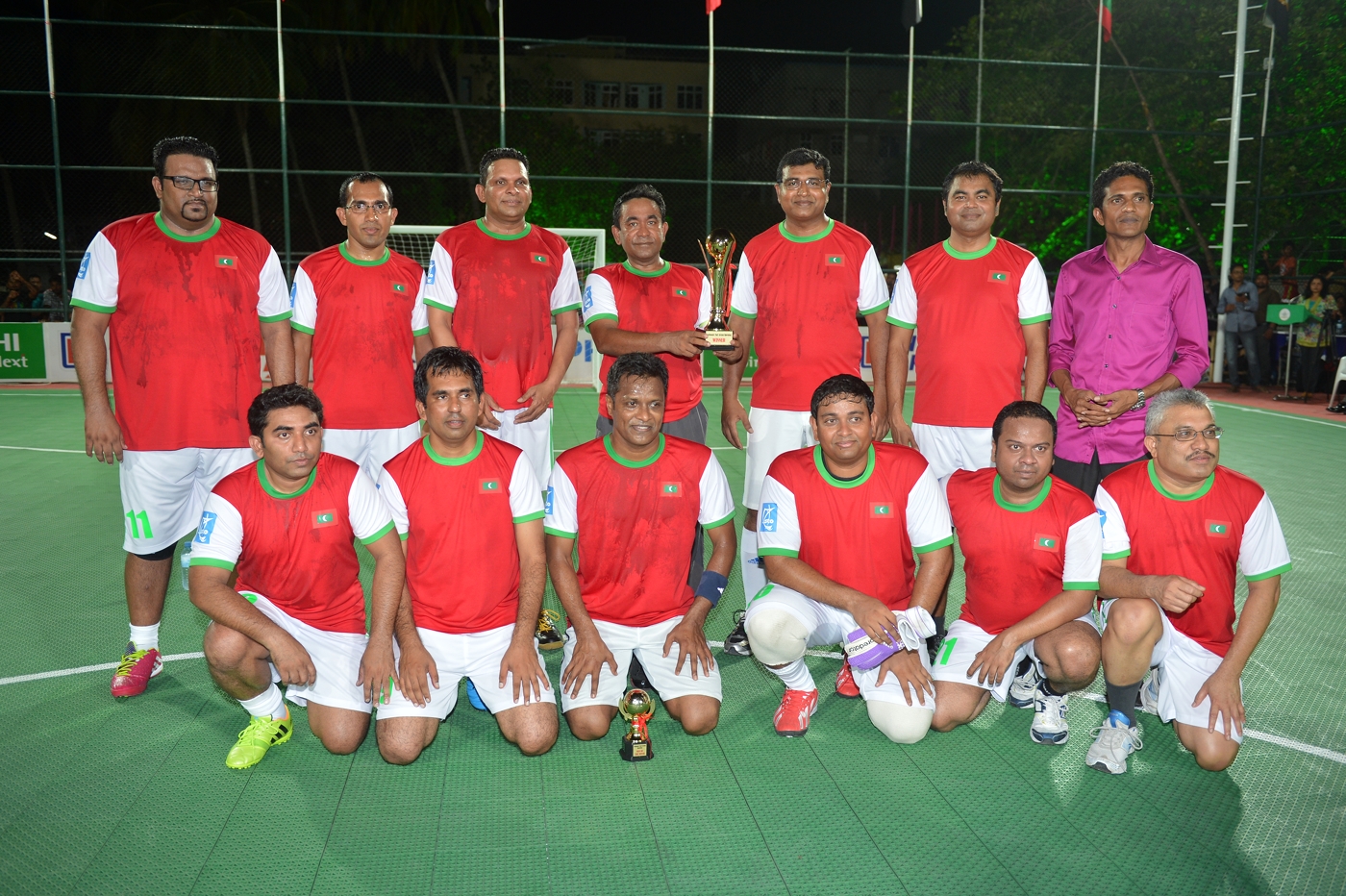
A team including cabinet members and President Abdulla Yameen last night beat a team of Maldives National Defence Force (MNDF) officials in a match held to inaugurate the opening of the Villimalé futsal pitch.

Chief of Defense Force Major General Ahmed Shiyam, and Managing Director of the State Trading Organisation Adam Azim officially handed over the pitch to the Minister of Youth and Sports Mohamed Maleeh Jamaal before the game began.

Local media reported the final score as being 7-6 to the president’s team, with Home Minister Umar Naseer being named man of the match.

Naseer, President Yameen, and Tourism Minister were all on the scoresheet. The attorney general sustained a suspected sprained ankle in the second half, being replaced by the fisheries minister.

Likes(0)Dislikes(0)

JSC president attempts to remove parliament’s representative

President of the Judicial Service Commission (JSC) has attempted to remove the parliament’s representative – Bileiydhoo MP Ahmed Hamza – from the commission.

In a letter sent separately to MP Hamza and the President Abdulla Yameen, Supreme Court Judge Adam Mohamed stated that Hamza is no longer a member of JSC as he is running for parliament.

Commenting on the attempt to remove him, Hamza said that the decision was unlawful and unwarranted.

“For one thing, I believe it is an incorrect interpretation [of the JSC Act]. And the president of the commission cannot make such a decision sending a letter by himself,” Hamza said.

Article 10 of the JSC Act states that the post of a commission member shall be deemed vacant if a member is “contesting for a political
position elected under the constitution or a law”.

However, Article 14 (a) of the Act states that certain appointments to the commission, including the representative appointed by the parliament, can only be removed from office by the appointer – in this case, the People’s Majlis.

Stating that Article 10 of the act is not a general statement, he said that if the JSC president’s interpretation is to be followed, the Majlis speaker’s seat would also be vacant.

“There seems to be a contradiction, I believe parliament members or the speaker running for the parliament shall be an exception [under article 10]. Otherwise it creates a legal vacuum,” he said.

Following his decision to remove the MP, Judge Adam Mohamed today asked for the removal of Hamza from a JSC meeting. When Hamza refused to leave, the JSC member representing the public -Sheikh Shuaib Abdul Rahman – proposed a motion requesting that no meetings be held until the matter had been settled. The motion was passed and the commission is expected to meet within the week.

Rahman has also criticised the JSC president’s decision:

“It is not his [Adam Mohamed’s] mandate, and it goes against article 20 [of the JSC Act]. He may have discussed it with certain members on the phone, but it should be decided by the commission.”

Accusing Judge Adam of trying to control all affairs of the commission, Rahman said that the judge “withholds any agenda item he wants, and prioritises and postpone cases at whim” – an accusation frequently made by former presidential appointment to commission Aishath Velezinee.

Rahman said that Judge Adam had sped up some cases and held back others without any regard to the urgency or importance of the matter in question.

The public’s member on the commission unsuccessfully attempted to file a no-confidence motion against Adam last August, later alleging that the commission’s president had refused to table the issue during meetings.

Rahman has accused Judge Adam of being responsible for the judicial watchdog‘s “state of limbo”, accusing him of failing to back the JSC’s investigation of Supreme Court Justice Ali Hameed’s sex-tape scandal, and abusing power to release press statements on behalf of the commission.

MP Hamza today said that Judge Adam had not taken such an action in previous cases where questions had arisen regarding the validity of JSC membership.

“Even in Gasim Ibrahim’s case [when he ran for President while still as parliament’s representative at JSC], he did not act like this. Gasim stepped down by himself,” said Hamza.

Hamza was appointed to the commission in October, being approved after the narrow rejection of Jumhooree Party MP Ilham Ahmed.

Likes(0)Dislikes(0)