SAARC calls for greater integration, recognises vulnerability of small island states

The 18th SAARC summit has concluded, with President Abdulla Yameen adding his signature to the Kathmandu Declaration.

A new regional Framework Agreement on Energy Cooperation was also signed by all members of the association, aiming to facilitate cross-border trade of electricity on a voluntary basis.

The summit declaration was themed ‘Deeper Integration for Peace and Prosperity’ and focused on institutional reform of SAARC as well as the vulnerability of Small Island Developing States.

At the start of the summit earlier this week, President Yameen had called upon the association to make its voice heard in the international community, as well as criticising the group’s complacency on the subject of climate change.

“Importantly, the Declaration underscores the importance of the international community to conclude a legally binding outcome in the fight against climate change before the end of 2015,” read a foreign ministry statement accompanying the summit’s conclusion.

“The Leaders also agreed to develop capacity of Member States to apply space technology for socio-economic development and the welfare of the peoples through experience sharing and technology transfer and in this context welcomed the offer of India to develop and launch a SAARC satellite.”

Another notable features of the Kathmandu Declaration was the recognition of the “manifold contributions of ocean-based Blue Economy in the SAARC Region and the need for collaboration and partnership in this area.”

The declaration pledged commitment to a phased-in South Asian Economic Union via a free trade area, customs union, common markets, and economic and monetary union.

Leaders “reaffirmed that SIDS would require special attention in view of their unique circumstances and particular vulnerabilities in realization of sustainable development.”

The Maldives has recently been elected chair of the Alliance of Small Island States – the 44-member lobby group for such countries within the UN system, which focuses primarily on the effects of climate change.

The Kathmandu Declaration also urged relevant bodies to identify projects in the area of power generation to meet growing regional as well as “taking into account the existential threats posed by climate change to some SAARC Member States”.

The Maldives government is currently aiming to generate 30 percent of its power from renewable sources within five years. Local media yesterday reported that India had offered to assist the Maldives in its search for oil.

All leaders also “reiterated their strong commitment to ensure good governance for sustainable development by promoting accountability, transparency, the rule of law and people’s participation at all levels of governance,” read the declaration.

The summit is the first such meeting since the Maldives’ summit in 2011, having been organised after recently elected Indian Prime Minister Narendra Modi invited his regional counterparts to his inauguration in May.

President Yameen was able to meet separately with Modi, Pakistani Prime Minister Nawaz Sharif, and Sri Lankan President Mahinda Rajapaksa during the summit before returning to the Maldives today.

Minister of Foreign Affairs Dunya Maumoon signed the energy agreement on behalf of the Maldives, committing to enable energy traders to negotiate the terms of exchange, and to share technical knowledge with a view to opening up the electricity sector.

Leaders also promised to sign further agreements on passenger and cargo traffic within three months, after Pakistan were reported to have declined signing the agreements until further internal discussions.

Observers of the 18th summit included Australia, China, Iran, Japan, South Korea, Mauritius, Myanmar, the USA, and the EU.

Suggestions that the status of China be upgraded were rebuffed by Indian officials earlier this week, who suggested that greater integration between current states should be remain a priority.

Pakistan has offered to hold the next summit, mandated by the SAARC Charter to held at least once a year.


Related to this story

18th SAARC Summit Declaration

President Yameen calls on SAARC to make its voice heard

Maldivians could be among first climate refugees, warns Nasheed

Likes(4)Dislikes(1)

Committee passes budget, recommends constitutional amendment to reduce independent commissions

The People’s Majlis budget committee has passed the record MVR24.3 billion (US$1.5 billion) state budget for 2015 and recommended a constitutional amendment to reduce the number of independent institutions.

The proposal by ruling Progressive Party of the Maldives (PPM) MP Riyaz Rasheed said that bringing the state’s independent institutions under one body would reduce government expenditure.

The committee did not make any changes to the budget.

The 11 recommendations also included a proposal by Rasheed to amend the Decentralisation Act to reduce the number of local councils and cut salaries of all councilors except the council’s president. All councillors except the council president would be paid an allowance based on their attendance at council meetings.

MPs of the opposition Maldivian Democratic Party (MDP) and the PPM’s ally Jumhooree Party (JP) did not vote for the two recommendations.

During former President Mohamed Nasheed’s tenure, the PPM leadership – formerly of the Dhivehi Rayyithunge Party (DRP) – rejected the MDP’s proposal for councilors to be established in only seven provinces.

DRP MPs at the time insisted on establishing a council in all inhabited islands and an atoll council for each of the 20 atolls.

As per DRP amendments, islands with a population less than 3000 now have five paid councilors, islands with a population between 3000 and 10,000 have seven paid councilors, and islands with a population over 10,000 have nine councilors.

Meanwhile, atolls which consist of two parliamentary constituencies elect three members from each constituency while atolls which have more than three Majlis constituencies elect two members from each constituency. Each Majlis constituency consists of 5000 people.

MDP MPs had walked out in protest from the Majlis sitting, claiming the DRP amendments would create “20 mini governments” and create an enormous financial burden on the state.

The budget committee today also passed a proposal by Rasheed requiring the government to formulate a master plan for population consolidation.

A proposal by the MDP to conduct all government trainings through the Maldives National University was also passed.

The committee also voted in favor of MDP MP Mohamed Aslam’s proposal requiring the government to commence work on establishing a development bank, get back money owed to the government, and to decrease the number of expatriate workers in the tourism sector by increasing the stake of Maldivians.

The Maldives Development Alliance (MDA)’s recommendation to establish a low interest loan scheme for housing and boat building, and the Jumhooree Party (JP) recommendation requiring the government to prioritise projects on constitutionally mandated services also passed.

The MDP had proposed establishing a pay commission to set state wage policy by the end of 2015 and providing a grace period of two to three years for new taxes, but the PPM dominated committee rejected these proposals.

The committee also rejected MDP proposals requiring deference to the Fiscal Responsibility Act and Public Finance Act in budget implementation.

The budget will now be forwarded to the Majlis floor for final review.


Related to this story

Finance minister presents record MVR24.3 billion state budget to parliament

MDP criticises proposed 2015 state budget as “aimless”

Government proposes changes to local government model

Decentralisation bill passed as MDP MPs walk out

Vice President calls for “population consolidation”

Likes(1)Dislikes(0)

Emirates to add third daily flight from Malé

Emirates airlines is to add a third daily flight between Malé and Dubai International Airport, starting from December 1.

Emirates flight EK656 will depart Dubai at 02:10 to arrive in Malé at 07:15. The return leg, EK657, will depart Ibrahim Nasir International Airport at 08:45 and arrive in Dubai at 11:55.

“The Maldives has proven to be a strong market for leisure and family travel. With a wide range of luxury hotel chains, romantic beaches and adventurous water sports activities; it certainly has something for everyone,” said Ahmed Khoory, a senior vice president at Emirates.

“The increased cargo capacity on the route will also help facilitate business between the Maldives and its key trading markets,” he added.

Likes(1)Dislikes(0)

President Yameen meets with Indian and Pakistani prime minsters

President Abdulla Yameen has met with both Indian Prime Minister Narendra Modi and Pakistani Prime Minister Nawaz Sharif on the sidelines of the 18th SAARC summit in Kathmandu.

Yameen expressed gratitude for India’s continued for support and assistance, and discussed opportunities to increase Indian assistance towards the Maldives health sector.

During his meeting with the Pakistani prime minister, Yameen discussed expanding relations, particularly in the fields of trade, commerce, and human resources. Yameen and Nawaz also exchanged views on making SAARC a more powerful regional bloc.

Likes(1)Dislikes(0)

Fully solar powered Maldives resort sets new standard in green tourism

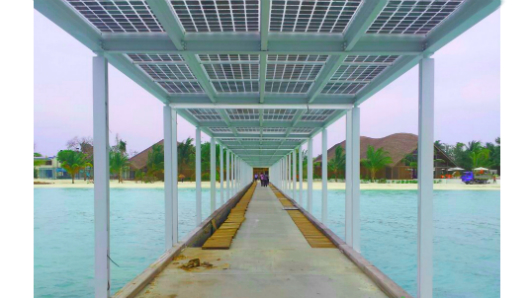
Arriving at Gasfinolhu Island, the eye is greeted by solar panels, thatch roofs, white sand and turquoise water. Solar panels shade the long walkway onto the island and cover the roofs of all the utility buildings.

The sparsely vegetated sandbank, approximately 40 minutes from Malé, is the first 100 percent solar-powered luxury resort in the world.

Standing inside the resort’s silent powerhouse, Gasfinolhu owner ‘Champa’ Hussain Afeef said, “The happiest moments are when I can see that the lights are still functioning after all the diesel generators have been switched off.”

Gasfinolhu’s 6,500 square meters of solar panel are capable of producing 1100 Kilowatts at power peak. The island at full occupancy only requires 600 Kilowatts at peak load.

Afeef, one of the pioneers of tourism in the Maldives, said he had first thought of the project in 2009 when Maldives announced it would become the world’s first carbon neutral country in 2020.

“We wanted to do something different. I believe renewable energy is not just the future for tourism, but for all other industries as well,” he said.

Pioneers

Praising the project, Environmental Consultant Ahmed Shaig, says Gasfinolhu sets very high standards for the tourism sector.

The resort’s power system is entirely automated, with computers programmed to switch between direct solar power, battery power, or diesel generators, as required.

Excess power generated during the day is stored in an extensive battery system, capable of powering the resort throughout the night. Three diesel generators are also on standby in case there are successive days of rain and the batteries run out.

In addition to the solar power system, Gasfinolhu also relies on a centralised chiller system that uses chilled water to cool air for air-conditioning.  Its harbor is set close to the reef’s edge to facilitate the shifting of sand in the lagoon with the monsoon, thereby minimising beach erosion.

A zero waste management system will also be installed on the island in the future, Shaig said.

Debunking myths

According to Ibrahim Nashid, the chairman of Renewable Energy Maldives Pvt Ltd, Gasfinolhu demonstrates that “it is possible to provide power from indigenous energy sources without compromising luxury comfort.”

The project also debunks several myths on the use of solar energy in the Maldives, Nashid said, stating that critics believe solar power is not suitable in the Maldives due to lack of space and its salty environment.

“They also say that it would deter from aesthetics on a luxury resort, but Gasfinolhu destroys all of these myths. Its architecture is beautiful, some have said it’s the solar paneled spaces on the island that are the most beautiful,” he said.

The Maldives’ 109 resorts use 49 percent of the US$470 million diesel imported into the country annually. The figure amounts to over a third of the country’s GDP. The capital Malé uses 90 percent of the inhabited islands’ energy consumption.

If the resorts and Malé transition to renewable energy, it frees up state funds for health and education, and increases the country’s energy security, Nashid said.

“Others will follow”

According to Afeef, Gasfinolhu will recover the US$8 million spent on the solar system within six to seven years.

Without solar power, Gasfinolhu would spend over US$1.5 million for fuel to power its 22 rooms on the beach front and 30 water bungalows. A typical resort with 200 or 300 beds would spend over US$4million fuel a year, he said.

“I hope this initiative will turn out to be a success. And I hope to see more and more resort developers employing such technologies in the future,” he said.

However, he noted already existing resorts would not find it cost-effective to transition to solar power all at once.

The transition would have to come gradually, by redesigning and converting facilities that consume electricity most such as laundry, desalination plant and kitchen to solar power first, he said.

“Everything is a risk. Someone has to do it first. Then, others will follow.”

The resort, developed by Global Pvt Ltd will be operated by Club Med and will open for business in January 2015.


Related to this story

2020 Carbon Neutral failure would be “disaster for Maldives”: President

Government targets generating 30 percent of electricity from renewable sources

Maldives’ solar ambitions stall due to politics, financing, “restructuring”

Likes(3)Dislikes(0)

Maldivian journalists told that China will not interfere with Maldives’ sovereignty

Maldivian journalists in China have been told that the country will not interfere in the domestic affairs of the Maldives.

Meeting with Maldivian journalists, Director of the Chinese Foreign Ministry’s Asian Department Xin Wang said that a lot had been planned between the two nations.

“China is just helping the Maldives pull itself up. It will be Maldives that makes the final decision on everything relevant to this development,” Haveeru reported Xin as saying.

President Abdulla Yameen announced earlier this month that increased ties with China were part of a policy of looking east. Criticising the interference of “Western colonial powers”, Yameen noted that working with China does not bring the same challenges.

Source: Haveeru

Likes(1)Dislikes(0)

Malé City Council close to shut-down after police confiscate documents and server system

Nearly all services at Malé City Council have come to a halt after police confiscated important documents and several hard drives, including the server system necessary for daily operation.

Police searched and confiscated the council’s office last night (November 26) after a search warrant was issued by the Criminal Court on request from the Maldives Police Service regarding a corruption case against council staff members.

The warrant, signed by the Criminal Court Chief Judge Abdulla Mohamed, said that “some council staff had shared and gained unlawful advantages from some PDF files sent to the council by Maldives Land and Survey Authority.”

The survey authority and the land registration project fall under the authority of the Ministry of Housing and Infrastructure.

The council has denied receiving any such files from the ministry or any other authority, stating that the council had previously provided information to the housing ministry and if any information had been sent back it would have originated from the council.

Council members told the media today that it was concerns it would be unable to prepare Friday prayer sermons, and that the waste management section might come to a halt as a direct result of the Police confiscating the server.

Deputy Mayor Shifa Mohamed said the council is now unable to receive any payments, expressing fears that human resources would be unable to pay the council’s 1000 employees this month.

Malé City Mayor Mohamed Shahib said that the MPS also confiscated information gathered by the council to write up a study on providing alternative methods to solve the housing issue faced by the city.

Council vs government

Maafannu Hulhangu constituency councillor Shamau Shareef said the incident is one of many intended to intimidate the council and to prevent it from providing the services to the people of Malé.

Shifa has previously suggested that the government was plotting to ‘destroy decentralisation’ after the housing ministry seized numerous plots of land from the council including two parks, artificial beach, carnival area, south harbour area, Usfasgandu, Dharubaaruge, and land near the T-Jetty.

Last month, she complained that poor allocation of funds for road development projects under the council as one of the main reasons behind the severe floodings on the western side of the capital island during heavy downpours.

Shamau said today that the council had no choice but to resort to “begging” the Maldives Water and Sewerage Company (MWSC) to assist it setting up flood control pumps which promise a temporary solution to the problem.

October also saw masked individuals wielding machetes uprooting over thirty council owned areca palm trees on the sides of the capital’s main thoroughfare road Majeedhee Magu.

Following a further disagreement over the replanting of the vandalised trees, the cabinet announced it had removed the council’s jurisdiction over the city’s roads.

The roads are now under the control of the housing ministry and the Maldives Road Development Corporation (MRDC) which has started cleaning the drains, bringing some alleviation to the flooding.

Former President Mohamed Nasheed alleged police involvement in the chopping down of the palm trees while naming several Special Operations (SO) officers after the MCC requested the public to submit any information about the issue.

Shamau also stressed the poor fund allocation towards the road development projects in Malé which only has a mere MVR 3.4 million (US$ 220,00) while pointing out that a new elevator at the president’s office has been budgeted MVR 3 million (US$ 200,000).


Related to this story

Government plotting to “destroy decentralization,” says Malé Deputy Mayor

City and Fini Park taken by Housing Ministry, council not informed

Newly planted areca palms uprooted on housing ministry orders

Can decentralisation take root in the Maldives?

Likes(2)Dislikes(0)

President Yameen calls on SAARC to make its voice heard

President Abdulla Yameen has called upon the SAARC nations to “walk the talk” and make their voice heard on the international stage.

“As a region, SAARC has the right, and surely has the might, to make it one of the most powerful regions in the world. Yet we continue to be led, rather than lead,” Yameen told the inaugural session of the 18th SAARC Summit in Kathmandu.

“This region accounts for one-quarter of the world’s population, yet as a region we hold limited sway, have limited say and we have not been heard enough, in the power rooms of the world.”

Despite the association’s charter calling for meetings at least once a year, the two-day summit is the first to be convened since 2011, when the Maldives hosted the event in Addu City.

Following the meeting of SAARC leaders at the inauguration of Indian Prime Minister Narendra Modi in May – dubbed the ‘mini SAARC summit’ by the Indian media – led to the reactivation  of the meetings.

Since assuming office, Modi has actively pursued regional cooperation, with his ‘neighbourhood first’ policy being applauded by President Yameen today.

“We are inspired, Excellency, by your various initiatives, in this short period of time, towards strengthening regional relationships including the ‘neighbourhood first’ policy. These are steps in the right direction, a signal of the renewed activism with which India is facing SAARC,” said Yameen.

Other initiatives of the Modi government have included a firmer commitment to improving ties within Asia – dubbed the ‘Look East’ policy.

At home, President Yameen has also recently declared a foreign policy shift to the East after accusing “Western colonial powers” of attempting to interfere with the sovereignty of the Maldives.

During the same speech on Republic Day (November 11) Yameen noted that the rapidly growing ties with China did not involve “any such compulsion”.

China’s increased involvement in the region appears to have invoked the concern of India, who reacted firmly to rebut suggestions made by the Maldives’ foreign minister this month that India had discussed joining China’s New Silk Road project.

India was also reported to have rebuffed suggestions from Pakistan during this week’s summit to promote China from its current observer status within SAARC.

“As far as we are concerned, we need to first deepen cooperation among Saarc (members) before we try and move horizontally,” external affairs ministry spokesperson Syed Akbaruddin told media.

Continuing his speech this morning, President Yameen repeated his view that trade and commerce were the key to peace and prosperity within the region.

“SAARC must attune itself to the realities of the day and seize the opportunities that are presented to us. We must not be left behind.”

Yameen also stated that, despite being one of the regions to be worst affected by climate change, “we continue to be complacent in taking action as a group”.

He pointed out that, as the next chair of the Alliance of Small Island States, the Maldives would expect support from its friends.

“I ask you, should we not demand for what we want? Should we not stand up for what we believe? Dare we not speak up for what is right for our people? Is it not time, Excellencies, that we stand up to receive our share, raise our voice, in the international arena?”


Related to this story

Trade and commerce “magic wand” for achieving SAARC’s goals: President Yameen

President Yameen slams “Western colonial powers,” declares foreign policy shift to East

Maldives accepts India’s leadership role, says President Yameen

Likes(4)Dislikes(1)

High Court concludes hearings into Criminal Court’s rejection of Thinadhoo terrorism cases

The High Court today concluded hearings into an appeal by Prosecutor General’s (PG) Office requesting the repealing of a Criminal Court decision to throw out charges of terrorism against 89 individuals from Gaaf Dhaal Thinadhoo Island.

Criminal Court Chief Judge Abdulla Mohamed had dismissed the charges, claiming the PG’s Office was refusing to cooperate with the trial after state prosecutors’ failure to turn up to a trial scheduled for 10am on Saturday, November 22.

PG Muhthaz Mushin has requested the High Court to rule the Criminal Court’s dismissal of the case through a letter as unlawful and to order the terrorism trials to continue.

The 89 defendants faced terrorism charges for allegedly setting fire to the island’s police station, court building, and several police vehicles during nationwide unrest on February 8, 2012 in the wake of former President Mohamed Nasheed’s controversial resignation the previous day.

State prosecutor Shaudha Shameem challenged the Criminal Court’s decision claiming state prosecutors had telephoned and informed the court in advance that they would not be able to attend the hearing on Saturday, November 22.

She contended the Criminal Court had attempted to handover summons to court outside work hours on November 22, Thursday.

But state prosecutors refused to accept summons, as Saturday is not a working day, and because the court had initially scheduled hearings for November 23 instead of November 22, she continued.

Shaudha argued that the Criminal Court could only throw out charges in a courtroom in the presence of the plaintiff and defendant, and claimed Judge Abdulla had failed to follow due procedures in dismissing the case.

She noted that the Criminal Court had previously consulted state prosecutors in scheduling hearings given their busy work schedule.

Two of the 89 facing terrorism charges intervened in the case. with their lawyers – Ibrahim Riffath and Hisaan Hussein – saying the Criminal Court had followed due process by informing the PG’s Office of the November 22 hearing via a letter on the afternoon of November 20.

Hisaan said a presiding judge is authorised to dismiss charges if the plaintiff fails to abide by the judge’s orders, and said a judge has the discretion to decide on the validity of reasons provided for failure to attend hearings.

State prosecutors must not receive special exemptions, she contended.

Meanwhile, Riffath suggested the PG’s Office was lax in cooperating with the trial, pointing out the state had only been able to provide witness testimony during two of the eight hearings.

The High Court bench has said it will issue a verdict in the next hearing. A date for the verdict has not yet been set.

Muhthaz has since resubmitted the cases to the Criminal Court twice. The court rejected the cases on Monday claiming it had no guarantee of cooperation from the PG office.

The PG office submitted cases again yesterday with a letter pledging full cooperation.

Defence lawyers have previously criticised Judge Abdulla’s earlier decisions during the hearings.

Last week, the chief judge ordered 55 of the 89 defendants be held in detention pending the outcome of the trials, claiming the accused were intimidating witnesses. All have subsequently been released.

Defence lawyers have described the judge’s decision to hold the accused in custody as “most unusual” as the identities of state witnesses were not disclosed and had their voices disguised in order to protect their identity.

Around 80 people from Addu City are also currently facing terrorism charges in relation to unrest in the southernmost atoll on February 8.


Related to this story


PG to appeal Criminal Court’s dismissal of terrorism cases

Criminal Court rejects Thinadhoo terrorism cases

55 Thinadhoo arson suspects detained until end of trial

Likes(2)Dislikes(0)