Mega Maldives opens route to Chonquing

One-year-old Mega Maldives Airlines welcomed its fourth scheduled route between the capital Male and the Chinese commercial powerhouse of Chongqing in China’s south-western mainland last weekend, the first time the route has been serviced from the Maldives.

“Mega Maldives viewed Chongqing as the next logical choice as a direct connection between one of the world’s most renowned and most sought after holiday destinations and the heart of China’s commerce and industry.”

Chongqing boasts one-third of China’s automobile industry, and is also home to international retail and finance groups Ford, Mazda, HSBC, Deutsche Bank and Wal Mart.

Mega Maldives currently operates flights to Beijing, Hong Kong and Shanghai.

Chonquing flights depart Ibrahim Nasir International Airport (INIA) every five days for the 7 hour flight.

Likes(0)Dislikes(0)

Foreign Ministry opposes UN Human Rights Commissioner’s call for debate on flogging

The Foreign Ministry does not support open debates on issues raised by UN High Commissioner for Human Rights Navi Pillay, namely the provision for flogging as a punishment for extra-marital intercourse and the requirement that all Maldivians be Muslims.

“What’s there to discuss about flogging?” Minister of Foreign Affairs Ahmed Naseem was reported as saying in newspaper Haveeru. “There is nothing to debate about in a matter clearly stated in the religion of Islam. No one can argue with God.”

Speaking to Minivan News, Naseem confirmed his statement but did not wish to comment further.

Pillay said flogging was “a form of punishment that is cruel and demeaning to women” and observed that in her travels in Islamic countries “apart from the Maldives and one other country that practices stoning, flogging is not a practice that is condoned.”

She further claimed that the Maldives is signatory to international treaties that are legally-binding obligations, “and such a practice conflicts with these obligations undertaken by the Maldives.” She said human rights conforms with Islam.

Naseem today advised Minivan News that the Maldives had submitted certain reservations to said conventions, including articles on gender equality and freedom of religion, and on these points the country could not be held legally accountable by an international body.

Pillay also called for amendments to the constitutional provision mandating subscription to Islam.

Since her press conference on Thursday, November 24, protestors bearing slogans “Ban UN,” “Flog Pillay” and “Defend Islam” have demanded apologies from Pillay and Parliament, and called for Pillay to be prosecuted in the Maldives for her comments about the national constitution.

Islamic Minister Dr Abdul Majeed Abdul Bari opposed Pillay’s critiques. Haveeru reports he also backed political parties including the opposition Dhivehi Rayyithunge Party (DRP) and Progressive Party of Maldives (PPM), and several MPs and religious groups who also  condemned the UN human rights chief’s comments.

In discussions with President Mohamed Nasheed, ministers and the judiciary, Pillay advised “permanent changes in the law [to] engineer a practical moratorium on flogging.”

NGO network Civil Society Coalition later announced a nation-wide mass protest on December 23 against the government’s alleged efforts to securalise the country.

Speaking with Minivan News today, President’s Press Secretary Mohamed Zuhair said he believed Pillay’s message focused more on the degrading implications of flogging women than on its portrayal of Islam. “Pillay called for a debate on punishment and how it is administered – these are two separate debates,” he said, distinguishing between Islam and the State.

Zuhair also suggested that the court procedure used to sentence individuals accused of extra-marital fornication to flogging was incomplete.

In response to Pillay’s urging for a debate “to open up the benefits of the constitution to all and to remove that discriminatory provision [requiring every citizen be a Muslim],” Zuhair said “The government’s religious policy is based upon the insights of religious scholars. The government has not made available the means for anyone to defy or ridicule our religion, and it will not do so.”

According to Zuhair, the involvement of religious scholars in the nation’s religious policies is a distinguishing feature of ruling Maldivian Democratic Party (MDP).

“These are the free times for religious scholars to speak their minds and not be subscribed into one state-sponsored brand of Islam,” he said.

When asked to relate his statement to the Islamic Ministry’s recent censorship of Ismail Hilath Rasheed’s blog, Zuhair said the matter belonged to the Majlis.

“The government cannot be held accountable for the contents of a constitution drawn up by the peoples’ Majlis. Any issues with the constitution will be addressed there.”

Zuhair emphasised that the government supports freedom of expression and assembly to the widest extent provided by the constitution, but he reiterated that the government would adhere to policies advocated by religious scholars as necessary.

Local media in the Maldives widely took Pillay’s remarks on the constitution out of context by reporting only half her sentence.

Miadhu Editor Gabbe Latheef had asked Pillay during Thursday’s press conference, “If you believe we have a Constitution, why are you speaking against our Constitution?” Her reply, “I don’t believe you have a Constitution, you have a constitution. The constitution conforms in many respects to universally respected human rights. Let me assure you that these human rights conform with Islam,” was partially reported by local media as, “I don’t believe you have a Constitution.”

When asked about the impact of the flawed reports on the protests, Zuhair said it suggested the mistake was intentional and demonstrated “a strong political bias”.

“Most media is tied to the opposition parties which were defeated in first round of the election. They are tied by a common rope in that they all include leaders of the formerly-ruling Dhivehi Rayyithunge Party (DRP). MDP doesn’t have a supportive media outlet, even in the state media. Any establishment or institution here with 50 or more staff will have some defeated and bitter people who don’t believe in the government,” he surmised.

Likes(0)Dislikes(0)

Part of convention centre roof falls to ground

A piece of ceiling on the outside of the Equatorial Convention Centre has fallen to the ground, reports Haveeru.

The centre was the venue of the recent SAARC Summit attended by leaders from around the region.

Haveeru spoke to a member of Addu City Council said Amin Construction was working to repair the ceiling.

“It’s an aluminium ceiling and it wasn’t a large part that fell,” the council member told Haveeru.

The government is seeking bids for the management of the Rf150 million (US$10 million) convention centre, and for the construction of a 100-bed hotel at the site.

Likes(0)Dislikes(0)

Rush to renewables stems as much from energy security and economic consideration: President Nasheed

As Europe and the US remain distracted by economic turmoil, an unlikely band of nations is taking up the climate cause: the small, the poor and the vulnerable, writes President of the Maldives, Mohamed Nasheed, for the UK’s Financial Times.
There are many reasons why poorer countries adopt tough greenhouse gas mitigation targets. My country, the Maldives, announced its 2020 carbon neutral target in part to cajole industrial behemoths to clean up their act. If a small nation with modest means can enact a radical plan for carbon-free energy, what excuse do larger, wealthier nations have for dragging their feet?
Environmentalism, though, is only half the story. For many developing nations, particularly far-flung, small-island states, the rush to renewables stems as much from energy security and economic considerations as from climate.
Many developing countries are among the world’s most energy insecure. Their economies run on imported oil and they are held hostage to an oil price over which they have no control. Fossil fuel addiction puts a brake on economic development.
The Maldives spends 14 per cent of gross domestic product on diesel imports – more than on education and healthcare combined. If we continue “business-as-usual” growth, our oil dependency will double by 2020.
As the oil price climbs, the cost of renewable energy such as solar is falling rapidly. Thanks in part to large increases in Chinese productive capacity, solar photovoltaic modules are about half the price they were in 2008. Daytime solar power in the Maldives is now a third cheaper than diesel-based electricity. For many countries without fossil fuel reserves, it makes simple economic sense to switch to clean power.”

Read more

Likes(1)Dislikes(0)

No future for metal in the Maldives, says band

Representing the Maldives in the global music arena, Sacred Legacy is a metal band with a vision to conquer, writes Hansini Munasinghe for Sri Lanka’s Sunday Times.

“As they sit around a coffee table, the brutality they unleashed on stage recently at High Voltage seems momentarily forgotten, yet the eager gleams in their eyes betray their passion.

Formed in 2006 by Shayd, the lead guitarist and the “key person” of the band, Sacred Legacy have so far released two albums of remarkable quality, Sacred Legacy (2006) and Apocalypse (2007) and have been invited to concerts in Germany, Austria, Switzerland and the Czech Republic.Their albums are available through 30 online stores.

“There is no future for metal in the Maldives. So we are aiming at taking our music to the international level,” explains Shayd, adding that the international community is surprised to hear of the existence of metal music in the Maldives.

“Every step we take is a challenge,” adds Wadde, the drummer of the band, elaborating on the limitations of the underground metal scene.

Read more

Likes(0)Dislikes(0)

New7Wonders “a moneymaking exercise”: Telegraph

A campaign to find the world’s most popular natural wonders, promoted as a contribution to environmental protection, has been attacked as little more than a moneymaking exercise, reports the UK’s Telegraph newspaper.

“There have been accusations that several of the more obscure places on the ‘New7Wonders of Nature’ list, announced earlier this month, owe their ranking less to their beauty than to the readiness of tourism or marketing organisations to stump up cash – including taxpayers’ money – in their support.

“Tourism authorities in the Maldives and Indonesia, which both withdrew their backing for the project earlier this year, have cited concerns over voting methods and “hidden” costs, while Unesco – the agency of the United Nations dedicated to protecting natural and man-made sites – has repeatedly distanced itself from the project.

“A provisional list of seven wonders – including little-known islands in South Korea and the Philippines – was published on November 11. People had been encouraged to vote for free online or by paid text message to help compile it from a shortlist of 28. That shortlist had itself been whittled down from an original list of more than 400 submitted since the launch of the project in 2007 by the Zurich-based New7Wonders Foundation (N7W).

“Each of the 28 finalists had to be represented by an ‘official supporting committee (OSC)’, which was charged an initial US$199 ‘administration fee’. The government-funded Maldives Marketing and PR Corporation (MMPRC) – which submitted the islands as a candidate – claims that organisers later demanded up to $350,000 in ‘sponsorship fees’ and hundreds of thousands more to organise an extravagant “world tour” event. The cost to the country’s economy would have been more than S$500,000.”

Read more

Likes(0)Dislikes(0)

Comment: India-Maldives ties moving forward

Nothing explains the width and depth of bilateral relations between India and Maldives than the speed with which the People’s Majlis passed a special legislation unanimously for the visiting Heads of State and Government to address members in a special session, only days before Prime Minister Manmohan Singh was to arrive in Male for bilateral talks with President Mohammed Nasheed.

Despite the deep divisions within the Maldivian polity, which often gets reflected in Parliament, as in other democracies, Maldives offered a near-full House when Singh became the first visiting Head of Government to address the House.

“The People’s Majlis is a testimony to the strong faith the people of Maldives have shown in democracy. As a fellow democracy, we take delight in your achievements,” the Prime Minister said.

“India will be at your side in your transition to a fully functioning democracy. We will assist the Majlis by way of training, formulation of rules and regulations, and any other assistance that you may desire,” he said, touching upon the democratic milestones achieved by this “pearl of the Indian Ocean” in a short span since 2008, when the nation adopted a new Constitution providing for multi-party democracy and elected a new President.

Singh also touched upon the formation of the India-Maldives Parliamentary Friendship Groups. The Indian Prime Minister also met with the Leader of the Opposition in the Majlis, Thaseen Ali of the Dhivehi Rayyathunge Party (DRP), setting a healthy precedent.

In a way, the Prime Minister’s references to the ushering in of democracy in Maldives and the strengthening of democratic institutions in the country were an acknowledgement of the initiatives taken by President Nasheed and his Government since his Maldivian Democratic Party (MDP) began a movement for the purpose while in the opposition.

As Singh pointed out in his Majlis speech, Maldives has “undertaken the reforms necessary for the independent functioning of the judiciary and other vital organs of the State. The People’s Majlis has upheld the freedom of speech and expression of the people and the media which are the pillars of democracy,” he said.

The Prime Minister’s references to capacity-building thus included Indian assistance to all sections and sectors of Maldivian Government and democratic institutions. When put into action, it would go a long way in furthering democratic linkages, whose institutional mechanisms would go a long way in deepening and widening the ties and trust between the two Indian Ocean neighbours.

Agreements

After structured talks between President Nasheed and Prime Minister Singh, the two sides signed six agreements. Topping the list was the Framework Agreement on Cooperation in Development. The agreement committed India to aiding and assisting Maldives in a series of development projects over the coming years. India is already committed to setting up the Maldivian National University in Male, for which buildings are already coming up.

Another agreement provides for New Delhi renovating the Indira Gandhi Memorial Hospital in the capital, a gift from India. Prime Minister Singh said that India would also undertake a feasibility study on constructing a port in northern Kulhudhuffushi. India also contributed substantially to the development of Addu City and Atoll into the ‘convention capital’ of Maldives to help integrate the southern part into the nation at a faster pace.

Given the economic realities in which Maldives is placed, combined with some of the politically-driven decisions of the Government in the past, Indian assistance for the atoll-nation has always been substantial and readily forthcoming. Immediately after President Nasheed came to office in November 2008, India extended a US$100 million line of credit, as sought by the Maldivian Government. In 2009, India fully subscribed the $ 100-m treasury bonds floated by Maldives.

Among the agreements signed during the prime ministerial visit this time, one provided for a US$100 million standby credit facility for the country.

Sensitivity to security concerns

The second item on the list of six agreements was a ‘Memorandum of Understanding on Combating International Terrorism, Trans-national Crime, Illicit Drug Trafficking and Enhancing Bilateral Cooperation in Capacity-Building, Disaster Management and Coastal Security’.

As the long title indicates, the agreement reads all-inclusive, to cover all aspects of security, starting with human security. At the news conference held after the conclusion of the agreements and bilateral talks, both the leaders touched upon the decision to introduce ferry services between the two countries.

Considering the logistics and other issues involved, the two sides would be holding further talks in the matter, to dovetail Indian concerns, if any, and Maldivian interests, given the continuing family and cultural linkages between the peoples of the two countries in some islands.

“In furtherance of the shared recognition that the security interests of both the countries are inter-lined in the region, they (the two leaders) reiterated their assurance that each side would be sensitive to the concerns of the other on the issue and that their respective territories would not be allowed for any activity inimical to the other and by any quarter,” the Joint Statement issued at the conclusion of the visit said.

Though tugged in between commitments on fighting international terrorism, piracy and drug-trafficking, the message was clear. In this context, the joint statement said, “The two leaders agreed to strengthen cooperation enhance maritime security in the Indian Ocean Region through coordinated patrolling and aerial surveillance, exchange information, capacity-building and the development of an effective legal framework against piracy.”

India’s concerns in the shared Indian Ocean neighbourhood do not stop with terrorism, piracy and drug-trafficking, though, among them, there is always a greater concern about the first in the list. Strategic analysts in India and elsewhere have often been writing about the perceived increase in fundamentalism in Maldives. At the conclusion of the SAARC Summit, fundamentalist elements in southern Addu set fire to, and later decamped with, the monument erected by Pakistan as part of a SAARC custom. To them, the motifs at the foot of the monument depicting the artefacts of the Indus Valley Civilisation had idols of worship, which was not allowed in Islam. The reference was to motifs resembling Buddha, worshipped in some of the SAARC nations.

While the fundamentalist Adhaalath Party has gone to court, charging the Government with going against the letter and spirit of the Constitution, some leaders of the newly-formed Progressive Party of Maldives (PPM), founded by former President Maumoon Gayoom, said those who destroyed the monument were ‘national heroes’. PPM and Adhaalath Party youth also held demonstrations, something that not all the senior leaders in the former reportedly relished. The strategic community reads all this in the context of the 26/11 experience, when sea-borne terrorists had attacked Mumbai, the nation’s business capital. For the Maldivian authorities, it is a concern about the increasing permissiveness and acceptance of fundamentalist elements, if not ideology. However, the dividing line, as they understand, is also thin.

India’s concerns are also directed at China, whose increasing interest in Maldives came to the fore with the opening of an embassy in Male on the eve of the SAARC Summit. India is alive to diplomatic and political realities, where the opening of an embassy by any country in any other by itself should not be a cause for concern. But New Delhi’s concerns now are because of China’s increasing military might and strategic ambitions, particularly in the immediate Indian Ocean neighbourhood. However, India draws clear distinction between China’s economic interests and investment potential in all nations in the neighbourhood and beyond, though New Delhi is not unaware of the political clout and dominance that it could facilitate over time.

While the neighbourhood countries are hungry for huge investments, Indian private sector, unlike their Chinese counterparts, if the latter could truly be called so, has not been so forthcoming. The result is that the countries are left with little choice. In this regard, the Indian Government may have to do as much at home as overseas to encourage the Indian industry to put big money in the neighbourhood, combining economic interests with a sense of national duty, and not crib that China and Chinese are everywhere and that they had no space to play out when they enter overseas markets belatedly.

The writer is a Senior Fellow at the Observer Research Foundation

All comment pieces are the sole view of the author and do not reflect the editorial policy of Minivan News. If you would like to write an opinion piece, please send proposals to [email protected]

Likes(0)Dislikes(0)

Rights awareness a leading concern for civil services

“Most people understand the rights themselves, but not what it means to have them. In a democracy, we hope that the people will all play a role.”

Commissioner Ahmed Tholal represented the Human Rights Commission Maldives (HRCM) at yesterday’s UNDP “Did You Know?” event at the Surf Point, the second in a campaign begun last year. The event targeted awareness building on human rights and the judicial system, particularly as provided in Chapter Two of the constitution. Over a dozen groups including Police Services, the Faculty of Shari’ah Law, Employment Tribunal, Courts, and the Elections Commission offered pamphlets and demonstrations of their social purpose.

“These kinds of things people will forget unless you keep on promoting it,” said UNDP National Project Manager Naaz Aminath. “It’s not something you can just accomplish by handing out pamphlets.”

Many groups interviewed said raising awareness of civil rights and how to exercise them was their biggest challenge.

Representatives from the Supreme Court defined the court as “part of a larger enforcement of human rights in the Maldives,” which she said “are there in the constitution but people don’t know how they can exercise them, or how they can defend them.”

She noted that though many citizens are unfamiliar with case filing procedures, the court had seen a “dramatic increase” in the number of cases filed and expected the trend to continue.

Speaking of the court as a robust institution, representatives concurred that there was room for improvement. “It’s only three years old, right, and it’s still growing. You can never reach maturity, right? There’s still room for improvement in anything, anywhere.”

Across the square, Police Integrity Commission (PIC) member Dr. Hala Hameed also reported a rising case rate.

“We are getting more reports of police misconduct than previously,” she said. “People are more aware of the commission and so they are using its services more.”

Hameed stressed that the PIC supports the police as well as the community. “We are here to empower the police and ensure that they have the appropriate resources to do their work, as well as oversee their operations.”

Saying that awareness was a concern, she said the PIC’s independent status validated its operations. “People know that if there is an independent commission to oversee the police activities then it will be effective.”
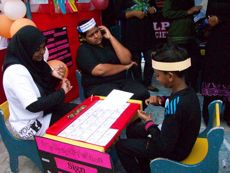
While many booths provided hard information about social services, several catered to the younger generations. Kids were invited to decorate cakes and paint pictures for various causes. At Care Society, children learned sign language from a hearing impaired instructor and familiarized themselves with disability icons over a board game.

One Care Society representative said community awareness had improved in recent years, “especially since the passing of the Disability Law last year.” But community tolerance “is an issue we are working to address. “

“There is still a fair amount of people who don’t understand the nature of various disabilities and how to interact with those individuals. It’s something that needs to be corrected,” she said.

HRCM Commissioner Tholal said social reform goes deeper than a pamphlet.

Attributing misconceptions of human rights to social instability, Tholal observed that “There’s this idea that if a prisoner has rights, it’s at someone else’s expense. But human rights are not about protecting one person’s rights and not another’s.

“The idea of self-expression and human rights is still fairly new to the Maldives under the new government, so as things stabilise I think the view of human rights could improve as well.”

According to Tholal, the HRCM has been targeted by proponents of Islamic fundamentalists, but the larger Islamic community has supported the commission’s work.

“The key thing for the public to understand is that the Maldives is a 100 percent Muslim country,” he said. “The rules and regulations that this status calls for can exist within the framework of human rights. They’re not incompatible. If anyone says otherwise, they negate the mission of the HRC. The idea that human rights are compatible with Islam, and the constitution, needs to be accepted by the people.”

Tholal did not wish to comment on the UN Human Rights Commissioner’s recent critique of the constitution’s provisions for flogging and mono-religious practice.

Calling for a more concerted media effort, Tholal said media is one of the most important factors for establishing a stable human rights framework. He criticised local media outlets for endorsing only a fraction of the rights issue.

“A lot more focus is placed on civil and political rights in the media, as opposed to social, economic and basic human rights,” he said, emphasizing that women and children are significantly under-represented. “Some media outlets, whether deliberately or inadvertently, have programs which impinge on the rights of women and rights, such as the right to work. In this environment, we need to focus on what is really crucial to people–like social rights.”

Earlier this year, a UNDP study found that gender equality is an area of development in which the country is lagging behind most.

HRCM will hold a media training program later this year.

Keeping the beat

After last year’s launch, the “Did You Know?” campaign aimed to tour Male’, Vilingili, Hulhumale, and the capital islands. “We exceeded expectations and reached 80 islands in 20 atolls,” said Aminath. “But we realized that it was just not possible to reach all the islands with the small number of volunteers we had.”

Aminath said the next phase of the campaign training approximately 10 NGOs across the country to providing information on the judicial system to islanders year-round.

“There are two main obstacles: geography, and capacity,” Aminath said. “The island geography makes it difficult for people to learn of and access all parts of the judicial system. And the Maldives has many many civil society groups, but not enough people to do the work.”

A UNDP report earlier this year found that although the civil society sector is impressive in size, it lacks efficiency and organisation. Aminath said collaborating with NGOs would support both the campaign’s purpose and the NGOs’ interest in capacity building.

Aminath said islanders are often aware of their rights, but that Maldivian culture is not traditionally litigal.

“People are used to talking and solving the problems that way. Going to court is a process, and if you appeal you have to go Male’ which takes time and money. There needs to be someone in the islands telling people how they can proceed with a complaint,” she said.

Plans to develop a mobile high court are indefinite.

This year’s event was widely attended by families and youth who enjoyed the activities, free candy, and social milling. Most booths were hosted either fully or in part by young people eagerly offering pamphlets.

Aminath said the UN strives to involve youth in most activities, and that they are the backbone to the “Did You Know?” campaign.

“Most of my volunteers are ages 19 to 30, and they’re an excellent group. They came on all 80 island trips this year. They also represent a real cross section of civil service, coming from the courts, the prosecutor general’s office, the police and other parts of society,” she said. “I couldn’t do these kinds of events without their support.”

At UNDP’s Democracy Day ceremony earlier this year, a study observed that youth in civil society were widely recognised as a key factor for democratic growth in the Maldives. Currently, youth ages 18 to 25 comprise nearly half of the country’s population.

Likes(0)Dislikes(0)

Maldivian Islamic groups call for arrest of UN High Commissioner on Human Rights

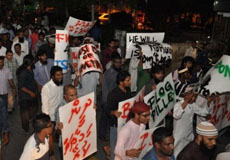
Protestors gathered outside the United Nations Building in Male’ on Friday afternoon to condemn UN Human Rights Chief Navi Pillay for her criticism of the Maldivian constitution, namely its provisions endorsing flogging and mandating that every Maldivian be a Muslim.

The protestors carried signboards with angry slogans, including “Islam is not a toy”, “Ban UN” and “Flog Pillay”, and called on authorities to arrest the UN High Commisioner.

Police Sub-Inspector Ahmed Shiyam told Minivan News that the sizeable protest was contained and there were no confrontations.

“Police cordoned off the area so people could not enter the UN building or the roads leading to the building. The protest was pretty heated, but there were no confrontations or arrests,” he said.

After a break for Sunset Prayer, protesters renewed their efforts at the Tsunami Memorial.

Shiyam said police guarded the UN building during the evening protest, and kept appraised of its movements.

No concerns have been voiced to the police by the UN.

During a press conference on Thursday evening, Pillay again called for the government and the judiciary to issue a moratorium on flogging.

“Flogging is a form of punishment that is cruel and demeaning to women. I have as High Commissioner traveled to very many Islamic countries, and apart from the Maldives and one other country that practices stoning, flogging is not a practice that is condoned,” she said.

“The issue needs to be examined, and therefore I called for a countrywide discussion. It is much better if the issue is transparent and debated.”

Challenged by a local journalist that the Maldives was both obliged to protect the religion of Islam, she replied: “You have a constitution which conforms in many respects to universal human rights. Let me assure you that these human rights conform with Islam.”

She added that the Maldives had signed international treaties that are legally-binding obligations, “and such a practice conflicts with these obligations undertaken by the Maldives.”

Pillay said she had raised this matter with President Mohamed Nasheed and the judges during her visit, “and they are all looking into this matter. The President is sympathetic because each time he travels outside the Maldives the issue is raised with him. He says he can only look at it on a case by case basis, but if there is a judicial decision, that may apply to all cases.”

She renewed her call for a moratorium, and noted that the Maldives “has an excellent track record regarding the death penalty. The death penalty is unIslamic and is not practiced in the Maldives. When I travel to places where the death penalty is used, I hold up the Maldives as an example of that.”

Asked to comment on the requirement under the Maldivian constitution that all Maldivians be Muslim, Pillay respond that “Such a provision is discriminatory, and does not comply with international standards. I would urge a debate again on the issue to open up entrance of the constitution to all.”

Asked by another local journalist to respond to the religious groups criticising her requests, “my response is that as the UN High Commission of Human Rights I look at the norms and standards that all the governments of the world have drawn up.”

“It is not that I am plucking principles from the air. I point my critics to universally accepted standards on human rights are consistent with Islam. Many governments and scholars have told be there is no conflict between human rights and Islam.”

Pillay also highlighted the plight of expatriate labourers in the Maldives, who make up a third of the population and in many cases have been lured to the country by unscrupulous employment brokers.

“The Minister of Foreign Affairs [Ahmed Naseem] is very aware of the suffering of foreign workers, and agreed that something needs to be done for these people,” Pillay said.

“You can’t have 60,000 people suffering here while performing work for the benefit of Maldivians and the tourism industry, and pretend this is invisible. The media has a role to give these people a voice so they can explain their problems.

“Many of them are trafficked and the little money they earn is exploited. This is of grave concern to me, because people like this are are protected under the UN Convention on Migrant Workers and their Families. I have urged the Maldives to ratify this, and regularise the presence of 60,000 people

“I also call for an end to the stereotyping of these people as a threat and unwanted.”

Likes(0)Dislikes(0)