Maldives appeals to world for technical help with carbon neutral plan

The Maldives has become the first country to crowdsource its renewable energy plan on the internet.

The current draft of the plan focuses on using solar energy to generate most of the country’s electricity and cut emissions by 60 percent before 2020.

The plan suggests that up to 80 percent of the electricity island communities use could be derived from renewable energy, without the cost of energy increasing.  The plan also proposes a shift to wind, batteries and biomass to complement solar power, retaining existing diesel generators for reserve power.

The Ministry of Economic Development revealed that economic modeling had shown that it was already cheaper to generate electricity from solar photovoltaic panels than from diesel on many Maldivian islands.

The direct cost of daytime solar PV is around US $0.21 per kilowatt hour, compared to $0.28 – $0.44 per kW/hour for existing diesel generators.

The cost of decarbonising the Maldives, which spends almost 25 percent of its GDP importing fuel, mostly on marine diesel, is estimated to be US$3-5 billion over the next 10 years.

“The investments will largely pay for themselves because the Maldives would save huge sums of money on oil imports,” the Ministry of Economic Development observed in a statement.

The Renewable Energy Investment Office, based in the Ministry of Economic Development, was established to help combat global warming. Last week it opened an internet forum for local and international groups and individuals to advise the Maldives’ plan to develop solar energy, which has been approved by the Cabinet.

“The government has limited experience working with renewable energies because these are relatively new technologies to the Maldives,” noted Minister for Economic Development, Mahmoud Razee.

“We have published our investment framework online and highlighted areas where we require feedback and help. We are crowd sourcing our energy plans and inviting the whole world to help us,” Razee said.

A more detailed plan will be submitted again in February, with details on investment strategies, explained Razee.

“Maldives is the first country to do this on a global scale and over the internet. This shows that we are innovative and willing to share by working with other countries on this issue, which affects everyone. Also, it shows that we are willing to be as transparent as we can,” Razee said.

Forum users must register with their real name and submit identification information before contributing, and they will be asked a series of questions to confirm that they are qualified to share their expertise. The forum rules encourage debate, but note that comments that “are deemed offensive or inappropriate, or don’t relate to the question” will not be published.

The forum rules further requests that “criticism of a proposal has to be supported by offering a better alternative, with a clear idea of cost and practicality,” in order to be useful.

The goals of the plan, Razee stated, were to free the country from the uncertainties and costs of its oil dependency, and to demonstrate global leadership in the fight against climate change.

“While we are working now on the initial production planning and development we will also be looking to use local and international expertise to develop storage capacity,” Razee said, acknowledging that storage was a primary concern.

While the Maldives has abundant sunlight during the day, the battery technology required for large-scale power generation at night is extremely expensive.

“Right now, we aren’t looking at storage because it would double the cost in this current economic environment. Technology is evolving reasonably rapidly though, and in five or ten years we think that providing storage will more affordable,” Razee said.

“Batteries are used at night, and as we know a lot of electricity is generated then. So we will need to address the issue of storage and how to provide energy at night within our larger goals.”

Forum topics in the comprehensive crowdsourcing project include solar and wind technology, energy storage, system control and demand management, novel technologies (including marine current and ocean thermal), biomass power generation, and finance.

Under each topic the Maldives appeals for expert assistance on several technical questions, around issues such as the use of solar panels in corrosive environments, the economics of tracking or fixed solar panel systems, and the viability of low velocity wind turbines.

Visit the forum (English)

Likes(0)Dislikes(0)

Maldives director of Amana Takaful resigns weeks before IPO

Director of the Maldives branch of Amana Takaful, Hassan Ali Manik, has resigned his post scarely a week after the company announced the launch of a landmark IPO on the local stock exchange.

Manik’s resignation will take effect from the 21st of September. In a statement, Amana Takaful said Manik was tendered his resignation “citing business and personal commitments”.

The company did not announce a replacement.

Sharia-compliant insurance company Amana Takaful will issue 800,000 shares in an initial public offering (IPO) on the Maldives Stock Exchange (MSE).

In a first for the country, 20 percent of the shares will be made available to expatriates and 15 percent to overseas applicants. The remaining 65 percent will be offered to Maldivians.

The Sri Lanka-based company hopes to generate Rf16 million (US$1.4 million) in proceeds through the IPO, by selling shares at a low issue price of Rf20 (bundled in packages of 25).

CEO of Amana Takaful Maldives, Hareez Sulaiman, said the IPO would “change the way the Maldivian Stock Exchange operates as this will be the first time that Maldivians, expatriates and foreigners will be able to purchase securities in a Maldivian listed company.”

The decision to price the shares low “at a price affordable to any average Maldivian” also promised to “be a kick starter for an active stock market which may benefit the entire economy at large,” the company said in an accompanying statement.

Likes(0)Dislikes(0)

First international fast food chain opens in Maldives

President Mohamed Nasheed attended the official opening of Marrybrown, a halal Malaysian fast food chain and the first international fast food chain to come to the Maldives.

The Marrybrown franchise currently operates in 15 countries worldwide. The restaurant in the Maldives was established by Lily International Private Limited, a leading business venture in the Maldives.

In his speech at the opening ceremony, the president thanked Lily International for its various contributions to Maldivian businesses since the 1980s.

The president also noted that the Maldivian lifestyle is changing to accommodate businesses enterprises such as Marrybrown, and that steps are being taken by the government to facilitate competition in the open market. The president said necessary legal amendments such as tax and state income laws were being made, and hoped more service enterprises would be established in the Maldives.

Marrybrown Chairman Lawrence Liew said the chain caters to a general population. “We have something different for everyone at a reasonable price in a clean environment. Our kids play centre creates a positive family space,” he said.

President Nasheed eats the inaugural fried chicken burger

After a moment of technical difficulties, Marrybrown opened its doors to the president, the press and the public. The President tasted the chain’s first fried chicken burger in the Maldives alongside franchise and government officials, and was given a tour of the facility which includes an air conditioned interior dining and play area and an upper open air veranda.

Families flocked to the restaurant doors for the next few hours, eager to acquire the free fried chicken meals that were being distributed in honor of the occasion.  A chipmunk mascot in a signature pair of green overalls welcomed children to the event outside, while groups were let in in stages to avoid crowding.

“The menu for Maldives was specially designed over the last six months by our chefs, and is a combination of Malaysian and Maldivian cuisines,” Co-Founder and Group Management Director Nancy Leiw told Minivan News.

When asked about the health value of the fast food menu, Leiw claimed Marrybrown “delivered all the necessary nutrients.”

“It’s a very balanced diet. Think about a burger. You have your carbohydrates, your protein, the lettuce gives you valuable vitamins and minerals, you have everything you need.”

Burgers are served with tomato and chili sauce packets and soft drinks.

Liew said that the franchise owner is “an ambitious businessman”, and that Marrybrown will be expanding business in the Maldives. “We don’t just serve food, we serve people. We will be providing opportunities in employment, business management, and local development,” she said.

The Marrybrown opening was facilitated by Malaysian staff, who will train Maldivian employees to “pass on our expertise and style of customer service,” said Liew.

The franchise’s nationality bore special connotations for the Maldives. “Malaysia is Muslim, and the Maldives is Muslim. We share a special synergy in Islam,” said Liew. “This synergy will allow us to work together in productive ways to create new opportunities for growth in line with our shared cultural standards.”

Liew noted that Marrybrown is celebrating 30 years of operation this year, and will be holding promotions and fundraising events for local charities and businesses throughout the year.

Marrybrown plans to open several more restaurants in the Maldives in the near future.

Likes(2)Dislikes(1)

Maldives one of seven most important countries on UN Human Rights Council: Human Rights Watch

The Maldives has been identified as one of the seven most important countries on the UN Human Rights Council, in a report by the Human Rights Watch organisation.

The Maldives, together with Argentina, Brazil, Chile, Mexico, the United States and Zambia were identified has making “a critical difference” during the period of the report, “working both collectively and in parallel to ensure that the Council’s mandate to address and prevent situations of violations was fulfilled more rigorously, recognising the Council’s inaction of the past”.

Negative influences identified on the Council included China, Cuba and Russia, the report noted, which “systematically voted to reject any action of the Council that they deemed too critical of a state, or that was not supported by the state in question. They argued that the Council should be a forum where states meet to discuss human rights issues cooperatively without what they considered to be interfering in the domestic affairs of others.”

In particular, the Maldives was praised for its energetic engagement with the council and its solid voting record.

“Despite having a small delegation, [the Maldives] commitment to human rights and democracy has motivated it to be a part of, or to take leadership on, a significant number of initiatives over the last year. The Maldives was among the first group of signatories calling for the special sessions on Côte d’Ivoire and Libya. The Maldives also cosponsored the resolutions on Iran, Tunisia, Côte d’Ivoire, Libya, and Kyrgyzstan,” the report said.

However it identified as “regrettable” the Maldives position on whether to launch an international investigation into war crimes in the final days of the Sri Lankan civil war, “particularly on the question of accountability.”

“The Maldives has been uncharacteristically reluctant to endorse the calls of the High Commissioner and the Secretary-General’s panel for the creation of an independent international mechanism to investigate the final months of the conflict. Its close bilateral relationship with Sri Lanka, rather than the credible allegations coming from the ground, has prompted this position,” the report noted.

“The Maldives should revisit its approach on Sri Lanka in order to bring it in line with its otherwise principled approach to human rights at the Council.”

The report also noted that despite its strong record of positive engagement on many issues at the Council, “the Maldives supported the resolution on traditional values and voted with the Organisation of the Islamic Conference (OIC) against the resolution on human rights, sexual orientation, and gender identity.”

Foreign Minister Ahmed Naseem meanwhile said the Maldives was proud that the country was now “internationally-respected for its commitment to human rights and for its influence on the global stage”

“At the time, many people doubted the Government’s decision to put forward the Maldives’ candidature for the UN Human Rights Council, saying we are too small to make a difference. Human Rights Watch’s new report shows unequivocally that such doubts were misplaced. Not only has the Maldives played a central role at the Council, we have also helped make the Council far more effective as the pre-eminent global body responsible for protecting human rights,” Naseem said.

Read the full report (English)

Likes(0)Dislikes(0)

ICC membership expected to reform Maldivian judicial system

The Maldives has become the 118th country to adopt the Rome Statute of the International Criminal Court (ICC), the world’s first and only permanent international court with jurisdiction over crimes against humanity, crimes of aggression, genocide and war crimes.

The Maldives is the third state in South Asia to become an ICC member, following Bangladesh and Afghanistan. It is the ninth in the south asian region alongside Cambodia, Japan, Republic of Korea, Mongolia, the Philippines and Timor-Leste; plans to ratify the statute are advancing in Malaysia and Nepal.

Asia has been slower than other regions in adopting the ICC regulations, allegedly because they maintain the death penalty which is prohibited by the ICC. William R. Pace, Convenor of the Coalition for the International Criminal Court, said the Maldives’ decision to accede to the Rome Statue was a significant step for the region.

“It is vital that the momentum towards increasing respect for the rule of law and accountability for those responsible for the most serious crimes is seized by other states in the Asia-Pacific region, many of whom are close to joining the ICC,” Pace said in a press release. “Joining the Court represents a strong deterrent effect that will contribute toward the prevention of gross human rights violations in the Asia-Pacific region and to the global fight against impunity.”

Acceding to ICC regulations as defined by the Rome Statute has been a long process for the Maldivian government. In 2003, the Maldives took steps to reject its judicial authority.

Wikileaks cables published on 1 September 2011 cite the Maldivian government’s intent to “never turn over a US national to the International Criminal Court (ICC). The Maldivian government would not sign the ICC treaty and would not respect its claim to universal jurisdiction.” Other cables indicate that then president Maumoon Abdul Gayoom was seeking approval for a visit with then US President George W. Bush, allegedly to improve his chances of re-election.

Speaking to Minivan News today, the President’s Press Secretary Mohamed Zuhair said ratification of the ICC statute highlighted the different values of the current administration.

“For us, it’s transparency that is at the top of our priorities. So right now, our highest priority is to improve the judicial system of this country.”

The ICC covers major crimes which are widespread, systemic and of concern to the international community. The ICC does not deal with small cases, even if the victims may be in the hundreds.

Among the criteria for the ICC to take on a case in the Maldives is doubtful willingness and capacity of the country’s own judiciary to handle the case in question.

Zuhair said it was important for Maldivians to have access to an international judicial system. “Individuals who feel they have a complaint, even against a leader, could refer the complaint to the Maldivian judicial system or to the ICC. This is a big step for a country whose previous leaders have been accused of human rights violations. I believe their cases would be fairly addressed in the ICC,” he said.

Evelyn Balais-Serrano, Asia-Pacific Coordinator for the ICC’s advocacy NGO Coalition for the International Criminal Court (CICC) told Minivan News that ratification would support domestic legal reform, and that heads of state would face new levels of accountability.

“The ICC only deals with the big fish. In the past only the small fish may have been sacrificed to show a semblance of justice – but the ICC targets the highest level of responsibility: the head of state, generals, kings,” she said previously.

The Debate

In October 2010, the debate to join the ICC created sparks in Parliament.

MDP MPs condemned the “unlawful and authoritarian” practices of the previous government. Group Leader “Reeko” Moosa Manik referred to 2009 legislation protecting former presidents who he considered “the worst torturers in the country’s history,” and said the purpose of the international criminal court was to “arrest torturers like Maumoon [Abdul Gayoom], people like Ilyas Ibrahim [brother-in-law of the former president] who stole state property and funds, and Attorney Generals like Hassan Saeed who tried to hide it.”

MPs from opposition Dhivehi Rayyithunge Party-People’s Alliance (DRP-PA) said MDP MPs were overlooking the fact that Gayoom had never been reprimanded in a court of law, and accused the current administration of disregarding rules of law. MP Dr Abdulla Mausoom accused the MDP government of formulating policies only to “benefit certain people”, which he argued could be “considered a crime in international courts.”

The question of religion was also inflammatory. DRP MP Dr Afrashim Ali said convention should not be signed if it could lead to “the construction of temples here under the name of religious freedom.” Other MPs pointed out that several Muslim countries had not joined the ICC, and the MPs were concerned that ratification would “shatter Islamic principles” and encourage gay rights.

Shari’a experts in ICC signatories and Muslim countries Afghanistan, Jordan and Malaysia have not found conflict between the Rome Statute and Sharia.

On 14 June this year, Parliament voted almost unanimously to sign the Rome Statute of the ICC.

The Effects

Speaking to Minivan News today, Balais-Serrano pointed out that ratification of the Rome Statute was well-timed.

“As a chair of the SAARC summit, Maldives will have quite an influence on south asian countries attending this year’s event,” she said. “It will certainly be constructive in reviewing human rights, a key point we plan to address at the summit.”

The South Asian Association for Regional Cooperation (SAARC) summit is scheduled for Addu City in mid-November this year.

Balais-Serrano also pointed out that by ratifying the Rome Statute, governments are committing to adapt current domestic legislation to meet international standards. She said ICC members could receive “training of local judges and prosecutors and other officials responsible for lawmaking and implementation”, and hoped the Maldives would forward with judicial reform.

“The judicial system in Maldives can benefit from the rules and procedures by which the ICC operates, for example, in the nomination and election of judges, in the protection of witnesses and victims and in ensuring due process,” said Balais-Serrano.

She said that ICC membership would expand Maldivian court procedures. “One of the motivations of joining the ICC is to let go of a commitment to include the domestic judicial system alone. Now, Maldivians can also refer to the ICC provisions and regulations. This is a timely event for the Maldives to review domestic law while making the ICC a reference point.”

As an ICC member, the Maldives will be able to send judges and lawyers abroad for internships and exchange programs in member countries. Balais-Serrano said that all member countries are obliged to send employees to the ICC to learn and assist with proceedings.

International liability

ICC membership could affect international relations. The Maldives recently made news headlines by supporting the Sri Lankan government, which is facing war crimes allegations by international human rights groups. A report from UN Secretary General Ban Ki-Moon has raised the likelihood of an investigation by the Human Rights Commission.

A Relationship Agreement between the ICC and the United Nations calls the UN “potentially the most important partner of the ICC on various levels,” and suggests that investigations by the UN are based on the same human rights standards put forth by the ICC.

“The Maldives cannot do anything if the ICC decides to investigate and put into trial the perpetrators of crimes in Sri Lanka,” said Balais-Serrano. “If suspected criminals from Sri Lanka seek refuge in the territory of the Maldives, as a state party to the ICC, the government is obliged to cooperate to the Court by arresting  the criminals.”

Likes(3)Dislikes(1)

Visa fees to be paid in 3 month lump sum

Recruitment agencies are newly required to pay visa fees for expatriate workers for at least three months, according to new policies at Maldives Inland Revenue Authority (MIRA).

The visa fees of Rf250 were previously payable every month. Under the new policy, agencies will be required to submit at least Rf750 when making payments, Haveeru reports.

A MIRA authority told Haveeru that the policy was designed by the Immigration Department.

Recruitment agencies expressed concern over the policy change, allegedly because of the difficulty of providing larger sums of money at once. Others have claimed that it’s a waste of money on workers who are imported for a single month of work.


Likes(0)Dislikes(0)

Confiscated swords found fake and flexible, sent to MNDF

Swords confiscated by Maldives Customs Service last Thursday have been reported as fake incapable of causing harm. The swords had been imported by Wushu Federation of Maldives for martial arts training.

Haveeru reports that the swords bend when waved or put in contact with a person. The swords allegedly look real, but are not used as weapons.

An assistant program director told Haveeru that the Chinese Wushu Association had donated the swords along with uniform kits, which were also confiscated.

Customs has released the martial arts uniforms, but sent the swords to the Maldives National Defence Force (MNDF). Customs also told local media that the swords were not imported with forged documents.

Likes(0)Dislikes(0)

“We don’t want Israelis to invest in our island”: Filadhoo islanders

Islanders on Filadhoo in Haa Alifu Atoll have reacted with outrage to news of an Israeli agricultural delegation scheduled to arrive on the island next Saturday, warning that the visitors from Teshuva Agricultural Products “will go no further than the island jetty.”

On its website the company claims its advanced agricultural methods “allow for fresh culinary herbs to be grown in soil-less hydroponic systems.”

Filadhoo islander Mohamed Hamidh told Minivan News that the majority of the island’s 550-strong population were against the visit by the Israeli company.

Hamidh said that when the islanders first received information about the delegation, they prepared a petition signed by 100 islanders and submitted it to the island council.

“That night the Island Council called the islanders for a meeting and 83 islanders attended the meeting. Councilors called for a vote and 82 out of the present 83 citizens voted that they do not want to let the Israeli delegation step on the island,” Hamidh said.

Local media reported that the petition signed by the 100 citizens claimed the Israeli delegation intended to preach Christianity on the island and conduct un-Islamic activities, although they came under the banner of an agricultural delegation.

An earlier press release by the Deputy Leader of the Adhaalath Party accused the agricultural delegation of being agents from Mossad, the Israeli secret service.

Hamidh meanwhile said the islanders would not welcome the delegation because Israelis “have been mistreating the Muslims in Palestine” and have “killed so many Palestinian men and left many Palestinian women widowed.”

“We have reports that although the islanders oppose their presence, they will still head towards our island. They are supposed to be arriving on Saturday morning around 8:30am, so we will keep an eye on the jetty and will not let them enter this island,” he said.

Island Council Member Mohamed Vijan told Minivan News that the council was “left with no other choice” but to support the will of the citizens.

“Last Monday the Atoll Council informed the Island Council that this delegation from Israel will visit Filadhoo on Saturday,” he said.

He said the council will be “with the citizens” whether they were in favour or opposed to the visiting delegation.

Earlier this month Deputy Leader of the Adhaalath Party Dr Mauroof Hussein called for alarm after alleging that a delegation from Teshuva Agricultural Products was due to arrive in the Maldives to assess the country’s agricultural potential.

The last time an Israeli delegation visited the Maldives – a team of volunteer eye surgeons – protests erupted across Male’ that saw the burning of Israeli flags and calls to “ban all Israeli medical teams” from practicing in the Maldives.

Likes(1)Dislikes(0)

Islamic Foundation files court case seeking repeal of Religious Unity Regulations

Religious NGO Islamic Foundation of the Maldives (IFM) has filed a case at the High Court requesting the court rule that the Religious Unity Regulations are inconsistent with the constitution.

Controversial new religious unity regulations were published in the government’s gazette last week, cracking down on extremist and unlicensed preaching of Islam in the Maldives.

Local media reported that prominent religious scholar Sheikh Ibrahim Fareed, who currently faces charges for allegedly violating the Religious Unity Act, filed the case in the High Court and spoke to the media outside the court.

Media reported Sheikh Fareed as stating that the regulation was inconsistent with the constitution as well as the Quran.

Fareed was quoted as saying that romantic thoughts, social talks and religious speeches were part of the fundamental right of freedom of speech as stated in the constitution.

Meanwhile, religious NGO Jamiyyathul Salaf and the religious council of the Adhaalath Party voiced opposition to the regulations.

Sheikh Fareed today told Minivan News that the regulation was “very” inconsistent with the Quran and the constitution.

“By God’s will next week I will request the High Court issue a court order to delay the implementation of the regulation until the court reaches to a conclusion on the issue,” Sheikh Fareed said. “The regulation was drafted by the Islamic Ministry and it pressured the government to publish it in the gazette.”

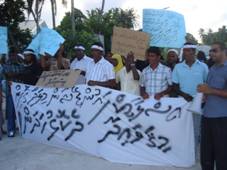
Islamic Foundation protestHe said islanders of Miladhoo in Noonu Atoll have been protesting outside on the streets of the island today calling for the religious unity regulation to be amended.

Media Coordinator of the protest and Chairman of Miladhoo Island Council Hassan Gassan told Minivan News that the protest started at 4:15pm today.

“The protest is organised by the IFM Miladhoo Wing and a huge majority of the islanders have joined the protest,” he said. “We walked around the main streets of the island and stopped at the island harbor.”

He said protesters were calling for the resignation of Islamic Minister Dr Abdul Majeed Abdul Bari, and to amend the Religious Unity Regulations.

New religious unity regulations were published in the government’s gazette last week, cracking down on extremist and unlicensed preaching of Islam in the Maldives.

The regulations reflect the enforcement of the Religious Unity Act of 1994 and were originally put forward by the Islamic Ministry, but have undergone numerous drafts and revisions over the past year. The penalty for violating the regulations under the Act is 2-5 years imprisonment, banishment or house arrest.

Likes(0)Dislikes(0)