Transparency asks authorities to investigate MPs for bribery over committee allowance justifications

Transparency Maldives has strongly condemned remarks by MPs justifying their newly inflated allowances by claiming that large portions of their salaries were spent on meeting demands from constituents.

MPs from both major parties have previously admitted that a large, usually undisclosed proportion of their salaries is spent on medical treatment, education and other requests from their electorate – a symptom of an enduring culture of patronage that persists in the Maldives – and confessed that ignoring these demands in such a culture of expectation is extremely difficult.

However, “Transparency Maldives believes such actions fall under article 3 of of the anti-corruption law and article 13 of the Anti-Corruption Commission Act regarding bribery,” Transparency said. “If such acts have taken place Transparency Maldives calls upon the relevant authorities to conduct investigations and take legal measures.”

The statement notes that 16 MPs have so far informed parliament’s secretary-general that they did not wish to take the Rf 20,000 (US$1300) allowance.

Today a group of citizens concerned about parliament’s committee allowances gathered in front of the Finance Ministry and presented a petition signed by more than 1000 people to the ministry, later intercepting President Nasheed as he left the Ministry.

The President spoke with the gathered activists and was requested to sign the petition himself, but asked why he should sign a petition that was to be presented to him anyway.

President Nasheed reportedly told the group that the government had no other choice but to issue the funds for the committee allowances as it had been already approved by parliament. The Rf20,000 allowance was initially approved on December 28, 2010 as part of a pay scale recommended by parliament’s Public Accounts Committee.

Nasheed explained that it was not a matter of whether he supported the allowance, but that “when parliament makes it legally binding the government does not have any discretion [to overrule the parliament’s decision].”

Project Cordinator of Transparency Maldives Aiman Rasheed told Minivan News that the campaign against the committee allowance will continue and there was hope for success.

”Today we presented the Finance Ministry 1365 letters signed by concerned citizens and eight cabinet members, plus high-profile people across the country,” he said.

”We have made plans to continue the letter campaign and to make the citizens aware of the impacts of this committee allowance.”

MP salaries have increased 18-fold since 2004, according to a graph released by the NGO.

The committee allowance was Rf18 million, Rasheed said. ”In comparison, the budget to combat drugs is Rf 14 million, the budget subsiding the fishing industry is Rf12 million, medical services Rf18 million and the budget for small and medium businesses is Rf16 million,” he said, adding that these areas would be impacted by the increased expenditure on MPs.

Opposition Dhivehi Rayithunge Party (DRP) MP Dr Abdulla Mausoom on his Facebook page said receiving the allowance made him feel like “Robin Hood”. Responding to criticism that such a justification would taint future elections by making them unfair for political challengers, he replied that “when the President appoints ‘directors’ for paper-companies and pays millions in public money to promote MDP…. that’s very unfair too. Why don’t we see any protest on that? This is my way of ‘protest’ for irresponsible ‘politically aligned’ spending of the government.”

The government has previously contested that expenditure on the 244 political appointees in the executive branch represented only two percent of the state’s wage bill, or Rf99 million (US$6.4 million) a year, a figure DR Mausoom has previously claimed represents “the tip of the iceberg”.

“The whole country was corporatised,” he explained. “There’s a roads corporation and all sorts of corporations. The people appointed to the boards of these corporations are all purely political appointees. They were appointed directly by the President to promote a political agenda.”

Dr Mausoom told Minivan News today that the moment he received the allowance he would start spending the same amount on his constituency for social projects.

“There is no benefit for the people in keeping the money in the government’s treasury because they will spend it all on political appointees,” he said.

“The real issue is that one institution has too much power. Parliament should not have the power to set their own salaries.”

Likes(0)Dislikes(0)

President awards Mark ‘Occy’ Occhilupo Four Seasons Maldives Surfing Champions Trophy

World Champion Surfer Mark Occhilupo has won all three divisions of the inaugural Four Seasons Maldives Surfing Champions Trophy, defeating longboard champion Josh Constable in the final and taking home US$19,000 in prize money.

President Mohamed Nasheed presented the trophy to Occy on board the Four Seasons Explorer, a luxury three-storey catamaran anchored near the Sultans surf break.

“We are people of the sea. We grow up with the elements around us, and the sea is never very far away. We are taught to swim from a tender age,” Nasheed said.

“44 percent of our workforce are fishermen, who spend more than half their lives on the sea, and many Maldivians looked up to famous surfers while growing up,” he said.

Nasheed dancing Bodu Beru with the surf champions

The relative seclusion of the country’s surf breaks compared to more famous surfing destinations such as Hawaii and Indonesia was not necessarily a bad thing, Nasheed said, “because we are not always clear about how to manage our resources. We have to use them wisely to benefit everyone.”

Nasheed told Occy that the Maldivian cabinet was not unfamiliar with the water, having conducted a cabinet meeting underwater in 2009. Occy asked if that was “the same as a cone of silence”.

Occy dedicated the champion’s trophy to Tony Hussain Hinde, the Australian-born surfer who pioneered modern surfing in the Maldives after becoming shipwrecked in the country, and who died in 2008.

Following the prize presentations, the six surfing legends, together with the President, Press Secretary Mohamed Zuhair, cabinet ministers and several MPs of the Maldivian Democratic Party (MDP) erupted into a spontaneous traditional Bodu Beru dance.

Final day of the competition

The six surfers, including two-time world champion Damien Hardman, four-time world champion Mark Richards, world longboard champion Josh Constable, 1966 world champion Nat Young and seven times female world champion Layne Beachley competed in one-, two- and three- fin divisions over the three days.

On the last day the Sultans reef break served up consistent four-foot right hand waves. During the final event, Occy required an 8.10 score to reclaim his lead, and waited patiently for a wave on which he delivered a 9 with full rail-to-rail maneuvers.

“I made a couple of mistakes, including losing priority, and I had to tell myself to just calm down,” Occy said of his performance.

“So I cleared my head and moved up the point where I needed to be and then a gem of a wave came through and I surfed it as good as I could and got that nine. I didn’t have one heat where I felt I was not under pressure. All those memories of being on tour came back and I had to rely on my instincts to win this event and now that I have, I am over the moon.”

Constable praised Occy as a “solid competitor”.

Reehan surfing with Layne Beachley

“I just couldn’t get him. He was on his game all week. I felt solid in the final and I had a good score but couldn’t get that back up so hats off to Occy.”

Sole female competitor Layne Beachley came close to taking the single fin division title from Occy in the final of the first day, and was only narrowly defeated.

“It’s been surreal competing against five male world champions and being a contender,” said Beachley, noting that such match-ups were rare in the surfing world due to the anatomical disadvantages women faced: “our hips get in the way.”

“I knew it was always going to be challenging but I stepped it up and gave them a run for their money,” she said.

Four-time world champion Mark Richards was forced to withdraw from the final day of the competition after suffering a hamstring injury, opening the way for Maldivian surfer Ali Reehan Mohamed to take to the water as a wildcard entry.

Grinning, the 18 year-old described that surf as “the best experience of my life.”

Confessing to an attack of nerves at being out among the world champions, Reehan said “I did my best to show them something.”

"Best experience of my life" - wildcard entry Reehan

“It was very friendly, we were sharing waves,” he said.

Reehan has been surfing for two years, after upgrading from “fighting the white water on a body board”. He has since made his hobby into his work, freelancing as a professional surf guide.

“I stopped my last trip just to come here – I gave it to someone else,” he said.

General Manager of the Kuda Huraa Four Seasons Resort, Sanjiv Hulugalle, said the HSBC, Billabong, Wataniya, Surfing World and Singapore Airlines-sponsored event would return next year.

“The aim was to showcase the Maldives as a world-class surfing destination,” Hulugalle said, “and the international media has broadcast it all over the world.”

Reehan agreed: “With the media here, Maldives surfing is only going to get bigger,” he said.

Likes(0)Dislikes(0)

GST will prioritise wholesalers, but requires administrative tax regulations

Maldives Inland Revenue Authority (MIRA) has said it will give priority to levy the Goods and Services Tax (GST) from merchants who import and sell goods at wholesale prices, reports Haveeru.

The GST bill, which was ratified by President Mohamed Nasheed last Friday, is required to be implemented within a month from ratification.

Commissioner General of Taxation, Yazeed Mohamed, told Haveeru that tax deductions from wholesalers will be the second major source of income. He said certain industries such as construction, food and entertainment would be given higher priority.

Yazeed said the act will be fully implemented in three months, but that administrative tax regulations had to be amended as well, Haveeru reported.

GST payers will be asked to register at MIRA.

Likes(0)Dislikes(0)

Conde Nast rates magazine rates Maldives world’s second most popular destination

Condé Nast Traveler magazine has rated the Maldives the second most popular island destination in the world.

The magazine’s 14th annual Readers’ Travel Awards also recognised the Kuda Huraa Four Seasons Resort as ‘The Best of the Best in the World’s Top 100’ resorts. The resort was also named ‘Best Overseas Leisure Hotel in the Middle East, Africa and Indian Ocean’.

Resort General Manager Sanjiv Hulugalle traveled to London last week to receive the award on behalf of the Four Seasons.

“This award is a testament to an amazing joint effort and we’re incredibly grateful to everyone who voted for us,” Hulugalle said at the ceremony. “We’re constantly looking to raise the bar.”

Likes(0)Dislikes(0)

President meets outgoing UNESCO director, Honorary Consul

President Mohamed Nasheed, Vice President Dr Mohamed Waheed and Chief of Staff Ahmed Mausoom yesterday met with Outgoing Director of UNESCO and Former Minister of Education of Mauritius, Amroogam Parsuramen, to discuss strengthening collaboration in the areas of higher education, trade and economic development.

During the meeting Parsuramen also congratulated the Maldives for its promotion of the values of democracy, human rights, and efforts to seek regional cooperation in an international arena.

Nasheed also met yesterday with the Salisbury-based Honourary Consul of the Maldives and Friends of Maldives founder David Hardingham, and discussed providing overseas volunteers to assist in areas of development and trade.

Likes(0)Dislikes(0)

Opening of premium lounge hints at airport’s future

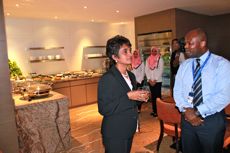
The Plaza Premium lounge was inaugurated today at Ibrahim Nasir International Airport (INIA), a step in GMR’s wide-scale renovation of the airport terminal.

The renovation, which began approximately 10 weeks ago, was designed by Hong Kong-based Premium Port Lounge Management Company Private Ltd. A message from company founder and CEO, Song Hoi See, indicated that the company was eager to design the project and “add more flights to Male.”

The Plaza Premium lounge was opened with a ribbon-cutting ceremony and a reading from the Qur’an. Among the officials who cut the ribbon were Tourism Minister Maryam Zulfa and GMR CEO Andrew Harrison.

“This is a proud moment,” said Zulfa. “It is sad that some of the resorts and institutions in the Maldives do not measure up to the standards of our premium customers. I am happy that GMR is setting an example for the Maldives as it moves forward.”

Zulfa, who arrived today from an international flight, described some fellow passengers who called a baggage delay “typical.”

“I said, ‘No, this is not typical. This is atypical. Because GMR is now taking care of us.’ It was a relief to know that a negative experience was not typical of how our airport works.”

Tourism Minister Maryam Zulfa surveys the Plaza Premium Lounge with GMR CEO Andrew Harrison

Baggage beltways were recently expanded, while eight check-in counters and two security lanes are being added. “We are de-bottlenecking departures, and things are running smoothly,” said GMR Chief Commerical Officer Prasad Gopalan.

Gopalan said the airport had seen an even higher increase in traffic this year than expected. “There is more traffic from Asia, and we are expecting Russian traffic to increase as well.”

Harrison said the renovation process had informed GMR of the higher standards that travelers now hold. He noted that washrooms and check-in counters were being refurbished “to make it a more ‘Maldives’ welcome for travelers,” and added that former staff had been re-trained to meet premium standards.

The lounge is open to first and business class passengers, and to economy class passengers for an undetermined fee. Services include a buffet and a la carte menu, computer and internet access, television, and spa-style foot rubs.

Harrison told Minivan News that “the quality of this lounge is a commitment to the quality of airport that the Maldives and its visitors can expect to see in the future. Even though this lounge is an asset with a short shelf life, it is appropriate that we demonstrate what the new terminal should be like.”

The new terminal at INIA is expected to be completed over the next three years, and will have a capacity of 5 million.

The renovation’s estimated cost is US$1 million. More renovations will be completed before the tourism peak season of November and December.

Likes(3)Dislikes(1)

JP asks Supreme Court to declare Kaashidhoo seat vacant

Jumhooree Party (JP) Youth Wing leader Moosa Anwar has filed a case in the Supreme Court of the Maldives requesting that the Kaashidhoo seat in parliament be declared vacant, and Elections Commission (EC) hold a by-election to reelect an MP for the seat.

The Criminal Court last week sentenced Independent MP for Kaashidhoo, Ismail Abdul Hameed, to one year and six months banishment after he was found guilty of abuse of authority for financial gain to a third party.

Under article 73(c)(3) of the constitution, MPs found guilty of a criminal offence “and sentenced to a term of more than twelve months” would be stripped of their seat.

Article 78 of the constitution meanwhile states that “whenever there is a vacancy among the members of The People’s Majlis, an election shall be held within sixty days from the date of the vacancy. A by-election shall not be held within six months prior to a general election.”

Moosa said that that the Supreme Court could determine whether Hameed should be given 90 days to appeal or if the seat should become vacant immediately following the lower court’s ruling.

“It is uncertain whether the seat is vacant. I believe that the seat is vacant following the Criminal Court ruling on 29 August and that the Elections Commission should have announced the by-election within five days as stated in the Parliamentary Elections Act,” he said. “But the commission has not, so the confusion over the vacant seat has to be cleared up by the Supreme Court.”

In other democratic countries, he noted, MPs would resign on their own when criminal charges were made against them with clear evidence, describing it as “best practice”.

The Prosecutor General pressed corruption charges against Hameed alleging that he had abused his authority as the former Director of Waste Management at the Male’ municipality to financially benefit a Singaporean company named Island Logistics in a deal to purchase a barge.

Deputy Elections Commissioner Hassan Fayaz told Minivan News at the time that the EC will begin preparations for the by-election when parliament officially informs the commission that a seat is vacant.

“I think it will take some time because he has the right appeal the verdict in superior courts,” he told Minivan News at the time.

Likes(1)Dislikes(0)

Tourist volunteers collecting data to protect Maldives reef ecosystems

A team of 15 volunteers from around the world have begun an expedition in the Maldives to collect data that will be used to compare and protect the health of the country’s vulnerable reef ecosystems.

The amateur marine biologists from countries as diverse as Germany, Russia, Australia and the Maldives have departed on a week-long tour aboard the luxury live-aboard Carpe Diem, during which they will be trained up on the Reef Check program and conduct as many as three research dives a day under the supervision of a team of professional biologists.

The hands-on ‘voluntourism’ trip is organised by not-for-profit wildlife conservation organisation Biosphere Expeditions and Six Senses resorts, which has provided a grant of US$79,000 over the four year program, and scholarships for two young Maldivians – Nishan Thoufeeg and Ahmed Shan – to participate on the trip.

At a press conference launching the expedition this morning, Executive Director of Biosphere Expeditions Dr Matthias Hammer explained that the objective was to involve ordinary people in conservation efforts while generating scientifically-rigorous data that can be used to recommend and implement policy.

Previous expeditions have focused snow leopards in Central Asia, turtles in Australia and jaguars in Brazil, “usually charismatic megafauna,” Hammer said.

Dr Jean-Luc Solantt, a scientist from the Marine Conservation Society in the UK who is accompanying the volunteers, noted that there was a lack of “basic, coarse-level data” required for monitoring reef ecosystems.

“We need to know what is happening on a national scale. The [Reef Check] program has a very basic methodology but it is very scientifically robust.”

The data would contribute to the monitoring and understanding of commercial fish populations, determine the reefs most resilient to environmental pressures, and serve as an early warning system for problems related to warming, bleaching and algae.

“In 1998 the water temperature reached 32 degrees for 4-6 weeks, and that caused most of the reefs down to 30 metres in the Maldives to die,’ he explained. “This data will help us see the pattern of recovery from that global impact, and recommend places that should be made marine protected areas.”

Solantt will check and evaluate the data collected by the group and produce a report based on the expedition. The data will then be collated and made available to scientists worldwide, as well as the Maldives Marine Research Centre (MRC) and the Maldives Whale Shark Research Project, if any of the creatures are spotted.

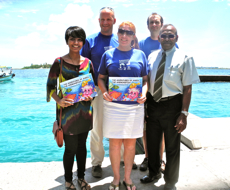
The group also presented 2500 copies of a colouring book, ‘The Adventures of Anees the Anemonefish’, to State Minister of Education Ibrahim Rasheed.

The book, written by Soneva Fushi’s Marine Biologist Kate Wilson and illustrated by Maldivian artist ‘Angel’, is intended to raise awareness around reef protection and inspire children to seek a career in environmental protection.

“Our country is the most beautiful in the world and we want to keep it that way,” said Deputy Minister Rasheed, “but we can only make policies based on the information and data we receive.”

“We need to make sure people are aware of the fragility of our environment. Education can create this awareness, which is why environment studies is a compulsory subject in the new curriculum,” he said.

Presenting the book "The Adventures of Anees The Anemonefish" to the Deputy Minister of Education

Program participants arrived last night from Europe, North America, Russia, Australia, Asia and the Maldives. Some had participated in previous Biosphere projects.

Tina Kuersten from Germany said the biggest results of a Biosphere expedition are seen long-term. “After my first expedition in Altai, I would get emails and updates about the project. It was great to see the results of our work, and to see how I had contributed to something significant.”

Kuersten’s husband Uwe said, “The value of these trips is that you can do something valuable, and learn more about biology.” He said seeing results motivated him to stay involved.

Riswil Ismail, who is from Malaysia, had followed Biosphere’s work for several years. She said in spite of the prohibitive cost, the diving aspect was very attractive.

“I’ve done a lot of dives, and I think because Malaysia and the Maldives are similar it would be great to learn about conservation in this way.”

Ismail said that the concept of paying to go on a volunteer work vacation was “not so popular” in Malaysia.

“People can donate money to a cause, but they don’t always get to see what their money can do. Paying to work on a vacation is a harder concept to understand in Asia, but I think it’s a really valuable way to contribute to a cause. If Maldives is doing this, why not Malaysia?”

Curnow said the average participant is “a well-educated person with a good job who wants to learn something new.” She said that scholarship programs are designed to attract students from the target location. This year, Six Senses’ Soneva Fushi and Soneva Gili resorts are co-sponsoring two Maldivians to take part in the expedition.

Biosphere Expeditions will run trips this week and next week; results are usually published six to eight months afterwards.

Likes(1)Dislikes(0)

Q&A: French tourist Mary Kivers

Minivan News interviewed French tourist Mary Kivers, a travel agent visiting the Maldives from France. Kivers came to the Maldives interested in seeing local life, and she shared her perceptions of a country that is both a world-class vacation destination and a unique victim of climate change. Kivers was randomly chosen for the interview, and nothing was known about her or her travel plans in advance.

Eleanor Johnstone: What made you decide to come to the Maldives?

Mary Kivers: When I’m traveling I just look for the cheapest opportunity because I have a promotion as a travel agent. So I saw Male’, and I thought, “Maldives, it’s one of my dreams to go there”, especially because I am a diver, so I decided to go. But then it was pretty hard to find accommodation at a good price.

EJ: How was your trip planned?

MK: I looked on the Internet a lot, and I knew I wanted to go to a local island. I found three websites: one was rather expensive and another never called back, but the third did a package with activities including a boat trip, and full board on Guraidhoo in South Male Atoll at a great price.

EJ: What was your first impression of the Maldives?

MK: When I arrived, I thought it was really nice. First, I went to a resort because I wanted to go diving. So I spent two days and two nights in a resort. I knew I wouldn’t like it too much though, because tourists stick together and it’s a honeymoon destination, so as a girl traveling alone the resort scene can get boring. But I talked to the staff who were very friendly, even though work was hard for them during Ramazan.

I talked with some Sri Lankan staff, who said they spent seven months here and three months at home, which seems very hard for them. But otherwise, the beach was clean, the nature is perfect and the sea is really amazing. Two days, though – it was enough.

EJ: Can you tell me about the local island experience?

MK: Well, when we arrived on Guraidhoo the manager took us to see the tourist beach. There’s only one beach for tourists to wear bikinis, which is hidden away from islanders. Everywhere else, you have to be appropriately dressed for the culture.

Afterwards, every day we took boats to see inhabited islands. But it’s a pity because there’s a lot of garbage and plastic bottles, shoes, everything really, everywhere. There are no trash bins anywhere, even on the local islands. There’s a large amount of garbage, and sometimes they burn it, but it’s right near the sea. There’s the beach, then the sea, then the garbage.

EJ: Where does the garbage come from?

MK: From the people on the island. At first I thought it was all from the boats, but on my last day I really wanted to see the village and local inhabitants so I decided to go there instead of taking the tourist boat. It was really great, I was walking around and everyone was inviting me to sit with them or eat in their house.

Even though it was Ramazan, they gave me food and drinks. They were very nice, even though they don’t see many tourists. It’s funny – children speak English but the older people don’t speak English. It’s now two years since they got a ferry, so before that there wasn’t a ferry or a teacher. Now it’s getting better. In this island for example they have two schools – one for ages 2-6, and the other for ages 6-14. After 14, they have to go to Male’ or another island. The government will pay for housing on another island. But because they have many children, I think it can be hard to get everyone educated.

EJ: You’ve seen the resort side of the Maldives, the local island side, and now you’re on the capital island. How would you describe Male?

MK: Big city, lots of buildings… it’s funny because people look at you  weirdly, because I think as I’m a woman alone so I stand out. But they’re very nice people. Yeah, it’s a nice city but it’s built above garbage, they put the garbage anywhere, there’s no trash, no bin. It’s funny because we who live abroad think that Male’ will be an example for the world about pollution and everything, since global warming is important here. But when you see the inhabitants in the Maldives, they put anything into the sea. It was funny, on Guraidhoo one of the girls had a diaper, you know for the baby, and I asked her where she was going. She said, “I am going to the bin,” and she went and threw it in the sea.

EJ: Really?!

MK: Yeah, I know! I even talked a little to the people about garbage, recycling, pollution, but I think it will be a long time for that change to happen. But it’s too bad, I think the sea is so nice, but when there is trash it distracts from nature and the sea.

EJ: So overall, how would you recommend the different parts of the Maldives to other travelers?

MK: Well for me, I prefer local islands for sure. Because you can really get into the culture and see how they live, and it’s more alive. Resorts are like a postcard. It’s just right, perfect…. but it’s not the real country. I guess if you like luxury and honeymoons it’s perfect, but for me it’s a little bit dead. Tourists aren’t smiling much, and I don’t like that, personally.

I would recommend people stay on a local island. I think I will do a post online about how someone can do that, because it was so hard to find a place where I could stay. So if I post on a forum and chat about where to stay in the local islands of the Maldives, maybe I can make it easier for other travelers.

EJ: What do the people you know think of the Maldives?

MK: I met a group of French people on the local island, and I think they were just happy to stay on the boat. They didn’t seem to really want to see the locals and the traditions.

EJ: Thank you, I hope you enjoy the rest of your stay, and have a safe flight home.

MK: You’re welcome.

Tourism is the biggest contributor of foreign currency to the Maldives, bringing in over 700,000 visitors each year. Some resorts, such as Soneva Fushi, appeal to the eco-minded tourist by providing environmentally conscious services. But waste remains an issue for the Maldives. In 2009, the UK’s Guardian newspaper reported that 330 tons of waste are transported to Thilafushi island for processing. Thilafushi is now commonly known as ‘garbage island’.

Likes(4)Dislikes(0)