BBC, National Geographic experts joining LUX* Maldives 2013 underwater festival

The art of filming beneath the waves and “getting the perfect shot” are to be among the key focuses of the LUX* Maldives resort’s second ever Underwater Festival taking place between April 15 and April 21 this year.

Producers from the BBC and the National Geographic organisations will be among key guests at the South Ari Atoll-based resort for the festival – attempting to help attendees perfect the art of taking world class holiday snaps and films.

“This year, we have gone a step further and invited BBC and National Geographic producers to run courses on underwater video-making and video-editing in addition to the photography. We all come to the Maldives with the latest underwater cameras hoping to get the perfect shot, but always end up going home with bits of videos taken while snorkelling,” said a spokesperson for the resort.

“This time the festival will give the great opportunity to the attendees to learn the basics of making their very own underwater reportage.”

The resort will also be joined by world champion free diver Sara Campbell, who will be teaching guests relaxation and advance breathing techniques well beyond the realms of the average tourist to help with exploring the surrounding marine environments.

Guests staying at the resort during the festival will be able to participate in the various events for a supplementary fee, according to LUX* Maldives.

Last year’s festival, which ran from May 14 to May 20, was attended by guests including photographer Junji Takasago and free diver Jean-Jacques Mayol.  They joined the resort’s Resident Marine Biologist Chiara Fumagalli during the week to oversee the festivities and provide special programmes and presentations on diving and photography.

Further news and reviews encompassing all aspects of the Maldives tourism industry can be found on Minivan News’ spin-off travel review site, Dhonisaurus.

Likes(0)Dislikes(0)

Statement accusing Mulay of interference was forged, says JSC

The High Commission of India in the Maldives has expressed disappointment with the Agence France-Presse (AFP) newswire after it published a story on what the high commission claimed was a “forged” media statement from the Judicial Service Commission (JSC).

The statement, with JSC header and dubbed an ‘official translation’, said the JSC “regrets the interference of the High Commissioner of India in Maldives in his personal capacity with the judicial process of the Maldives, by keeping former President Mohamed Nasheed within the diplomatic confines  of the High Commission thereby impeding the due process of the Law.

“We appreciate the official stand of the Indian Government to refrain from interfering with the internal affairs of Maldives and respect independence of the judiciary,” read the statement.

It was emailed from an anonymous gmail account, [email protected].

The High Commission of India issued a press release on Sunday (February 17) admonishing the AFP for circulating the report based on the false JSC statement.

“The High Commission expresses its disappointment that a respected news agency like AFP has chosen to give undue publicity to such a cheap gimmick against the High Commissioner in the current sensitive atmosphere, without even bothering to check the veracity of the said letter with the JSC or High Commission of India in Male’,” the statement read.

The high commission statement was accompanied with an email from the JSC Secretariat denying having issued the release.

JSC Secretary General Aboobakuru Mohamed said the letterhead was “forged” and the statement was “false”.

“Regarding the issue of sheltering by the Maldivian ex-president, Mr Mohamed Nasheed within the compound of the High Commision of India, Male’, Maldives, we, the Judicial Service Commission (JSC) of Maldives, categorically deny issuing any statement on this regard,” the statement said.

The Indian High Commission called on AFP “to immediately retract its report and issue an apology prominently for the damage caused to the reputation and good will of the High Commissioner and the Indian Mission.”

Various new outlets have reported senior Maldivian government officials echoing the sentiment of the “forged” JSC statement: “The fact of the matter is that some individual Indian diplomats are interfering in our internal affairs. This must stop,” a senior government official told AFP, asking not to be named.

Maldives-India relations

Indian High Commissioner D M Mulay was meanwhile summoned to the Ministry of Foreign Affairs on Sunday (February 17) – the first time a high commissioner has been summoned by the ministry according to local media.

Mulay reportedly delivered a brief diplomatic note discussing the Indian government’s accommodation of Nasheed.

“We have not interfered with Maldivian politics and have no intention of even doing so. India also wants the Maldives’ judicial process to go on. We also want stability and peace in the Maldives. We want political reconciliation through peaceful dialogue,” Mulay told local media afterwards.

Following India’s initial warning that a failure to allow all political leaders to contest the elections would call into question the integrity of the electoral process and perpetuate instability, the Ministry of Foreign Affairs Ministry declared it was “unfortunate that the government of India has decided to comment on the types of candidates that could contest the upcoming Presidential Elections in the Maldives scheduled for September 2013.”

Local newspaper Haveeru quoted an unnamed government official as stating that the “political atmosphere in the Maldives would reach a boiling point” if India allowed it.

Meanwhile, President Waheed Hassan Manik  promised to promote democracy and maintain law and order in a statement issued Saturday (February 16).

He emphasised his “dismay” that Nasheed had sought refuge in the High Commission, instead of heeding his court summons, which expired on February 13.

“There is no reason for him to remain in the High Commission and to instigate street violence. The court order has nothing to do with my government. Upholding the rule of law means nobody is above the law,” Waheed said.

President’s Office Media Secretary Masood Imad implied that India was trying to fuel political turmoil in the Maldives.

“Mulay should take direct responsibility for the fresh unrest and violence in the capital,” he told local media.

Home Minister Mohamed Jameel Ahmed has also expressed his disappointment over the Indian government’s decision to provide refuge to Nasheed in the Indian High Commission.

Nasheed’s trial

Former President Mohamed Nasheed failed to attend the Hulhumale’ Magistrate Court hearing on February 10, resulting in a court order for police to produce Nasheed for trial regarding his controversial detention of Chief Judge of the Criminal Court Abdulla Mohamed in January 2012.

In response to rumours of Nasheed’s imminent arrest, he entered the Indian High Commission on February 13 seeking India’s assistance.

His Maldivian Democratic Party (MDP) maintain that the charges – based on his detaining Chief Judge of the Criminal Court Abdulla Mohamed during his final days in office – are a politically-motivated attempt to prevent him contesting the 2013 elections.

Likes(0)Dislikes(0)

Comment: India an unreliable friend

On 7 February 2012, somebody in the Indian High Commission – located barely a few meters away from the scene where mutinying cops brought down the first elected government in Maldivian history – gave some astoundingly poor advice to somebody in New Delhi, and what followed was one of the worst diplomatic blunders by India in recent memory.

The tear gas clouds had barely settled when Indian Prime Minister Dr Manmohan Singh sent his ‘warm felicitations’ and became the first country to recognise Vice President Mohamed Waheed’s newly installed government – a coalition of radical Islamists and far right nationalists led by former dictator Maumoon Abdul Gayoom’s party.

The United States and other Western powers would follow India’s lead in recognising the new regime, and – even as Maldivian democrats watched in disbelief – a major wrong that should have been straightened out was instead set firmly crooked.

The next day, the regime police continued targeted attacks on MDP leaders and activists. MPs were beaten half to death and lay unconscious on the pavements. Mohamed Nasheed, the first elected President of the Republic, was roughed up on the streets by uniformed men and was seen bleeding from the forehead. Scores of civilians were publicly brutalised and hundreds of pro-democracy demonstrators were arrested while India naively pursued relations with the new regime.

Over one year later, the cycle of violence and unrest continues on the streets of Male’, as pro-democracy protesters clash with regime police. The latest confrontations started after President Nasheed, in a dramatic turn of events last Thursday, sought refuge inside the Indian High Commission following the Waheed regime’s renewed efforts to arrest him and convict him in what is essentially a kangaroo court.

Once again, all eyes are on India, keenly observing if there will be a repeat of the ghastly diplomatic miscalculations of last year.

A series of unfortunate decisions

The gamble in 2012 was this: in return for the recognition of his regime, Waheed had pledged to honour major Indian investments in the Maldives, including the $500 million investment by Indian infrastructure company GMR in the country’s main international airport. As senior Indian diplomat G Parthasarathy confirmed in a recent televised debate, India had also been given assurances that there would be inclusive, free and fair elections.

Once again, somebody in India’s MEA should have easily flagged that Waheed, being a political nonentity, could hardly be held to his word. As the tinpot leader of a party whose very existence – with merely 3000 odd members – is an exercise in vanity, Waheed hasn’t a prayer of being nominated, much less winning an election, and is destined to be discarded into political oblivion before the end of this year.

And yet, India went with his assurances even as the the regime’s extremist allies took out motorcades around the streets of the capital, demanding GMR’s exit and, for the first time in recent Maldivian history, spreading radical anti-Indian propaganda over loud megaphones.

Sure enough, with the same belligerence and arrogance that characterised their early diatribes against the CMAG and EU, the regime thumbed their nose at India, and the GMR deal was scrapped without the slightest courtesy and amid a barrage of heavy anti-Indian rhetoric propagated by radical regime allies like the DQP and the Adhaalath Party.

India’s big gamble failed, and the aspiring superpower was left with egg on its face as Waheed’s spokesperson Abbas Adil Riza publicly slandered the Indian ambassador, calling him a ‘traitor’ and an ‘enemy of the Maldives’. Furthermore, the regime that was legitimised with Indian support would proceed to cozy up to rival power China, with regime actors going so far as to lambast India while on Chinese soil.

Eliminating Nasheed

In the bargain, India also lost favour with former ally Nasheed – whose government had gone out of its way to align with them. From plugging the Maldives into the Indian coastal security grid, to seeking Indian investments in his much celebrated environmental, energy and infrastructure projects, to unilaterally sharing intelligence on religious radicals operating in the country, Nasheed was thoroughly a friend of India in every imaginable sense until India, with remarkable urgency, dumped him and rushed to Waheed’s aid in 2012.

Having scrapped the GMR deal in an ugly fashion, the Waheed regime also backtracked on the second assurance of conducting early, inclusive elections.

Observers of Maldivian politics would recollect that Umar Naseer, Vice President of Gayoom’s political party, had specifically stated in an interview immediately after the February 7 coup d’etat, that Nasheed would not be a part of the next elections.

The regime’s Home Minister Mohamed Jameel has been unable to hide his deep frustration over the overwhelming international pressure that has so far thwarted his concerted attempts to eliminate Nasheed from the political scene ahead of the elections.

Mohamed Nasheed, the lifelong democratic activist, is easily the only MDP leader who commands popular nationwide grassroots support and absolute loyalty of his party activists, making him the last remaining obstacle for the Gayoom network – of which Waheed is the nominal puppet head – to permanently dismantle the country’s nascent democracy and reestablish the old order.

It would be pertinent at this moment to recall that the Waheed’s former Human Rights Minister Dhiyana Saeed, as well as former Military and Police Intelligence Chiefs have independently revealed the existence of opposition plots to assassinate President Nasheed while he was still in power.

With the change of guard on February 7 last year, that has become unnecessary. With the country’s runaway judiciary and security forces firmly under their grip, there is not much to stop the Waheed regime from eliminating him ‘legally’ and ‘by the book’. And this, evidently, is the plan that is currently in place.

Your friendly neighbourhood democracy

Simply put, there is a zero percent chance of an inclusive, fair or free elections being held in the Maldives with the current regime in power.

Faced with this conundrum, Maldivian democrats as well as Indian analysts appear to be looking towards India as the saviour to back Nasheed, who – in a frantic Hail Mary move – is now holed up at the Indian Embassy.

The question is: Why should Maldivian democrats trust India?

There is little reason to expect India to step into the internal affairs of the Maldives for the sake of grand concepts like freedom or democracy in the neighborhood.

One feels that despite the rise of nationalist and Islamist radicals, and the runaway judiciary, and the reversal of democracy in the neighbourhood, and the creation of a police state in the Maldives, what really inspired India’s change of heart about the Waheed regime was the loss of its economic investments. In other words, had GMR not been thrown out, India would have likely continued to turn a blind eye to the regime’s systematic dismantling of democracy in the Maldives.

Perhaps, having been rudely rebuffed by the Waheed regime that has now chosen to align with China, India is merely invoking the patron saint of lost causes by turning to Nasheed.

For the average Maldivian, however, the power struggles between the two large regional powers are a matter of less importance than having a working economy, a functioning judiciary, an expectation of justice, a representative government, and freedom from a familiar brutal police state that has reared its head again after a 3 year slumber.

The solution to these problems have to necessarily be local. Far from relying on foreign intervention, the MDP needs to campaign and educate and rally the public behind the goals of judicial overhaul and peaceful civil disobedience for change.

While one must acknowledge the invaluable assistance from theiInternational community in forcing the iron-fisted Gayoom to bow down before the people and ushering in the democratic transition in the last decade, the truth is that sustaining a democracy is a task that is best accomplished at home.

Not India’s war

The playwright George Bernard Shaw said in the early 1900’s, “Democracy is a device that ensures we shall be governed no better than we deserve”.

The harsh truth is that the Waheed regime has survived for over an year – despite the reckless trampling over citizens rights, the outright hostility towards the free media, the excessive brutality and the total impunity – only because the Maldivian public has allowed this injustice to take place.

Appearing on The Daily Show, President Nasheed quipped about the Americans following India’s lead in legitimising the coup: “I wonder if it is an intelligent thing to outsource your foreign policy”

Likewise, it is perhaps lazy and counter-productive for Maldivians to outsource the task of nation building to a neighbouring country that has its own vested interests. Indeed, this is perhaps one of the primary lessons that Maldivian democrats should take away from the experience of the February 7 coup. What has been stolen from the Maldivian citizens must be reclaimed by the Maldivian citizens. The responsibility for safeguarding our democracy remains ours and ours alone.

While India intervention could certainly make the task of restoring democracy exponentially easier, it nevertheless remains an objective that needs to be met regardless of India’s stand on the matter.

And yet, as a liberal, democratic Maldivian citizen, one hopes that New Delhi might one day realise that propping up military and Islamist backed anti-democratic forces in its immediate neighborhood will never serve India’s interests – either in the short term or the long term.

All comment pieces are the sole view of the author and do not reflect the editorial policy of Minivan News. If you would like to write an opinion piece, please send proposals to [email protected]

Likes(0)Dislikes(0)

Pakistan sunk 3-0 in final Maldives clash

The Maldives National Football Team on Thursday (February 14) won the second of two friendly matches held against Pakistan in Male’ this week – bouncing back after conceding a last minute equaliser in their opening fixture played two days earlier.

The Maldives were convincing winners during Thursday’s game, which ended 3-0, despite some near misses from the visitors early on during the game, according to Pakistan-based publication, ‘The News International‘.

After squandering a one goal lead against Pakistan during the final touch of their first friendly first game the Maldives sealed victory Thursday night through three second-half goals from Mohamed Umair and captain Ali Ashfaq. Ashfaq scored twice in the 67th and 90th minute of the match.

Despite the seemingly one-sided final score, local media reported that both teams started the match brightly, with Pakistan’s Denmark-based attacker Hasan Bashir rattling the home-side’s cross bar with a strike in the opening ten minutes of the game.

The Maldives also came close to scoring during the first half with a close range header that went wide in the 27th minute of the match.

Ten minutes later, the Maldives Mohamed Arif once again hit the post with a powerful shot, according to media reports.

With the first half ending in a stalemate, Mohamed Umair opened the scoring for the hosts with a long range effort in the 59th minute.

Maldives Captain sealed the win eight minutes later, before netting a second in the final minute of standard time.

Pakistan’s two friendly matches in Male’ were held as part of the national squad’s preparation ahead of its first qualifying matches for the 2014 Asian Football Confederation (AFC) Challenge Cup.

Likes(0)Dislikes(0)

Protesters clash with security forces

Additional reporting by Mariyath Mohamed, Neil Merrett.

Thousands of supporters of former President Mohamed Nasheed marched through the streets of Male’ on Friday night, clashing with security forces until the early hours of the Saturday morning.

Minivan News observed a column of at least 5000 demonstrators marching through the city shortly before 10:00pm.  The demonstrators were accompanied by three pickup trucks playing party songs and a recorded speech by Nasheed.

The former President has been inside the Indian High Commission since Wednesday afternoon after he sought refuge from a court warrant ordering police to present him before the Hulhumale’ Magistrate Court.

Nasheed and his party have maintained that the charges – of illegally detaining Chief Criminal Court Judge Abdulla Mohamed prior to his controversial resignation on February 7, 2012 – are a politically-motivated attempt to prevent him from contesting presidential elections scheduled for later this year.

Protesters reached the restricted area near President Dr Mohamed Waheed Hassan Manik’s residence and were were blocked by a line of Maldives National Defence Force (MNDF) officers.

Protesters shook a bus that had been parked in front of MNDF until the driver stepped out, and then pushed it through the MNDF lines. The protesters were were pushed back after the MNDF line formed up again.  At this point, demonstrators were witnessed throwing objects at the officers.

Special Operations riot police arrived on the scene from a side street, conducting a baton charge without warning. Minivan News heard one masked riot policeman yell at the MNDF line: “If you’re not going to hit anybody why don’t you just go home?”

Police conducted baton charges into the crowd and detained a number of people, including Nasheed’s representative on the Commission of National Inquiry (CoNI) Ahmed Saeed, former Home Minister Hassan Afeef, and former Defence Minister Ameen Faisal.

Police Sub-Inspector Hassan Haneef confirmed 55 people were arrested including four women and one minor. Seven police were injured “severely”, he added.

At one stage, Minivan News heard a dozen discharges of what sounded like some kind of firearm, prompting a number of demonstrators to panic and disperse.

Riot police had been deployed with rubber bullet guns, however Haneef said these were not used.

“We responded with proportionate force given the situation,” he said.

Around 11:00pm on the road in front of the Salsa Royal restaurant, Minivan News observed a small group of supporters from a government-aligned political party urging police to “beat and kill” MDP supporters.

A female Minivan News journalist wearing press identification was hit on the back twice with a police baton, after the group called on police to “kill the Minivan bitch”.

As the protest escalated, senior MDP officials began leading protesters away from police lines. One group of women were yelling “We don’t want to go. We will die only once. We will fight.”

Minivan News observed one man on the ground, apparently unconscious.

Shortly before midnight, police used an irritant of some kind to disperse protesters, who were pushed back to the main street Majeedee Magu and regrouped at the southern end of the tourist strip.

Minivan News spoke to a resident of a nearby building, a woman in her early 60s, who said she had been sprayed directly in the face with pepper spray.  She  claimed that police had attempted to force their way into her house before she managed to close the door.

A middle-aged female relative of the woman from the same house told Minivan News, “She only panicked and tried to close the door when police attempt tried to barge in. I yelled at police to get out, and that they couldn’t just force their way into a private residence. Police then pepper-sprayed her while yelling ‘shut up, we can get in to any place we want’. They used much more vulgar language, of course.”

Shortly before midnight, the majority of the demonstrators who had gathered ahead of police lines on Chandhanee Magu moved back along the capital’s main strip of Majeedhee Magu to regroup and continue chants heckling the police and government.

Meanwhile, outside the Indian High Commission building at the centre of the week’s main political developments, there was near silence save for a small numbers of police at various checkpoints and groups of tourists making for their hotels.

The peace lasted for a few minutes until demonstrators began to arrive back on Sosun Magu on approach to the parliament building. Protesters began shining laser pointers at a small number of gathered officers guarding the street leading up to parliament, while a group of young men carried off police barricades and threatened some uniformed officers.

A small number of glass bottles and other missiles were thrown at police before riot officers reappeared and charged, pushing demonstrators and curious onlookers back up Sosun Magu. Minivan News observed a group of individuals hurling glass and bricks at officers in the build up to the baton charges.

Down an alleyway, Minivan News observed six or seven riot officers dragging a man on his back towards Sosun Magu before carrying him off to be arrested.

Protesters who had been forced back down the road were later observed by Minivan News returning to the area to collect their sandals, discarded when riot officers began baton charges to clear the area.

As the scene moved further down Sosun Magu, officers were heckled from balconies, many crowded with five or six people shouting at officers below.

Meanwhile, some residents, watching from their doorsteps on ground level were warned by police to remain in their buildings and avoid coming out onto the streets.

Protester hospitalised

At around 12:45am, a 32-year-old woman was admitted to ADK hospital after riot police arrested her in a side street from Orchid Magu.  The woman’s family alleged officers had hit her with batons on her neck and hands.

The girl was identified as Zeenath Zaki, the niece of former Home Minister Hassan Afeef who was arrested during the protests.

“At the moment she is okay, however doctors are keeping her in hospital while they carry out their investigation,” said the woman’s younger brother, Aalim Zaki.

Doctors had originally wanted to carry out a CT scan, however the woman had refused,” Aalim said.

“The ADK doctors have told us that once they conclude their investigation she will be discharged from hospital,” Aalim said.

Police Spokesperson Hassan Haneef said that the woman had been in the protest when police entered the crowd and that minimum force had been used to detain her.

“At the time, the situation was not like a normal protest. People were throwing stones at police officers and so we went by procedure and charged into the protest,” he said.

“At the time, we used minimum force. She was arrested and was shouting and crying before she became unconscious. At that point, we took her to ADK hospital,” Haneef said.

Haneef said allegations that police had put a substance into the woman’s mouth were “totally untrue”.

A small group of protesters including members of her family came to the ADK hospital shortly after she was admitted, as rumours spread that a protester had been seriously hurt.

Minivan News observed that a group of police Special Operation (SO) officers were also present.

Around 15 minutes later, a large group of male and female protesters came into the hospital and demanded to know what had happened to the woman.

Speaking to Minivan News, a member of family said that Zeenath had suffered an epileptic seizure while she was taken to police custody.

“She used to get fits when she was young. But she has not had a fit for a very long time after she took medication. But last night when she was in police custody, she had a fit. It is likely that the cause of the fit was due to police beatings,” the family member alleged.

Police response

In a statement, police claimed “groups of people led by members of the Maldivian Democratic Party (MDP) and supporters of President Nasheed have attempted to create unrest within the society both day and night. They have been attempting to create disorder and chaos amongst the society,” police stated.

“[This group] under the claim of freedom of expression and assembly have taken to the streets and are repeatedly seen indulging in unlawful activities, including throwing objects towards the police, forcing their way through police lines, obstructing police duty and inflicting damage on police property such as police barricades.

“It has also been noticed that some media outlets covering the protests are giving absolutely false information about police actions to public, thereby creating hatred and anger towards the police service. As the circumstances remain such, these protests cannot by any way be described as peaceful protests or protests carried out within the boundaries of the law,” the police statement concluded.

None of the demonstrators arrested had been released at time of press.

Sub-Inspector Haneef said “all allegations raised in the media concerning police using excessive force would be investigated internally.”

No officers were believed to have used excessive force at time of press, he said.

EU, Commonwealth issue statements

The UN, US, UK and now the EU and the Commonwealth have joined India in urging restraint on both sides, and “inclusive” elections in September.

Yesterday, EU High Representative Catherine Ashton said she was following the latest developments “with concern” and “called on all parties to refrain from actions or statements which are liable to inflame the political climate in the country.”

“I underline the urgent need to resume dialogue between the parties, so as to ensure that the presidential elections set for September 2013 are credible, transparent, inclusive and fully representative of the wishes of all Maldivians, and so that the reforms identified by the Commission of National Inquiry in August 2012 can be rapidly implemented,” she said in a statement.

The Commonwealth stated that Secretary-General Kamalesh Sharma had contacted President Waheed and “stressed the national importance of inclusive and credible presidential elections.”

“This requires that chosen candidates of political parties are able to contest the elections freely on a level playing field,” the Commonwealth stated.

In response to the international statements, the Maldives’ Foreign Ministry issued a statement emphasising that the political situation remained “calm and normal”, “and does not warrant other countries and international organisations to issue statements characterising the situation in any other light.”

The Foreign Ministry insisted that the judiciary and prosecutor general were independent, and said the court case against Nasheed “would have thus proceeded, and be where it is today, even if Mr Nasheed remained as president.”

“The government also has full faith in the ability of the Independent Elections Commission to decide the eligibility of various candidates contesting the elections and in organising the electoral process in accordance with the Constitution and the laws of the Maldives,” the government added.

“Public statements by other countries and international organisations that favour a particular candidate are seen by the people of the Maldives as attempts to influence the outcome of the elections in the Maldives,” the ministry said.

Likes(0)Dislikes(0)

Disappointment over low government turnout at One Billion Rising event

Organisers at One Billion Rising in the Maldives have expressed disappointment over the number government officials who failed to attend the event, aimed at ending violence towards women.

The international campaign was launched in the Maldives on Thursday (February 14) by NGO Hope for Women at Jumhooree Maidhaan in Male’.

The One Billion Rising campaign began after research revealed that one in three women around the world will be raped or beaten in their lifetime.

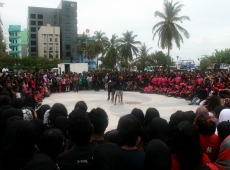
The gathering in Male’ featured live music and dance performances, and saw many young men and women in the crowds dancing together.

Despite the event’s popularity with youth in Male’, Chair of Hope for Women, Aneesa Ahmed, said the poor turnout from government officials “showed their lack of commitment” in tackling the issue of violence against women.

“We have been working alongside the Ministry of Gender, Family and Human Rights, and they have invited all government agencies and ministries, but I have hardly seen any of them here,” she said.

“I really don’t know what to say – the commitment is just not there. In the last few years nothing has really been done to help this particular cause,” Aneesa said.

Speaking to Minivan News, President’s Office Media Secretary Masood Imad said that the government was a broad entity consisting of many ministries and that he had not been aware of any specific invite to members of the government.

“As I understand, Acting Minister of Gender, Family and Human Rights] Dr Mariyam Shakeela attended. Some other ladies from the the government were there,” he said.

Masood said a member of staff from the President’s Office had also attended the event, as he had “skipped a meeting he was supposed to attend”.

Last month a study by Human Rights Commission of the Maldives (HRCM) found that support for women’s equality in the country had experienced a “significant drop”.

The report found that fewer respondents – compared to the 2005 survey – believed that women should have equal rights to men.

Aneesa said that the event was aimed towards the younger generation in the Maldives as they do not possess the “prejudices” elderly people have in regard to equality.

“I am particularly happy because there were so many young people here, it is very encouraging. These people will stand up against violence, they are going to be a very strong force.

“In the past few years we have this increasing influence of conservatism in the country and because of this the older generation are more cautious about coming to such an event. Things like dancing, as you see today, we are not supposed to do this,” Aneesa added.

Speaking at the event, Heat Health and Fitness Managing Director Aishath Afra Mohamed spoke about her concerns regarding violence against women in the Maldives.

“Some men are trying to keep their wives in the house, they don’t want women to work and socialise with their friends. They are very possessive.

“The rate of violence is going up and women are keeping quiet about it here. But this event is good to see, the more we make light of the matter, the better it will be,” Afra added.

Likes(0)Dislikes(0)

Nasheed gives India a second chance to correct diplomacy: Firstpost

Having played a stupendously bad hand in the diplomatic game with Maldives a year ago, when former President Mohamed Nasheed was ousted in a coup, India has been given a rare second chance to get its priorities right in the Indian Ocean island, writes Venky Vembu for India’s Firstpost publication.

On Wednesday, Nasheed sauntered into the Indian High Commission in Male and sought refuge there from imminent detention by the police. An arrest warrant had been issued in his name for failing to appear before a local court in connection with events that preceded the coup that displaced him in 2012.

India has done right by giving Nasheed shelter, even at the risk of incurring the wrath of the government of President Mohammed Waheed, which is now preparing to use “non-lethal chemical agents” to disperse Nasheed’s supporters outside the Indian High Commission. Police are gathered in force outside the Indian High Commission, waiting to nab Nasheed, should he step out.

The situation is very volatile, and although the court appears to have rescinded the requirement for Nasheed to appear before it, it seems clear that the government is hell-bent on ensuring that Nasheed, who retains immense mass popularity even a year after his ouster, does not get to contest the upcoming presidential election, scheduled for 7 September.

On Wednesday, a statement issued by India’s external affairs ministry also signaled its support for Nasheed’s candidacy in the election, and urged the Maldivian government not to disqualify candidates – as that would impinge on perceptions of how free and fair the elections are. The Maldivian government has responded petulantly, urging India to respect Maldives’ judiciary and not interfere in internal political matters. The gloves, it appears, are coming off.

All these expressions of Indian solidarity with Nasheed come as a sharp contrast to the events of a year ago, when India ended up backing the wrong horse. It gave tacit backing to Mohammed Waheed, the coup leader, who replaced Nasheed, the island’s first democratically elected leader.

Read more

Likes(0)Dislikes(0)

Irritant and dye to be used in water cannons against violent protestors

A new method to break up violent protests involving the use of an irritant in water cannons is to be implemented by police this year, local media reported.

During a meeting to provide information on the peaceful assembly bill, Chief Inspector of Police Ahmed Shameem told local media that police will add “dye” and “irritant” to water in order to break up protests.

The irritant will be used in water sprayed at protesters, and will cause itching of the skin that can only be relieved when the affected area is washed.

“It will force protesters to temporarily leave the area. The skin will continue to itch until it is washed,” Shameem was quoted as telling Sun Online.

Shameem added that the dye will be used in order to identify protesters who escape the scene after causing damage to property during protests.

The colour will apparently remain on the body for two to three days.

Shameem said that the new substances are not harmful or dangerous and that similar methods are employed by developed countries to break up protests.

Likes(0)Dislikes(0)

MVR 11.7 million awarded to nine political parties from state budget

MVR 11.7 million (US$762,215) has been awarded to nine political parties from the state budget according to local media.

Secretary General of Elections Commission (EC) told local media that the Maldivian Democratic Party (MDP) had been awarded MVR 3.6 million (US$ 234,527) alone – the most money given to a political party this year.

Out of the 16 political parties registered at the EC, the nine that were awarded money include: MDP Dhivehi Rayyithunge Party (DRP), Adhaalath Party (AP), Maldives National Congress (MNC), Jumhooree Party (JP), Dhivehi Qaumee Party (DQP), Progressive Party of Maldives (PPM) and Maldives Development Association (MDA).

PPM received a total of MVR 1.98 million (US$128,990), DRP were awarded MVR 1.9 (US$123,778) million and JP received MVR 1.2 million (US$78,175).

Islamic Democratic Party, Maldives Social Democratic Party, Social Liberal Party, People’s Party, People’s Alliance, Maldivian Labour Party and Maldives Reform Movement, received no funding from the EC.

President of the EC, Fuad Thaufeeq, told local media that some parties were not awarded the money this year due to the commission being unable to contact them through the details the party had provided.

Parties were also not awarded money due to lacking the minimum number of members required by political party regulation.

The EC will disburse money to the political parties if the courts issue an order to do so, local media reported.

Likes(0)Dislikes(0)