World champions and Maldivian locals shred ‘sultans’ during Four Seasons surfing competition

Famed big wave surfer Taylor Knox dominated the Four Seasons Surfing Champions competition, winning the twin-fin, thruster and Grand Champions Final events, while six-time Maldives national champion Hussain ‘Iboo’ Areef clinched the Domestic Champions competition for the second year.

This is the third consecutive year the Four Seasons Resort at Kuda Huraa and luxury surfing pioneers Tropicsurf have hosted the contest for the ex-world champions. It is the second year Maldivian talent has competed in this prestigious event.

Six ex-world champions – Tom Carroll, Layne Beachley, Damien Hardman, Tom Curren, Taylor Knox, and Pedro Henrique – “represented the toughest field ever assembled” at the Four Seasons competition, according to the event organisers.

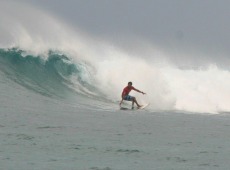
They competed in single-fin, twin-fin, thruster (three-fins) events that kicked off last Tuesday (August 27) at Thamburudhoo Island – home to two of the Maldives’ “premier” surf breaks ‘sultans’ and ‘honkeys’.

The two surfers who accrued the most points following the three divisional rounds qualifyied for the Grand Champions Final. Divisional and Grand Champion winners split a prize pool of US$25,000.

The evolution of the surfboard was showcased by the competition’s format, with the old school 1970s single-fin in round one, and round two celebrating the twin-fin boards that dominated during the early 1980s, while round three featured the state-of-the-art contemporary three-fin thrusters.

Knox, who retired as one of the most respected surfers on the Association of Surfing Professionals (ASP) world tour last year – aged 41 – said he achieved today what he had failed to do at the elite level.

“I could never do it on the world tour, I had to come to the Maldives and learn off these guys, and as Kelly Slater said ‘I’m one of the best surfers but not a good competitor’, but that’s changing now,” said Knox.

Single-fin division

Former three-time ASP world champion, American Tom Curren defeated former world junior champion Brazilian Pedro Henrique to win the single fin division of the Surfing Champions Trophy the first day of competition.
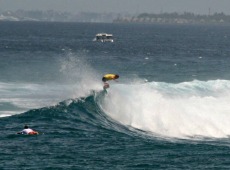
The surfing legends had to contend with high winds and sporadic rain throughout the day at ‘sultans’ which forced the organisers to stop and start the event several times throughout the day.

“Today was difficult because the wind comes around and creates rips [on the waves],” Curren told Minivan News.

“I’ve surfed in the Maldives three times before. When conditions are good, these are some of the best waves in the world,” said Curren. “The water is beautiful, the water temperature is warm, the reefs are well shaped and swells come from far [out to sea] when its less windy.”

“It’s rarely heavy, but a lot of fun,” Curren continued. “It brings a lot of people here. The Maldives is quite a destination for intermediary surfing.”

Despite the difficult conditions Pedro Henrique was able to make the most of the four foot waves, beating defending event champion Australian Damien Hardman in the semi-final and taking second in the final.

“This was the first time I’ve surfed a single fin,” Pedro Henrique told Minivan News. “It required heavy use of the surfboard’s rail and different body balance.”

Twin-fin division

The surfing pros faced another day of difficult weather conditions and “testing but fun” three foot waves during the twin-fin division held Saturday (August 31) at ‘sultans’.

Lone female competitor Australian Layne Beachley – the only woman to win seven ASP world champion titles, and arguably the greatest female surfer in history – was literally blown off her first wave due to strong offshore winds, causing her to ultimately suffer an opening round loss.

“They were really challenging conditions out there,” said Beachley. “Never underestimate the competitive spirit of these guys, they don’t want to lose, especially to a girl. It doesn’t matter how many world titles you have,” she added.

Competition was fierce with successful twin-fin performances requiring speed and maneuverability.

Ultimately, it was big wave surfing legend Taylor Knox defeated Tom Curren to claim the divisional win.

“That was an emotional contest for me because I was surfing with all my hero’s,” said Knox. “It was just really cool today, everyone I came up against was just surfing so well.”

Thruster division and Grand Champions final

After a week of surfing in stormy conditions, light offshore winds, sunny skies and steady four to five foot surf made for a fierce final day of competition yesterday (September 1).

Beachley narrowly missed out on the semi-finals after being defeated by former two-time world champion, Australian Damien Hardman on the buzzer during the thruster division round one heat.

Ultimately Knox’s “extremely committed power surfing” in which he scored the tournament’s first-ever perfect 10-point ride and tallied the event’s highest heat score enabled him to to defeat Hardman in the thruster division final.

Hardman noted that Knox’s performance raised the bar of the entire contest.

Following the thruster division, the Grand Champions Final pitted Knox against Curren and culminated in a showdown during the final 30 seconds of the competition, when Knox scored a late 9.17 to claim victory.

Domestic Champions competition

The Domestic Champions contest kicked off last Monday (August 26) with 14 local surfers facing off on conventional thruster boards, vying for glory and the MVR35,000  (US $2275.7) prize money pool.

The competitors’ excited energy escalated during the short 45 minute trip to Thamburudhoo – the last untouched island in Kaafu Atoll with public surf break access – known for its left and right hand breaks.

While en route to ‘sultans’, local surfers from Himmafushi and Thulusdhoo islands in Kaafu Atoll appeared on ferries they had arranged to transport them from their home islands to compete.

Although conditions at ‘sultans’ were not ideal – choppy seas, rain, wind, and three to four foot “fat lady” waves – the weather and surf improved by early afternoon.

After six fierce but friendly 20 minute heats, four surfers advanced from the semi-final round to compete in the final, last year’s Domestic Champions winner and six time Maldives’ national champion Hussain ‘Iboo’ Areef, Ahmed ‘AJ’ Aznil, Ahmed ‘Ammadey’ Agil, and
Ahmed ‘Madey’ Rasheed.

“This is a great opportunity for the Maldives’ best surfers to showcase their talent alongside world legends at our ‘home break’ of Thamburudhoo – the heritage and heart of Maldivian surfing,” said Maldives Surfing Association (MSA) President Ahmed Fauzan ‘Karo’ Abbas.

Following the competition heats, Tropicsurf Founder and CEO Ross Phillips conducted a coaching session for the Maldivian surfers. They were enraptured as Phillips leveraged his 24 years of professional coaching experience to delineate the five fundamental principles of surfing: 1) weight distribution, 2) center of gravity, 3) how the surf board is used (e.g. rail transitions), 4) body rotation, and 5) extension (for speed).

“I’m very happy and willing to offer coaching [tips] and give the Maldivian surfers my time,” Phillips told Minivan News.

During the coaching session, Phillips explained that professional surfers “make it look easy, like they’re not trying” and develop their own personal style, which is “all about body movement and flow”.

“The average surfer has a lot of body movement and minimal board movement. But for the board to maximum ‘radical’ movement, body movement should be minimal,” he continued.

Phillips also explained some of the science behind surf board shaping as well as providing contest strategy tips before everyone – including Phillips – took to the water for the last surf of the day.

“We didn’t know the five principles, we tried it [after the coaching session] and it helped a lot,” exclaimed Maldivian competitor Azly ‘Dude’ Nazeem.

“It was a good experience to participate, we’ve never had a coach before. No one taught me [to surf], I’ve never had a coach in my life,” added semi-finalist, 21 year-old Hussain ‘Kuda SP’ Rasheed.

The Maldivian surfers who attended the coaching session were elated on the trip back to Male’, having experienced noticeable improvements after applying what they learned during the brief coaching session with Phillips.

Domestic Champions final

Maldivian finalists Hussain ‘Iboo’ Areef and Ahmed ‘AJ’ Aznil from Male’, as well as Ahmed ‘Ammadey’ Agil from Thulusdhoo Island in Kaafu Atoll faced off in the late afternoon after spending the day chatting with the pros aboard the Four Seasons’ luxury catamaran.

Ahmed ‘Madey’ Rasheed was unable to return from his home island in Gaaf Dhaal Atoll to compete.

Areef dominated the competition for the second year running, scoring a 10 during the trials and taking an early lead during the final. He ultimately won the competition, with Agil placing second.

“It feels great to win. I applied the contest strategies [Phillips discussed during his coaching session] and surfed smart,” 36 year-old Areef told Minivan News.

“I made sure to have an early start and caught a wave right after the buzzer. That was really good because it gave me lots of confidence and set the bar for the judges,” Areef explained. “After that I waited for good waves with scoring potential.”

His message for the young generation of Maldivian surfers is to “surf a lot, get advice from experienced people, watch surf movies, and always push the limits.”

“This competition was really good from a local point of view, it was an awesome opportunity,” third runner-up Aznil told Minivan News.

“It was great to have a chance to hang out and talk to the champions,” he continued.

Aznil, also a finalist in last year’s event, noted that the bigger, cleaner waves made for a great last day of competition.

Although this was the second year the Four Seasons hosted a Domestic Champions competition for Maldivian surfers, this was the first time the Maldives Surfing Association (MSA) – the country’s surfing governing body – was involved.

While there were some hiccups, ultimately representatives from the Four Seasons and Tropicsurf sat down with some of MSA’s leaders – who were also competition finalists – after the event to discuss how they can better involve MSA and the local surfing community in next year’s competition.

“This year was the first time communication was established between MSA and the contest organisers,” Areef explained. “We had a long meeting with these guys and they are going to better involve our members in the event next year.”

“We were not asking for much – we don’t care about money – just fair involvement for the development of our local surf community. To be given an opportunity for local judges to improve their skills, to be involved in event organising, and to gain experience from the whole event,” he continued.

“Next year will be a bigger event with better local involvement, including shadow judging, beach marshalls, and we’re hoping locals will be given wildcards to compete in the main event,” he noted.

“It was great to sit down to talk and work it out,” added Aznil.

Likes(1)Dislikes(0)

Translation: Leaked ‘coup agreement’

The following translation is of a document apparently signed and stamped by then opposition political parties on December 29, 2011, outlining a planned overthrow of the Nasheed government on February 24, 2012. Nasheed resigned amid a police-led mutiny on February 7, 2012.  Parties involved have rejected the document’s authenticity – read the full story here.

Download the original document in Dhivehi

1. Introduction

As the current President of the Maldives, Mohamed Nasheed of G. Keneryge, has disrespected Islam as well as the country’s laws and regulations, declared blatantly anti-Islamic sentiments, obstructed the enforcement of Islamic hadd [punishments] in the Maldives, carried out laadheenee (irreligious or secular) actions, illegally arrested politicians, committed many acts that undermine the dignity of the country’s courts, and since the fraternal political groups have determined that he is unfit to remain as President of the Maldives, this agreement is made among the fraternal political groups to remove him completely from Maldivian politics and do what is required to completely erase the Christian-influenced Maldivian Democratic Party (MDP) from the Maldivian political arena.

2. The fraternal political groups

  1. Progressive Party of Maldives (PPM)
  2. Civil Alliance
  3. Adhaalath Party
  4. Jumhooree Party
  5. Dhivehi Qaumee Party
  6. Dhivehi Rayyithunge Party (DQP)
  7. People’s Alliance

3. Plan for the 24 February 2012 Symposium

3.1 Purpose of the symposium

The purpose of the symposium on 24 February 2012 is to make it a day of civil obedience across the Maldives with the aim of toppling the MDP government and establishing a national unity government formed among the fraternal political groups. And to overthrow the government within 24 hours of the beginning of the symposium.

As the fraternal political groups believe that it is important to carry this out in a way that would avoid foreign influence in Maldivian political affairs brought about because of the manner of changing the government, it has been agreed that this can be conducted most smoothly with the assistance of Vice President Dr Mohamed Waheed Hassan Manik. Therefore, the first order of business has to be worsening the relationship between MDP and the vice president, seeking the approval of senior figures of the vice president’s Gaumee Ihthihaad Party and his close associates and bringing them into this.

The assurance needed from the vice president is that he will immediately assume the office of the presidency if Nasheed leaves the post under any circumstances, form a national unity government on the advice of the fraternal political groups, endure everything faced during this process, conduct the affairs of the nation until the presidential election in 2013, pave the way for the 2013 election, and not contest in the election in 2013.

The assurance that the fraternal political groups will give to the vice president will be to provide any and all assistance that he may require in this. And provide the assurance that he will remain in power until 11 November 2013.

3.2 How the government will be changed

At 4 o’clock in the afternoon of Friday, 24 February 2012, a mass protest in the form of symposium will begin in all inhabited islands of the country. The protest will begin in Male’ at the tsunami memorial area. After the protest begins, a demand from the participants will be proposed to the government. The only demand of this protest will be for President Mohamed Nasheed of G. Keneryge to resign without any conditions as he has insulted Islam and violated the laws of the country.

3.3.1 Going to Republic Square

The government will give a deaf ear to the demand for resignation. Therefore, after offering a five-hour period to comply with the demand, at 9 o’clock at night the participants of the protest will head towards the Republic Square divided into three groups. It has been agreed that protests will take place in all inhabited islands at this time.

The first group with Adhaalath Party President Sheikh Imran Abdulla will go past Kalhuthuhkala Koshi [military barracks near southwest harbour] on Boduthakurufaanu Magu and stop near MMA west of the Republic Square.

[Text missing]

The third group with PPM interim deputy leader, Umar Naseer, will leave the tsunami memorial area in vehicles, go down Majeedhee Magu, turn near mercury to Orchid Magu and stop near Reefside at the intersection of Republic Square and Chandanee Magu.

Help will be received from former police and army officers to overcome obstacles posed by police and the army to the protesters reaching these areas. PPM interim deputy leader, Umar Naseer, will coordinate this.

3.3.2 Showing stringency

After all the participants of the protest gather at the areas surrounding the Republic Square, Adhaalath Party President Sheikh Imran Abdulla will address the police from the group near the MMA [building]. The Sheikh’s speech will mostly focus on Mohamed Nasheed’s laadheenee [irreligious or secular] ideology and convincing police and the army that obeying the commands of such a person with a laadheenee ideology is completely haram [forbidden] in Islam. The Sheikh along with different scholars will speak on this subject for 45 minutes.

After that, Abdulla Mohamed, representing the civil groups, and other civil society persons will give speeches.  Their speeches will mostly focus on stability in the Maldives, establishing justice and the economy under Nasheed’s rule. They will speak on this topic for 45 minutes.

After the speeches by the civil society persons, the first person to talk from among the politicians in the group gathered in front of Reefside will be PPM interim deputy leader Umar Naseer. Umar Naseer will begin his speech by calling on those in the front ranks of the government to join the protesters as President Mohamed Nasheed has not resigned by the time the period offered to him had elapsed. An opportunity will be offered to those in the front ranks of the police and army to either resign or step aside from their posts. The speeches will be interrupted for 30 minutes to provide an opportunity for these officers to do so.

It is not expected that cooperation will be forthcoming within 30 minutes from those working in the senior ranks of the police. However, a brigadier general and a lieutenant colonel from the military has agreed to vacate their posts and refuse to carry out their responsibilities. This will be first announced via DhiTV. And a live interview with the resigned brigadier general will be brought on DhiTV. After this news, Umar Naseer’s speech will resume to raise the spirit of the protesters and divide the ranks of the police and the army. And he will call for the protesters to step forward and for the police and army to step back. The protesters will clash with police and attempt to enter the Republic Square by force.

3.3.3 Receiving the assistance of police

While the protesters face the police and army with severity, the special platoon of police on duty in front of MMA will abandon their command, enter the Republic Square and sit down in protest. At this time, some protesters will get an opportunity to enter the Republic Square. However, it is believed that an MNDF [Maldives National Defence Force] backup will cordon off the area.

Complete assurance has been received from friendly police that this police platoon will be arranged to be on duty in front of MMA. The PPM deputy leader has met the officers of this platoon individually and briefed them on what they have to do. Their demands have now been taken care of.

Defence Minister Tholhath Ibrahim Kaleyfan will announce on MNBC One that the striking or protesting police have disobeyed orders and that they will be arrested and taken inside Bandaara Koshi [main military headquarters in front of Republic Square]. A retired former colonel will communicate with the defence minister concerning this and provide assistance to him. PA parliamentary group leader, Ahmed Nazim, will monitor this.

3.3.4 Friendly police and friendly military playing their role

Following the arrest of the protesting police, a senior team of friendly police will begin working on their behalf. They will claim that the military cannot arrest police and request discussions between a senior police team and the defence ministry.  This team will comprise of 9 senior police officers and former police officers. When the defence ministry says that there is no room for negotiation regarding this, the team will command all police to abandon their command and gather at the Republic Square helipad.

[Text missing]

Police will be informed under the guidance of Umar Naseer. And all police will be informed via SMS. This will incite hatred of the police towards the military and the coordination established between police and the military will be lost. And at this time, protesters gathered near the Shaheed Hussain Adam building [police headquarters] will get the opportunity to break the barricade and enter the Republic Square. However, it is believed that the military will strongly look after the MMA and Reefside area.

3.3.5 Media and communication

The media will play the most important role at this juncture. DhiTV, DhiFM and VTV will claim that the police and the military are preparing for a major confrontation. And former senior police officers will call in the media for all police to go to the Republic Square in defence of their brothers.

Phones will be used as the primary mode of communication to carry this out. Friendly police will ensure by this time that communication-jamming facilities will be damaged beyond use. If phone calls and SMS are jammed due to any reason, messages that must be sent to police and the army will be delivered directly from DhiTV and DhiFM. Under such circumstances, these two media will become the primary communication and the communication coordination team will shift to the DhiTV studio.

3.3.6 Assistance from the military

As preparations would be underway for a major confrontation between police and the military, and because of the large number of police gathered at the Republic Square, the numbers of the military in Male’ at the time being small compared to the police, the police being in possession of non-lethal weapons, the most important power of the military being lethal weapons, and the fear of serious bloodshed in the country if the military uses lethal weapons against police, and after informing senior military officers of the superiority of police over the military, all of the military troops will be called on, with the assistance of the defence minister, to lay down their arms and join the protest.

It is believed that under the circumstances, with the situation brought to this [state], the military will have no other option and will accept the proposal. If they do not accept, the defence minister will do it forcefully.

3.3.7 Arresting Mohamed Nasheed

Following cooperation from the police and military, as it is the responsibility of the SPG [Special Protection Group] military officers to protect the president at such a time, Mohamed Nasheed will be taken out of Male’ by them under the pretence of protection. Mohamed Nasheed will be kept at Aarah [presidential retreat island] under military custody.

3.3.8 Supreme Court ruling that Mohamed Nasheed’s presidency is illegitimate

As the country’s order and stability would be lost with matters at this state, with the police and military clashing and the military not obeying Mohamed Nasheed’s command, a case will be filed at the Supreme Court requesting a ruling declaring that Nasheed has been found incapable of performing the duties of the President as there could be serious discord, unrest and bloodshed in the country if he remained in the post. Assurances have been received that the Supreme Court will issue such a ruling or court order to that effect when the case is filed.

The Supreme Court will sentence Nasheed to jail and bar him from politics for life because of the illegal activities committed while he was president, the allegations of efforts to wipe out Islam from the Maldives, and for the crime of illegally detaining politicians.

Filing the case at the Supreme Court and discussions concerning this matter will be carried out under the supervision of Qaumee Party President Dr Hassan Saeed. Dr Hassan Saeed and Ahmed Nazim from the People’s Alliance will carry out lobbying efforts to secure the support of a majority from the Supreme Court bench. Assurances have been given by PPM that Azima Shukoor will work to secure the assistance of the Chief Justice.

3.3.9 Vice President Dr Mohamed Waheed Hassan Manik taking the oath of office

Following the judgment of the Supreme Court passed upon Mohamed Nasheed, Vice President Dr Mohamed Waheed Hassan Manik will take the oath of office and become the president. After the swearing-in, Dr Mohamed Waheed will immediately dissolve the cabinet.

After the president dissolves the cabinet, the fraternal political groups together with the president will carry out forming a new cabinet and appointing ministers. The newly formed cabinet will comprise of 10 ministries. As the defence ministry and home ministry are important for national security, ministers will first be appointed for these two ministries. The two ministers that shall be appointed are,

  1. Defence Ministry. Appointing current Defence Minister Tholhath Ibrahim Kaleyfan to the post.
  2. Home Ministry. Appointing PPM interim deputy leader, Umar Naseer, on behalf of the party, as the Home Minister.

In addition, ministers will be appointed to the rest of the ministries on an equal basis among the fraternal political groups. And a vice president will be appointed as agreed upon by the fraternal political groups.

The following persons shall be appointed as the senior officers of the police and military,

  1. Retired Colonel Mohamed Nazim will be appointed to the post of Chief of Defence Force.
  2. Retired Assistant Commissioner of Police Abdulla Riyaz will be appointed to the post of Commissioner of Police.

4. Dissolving MDP’s political activities

As the fraternal political groups have agreed that exerting influence upon the current leadership of the MDP and taking over control of the MDP is of utmost importance, it has been agreed to do the following to dissolve the current MDP leadership,

4.1 MDP President Dr Ibrahim Didi

As Dr Ibrahim Didi is politically weak and not a political person despite being someone paving the way to advance politically, it has been noted that controlling MDP through Dr Didi will be easy. To this end, it has been decided to secure MDP’s presidential ticket for Dr Didi.

With the likelihood of MDP splitting being high as a result of the difficulties Dr Didi will face under his leadership from Mohamed Nasheed’s friends, Jumhooree Party Leader Gasim Ibrahim will provide assistance to Dr Didi at such a time.

[Text missing]

As Alhan Fahmy has been noted as someone with the capability of rallying and uniting MDP supporters in the absence of Mohamed Nasheed, it has been agreed that removing Alhan Fahmy from the MDP leadership is essential. It has also been noted that Alhan Fahmy does not have the opportunity of contesting in the 2013 election or becoming a vice presidential candidate.

It has been agreed that efforts to remove Alhan Fahmy from the MDP leadership will be carried out under the supervision of PA parliamentary group leader, Ahmed Nazim.

4.3 MDP interim chairperson Reeko Moosa Manik

It has been agreed that keeping MDP interim chairperson Reeko Moosa Manik in his post would be fine. It has been noted that there is room to forcefully do things through him by using the corruption cases involving his Heavy Load company and intimidating him through his business dealings.

As Moosa Manik is seen as someone who would contest for the MDP’s 2013 presidential ticket, he has been noted as a leader who has the approval of MDP’s common members. Therefore, it has been noted that Moosa Manik could be used in the efforts to divide MDP and create antagonism towards Dr Didi within the MDP. It has also been agreed that a group could be formed under Moosa Manik to protest against the new government and create unrest. It has been discussed that the end of MDP could be brought about through these protests.

4.4 MDP National Council

As Mohamed Nasheed directly controls the MDP’s National Council, it has been agreed that controlling the council and bribing members would be important. And it has been agreed to hold a meeting in the coming month of January to formulate a long-term plan to that end.

5. Securing finance

It has been calculated and agreed that a total of 43 (forty-three) million rufiyaa will have to be spent to complete the matters stated in this agreement and to fulfil the demands of the persons who will provide assistance. The funding will be secured through the political parties involved in this agreement and supportive businessmen. PA parliamentary group leader Ahmed Nazim will be tasked with collecting the funds and spending it in accordance with the agreement. And 20% (8.4 million rufiyaa) has been handed over to Nazim by the Jumhooree Party on 26 December 2011.

6. Maintaining secrecy

This agreement, the content of the agreement and any affairs conducted in connection with this agreement shall not be shared or revealed to anyone other than those who sign the agreement. As this is an agreement that is of utmost importance made in defence of Islam and the Maldives, it should be considered that safeguarding this agreement and the information contained therein is done in defence of Islam and the Maldives, and we agree to not share any of this with any other person.

7. Resolution

On this day, 29 December 2011, I agree with a sound mind and following extensive discussion to completely carry out the aforementioned matters, as they are necessary for the defence of Islam and the nation, with the involvement of everyone party to this agreement.

Download the original document in Dhivehi

Likes(1)Dislikes(0)

Indian election observers arrive in Maldives

Indian election observers have arrived in the Maldives ahead of the 2013 Presidential Elections.

According to a statement from the Indian High Commission, the team includes former Chief Election Commissioners of India, JM Lyngdoh, B B Tandon, N Gopalaswami, and former High Commissioner of India to the Maldives, S M Gavai.

“The team is visiting Maldives on the invitation of the Elections Commission of Maldives and will undertake visits to a number of polling stations in different islands,” read the statement.

Current High Commissioner of India to the Maldives Rajeev Shahare hosted a reception for the delegation attended by President of the Maldivian Elections Commission, Fuwad Thowfeek, and members of the Elections Commission of Maldives as well as international community including the UN Resident Coordinator Tony Lisle and Head of the International Foundation for Electoral Systems, Dan Malinovich.

“In the interactions with political leaders in the Maldives, the Government of India has emphasised the importance of conducting free, fair and credible elections in a peaceful environment followed by a smooth transition,” stated the Indian High Commission.

“India is committed to strengthening the institutions of democracy in the Maldives. In this context, the Election Commission of India is working closely with the Elections Commission of Maldives to further strengthen its capacity. India is also arranging for the training of Maldivian judges in India and is working closely with the Majlis.

“India attaches the highest importance to its relations with Maldives, a close and friendly neighbour, and desires to see a peaceful, stable and prosperous Maldives,” the statement added.

Likes(0)Dislikes(0)

Supreme Court annuls 10,000 member minimum for political parties

The Supreme Court has annulled the 10,000 member minimum for political parties, stipulated in the recently-passed Political Parties Act.

Local media reported with the Supreme Court’s ruling, the minimum membership will fall to 3000 members as per previous legislation.

Following ratification of the 10,000 member limit, 11 smaller political parties were effectively dissolved, including the Gaumee Ithhiaad Party (GIP) of President Mohamed Waheed. He is contesting the upcoming election as an independent candidate.

Likes(0)Dislikes(0)

Australian surfers followed, photographed, questioned for hours by Maldives police

The Maldives Police Service (MPS) has confirmed that it held three Australian surfers in Male’ for five hours of questioning yesterday (August 31), before releasing them without charge.

The surf tourists, who arrived in the Maldives on August 30, were wearing ‘Save Thamburudhoo’ t-shirts, in support of a locally-led awareness campaign against the privatisation of a local surf break .

“The three Australian men were not in police custody, they were being questioned in regard to an ongoing investigation,” Police Spokesperson Chief Inspector Hassan Haneef told Minivan News today (September 1).

“They were released without charge right after being questioned,” he added.

Haneef was unable to state why the Australian surfers who had been in the Maldives for around 24 hours would be involved in a prior investigation, or why they were being followed and photographed, explaining that the investigation was ongoing.

Asked why questioning the Australians took five hours, Haneef said he would need to clarify the details of the investigative process with the MPS Criminal Investigation Department.

Multiple sources in the surfing community with knowledge of the incident told Minivan News the Australians were questioned because government authorities thought they were involved in a political protest against the current government, due to their ‘Save Thamburudhoo’ t-shirts.

Maldivian law prohibits foreign nationals from participating in political protests.

“The Australians have been followed and photographed [by police] since they got to Male’,” a source speaking on condition of anonymity told Minivan News.

“The police kept the Australians in custody for seven hours and checked their camera memory cards,” said another person familiar with the matter. “But they were not involved in any political protests.”

The ‘Save Thamburudhoo’ campaign aims to raise awareness and end surf break exclusivity in the Maldives, particularly the practice of resort islands shooing visiting local and foreign surfers off ‘their’ breaks. The campaign has been led by local surfers in partnership with the Maldives Surfing Association (MSA) and the Liveaboard Association of the Maldives (LAM), and has been widely covered in international surf media.

Thamburudhoo has become the campaign’s focal point, as it is the only uninhabited, untouched island near Male’ with a publicly accessible surf break . However, the island is currently owned by a Maldives National Defence Force (MNDF) co-operative company that is seeking bids to develop a resort on the island, which would limit access to the Thamburudhoo’s left and right-hand breaks, known locally as ‘sultans’ and ‘honkeys’.

The proposal was first submitted in 2011 under the Maldivian Democratic Party (MDP) government, but appeared to have stalled until it was revived under the new government in early 2012.

Under the July 2011 proposal, submitted by senior Maldives National Defence Force (MNDF) figures and Telos Investment, Telos would receive a 50 year lease on the military training island to develop a “boutique surf resort”, in exchange for US$5 million to develop an MNDF training facility on nearby Girifishi.

According to the proposal, the 3.6 hectare island “does not have the normal beauty found in Maldivian resorts”, as it does not have natural lagoon or sandy beaches. Furthermore, the strong currents limit recreational swimming, and therefore “the only development for Thanburudhoo which is sensible is that of a boutique surf resort.”

The surf resort would “open its doors to Maldivian surfers for a special surfing session twice per month,” the 2011 proposal notes.

“Unlike other resorts which do not allow local Maldivians to surf, Thanburudhoo would make available two surfing sessions per month, most likely Friday mornings or Saturday afternoons. The Maldivian surfers coming to Thanburudhoo for the special local surfing session must be in good standing with the Maldivian Surf Association and must abide by all the rules and regulations of Thanburudhoo surfing activities,” the proposal stated.

A ‘Save Thamburudhoo Expression Rally’ organised by MSA and LAM was planned to be held yesterday (August 31) but has since been delayed.

The rally would have involved over 24 vessels cruising between Male’s surf point ‘raalhugandu’ and Thamburudhoo’s surf breaks, as well as a petition to end surf break exclusivity.

Likes(2)Dislikes(0)

Former President Nasheed performs live techno-rap debut at campaign concert

Former president Mohamed Nasheed performed live at a Maldivian Democratic Party (MDP) music concert on Thursday (August 31) as certain supporters donned t-shirts proclaiming their presidential candidate an ‘Eco rock star’ ahead of his techno-pop-rap debut.

The ‘Emmen Ehburun’ (‘Everyone one round’) music show (August 29) showcased some of the Maldives’ most popular artists and a variety of musical styles in an effort to galvanise voters to participate in the September 7 presidential election.

The lively campaign event was hosted by MDP MPs Eva Abdulla and Imthiyaz ‘Inthi’ Fahmy, and drew a crowd of nearly 4,000 people near ‘raalhugandu’, Male’s surf point, adjacent to the Tsunami Monument. A broad demographic of women, men, teenagers, small children accompanied by their families, and the elderly gathered to watch the show.

Maldivian rock band Eman’s Conspiracy fired up the audience with their unique style – some of the male band members sported women’s flower-print stretch pants and jumpers – and witty lyrics. One song joked about police breaking up protesters by tickling their stomachs, in reference to the Maldives Police Service’s violent crackdown on protesters, and former Civil Service Commission Chair Mohamed Fahmy Hassan’s dismissal in November 2012 over allegations he sexually harassed a female staff member by caressing her stomach.

After their performance the crowd around the stage rapidly multiplied and surged forward in anticipation of Nasheed’s performance. Cheers and shouts of ‘ehburun’ erupted from the audience as Nasheed took the stage with DJ Umar.

The ‘Eco rock star’ launched into an original rap spun by DJ Umar to a techno remix of Michael Jackson’s ‘Billie Jean’. Nasheed’s on-stage excitement was contagious, with onlookers energised by his political lyrics and unique techno-pop-rap musical style.

Although audio clips from some of Nasheed’s speeches have been set to techno house music and have been endlessly echoing through the Maldives since the controversial transfer of power in February 2012 – this is the first time the former president has sung live. (See below for translated lyrics and video of Nasheed’s performance).

Nasheed may have stolen the show with his techno-pop-rap musical debut, but the artists that followed kept the crowd in a fevered frenzy.

Famed boduberu (traditional singing, drumming, and dancing) group Harubee, two time winners of the Maldives Boduberu Challenge and invitees to multiple international events, riveted the crowd with renditions of classic Maldivian songs. The ladies in the crowd were particularly enthralled with lead singer Ibrahim ‘Mandey’ Mamdhooh, who forewent his drum in favour of impassioned singing and dancing.

Men and women alike were headbanging in the ‘pit’ that formed in front of the stage during Maldivian metal band Traphic Jam’s performance. Their rock performance and political protest song lyrics – “Anni (Nasheed) was there when I went to bed, when I woke up it was a baaghee (traitor)” – resonated with the youth who shouted the lyrics in time with the band.

The ‘Emmen Ehburun’ show resonated with young MDP  supporters, several of whom in the crowd described the eclectic mix of music as “habeys” (awesome) and that “Anni’s performance was epic”.

DJ Umar featuring former President Mohamed Nasheed:

“Fasten your seatbelts. We are cleared for landing. We will only rest after taking the oath of office as the President of the Maldives on November 11, 2013.

The people of the Maldives have seen, they have weighed, the people of the Maldives have decided to give this election to the Maldivian Democratic Party. We will win this election in one round. In one round. In one round. Forward, forward, forward, forward. Forward with the Maldivian nation.

Come. Come out with us, roll up your sleeves, and come out to develop this country. Our country has seen how things happened during 30 long years – our people has seen that. It was quite recently that education in the English-medium began in Maldivian schools. In our three years, we built 240 schools, in our three years we changed Maldivian schools to single session.

The people of the Maldives are yearning again for a Maldivian Democratic Party government. The people of the Maldives are yearning again for compassionate, good governance. We will come back. We will return. We will provide good governance for the people of the Maldives.

We cannot secure the change we seek without connecting the islands of this country with public transport. The people of the Maldives want development. The people want housing. We all want the same things. We want a good life – public transport, good healthcare when we’re sick, a good education for our children, we all want good governance.

We will come back. We will beat the traitors and win this election in one round. The people of the Maldives are not ready to leave this country to a coup. The people of this country want to establish a government of the people in the Maldives.

Forward, forward, forward. Come. Come out with us to develop this nation. We will not step back. Our courage will not slacken, our resolve will not be shaken. We will come back. We will offer good governance for the people of this country. The Maldivian Democratic Party will always remain with the people of the Maldives. Our prayer is always for a better way than this for our country. This country is rich in natural resources. We can develop and achieve progress. We can find a better way than this for our youth.

We want development. We want entertainment. We want housing, education for our children. We want compassion, social security. The Maldivian Democratic Party is a party that makes pledges and fulfils pledges. God willing, we will deliver on our pledges. Our country is headed towards a safe shore. Come out with us. Come out. We will secure our country. We can see the horizons of the Other Maldives. We have come out seeking this country’s development. We have always had one goal.

You would have heard the pledges of political leaders. When they go to an island first they’ll meet a fisherman. The fisherman will say, ‘Seytu [literally shopkeeper, used to refer to Gasim], my boat is on land.’ And Seytu will pledge a boat for every fisherman. In the middle of the island he will meet a teacher. The teacher will say I want a laptop and Seytu will say, ‘a laptop for every teacher.’ That is not a political pledge. Political pledges are those that can be fulfilled through a policy. The Maldivian Democratic Party manifesto is one that has been costed and budgeted. We are a party that makes pledges and fulfils pledges.

God willing, we will win this election in one round. In one round, one round, one round. Valhamdulillah. Thank you very much.”

Likes(1)Dislikes(0)

Presidential elections bring a chance to start afresh: Economist

Sipping beer and staring at the ocean, tourists on Addu atoll at the southern tip of the Maldives usually ponder weighty questions such as whether to strap on a snorkel or sunbathe on the pristine beaches. An alternative exists: a political safari on the equatorial islands that bob up from the Indian Ocean, reports The Economist.

On the island of Gan, once home to a British military base, the police station is a blackened mess of glass and twisted pipes. Drive on beyond coconut trees and moored yachts and you find the burned wreck of a courthouse. Like other smashed official buildings, it is daubed with abusive graffiti.

Rioters struck in February last year, furious at the ousting of the country’s first directly elected president, Mohamed Nasheed. He, not unreasonably, called it a coup, having resigned under threat of violence. His immediate sin was ordering the arrest of a judge close to politically powerful families.

A new democracy, born with a fresh constitution in 2008, seemed about to die. Yet the evidence from the Maldives, where politicians campaign by speedboat, is that it struggles gamely on. Those who forced Mr Nasheed’s resignation have honoured the constitution and announced they are sticking to the timetable for presidential polls on September 7th, when voters will get a second chance. Parliamentary elections follow next year.

Rocking on a garden swing among coral houses on Addu, the slim ex-president is sure he will soon be back in office. “Statistics and the smiles of the people” suggest victory, he says. His Maldivian Democratic Party (MDP) says it has identified that over half the 240,000 registered voters will back him.

Mr Nasheed’s overthrow and subsequent harassment appear to have boosted his popularity. Foreign pressure kept him out of jail. As speakers blare out his party tunes, he says: “Somehow the country rose up in yellow,” his party colour. Voters perhaps also credit him for new pensions, social housing and cheaper health care brought in while he was in office.

It helps that his core supporters, the young, predominate among the population of 350,000: the median age is just 26. Politics is fiercely and widely debated on social media, where the MDP is adept. His party, advised by Britain’s Conservatives, looks professional. Recent local elections suggest strength in a heavily urban population: in Male, the crowded capital, and Addu, the emerging second city.

Full story

Likes(1)Dislikes(0)

Comment: Election 2013 – where to, people?

This article first appeared on DhivehiSitee’s Election 2013 hub. Republished with permission.

It has been 569 days since the coup of 7 February 2012. We have walked a long way back in those five hundred odd days.

State-sponsored violence has returned with a vengeance, along with arbitrary arrests and detentions. Precious civil liberties – freedom of expression and freedom of assembly among others, have been scaled back to alarming levels. Basic human rights—freedom from arbitrary arrests, detention, torture and other state-sponsored violence – have been taken away.

Xenophobic nationalism coupled with radical religious ideologies has damaged not just our relations with each other but our relations with the rest of the globalised and inter-connected world of today. From a respected actor punching far above our weight in international relations, we have become a nation viewed as a ‘terrorist hotbed’ dominated by radical Islamist thought with little respect for universal human rights.

Foreign investors have been scared away, international financial agreements reneged on and international treaties cut up and thrown out. Corrupt oligarchs and self-interested government officials have negotiated our sovereignty to appease the national interest of big powers while petty crooks posing as cabinet ministers have sold or rented out our precious natural resources to international gangsters and unethical international business partners for hefty sums that line only their own pockets.

We as a people, once united by a shared belief in our own moderate Muslim identity, are now more divided than ever before, torn apart by the political abuse of religion as a form of absolute control over our hearts, minds and lives. Facts have been sacrificed in the construction of a particular truth, reality itself has become what the rulers tell us what it should be. It seems like we have lived five hundred years in the last five hundred days, all roads leading back to the past, further and further away from the world at present and what it looks set to become in the days to come.

It can all change in the next week. On 7 September 2012 we will decide whether to stay on this road to the past, or return to the present and back to the future. On the other side of this inter-connected world, in the Middle East especially, we have watched the ‘Arab Spring’ unfold. We were ahead of other countries in the ‘Islamic world’ in making a peaceful democratic transition. And we were ahead of others, like Egypt, in having the heady joy of a revolution killed by an authoritarian reversal that took the form of a coup.

Analysts have identified an emerging trend among such countries of an ‘authoritarian push-back‘. Judging from the number of people who have failed to see the events of 7 February 2012 in the Maldives as a coup, both home and abroad, we may well fall within this new trend. Or, we can prove the analysts wrong like we did those who believed peaceful democratic transition is impossible in an Islamic country. We can say no to the authoritarian push-back, preempt the forecasted trend before it can even begin. The choice is ours to make on 7 September.

Let us make it an informed one.

Candidate 1: Gasim Ibrahim

Gasim Ibrahim (61) [or Qasim Ibrahim after re-branding for the campaign] is the candidate for Jumhooree Party. Gasim’s main ally isthe Adhaalath Party, the most politically active ‘Islamic organisation’ in the country.

Candidate Gasim’s defining characteristic, as put forward by him and his campaign team, is that he is the richest man in the country. Gasim is the owner of Villa Group, the largest company in the Maldives with 6000 employees. According to Gasim’s Wikipedia page, although ‘his net worth has not been made public’, it is ‘believed to be in access of 500 million dollars’. Gasim’s properties include several luxury tourist resorts, uninhabited islands, and shipping, fisheries, fuel, construction and manufacturing as well as import/export companies. Gasim also runs Villa High School and Villa College, which, although money-making businesses, he also aggressively promotes as evidence of his philanthropy along with a large number of study loans he has provided for many Maldivian students to study abroad.

Gasim’s chief selling point is his ‘rags to riches’ biographical narrative. Born to a blind father on the island of Dhiddhoo in the neighbouring Alif Atoll, his mother died when he was 39 days old. Gasim was brought up on Maamigili island by his grandmother and other relatives until he came to Male’ at a young age, ending up as a servant boy in Endherimaage, the unofficial residence of Maumoon Abdul Gayoom. Gasim’s chief patron in the house was Ilyas Ibrahim, Maumoon’s brother-in-law. That Ilyas, a powerful political figure throughout Gayoom’s reign, is now working under Gasim to promote his presidency, is another glorified strand in Gasim’s poor boy made millionaire narrative. Another celebrated one is that Gasim, who did not receive any formal education, was awarded an honorary doctorate from the Open University of Malaysia in December last year.

Gasim’s chief pledges are in line with his multimillionaire identity. In addition to laptops and iPads for all children and more materialistic goods to all voters and various constituencies, the Jumhooree Coalition has also pledged that a win for them would ensure everyone in the country will have the opportunity to ‘be a Qasim’. Last Friday Gasim donated a large number of equipment — computers, air-conditions and LCD TVs to schools in Addu City, but has denied it is a bribe intended to influence the elections.

What Gasim’s campaign carefully omits from all discussions about his wealth is his enormous debt. While Gasim was the Minister of Finance (2005-2008), the state-owned Bank of Maldives approved loans to Gasim’s Villa Group worth almost US$ 40 million (US$37,601,520) — 32.4 per cent of the bank’s entire capital. The Finance Ministry, which Gasim headed at the time, held a 51 per cent veto over any decision of the Bank of Maldives board, of which he was also a non-executive member.

Gasim is also presenting himself to voters as a champion of Islam and has formed an alliance with the ‘Islamic party’, Adhaalath, to ‘defend Islam’. This part of his campaign appears geared towards the not insubstantial segment of the voter population that prefers a manifesto for the afterlife to one for here and now. Given Adhaalath’s goal of making Sharia the only source of law in the Maldives, Gasim’s alliance with the party means that a win for him is likely to bring the country closer to Adhaalath’s dream of the Maldives as an ‘Islamic state’ belonging to a revived global Caliphate.

Personal Tidbits

Gasim has four wives, the maximum allowed for a Muslim man, and 12 children, seven boys and five girls. His oldest is studying for a Master’s and the youngest is less than two years old. He also has six grandchildren. Gasim is reputed to have a hot temper and a reputation for not being the politest man in politics. One of his wives has said he is a very ‘caring and sharing’ husband who answers the phone no matter where in the world he is. Another says he is ‘very kindly’, and that he has never spoken to her in anger. Gasim has said that he married four women to increase his chances of having a daughter.

Why should you vote Gasim?

In his own words:

Maldivians would know very well that there is no other reason for me to contest these elections except to bring them the development and progress they want. If I were driven only by personal interest or my own business interests, I wouldn’t need to be running for this position. Anybody who gives it serious thought will know that what I am doing is making their development certain.  In the same breath, every Maldivian who gives it serious thought will also be certain that I will not touch even a penny from our treasury; that I will not allow room for hatred to spread in this country; that I will get the economy back up and running; that with God’s help I will establish justice to their satisfaction; I will not let our independence and sovereignty be disturbed even the slightest; and that I am ready to spill my blood on this ground in protecting our glorious and sacred religion and independence. Every person who gives this some thought will know that they must vote for me as President of the Maldives.

-RiyaaC Programme, MNBC One

Candidate 2: Mohamed Waheed

Mohamed Waheed Hassan Manik (60), is the incumbent President, running as an independent candidate. Waheed took oath on 7 February 2012, a few hours after Mohamed Nasheed resigned under duress. Until then Waheed was Nasheed’s Vice President. Waheed insists his presidency is legal, a claim legitimised by the Commission of National Inquiry (CoNI) ruling a year ago that the events of 7 February 2012 did not amount to a coup d’état.

Waheed’s chief selling point to voters has been a claim to calmness, an ability to remain undisturbed in extreme turbulence. As evidence of this, Waheed has pointed to his two inaugural speeches at the Majlis, delivered amid riotous heckling by MDP MPs and large protests outside. According to his brother Ali Waheed, it is down to Waheed’s infinite patience and unflappability that the streets of Male’ are not completely chaotic as they were in the immediate aftermath of the coup. With a long and illustrious career in the United Nations behind him, Waheed’s campaign also projects him as a man of the world with the kind of international experience that all his rivals lack.

Waheed has been described by Hassan Saeed, then his chief political advisor as ‘politically the weakest person in the Maldives‘, and his 18 months as acting president has been disastrous for both him and the country. He has presided over a shocking decrease in freedom of expression and other civil liberties as well as the biggestincrease in state-sponsored violence since democratic rule began. Waheed’s government has entirely failed to take any steps towards crucial judicial reform, has been dogged by massive economic problems, and has damaged foreign investor confidence with a range of bad decisions, especially the decision to void GMR’s airport development contract. Waheed insists none of this has anything to do with him and maintains that he has support of ‘the silent majority’ which he estimates to be about 90 percent of the population.

Personal Tidbits

Waheed makes a mean lamb/beef curry, shares domestic chores with his wife Ilham Hussein, loves cycling and listens to Ghazals. He has three grown-up children, two of whom are as involved in his political life as his wife. Until recently, his youngest, a son, was known as Jeffrey but is now referred to as Salim, perhaps to appease the radical Islamists who insist on Arabic names for children as proof of the parents’ Islamic beliefs. His wife Ilham, who is also his first girlfriend, has said what she admires most about him is his morals and good manners.

Why should people vote for Waheed?

In his own words:

I believe that today the Maldivian people want a leader who will take the nation forward calm and steady. People who can bring the necessary development and reforms as smoothly as possible. I have shown this to the best of my ability in recent days. This is a difficult time. This is an unusual time in Maldivian history. It is a time of exceptional change, a time which requires that we go forward with some amount of maturity, calm and steadiness. It requires development of the whole country without personalising the difficulties, by looking at the big picture. We have to find a way to continue with the democratic work that has already been started. I believe that our brothers and sisters will carefully look at all candidates. When they do, I believe that I will receive a lot of support.

-RiyaaC Programme, MNBC One

Candidate 3: Abdulla Yameen

Yameen Abdul Gayoom (54) [also known as Abdulla Yameen] is PPM’s [Progressive Party of Maldives] candidate and brother of Maumoon Abdul Gayoom who ruled Maldives from 1978-2008. The defining characteristic of Yameen’s candidacy is, in fact, this family relationship—a vote for Yameen, the electorate is told on a daily basis, is a vote for Gayoom; electing Yameen would be a re-election of Gayoom by proxy.

Yameen’s chief selling point is that he is an economist and as such someone who can manage the country’s bankrupted finances better than any other candidate. Giant billboards appeared all over Male’ in the early days of the PPM campaign, some with quotations from famous world economists, as evidence of Yameen’s economic competency. Yameen has also promised to concentrate on making things better for the country’s youth, the most troubled and troublesome segment of the Maldivian population.

Several accusations of corruption, including alleged involvement in an international money laundering racketworth  US$800 million with ties to the Burmese junta have been levelled against Yameen. He denies the allegation and all others, describing them as ‘baseless and unfounded‘. Yameen is known for his tendency to sue for libelagainst anyone who makes or repeats such accusations, sometimes claiming millions in damages purportedly for no other reason than to ‘vindicate his good name.’ Apart from the promise to bring back the policies and characteristics of brother Thuththonbe’s [Gayoom’s] rule, one of Yameen’s main pledges to voters has been his promise the plan to restart his earlier attempts to explore for oil in the Maldives. Most of Yameen and PPM’s campaign has otherwise concentrated on criticising rival Mohamed Nasheed, the Maldivian Democratic Party candidate and others.

Personal Tidbits

Yameen has a hard time smiling, a fact which his campaign has sought hard to remedy with several friends appearing on MNBC One’s RiyaaC programme with Yameen to insist on how much fun he reallyreally is. He is, the PPM campaign has insisted, ‘a seriously funny man’, and it is a mistake to view his normal ‘reserve’ as arrogance. Yameen has three children, oa six-year-old boy and two grown-up children. His wife Fathimath Ibrahim is an active member of his campaign, although both his older children he says, absolutely hates the fact that he is in politics. When he appeared on the RiyaaC programme, he was shown relaxing at home with a book which, on close inspection, appears to be Heart Work by Chan Chin Bock [Publisher: Singapore: Economic Development Board] – more evidence of his competency as an economist.

Why should you vote Yameen?

In his own words:

The only viable option for any Maldivian who wants to make their lives better is to vote for me. [Why?] Because the biggest challenges we currently face are in the economic sector—problems in this area are permeating all others. Why is the health sector not developing as it should? Why cannot we add a new classroom to a school? Why aren’t there more doctors, more foreign doctors? Why are we short of IV fluid? These are all budget, money, dollars and sense, Rufiyaa, Laari, aren’t they? So, to find out how to earn Rufiyaa Laari, to understand how to spend Rufiyaa Laari with the least amount of waste and knowing how to draw the political map is the only way to draw the map and get there. Is it not? That’s why I have said a person who comes to the leadership will come with the aim to do something, not to continue business as usual. That’s why I want to say to all Maldivians: if you want to seriously change things for the better, there’s no need to look at any other candidate in my opinion, okay?

– RiyaaC Programme, MNBC One

Candidate 4: Mohamed Nasheed

Mohamed Nasheed (46) is the candidate for Maldivian Democratic Party (MDP) and the only democratically elected president in Maldivian history. He was ousted on 7 February in the coup that was ruled ‘not a coup’ by the Commission of National Inquiry (CoNI).

Nasheed’s chief selling point is his long history of fighting for democracy in the Maldives and his pledge to restore it if elected again. Nasheed’s two and half years in government (November 2008- February 2012) was controversial — people either loved him or hated him. Few were indifferent. The Nasheed administration introduced free healthcare, a basic pensions scheme for the elderly, and a desperately needed transport system that made travel between the islands scattered across 90,000 square kilometres of Indian Ocean easier than ever before. Freedom of expression and other civil libertiesflourished to unprecedented levels during his presidency.

A large share of Nasheed’s time in government, however, was spent fighting the always present threat of an authoritarian reversal, the ‘dregs of dictatorship’ that remained within every branch of government. The opposition majority in parliament blocked several key plans of the administration and opposed judicial reformat every turn, vehemently obstructed Nasheed’s push for taxing the rich, making the executive’s job as difficult as possible in the new democracy.

Throughout his years in power, his administration was also dogged by accusations of nepotism, over-indulgence, and most damagingly, of being ‘irreligious’ [Laa Dheene] and anti-Islamic. Despite the latter, it was also during Nasheed’s presidency that Maldivian religious radicals, liberated by Nasheed’s commitment to freedom of expression, most widely disseminated their hate-filled ideologies ultimately contributing to his downfall.

As a presidential candidate, Nasheed still rouses strong emotions. Tens of thousands—men and women of all ages—clearly adore him. Detractors hate him, refusing to believe he resigned under duress and accusing him of concocting a tall tale about being forced to resign. In their version of the truth, he left the position unable to govern or in a moment of weakness. Despite the allegations, all his opponents acknowledge that he is their strongest rival. In fact, all of them have said he is their only rival.

Personal Tidbits

Nasheed is a history enthusiast who has authored two books. A former journalist and an avid reader, he has said his true passion is writing. He loves animals and kept a whole cage full of birds until he was jailed himself. On returning from prison, he freed them all. He loves spending time with his two daughters and, as a committed weekend-cleaner at home, has said if he loses the election his teenage daughter has suggested they start a domestic cleaning company together. His wife of nineteen years, Laila, has said what she loves most about Nasheed is his great sense of humour.

Why should you vote for Nasheed?

In his own words:

I believe the Maldivian people really wanted to ask ‘why’, and to do something by themselves to find an answer to the ‘why’. They wanted to vote, and to establish a leadership from the results of that vote. They wanted to have more than one person to vote for and to have a competitive political environment . People are realising that it is we who have tried to establish competitive politics in this country and I think they accept what we have done in this regard. People also appreciate what we were able to do in our two years. Our track record in government is good. We did not arrest and torture a single person. We did not seize anyone’s property unlawfully. People really wanted to be free from torture, to be safe from inhumane violence. Our track record on that is impeccable. I also feel that people accept the policies we propose for the future. I believe this year’s election results has almost been decided already. The re-registration of voters casting their ballot paper in places other than their home islands has shown clearly that we will win in one round. God willing, we will win in one round.

– RiyaaC Programme, MNBC One

Dr Azra Naseem has a PhD in international relations

All comment pieces are the sole view of the author and do not reflect the editorial policy of Minivan News. If you would like to write an opinion piece, please send proposals to [email protected]

Likes(3)Dislikes(0)

Constitutional amendment to limit number of parliamentarians lacks support

A constitutional amendment that would limit the number of elected parliamentarians to 77 was opposed by a majority of legislators today, reports local media.

Previously, the Elections Commission noted that eight additional members of parliament would need to be elected next year, which would increase the total number of parliamentarians from 77 to 85.

Maldivian law stipulates that one administrative constituency must be designated for every 5,000 citizens, while atolls containing less than 5,000 inhabitants must be represented by two MPs, according to Haveeru.

However, the amendment proposed by Maldivian Development Alliance (MDA) MP Ahmed Amir would maintain the same number of constituencies in the Maldives as were established in May 2009.

During today’s parliamentary debate on the amendment, MPs objected that political party members and their leaders had not been consulted before the amendment was submitted.

Conversely, Amir claimed that MPs, lawyers and other experts from various sectors had been consulted. He alleged that increasing the number of MPs will create “various challenges” in light of the Maldives’ current financial and economic state.

The Maldivian Democratic Party (MDP) MPs who opposed the amendment noted that amending the constitution during a period of political turmoil would be “unwise”.

“A time of political turmoil is not the time to take apart the constitution,” said MP Moosa Manik. “This should be done through dialogue between political leaders.”

The basic salary for MPs is MVR 62,500 (US$4061) monthly, thus eight additional parliamentarians would cost the state 500,000 MVR (US$32,489) monthly, according to Haveeru.

The parliamentary debate on the amendment is ongoing.

Likes(0)Dislikes(0)