Comment: Conspiracy of silence over GMR arbitration

Amidst the high decibel of the election campaign, it is easy to completely miss out on some critical issues.

This seems to have happened last week, when the Maldives Airport Company Limited (MACL) recorded an early loss in its legal battle with GMR over [President Dr Mohamed] Waheed’s government’s decision to terminate the Male airport concession agreement. There has been no word or confirmation from the Waheed government on this and his eager-than-ever spokespersons are nowhere to be found. This is especially interesting since they have been more than keen to take any credit they can on the entire airport saga.

Per a report in Minivan News, this is an “early legal skirmish” for GMR in its $1.4Bn claim against Government of Maldives and MACL for illegal termination of its concession agreement in December last year. In one of the earlier comment pieces in this same publication, it has been argued how the termination was a political decision, not an economic decision and how politicisation of the airport by Waheed and his ex-allies is systematically destroying our national asset. This latest news now is all the more concerning and I am certainly surprised to see that it hasn’t been picked up by any of the other newspapers which leads me to believe many people didn’t realize what this may mean for us as a nation.

While Minivan News hasn’t highlighted their source for this judicial order. I wish they had.  In this column I will highlight what I believe are the implications of this order.

Legal setback – arbitration panel leaning away from MACL?

No doubt this is a major setback for Waheed and his Attorney General, Azima Shukoor. Waheed’s government has lost the first round of the battle and the first blood has gone to the other side. The judicial order provides early indications as to which way the arbitration panel may be leaning based on the arguments that they have heard from both parties till now.

Waheed government could not convince the tribunal members on the right way to proceed with the case and this would certainly make one nervous about whether they will be able to convince the panel about their legal position that the contract is void. We have to keep in mind that members of the government and their allies were publicly criticising the deal, protests were being staged against GMR and cries of nationalisation were being made just before Azima suddenly pulled the rabbit out of the hat and claimed that there was no contract all this while!

Details of the political campaign run by members of the government are in the public domain, and they raise questions as to whether the contract was invalid or if the lawyers were asked to find ways of canceling it.

Certainty of compensation by Maldives for termination?

The most important part of the article that the tribunal has discussed is awarding three different types of claims according to which way the panel decides on the legal question of whether the contract was void ab initio or not: “GMR-MAHB’s claim for compensation as per the termination clause of its concession agreement, its parallel claim for loss of profits over the lifespan of the agreement due to its termination, and the government’s counter-claim for restitution should the tribunal decide in its favour”. If one thinks deeply about it, this doesn’t sound like good news at all for Waheed and Azima, or for our nation.

If we lose the legal arguments, we will be faced with a US$1.4 billion claim that we may have to pay for how the airport contract was terminated. However, if Azima wins the legal arguments in the panel then it’s the restitution claims that will be relevant. Otherwise, the contract itself has some termination clauses and this is the third type of claim that may be awarded by the panel based on legal arguments. Let’s look at each of these three claims one by one.

GMR’s US$1.4 billion claim is what it is and we will have to wait and watch if they are awarded this claim. The more interesting aspect is what the panel seems to have said on the other two types of claims.

On the termination payments per the contract, I am all but reminded that in a press conference last year Azima herself said that if the contract is cancelled, we may have to pay GMR anywhere between US$600-700 million in compensation. Given that Azima has been maintaining that Nasheed’s government did not do any due diligence while procuring the contract, whereas she has done extensive due diligence before canceling the contract, I am tempted to take her word on the estimated cost of termination. Hence, in this case, we may have to pay GMR around US$600-700 million.

Now, for the worst part and which Azima has argued in court: in case we win the legal arguments in court, the panel will decide for restitution. If one quickly goes to Wikipedia and understands what restitution refers to in legal terms, it means “orders the defendant to give up his/her gains to the claimant… to restore the benefit conferred to the non-breaching party”.

In essence, if restitution is done in this case, the government will have to give back all the money that GMR brought to Maldives with them to invest and GMR will have to give back what they got from Maldives. Even some quick ‘back-of-the-envelope’ calculations reveal that this would still mean paying around US$240 million to GMR!

If one believes their statements that they have already invested ~US$240 million in the airport, then this money will need to be given back to GMR. At the same time, they have also said that they haven’t taken investment out of the airport and whatever they earned was put back in the airport. Hence, we are still looking at a claim of US$240 million that we may need to give GMR even if we win the legal case!

Conspiracy of silence?

During his controversy-ridden reign in which he has lost allies one by one, Waheed has taken a number of suspect decisions which he has been too happy to slip under the carpet. He perhaps thought that the decision to axe the airport contract was a populist decision and he had probably hoped that it would bring him back to power.

This is why his spokespersons as well as the AG were trigger-happy to announce that nothing will happen in the arbitration before next year – “since there is no valid contract, there can be no compensation”.

Now, this early legal setback– which may cost us millions of dollars in damages even if we win the arbitration– has laid bare all the arguments that Azima gave when the contract was cancelled. The shallowness of her arguments has now left the nation with a US$240 million bill in the best case, and more than a billion dollars at worst! So much for the “legal due diligence and advice of foreign lawyers” that she received.

No wonder that there has been no word from the government on this so far. This may be either because they have nothing to say given the early setback that they have received or they would rather push this under the rug and hope they can get through the elections without making any comment which may jeopardise their chances. At the end of it, they seem to have taken advantage of a tight election schedule to hide without giving any explanations whatsoever!

All comment pieces are the sole view of the author and do not reflect the editorial policy of Minivan News. If you would like to write an opinion piece, please send proposals to [email protected].

Likes(0)Dislikes(0)

Carnival atmosphere in Male’ as capital prepares for polls

Votes on Male are divided for Saturday’s presidential election, however ‘Nasheed’ and ‘Yameen’ are the two names on people’s minds as they look forward to a resolution of the 18-month campaign season.

Forty-eight year-old shop owner Ahmed asserts that former president and Maldivian Democratic Party (MDP) candidate Mohamed Nasheed, and Progressive Party of the Maldives (PPM) candidate Abdulla Yameen, are the two most likely winners of Saturday’s election, but believes that the final decision will be made in a second round.

“The candidates are equal right now,” he said, suggesting that Yameen and Jumhoree Party candidate Gasim Ibrahim had conducted the most effective campaigns “because they have the money… to spend on traveling to the islands.”

To the Maldives’ 350,000 citizens, the four presidential candidates’ personal and political histories are familiar tales. For one middle-aged man surveyed on Majeedhee Magu, the present campaign cannot undo past experiences.

“Anni’s [Nasheed] campaign is most effective, he is good for campaigning but not for the presidency,” he said. He firmly believes that the MDP executed the most effective campaign, but feels that Nasheed’s actions during his presidency have lost him the vote to PPM’s Yameen.

“We have seen 30 years [under PPM president and former president Maumoon Gayoom, Yameen’s half brother]. And then we saw Nasheed’s three years. In these last three years we didn’t see development,” he said. “Giving my mom MVR 2,000 (US$130) is not development. Giving insurance to buy Panadol pills for my mom is not development either. I do believe Nasheed is the one who can bring the development we desire, but the way his Aasandha [health insurance] program and other policies are organised is not helping the most needy.”

The man explained that his request for then-president Nasheed’s help for his dying 18-year-old son elicited only a letter from the party stating that “the Attorney General has instructed them not to spend on anything beside state expenses.”

Across town, 49-year-old Asfari anticipates a 70 percent win for Nasheed in the first round, but allows that Yameen was the likely runner up. “He is the second-best man to be president,” she said.

For some, familiarity generates confidence; for others, apathy.

“Politics gives me a headache,” declared a middle-aged female shop owner.

Some youth surveyed were similarly apathetic.

“In my thinking there is no candidate that is suitable for the election,” said Naushad, age 22, adding that alienation of the young generation was a key factor. “Politics will destroy the country, 100 percent.”

Twenty-three year-old voter Ahamed said the campaigns “were really good, but some of them have been using money and buying people’s vote.”

Although he intends to vote, he expressed frustration with the way that voters we reacting towards free handouts.

“Most of the people just take it. If they’re given money, they don’t see the disadvantages of it… but the campaign will affect the votes, obviously. Some will even feel guilty when they vote.”

Ahamed pointed out that party manifestos have become another means of buying votes.

“One of my friends is voting just because one candidate promised to give a salary to all the national chess players,” he explained.

Of surveyed youth who said they will vote, most self-identified as MDP supporters who anticipated a sweeping win on Saturday.

Rhombus employee Ibrahim, age 23, expects MDP “will win 100 percent”. In a nearby shop Ahmed Ibrahim, age 19, declared “this is the young generation voting for Anni [Nasheed].”

Ahmed works on a safari boat that was recently chartered for President Waheed’s campaign tour in Gaaf Dhaal Atoll. He said he is tired of “chaos and fighting” and that if Nasheed is elected “everything will go back to normal and the Maldives will [progress].”

While many youth surveyed cited general hopes for calm and progress, a few highlighted the importance of a manifesto.

“I wouldn’t vote if there wasn’t a manifesto,” said Ahamed, noting that MDP’s manifesto was a “very different, good and cost-effective manifesto.”

Shauna Rashid, age 18, said that as a student she sides with MDP for its position on education.

Peaceful polls, but “we had a coup”

Security preparations for the election have been a concern since the February 2012, when forces clashed with protesting citizens over the change in government.

With the security forces on red alert all week, Male residents surveyed expect a peaceful election but were hesitant offer predictions beyond close of polls.

Several people, ages 20-50, said they expect the roads to be crowded with excited voters and are wary of possible trouble.

Naushad and Ahmed Ibrahim expect Male’ to be calm on Saturday. “But after the election something will happen,” Naushad surmised.

“There are a lot of concerns because we had a coup, so there is a possibility that there will be a fight,” Shafa said.

Others dismissed concerns of violence. “It will be normal,” said shop-owner Ahmed.

A Commonwealth-appointed security expert will oversee security activities this weekend.

Some observed that rainy forecasts may temper election enthusiasm- forecasts show a 40-60 percent chance of rain through Sunday.

Race to the finish line

Candidates are squeezing Male’ for votes prior to Friday’s 6:00pm campaigning deadline. Party camps were partially closed on Thursday while candidates and volunteers conducted door-to-door campaigns, representatives said. All parties will be holding rallies between Thursday evening and Friday afternoon; MDP, JP and GIP will hold marches on Friday afternoon.

MDP and GIP alleged that they are targeting all demographics, although JP hopes for a strong turnout from the elderly in response to the party’s welfare proposal. PPM and JP representatives were unavailable for comment.

Party representatives interviewed all said they are hoping to reach the winning minimum 51 percent vote on Saturday; one ambitious MDP activist said they anticipated more than 80 percent.

Likes(0)Dislikes(0)

Q&A: Former President Mohamed Nasheed

Former President and Maldivian Democratic Party (MDP) presidential candidate Mohamed Nasheed is signing 1400 letters an hour in an attempt to mail a personalised letter to every single one of the Maldives’ 239,593 voters before Saturday’s election.

“He insisted on signing each one personally,” sighed a party official.

Nasheed continued this feat during a series of ‘one on one’ interviews with local and international media on Wednesday afternoon.

JJ Robinson: What’s with the letters?

Mohamed Nasheed: Our whole campaign has been very personal. I’m trying to reach out to the normal Maldives person. I’ve met them, I’ve touched them, I’ve visited their homes, and finally I want to write them a letter. When I’m signing them, I’m looking at the homes. I know who I am signing it to. I like that. I don’t think a printed version is appropriate.

I think the whole democratic idea is built on very Roman principles: individuals getting together and talking about things. When you go into mass media and mass organisation you lose the sense of doing something for a person. I think in good politics you do things for individuals.

JJR: The last time you came to power you were magnanimous in victory. You’ve since said this was a romantic idea that did not work in practice. How will you approach it this time if elected?

MN: I don’t think I can change overnight. I’ll still be the same person. I think it’s not viciousness that will bring justice. It is a process. We must strengthen the institutions, especially the Judicial Services Commission (JSC), the judiciary, especially the institutions associated with rule of law. We must increase their capacity to do things and reform them.

I would not come between any investigation of suspected wrongdoing. I think the main perpetrators must be brought to justice. Then again, it is very difficult to do these things to your political opponents. You are always mindful that if you stultify your position, that is not a good recipe for a vibrant democratic society.

Now it is getting very obvious that these opposing parties will come out with new leadership after these elections. I hope that the wrong-doers are brought to justice.

JJR: Given the immediate state of the police and judiciary, how do you propose such an investigation would be conducted?

MN: Well I’ve written to all the policemen and MNDF personally. The vast majority of them seem to believe that the coup was very, very wrong, and that their institutions got a very bad name out of it and they need to salvage their [institutions].

I feel there are enough people within these institutions who are of this view and want to investigate the wrongdoing. Previously when we were in government there was nobody [in the police or military] who wanted to reform this vigorously. But if you look at the top brass of the police, they may be out now, but I don’t think they should be outside. We will bring them in. I think they are very clear in their minds about what needs to be done.

JJR: Observers are asking how, even if you do return to power and given how swiftly your government fell on February 7, you propose preventing that from happening again?

MN: One thing is – the international community should not so be so naive or short-sighted. Please don’t fund coups. Please don’t encourage forceful change of government.

What we saw was a lot of evidence that the UN was busy at it. Instability comes because outsiders side with one faction or another. Just don’t do that.

JJR: What do you mean when you say the UN was ‘busy at it’?

MN: The [now reassigned] UN Resident Coordinator’s safety address in case of an issue on February 7 was the Vice President’s residence. I was shocked to learn that.

I felt the UN specifically wanted to recognise the new regime instead of conducting a proper investigation. They dragged the investigation out until they could cover it up. From the evidence we saw afterwards, especially from the government accountability committee in parliament, it is obvious it was a coup, and it is obvious that anyone should have seen it as a coup.

We should have gone for an early election instantly. We should not legitimise any forceful transfer of power. Right now the situation is that everyone believes ‘winner takes all’. [The impression is that] if you are the ruler, the UN and international community won’t give two thoughts about that and simply recognise whoever is holding power. That kind of attitude doesn’t help.

JJR: If you had the whole February 7 period again, on reflection is there anything you would have done differently?

MN: On the 7th? No. If you’re specifically talking about that day, no. In the lead up to it, yes. We have learned a lot of lessons from what led to this, the political nature of the police and military, and elements of the international community taking sides.

JJR: Many MDP supporters privately profess a sense of doom should you not win. Are the stakes really that high, and what sort of challenges do you think you would have in opposition?

MN: There is no doubt [we will not not win]. Not even entertaining that thought.

JJR: Given the high stakes then, what kind of concerns then do you have for the transition period of nearly two months?

MN: About a month back I had some concerns. But now I think there is enough inertia among the people so that this can be brought into proper alignment. There’s not a lot [the government] could do. I don’t see the military being able to do anything. There is enough support for us within the military, there is enough support for us within the police, it’s just the top brass [of concern], and they won’t have support among the rank and file. So we are fairly confident.

JJR: A lot of young Maldivians, particularly those aged between 18-25, those perhaps without direct experience of Gayoom’s rule in the 80s and 90s, give the impression of being politically apathetic. What kind of message would you give to these politically disengaged?

MN: Get involved. If you are not involved, you better not complain.

This is a multi-party participatory democracy, and there is room for everyone to make their views heard and get involved. I’m very encouraged that during these elections the bulk of the MDP’s campaign machinery has been run by young people. There’s a lot of people who are very involved.

Very often when your own personal viewpoint does not have resonance, you tend to become apathetic. It is not that you are politically apathetic, just that you sense that your viewpoint is not represented, so you go home.

We suggest – don’t do that. Come to us. We have room, and your voice is very, very necessary. And we need it.

JJR: Given that your government’s detention of the Criminal Court judge and efforts toward judicial reform were used to justify the protests in the lead up to February 7, how can you reform the judiciary from the position of the executive without risking this happening again, or without compromising the integrity of the three arms of state?

MN: We must reform the JSC. The police must have enough leverage to investigate wrongdoing. The police were aware of the brewing coup but were not able to investigate it. The Criminal Court was always obstructing that investigation. Primarily that was why the police felt that Abdulla Mohamed was a threat to national security.

In hindsight it was easy to understand why police were saying that, because left alone they felt there would be a coup. If the investigation was not done, and if these people were not apprehended, then police felt there would be a military coup. That is why they wanted to restrain certain elements.

Likes(0)Dislikes(0)

Police summon white magic practitioner to investigate possible cursed coconut

Police summoned a white magic practitioner to evaluate a young coconut believed to have been cursed by a black magic spell, after it was found near the Guraidhoo Island presidential election polling station in Kaafu Atoll.

Police told local media they took the coconut into their possession around 7:05am yesterday (September 3) after receiving a report that the suspicious ‘kihah’ (immature coconut) was located near the Guraidhoo Island School – the island’s polling station for the September 7 presidential election.

The coconut was discovered near the school where the polling station is to be set up, Island Council Vice President Abdul Latheef Ahmed confirmed to local media.

“The police brought a ‘ruqyah’ practitioner (white magician) to examine the coconut, who said it was a fake,” a police source told Minivan News today. “Because it’s a fake the police are not worried,” the source added.

No arrests have been made in the case, according to CNM.

“The four-inch coconut had a Sura [Qur’anic verse] written in Arabic and was lying on the ground near the school, easy for the public to see,” said a source from Guraidhoo with knowledge of the incident.

“When school students saw the coconut they called the principal, who then contacted the police,” he continued.

“It was not really ‘fanditha’ (black magic) on the coconut. If it was fanditha, there would have been Arabic letters and numbers written, not a Sura,” he explained.

“It seems like it was a joke, just a prank, so that people will become aware, learn the moral, and not do it again,” he noted, suggesting the coconut was a lesson for islanders not to practice black magic in an attempt to influence voting, and that the polling area would be closely monitored to prevent such activities from occurring.

“Now the police and school officials are more aware and police are patrolling the school at night, so magicians can’t practice real black magic at the school,” said the Guraidhoo source.

Currently nine police are stationed on Guraidhoo for the upcoming election. Normally only five officers are present.

Election fanditha

Using black magic to either prevent people from voting or influence them to vote for a particular party or candidate is common practice on Guraidhoo.

“Here for most of the elections people use  black magic to win [elections],” said a source from Guraidhoo on condition of anonymity.

He recalled an incident where a black magic practitioner predicted a man would die because of the election.

“Then on the election day the 45 year-old man died and people said it was because of black magic,” said the source.

In July, parents at Guraidhoo Island School refused to allow a polling station in the school for the upcoming presidential elections, due to concerns over black magic practiced by a local witch.

The parents alleged there was a witch on the island who, during previous elections, had cast spells to influence the outcome in favour of the Progressive Party of the Maldives (PPM) which had affected children after targeting the school premises.

“Girls in the school were getting headaches and having been fainting school for years,” the island source explained.

The Elections Commission ultimately decided to place the ballot box inside Guraidhoo School despite parents’ concerns, reported CNM.

Elections Commissioner Fuwad Thowfeek reassured the parents that the commission would take full responsibility if any black magic incidents occurred.

Likes(2)Dislikes(0)

Loyalty, support, money: The motivation behind Male’s political decoration

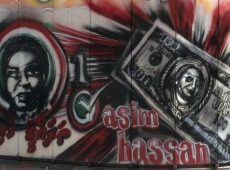
In the months leading to the September 7 presidential election, the streets of Maldives have erupted into a mosaic of party banners, with posters, flags, banners, and graffiti decorating every street corner.

While it may seem to an onlooker that the amount of material each party has placed around the country represents the amount of public support they enjoy, some volunteers putting up the decorations suggest another side to the story.

Party supporters are largely responsible for the colourful displays, but some parties are accused of spending thousands on hiring groups to help them keep up with the campaign craze, oftentimes spending large funds on the process.

“Doing it for democracy”

“We’re doing this for democracy. We don’t want any money or incentives for this. All we want is an elected government that cares about the people”, one group of young graffiti artists painting Maldivian Democratic Party (MDP) themed artwork in their neighbourhood told Minivan News.
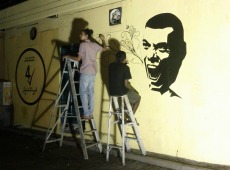
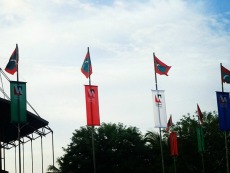
“The thing is, if we don’t get involved and try to guarantee a better life for ourselves, why would anyone else bother? I’m all for MDP, especially after the rest of the political lot brought about the coup d’etat. That is the ultimate shove of their boot against the people, a blatant admission from the ‘baaghees’ that they have no respect or concern for the common man,” said Ahmed Affan, a 26 year old man, an accountant who volunteers in his free time with a team hoisting MDP flags across the streets of Male’.

Another 23 year old volunteer who frequents MDP campaign offices during his free time to help out with banner and t-shirt printing explained his own motivations: “With the best manifesto and policies, I want MDP to win of course, I volunteer to help as I believe our artwork and ideas would get the message across in additional ways to the public and help gather more support.”

Progressive Party of Maldives (PPM) teams also told Minivan News that they were voluntarily engaging in campaign decorating.

“It’s ‘Zaeem’ [Supreme leader – referring to former President and Leader of PPM Maumoon Abdul Gayoom] who has done the most for our poor country. We will do whatever he wants of us. We are determined to have our candidate [Abdulla Yameen – half brother of Gayoom] have a clear win in the election, and we are spreading this message to as many people as possible,” said a 37 year old man hoisting PPM flags and putting up posters down a street in Galolhu.

One team of PPM volunteers refused to speak with Minivan News, stating, “Our leadership refuses to speak to you, and that means we have nothing to say to you either.”

“Heartfelt support” vs “just for the money”

Aishath Zubaira, a 63 year old supporter of President Dr Mohamed Waheed, who has posters of her preferred candidate on the walls of her residence, says she supports him “with heart and soul”.
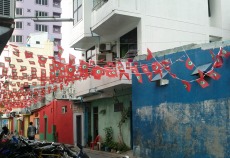
While Minivan News spoke with two different groups streaming the streets with strings of small ‘Forward with the Nation’ coalition flags, they had contradicting reasons for doing so.

“Waheed’s a capable man, and the majority of his supporters are mature and, well, kind of elderly to be honest. There are few young people like us who are aware of just how much Waheed can do for this country, so we need to come out and help make him more popular,” said a 43 year old volunteer, holding a dozen or so rolled up posters sporting photos of Waheed with his running mate, Dhivehi Rayyithunge Party (DRP) Ahmed Thasmeen Ali.

Another man who appeared to be in his late twenties, who introduced himself as “Issey”, put up posters and distributed copies of the coalition’s manifesto. “It doesn’t matter which candidate’s campaigning I am doing, it’s not even like these ugly flags and photos will make a difference for any party,” he said.

“I sometimes even go with the Jumhooree Party guys. Point is, this is an excellent time to make some money on the side and I’m going to make the best use of it. But then, I know who I’m voting for and no one’s got any business asking me who it is.”

“They spend like crazy, we earn like crazy”

A 31 year-old man working at Ibrahim Nasir International Airport (INIA) told Minivan News – on condition of anonymity – that he works in one of Jumhooree Party (JP) coalition’s campaign teams of six to ten persons each.

“When we finish putting up the strings of flags across a street, we need to ring a number that the party has given us. Then a party official will turn up with a file which has information on when and where the teams are active. They will put a tick confirming the job is done and pay us in cash on the spot. We get about MVR 3000 (US$195) a night on average,” he explained.

“Some teams wait a while after the official has left and then cut off the recently hung flags, thereby allowing some other team to earn from the same street a few days later. It’s probably not right, but well, the politicians spend like crazy when elections near, and so us lucky folks earn like crazy.”

Another young volunteer laughed when asked for his reason for being so actively involved in campaign activity, “Every JP graffiti artwork that goes up is a job done for about MVR 10,000 (US$650). We’re economizing the situation when there is a demand for skills like ours. Nothing wrong with that, eh?”
According to local media reports, Police have arrested at least eight people for cutting off lines of flags of various political parties in late August, though police media officials were not responding to calls at the time of press for confirmation.

Visit our facebook page for more pictures as Male’ dresses for the election

Likes(0)Dislikes(0)

Six hundred flats awarded to police and military

Government authorities have awarded 600 apartments to Maldives Police Service (MPS) and Maldives National Defence Force (MNDF) personnel this week, including to Police Commissioner Abdulla Riyaz and senior police officers.

The housing development projects – providing 300 apartments for MPS, and 300 for MNDF officers – are being jointly managed by the government-owned Housing Development Corporation (HDC) in conjunction with the Police Cooperative Society (POLCO) and the MNDF co-operative SIFCO.

The opposition Maldivian Democratic Party (MDP) has described the awards as a continuation of the patronage policies that prevailed under the 30 year autocracy of Maumoon Abdul Gayoom.

Under the MPS’s MVR580 million (US$37.6 million) ‘Blue’s Housing Project’ 210 three-bedroom and 90 two-bedroom apartments will be built.

The housing scheme was described as being important for the maintenance of the police force’s welfare by Commissioner Riyaz during the project’s foundation laying ceremony in March. Acting Home Minister Ahmed Shafeeu presented recipients with the official documents yesterday (September 2).

Apartments were awarded to officers with at least 20 years of service and based on a points system used in other housing schemes, Chief Superintendent of Police Abdulla Nawaz told local media.

The awarding of flats marks the beginning of the POLCO project, which is seeking private investment for a further 150 apartments, said Commissioner Riyaz during Monday’s ceremony.

Last month, 50 apartments on Hulhumale’ were handed over to police officers by President Dr Mohamed Waheed, who expressed hope that more housing would be made available exclusively for police and military officers.

Since the controversial transfer of presidential power involving elements of the police force, 1000 officers have been promoted and 110 new officers were hired. More recruits have been sought for a “special constabulary” reserve force, a loan scheme has been established for officers, and arrangements have been made for officers and their families to receive cheap accommodations and medical treatment in Sri Lanka.

The Maldives Police Service had not responded to Minivan News’ enquiries at time of press.

MNDF flats

Meanwhile, the government has re-started construction of 300 housing units on Hulhumale’, specifically for MNDF officers.

President Waheed, Defence Minister Mohamed Nazim, and senior MNDF officials laid the foundation stone for the apartment complex during a ceremony held on Hulhumale’ yesterday.

The apartments will be given to female officers who had not been previously awarded housing units, as well as to retired officers, the MNDF told local media.

Once constructed, the housing units would provide MNDF personnel and their families “adequate accommodation” as many are currently “living under a degree of hardship, having to rent their living spaces,” Waheed said during yesterday’s ceremony. Nazim added that the project would provide facilities such as playgrounds, a swimming pool, and a gym for residents.

President Waheed also awarded 50 apartments to MNDF personnel and their families last month, although seven of these flats had yet to be assigned.

Waheed noted during yesterday’s ceremony that the provision of shelter for military personnel was not an act of kindness, but rather a government obligation.

“The development and welfare of personnel should be improved in accordance with financial capability of the government, and the flats awarded today provides evidence of that fact,” Defence Minister Nazim stated at the time.

In April 2012, MNDF officers were given two years of allowances in a lump sum, which amounted to MVR 150 million (US$10 million) for the institution.

The Maldives National Defence Force was also not responding to enquiries at time of press.

“Patronage” continues: MDP

The Maldivian Democratic Party (MDP) believes the award of 600 housing units to MNDF and MPS officers is a continuation of the patronage system established during former President Maumoon Gayoom’s 30-year autocratic rule.

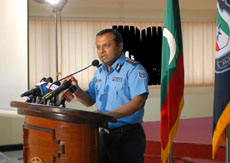
“In the light of extensive exposes, such ‘patronage’ is familiar to voters from the single party dictatorship of Gayoom and I believe they will simply say to each other ‘I told you so’,” MDP MP and Spokesperson Hamid Abdul Ghafoor told Minivan News today (September 3).
The MDP previously raised concerns about whether the already constructed flats – which it contends forms part of the “Veshi Fahi” Male’ (decongestion) project launched under the previous government in 2011 – were being given to the “needy” and most deserving.

Ghafoor said it was “very concerning” that police should be given flats exclusively, to the detriment of teachers, doctors and other civilians. He also questioned how officers themselves had been selected for the process.

While some of the officers may have deserved the housing, there was concern that some officers involved in last year’s mutiny had been rewarded with flats, claimed Ghafoor.

Last month, President Waheed requested parliament approval to obtain a US$29.4 million loan from the Bank of Ceylon to finance the government’s budget and manage cash flow.

The Ministry of Finance and Treasury was seeking to secure the loan as a way to “enforce” the 2013 budget approved by parliament, stated a letter from the President’s Office read during a parliament session held on August 13.

Likes(0)Dislikes(1)

Perils of fundamentalism in the Maldives: International Security Observer

In recent months several newspapers, blogs and academic outlets have highlighted the tumultuous domestic skirmish between Nasheed and Waheed in the Maldives as well as the strategic balancing act of the archipelago state between India and China, writes Djan Sauerborn for the International Security Observer (ISO).

Surprisingly however the troubling rise of religious fundamentalism within the Maldives has not fully moved into the limelight of international media and organisations. This is especially astonishing, because the battle between moderate and extremist forces within the country not only has a strong impact on the upcoming elections in September but also on civil society as a whole.

Islam, which only decades ago did not play a major role within the public sociopolitical sphere, has turned into a divisive “game changer”. Moderate, peaceful and inclusive forms of religious expression are being violently pushed aside by adherents of fundamentalism.

Read more

Likes(0)Dislikes(0)

Comment: A Jumhoree Maldives?

This article was first published on DhivehiSitee.com. Republished with permission.

I went with a friend to the Jumhoree Maalan on Majeedhee Magu last night to get a copy of the Jumhoree Party manifesto.

The Maalan is a vast space of two floors, on a piece of land well over 2000 square feet. Part of it, towards the back, is cordoned off with a big red banner saying ‘Voting Booth’. Two men sat at a table to the side – they looked the closest thing to receptionists we could find. We asked them for a manifesto.

For some reason, the request surprised them. They called over a harried looking man, ‘Ahammadhey’. He agreed to give us a copy and walked over to a room at the back with a big bunch of keys. JP manifesto is kept under lock and key, like a tightly guarded trade secret. He brought us each a little leaflet, a six page summary of the People’s Manifesto: Development Certain.

The frontpage is an illustration of JP’s vision for Maldives. There’s a small island to the far right, connected to an ‘Islamic city’ rising from the sea. The entire shoreline is dominated by a mosque which itself dominates a university standing adjacent, to the left. There’s one or two trees, a crane busily constructing more buildings in a concrete jungle.

A father and son are at the forefront of the picture, walking into the mosque together. They are the nucleus, the centre of the universe as imagined by JP. A woman is somewhere in the distant background, attending to a little household chore, as women do. The only other person is a figure of non-distinctive gender, standing on a bridge. S/he looks about to jump off it. A Maldivian flag is the tallest of all things, rising above everything except the minaret. Not one but two suns shine down on this JP idyll.

There’s quite a few things—eighty three to be exact— that JP promises will happen to make this vision a reality. It begins with the promise to build an Islamic university, followed by the promise to include Nationalism as a separate subject in the national curriculum. Four regional institutes for ‘Arab Islamic learning’ will be established across the country. Next to religion is crime and punishment. Better forensics, more surveillance, better trained police with its own ‘world class’ Police Academy and an all powerful Anti-Drug Agency that will ‘completely stop’ Male’s thriving drug trade.

We asked Ahammadhey if he could talk us through some of the pledges. ‘I am a masakkathu meeha [handyman],’ he said. ‘I don’t know what’s in it.’Ahammmadhay went to fetch us a man more familiar with what JP wants to do for us people. The resident expert turned out to be Umar Bey [Mohamed Hameed], who used to teach in Majeediyya School and is a familiar figure to thousands, like us, of Male’ voters.

‘Can you tell us a little bit more about the pledges here?’

‘It’s pretty straightforward, is it not?’

‘Can we have a copy of the full manifesto?’

‘I don’t have it. To be honest, I haven’t seen it yet.’

‘It does exist? You have one?’

‘Yes, there’s a big manifesto, it’s printed and everything.’

‘So where is it?’

‘I don’t have access to it.’

‘Who does?’

Umar Bey summoned another person who confirmed there is a manifesto the party can give us, but ‘not right now.’ He asked us to come back another time.

We continued our conversation with Umar Bey.

‘There’s a manifesto published on Scribd by Hassan Saeed, promoted on his FB page. What’s that about?’

‘Haha. That’s not a JP manifesto. That’s Hassan Saeed’s.’

‘Oh? Hassan Saeed has a different manifesto?’

‘He must do. I haven’t seen it.’

We had. A few days ago it appeared on running mate Hassan Saeed’s Face Book page.

The summary we got last night is a summary of Hassan Saeed’s manifesto on Scribd: build an Islamic state where religion, together with nationalism — taught as a subject in the national curriculum — will inform all socio-political and juridical decisions and conduct of society and individuals. It also speaks of ‘maintaining’ this traditional Islamic state, as if this is not an imagined place yet to be created but the way we have always lived.

I wonder how many people intending to vote for Gasim Ibrahim know the Maldives they are voting for.

All comment pieces are the sole view of the author and do not reflect the editorial policy of Minivan News. If you would like to write an opinion piece, please send proposals to [email protected]

Likes(2)Dislikes(0)

State broadcaster hosts Presidential Debate ahead of September 7 election

State broadcaster Television Maldives on Sunday aired a live question and answer session with the four candidates contesting the September 7 presidential election.

Moderator Heena Waleed stated that the questions asked – concerning education, health and economy, development and social protection – were based on a survey done by the Maldives National University (MNU) on citizens’ concerns.

The candidates included Gasim Ibrahim representing the Jumhoree Coalition – consisting of the Jumhoree Party (JP), Adhaalath Party (AP), Dhivehi Qaumee Party (DQP) and former PPM interim deputy president Umar Naseer and supporters, President Mohamed Waheed contesting as an independent candidate in coalition with the Dhivehi Rayyithunge Party (DRP) coalition, Abdulla Yameen representing the Progressive Party of Maldives (PPM) and Maldives Development Alliance (MDA) coalition, and Maldivian Democratic Party (MDP) candidate Mohamed Nasheed.

TVM also held a running mates’ debate on August 26.

In their introductory statements Gasim, Waheed and Yameen spoke of the “deteriorating standard of living, torn up social fabric and the lack of peace and unity”, pledging to rectify these issues if elected.

Waheed said that he had assumed power in very dangerous times – referring to 7 February 2012’s controversial transfer of power – “I will remain a faithful leader,” he pledged.

Nasheed focused on reiterating the policies covered in MDP’s “Costed and Budgeted” manifesto, which was released on August 24.

Education policies

The first question posed concerned what changes would be brought to the education system, with the host claiming that  many citizens felt that while the country followed the UK system, other South Asian countries had “far better systems with a higher pass percentages”. This was followed by asking how the candidates planned to increase the number of people interested to pursue a career in teaching.
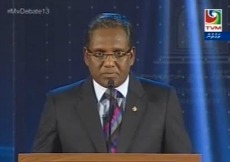
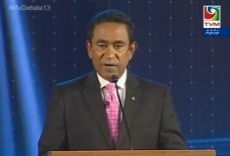
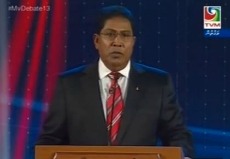
All candidates spoke of making arrangements to allow teachers to work on their islands of origin, to provide accommodation, and of introducing or continuing vocational technical training and higher education opportunities.

The three candidates from the current government’s unity coalition also emphasised that building interest in the field depended on how much financial and other incentives can be offered, pledging to increase them.

Gasim added that he will introduce Islam, Dhivehi and Quran as subjects, although all three are already taught in primary and secondary schools. He also said that all students in and above Grade 8 will be given a laptop and an internet connection under his government.

Nasheed spoke of his previous three years in office, noting that he had introduced single sessions for 150 schools, built 243 classrooms, and worked towards increasing the the number of students who passed at least five subjects in GCE O’Level examinations. He said that if elected, his administration will continue these efforts while also training educators to conduct multi-grade teaching.

Economy

Candidates were asked to name three steps that could be taken immediately to strengthen the country’s weakened economic status.

Gasim spoke of decreasing the deficit and establishing a tax system.

Waheed highlighted the importance of broadening existing industries, claiming that he was currently holding discussions with foreign bodies to introduce new industries including financial and ICT services.

He also claimed that he had brought down the budget deficit from 14 percent to 5 percent.

Yameen spoke of increasing investor confidence and establishing special courts to look into cases of concern for the investors. He added that fishermen would be given “a monthly salary of MVR 10,000 (US$650) whether they catch fish or not.”

“In the first two years we will make the budget zero or completely get rid of deficit. In the remaining three years there will be a budget surplus,” Yameen stated.

Nasheed stated that his party’s aim is to decrease the difference between the rich and the poor, adding that this can be achieved through setting up a solid tax system.

“It is very important to decrease debt. Although Waheed just claimed otherwise, our economic situation has been deteriorating ever since he brought about the coup d’etat. Debt is at 82 percent of GDP, there is a huge deficit, inflation is extremely high,” Nasheed retorted, adding that an MDP government would work to bring all of this back into balance again.

While all spoke of how the difficulty of getting foreign currency in the country could be addressed through increasing foreign investment, Nasheed alleged that investors are reluctant to invest in the Maldives “after the coup d’etat and the harassment of investors following it, including sending our investors without any justification”.

Waheed responded by saying that “It is ridiculous to claim we are not getting foreign investments now. They are very eagerly coming, even more now. One example of a great investor that I brought in recently is BlackStone.”

The US private equity firm bought both Maldivian seaplane operators, Trans Maldivian Airways (TMA) and Maldivian Air Taxi (MAT), in February 2013 for an undisclosed sum.

Cost of living

All candidates pledged to establish sewerage and water systems on all islands.
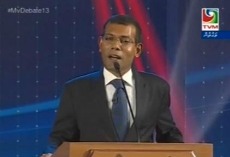
Asked about policies focused on permanently reducing costs of electricity, Waheed and Nasheed spoke of increasing the use of renewable energy.

“While some people spend time acting in movies with the pretence of ‘protecting environment’ and managed to make no more than US$11 million available for renewable energy, in the past one and a half years I have raised US$200 million. I will make 30 islands run 100 percent on solar energy in the next two to three years,” Waheed claimed, referring to Nasheed’s documentary, the Island President, filmed while Waheed was serving as Vice President in Nasheed’s administration.

Gasim also spoke of introducing solar energy, promising to “create power stations and then connect them with a grid through submarine cables or something like this. In order to bring down electricity prices, we will maintain the same price countrywide for wheat flour, rice and sugar”.

Social protection

All candidates except Nasheed spoke of establishing centres to care for the elderly. Nasheed’s proposal is to continue offering a pension to the elderly.

“I plan to build rehabilitation centres for the elderly in the atolls, which can be managed with the cooperation of the community. The problem of elderly or of health can be dealt with through a sustainable insurance scheme,” Yameen said.

Gasim said: “As Muslims, we see parents taking care of children, treating them like [the apple of their] eye. And we should return this care when parents grow old. Our manifesto also says we will provide health care through insurance or something so I have no worries about that,” Gasim stated.

Waheed, meanwhile, pledged to increase the current monthly allowance to the elderly of MVR 2300 to MVR 3500, while Yameen said he will increase it to MVR 5000.

End notes

Waheed was mainly asked how much independence should be granted to the judiciary, to which he responded, “I don’t think that in the history of the Maldives, except in the past year and a half, there has been a single president who did not meddle with the judiciary. I have never done so, and I never will.”

“I have done as much work as anyone else here to bring democracy and I will protect it. But differing opinions can’t be an excuse to commit arson and murder. A lot of people even accused me of not wanting to hold elections, but look, we are having elections soon. I will remain a faithful leader,” Waheed stated.

Responding to a question on what assistance would be provided to pre-schools if he was elected, Yameen said he would ensure that pre-schools stop charging fees.

“An elected president must be someone who will spend all day, every day thinking about nothing but the country’s economy,” he ended.

Gasim, asked about corruption and gang violence, among other topics, focused mostly on reviewing existing laws. He said he is of the opinion that corruption is lower in the private sector, adding that salary increments for government posts could be a possible solution.

He also said that gang crimes can be dealt with by introducing legal frameworks into the school curriculum and offering rehabilitation to gang members, while better implementing legal action against gang crimes.

“I will do all possible to make Maldives into a country like Singapore or Dubai,” was Gasim’s concluding statement.

Questions posed to Nasheed were regardingthe high level of corruption, separation of powers, and concerns that political activity and its broad media coverage has decreased national unity.

“Some people feel that remaining behind an authoritative leader without asking questions is unity. But in the new constitution we adopted, there has to be differences in opinion. We must be able to conduct freedom of expression and freedom of assembly,” Nasheed began.

“Our aim was to expose and reveal all corruption cases that we discovered. This led to the illusion that corruption increased. However, after the coup, we have not seen the audit of the coup regime’s spending, nor has the corruption index been publicized. We will govern with transparency.”

He ended saying that Maldives needs to rid itself of its culture of coup d’etats, adding “we see the situation the people that called themselves “the unity government” is in now. The insults they hurl at each other are far harsher.”

Nasheed closed the show criticising his opponents for the lack of projects completed in the past one and a half years, while saying, “the people of Maldives are aware that the competitors are “baaghee” [traitor] who are part of a coup regime. The people want governments to change through votes. The people will no longer give a chance to those who flee at every sign of political turmoil.”

Watch the debate:

Likes(0)Dislikes(0)