MDP to resume campaigning for “few thousand extra votes” needed for second round win

Maldivian Democratic Party (MDP) presidential candidate, former President Mohamed Nasheed has stated that the party has resumed campaign activities on Sunday (September 8 ) to gather “the few thousand additional votes” needed to guarantee a win in the second round of the election scheduled for September 28.

“My first obligation, of course, is to thank every single Maldivian for participating in yesterday’s democratic election,” the candidate leading Saturday’s poll began.

Speaking to the press at his residence Kenereege for the first time since Saturday’s election, Nasheed stated that he did not believe anyone could describe the party’s total 45.45 percent of votes as “failing in the first round”.

“After three years of government we have received an overwhelming majority of over 95,000 votes. That is far, far more than, for instance, Gayoom managed to do after 30 years in government. And of course, Dr Waheed, after two years in government has failed so, so badly,” Nasheed said, referring to the incumbent’s 5.13 percent support in the first round.

“The election held yesterday was very well organised by the Elections Commission (EC). There were a few concerning issues about some ballot boxes. We believe that in some of the ballot boxes the voter turnout is much higher than the electoral list, and we would like the Elections Commission to explain these irregularities and discrepancies to us,” Nasheed said.

“As I see it, many Maldivians have voted for the MDP: over 95,000 citizens came out and voted in support of having our policies implemented. However, these 95,000 votes are still two or three thousand short of what we needed to win the election in a single round,” Nasheed claimed.

“Our discussions are now about what needs to be done to gain these two to three thousand additional votes that we need. There are things that this party knows for certain: as in, we know that, God willing, we will succeed if we put in hard work and maximum effort,” Nasheed said, adding that the party will hold a rally to initiate campaign efforts tonight.

“Many renowned and capable individuals in the Maldives who used to support or work for other political parties called me last night. I am speaking about many individuals from the Jumhoree Party (JP), Progressive Party of Maldives (PPM) and Dhivehi Rayithunge Party (DRP). What I have to tell them all is that MDP has development in its heart, we have no other objective. All persons are welcome to join us,” Nasheed said. He added that this included former ministers, as well as members of former President Maumoon Abdul Gayoom’s family.

“One of the biggest realities that has come to light due to the results of this election is that the citizens of the Maldives want an MDP government, they want good governance. Another reality that came to light from the results is that my former Vice President, ‘baaghee’ (traitor) Mohamed Waheed Hassan has no support at all, and that activities like [his] have no support in the country.”

“I still believe that it will be detrimental to the country’s development if we are to split up the cabinet to various parties,” Nasheed said, when asked if he planned to form alliances with other political parties for the second round.

He added that any individuals are welcome to work with the party to contribute to the development plans included in the party’s “Costed and Budgeted” manifesto.

“Some parties were creating a lot of deception under the pretence of speaking about Islam. I hope that these people will stop working in this manner. I believe that a small number of citizens get confused by these deceptive messages, but my hope is that in the next two weeks or so, they too will come to see the reality,” Nasheed responded, when asked what he felt could be the cause of failing – with such a narrow margin – to win the election in the first round itself.

“We will respect Islam and uphold its values. We will not place religion in trays and peddle it out like them,” said Nasheed.

International community

“What the international community now needs to understand is, despite what is written in the CONI (Commission of National Inquiry) report, MDP is the party that has the largest support base in the Maldives,” Nasheed stated.

“Unfortunately, the party which is ideologically closest to MDP has not been able to make much of a show in this election because of how they were led to work with Dr Waheed. I sometimes feel this is the work of the international community, who pushed the DRP towards Waheed, because they have been engaged in the politics of this country very heavily,” Nasheed alleged.

“They have always wanted Dr Waheed to come out with a better showing. And they have edged and shoved certain political groups in this country towards Dr Waheed,” Nasheed continued.

“I honestly hope that they will understand the realities of this country, and that they backed the wrong horse,” Nasheed said.

Battle lines

After narrowly finishing third during yesterday’s election with 24.07 percent of the vote, the Jumhoree Party (JP) said it had not yet decided on how it would approach a second round of voting. Despite coming third by just over a percent, the party said no decision had been taken over whether it would contest the provisional result.

“We need to consult the various party councils on how we will stand,” said JP Policy Secretary Mohamed Ajmal.

After a group of around 15 JP supporters demonstrated outside the Dharubaruge convention centre early on Sunday after of the Elections Commission (EC) unveiled the provisional election results, Ajmal said the party had not yet decided to contest the validity of the counting.

“We have raised some concerns with the EC about the voting process, but have not said we will contest [the poll],” he said. “We have alerted [the EC] of our concerns and they are gradually coming up with responses to them.”

According to Ajmal, the party has raised several concerns about how polling was conducted by the EC yesterday, including instances where certain individuals had reportedly been barred from voting, and cases of other people finding ballots already cast under their name.

EC President Fuwad Thowfeek today dismissed allegations of improper conduct during voting, but said the commission’s complaints department would investigate any reported irregularities.

Meanwhile, President Dr Mohamed Waheed’s campaign team said the incumbent would not be putting out a statement regarding his own intentions after Saturday’s result. A statement was expected later this week, according to a source in his team.

The Progressive Party of the Maldives (PPM) confirmed that senior officials including presidential candidate Abdulla Yameen and his running mate Dr Mohamed Jameel Ahmed had met in Male’ shortly after ballot counting had to discuss their second round plans.

MP Ahmed Nihan said at the time that the party had looked to meet with potential allies, including President Waheed and Gasim Ibrahim ahead of the second round, confirming that every other candidate who stood in the election against Nasheed would be invited “to be on-board” in the run-off.

MP Nihan and vice presidential candidate Dr Jameel were not responding to calls at time of press.

Likes(0)Dislikes(0)

Maldives election another chance at unity: Associated Press

“The Maldives — more than 1,100 islands scattered across the Indian Ocean — are sharply divided along political lines. The first democratically elected president insists his former deputy helped force him out in a coup d’etat,” writes Krishnan Francis for the Associated Press.

“And the brother of the longtime dictator of the country, where widespread unemployment exists alongside some of the world’s most expensive beach resorts, now wants to be president himself.

Few hope that Saturday’s presidential elections will soothe the divisions that have inflamed the archipelago since last year, when former President Mohamed Nasheed resigned amid a standoff with security forces and widespread protests.

‘‘Even families are divided and some are not on talking terms,’’ said Mohamed Visham, editor of local English daily Haveeru. He said the new leader will have to shift attention away from the political divide and toward issues like economic development and infrastructure.

The Maldives had its first democratic presidential elections just five years ago, after 30 years of dictatorship under Maumoon Abdul Gayoom. Most of its public institutions, from the police to the public service commission and the courts, are widely seen as political partisan, and it is believed that most government workers continue to support Gayoom.”

Read more

Likes(0)Dislikes(0)

Development is our only objective, Nasheed addresses pre-election rally

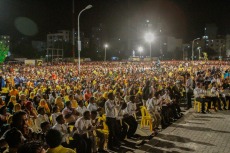
The Maldivian Democratic Party (MDP) has estimates that over 10,000 supporters were in attendance on Thursday night as it held its final major rally prior to the Saturday (September 7) presidential election in capital city Male’.

The rally started with a set of video interviews with members of the general public, who shared their reasons for supporting MDP presidential candidate, and former president, Mohamed Nasheed.

As the first speaker at the rally, the MDP’s vice presidential candidate Dr Mustafa Lutfi stated that “Saturday will be the historical day when we citizens re-establish the democracy that was taken away from us”.

“Nasheed is neither a relative, nor an old friend of mine. He used to be just a name I heard. However, today I have for him the deepest respect and love I would have for a hero of the nation.”

“He has been working since 1990 to gain human rights and democracy for us citizens of Maldives. He continued with the struggle for freedom despite being jailed, tortured, placed under house arrest and being placed in solitary confinement. And even when his democratic government was toppled in the February 7 coup, he took a step back and then with more might is walking forward with us again to regain democracy,” Lutfi continued.

The only other speaker at the rally was the presidential candidate himself.

“MDP is a party that takes steps forward. We are here to establish a people’s government. We believe the people of this country deserve far better than they have today. We are here to develop the Maldives,” Nasheed said addressed the large gathering of supporters.

“In the past 18 months, I have slept in 343 different beds. We have visited all the islands of Maldives. We have met with many Maldivian citizens. We know the sentiments of the Maldivian people. We have stepped forward to make the dreams of the Maldivian people a reality. We will win this election in the first round, in a single round,” he said, prompting loud applause from the crowd.
“We are calling on the people to roll up your sleeves and come with us to develop the country. Development of this country is our only aim, our only objective,” Nasheed continued.

“A nation is developed through doing particular things at a particular time in a certain manner. These things can be known through putting forward criticism and conducting peaceful political activities by competitive parties in a multi-party system. The biggest obstacle to this country’s development was the habit of torture and brutality exercised in this country’s past against anyone who expressed differences in opinion. We are here to overcome this obstacle. We will win the elections in one round,” he stated.

“You can push us down onto the ground and force us to eat sand, but we will stand up again. We will not step back. We will bring good governance to the people. Our courage cannot be deterred. We will develop this country, we will build the whole nation,” Nasheed concluded his speech.

Former State Minister of Islamic Affairs during Nasheed’s administration, Sheikh Hussain Rasheed, concluded the rally with a prayer, joined in by the thousands of supporters gathered at the rally.

After the speeches were delivered and the prayer recited, the party then held a laser show, with some of the images depicting themes related to the party and its policies, along with campaign songs by various artists from around the country.

Likes(0)Dislikes(0)

Loyalty, support, money: The motivation behind Male’s political decoration

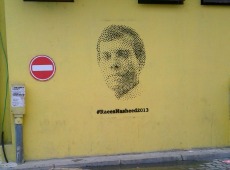
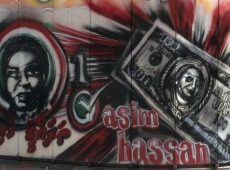
In the months leading to the September 7 presidential election, the streets of Maldives have erupted into a mosaic of party banners, with posters, flags, banners, and graffiti decorating every street corner.

While it may seem to an onlooker that the amount of material each party has placed around the country represents the amount of public support they enjoy, some volunteers putting up the decorations suggest another side to the story.

Party supporters are largely responsible for the colourful displays, but some parties are accused of spending thousands on hiring groups to help them keep up with the campaign craze, oftentimes spending large funds on the process.

“Doing it for democracy”

“We’re doing this for democracy. We don’t want any money or incentives for this. All we want is an elected government that cares about the people”, one group of young graffiti artists painting Maldivian Democratic Party (MDP) themed artwork in their neighbourhood told Minivan News.
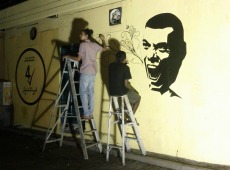
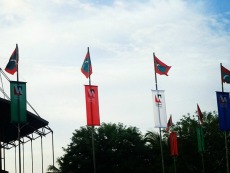
“The thing is, if we don’t get involved and try to guarantee a better life for ourselves, why would anyone else bother? I’m all for MDP, especially after the rest of the political lot brought about the coup d’etat. That is the ultimate shove of their boot against the people, a blatant admission from the ‘baaghees’ that they have no respect or concern for the common man,” said Ahmed Affan, a 26 year old man, an accountant who volunteers in his free time with a team hoisting MDP flags across the streets of Male’.

Another 23 year old volunteer who frequents MDP campaign offices during his free time to help out with banner and t-shirt printing explained his own motivations: “With the best manifesto and policies, I want MDP to win of course, I volunteer to help as I believe our artwork and ideas would get the message across in additional ways to the public and help gather more support.”

Progressive Party of Maldives (PPM) teams also told Minivan News that they were voluntarily engaging in campaign decorating.

“It’s ‘Zaeem’ [Supreme leader – referring to former President and Leader of PPM Maumoon Abdul Gayoom] who has done the most for our poor country. We will do whatever he wants of us. We are determined to have our candidate [Abdulla Yameen – half brother of Gayoom] have a clear win in the election, and we are spreading this message to as many people as possible,” said a 37 year old man hoisting PPM flags and putting up posters down a street in Galolhu.

One team of PPM volunteers refused to speak with Minivan News, stating, “Our leadership refuses to speak to you, and that means we have nothing to say to you either.”

“Heartfelt support” vs “just for the money”

Aishath Zubaira, a 63 year old supporter of President Dr Mohamed Waheed, who has posters of her preferred candidate on the walls of her residence, says she supports him “with heart and soul”.
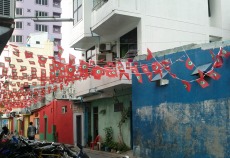
While Minivan News spoke with two different groups streaming the streets with strings of small ‘Forward with the Nation’ coalition flags, they had contradicting reasons for doing so.

“Waheed’s a capable man, and the majority of his supporters are mature and, well, kind of elderly to be honest. There are few young people like us who are aware of just how much Waheed can do for this country, so we need to come out and help make him more popular,” said a 43 year old volunteer, holding a dozen or so rolled up posters sporting photos of Waheed with his running mate, Dhivehi Rayyithunge Party (DRP) Ahmed Thasmeen Ali.

Another man who appeared to be in his late twenties, who introduced himself as “Issey”, put up posters and distributed copies of the coalition’s manifesto. “It doesn’t matter which candidate’s campaigning I am doing, it’s not even like these ugly flags and photos will make a difference for any party,” he said.

“I sometimes even go with the Jumhooree Party guys. Point is, this is an excellent time to make some money on the side and I’m going to make the best use of it. But then, I know who I’m voting for and no one’s got any business asking me who it is.”

“They spend like crazy, we earn like crazy”

A 31 year-old man working at Ibrahim Nasir International Airport (INIA) told Minivan News – on condition of anonymity – that he works in one of Jumhooree Party (JP) coalition’s campaign teams of six to ten persons each.

“When we finish putting up the strings of flags across a street, we need to ring a number that the party has given us. Then a party official will turn up with a file which has information on when and where the teams are active. They will put a tick confirming the job is done and pay us in cash on the spot. We get about MVR 3000 (US$195) a night on average,” he explained.

“Some teams wait a while after the official has left and then cut off the recently hung flags, thereby allowing some other team to earn from the same street a few days later. It’s probably not right, but well, the politicians spend like crazy when elections near, and so us lucky folks earn like crazy.”

Another young volunteer laughed when asked for his reason for being so actively involved in campaign activity, “Every JP graffiti artwork that goes up is a job done for about MVR 10,000 (US$650). We’re economizing the situation when there is a demand for skills like ours. Nothing wrong with that, eh?”
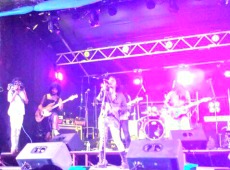
According to local media reports, Police have arrested at least eight people for cutting off lines of flags of various political parties in late August, though police media officials were not responding to calls at the time of press for confirmation.

Visit our facebook page for more pictures as Male’ dresses for the election

Likes(0)Dislikes(0)

Former President Nasheed performs live techno-rap debut at campaign concert

Former president Mohamed Nasheed performed live at a Maldivian Democratic Party (MDP) music concert on Thursday (August 31) as certain supporters donned t-shirts proclaiming their presidential candidate an ‘Eco rock star’ ahead of his techno-pop-rap debut.

The ‘Emmen Ehburun’ (‘Everyone one round’) music show (August 29) showcased some of the Maldives’ most popular artists and a variety of musical styles in an effort to galvanise voters to participate in the September 7 presidential election.

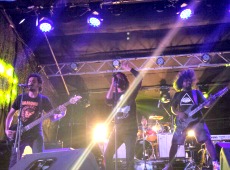
The lively campaign event was hosted by MDP MPs Eva Abdulla and Imthiyaz ‘Inthi’ Fahmy, and drew a crowd of nearly 4,000 people near ‘raalhugandu’, Male’s surf point, adjacent to the Tsunami Monument. A broad demographic of women, men, teenagers, small children accompanied by their families, and the elderly gathered to watch the show.

Maldivian rock band Eman’s Conspiracy fired up the audience with their unique style – some of the male band members sported women’s flower-print stretch pants and jumpers – and witty lyrics. One song joked about police breaking up protesters by tickling their stomachs, in reference to the Maldives Police Service’s violent crackdown on protesters, and former Civil Service Commission Chair Mohamed Fahmy Hassan’s dismissal in November 2012 over allegations he sexually harassed a female staff member by caressing her stomach.

After their performance the crowd around the stage rapidly multiplied and surged forward in anticipation of Nasheed’s performance. Cheers and shouts of ‘ehburun’ erupted from the audience as Nasheed took the stage with DJ Umar.

The ‘Eco rock star’ launched into an original rap spun by DJ Umar to a techno remix of Michael Jackson’s ‘Billie Jean’. Nasheed’s on-stage excitement was contagious, with onlookers energised by his political lyrics and unique techno-pop-rap musical style.

Although audio clips from some of Nasheed’s speeches have been set to techno house music and have been endlessly echoing through the Maldives since the controversial transfer of power in February 2012 – this is the first time the former president has sung live. (See below for translated lyrics and video of Nasheed’s performance).

Nasheed may have stolen the show with his techno-pop-rap musical debut, but the artists that followed kept the crowd in a fevered frenzy.

Famed boduberu (traditional singing, drumming, and dancing) group Harubee, two time winners of the Maldives Boduberu Challenge and invitees to multiple international events, riveted the crowd with renditions of classic Maldivian songs. The ladies in the crowd were particularly enthralled with lead singer Ibrahim ‘Mandey’ Mamdhooh, who forewent his drum in favour of impassioned singing and dancing.

Men and women alike were headbanging in the ‘pit’ that formed in front of the stage during Maldivian metal band Traphic Jam’s performance. Their rock performance and political protest song lyrics – “Anni (Nasheed) was there when I went to bed, when I woke up it was a baaghee (traitor)” – resonated with the youth who shouted the lyrics in time with the band.

The ‘Emmen Ehburun’ show resonated with young MDP  supporters, several of whom in the crowd described the eclectic mix of music as “habeys” (awesome) and that “Anni’s performance was epic”.

DJ Umar featuring former President Mohamed Nasheed:

“Fasten your seatbelts. We are cleared for landing. We will only rest after taking the oath of office as the President of the Maldives on November 11, 2013.

The people of the Maldives have seen, they have weighed, the people of the Maldives have decided to give this election to the Maldivian Democratic Party. We will win this election in one round. In one round. In one round. Forward, forward, forward, forward. Forward with the Maldivian nation.

Come. Come out with us, roll up your sleeves, and come out to develop this country. Our country has seen how things happened during 30 long years – our people has seen that. It was quite recently that education in the English-medium began in Maldivian schools. In our three years, we built 240 schools, in our three years we changed Maldivian schools to single session.

The people of the Maldives are yearning again for a Maldivian Democratic Party government. The people of the Maldives are yearning again for compassionate, good governance. We will come back. We will return. We will provide good governance for the people of the Maldives.

We cannot secure the change we seek without connecting the islands of this country with public transport. The people of the Maldives want development. The people want housing. We all want the same things. We want a good life – public transport, good healthcare when we’re sick, a good education for our children, we all want good governance.

We will come back. We will beat the traitors and win this election in one round. The people of the Maldives are not ready to leave this country to a coup. The people of this country want to establish a government of the people in the Maldives.

Forward, forward, forward. Come. Come out with us to develop this nation. We will not step back. Our courage will not slacken, our resolve will not be shaken. We will come back. We will offer good governance for the people of this country. The Maldivian Democratic Party will always remain with the people of the Maldives. Our prayer is always for a better way than this for our country. This country is rich in natural resources. We can develop and achieve progress. We can find a better way than this for our youth.

We want development. We want entertainment. We want housing, education for our children. We want compassion, social security. The Maldivian Democratic Party is a party that makes pledges and fulfils pledges. God willing, we will deliver on our pledges. Our country is headed towards a safe shore. Come out with us. Come out. We will secure our country. We can see the horizons of the Other Maldives. We have come out seeking this country’s development. We have always had one goal.

You would have heard the pledges of political leaders. When they go to an island first they’ll meet a fisherman. The fisherman will say, ‘Seytu [literally shopkeeper, used to refer to Gasim], my boat is on land.’ And Seytu will pledge a boat for every fisherman. In the middle of the island he will meet a teacher. The teacher will say I want a laptop and Seytu will say, ‘a laptop for every teacher.’ That is not a political pledge. Political pledges are those that can be fulfilled through a policy. The Maldivian Democratic Party manifesto is one that has been costed and budgeted. We are a party that makes pledges and fulfils pledges.

God willing, we will win this election in one round. In one round, one round, one round. Valhamdulillah. Thank you very much.”

Likes(1)Dislikes(0)

Development pointless without peace, freedom and happiness: PPM Yameen

The Progressive Party of Maldives (PPM) presidential candidate Abdulla Yameen has told the population of Kudahuvadhoo that development is “pointless if people can’t relax.”

“The end result of all this effort, of constructing harbours, and sending our children to school, should be to ensure that people can relax and live in peace, happiness and freedom. Otherwise there’s no point in doing all this,” Yameen was reported as saying during a campaign rally.

The PPM candidate is also said to have urged voters to say no to politicians who disturb the peace and make unrealistic promises.

Yameen’s comments echo his prior argument that the worst kind of extremism in the Maldives is the encroachment on other people’s rights.

The comments follow the Maldivian Democratic Party’s (MDP) pledge to implement 137 development projects worth MVR 30 billion (US$1.9 billion) over five years by the PPM’s primary opponent.

In the party’s detailed ‘Costed and Budgeted’ manifesto, former President – and current candidate – Mohamed Nasheed explained that the manifesto included 51,000 job opportunities, a savings scheme for higher education, a student loan scheme, a MVR2000 (US$129) allowance for every single parent and person with special needs, and an allowance of MVR2300 (US$149) for the elderly.

Nasheed also pointed out the importance of introducing a development bank in the Maldives.

“Take a look, this manifesto will not contain even a single policy which has not been accounted for. Even if we are asked to submit a budget to the parliament by tomorrow, we are ready to do so,” Nasheed told a crowd of 8,000 on Saturday (August 24).

The current government’s  – of which the PPM is a partner – decided to suspend development projects this year after the state was found to have exhausted its annual budget for recurrent expenditure (including salaries, allowances and administration costs) in the first quarter of 2013.

President Dr. Mohamed Waheed Hassan has blamed the current economic situation on the excesses of the Nasheed government.

The decision was made in same month that currency reserves in the Maldives were found to have “dwindled to critical levels”, according to the World Bank’s biannual South Asia Economic Focus report.

Criticisms made by Yameen in Kudahuvadhoo were also addressed at the MDP rally earlier in the week, with Nasheed railing against politicians who campaign by promising gifts to certain individuals and communities.

Jumhoree Party (JP) candidate Ibrahim Gasim has come under fire from both the MDP and the PPM this week, with PPM spokesman Ahmed Nihan describing the JP’s campaign as effectively “dumping money” in certain parts of the country.

Former President Maumoon Abdul Gayoom also travelled to Kudahuvadhoo as the campaign entered its final ten days. The PPM leader told the island’s people that the “shattered” economy could only be mended by his half-brother Yameen.

“Our economy is seriously damaged and destroyed. This is not the way it should be, and this is not how it was before either,” said Gayoom.

After succeeding Gayoom, Nasheed was said to have inherited “the most challenging macroeconomic situation of all democratic transitions that have occurred since 1956”, according to the World Bank.

Likes(0)Dislikes(0)

Maldives Decides 2013

Click to visit Maldives Decides 2013

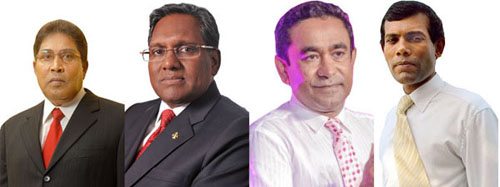
Minivan News has launched ‘Maldives Decides 2013’, a hub of content concerning the four candidates competing in the 2013 presidential election.

Each candidate’s entry includes an overview of their recent political history with extensive links to relevant articles published by Minivan News, an overview of their policy positions, and a brief analysis of their support base.

The hub also includes an unofficial poll, links to Minivan News’ ongoing election coverage, and resources provided by the Maldives Elections Commission.

Additionally, all candidates have been sent and invited to respond to the following 10 questions, which will be published unedited as received:

  1. What about your personal experience makes you suitable to become President?
  2. What are the top three challenges facing the Maldives, and how do you intend to address these?
  3. Given the present state of the economy, how are you going to get the money to fulfill your pledges?
  4. Is there a need for judicial reform, and how do you intend to address the state of the judiciary should you be elected?
  5. How do you expect the events of 7 February 2012 to affect voter sentiment at the ballot box?
  6. Is Islamic fundamentalism a growing concern in the Maldives, and how should the government respond?
  7. What role should the international community play in the Maldives?
  8. Why should a woman vote for your party in the election?
  9. Why should a young person vote for your party in the election?
  10. What will the Maldives be like in 10 years time, should you be elected in September?

Minivan News hopes ‘Maldives Decides 2013’ is of value to its readers, and looks forward to a free, fair and inclusive election on September 7.

Visit Maldives Decides 2013


Feel free to discuss this project below, or send enquiries directly to [email protected]

Likes(2)Dislikes(0)

Comment: Revisiting the Maldives’ transition to democracy

This article was first published on Dhivehi Sitee. Republished with permission.

The first multiparty presidential election of 2008 in Maldives saw an end to the 30-year dictatorship of Maumoon Abdul Gayoom and the adoption of a modern democracy for the first time in the Maldives. Nevertheless, as in many other nascent democracies, there is real doubt whether Maldives can sustain its democracy in its fullest sense, especially after the recent coup that ousted the first democratically elected president in February 2012.

Some scholars argue that the mode of democratic transition a country experiences proves to be a critical factor in determining the country’s democratic future. Hence, an analysis of the mode of democratic transition that occurred in Maldives may help in predicting whether democracy could be sustained in future.

Political scientist Samuel Huntington argues that the process of democratisation could be determined based on ‘the relative importance of governing and the opposition groups as the sources of democratisation’.

He identifies three broader modes of democratisation; (1) ‘transformation’ (from above) occurs when the regime itself takes initiative in bringing democracy; (2) ‘replacement’ (from below) occurs when opposition groups take the initiative and replace the regime by bringing democracy; and (3) ‘transplacement’ (through bargain) occurs when both government and opposition work together to bring about democracy.

My aim here is to analyse the process of democratisation in Maldives in terms of the theories offered by Huntington, and identify the modes of democratic transition that occurred in Maldives.

This in turn may help predict the future sustenance of democracy in Maldives. I will argue that no one particular mode of democratisation occurred in Maldives as none of them materialised fully. However, various efforts from the current opposition Maldivian Democratic Party (MDP), together with the leadership of Mohamed Nasheed, have contributed significantly to the process and facilitated negotiations with the regime leading to democratisation.

To achieve the stated-aim, I will discuss the major events that contributed to the democratisation process in Maldives by relating them to the modes of transition outlined above.

The initial period of democratic struggle – a period of near ‘replacement’

The initial period of the struggle for democracy in Maldives depicts characteristics of ‘replacement’ where citizens started to challenge the regime through various means and made attempts to overthrow the autocratic government. The first serious challenge to dictator Gayoom was in 1988, with a failed coup attempt carried out by Sri Lankan Tamil mercenaries financed by wealthy Maldivians. A year after the attempted coup, the election of western-educated young politicians to the parliament in 1989 resulted in increased pressure for democratic reforms.

However, many of them and their family members faced significant threats from the regime and some of them were imprisoned for various politically motivated charges[3]. The regime continued to suppress major opposition figures through arbitrary arrests. In 2001, Mohamed Nasheed – both a Member of Parliament and a major opposition figure – was arrested and imprisoned for two and half years. The same year, the opposition MDP made their first attempt to formally register themselves as a political party. The Home Ministry, mandated to register civic organisations, sent the petition to parliament where it was overwhelmingly rejected.

On September 20, 2003, civil unrest broke out in the capital Male’ sparked by the death of prison inmate Hassan Evan Naseem. Evan was tortured to death by security forces during an interrogation. News of his death led to riots in the prison and a subsequent shootout by the police that killed three more inmates and injured many others. The news spread throughout Maldives, becoming the major trigger for many to publicly demand democratic reforms.

Since the September unrests, Gayoom came under tremendous pressure from both domestic and international actors that compelled him to announce democratic reforms. On June 2004, during an informal meeting, Gayoom announced his proposed changes to the Constitution including two term limits for the president, direct election of the president, measures to increase separation of powers and removing the gender bar for political participation. Moreover, he urged citizens to publicly debate his proposals. The opposition were still very sceptical about Gayoom’s real intentions and raised doubts about whether he could bring about concrete reforms.

However, the reform announcement itself facilitated the opposition to organise more activities publicly. Matt Mulberry from the International Center on Nonviolent Conflict, argues that the reforms announced by Gayoom ‘technically gave citizens freedom of speech and freedom of assembly’. As a result, some citizens organised a series of “minivan debates” (‘minivan’ means ‘independent’ in Dhivehi) where they discussed the political issues facing the country. Unsurprisingly, the government sent police to disrupt these debates, eventually declaring them illegal.

Despite these repressive actions, the opposition organised a huge protest on August 12-13, 2004 to mark the death of Evan Naseem and demanded reforms, including the release of political prisoners. A record number of citizens took part in the protest which became the largest political gathering ever in the history of Maldives at that time.

The crackdown that followed the protest led to the arrest of hundreds of activists and injured many protesters. As a result, violence erupted in capital Male’ and other parts of the country. Despite the oppressed media, news of the regime’s repressive actions attracted the attention of many international actors. By then, President Gayoom faced immense pressure from the UK, US, India and Sri Lanka to bring about political reforms.

From ‘replacement’ to ‘transplacement’ – a period of joint action

The mounting international pressure and political instability in Maldives led to a new phase in the democratisation process as the regime agreed to have serious negotiations with the opposition. The willingness of joint action from both the regime and the opposition led to a period of ‘transplacement’ in the democratisation process. The regime agreed to sit with the opposition for the first time in the UK.

During the negotiations, the regime agreed to more reforms including formation of independent oversight bodies such as the Police Integrity Commission and the Judicial Services Commission. Moreover, informal talks between reformers within the regime and the opposition were held in Sri Lanka facilitated by the British High Commissioner.

However, the lack of true commitments from the regime led the opposition to realise that international pressure alone would not help bring down the autocratic leadership. Hence, they increased their efforts in organising more protests, speeches and sit-ins. As a result of the mounting support for the opposition’s cause, reformers within the government increased their efforts in pressuring Gayoom to implement urgent reforms.

The pressure from a few reformers within the government and the opposition MDP led to a period of ‘transformation’ where the regime was compelled to take reform actions. In April 2005, the then Attorney General Dr Hassan Saeed overturned his predecessor’s decision by issuing a formal legal opinion to allow the registration of political parties. In June 2005, the parliament unanimously voted in favour of a resolution to allow multi-party democracy for the first time in Maldives. The MDP – the main opposition party – led by Mohamed Nasheed was formally registered, along with several other political parties representing different views. In March 2006, the regime published a roadmap that ‘included 31 proposals for revision of the Constitution, a series of time-bound commitments on human rights, and proposals to build institutions and mobilise civil society’.

However, many still doubted whether the regime was committed to real reforms. Ahmed Shaheed (then Foreign Minister) later argued that, through the reform agenda, Gayoom was seeking to get rehabilitated and thereby stabilise his presidency. He argued that, by 2007, Gayoom had achieved his aim by gaining widespread domestic support and getting rehabilitated.

However, new cracks that significantly weakened the regime emerged as those most closely associated with the reform agenda left the government. On 5th August 2007, both Dr Hassan Saeed and Mohamed Jameel (Justice Minister) resigned from their posts. They claimed that working outside Gayoom’s regime was the only option to advance their reform agenda. Later on the same month, Ahmed Shaheed resigned from the post of Foreign Minister, accusing the government of stalling democratic reforms. These developments saw more public support for the opposition reform movement. After several disagreements with the Special Majlis (Special Parliament), Gayoom ratified the new Constitution in August 2008, allowing key democratic reforms and paving way for the first multi-party presidential election in October that year.

Democracy sustainable?

As evident from the discussion above, three modes of democratisation have contributed to the democratisation process in Maldives, though characteristics of ‘transformation’ are very little. Interestingly, there appears to be a correlation between each mode as the occurrence of one type led to the other. This observation therefore contradicts Huntington’s view that the three modes of democratisation are alternatives to one another.

However, it is important to note the significant role played by the opposition MDP, especially Mohamed Nasheed as the leader who never took a step back in his quest to bring democracy to Maldives. It is clear that MDP played the most critical role in the process of democratisation. I have previously argued that Gayoom is the major obstacle to sustaining democracy and the threat is heightened more than ever with his current political activeness.

Reflecting on the process of democratisation and the strong influence of Gayoom on many institutions till today, I still doubt sustenance of democracy in the Maldives. Similar to the 2008 election, this year’s election is very much a choice between democracy and autocracy.

All comment pieces are the sole view of the author and do not reflect the editorial policy of Minivan News. If you would like to write an opinion piece, please send proposals to [email protected]

Likes(0)Dislikes(0)

Police Integrity Commission to investigate Commissioner Riyaz’s tweet

The Police Integrity Commisson (PIC) has confirmed that it is investigating a tweet posted by Police Commissioner Abdulla Riyaz.

Riyaz yesterday posted a letter he claimed to have been sent, urging the police to “say no” to former President Mohamed Nasheed on September 7, just as they had on February 7 – an event the author described as a “jihad”.

The letter, addressed to the entire police force, praised it for its “patience” in the face of Nasheed’s “cunning” and “malicious” actions during his presidency.

Whilst not responding to inquiries from Minivan News today, Riyaz is reported to have told local media that he had no specific intentions in mind when re-posting the letter.

Elections Commissioner Fuwad Thowfeek today told Minivan News that his office had received a complaint regarding the letter, and had opted to forward the issue to the PIC.

When asked about his recommendations regarding the social media activities of public officials in the run-up to the presidential election, Thowfeek urged restraint on the part of members of all independent commissions – including the Elections Commission – the police, and the MNDF

“It is advised to be as neutral as possible – even on Facebook – so there will be nothing to complain about,” he added.

EC Legal Director Haneefa Khalid currently facing an internal investigation after the Progressive Party of Maldives (PPM) accused her of posting  “politicised” tweets.

President Dr Mohamed Waheed told local journalists yesterday that he imagined the tweet had been posted in the commissioner’s personal capacity. When pressed on the appropriateness of such a post, Waheed said that he could not comment further without more information.

Whilst President’s Office Spokesman Masood Imad told Minivan News today that he was not personally aware of the Riyaz tweet, he said the government would “express concern” over any such post which threatened free and fair elections.

“We caution everyone in the country to follow election guidelines and not to play into the hands of anyone looking to undermine free and fair voting. Everyone must exercise judgement,” he added.

Commissioner Riyaz last month posted an interview on the police service website maintaining that the organisation would refuse to follow any orders deemed unconstitutional.

“Whichever individual becomes president tomorrow can no longer just change the constitution, the existing law. That individual, holding the presidency, can only bring such big changes with a parliamentary majority,” said Riyaz.

February’s controversial transfer of power came after units of the police refused to obey former President’s Nasheed’s orders, with Nasheed resigning from office soon after.

Days earlier, Nasheed had ordered the detention of Criminal Court Chief Judge Abdulla Mohamed after the latter had blocked investigations into his own misconduct.

Nasheed’s decision was later described as in breach of the constitution by the Human Rights Commission of Maldives (HRCM).

Riyaz was appointed commissioner immediately after Nasheed’s resignation, which Nasheed and Maldivian Democratic Party (MDP) would later claim was a police coup.

The allegations were later rejected by a Commonwealth-backed Commission of National Inquiry (CoNI) that ruled that there had been “no coup, no duress and no mutiny”, while also calling for action taken against unlawful acts committed by the country’s security forces following the transfer.

Likes(0)Dislikes(0)