Comment: Intravenous drug use raises AIDS spectre in Maldives

Thirty years since the first reported cases of acquired immunodeficiency syndrome (AIDS) in 1981, the response to the HIV/AIDS epidemic has been unprecedented, especially in terms of global and national initiatives.

Substantial progress has been made, such as a 31 percent reduction in the number of new infections between 2001 and 2009 in South-East Asia. A revolutionary new approach to treatment endorsed by UNAIDS and WHO, which includes improved, lower-cost drugs, simplified HIV diagnostic technologies, improved delivery systems, and innovations  in prevention of HIV infection, give hope for achieving universal access to prevention, care and treatment of HIV/AIDS, even in resource-constrained settings.

Yet, the challenge is far from over. HIV still remains a formidable foe, affecting 33.3 million people globally, including 2.5 million children. Despite years of concerted global efforts and investments, there is still neither a cure nor an effective vaccine for the disease.

However, over time, the profile of the HIV epidemic is evolving from a life threatening to a chronic disease, thanks to availability of more effective drugs and efficacious service delivery models involving communities and people living with HIV/AIDS. With changing realities, it is time, then, to reflect and re-strategize in the long-drawn war against HIV/AIDS. Fundamental to success is acknowledging that HIV/AIDS is a social and developmental issue as much as a health one.

The impact on women and children is devastating. An estimated 1.3 million women aged 15 and above currently live with HIV in the WHO’s South-East Asia Region (Bangladesh, Bhutan, Democratic People’s Republic of Korea, India, Indonesia, Maldives, Myanmar, Nepal, Sri Lanka, Thailand and Timor-Leste).

The estimated number of children living with HIV has increased by 46 percent during 2001 – 2009. Of the 448 million cases of sexually transmitted infections that occur globally, 71 million are in South-East Asia. Due to low coverage of the prevention of mother-to-child transmission (PMTCT) programme in the South-East Asia Region, a large number of babies born to HIV-positive mothers acquire HIV infection in the womb.

Despite considerable diversity in the HIV epidemic among the countries of the Region, unsafe sex and injecting drug use are the main drivers. Five countries -India, Indonesia, Myanmar, Nepal and Thailand – account for a majority of the disease burden. Sexual transmission accounts for the majority of cases in Bhutan, India, Myanmar, Sri Lanka, Thailand and Timor-Leste.  The HIV epidemic among people who inject drugs is significant in Indonesia, Myanmar, Nepal, Thailand, and some regions of India.

The Maldives has a growing threat of the HIV epidemic due to injecting drug use.

The evolution of the epidemic from life threatening to a chronic disease, with better drugs and better access to drugs, has resulted in prolonging survival and quality of care for people living with HIV/AIDS. This necessitates evolution of an HIV care model that is in line with chronic disease management, with primary care providers playing an important role.

The spectrum of HIV care needs to evolve into a comprehensive primary care model that has an integrated, patient-centered approach, and is linked to specialist care where and when needed. It also needs to address the various socio-cultural issues that take the response beyond the health sector into the families and communities.

Other key challenges include late diagnosis of HIV, stigma and discrimination faced by people with HIV and most-at-risk population; limited capacity of health systems; high prices of antiretroviral drugs especially the second line drugs, and lack of sustained finances.

The health sector can only overcome these challenges if it collaborates with other sectors in order to tackle the social, economic, cultural and environmental issues that shape the epidemic and access to health services.

WHO’s  Health Sector Strategy on HIV for South-East Asia has been endorsed by all the eleven Member States of the Region. It envisions “Zero new HIV infections, zero AIDS-related deaths and zero discrimination in a world where people living with HIV are able to live long, healthy lives.”

The four strategic directions to achieve the goal include: optimising HIV prevention, care and treatment outcomes; strengthening strategic information systems for HIV and research; strengthening health systems to ensure that the expanded response to HIV will build effective, efficient and comprehensive health systems in which HIV and other essential services are available, accessible and affordable; and fostering supportive environment to ensure equitable access to HIV services.

WHO continues to work with countries to achieve universal access to comprehensive HIV prevention, treatment and care and to contribute to health-related Millennium Development Goals (MDGs), particularly MDG 6 (combat HIV/AIDS, malaria and other diseases). Together, we hope to move closer to a world free of AIDS.

Dr. Samlee Plianbangchang is the Regional Director of the World Health Organisation for the South-East Asia Region.

<em>All comment pieces are the sole view of the author and do not reflect the editorial policy of Minivan News. If you would like to write an opinion piece, please send proposals to [email protected]</em>

Likes(0)Dislikes(0)

Nasheed makes Cameron’s top five for Berlusconi stag party

If given the chance, British Prime Minister David Cameron would include President Mohamed Nasheed in a stag weekend organised by former Italian Prime Minister Silvio Berlusconi.

Graffiti artist Eine published a Q&A in UK media The Guardian in which he asked Cameron to choose five living world leaders to invite, and if he omitted Bill Clinton, to explain why.

After listing Clinton and Obama, Cameron said, “My new best friend is the president of the Maldives. He’s great.”

Press Secretary at the President’s Office Mohamed Zuhair told Haveeru that President Nasheed and the British PM maintain an “ever growing” friendship, and that their respective parties share a close partnership.

France’s Nicholas Sarkozy and New Zealand’s John Key also made the list.

Cameron gave one of Eine’s pieces to Obama as an official gift in 2010.

Likes(0)Dislikes(0)

Mega Maldives opens route to Chonquing

One-year-old Mega Maldives Airlines welcomed its fourth scheduled route between the capital Male and the Chinese commercial powerhouse of Chongqing in China’s south-western mainland last weekend, the first time the route has been serviced from the Maldives.

“Mega Maldives viewed Chongqing as the next logical choice as a direct connection between one of the world’s most renowned and most sought after holiday destinations and the heart of China’s commerce and industry.”

Chongqing boasts one-third of China’s automobile industry, and is also home to international retail and finance groups Ford, Mazda, HSBC, Deutsche Bank and Wal Mart.

Mega Maldives currently operates flights to Beijing, Hong Kong and Shanghai.

Chonquing flights depart Ibrahim Nasir International Airport (INIA) every five days for the 7 hour flight.

Likes(0)Dislikes(0)

Foreign Ministry opposes UN Human Rights Commissioner’s call for debate on flogging

The Foreign Ministry does not support open debates on issues raised by UN High Commissioner for Human Rights Navi Pillay, namely the provision for flogging as a punishment for extra-marital intercourse and the requirement that all Maldivians be Muslims.

“What’s there to discuss about flogging?” Minister of Foreign Affairs Ahmed Naseem was reported as saying in newspaper Haveeru. “There is nothing to debate about in a matter clearly stated in the religion of Islam. No one can argue with God.”

Speaking to Minivan News, Naseem confirmed his statement but did not wish to comment further.

Pillay said flogging was “a form of punishment that is cruel and demeaning to women” and observed that in her travels in Islamic countries “apart from the Maldives and one other country that practices stoning, flogging is not a practice that is condoned.”

She further claimed that the Maldives is signatory to international treaties that are legally-binding obligations, “and such a practice conflicts with these obligations undertaken by the Maldives.” She said human rights conforms with Islam.

Naseem today advised Minivan News that the Maldives had submitted certain reservations to said conventions, including articles on gender equality and freedom of religion, and on these points the country could not be held legally accountable by an international body.

Pillay also called for amendments to the constitutional provision mandating subscription to Islam.

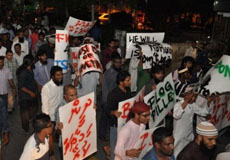
Since her press conference on Thursday, November 24, protestors bearing slogans “Ban UN,” “Flog Pillay” and “Defend Islam” have demanded apologies from Pillay and Parliament, and called for Pillay to be prosecuted in the Maldives for her comments about the national constitution.

Islamic Minister Dr Abdul Majeed Abdul Bari opposed Pillay’s critiques. Haveeru reports he also backed political parties including the opposition Dhivehi Rayyithunge Party (DRP) and Progressive Party of Maldives (PPM), and several MPs and religious groups who also  condemned the UN human rights chief’s comments.

In discussions with President Mohamed Nasheed, ministers and the judiciary, Pillay advised “permanent changes in the law [to] engineer a practical moratorium on flogging.”

NGO network Civil Society Coalition later announced a nation-wide mass protest on December 23 against the government’s alleged efforts to securalise the country.

Speaking with Minivan News today, President’s Press Secretary Mohamed Zuhair said he believed Pillay’s message focused more on the degrading implications of flogging women than on its portrayal of Islam. “Pillay called for a debate on punishment and how it is administered – these are two separate debates,” he said, distinguishing between Islam and the State.

Zuhair also suggested that the court procedure used to sentence individuals accused of extra-marital fornication to flogging was incomplete.

In response to Pillay’s urging for a debate “to open up the benefits of the constitution to all and to remove that discriminatory provision [requiring every citizen be a Muslim],” Zuhair said “The government’s religious policy is based upon the insights of religious scholars. The government has not made available the means for anyone to defy or ridicule our religion, and it will not do so.”

According to Zuhair, the involvement of religious scholars in the nation’s religious policies is a distinguishing feature of ruling Maldivian Democratic Party (MDP).

“These are the free times for religious scholars to speak their minds and not be subscribed into one state-sponsored brand of Islam,” he said.

When asked to relate his statement to the Islamic Ministry’s recent censorship of Ismail Hilath Rasheed’s blog, Zuhair said the matter belonged to the Majlis.

“The government cannot be held accountable for the contents of a constitution drawn up by the peoples’ Majlis. Any issues with the constitution will be addressed there.”

Zuhair emphasised that the government supports freedom of expression and assembly to the widest extent provided by the constitution, but he reiterated that the government would adhere to policies advocated by religious scholars as necessary.

Local media in the Maldives widely took Pillay’s remarks on the constitution out of context by reporting only half her sentence.

Miadhu Editor Gabbe Latheef had asked Pillay during Thursday’s press conference, “If you believe we have a Constitution, why are you speaking against our Constitution?” Her reply, “I don’t believe you have a Constitution, you have a constitution. The constitution conforms in many respects to universally respected human rights. Let me assure you that these human rights conform with Islam,” was partially reported by local media as, “I don’t believe you have a Constitution.”

When asked about the impact of the flawed reports on the protests, Zuhair said it suggested the mistake was intentional and demonstrated “a strong political bias”.

“Most media is tied to the opposition parties which were defeated in first round of the election. They are tied by a common rope in that they all include leaders of the formerly-ruling Dhivehi Rayyithunge Party (DRP). MDP doesn’t have a supportive media outlet, even in the state media. Any establishment or institution here with 50 or more staff will have some defeated and bitter people who don’t believe in the government,” he surmised.

Likes(0)Dislikes(0)

Part of convention centre roof falls to ground

A piece of ceiling on the outside of the Equatorial Convention Centre has fallen to the ground, reports Haveeru.

The centre was the venue of the recent SAARC Summit attended by leaders from around the region.

Haveeru spoke to a member of Addu City Council said Amin Construction was working to repair the ceiling.

“It’s an aluminium ceiling and it wasn’t a large part that fell,” the council member told Haveeru.

The government is seeking bids for the management of the Rf150 million (US$10 million) convention centre, and for the construction of a 100-bed hotel at the site.

Likes(0)Dislikes(0)

Rush to renewables stems as much from energy security and economic consideration: President Nasheed

As Europe and the US remain distracted by economic turmoil, an unlikely band of nations is taking up the climate cause: the small, the poor and the vulnerable, writes President of the Maldives, Mohamed Nasheed, for the UK’s Financial Times.
There are many reasons why poorer countries adopt tough greenhouse gas mitigation targets. My country, the Maldives, announced its 2020 carbon neutral target in part to cajole industrial behemoths to clean up their act. If a small nation with modest means can enact a radical plan for carbon-free energy, what excuse do larger, wealthier nations have for dragging their feet?
Environmentalism, though, is only half the story. For many developing nations, particularly far-flung, small-island states, the rush to renewables stems as much from energy security and economic considerations as from climate.
Many developing countries are among the world’s most energy insecure. Their economies run on imported oil and they are held hostage to an oil price over which they have no control. Fossil fuel addiction puts a brake on economic development.
The Maldives spends 14 per cent of gross domestic product on diesel imports – more than on education and healthcare combined. If we continue “business-as-usual” growth, our oil dependency will double by 2020.
As the oil price climbs, the cost of renewable energy such as solar is falling rapidly. Thanks in part to large increases in Chinese productive capacity, solar photovoltaic modules are about half the price they were in 2008. Daytime solar power in the Maldives is now a third cheaper than diesel-based electricity. For many countries without fossil fuel reserves, it makes simple economic sense to switch to clean power.”

Read more

Likes(1)Dislikes(0)

No future for metal in the Maldives, says band

Representing the Maldives in the global music arena, Sacred Legacy is a metal band with a vision to conquer, writes Hansini Munasinghe for Sri Lanka’s Sunday Times.

“As they sit around a coffee table, the brutality they unleashed on stage recently at High Voltage seems momentarily forgotten, yet the eager gleams in their eyes betray their passion.

Formed in 2006 by Shayd, the lead guitarist and the “key person” of the band, Sacred Legacy have so far released two albums of remarkable quality, Sacred Legacy (2006) and Apocalypse (2007) and have been invited to concerts in Germany, Austria, Switzerland and the Czech Republic.Their albums are available through 30 online stores.

“There is no future for metal in the Maldives. So we are aiming at taking our music to the international level,” explains Shayd, adding that the international community is surprised to hear of the existence of metal music in the Maldives.

“Every step we take is a challenge,” adds Wadde, the drummer of the band, elaborating on the limitations of the underground metal scene.

Read more

Likes(0)Dislikes(0)

New7Wonders “a moneymaking exercise”: Telegraph

A campaign to find the world’s most popular natural wonders, promoted as a contribution to environmental protection, has been attacked as little more than a moneymaking exercise, reports the UK’s Telegraph newspaper.

“There have been accusations that several of the more obscure places on the ‘New7Wonders of Nature’ list, announced earlier this month, owe their ranking less to their beauty than to the readiness of tourism or marketing organisations to stump up cash – including taxpayers’ money – in their support.

“Tourism authorities in the Maldives and Indonesia, which both withdrew their backing for the project earlier this year, have cited concerns over voting methods and “hidden” costs, while Unesco – the agency of the United Nations dedicated to protecting natural and man-made sites – has repeatedly distanced itself from the project.

“A provisional list of seven wonders – including little-known islands in South Korea and the Philippines – was published on November 11. People had been encouraged to vote for free online or by paid text message to help compile it from a shortlist of 28. That shortlist had itself been whittled down from an original list of more than 400 submitted since the launch of the project in 2007 by the Zurich-based New7Wonders Foundation (N7W).

“Each of the 28 finalists had to be represented by an ‘official supporting committee (OSC)’, which was charged an initial US$199 ‘administration fee’. The government-funded Maldives Marketing and PR Corporation (MMPRC) – which submitted the islands as a candidate – claims that organisers later demanded up to $350,000 in ‘sponsorship fees’ and hundreds of thousands more to organise an extravagant “world tour” event. The cost to the country’s economy would have been more than S$500,000.”

Read more

Likes(0)Dislikes(0)

Eliminating gender inequality essential for development, says President

Eliminating gender inequalities is essential for the nation to benefit from women’s contribution to economic development and progress, President Mohamed Nasheed said in his weekly radio address on Friday.

Speaking on the ‘International Day for the Elimination of Violence against Women,’ Nasheed expressed gratitude and encouragement for the campaign against domestic violence launched by a gender advocacy working group under the slogan ‘Thinakun Ekeh’ (one in three).

The slogan refers to the findings of a Ministry of Gender and Family study in 2007, the first comprehensive nationwide survey of domestic violence in the Maldives, which revealed that one in every three women between the ages of 15-49 has been a victim of domestic violence.

“Although it is believed that the status of women in our society is better in comparison to other SAARC nations, active participation of women in important sectors in the country is comparatively low,” Nasheed observed. “For example, while 24 percent of women are unemployed in the Maldives, that figure is eight percent in Sri Lanka. Out of all SAARC countries, the Maldives is at the bottom in this respect.”

While women make up 28 percent of the Afghanistan parliament, Nasheed noted that women represented just seven percent, or five out of 77 MPs, in the Maldivian parliament.

“The most important facility for a country’s development is its people,” he said. “And since women are half of the population in any country, for a certainty their full participation will speed up the pace of development.”

The President noted that legislation on domestic violence was submitted to parliament in October 2010 and sent to committee in November, urging MPs to “pass the bill as soon as possible.”

Compassion and care from others is important to give women the courage to “surmount obstacles and escape the different forms of violence they face,” said Nasheed, recognising the activities of NGOs and women’s rights advocates.

Meanwhile, the Thinakun Ekeh gender advocacy group organised events on Friday in collaboration with the United Nations Population Fund (UNFPA) to launch a 16-day campaign against domestic violence with programmes to disseminate information of its incidence and raise public awareness.

The gender advocacy group was formed on September 29, 2011 with UNFPA assistance to “work with strategic partners in civil society, media, parliamentarians and religious institutions to pave ways for women and men to work together to find lasting solutions to the society’s most serious social, economic and political problems.”

An information session took place at the artificial beach late Friday afternoon after a run round Male’. Participants included Prosecutor General Ahmed Muiz, philanthropist Mohamed Waheed Deen, former Foreign Minister Dr Ahmed Shaheed, former Gender Minister Aneesa Ahmed and members of civil society organisations.

Likes(0)Dislikes(0)