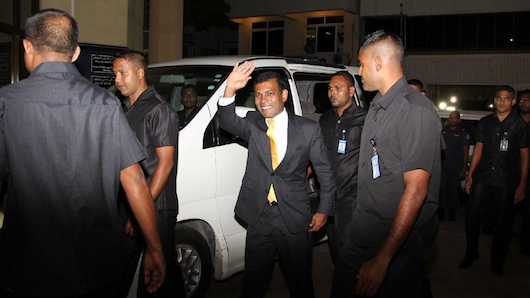
Comment: A climate hero languishes in prison. Let’s fight to get him out

This article is by Bill McKibben. It was first published on April 16 on www.commondreams.org

The underwater pictures from the Maldives last weekend brought back a staggering rush of memories.

In 2009, when 350.org was still a fledgling organization and not the world’s largest grassroots climate campaign, we’d called for our first global day of action. All around the world people rallied in iconic locations, from the summit of Antarctica’s highest mountain to the middle of Times Square. There were 5,200 demonstrations in all, in what CNN called ‘the most widespread day of political activity in the planet’s history.’ But maybe the most memorable was from the Maldives.

Or rather, from below the Maldives. Where newly elected president Mohamed Nasheed, who had taught his cabinet to scuba dive, convened their regular meeting underwater, on the edge of their threatened coral reef. There they signed a proclamation to the UN, asking that it work to lower the level of carbon in the atmosphere.
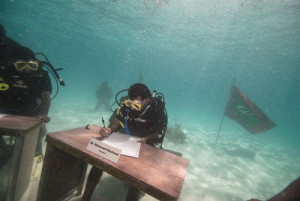
Underwater Cabinet

That picture helped bring home the newly dawning truth of global warming—that entire nations like the low-lying Maldives were on the edge of extinction. It also marked Nasheed as the most committed head of state in the climate fight.

But that’s not all Nasheed represented. He’s also the Mandela of the Indian Ocean, the man who through long years of nonviolent resistance freed his nation from a long tyranny and won its first democratic election.

That thug government just receded into the shadows, though, and a few years lateroverthrew Nasheed in a military coup. And now it has jailed him for 13 years on absurd charges of terrorism after a trial that would have delighted Kafka—among other things, the presiding judges were also witnesses against the accused.

The long-suffering people of the Maldives are fighting back, though—peacefully, with massive demonstrations night after night in the streets of Male. And over the weekend, a hundred of them dove down to the reef with scuba tanks, and with banners demanding Nasheed’s release. The picture—a purposeful echo of the moment when he made the world notice his embattled archipelago—should alert the planet once more.

There are signs of international support beginning to emerge. Maybe most significantly the renowned human rights lawyer Amal Clooney (yes, that Clooney) has joined his defense team, bringing both great skill and a bright spotlight. But much more is needed.

For one thing, though Nasheed and his colleagues have not called for a tourist boycott, it’s hard to imagine anyone with a conscience wanting to support the goons running the country at the moment. Its beaches are indeed beautiful—but they will be more beautiful once the Maldives have returned to democratic rule.

Our leaders, too, need to act. India, America, the EU all need to be firm in the demand for Nasheed’s safety (there are great fears for his life as he returns to the prison where he’s already spent so many years) and for his release.

For those of us in the worldwide climate movement, this is not just a moment to stand by one of our own. It’s also a good reminder that we need working, inclusive, democratic governments if we are to make real progress. The autocrats now running the Maldives of course abandoned the Nasheed government’s remarkable plan to turn the nation carbon-neutral and even offered to drill for oil in the surrounding waters; as in so many places around the world, tyranny and fossil fuel have a friendly working relationship.

The Maldives is existentially imperiled by a rising ocean. But before it can fully deal with that predicament it needs its voice back. At the moment that voice is languishing in prison.We all should work to get him out.

Bill McKibben is the Schumann Distinguished Scholar at Middlebury College and co-founder of 350.org. His most recent book is Eaarth: Making a Life on a Tough New Planet.

All comment pieces are the sole view of the author and do not reflect the editorial policy of Minivan News. If you would like to write an opinion piece, please send proposals to [email protected]

Likes(3)Dislikes(0)

Police in row with opposition MP over tweet

Police have accused opposition MP Rozaina Adam of posting a photo of a police officer on Twitter to intimidate security personnel.

Rozaina had accused the officer in question of obstructing her car on Wednesday night while she was heading to the parliament for a committee meeting.

The MDP said in a statement today that police officers had refused to remove a barricade set up near Dharumavantha School to allow Rozaina’s car through.

When one officer tried to let the car pass, another officer insisted that they must seek permission from a superior officer, the party said.

However, he removed the barricade after talking on a handheld transceiver.

Rozaina posted a tweet with a photo of the officer, her account of the incident, and an article from the parliamentary privileges law, urging police to “keep officers near barricades after teaching them the law.”

“If we are stopped on the way to Majlis, police will have the opportunity to stop us on the road until a vote is taken,” she argued.

However, police said a fire evacuation drill was ongoing at a nearby school at the time and said the officer had informed the senior officer in charge that a car will be passing through as the students were preparing to rush out.

Police criticized Rozaina for posting the photo of the officer, saying her intent was to intimidate, undermine public confidence in police, and bring the institution into disrepute.

The MDP said the police statement was symptomatic of the politicisation of the institution and its senior officers, whom it accused of bearing personal animosity towards opposition MPs.

The opposition party advised senior officers against exerting “political influence” over junior officers and against encouraging illegal actions.

Likes(1)Dislikes(0)

Gayoom’s son seeks PPM ticket for Dhiggaru by-election

Former president Maumoon Abdul Gayoom’s eldest son, Farish Maumoon, is seeking the ruling party’s ticket for the upcoming by-election for the vacant Dhiggaru constituency parliament seat.

The by-election, scheduled for June 6, was triggered by the conviction of former Progressive Party of Maldives (PPM) MP Ahmed Nazim on corruption charges. The Supreme Court sentenced Nazim to 25 years in prison on April 6 for defrauding the state of MVR1.4 million (US$91,400).

Ahead of a 4:00pm deadline today, four others have submitted applications to contest the primary, including Meemu atoll councillor Moosa Naseer, Imran Ismail, Moosa Naseer Ahmed, and deputy environment minister Mohamed Hanim.

The candidates are to be first vetted on their loyalty to the party, role in campaigning for the party’s candidate in the 2013 presidential election, and the duration of membership in the party.

A primary will only take place if more than one candidate receives over 75 percent or higher.

The opposition coalition, made up of the main opposition Maldivian Democratic Party, religious conservative Adhaalath Party, and leaders of the Jumhooree Party, are meanwhile holding discussions on fielding a single candidate.

Adhaalath spokesperson Ali Zahir told the press today that he will contest the by-election.

Likes(0)Dislikes(0)

Second victim of link road accident dies

A second victim of a motorcycle accident in southern Addu City died while undergoing treatment in India last night.

Ahmed Sammah, 20, suffered severe head injuries in the accident on Addu City’s link road on April 1o.

Mamdhoon Ahmed Ali Didi ‘Mandey,’ who was sitting on the back seat of Sammah’s bike died within a few hours of the accident. He had also suffered severe head injuries.

Sammah was treated at the Hithadhoo Regional Hospital and Malé’s Indhira Gandhi Memorial Hospital before he was flown to India on April 12.

The accident occurred when Sammah attempted to overtake a car.

His death is the third fatality in Addu this month. A 16-year-old victim of an accident died of injuries on March 30 while undergoing treatment at the regional hospital.

Hussein Hilmy, an Addu City councillor, said more police officers are needed to effectively control traffic.

However, police said most accidents in Addu City were caused by speeding rather than traffic congestion.

Likes(0)Dislikes(0)

Visiting specialist doctors to improve healthcare services

The government is enlisting the services of visiting specialist doctors to improve healthcare services in the Maldives.

The ‘Super Specialist Service’ will employ neurologists, cardiologists, urologists, neurosurgeons, ENT doctos and pediatricians to provide consultations in different parts of the country.

The CEO of the national social protection agency, Mujthaba Jaleel, said twenty two foreign hospitals registered with the government’s health insurance scheme, Aasandha, have applied to send specialist doctors to the Maldives.

The visiting doctors will improve healthcare for people suffering from serious conditions, he said.

“Teams of Super Specialists have arrived today morning and have started work at the blood services unit and the Thalasseimia center. Some will start work at hospitals in the north and south tomorrow,” Mujthaba said.

President Abdulla Yameen inaugurated the Super Specialist service on Wednesday and handed over agreement copies to the overseas hospitals contributing to the super specialist program.

Likes(0)Dislikes(0)

Comment: International community must not ignore the plight of ‘Mandela of the Maldives’

The following op-ed was written by Anders Henriksen and Lykke Friss from the University of Copenhagen and first appeared on The Conversation. Republished with permission.  

This year has been anything but tranquil in paradise. In March, after a prolonged period of tension in the Maldives – the Indian Ocean island nation better known as a honeymoon paradise – a panel of judges found the former president, Mohamed Nasheed, guilty of terrorism and sentenced him to 13 years imprisonment.

The international community has condemned Nasheed’s trial as a farce. The charges against him were highly dubious, he was denied the right to legal counsel, given just a few days to prepare his defence – and two of the presiding judges even testified on behalf of the prosecution. Amnesty International labelled the trial as “a travesty of justice”.

As numerous UN reports have shown, the Maldivian judiciary is highly corrupt. It is a judiciary that is loyal not to the rule of law, but to the regime that has been in charge since a coup d’état in 2012. Nasheed is now back in the same jail where he spent years as a prisoner of conscience during the former Maldives dictatorship.

Shattered dreams

At the end of 2008, when democracy swept aside 30 years of dictatorship, it all looked so promising. The Maldivian people chose Nasheed as president in their first democratic elections and, for a brief moment, freedom blossomed.

During Nasheed’s presidency, Maldivians could speak freely for the first time, enjoy new found political freedoms, and express themselves through art and culture. Internationally, the charismatic new leader gained fame for his remarkable efforts to persuade the world to combat climate change, which threatens low-lying Maldives. Nasheed toured the world as a political rock-star, receiving accolades from the White House to Windsor Castle.

But it did not take long for the old regime to move against the young democratic government. On February 7 2012, Nasheed was forced to resign and the presidency was handed to Mohamed Waheed, a puppet of the former regime. The Maldivessoon reverted to type: journalists were targeted, protesters beaten up, and opposition politicians threatened and murdered.

The subsequent presidential elections 2013 were marred by widespread allegations of vote-rigging. The former dictator’s half brother, Abdulla Yameen, won – despite an overwhelming expectation that Nasheed would be returned.

Democracy trampled

Nasheed’s incarceration should be cause for concern to anyone who cares about democracy, liberty or the rights of women. In the Maldives, the moderate, freedom-oriented version of Islam that Nasheed espoused is under threat from a regime that colludes with Islamic extremists.

Unless the current trajectory is turned, the liberal forces in the countries will lose the on-going battle with fundamentalist Islam. In the last year alone, Islamic State supporters have rallied in the streets of Male, the Maldivian capital, and a growing number of Maldivians – some with experience of terrorist training camps in Pakistan – have gone to Syria to fight for Islamic State. Only Nasheed and his Maldivian Democratic Party have been willing to tackle the growing problems of Islamic radicalism.

There are few statesmen of Nasheed’s stature. Many foreign journalists, with good reason, refer to him as the “Mandela of the Maldives”. In the interests of democracy and stability, the international community must take a clear stand. Unless Nasheed is swiftly released from prison, the European Union and other nations should impose targeted sanctions against those in power.

These sanctions should include travel bans and foreign asset freezes. The sanctions should target President Yameen, his cabinet ministers, including the minister of tourism, and the corrupt judges who imprisoned Nasheed, and members of the security forces responsible for attacks on peaceful protesters.

Furthermore, since the survival of the regime depends on the annual arrival of the more than a million foreign tourists, individual countries should also supplement sanctions with a tourism boycott. Just like potential tourists should think twice before spending their money on the atolls. Yameen’s regime is baring its teeth. It is time for the international community to respond in kind.

Anders Henriksen is an associate professor of public international law and Lykke Friis is the prorector for education at the University of Copenhagen.

All comment pieces are the sole view of the author and do not reflect the editorial policy of Minivan News. If you would like to write an opinion piece, please send proposals to [email protected]

Likes(6)Dislikes(0)

Dismissed principal to sue education ministry

The former principal of Aminiya School has said she will sue the education ministry for unfair dismissal.

Athiya Naseer was sacked on Monday without warning after the education ministry deemed her a threat to the school. Her dismissal sparked outrage with dozens of teachers signing a petition demanding an explanation from the ministry.

Speaking to Haveeru today, Athiya said she was “shocked” by the dismissal and said: ““Honestly, I have no idea what the issue is.”

Aathiyaa said in her four years as the principal, the only “damages” she had caused were increasing the number of students who passed tenth grade exams and improving the students’ discipline and the school’s reputation.

Several teachers have alleged the move was politically motivated as Athiya is the wife of former opposition MP Ahmed Abdulla.

Parents of students attending Aminiya school have also criticised the education ministry’s decision. Some students told Haveeru they saw Athiya more as a friend than a principal.

The education ministry has declined to comment on the issue.

Likes(3)Dislikes(1)

Police dogs to be used at airport and seaports

Police are planning to conduct operations to combat drug smuggling using its new dog squad at the country’s airports and seaports.

The Maldives Police Service signed Memorandums of Understanding with the ports authority, airports company, immigration department, and the customs authority yesterday to use the sniffer dogs to locate drugs.

The MoUs outline mechanisms for relaying information, conducting joint operations, and sharing resources, according to police.

In an exclusive interview with Minivan News last year, home minister Umar Naseer said tackling the country’s entrenched drug problem was his main priority and vowed to “seal” the gateways to the Maldives.

Likes(1)Dislikes(0)

Dead man found in city park

A man has been found dead at the city park on Alikilegefaanu Magu in Malé around 9:40am this morning.

Police have identified the deceased as Ahmed Nazeem, 27, from Fuvahmulah, but said the cause of death remains unclear.

Police took the body to the Indira Gandhi Memorial Hospital, where doctors pronounced him dead upon arrival.

An elderly man was meanwhile found dead in the lagoon of Raa Alifushi today.

According to local media, the man was over 65 years of age and was found around 8:40am.

An island councillor said it was unlikely that the deceased, identified as Alibe from the Kinaaraa house, had gone swimming.

Likes(1)Dislikes(0)