Profits from resorts that serve alcohol are haram, explains Dr Zakir Naik

Visiting Islamic speaker Dr Zakir Naik clarified during a question and answer session this morning that profits generated from the sale of alcohol are haram (prohibited), and urged the Maldives to encourage investment in halal (permitted) tourism.

“In Islamic finance, you cannot involve in any business as the owner of that business if it is even one percent a haram activity,” Dr Naik said.

“As a main partner you cannot be involved. If you are investing as a pool and you are a small partner, then a little bit is permitted, but as a 100% owner I cannot say ‘fine, I will have a hotel that will allow alcohol, and that money I will give to charity.’ You cannot say that. Because you are involved in haram activity.”

It was permitted, Dr Naik explained, to invest in part in a mutual fund where a haram activity might be a small percentage of the investment, as “then I can give the small amount to charity, because I have no major say in the business. But if I am a bigger shareholder, I cannot allow even 0.1% of haram activity to take place.”

Under Islam the use, handling and sale of alcohol are considered haram to Muslims, a tenet that led to vigorous opposition against the government’s attempt in February to legalise the sale of alcohol to non-Muslims on inhabited islands. Critics of the regulations claimed they were unconstitutional, as Article 10(b) of the Maldives’ Constitution states that ‘no law contrary to any tenet of Islam shall be enacted in the Maldives..

However the country depends heavily on tourism for its economy, particularly resorts which profit from the sale of alcohol, many of which are owned by local businessmen.

Dr Naik, who is speaking tonight and tomorrow at Maafaanu Stadium, after being invited by the Ministry for Islamic Affairs, questioned why the Maldives had no resorts that were “100 percent halal.”

“Your country is so beautiful. I have visited many countries in the world and I have to profess, the islands in Maldives are par excellence. I’ve been to many parts of the world, been to many top resorts in the world, but the one where I am staying in the Maldives is par excellence. Allah has blessed you with such beauty, scenery and natural resources,” he said.

“I put forward the proposal that why don’t we have an Islamic resort? I’m aware the Maldives prohibits alcohol for citizens, but those people who come from outside the Maldives can have access to these things which are haram for Muslims.”

Such resorts, he suggested, should be “exclusively halal, free of pork and alcohol, and with proper segregation and dress code – it will be a benefit.”

Similar segregated, alcohol and pork free hotels in other parts of the world had proven very successful, he explained, “with revenue far more than other hotels. The same thing can be done here.”

“The income for people investing in such Islamic resorts will be much higher,” he suggested. “I have spoken to government officials about it, and they say Inshallah, they look forward to it. Believe me it will attract more tourists very soon, in the next couple of years, with better revenue and a better profit.”

State Minister for Islamic Affairs Sheikh Mohamed Shaheem Ali Saeed has similarly argued for promotion of Islamic “cultural tourism” within the Maldives, noting that “a lot of hotels, such as the Intercontinental in Medina, are without alcohol. What about developing alcohol-free resorts; Islamic tourism, just like Islamic banking?”

Dr Zakir Naik is speaking at an event at Maafannu stadium tonight and tomorrow, at 8:45pm.

Likes(0)Dislikes(0)

Ali Waheed reports leaking of documents to police, “too late” says Zuhair

Dhivehi Rayyithunge Party (DRP) MP Ali Waheed has also reported the leakage of several document concerning the Guantanamo Bay detainees to police. The Foreign Ministry said it was reporting the matter to the police on Tuesday.

Press secretary for the President Mohamed Zuhair said that Waheed was trying to escape after he was accused of being the recipient of a stolen secret document of the government.

Zuhair claimed Waheed had reported the case because ”he realised what he had done.”

”All the collaborators involved in the crime of stealing a government document and spreading it without clarifying its validity are also equally culpable,” said Zuhair. ‘They should be given the punishment that one receives for being a thief.”

Zuhair said the theft of the documents was a crime under articles 12 and 13 of the penal code.

”Politics is not an excuse for crime,” he said. ”Whoever stole the documents is a criminal shall be treated as a criminal.”

He said that government was not trying to bring Guantanamo Bay detainees into the country in secret.

”We will only bring him according to the law,” he said. ”What is the problem with it if he has a valid passport, the threat of being attacked if he goes back to his own country and he is a innocent Muslim?”

He said that Ali Waheed was aware the matter was not unlawful or dangerous, and dismissed counter-claims by the opposition as ”pure political circus”.

”That man [Waheed] has the look of a comedian,” Zuhair said.

Waheed, in a press conference yesterday, announced that he had reported the leaked document to police and said he had requested they investigate the case, so the government’s documents could be safely protected while the National Security Committee was investigating the Guantanamo Bay affair.

”I did not steal anything,” he claimed. “When I received government documents that I believed had the potential to harm the national security of the country I presented it to the national security committee to investigate,” he said.

”I do not believe that it is known as thieving. It was not leaked by my mistake.”

Foreign minister Dr Ahmed Shaheed has also reported the case to the police.

Dr Shaheed said the documents consisted of unofficial communications to the Maldives government from the US government, and a document sent to the Attorney General’s office by the Foreign Ministry.

Dr Shaheed said the documents also included an unofficial letter sent from the US discussing how a legal framework could be established to bring in the detainees.

Press Secretary for the President Mohamed Zuhair has recently said that the document was not leaked but was “deliberately stolen”, which he said caused “a lot of trouble” for the Maldives, by disrupting diplomatic relationships between countries.

Likes(0)Dislikes(0)

Foreign Ministry accuses Nihan of “creating mistrust” over Gitmo claims

The Ministry of Foreign Affairs has accused DRP MP Ahmed Nihan of “irresponsibly” spreading false rumours that Guantanamo Bay detainees had been secretly brought to the Maldives, calling his claims “not only false but designed to mislead the public and create mistrust.”

Nihan yesterday claimed he was “99.99 percent sure” that the detainees had already been brought to the Maldives, an assertion the government has “categorically rejected”.

“The Maldives government, last December, publicly announced its intention to contribute to the closure of the Guantanamo Bay detention facility by receiving a few innocent detainees in the Maldives,” the Ministry said today in a press statement.

“The governments of the United States and the Maldives are carrying out bilateral discussions to establish the legal framework within which the humanitarian transfer will take place, in full compliance with the laws of the two countries, and in manner that will ensure that the persons invited to the Maldives will not a pose a security threat to the Maldives,” it added.

Accepting detainees would “directly contribute to the enhancement of the national interests of the Maldives, through promotion of human rights and solidarity with fellow Muslims, and strengthening partnership with countries who cherish freedom and human dignity,” the Ministry said.

Nihan, who said he was on his way to Mecca for a pilgrimage, today claimed that “a press statement is not enough to prove I’m wrong.”

“I wonder why they are so worried about what I said?” he asked, accusing Foreign Minister Dr Ahmed Shaheed of “speaking in double tongue.”

Nihan argued that the government had not been open with the public on the matter, saying “I’m sure the government can clarify that 0.01 percent. Parliament’s National Security Committee will be requesting information from immigration regarding people who had visited the Maldives with improper passports.”

He said the government, “especially President Nasheed and the Foreign Minister Dr Shaheed”, “should be more open to the public regarding the Guantanamo Bay issue if they really want to prove that the gitmos are not here already.”

Likes(0)Dislikes(0)

“Bad effects” if Dhivehi and Islam made optional, warns State Islamic Minister

State Islamic Minister Sheikh Mohamed Shaheem Ali Saeed has warned on the Adhaalath Party website that making Dhivehi and Islam optional subjects at A-Level would risk “bad effects” to the country.

Shaheem said that changing the subjects from compulsory to optional was one of the biggest disputes regarding the new developing school curriculum.

”In my view it would wiser to instead revise the school curriculum and keep Islam and Dhivehi as compulsory subjects,” said Shaheem.

He recommended that A-Level Islamic studies be improved through the inclusion of topics such as ‘human rights in Islam’, ‘freedom of expression in Islam’, and ‘the Quran and science.’

”It would prove to the students that Islam is a religion fit for all ages, and will lead students to understand how developed it is,” Shaheem said.

He said that changing Islam and Dhivehi to optional subjects was like ”breaking down a good habit attached to the country.”

He said the school curriculum should be designed in a way that would make Islam an interesting subject for students.

”We do not have to demolish mosques because people do not pray,” he said.

The controversial decision to make Dhivehi and Islam optional subjects for A-Level students has sparked a series of protests outside the home of Education Minister Dr Mustafa Luthfy.

Dr Luthfy recently said the decision was not finalised and was ”just a suggestion proposed by the Education ministry’s steering committee.”

The move led Independent MP Ibrahim Muthalib to push a no-confidence motion against the Education Minister over the decision, while the Adhaalath Party meanwhile warned that Dr Luthfy “has put the final nails in his political coffin.”

Likes(0)Dislikes(0)

PA membership drops to less than 3000

A political party membership report published by the Elections Commission (EC) shows that the membership of People’s Alliance (PA) has dropped to less than 3000.

The EC recently sent a bill to parliament that if passed, will mean any political party which does not have a minimum of 3000 members will dissolves by default.

The EC report, published on May 20, indicates that the PA now has 2986 members, 35 less than the previous report published on May 13.

President of the EC Fuad Thaufeeq said that after the bill is passed any political party with a membership of less than 3000 would be given a period of one year before it was disbanded.

He said that he did not know when the bill would be passed and implemented.

PA Registrar Mohamed Rasheed said the party had sent 250 membership forms to the EC which would take the membership number above 3000.

”We focus to maintain the membership at least at 3000,” Rasheed said. ”As we are in a coalition with the DRP we don’t do much work to increase the number of members.”

Rasheed said that people have always been resigning and joining the party.

”400 people may resign within a week,” he said, ”another week 800 people may join.”

The Dhivehi Rayyithunge Party (DRP), led by Ahmed Thasmeen Ali, has the highest amount of members according to the EC report, ahead of the Maldivian Democratic Party MDP by 2036 members.

The DRP hada  total of 38,254 on the last report, which was 191 members less than the previous report.

MDP had 36,218 members in it, 1185 members more than the previous report.

The Jumhoory Party lead by Gasim ‘Buruma’ Ibrahim was the third largest political party with 6204 members.

Likes(0)Dislikes(0)

Doubling salary spend in 2007-09 crippled economy: World Bank

An internal World Bank bank report produced for the donor’s conference, called ‘Placing the Macro Challenge Facing the Maldives in Context’ has revealed the full extent of the economic challenge facing the country.

“The Maldives faces the most challenging macroeconomic situation of all democratic transitions that have occurred since 1956,” the report claims, noting that the full level of financial strife “may not be fully appreciated.”

In terms of GDP growth rate the Maldives is in the lowest 10 percent of the distribution of all transitions, and in terms of public sector deficit, the Maldives faces the worst situation of all previous democratic transitions.

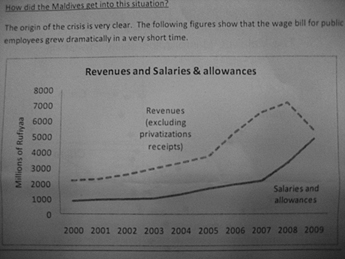
Under the heading ‘How did the Maldives get into this situation?’, the World Bank report notes that “the origin of the crisis is very clear… the wage bill for public sector employees grew dramatically in a very short time.”

An accompanying graph of the country’s total spending on ‘salaries and allowances’ shows a doubling of expenditure between 2003 and 2007, and a sharp increase between 2007 and 2009 as spending more than doubles yet again from Rf2 billion to almost Rf5 billion. Revenues meanwhile plummet steadily during 2008.

worldbanksitrep
Inflated spending on salaries in 2007 sparked an economic crisis

“Even before government revenues fell and when government revenues were at an all time high in 2008, the ratio of the wage bill to revenues at 46.5 percent was also at an all-time high (46.5 percent compared to an average of 38.1 percent between 2000 and 2007). When revenues plummeted in 2009, the share of the wage bill to revenues rose an astronomical 89 percent,” the report explains.

“While part of the increase was due to hiring more workers, the major part of the increase was due to the increase in compensation,” it said.

Increases to the salaries and allowances of government employees between 2006 and 2008 reached 66 percent, “by far the highest increase in compensation over a three year period to government employees of any country in the world,” the report noted.

Spokesman for the Civil Service Commission (CSC) Mohamed Fahmy said the increases needed to be considered in the context of “the total budget situation”, and were in line with government expenditure during the period.

“We have a tradition of salary increases every other year,” he said, rather than an annual increase based on inflation.

Those paid by the government included not only civil servants, “but political appointees, commissions, the judiciary”, he emphasised.

“Our case all long has been that everyone employed by the government has to be treated equally,” Fahmy said.

“If the government does not have the money to pay in full, then whatever it does have has to be paid out in an equitable manner that upholds the constitution. Everybody has to be treated equally – it is very important to make that distinction.”

World’s greatest tax haven

Meanwhile, the World Bank’s annual ‘Doing Business’ report for 2010 saw the Maldives’ ‘ease of doing business’ ranking fall from 71 to 87, and identified no ‘business-friendly’ reforms. The report acknowledges the Maldives as the world’s number one tax haven, although this could soon change if a pending bill on taxation is passed by Parliament.

Countries with successful business reforms “follow a longer-term agenda aimed at increasing the competitiveness of their firms and economy,” the report noted.

“But while successful reformers follow a clear direction in their policy agenda, they do not hesitate to respond to new economic realities,” it said. “Mauritius, the top-ranked economy in Sub-Saharan Africa, just announced a new insolvency act ‘to maintain the viability of the commercial system in the country.'”

The top countries in which to do business are Singapore, New Zealand and Hong Kong, the report noted.

Correction: An earlier version of this story described Mohamed Fahmy as a member of the ‘Civil Service Association(CSC)’.  Fahmy is a member of the Civil Service Commission (CSC).

Likes(0)Dislikes(0)

Leaked Gitmo documents spark police investigation

Foreign Minister Dr Ahmed Shaheed has said the ministry yesterday asked police to investigate the case of leaked documents concerning Guantanamo Bay detainees.

Dr Shaheed said the documents consisted of unofficial communications to the Maldives government from the US government, and a document sent to the Attorney General’s office by the Foreign Ministry.

Dr Shaheed said the documents included an unofficial letter sent from the US to discuss how a legal framework could be established to bring in the detainees.

”The documents were sent to Parliament’s National Security Committee by an MP,” Said Dr Shaheed. ”MP Ali Waheed was the person who first spoke about these documents.”

Dr Shaheed said that the person who leaked the documents and delivered them to MPs was responsible for the act.

”The Maldivian government has not officially agreed to bring in the detainees,” he said. ”It is just at an early stage and a group of people who do not properly understand the matter are worried and concerned.”

Independent MP Mohamed Nasheed said the government’s desire to investigate the case was “stupidity and weakness”, ”as there are more concerning issues than the leaked document.”

Nasheed claimed to have seen the documents, summarising the communication in his blog and identifying it as an official diplomatic document sent by the US government to the Maldivian government.

”The government cannot take action against the person who leaked the documents,” said Nasheed. ”There is a law allowing people to inform others if an unlawful activity was going on inside the area in which he or she works, and according to that law, no action can be taken against that person.”

Nasheed said the letter to the AG from Foreign Ministry revealed that the government has already agreed to bring the Guantanamo Bay detainees in the country, but legal advice was needed on the matter.

”That was an official agreement and they are just pretending to make it an ‘early stage negotiation’,” Nasheed said.

He added that the document from the US government consisted of a list of things it believed had been been agreed by the Maldives, and was requesting confirmation.

”One of the leaked document gives information that the former inmate’s communication will be under surveillance and they cannot leave the Maldives,” Nasheed said.

Press Secretary for the President Mohamed Zuhair said that the document was not leaked but was “deliberately stolen”.

Zuhair said anybody who stole the documents has causes “a lot of trouble” for the Maldives, by disrupting diplomatic relationships between countries.

”Now the US government may think that we deliberately leaked the document,” Zuhair said. ”The recipient should be aware that it is unlawful to have a leaked document of the government and should have clarified whether the document was the original before distributing it to everyone.”

Zuhair said the US government had approached the Maldives to handle two detainees from the Guantanamo Bay prison.

”One of them was a man born in the West Bank,” he said. ”We do not have the information on the other person yet,”

He said the Maldives would be receiving “numerous benefits” for accepting the two detainees from Guantanamo Bay prison.

Likes(0)Dislikes(0)

Claims of citizenship for Guantánamo detainees are “total lies”, says Attorney General

Attorney General Husnu Suood has described a claim by the Opposition Dhivehi Qaumee Party (DQP) that Guantánamo Bay detainees will get Maldivian citizenship as  “a total lie.”

After a meeting with the US Ambassador in Colombo last week, DQP has said the agreement between the US and Maldivian government involves granting citizenship to any detainees resettled in the country.

AG Suood said negotiations were still at a very “early stage” and added that claims of the government giving citizenship to foreign detainees were fabricated.

“We are not obliged to give citizenship to foreigners,” he said, noting the same guidelines would apply to a foreign detainee as to any other foreign national wishing to acquire Maldivian citizenship.

He said “we are still in the preliminary stages of negotiation between the Ministry of Foreign Affairs, the US Embassy and the governments,” and currently there is only “a basic text, a draft proposal” of the regulations and procedures for resettling Gitmo detainees in the country.

The AG’s office and the Ministry of Foreign Affairs will then make comments on the draft. “Based on that,” Suood said, “the ministry will negotiate.”

One of the conditions proposed by the US states that the Maldivian government shall “conduct surveillance on the prisoners while they are in the country, including monitoring their phone calls, letters and other communications.”

Additionally, they must “prevent them from leaving the country.”

Suood said “that’s what we’re seeking to clarify, how we deal with [the former inmates]”, and added that their comments and concerns would all be sent to the US Embassy before the transfer was formally accepted.

“There is no concrete agreement between the two countries as of yet,” he noted.

Press Secretary for the President’s Office, Mohamed Zuhair, said “the government of Maldives supports President Obama’s plans to close Guantanamo,” adding that “a Palestinian gentleman is due to be transferred from Guantanamo to the Maldives.”

He said “the United States has cleared this Palestinian man of any association with terrorism or any violent activities,” and have also confirmed “he has no criminal charges pending against him.”

He noted the man could not return to the Middle East due to his association with Guantánamo, and it is feared his life will be in danger if he is sent back.

“We should support innocent Palestinians. As a people, they have suffered so much injustice,” Zuhair said. “I hope when he arrives in the Maldives, we will treat him as he should be treated: as a victim who has been jailed for many years even though he has committed no crime.”

Minister of Foreign Affairs, Dr Ahmed Shaheed, said the identity of the prisoner “has not been confirmed yet,” and added it will only be confirmed once the National Security Committee has concluded its meetings and have cleared the detainee of any charges.

He said “it will take some time” until the committee concludes its inquiries, as they have to “look at files and go through the process they require.” Dr Shaheed said after the legal framework is looked at, they can start assessing individual detainees.

Dr Shaheed did not attend a committee meeting held today.

He said although the Palestinian man Zuhair referred to was “one of the candidates” to be transferred to the Maldives, “it is not confirmed.”

Citizenship for detainees was not something the government was discussing yet, he said.

“I’m not saying we will do it or not,” he said, adding it would only be raised after the legalities of the transfer were cleared.

He added the transfer of detainees to the country was being looked at as “temporary,” like a “half-way stop” for the detainees, and not something permanent.

MPs meet US High Commissioner

A number of MPs met with the US High Commissioner today, said Dhivehi Rayyithunge Party (DRP) MP Ahmed Nihan.

Besides Nihan, Maldivian Democratic Party (MDP) MP Abdul Gafoor, Jumhoory Party MP Gasim ‘Buruma’ Ibrahim, DQP MP Riyaz Rasheed and Independent MP Mohamed Nasheed participated in the meeting.

Nihan said “very important doubts about the Gitmo issue were clarified by the American High Commissioner.”

“We exchanged information between the High Commissioner and MPs,” he said, noting “the High Commissioner gathered us to see our opinion on the issue.”

Nihan said in the meeting he highlighted how poor the communication is between people and the government, adding “the administrative decision was made inside the ‘smoking room’ of the president and not in the Cabinet.”

He said President Mohamed Nasheed never discussed the detainee issue with either Vice President Dr Mohamed Waheed or the Cabinet.

“He always presents decisions in the cabinet meetings,” Nihan said, “but he did not discuss it with anyone before deciding.”

National security committee meeting

Parliament’s National Security Committee held their first meeting on the resettlement of Guantánamo Bay prisoners in the Maldives on Sunday, after it was postponed last week by Speaker of Parliament, Abdulla Shahid.

There are still more meetings to be held on the issue, as they need to hear from more government officials and police.

AG Suood said he was meant to attend a meeting tomorrow, but it has now been cancelled. He said he was asking the Majlis to look at Article 5 of their rules of procedure, which says “any summons should be in writing and signed by the Speaker.”

The AG said he and the foreign minister received letters of summons from Parliament, but “they were signed by a legal council” and not the Speaker. “We are seeking clarification,” he said.

The US Embassy in Colombo said they could not confirm or deny whether DQP members met with the ambassador last week, and could not say whether they spoke about the transfer of detainees or the issue of citizenship.

Leader of the DQP, Hassan Saeed, did not respond to Minivan News at time of press.

Likes(1)Dislikes(0)

Adhaalath slams Haveeru for publishing alcohol ad

The Adhaalath Party has attacked daily newspaper Haveeru for publishing an apparent advertisement for alcohol in its May 19 edition, calling on “concerned authorities” to investigate the matter.

The party claimed this act of Haveeru news violated article 27 of the Constitution, guaranteeing freedom of expression “subject to the tenets of Islam.”

” The ad consists of a label of a certain brand of whiskey and had no name or contact number associated with it,” the  Adhaalath Party said on its English-language website.

The party claimed it was “surprised and shocked” that as the Maldives is a 100 percent Muslim nation, such an act should not happen  “since all the ads published in the local newspapers are screened for conformity with the laws and regulations of the country.”

The party said the issue was “very serious” and warned it could “disrupt the peace and harmony of the country.”

Editor of Haveeru Moosa Latheef said the newspaper did not advertise alcohol.

”It was a notice sent to us by a whiskey-producing company,” Latheef said. ”The notice was to inform people that the usage of their brand name fraudulent and unauthorised.”

Latheef said that the newspaper had mistakenly failed to include the written notice and published only the whiskey picture.

”Yesterday we wrote that we missed the notice and it was a mistake,” Latheef said. ”We will not promote alcohol in the country.”

Likes(0)Dislikes(0)