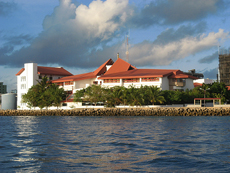
Senior figures at Male’s two major hospitals have claimed the institutions could “run into difficulties” supplying certain medicines and services if the current currency crisis in the country continues, although stocks are currently sufficient.
Amidst a controversial government decision to devalue the rufiya against the US dollar in order to address the black market dealings for foreign money, businesses such as flight providers have also claimed to be facing difficulties in providing their services.
In this market place, ADK Hospital Managing Director Ahmed Afaal said that ADK Enterpises, the hospital’s parent company, had raised concerns about the availability of dollars to purchase certain medicines for its pharmacy operations.
“At the moment, the hospital has stock for our needs. Yet if we cannot get enough because of a lack of dollars we may run into difficulties in the future,” he said. “For the time being, we have enough medicines to treat patients, although some medicines may become difficult to find at our pharmacies.”
Cathy Waters, Chief Executive of Indira Gandhi Memorial Hospital (IGMH), agreed that concerns over the availability of dollars may hamper the hospital’s efforts to purchase medical goods and services in the short to medium-term, though she believed payment of the expatriate workers vital to running health centres was a greater problem at present.
“My biggest concern is how [this financial situation] may impact our ability to employ expatriate workers, as well as pay for certain goods,” she said. “We are particularly dependent on an expatriate workforce at the hospital and these workers are particularly aware of the dollar situation in the Maldives.”
According to Waters, expat staff had already raised concerns about difficulties they have experienced in sending dollars abroad to support their families – a key reason many initially accepted work in the Maldives.
Waters said she believed the hospital could also face ongoing problems in covering the costs of imported medicines and other services, despite supplies currently meeting needs.
Requests had been made to national health authorities to try to find ways to alleviate possible short-term and medium-term supply and payment issues, she added, although she said she had not yet been informed as to what measures might be taken.
The Ministry of Health was not responding to Minivan News at time of press.
However Dr Jorge Mario Luna, World Health Organisation (WHO) representative to the Maldives, told Minivan News that at present there had not been any requests from health service providers in the country concerning possible procurement problems as a result of a shortage of US dollars.
Dr Luna said that the WHO itself did not procure drugs or treatments outside of public health medicines for certain illnesses like tuberculosis or filariasis, yet it was ready to assist health services if required.
“As of today, we have not received any request for emergency medicines due to a procurement problem,” he said. “In case we receive a request, we stand ready to assist.
The government has meanwhile claimed that fluctuations caused by the managed float of the rufiya will stabilise in three months as the market adjusts.
Police have arrested a third female in connection with the prematurely abandoned baby found inside a Coast Milk Tin in Villingili last week.
Police Sub-Inspector Ahmed Shiyam confirmed that the arrest was made.
‘’She’s an 18 year-old female,’’ said Shiyam, adding that investigation was ongoing.
Shiyam said the six month premature baby was discovered after police were informed about the incident.
Yesterday, Deputy Head of police Serious and Organised Crime Department Inspector Abdulla Nawaz told the press that police had arrested a 30 year old woman from Noonu Atoll who was the suspected mother of the baby, and a 24 year old woman from Kaafu Atoll who was alleged to have assisted her deliver the baby prematurely.
Nawaz identified the suspected mother as Aiminath Shaira, 30 of Manadhoo in Noonu Atoll and the 24 year-old woman who allegedly assisted with the abortion the baby as Fathmath Aniya of Hura in Kaafu Atoll.
According to Nawaz, both women live in Male’ in the same house.
Nawaz told media that Shaira had confessed giving birth three days ago but was unable to tell police where the baby was, and that Aniya had confessed to assisting Shaira deliver the baby.
Meanwhile, islanders on Manadhoo told Minivan News they felt “deep shame” as news of the incident circulated.
‘’The island of Manadhoo has a very low profile in crime and it has remained like that for ages, until we heard that an islander of our island has given birth to an illegal child and thrown the baby away,’’ said an islander.
Shaira was a dancer, he claimed.
‘’Others arrested in connection with this case are not related to our island, we hear that they are members of her dance group,’’ he added. ‘’It’s the first time something like this happened concerning our island, we are all in deep shame, especially because people notice this island as an island that maintains a low crime rate compared to all other islands in this atoll.’’
Having a child out of wedlock remains heavily stigmatised in the Maldives. Previous studies conducted in the country by groups such as the International Planned Parenthood Foundation (IPPF) have anecdotally pointed to high rates of illegal abortion, while other studies on HIV risk factors have pointed to high levels of promiscuity and limited use of contraceptives.
The High Court has today ordered the immediate release of former head prison warden ‘Isthafa’ Ibrahim Mohamed Manik, citing that his arrest was unlawful and he was currently not in a position to eliminate evidence as claimed by police.
Isthafa was arrested in Male’ in connection with the investigation of photographs allegedly obtained from the Department of Penitentiary and Rehabilitation Services (DPRS) and leaked to the media, appearing to show inmates being tortured in custody. Police obtained permission to extend his detention to 15 days from Maafushi Court on Friday.
The photos released so far include images of men tied to coconut palms, caged, and bloodied. One of the photos, of a prisoner lying on a blood-soaked mattress, has a 2001 date stamp.
The High Court ruled that Isthafa was required to be summoned to the Criminal Court because he was arrested in Male’.
The decision of the Maafushi Court was inconsistent with systems applied in such situations, and the Supreme Court’s procedures, said the High Court.
The High Court also said that the Maafushi Court warrant to extend the detention of Isthafa noted that the extension warrant was issued to prevent Ishtafa from influencing witnesses and evidence.
Inspector of Police Abdulla Nawaz confirmed in a statement to the state broadcaster MNBC that the matter involved severe cases of torture and suspected fatalities, and had been passed to police.
Isthafa was summoned for questioning by police in March in mid-March 2011, regarding an undisclosed investigation.
Local media reports citing unnamed sources at the time claimed Isthafa had been summoned to clarify information surround the possible death in custody of a prison inmate named Abdulla Anees.
Abdulla Anees of Vaavu Keyodhoo Bashigasdhosuge, was an inmate at the former Gaamaadhoo complex and was officially declared missing in the 1980s. President Mohamed Nasheed has claimed that human bones discovered on the site of the former Gaamaadhoo prison were thought to match the age and estimated period of death of Anees, after sending the samples to Thailand for DNA analysis and carbon dating, and asked police to investigate.
In April the government claimed crucial files relating to the investigation into the Gaamaadhoo bones had gone missing – including the originals kept with the DPRS, and copies stored with police.
State Home Minister Ahmed Adhil told Minvan News at the time that the government had ordered a police investigation into the missing files.
“Police informed the Home Ministry that they have located copies of the files, but the original was held by the DPRS and is still missing. We don’t count copies of papers so we don’t know whether any important documents are missing unless we find that original,” he said.
Adhil said at the time that the Ministry could not yet say whether the files had been misplaced or deliberately removed, although the theft of the documents “is a very close possibility.”
Earlier this month, former deputy leader of the opposition Dhivehi Rayyithunge Party (DRP) Umar Naseer, a key leader in Gayoom’s faction of the DRP, claimed to have obtained information that results of the examinations showed the bones were “over 800 years old.”
”Those bones were first taken to Thailand for investigation and [investigators] said they were over 800 years old,” said Naseer. ”Later the government sent the bones to America, where they also said the same.”
Umar said the investigation into the identity of the bones was now closed, ”but the government will never say that because they want to use it for political purposes.”
Following Isthafa’s arrest, former President Maumoon Abdul Gayoom’s spokesperson Mohamed Hussein ‘Mundhu’ Shareef told Haveeru that the detention of the former head of prisons was the “the third part of the drama” in a long-plotted lead up to the arrest of the former president.
“The attempt to arrest President Maumoon will only boost his profile. We see this simply as the government’s attempt to divert the people’s attention from the dollar crisis and rising commodity prices,” Shareef told Haveeru.
Press Secretary for the President’s Office, Mohamed Zuhair, did not respond to Minivan News at time of press.
The body of a newborn baby boy discovered in a park in Hulhumale’ this morning was found with underwear tied tightly around his neck.
Spokesperson for Hulhumale’ Hospital Dr Ahmed Ashraf said the baby may have died from asphyxiation.
‘’When the baby was found the knot was a bit loose, but the marks on its neck shows that it was tied tightly around the neck,’’ Dr Ashraf said.
Dr Ashraf said the baby was dead when discovered, and was first brought to Hulhumale’ hospital before the police took the body for forensic investigation.
Police Sub-Inspector Ahmed Shiyam said the baby was male and appeared to have competed nine months gestation.
The dead baby is the third to have been found abandoned in the last few weeks. On Friday the corpse of a three-month premature infant was discovered in a Coast Milk tin in Villingili, while on May 5 another premature baby was found in a plastic bag in Male’s swimming track area. A medical examination later concluded that the baby had sustained cuts, bruises and other wounds.
Police have since arrested two women in connection to the discovery of the infant found in the tin, including a 30 year old suspected of being the mother and a 24 year old woman police said had confessed to helping the first deliver the baby prematurely.
In November last year another abandoned newborn was discovered alive in some bushes near the Wataniya telecommunications tower in Hulhumale’. The child was put in the care of foster parents.
Birth out of wedlock remains heavily stigmatised in the Maldives. An unreleased 2007 study by the International Planned Parenthood Federation (IPPF) found that the stigma of having a child out of wedlock compels Maldivian women and girls to opt for abortions, and while a taboo subject, the practice was found to be widespread.
Some of those interviewed for the study said they knew of girls as young as 12 who had undergone abortions, and each knew at least one person who had terminated a pregnancy.
Abortion is illegal in the Maldives except to save a mother’s life, or if a child suffers from a congenital defect such as thalassemia. Many women unable to travel to Sri Lanka resort to illegal abortions performed by unskilled individuals in unhygienic settings, or even induce abdonminal trauma or insert objects into their uterus.
Other studies focusing on HIV have identified associated risk factors contributing to unplanned pregnancy including high levels of promiscuity and limited use of contraception.
Correction: An earlier version of this article stated that the infant was a nine-month old baby. This was a confusing translation and has been clarified as the infant was a newborn.
Deputy head of police Serious and Organised Crime Department Inspector Abdulla Nawaz told media today that police had arrested a 30 year old woman from Noonu Atoll who was the suspected mother of the baby, and a 24 year old woman from Kaafu Atoll who was alleged to have assisted her deliver the baby prematurely.
Nawaz said that police were now examining the body of the 30 year old woman after she confessed to giving birth two days ago but was unable to tell police where the baby was.
The 24 year old had meanwhile confessed that she had assisted Shaira in delivering the baby prematurely, Nawaz said.
Abortion is illegal in the Maldives, although an unreleased 2007 by the International Planned Parenthood Foundation (IPPF) found the practice was believed to be widespread due to the social stigma faced by a woman bearing a child out of wedlock.
The corpse of a premature baby boy was discovered yesterday inside a Coast Milk tin on the island of Villingli, the second abandoned infant found in as many weeks.
Police Sub-Inspector Ahmed Shiyam told Minivan News that the dead child, believed by forensic examiners to have been born three months premature, was discovered in the discarded container near the powerhouse area of the island.
The baby was taken to Indira Gandi Memorial Hospital (IGMH) in Male’ for forensic examination before being buried, according to the police.
On May 5 a dead infant was been found in a plastic bag in the swimming track area of Male’. A medical examination later concluded that the baby’s had sustained cuts, bruises and other wounds.
Shiyam said that yesterday’s discovery of the dead infant on Villingli was not believed by police to reflect an escalating problem in the country concerning child abandonment or abortion. However, he said police did have serious concerns about the health implications for mothers of these abandoned children.
“Although we know this [abandonment] is happening, it is not something we believe is a growing issue. However, we request the public not support people who are thinking of abandoning a baby,” he said. “We are very concerned about the health of the mothers of these children, who are not receiving proper medical treatment or the drugs they may require for recovery.”
Police added that they had not yet made any arrests in connection with the discovery of either body and asked for members of the public with any possible information about the case to come forward.
In November last year another abandoned newborn was discovered alive in some bushes near the Wataniya telecommunications tower in Hulhumale’.
Abortion is illegal in the Maldives except to save a mother’s life, or if a child suffers from a congenital defect such as thalassemia. Several studies on HIV in the Maldives have identified risk factors including high levels of promiscuity and little use of contraception, and anecdotal evidence points overwhelmingly to a high rate of abortion.
In an article on the subject in 2009, Minivan News reported that many women unable to travel to Sri Lanka resort to illegal abortions performed by unskilled individuals in unhygienic settings.
Abortion-inducing pills and injections administered by amateur abortionists are one recourse while others turn to harmful vaginal preparations, containing chemicals such as bleach or kerosene. Although infrequent, some insert objects into their uterus or induce abdominal trauma, such is the stigma of having a child out of wedlock.
The Foreign Ministry of the Maldives has invited a delegation from the International Federation of Journalists (IFJ) to the Maldives “to judge [for themselves] whether the local media is able to meet the needs of the public it serves, and of freedom of expression in the Maldives.”
The invitation was given after the IFJ issued a statement supporting the transfer of assets of the Maldives National Broadcast Corporation (MNBC) to parliament’s Maldives Broadcasting Corporation (MBC).
The MNBC is a 100 percent government-owned corporation that controls the assets of the former State Broadcaster Television Maldives (TVM) and Voice of Maldives (VOM).
In April 2010 the then-opposition majority parliament triggered a tug-of-war for control of the state broadcaster after it created MBC, appointed a board, and then ordered MNBC transfer the assets to the new body. Following a refusal to do so by the President’s Office, a Civil Court ruling last week ordered the transfer take place within 20 days. The government has said it intends to appeal.
“The IFJ has consistently argued the case for public service journalism which is independent of state control and insulated from a dependence on advertising revenue which is known to often impair editorial independence,” said IFJ’s Asia-Pacific Director Jacqueline Park.
“The Maldives Journalists’ Association (MJA), an IFJ affiliate, has placed on record its belief that the empowerment of the autonomous corporation [MBC], which has been designated as a public service broadcaster under Maldives’ national law, is key to raising awareness during a challenging time of transition for the Indian Ocean republic.”
The Foreign Ministry claimed that “Unfortunately the current MBC Board was appointed at a time when the opposition majority of the People’s Majlis was being used for obvious political reasons.”
“However, the government looks forward to the day when the MBC can function as an independent, impartial and objective State broadcaster, backed by an independent and well-respected Board.”
The Maldivian media – including MNBC – is frequently accused of overt political bias favouring one or other of the major political parties, a legacy of decades of autocratic governance and a state-controlled media establishment.
Several opposition-allied MPs and businessmen remain key owners of much of the country’s private media, and visiting journalism trainers have voiced concerns from young Maldivian journalists that senior editorial management obstruct them from reporting ethically.
Iraq Editorial Manager for the Institute of War and Peace Reporting (IWPR), Tiare Rath, observed in September 2010 following a series of journalism workshops that “one of the major issues all my students talked about is resistance among newsroom leadership – editors and publishers.”
“Even if the journalists support and understand the principles being taught, they consistently tell me they cannot apply them,” Rath said.
“This is a very, very serious problem that needs to be addressed.”
Inviting the IFJ to the Maldives, the Foreign Ministry said it requested that the IFJ “only uphold the very principles they espouse when they report on the situation on the ground. In this regard, perhaps it would be useful for the IFJ to send a delegation to Male’.”
Minivan News is currently seeking a response from the IFJ to the Foreign Ministry’s invitation.
Tourism authorities in the Maldives have withdrawn the country from the New7Wonders campaign, after claiming the private company behind the competition began demanding increasingly high fees in order for the Maldives to compete meaningfully for the remainder of the competition.
The decision was made during Tuesday’s cabinet session after weeks of deliberation between the Ministry of Tourism Arts and Culture, the Maldives Marketing and Public Relations Corporation (MMPRC) and industry stakeholders.
State Minister for Tourism Thoyyib Mohamed announced at a press conference on Wednesday morning that the Maldives was withdrawing from the competition “because of the unexpected demands for large sums of money from the New7Wonders organisers. We no longer feel that continued participation is in the economic interests of the Maldives.”
The Maldives has only invested US$12,000 over the lifespan of the campaign, mostly significantly on banners and voting terminals at Male’ International Airport, Thoyyib said.
Minivan News understands that the company behind New7Wonders, the ‘New Open World Corporation’ (NOWC), initially levied a US$199 participation fee upon signing of the initial contract in early 2009.
However, once the Maldives was announced as a finalist, NOWC began soliciting additional fees and expenses not clearly articulated in the original contract, which tourism authorities estimate will cost the Maldives upwards of half a million dollars.
Requests have so fair included ‘sponsorship fees’ (‘platinum’ at US$350,000, or two ‘gold’ at US$210,000 each), and funding of a ‘World Tour’ event whereby the Maldives would pay for a delegation of people to visit the country, provide hot air balloon rides, press trips, flights, accommodation and communications. According to tourism authorities, these services would amount to a total cost to the country’s economy of over US$500,000.
Minivan News understands that NOWC also attempted to charge telecom provider Dhiraagu US$1 million for the right to participate in the New7Wonders campaign – approximately US$3 for every citizen in the Maldives – a fee that was dropped to half a million when the telco complained about the price.
When tourism authorities expressed concern about the skyrocketing cost of participating in the competition, billed as a global democratic selection of the new seven wonders, NOWC expressed sympathy for the Maldives’ economic situation and instructed it to solicit money from the resort industry.
“We require sponsorship if you are going to benefit from a full World Tour visit,” a company representative said in correspondence obtained by Minivan News. “We believe it is perfectly within the financial means of the leading resorts, when combined, to afford this sponsor fee (especially considering the extraordinary image, economic and marketing benefit it brings to the Maldives and therefore to their businesses).”
The correspondence reveals that should the Maldives be unable to provide the money demanded by NOWC, it would be offered an alternative “protocol visit to your capital city, lasting one day. This visit includes the presentation of a certificate to the appropriate authority and a short press conference. The N7W team arrives in the morning and leaves the same day.”
New7Wonders emphasised however that “during our first campaign (for the man-made wonders) all the seven winners had very strong and exciting World Tour visits.”
In the terms and conditions on the organisation’s website concerning participating candidates, NOWC “ultimately decides whether a nominee, candidate or wonder is able to participate and or retain its status in the New7Wonders campaigns.”
Vague terms such as ‘non-compliance’ “may result in the temporary suspension of the participating nominee, candidate or wonder from that country. Persistent or un-remedied non-compliance may result in the permanent elimination of a nominee, candidate or wonder.”
“Essentially we’re paying a license fee for the right to throw a party, at our own cost, for an unproven return,” a senior tourism official told Minivan News, suggesting that claims a billion people were voting in the competition did not add up, as the Maldives had fluctuated wildly between 19th and 2nd and the tally was not transparent.
Furthermore, “any media that drops its price 50 percent at the first complaint is totally unprofessional, and in a mature media market this is considered highly unusual and poor practice. It means they haven’t justified the original cost,” the source said.
Not alone
The Maldives is not the only country to have been stung by surprise demands for sponsorship cash, not clearly outlined in the contract. NOWC reportedly demanded US$10 million in licensing fees from tourism authorities in Indonesia, which had fielded the Komodo national park as a wonder, and required that it foot an estimated US$35 million bill to host the World Tour event.
In February this year, the Jakarta Post reported the country’s Tourism Minister Jero Wacik as stating that the Ministry had received a letter on December 29, 2010 claiming that NOWC would “suspend” Komodo from the list of finalists if it refused to pay the US$10 million license fee.
“It’s not fair and irrational,” Wacik said. “I refuse to be extorted by anyone, including this NGO. I thought these are about votes, if the world votes for it, then it will win, what does that have to do with hosting the event?”
N7W founder Bernard Weber, "filmmaker, aviator, adventurer".
In response, New7Wonders founder Bernard Weber, a Swiss-born Canadian who describes himself as a “filmmaker, aviator and adventurer”, accused the Indonesian Ministry of Culture and Tourism of “reacting with malicious misinformation, invented financial commitments and prejudicial action to cover up for an apparent lack of moral responsibility and duty. In my view, with this behaviour, the Ministry has also reduced the chances for Indonesia to host other major global events that create goodwill in the world, such as the Olympics or the World Cup.”
He then announced that New7Wonders was revoking Indonesia’s Ministry of Culture and Tourism from its status as ‘Official Supporting Committee’ for Komodo, claiming that “last week strengthened the case for us to withdraw from Indonesia completely. If we depended on the Ministry, then today we would be forced to announce a complete pull-out.”
Although the New7Wonders site contains a link ‘United Nations Partnership’, the UN’s World Heritage body UNESCO in 2007 disavowed participation in the first New7Wonders campaign, claiming it was “a private initiative by Bernard Weber” with whom the organisation had decided “not to collaborate”.
“There is no comparison between Mr Weber’s mediatised campaign and the scientific and educational work resulting from the inscription of sites on UNESCO’s World Heritage List. The list of the 7 New Wonders of the World will be the result of a private undertaking, reflecting only the opinions of those with access to the Internet and not the entire world. This initiative cannot, in any significant and sustainable manner, contribute to the preservation of sites elected by this public,” UNESCO stated.
After the world’s sole remaining ancient wonder of the world, the Pyramids of Giza, failed to garner enough votes in Weber’s first New7Wonders campaign, Egyptian Culture Minister Farouq Hosni criticised the project as “absurd” and described its creator as “a man concerned primarily with self-promotion”. The pyramids were subsequently made an ‘honorary’ wonder of the world.
The fate of the money apparently now being paid to NOWC by tourism authorities all over the world is unclear, although New7Wonders claims on its site that funds from the first campaign “have been entirely used to fund the running and campaign costs. The mission is thus to create a surplus during the current New7Wonders of Nature campaign which ends in 2011.”
Funds beyond that, the site states, are used “to set up and run the global New7Wonders voting platform, to run the first campaign that chose the Official New 7 Wonders of the World, to run the current campaign electing the Official New7Wonders of Nature, to run the New7Wonders organisation, [and] to create a surplus for distribution.”
Fifty percent of its surplus net revenues, the site states, are pledged “ to the main New7Wonders Foundation cause: the promotion of Global Memory, specifically the documentation and 3D virtual recording of all New7Wonders.”
Minivan News confirmed that a ‘New7Wonders Foundation’ is registered in the Swiss canton of Zurich as a charitable foundation, however the New7Wonders own website describes it as “a major, global-scale proof of a business concept based on mass virtual online dynamics creating concrete economic positive outcomes in the real world”, and the contract signed with the Maldives gives NOWC’s address as a law firm in the Republic of Panama.
Responding to enquiries from Minivan News, New7Wonders Spokesperson Eamonn Fitzgerald said the Maldives remained in the competition despite the government’s decision.
“We accept the resignation of the Ministry [of Tourism] as Official Supporting Committee (OSC), and we plan in due course to replace them therefore with a new OSC,” he said.
“As we enter the final months of the campaign we clearly see the difference between those who are ready for the unique opportunity of participating in the New7Wonders of Nature — such as the people and workers of the Maldives, who remain strong and active supporters — and those who are not able to step up to the challenge for whatever reason. New7Wonders always listens to the people, the voters, first, and therefore I can confirm to all the fans of the Maldives from all over the world, who are actively campaigning and voting, that they will be able to continue doing so.”
Fitzgerald further denied New7Wonders had requested sponsorship from the Maldivian government.
“We have offered the opportunity for Maldivian companies to come on board as sponsors, in the same way as other global events and campaigns are sponsored,” he claimed.
Asked whether the organisation was a charitable foundation or a commercial enterprise, Fitzgerald claimed it was both.
“At the heart of New7Wonders is the officially Swiss-registered not-for-profit Foundation, the New7Wonders Foundation. As with other Foundations, who cannot themselves by statute operate commercially, New7Wonders has formally transferred the commercial operation to its licensing company, New Open World Corporation, which then runs the commercial aspects.”
Addendum: This story has been updated to include a response from NOWC, received subsequent to publication.
Cathy Waters is the new Chief Executive of Indira Gandhi Memorial Hospital (IGMH), the main hospital in the Maldives. She is one of three foreign medical experts brought out by the UK-based Friends of Maldives NGO and the Maldives High Commission to improve the country’s standard of medical treatment, alongside Medical Director Dr Rob Primhak and Nursing Director Liz Ambler.
JJ Robinson: How did your role at IGMH come about?
Cathy Waters: I’ve been on holiday to the Maldives many times, but it’s been a very different experience living and working here, compared to the sanitised version [of the country] you get at the resorts.
I knew nothing about Friends of Maldives – instead a friend of mine sent me an advert in the Health Services Journal, and said “This is the job for you.” I thought it was interesting, was interviewed in December and found myself out here very quickly, in February.
My background is 28 years working in the UK’s National Health Service (NHS), starting as a clinical nurse and working my way up. For the last 15 years I’ve been working in management, and the last eight as Chief Executive of a primary care trust, which commissions health care services.
I’ve had lot of exposure training and working in hospitals, as well as the broader healthcare system. I left the NHS three years ago and worked in a small management consultancy in the UK, which involved going into companies that were facing problems, and working with them to solve those and bring about change.
My last big contract involved working with big local authority in London than needed a transformational change. In reality it meant making significant savings – we had to make 80 people redundant.
JJR: What was your understanding and knowledge of what the position involved before you arrived?
CW: I understood that IGMH is one of five entities that comes under the umbrella of the Male’ Heath services Corporation (MHSC), IGMH being the largest entity, at about 90 percent.
I knew they needed to make significant changes to patient care, and the overall environment for patients. I knew IGMH needed change, which was part of attraction for me as it was somewhere I could utilise all the skills I had to bring about that change.
I also knew it was a hospital that people care passionately about. There’s a real sense that it belongs to the community and that we should be providing high quality services.
One of the things I noticed early on was that staff morale was very low, and people were unsure about what was happening with the organisation and had all sorts of concerns about the future. One of the things I did when I started was observe what going on and try to be very visible as a chief executive, spending time with the doctors and in the labour ward.
A new executive nurse director Liz Ambler is already here, and a Medical Director Dr Rob Primhak will be joining in July, so together we want to be able to demonstrate importance of management staff and clinical teams working closely together. We need to break down some of those barriers and reduce the divide between management and clinical services.
JJR: You arrived three months ago on the tail end of the collapse of the Apollo deal, a 15 year agreement signed in January 2010 with India’s Apollo Hospital Group to manage IGMH. What actually happened?
CW: I did read about Apollo. My understanding was that they wanted to bring about significant change but they wanted significant resources to do that, and that wasn’t an option. One of the things I’m very clear about is that we need to bring about significant change, but within the existing budget. That might involve reviewing everything we do as an organisation.
Unless we can find resources elsewhere we have to work within the budget we’ve got. That’s quite a challenge, because previously there may not have been the same budgetary controls [there are now]. We have to be careful how we utilise our very precious resources.
JJR: What parallels have there been so far with your earlier experience?
CW: Working in an organisation where there are significant financial challenges, and working in an organisation where patient needs are very clearly evident. The population is very vocal about what they want and need – some of that is about manging expectations.
One of the things I know we need address is that people can’t access doctors as quickly as they want. We need to increase outpatient appointments. At the same time there is no system of triage, or prioritisation of the emergency room, which we are now developing.
JJR: It’s true that many people claim the quickest way to get an appointment is to have the mobile number of a friendly doctor.
CW: We have a Maldivian ER consultant in training who is coming back to develop a triage system and ensure those patients who need to be urgently seen are seen straight away, or that those with minor ailments are seen by someone else, or not as quickly.
From what I understand there isn’t a word in Dhivehi that translates into ‘urgent’. We have quite a lot of work to do to make sure patients get to the right place at the right time.
One thing common to people working in the NHS and IGMH is that staff are passionate about what they do. We have to channel that in a positive way. We need to engage staff in decisions rather than it being a top-down management style.
This means helping them to be part of the decision making process, which can be difficult to get your head around. The key groups are patients and staff – happy patients mean staff are pleased they are doing a good job, equally, happy staff are more likely to perform well.
Sometimes it’s very simple stuff – such as saying ‘Thank you, well done.’ I don’t think that’s happened here very often. It doesn’t take a lot to say thank you.
The work that went into planning for mass causalities for the Friday of the recent protests was great. It was a really great example of working as a team and getting everything ready for an influx of casualties.
I recognised the hard work that had gone in so I made sure I came in on the Friday and was part of what was going on, so staff felt supported, and afterwards I wrote a thank you memo. Simple stuff like that makes people feel valued for what they are doing.
IGMH was gifted to the Maldives by the Indian government
JJR: What have been some of the key cultural challenges?
CW: There is a very, very different work ethic to the UK. Some of the things I’ve found very different and very frustrating are about how people manage their time, and motivating people to work. That’s a huge issue.
Getting people to plan ahead and put processes together is challenging. One exciting project is expanding the intensive care unit – I said we need a proper process and justification of the expansion, a proper plan about how we are going to do this. For me there’s a discipline to this, but it’s not always the way things have been done.
Also different and very distinct to IGMH is the lack of use of email – staff still attempt to use memos. I’m trying to encourage the use of email, and encourage people to think ahead and write agendas for meetings.
JJR: On other side of the cultural question, what has been the reaction among staff to a foreigner coming in as a top-level manager?
CW: Inevitably there’s been a degree of suspicion at someone new coming in, at someone from the UK coming in and imposing their views. For me what has been important is how we work with people and lead. I firmly believe that how you lead is important – working with staff, rather than telling them what to do. You do need boundaries and parameters, but people need a sense of direction, and permission to do things themselves.
The other issue is that my contract is for a year with the possibility of extending to two years. Whatever I do, I will feel I’ve failed if I haven’t managed to find someone in IGMH to transfer leadership skills to, and leave a positive legacy. The worst thing would be for me to do would be to go back to the UK and for things to tumble down. That would be an absolute failure on my part.
JJR: How did these obstacles come across? Were there initial difficulties?
CW: People have been very accommodating and very welcoming. I’ve convinced people that they don’t need to stand up when I walk into the room, which was very traditional, and I don’t expect people to call me “ma’am”. People generally been very welcoming. There’s been a few challenges with language barriers, although this has proved less of a problem than I thought it would be. I have very good support in meetings- I might do an overhead presentation, and it is translated into Dhivehi. Unfortunately I’m failing miserably at learn Dhivehi words. Generally people have been helpful and make sure I’m involved in what’s going on.
JJR: What are some of the unique characteristics of the Maldivian hospital-going public?
CW: They are very demanding, and very quick to blame the doctors if things go wrong. Inevitably in a hospital things go wrong, by the very nature of the work we do. And because IGMH is the country’s main hospital, we inevitably get the more complicated and high-risk cases. People are quick to be cutting.
Equally the general public should demand good care, and rightly get that care.
We need to work to enhance communication. One of the things I’ve noticed that is quite different from UK is that different departments still work in silos. We’re trying to break down these silos and get people to work across the organisation.
JJR: There has previously been conflict and misunderstandings between Maldivian doctors and foreign doctors working at the hospital, amid the cultural challenges of having a high turnover of foreign medical staff. Is this something you have observed?
CW: It fascinating that the hospitial talks about ‘Maldivian doctors’ and ‘foreign doctors’ as though they are completely different. Part of the problem I think for the Maldivian doctors who are very dedicated and are here for the duration is that they don’t get some of the benefits expatriate doctors get, such as support with their accommodation. Inevitably that brings some degree of conflict.
Expat doctors are also here for a short time, and I’m making a huge generalisation, but the commitment of some of them may not be as high as that of the Maldivian doctors. Some of that is the sort of contract we have for expatriate doctors, and that needs to be reviewed. Some of the expatriate doctors see IGMH as a staging post to get broader experience and go off to somewhere else, which must be quite annoying for the Maldivian doctors.
We’re trying to move to a position where as much of the workforce as possible is Maldivian, but inevitably that takes time.
JJR: What about the training of local staff, such as nurses?
CW: We have a good relationship with the Faculty of Health, and more Maldivian nurses are coming back into the system. Liz [Ambler] is very keen on in-service training to make sure we are training effectively, and Dr Rob [Primhak]’s background is in education so I’m sure he’ll be keen to ensure high standards of education and training when he starts in July. It’s an area we’re developing.
JJR: How have you found living in Male’?
CW: We’ve settled in well. My husband is semi-retired; he used to be a director of Mental Health Services. He’s made a decision not to work at the moment – he’s a diver and he’s doing his diver master training and really enjoying it.
One of my worries at the hospital is that we haven’t got the facilities to care for patients at the acute stages of mental health problems, and we haven’t necessarily got the right staff.
JJR: What do you think of the relationship the hospital has with the community, and what did the outcry over the widely reported ‘baby decapitation’ incident tell you about that relationship (the head of a deceased newborn had to be surgically removed during labour after its shoulders became stuck during delivery, endangering the mother).
CW: I had only been here a few weeks when that happened. Without going into the details, what surprised me was how quickly quite confidential details about the patient and the case were spreading like wildfire across Male’.
Understandably there was a lot of anger and concern, and fear generated. One of the key learning points for IGMH was how we need to handle that more effectively with the media – we didn’t handle that very well at all. It’s in the hands of lawyers now – it was a tragic and very unfortunate case, and a very emotive situation. From the hospital’s perspective we did all the necessary investigations that we needed to do.
JJR: Does it come back to this recurring mistrust of doctors?
CW: That’s one of the things I’ve picked up on – there is this mistrust. We still have to rebuild that, because we have some fantastic doctors and clinical staff in IGMH, and inevitably when we have high profile cases like that it creates more damage for the medical profession, which bore the brunt of that incident. We need to be more proactive about how we talk about some of the great things that happen in the hospital.
I’m not sure Male’ is ready for it, but I’d like to start a patient involvement group – a number of people from the community who work with us to improve what we do in the hospital. We do that a lot in the UK, but I’m not sure people here would be interested in doing that yet. It does help people understand the challenges we face as an organisation on a daily basis.
The President has appointed an envoy to work with the hospital. He has already brought through some significant changes in terms of the environment. It’s looking much better when people come in, and the outpatient area is now air-conditioned.
We need to focus on what we need to do to implement quality of care and improving access – there are hundreds of things need to do, but have to manage expectations.
One of the things we want to introduce is catering – at the moment patients’ relatives have to bring food in for them. That’s so different to the UK – nutrition is so important to a patient’s recovery. We want to try and introduce a catering service before the end of the year, so patients get a better service.
JJR: What are the hospital’s key strengths and weaknesses at the moment, aside from the shortage of mental health support you mentioned earlier?
CW: One area we do need to improve on is diagnostic capacity, and tools for helping diagnose. We are going to get a mammogram machine, which will have the facility to do biopsies, and we are going to get an MRI scanner which will improve diagnostics.
One of the key problems we have is access to equipment and medical consumables. We’ve put new processes and deals in place which will hopefully improve that, but I didn’t realise until I lived here that absolutely everything has to be imported. We are reliant on things coming in a timely way, and I don’t think that just affects us.
We also have a hospital kindly donated by the Indian government, but inevitably the building itself is in need of renovation. It was fit for purpose then but with the influx of people living in Male’ the need for services is huge. We have 500-600 patients a day, sometimes more, and the building is almost too small now. We have to look at how we take care of it and develop a more modern facility.
One of our big concerns in relation to the operating theatre is lack of anaesthetists. We have to pay a premium for them to come, as there’s international shortage. That’s a real problem for delivering key services.
Those are some of the key areas. We have a good team paediatricians, and a very busy but effective neonatal intensive care unit with 20 cots.
JJR: Is it difficult to attract people to come and live and work in the Maldives?
CW: I think it’s becoming more difficult now because of the dollar situation, and the cost of accommodation in Male’. The MHSC provides accommodation to doctors as part of their package, but nevertheless food prices and living expenses are going up.
A big problem is paying people in rufiya – the expats who come and work in the Maldives want to send part of their salary home but banks are struggling to enable them to send dollars. That seems to be a very major problem at the moment.
The big thing is making sure there is the right commitment from expatriates to stay and make a positive difference. There’s got to be some way of making the working conditions right for the Maldivian doctors as well. They are the life of the organisation, and we are dependent on making sure they don’t move elsewhere.
We are in the process of expanding inpatient facilities, and renovating the old staff quarters into more private facilities. We will have 56 beds finished in late summer, and we have also signed an agreement with the 11 storey building next to IGMH to provide 72 beds. This time next year we will have a significant increase in the number of beds, but that brings its own problems, such as where we are going to get staff. We’re trying to make sure there is joined-up thinking going on.
 (0)Dislikes
 (0)
(0)