Pollution in water surrounding Malé poses serious health risks, warn doctors

Sewerage and contaminants infiltrating the water and reefs around Malé have been a concern for many years, but as the population grows, so does the amount of sewerage going into the water, and the health and environmental risks this could pose are spiralling.

Business Development Manager at the Malé Water and Sewerage Company (MWSC), Hassan Saeed, said waste in Malé is simply “disposed into the sea.”

He said at the moment there is no governing law that prohibits sewerage from being dumped into sea, and it is just being discharged at 50-100 metres below the surface.

Saeed said the seweage is not treated before being discharged, but is collected from households and then directed to the sea.

“So far it’s safe,” Saeed said. “We are discharging it into deep water and the currents take it away from the island.”

He said the MWSC has tested the waters near the swimming tract and artificial beach, and the Ministry of Health has also done independent studies.

He noted that the discharge pipes near the swimming areas have been extended up to 600 metres in length, to ensure they are taken further away from swimmers. “We have tested near the tract and we have found it is safe in that area,” he said.

The issue of safety had been raised before, he said, and added the government is looking into investing in treating the water.

“We are also ready to do that, the treatment of sewage,” he said, “but total investment is very high. We might have to ask the public to pay for it, it’s very costly.”

Saeed explained a lot of land space was needed for a water treatment plant and would require a high investment. He noted the project could also be carried out on a barge, if necessary, but said the cost for that would probably be higher than doing it on land.

“If we have to do it in a floating area, then we will need a lot of investment,” he added.
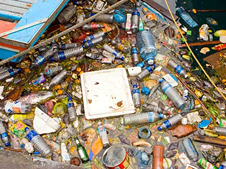
Garbage around Malé harbour

Medical concerns

Dr Abdul Azeez Yousuf from Malé Health Services Corporation said pollution in the water is a concern, since it is “a question of considerable contamination” and added there is “not an easy solution” to the problem.

He noted that since it’s not just sewerage in the water, but also many chemicals, it could cause many diseases, including ear and throat infections diarrhoeal diseases.

Dr Yousuf said the government had looked into the issue in the past and “have done some damage minimising” to improve the state of the water in the artificial beach and swimming tract.

The biggest problem, Dr Yousuf said, are all the boats in the harbour. “They don’t have proper sewerage disposal,” he said. “It goes straight into the sea.”

Medical doctor at the Central Clinic in Malé, Dr Ahmed Razee, said he has treated cases of gastro-enteritis caused by infections from the water.

“I am able to say very emphatically that yes, people can develop gastro-enteritis from swimming in Malé lagoon,” Dr Razee said.

He noted that “theoretically, the possibility [of getting gastro-enteritis] is very much real,” and “in medicine what we say is if something is possible, it will happen.”

But he added that “as far as the local population is concerned, and people who are continuing to go swimming, even if there was an infection, they would probably all have immunity to it, most of the common organisms.”

He explained it’s like traveller’s diarrhoea, “because you’re not [as vulnerable] to the germs that are in your surroundings.”

Dr Razee said the more “ominous thing is the presence of typhoid in the water and enteric organisms.” He said although enteric typhoid has been almost “wiped out” in Malé, “we do see some sporadic cases.”

He noted though, due to constant travelling between the Maldives and neighbouring Sri Lanka and India, “we cannot definitely say that the few cases we have seen have been locally infected.”

People get typhoid fever from contaminated water, Dr Razee explained, and noted it is a “bacteria which is excreted in the stool, so where the stool goes, the bacteria goes”.

He said “the waters are polluted with bacteria” that could cause digestive infections, and was mostly due to the boats in the customs area of Malé.

“There are a lot of boats which are more or less permanently moored there, and they are using the sea as a toilet,” he said. Additionally, “the sewage that is treated in Malé is not treated to eliminate bacteria, so it’s almost raw sewage, in an unrecognisable form, that is being let out into the sea.”

Dr Ramzee was considerably angry at those working in sewerage disposal. “These people are making so much profit, where is their social responsibility?”

“They, as professionals and scientists, know they are not doing what they are supposed to be scientifically doing,” he said, adding “it is the responsibility of the sewage company to ensure they do not pollute the water. They make millions of dollars out of these poor folks.”

Media Coordinator for Indira Gandhi Memorial Hospital (IGMH) Zeenath Ali Habib said “we haven’t got any cases regarding the matter” and it is “not a concern” for the hospital.

Environmental impact
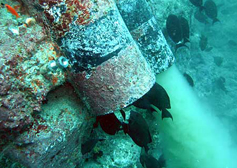
fish feeding off sewerage which is discharged every half an hour
Fish feeding off sewerage vented from a Male outlet

Ali Rilwan from environmental NGO Bluepeace says his organisation is “concerned with the contamination from sewage” seeping into the coral around Malé reef.

Rilwan said “there are all sort of things” contaminating the water, including heavy metals. The contaminants are reaching Malé reef from five outlets, he said, noting that “the reef is decaying.”

Another major concern is these contaminants reaching people through the food chain; if the fish get infected, people who eat it could also be infected.

Photographs courtesy of bluepeacemaldives.org

Likes(3)Dislikes(0)

JJU to establish Juvenile Act to take action against irresponsible parents

The Juvenile Justice Unit (JJU) will draft a ‘Juvenile Act’ outlining the actions that can be taken against irresponsible parents.

Spokesperson for the Juvenile Court Zaeema Nasheed said the JJU held a meeting with Prosecutor General’s Office, Police, Department of Gender and Family and the Juvenile court to discuss the draft bill, which it believes will help reduce the number of children becoming involved in crime.

”We have noticed that many children are led to crimes due to a lack of care from their parents,” Zaeema said. ”To reduce the number of children involvement the crimes, we should take action against irresponsible parents.”

”In the Maldives there are no laws on irresponsible parents.” Zaeema added. ”That’s why we face difficulties prosecuting such cases.”

”Sometimes when we go to deliver the chit from the court, the kid’s Mum or Dad says that they do not know where he lives or how to contact him,” she said.

”It is irresponsible for them to not know where their children live.”

She said that according to the law parents should protect children from danger, but that the divorces were leading the children to become isolated join gangs.

”When a couple divorces when they have children, then due to lack of care the child becomes isolated and they start going out to the streets,” she said. ”When they go out like that, they meet the gangs and join them and then they become involved in crime.”

She said that children usually became involved in crimes such as assault and battery, fornication and drug related cases.

Head of Child Section in Health Ministry Saudhath Afeef said that the discussion’s main target was to increase awareness among parents and children.

”With children we can make them understand that they also have responsibilities at their level,” Saudhath said. ”We can make aware parents by running advertisements and by holding awareness programs.”

She said that parents should not leave children on the streets saying that they “are grown up now”.

”The discussion are not finished yet,” Zaeema said. ”We will hold more meetings continuously.”

Deputy Prosecutor General Hussain Shameem did not respond to Minivan News at time of press.

Likes(0)Dislikes(0)

Man stabs child in front of police officers and flees on motorbike

Two men on a motorbike stabbed a 16 year old child in front of two police officers last night on Ameenee Magu near Imadudeen School, before fleeing.

Police Sub-Inspector Ahmed Shiyam said that the two police officers were investigating a motor vehicle accident when the incident occurred.

”A car and motorbike hit each other and police were investigating the accident,” Shiyam said. ”The victim was the person on the back seat of the motorbike which hit the car.”

Shiyam said the boy’s condition was not very serious.

”He is now hospitalised in Indira Gandhi Memorial Hospital,” Shiyam said.

He said that the police ran after the two men but did not manage to catch them.

He said that case was under investigation and he was unable to give further details.

A witness at the scene told Minivan News the boy was stabbed in two places right in front of the police, at 8:45pm.

”He injured his lungs and arm during the incident,” the man said.

The witness added that bystanders ran after the pair when the boy shouted in pain, but the two men managed to flee.

He said a team of forensic police came and discovered a knife under a parked pick-up behind Imaduddeen school.

He said that the road was bright and there were a lot of people on the street when the incident occurred.

There was also a stabbing near the Central Hotel last week and a man was seriously injured.

He has since been taken to Sri Lanka for medical treatment.

Likes(0)Dislikes(0)

President Nasheed meets with Chinese President

As part of his official visit to China for the Shanghai World Expo 2010, President Mohamed Nasheed met with Chinese President Hu Jintao yesterday at the International Convention Centre in Shanghai.

President Jintao said President Nasheed’s visit was a historic one and represented the importance of relations between China and the Maldives.

He thanked the government and people of the Maldives for their support of China and hoped to strengthen bilateral relations to benefit both countries. He said he hoped to increase mutual trust, economic and trade cooperation, and improve communication and coordination between the two governments.

President Jintao continued to say China would assist the Maldives in overcoming economic challenges, and pledged 50 million Chinese Yuan (US$7.3 million) in grant aid for the Maldives.

The Chinese president added climate change was an issue equally important to China as it is to the Maldives and assured support to the Maldives on the issue.

President Nasheed thanked the Chinese government and people for making an important contribution to the social and economic development of the Maldives.

He said the Maldives was facing many developmental challenges due to climate change, with fresh water and housing both in short supply.

President Nasheed encouraged Chinese companies working in renewable energy technologies to invest in the Maldives, thus improving their bid to become carbon-neutral by 2020 and creating an example on green technologies.

President Nasheed also briefed President Jintao on the recent sixteenth South Asian Association for Regional Cooperation (SAARC) Summit that took place in Bhutan last week, as China is an observer country of the SAARC.

Likes(0)Dislikes(0)

President returns to the Maldives

After their official visits to Bhutan and China, President Mohamed Nasheed and First Lady Laila Ali have returned to the Maldives.

The president visited Bhutan for the Sixteenth South Asian Association for Regional Cooperation (SAARC) Summit, which was held in Thimphu on 28 and 29 of April.

President Nasheed met with several SAARC country leaders during his first visit to a SAARC summit.

They departed for China after the summit to attend the Shanghai World Expo 2010 and inaugurate the Maldives Pavilion at the fair.

The president also met with Chinese President Hu Jinato and with Honourary Consuls to the Maldives in China.

First Lady Laila Ali also met with the Honourary Consul in Shanghai, who donated US$20,000 to Kudakudhige Hiya home for children in Vilingili.

Likes(0)Dislikes(0)

GIP hopes Dr Waheed will run for president in 2013: Taqfeeq

Secretary General for Gaumee Ithithihaadhu Parly (GIP), Ahmed Tafeeq, has said a potential bid by Vice President Dr Mohamed Waheed to run for president in 2013 is a positive development, “as there is no other personality as educated and qualified”, reports Miadhu.

After recent criticisms from Dr Waheed regarding the government, first on VTV’s show Hoonu Gondi (Hot Seat) and later at a GIP rally, speculations that he will run for president in the 2013 elections have erupted. But Dr Waheed said he has “no idea where this is coming from,” noting he still has not decided whether or not he will run in the elections.

Tafeeq said his party, also Dr Waheed’s party, has the right to raise issues regarding how the country is being run, and said the ruling Maldivian Democratic Party (MDP) should welcome the Vice President’s criticisms.

According to Miadhu, MDP has said if Dr Waheed is running for president, “there is no point in remaining in the VP’s position as there would be a very distinct and clear conflict of interest.”

Likes(0)Dislikes(0)

President meets with Honourary Consuls in China

As part of their official visit to China, President Mohamed Nasheed and First Lady Laila Ali met with Honourary Consuls to the Maldives in China.

President Nasheed met with Honourary Consul in Shainghai, Yang Guisheng, and with Honourary Consul in Hong Kong, Bob N Harulela.

President Nasheed called for more dynamic roles of Honourary Consuls in the development of the Maldives, noting they could play an important role in developing stronger relations and increasing commercial ties between the Maldives and their countries.

The president noted the areas the Maldives needed most assistance, and the consuls assured assistance to the Maldives and said they would be more engaged in finding new investments for the Maldives.

Likes(0)Dislikes(0)

Cracks in reef could cause Male’ to collapse, warns Ministry of Agriculture

The Ministry of Fisheries and Agriculture has raised the alarm over cracks appearing in Male’ reef, after surveys revealed they could eventually cause the reef to collapse just as it did in January outside the Nasandhura Hotel.

State Minister for Fisheries and Agriculture, Dr Mohamed Ali, said the cracks in Malé reef are “serious problems because it is the reef on which we are building this infrastructure.”

He said the amount of weight and activity around the reef is “debilitating the structure [and] part of it has already collapsed.”

“Cracks are a significant threat to infrastructure,” he said. “We fear some of the reef face might just fall off.”

Dr Ali said although there were many options being looked to try and resolve or alleviate the issue, “nothing is being done” at the moment. He added one of the simplest options to help relieve the pressure on the reefs was to “reduce the load” they are subjected to.

He said although some of the cracks were natural, “it is [mostly] due to some external forces that exacerbate it.”

He added that the effect of pollution and contamination were also of major concern.

Director of Environmental Protection and Research at the Environmental Protection Agency (EPA) Ibrahim Naeem said although “cracks are a common occurrence… there are some threats.”

He said the cracks were occurring “on the reef structure, on the non-living basement of the reef.”

Naeem noted “there is a possibility of collapse” and added “it has happened in many regions,” including in Malé near the Hulhumalé ferry terminal. He said the north-east area of the island was the most vulnerable.

The cracks were usually caused “when people start making buildings and heavy structures, and loading and unloading heavy equipment and goods,” such as granite rock, near vulnerable areas of the reef.

He noted it is “really hard to reconstruct [the reef base]” and if it was to be done, reconstruction might have to start from the sea bed. “We would have to be careful,” he suggested.

Naeem said there had been some studies on the corals around Malé which concluded “it is not a good idea to build heavy structures in these [vulnerable] areas.”

He said the government has also “advised agencies not to give licences to build high structures in those areas.”

Head of Malé Municipality Adam Manik said the incident in front of Nasandhuraa Hotel in Malé, where part of the reef seemingly collapsed, “has nothing to do with the coral reef. It’s the piling.”

Manik said some of the metal pilings beneath Malé, which are 18 inches wide, “don’t reach the lagoon floor bed.”

He said due to “wave action,” the sand beneath the pilings loosens, leaving a gap between the sea bed and the pilings.

He said on 1 January 2010, when the reef collapsed at the hotel, he rushed to Malé to find “several ministries were involved, making a mountain out of a mole-hole.”

He said it would be very “irresponsible of the government” if they were “not giving due credence to these things if they are true.”

Manik said there could be caves in the reef, which would account for the sightings of large cracks. But overall, he said he felt “the whole concept is wrong.”

Building codes stipulate the height of buildings should be determined by the size of their base, but there is no code that limits the weight of a building, Manik added.

Currently, Malé Municipality is in charge of overseeing constructions and making sure they follow the building codes.

Ali Rilwan from environmental NGO Bluepeace said there are places in the reef where “reef slope failure” can be found, meaning the reef has sloped down, as it would happen in a landslide.

Rilwan noted there were some incidents in 1991 when dynamite was used to place the cables for a desalination plant and caused cracks in the reefs. The reef was damaged again near the Hulhumalé ferry terminal, he said, when the sea wall was being put in.

Rilwan said the barge that was transporting all the rocks to build the sea wall unloaded from this area, where the barge was anchored for a long period of time. This in itself, he said, could have worsened sloping of the reef, if not caused it.

Likes(3)Dislikes(0)

“We inherited an economy in crisis”: President Nasheed

The Maldives faced the worst economic situation of any country undergoing democratic transition, according to World Bank statistics for the last 50 years, President Mohamed Nasheed has said.

In his address at the 16th SAARC Summit last week, President Nasheed said the global recession hit the domestic economy hard at a time when the country was “still adjusting to the recent shift from authoritarianism to democracy”.

While the transition has been “smooth, secure and stable” in the first 18 months of democratic governance, said Nasheed, the new administration inherited “an economy in crisis”.

“In the years leading up to the 2008 presidential elections, the former administration went on a spending spree that almost bankrupted the country. Public expenditure was at a peak of 64% of GDP in 2008,” he said.  “We took over a budget where 70% of government revenue was spent on public sector wages. Our administration inherited a huge national debt. Our deficit in 2009 was set to be at 33% of GDP.”

But, he added, the deficit was reduced to 28 per cent of GDP through austerity measures introduced last year, including controversial and unpopular pay cuts for civil servants.

Among other measures taken by the government to alleviate the budget deficit were cutbacks on foreign travel and a freeze on non-essential expenditure.

In addition, the new government was “bequeathed millions of dollars of unpaid bills”.

While the Maldives continue to face serious budgetary shortfalls, the government was determined to “implement structural reforms that will set the economy on a straight course”.

The president’s remarks were lampooned at the opposition Dhivehi Rayyithunge Party (DRP) rally last week as “humiliating” the country in the international arena.

Moreover, opposition parties have strongly condemned the government for disregarding campaign pledges by enforcing pay cuts and hiking electricity tariffs.

Economic outlook

The Asian Development’s Banks annual flagship economic publication, the Asian Development Outlook 2010, released last month noted that reckless fiscal expansion and a recession-induced drop in tourism “have taken the economy to the brink of crisis”.

The fiscal expansion of the past few years was “excessive”, the report notes, as it included large increases both in public sector wages and subsidies.

“It pushed budget expenditure to 63% of GDP by 2008 and the overall deficit to 17% of GDP,” it reads.

Meanwhile, the deficit spending led to “a marked balance-of-payments deterioration”, which, coupled with the impact of the global recession, threatened macroeconomic stability.

Consequently, GDP tumbled in 2009 by nine percentage points due to contractions in the tourism, construction and fisheries industries.

While GDP is projected to grow by 3 per cent this yyear, the report notes that economic outlook depends on the performance of tourism and fisheries “as well as the government’s ability to push through its reform measures”.

Apart from cuts in spending, the economic reform programme initiated by the current government includes broadening the revenue base by raising airport service charges, introducing a business profit tax and transforming the tourism bed tax into a goods and services tax.

“In order to align expenditures with revenues, the government is streamlining administrative machinery by downsizing the civil service, reducing electricity subsidies, and linking power tariff adjustments to cost of inputs twice a year,” it reads. “The government also plans to privatize parts of the extensive network of state-owned enterprises.”

In December 2009, the International Monetary Fund (IMF) approved a US$79.3 million standby arrangement US$13.2 million under a program to deal with external shocks.

As the role of monetary policy was limited with the currency pegged to the US dollar, the report advises that fiscal policy has to “play the greater role in demand management and economic stabilization”.

Weak institutions and human resource deficiencies, including “the fragmented structure of government”, were identified as major constraints to economic growth.

Moreover, the report notes that the government’s policy of grouping atolls into seven provinces to develop regional administration and economic centres was “a tall order” as the government “aims to reduce the cost to itself at the same time”.

Globe-trotter

In his radio address on Friday, the president said he received a text message from a resident of an “isolated island”.

The person observed that the president was “always abroad” and implied that he was neglecting domestic affairs.

The president arrived in China yesterday to open the Maldives pavilion at the Shanghai Expo 2010.

Addressing the concerns in his radio address, the president said he would leave “no stone unturned” in his efforts to secure aid and assistance for development projects.

“I have to go to all these places. I have to talk to a lot of people. I have to do a considerable amount of work to secure financial support, projects and assistance for the country,” he said, adding that he did not enjoy travelling.

Meanwhile, in his speech at the summit, Nasheed said he was under “tremendous pressure” to prosecute members of the former regime accused of corruption and torture.

He added that it was “understandable” for people who had been wronged in the past to seek justice and reparations.

“It is particularly difficult to forgive people, when they refuse to say sorry for the hurt they have caused,” he said. “But I am loath to act against the former regime. If we took action against everyone implicated in corruption and torture, we would end up arresting most of the opposition. I do not believe that arresting the opposition, is the best way to build a healthy democracy.”

Likes(0)Dislikes(0)