President Mohamed Nasheed has refuted claims reported earlier this year in the Indian media that Pakistan-based terrorist group Lashkar-e-Taiba (LeT) is present in the Maldives.
The isolation and strategic location of the Maldives make it a tempting target for groups such as Lashkar, which India has identified as responsible for the attacks in Mumbai on 26 November 2008, in which gunmen entered the city by sea and killed at least 173 people and wounded 308.
India’s Sify News reported Nasheed as stating that while the LeT had no presence in Maldives, there were “serious” issues concerning the emergence of some radical groups with members trained in Pakistan.
Nasheed ruled out the possibility of any terror group using Maldives route to attack India, saying the country had sound border control systems.
A spokesman for the Indian High Commission previously told Minivan News that defence agreements between India and the Maldives were “a continuous arrangement” and not specific to a particular incident or group.
He acknowledged that there was “support for fundamentalist groups” in the Maldives but would not speculate on who those groups were or defence arrangements between the two countries.
The parliament has scheduled the formal endorsement of cabinet ministers for Wednesday.
President Mohamed Nasheed’s cabinet ministers resigned earlier this year in protest against what they claimed was the opposition-majority parliament’s obstruction of their constitution duties.
They were reappointed shortly afterwards, but this has not yet been formally approved by parliament, as required.
Speaker Abdulla Shahid announced that the parliamentary committee findings would be presented to the parliament Wednesday. Haveeru cited Parliamentary Committee Chair Hussein Mohamed as saying that the cabinet ministers did not cooperate with the parliament procedure. “So we decided that the parliament would decide on the matter. We did not get their cooperation. The committee concluded its work and sent the report to the parliament last term. I am sure that the matter will be scheduled soon,” he said. The opposition-controlled committee decided to interview each minister separately. The government however insists that parliament is required to endorse the cabinet as a single unit, and not ‘pick and choose’ ministers. President Nasheed has stated that cabinet ministers will respond to parliament enquiries only under articles 98 and 140 of the constitution.
The Speaker of the parliament Abdulla Shahid has terminated today’s session until Maldivian Democratic Party (MDP) MP Mohamed ‘Colonel’ Nasheed leaves the chamber, reports local newspaper Haveeru.
Haveeru reported that speaker ordered Nasheed to leave the chamber claiming today’s session was heated when Nasheed raised a point of order and spoke against the report of Financial Committee while it was read.
According to Haveeru, Nasheed said the Financial Committee’s report was wrong and raised his voice against it.
This triggered an uproar inside the parliament chamber, according to Haveeru. The speaker is presently waiting to restart the session when Nasheed leaves the chamber.
A eight foot long ‘cross-shaped’ object have been discovered on an uninhabited island in Gaafu Alifi Atoll, reports Haveeru.
Haveeru reported that the object was discovered by a group of people who visited the island.
According to Haveeru, Councilor of Gemanafushi [an island nearby], said the item “is a cross. But the lessee claims that it was an instrument used on speedboats. But I do not see another use of it.”.
Preliminary debate today over the proposed Domestic Violence Bill has MPs optimistic it will be passed, after it is sent to a special committee to refine the particulars.
“It will most definitely be passed – there are a few things we must keep in mind but there is nothing contentious about it,” said Eva Abdulla, MP for the ruling Maldivian Democratic Party (MDP).
“We need to ensure it fits with international best practice, and ensure sufficient budget allocation for each step, as without sufficent budget things like the protective services mentioned in the bill become futile.”
Eva noted that the bill also needed to categorise different offenses, “as sweeping criminal offences do not fully protect the victims and can often discourage the reporting of offenses.”
“The draft bill is very good, however it only becomes meaningful if we can meet it with the necessary human and financial resources,” she added.
Opposition Dhivehi Rayyithunge Party (DRP) MP Rozaina Adam, who presented the bill to parliament, noted that both major parties were working together on getting the bill passed, and would likely vote to send it to a special committee tomorrow.
“Some MPs are finding it hard to accept that this is about violence against women, and are trying to twist it by saying violence also occurs against men. But most accept it,” she said.
Health authorities identify domestic violence as a major problem in the country. Rozaina noted that it was difficult to obtain figures because of a lack of reporting: “a lot of women accept it as if it’s their due.”
If passed, the bill would require monitoring of domestic violence cases and the publication of figures at the end of each year.
“Right now people don’t report it, and people are reluctant to make bring very personal family issues public,” Rozaina said. “We hope that NGOs and the health sector can become more involved, rather than people having to go to the police all the time.”
Deputy Minister for Health Mariya Ali said that the Ministry received 100 cases of reported domestic violence last year, “and so far this year we are already up to 100. It is a significant problem, and I don’t think this reflects the true prevalence,” she said, adding that more women were likely to come forward once the Ministry had completed work on a temporary shelter, hopefully by November.
“This bill will bring positive changes to the lives of women,” she added.
The DRP announced it was drafting a bill on domestic violence in April, hoping to create more comprehensive legislation for victims and perpetrators of violence in the home.
The bill would encompasses legislation on both physical and sexual violence against women and children, as well as improve how people who report these cases are dealt with, and to give more security and assistance to anyone affected by domestic violence.
Former president Maumoon Abdul Gayoom’s daughter and leader of the DRP’s Women’s Wing, Dhunya Maumoon, first announced the drafting of the bill.
In November last year MPs signed a declaration supporting the elimination of violence against women, recognising the problem of domestic violence facing the Maldives and undertaking to bear it in mind when legislating.
The signing marked the 10th anniversary of the International Day for the Elimination of Violence Against Women, a UN-led initiative to encourage countries to create and enforce laws punishing violence against women and girls, increase public awareness and strengthen collection of data on the issue.
In April 2007, a student who was the subject of a sexual assault by her teacher spoke to Minivan News about the incident and how she felt justice had betrayed her.
Some of the world’s leading environmentalists, energy experts and economists gathered under a thatched roof, barefoot and in shorts for a conference with a difference.
The ‘Eco-Symposium’ took place over the weekend in Soneva Fushi, a luxury resort renown for its green credentials and the first in the Maldives that has pledged to go carbon neutral – by the end of this year.
Set in Baa Atoll, the 100 hectare resort grows most of its own food organically on the island, has banned any use of plastic, and provides guests with drinking water in re-usable glass bottles, produced in the island’s own bottling plant. Guests pay an additional two percent on their bills to help offset their carbon emissions.
The symposium’s stated aim was to reconcile luxury tourism with environmental sustainability. Soneva Fushi’s owner, Sonu Shivdasani, a long time environmental entrepreneur, says: “We want to present practical solutions that make both business and environmental sense. The tourism industry must realize that reconciling its business with carbon neutrality is a matter of commercial as well as planetary survival.”
Speakers at the Symposium included Jonathan Porrit, Founder and Director of Forum for the Future, Professor Geoffrey Lipman of Unite Nations World Tourism Organisation, Eric Scotto CEO Akuo Energy Group, Jeremy Legget, Founder & Chairman Solarcentury and Mark Lynus, the government’s Climate Change Advisor.
They spoke on issues including surviving climate change and profitable climate solutions, the living building challenge and improving the transportation footprint. Special guest President Mohamed Nasheed spoke on the plans to make Maldives carbon neutral by 2020.
Minivan News spoke to Mike Mason on the sidelines of the eco symposium, following his presentation on ‘Carbon neutral Maldives: foresight or folly’.
Mason is considered a world expert in environmental economics and renewable energy technologies. He is the founder of Climate Care, a voluntary carbon offset company based in UK, which he recently sold to investment bank JP Morgan. For the past six months he has been supervising an Oxford student’s Masters thesis on energy consumption in the islands of Baa Eydhafushi and Baa Maalhos.
Aishath Shazra: When you discuss going carbon neutral with Maldivians from all walks of life, you have said the most you get from them is “that’s interesting”, or “it’s a policy that will come and go.” In lieu of this, how can you change mindsets?
Mike Mason: Nobody wakes up thinking “I want to destroy the planet today.” But a lack of knowledge about low carbon technologies, and in poor countries in particular, a lack of capital, means people find it difficult to switch to renewable technologies. A poor person can’t afford to invest in something [such as solar panels] unless is gives an immediate financial return.
A two part strategy is needed to tackle this. One is by providing the best technical advice to those in power: the government, ministers,island chiefs and so on. And secondly, providing things to win hearts and minds of people, so that local people demand change.
AS: What have you learned from the data collected from Maalhos in Baa Atoll, and what does it suggest in terms of harnessing wind and solar energy?
MM: In the study of Maalhos we learned that we absolutely can make the transition to renewable energy without increasing people’s energy bills. Moreover, we can make people’s lives better in the process, by improving their fridges and cooling their houses.
We have to integrate energy and tax policies. For example, a typical fridge in the Maldives uses 10 times as much electricity as the very best fridges currently available in Europe. This costs the household money, wastes government money in electricity subsidies and damages the environment. The irony of the fridges example is that the cost to the government of changing someone’s fridge is less than the cost of subsidising the electricity the old fridge wastes.
The second thing we learned from Maalhos concerns the choices you need to make in order to provide cheap renewable energy. For example, if you only want 30 percent of your electricity to be renewable, you can do it mainly with wind, rather than solar. But if you aim to power an island with 90 percent renewable energy, you need to use all solar and very little wind.
We have to understand these issues, and work out what targets we want to hit, before we spend a lot of money on equipment.
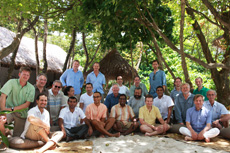
Participants at the Eco-Symposium, including Mike Mason and President Mohamed Nasheed
AS: Will the scattered islands of Maldives make it a challenge to use renewable energy or can we have a one-size-fits-all solution for the islands?
MM: The scattered islands of the Maldives are not a problem in going for renewables. Renewable energy is naturally distributed and there are so few advantages to connecting isolated islands. Each island can generate its own renewable energy.
However, there are exceptions, such as where islands are densely populated, and there is no room to put up all the energy harvesting equipment that is needed, such as solar panels. In these cases we have to go for an off-island solution and possibly an electricity grid [connecting islands to one another].
Male’, for instance, should have a grid linking Thilafushi, Vilingilli, Male’ and Hulhumale’. There may be other areas in the Maldives where an electricity grid is advisable.
AS: There is no income tax in the Maldives; the government imposes import duty on goods. You have said that this could prove to be our greatest national asset on our road to carbon neutrality, how is that?
MM: Everyone in the world who is an expert in this area says one has to tax the ‘bad’ and not the ‘goods’. The Maldives has an interesting tax regime that can be used to steer people towards buying better equipment, by varying import duties depending on whether an appliance is energy efficient or not.
AS: You have said that the Maldives’ most immediate danger is not climate change but our acute vulnerability to oil price shocks. Can you explain that?
MM: In the next 10 years, the world economy is likely to grow by the same amount as it did in every year until 2010. China, India, Indonesia… these countries are experiencing tremendous growth. Economic growth is always accompanied by oil demand and oil prices have risen 10 times over the last 40 years. We have now discovered most of earth’s oil, and we are unlikely to discover new oil as fast as new demands grow. When demand exceeds supply, prices rocket. What happened two years ago [when oil prices reached US$150 per barrel], was a warning for what could happen in the future.
AS: What are the benefits for ordinary people in a country going carbon neutral?
MM: Shifting to renewable energy means you are no longer exposed to the risk of oil price shocks. It means the Maldives no longer has to worry about going bankrupt because of oil price spikes. This is as much a benefit for the government as it is for the people. Put environmental considerations aside; the Maldives should go carbon neutral for economic and energy security reasons.
Police have concluded an investigation into an incident in which 168 bottles of whiskey and menthol gin were discovered in a car registered to Maldivian Democratic Party (MDP) Parliamentary group leader and MP ‘Reeko’ Moosa Manik.
Following the incident in February, Moosa claimed his driver was bribed to put “cheap alcohol” into his car in an attempt to frame him for the crime. The MP was in Singapore when the driver was arrested, the same day controversial liquor licensing regulations were unveiled by the Ministry of Economic Development.
Police Sub-Inspector Ahmed Shiyam said the police would not declare whether Moosa had any connection with the bottles, and instead sent the case to the Prosecutor General’s (PG) office.
‘’We cannot declare whether Moosa should stand trial in this case,” Shiyam said. “The Prosecutor General’s Office will look into the matter and decide.”
He declined to disclose further information of the case.
Deputy Prosecutor General Hussain Shameem did not respond to Minivan News at time of press.
Following the incident in February, Press Secretary for the President Mohamed Zuhair told Minivan News he had spoken with police about the incident “and it looks like a set up.”
“Whoever brought that booze out from their warehouse knew it would be confiscated. The brands are not what you would call hot sellers – it was menthol gin and watered-down whiskey.”
Zuhair told Minivan News at the time that he suspected expatriates had been bribed “and were connected to certain political opponents of Moosa Manik, owing to the fact he is currently in Singapore.”
DRP Deputy leader Ibrahim Shareef told Minivan News that he was “not surprised” at the case, “but I doubt it will go very far.”
In September Dhivehi Rayyithunge Party (DRP) Noonu Atoll wing leader Mohamed Abbas was arrested and charged for possession of a bottle suspected to contain alcohol.
Online newspaper based on Noonu Atoll, Velidhoo Online (VO), reported that three bottles of alcohol were discovered inside Abbas’s backpack, discovered by police when the three were checked on their arrival from the Ranveli Resort.
Democracy in the Maldives is in a crucial phase and needs to prove to the people that it is able to guarantee liberty, according an independent evaluation of the European Commission’s €26.3 million (US$36.6 million) assistance package to the Maldives over the last 10 years.
“The political, administrative, and judicial system needs reforming in order to implement constitutional guarantees and requirements,” the report found.
“The passing of an important number of bills has been delayed in parliament, which is composed predominately of newcomers to politics and in which the opposition coalition has the majority – resulting in the problem of consensus having to be reached between the government and its parliamentary opposition.”
As a consequence, the country was under pressure to provide a functioning political, judicial and local governance system, the EC report noted, identifying two major areas of reform: the judicial sector (including police and prisons), “and the decentralisation reform, beginning with the local [council] elections.”
The independent evaluation was commissioned by the EC to critique its funding of programs between 1999 to 2009, which have included support for the empowerment of women, over €15 million in tsunami-related assistance, technical support for the presidential and parliamentary elections, island waste management centres and more recently, pledges off €6.5 million for climate change adaption and mitigation support, as well as €1.3 million earmarked for combating drug abuse.
The report was presented at Holiday Inn yesterday to a cross section of stakeholders including government officials, civil society, international donor organisations and the press.
Overall achievement of executives was described as “mixed”. The strategic planning of many programmes was “too ambitious given the level of available funding”, the report noted, with gaps between planning and implementation.
“The environmental support program was too ambitiously planned and had to be scaled down to solid waste management only,” the report stated. “Constructed island waste management systems are, with few exceptions, not operational, and waste management centres are unequipped.”
The failings of this project were due in part to “technical” problems, including design weaknesses and missing equipment, “and insufficient involvement of communities in general, notably the Island Women Development committees.”
“Women on the islands are quite well organised and are often the main actors in terms of environmental issues and social and economic life. Many households are managed by women, as men are often working in the tourist resorts, in the fisheries industry, or abroad,” the report observed.
“However the present local governance structures generally do not sufficiently allow women to play an effective role in the local decision-making process.”
Equipment for the island waste management systems, purchased with the project’s remaining funding, remains stored in Male’, the report noted.
Economic vulnerability
The EC had identified the Maldives’ reliance on a single export commodity as a fundamental weakness in its commodity, but plans to diversify these exports “were too ambitious an objective for EC support.”
The problem was going to exacerbate when the Maldives graduates from Less Developed Country (LDC) status in January 2011, the report noted, when it will lose preferential market access and technical and financial support from multilateral and regional sources. This will have particular impact on the country’s trade with Sri Lanka and Thailand.
“Maldives exports can be built up and diversified only if action is taken to resolve serious supply-side issues in the economy, including access to investment finance, improvement of production procedures and standards, training of the workforce, development of modern marketing principles, and improvement of transport infrastructure.”
Programmes identified as successful by the EC report included that allocated to the presidential and parliamentary elections, which produced “a positive perception of the EC as a recognised political partner in the democratisation process.”
Looking ahead, the report suggested ensuring that projects had clearer objectives and were realistically planned, and preferably managed from within the country rather than outside.
It also recommended greater strategic focus on no more than two areas of priority, “such as environment/climate change and the good governance/decentralisation sector”.
Ambassador and Head of Delegation of the European Union Delegation to Sri Lanka and the Maldives, Bernard Savage, observed that programmes run in cooperation with other donors such as the World Bank and UN Agencies had been the most successful.
“Programmes carried out under this collaboration have been reviewed as both effective and efficient in general,” he said.
Deputy leader of the main opposition Dhivehi Rayyithunge Party (DRP) Umar Naseer has warned President Mohamed Nasheed against putting “one step outside of the chart” in his handling of former president Maumoon Abdul Gayoom.
Naseer, who has recently faced factional difficulties within his own party after it voted to send him before the DRP disciplinary committee, threatened that Nasheed did so, “it will be the end of his regime.”
President Nasheed spoke yesterday at the launch of historian Ahmed Shafeeg’s book alleging that 111 Maldivian citizens were held in custody and tortured by the former administration.
Nasheed stressed that Gayoom alone could not be blamed for all the human rights abuses that occurred under his watch.
“It was not done by him alone. It was a whole system that did it. It was Dhivehi tradition that did it. It was Dhivehi culture that did it,” he said.
Nasheed’s use of the phrase “outside the chart” in an earlier speech has been widely interpreted by the opposition as “acting outside the Constitution”, ostensibly in his detention of the Gayoom’s brother and People’s Alliance MP Abdulla Yameen on charges of treason and bribery, after he was released by the court.
Naseer said that if Nasheed acted in such a fashion with Gayoom, “there will be consequences.”
‘’We have seen Nasheed arrest some of our leaders and MPs, out of the chart,’’ Umar said. “We waited patiently and tried to set them free smoothly, and eventually we made the President release them.’’
Gayoom was a different matter, he suggested.
‘’The next day we will file a no-confidence motion against the President and we will make it the end of his regime,’’ Umar said. “Rephrase: do not touch our beloved honorary leader out of the chart.’’
While the opposition has a parliamentary majority and has dismissed former Auditor General Ibrahim Naeem with a majority vote, it presently lacks the two-thirds majority it would require to dismiss Nasheed or Vice President Mohamed Waheed Hassan. However the government has previously accused the opposition of attempting to buy the cooperation of MDP MPs.
Speaking at a rally yesterday, Naseer also strongly criticised the president for climbing onto the roof of the president’s residence to install solar panels.
‘’I wasn’t astonished to see how fast he climbed up the roof, because he is a pro-tree climber,’’ he said.
 (0)Dislikes
 (0)
(0)