Police push back protesters with tear gas

A third night of protests in the capital Male’ forced the government to deploy defence forces to guard the residence of President Mohamed Nasheed, as hundreds of demonstrators clashed with police following the arrest of Dr Mohamed Jameel, Deputy Leader of minority opposition Dhivehi Qaumee Party (DQP) and Criminal Court Cheif Judge Abdulla Mohamed.

The protesters gathered outside police headquarters following the arrest of Jameel last night, for the second time this week.

At last night’s demonstration began around 9:00pm, as protesters led by opposition MPs yelled for the release of Jameel and Chief Judge Mohamed, who was detained by the military.

Minivan News reporters witnessed protesters continue to penetrate the line of shielded police patrolling the headquarters – ignoring repeated warnings by police. They yelled for the  resignation of President Nasheed, Police Commissioner Ahmed Faseeh and Home Minister Hassan Afeef.

Police responded with tear gas and marched forward, pushing back the crowd to the Maldives Monetary Authority (MMA), where they continued to protest.

A policeman, who was reportedly injured after being pushed by some protestors, was rushed to hospital.

Minivan News also witnessed crowds apprehend and smash up a pickup registered to Male City Council, which has a ruling Maldivian Democratic Party (MDP) majority.

Meanwhile, around 15 or so Maldivian Democratic Party (MDP) activists faced the crowd of opposition protester, leading to direct confrontation between the two groups.

As some ran away from crowd, a few were seen falling to the ground. Police meanwhile intervened to control the violence and arrested some protesters. Crowds dispersed shortly afterwards.

However, pockets of demonstrators continued to roamed around the streets, uprooting the coconut palms planted by the city council.

DQP member Didi was reportedly attacked by MDP activists and suffered cigarette burn marks to his neck. He was treated at the ADK hospital.

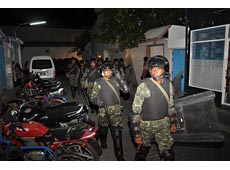
MNDF officers guarding Muleaage

Meanwhile opposition protestors marched towards President Nasheed’s residence Muleaage, which was guarded by the defence forces.

Protestors faced the guards, yelled for President’s resignation calling him a “dictator”. However, they turned back after repeated attempts to break the defence line of defence guards failed.

Few gathered near Home Minister’s house, which was also guarded by police and defence.

The protests slowly receded into the morning.

Police media official Sub-inspector Hassan Haneef confirmed eight were arrested last night, including a woman, and all were released afterwards.

As political parties’ vowed to continue protests as long as the government pursue actions against the opposition leaders, Haneef said that “to ensure stability, police will continue to take measures according to the constitution and laws”.

Likes(0)Dislikes(0)

Islamic Minister to investigate “Christian missionary” allegations against the State

Minister of Islamic Affairs Dr Abdul Majeed Abdul Bari has consulted with President Mohamed Nasheed on allegations that the government has cooperated with Christian missionaries in an effort “to wipe out Islam”.

“The President is now considering the best way forward,” said Press Secretary Mohamed Zuhair. “He will either form an independent commission to address the issue, or allow the Islamic Minister to consult with his colleagues. The Islamic Minister will advise the President in the matter.”

The consultation is in keeping with the government’s commitment to share decisions of religious matters with Islamic scholars.

Speaking to local media today, Dr Bari said “The President called very late yesterday and said he would request the Ministry to look into the allegations to understand the truth.” At the time, Bari had not received a formal letter stating the request but said he would cooperate with the request upon receiving such a document.

The Minister and officials at the Islamic Ministry could not be reached at time of press.

Over the past week, members of minority opposition Dhivehi Quamee Party (DQP) Dr Mohamed Jameel Ahmed and ‘Sandhaanu’ Ahmed Ibrahim Didi have accused the government of cooperating with “Christian missionaries” and “Jewish parties” against the state religion of Islam- Didi claimed the President was “a madman and a Christian”- and of spreading undue fear with the claim that the islands are sinking.

Both men have been repeatedly summoned for police interrogations, prompting protests outside police headquarters and the Presidential Palace.

Speaking today with Minivan News, Zuhair called the allegations “a big lie that has been repeated since 2003, when Maldivian Democratic Party (MDP) began to work abroad.”

He added that the claims were also raised in the run-up to the 2008 presidential election, in which currently ruling MDP won the election over the 30-year administration of Maumoon Abdul Gayoom.

“At that time Dr Hassan Saeed had made these allegations and the government carried out a full-scale, professional investigation in the United Kingdom. The ‘Operation Druid’ found no substance to any of the allegations. There was no evidence of any contact with Christian missionaries or priests. So it is surprising that members of Saeed’s party are again repeating these allegations,” Zuhair observed.

Operation Druid

In 2007, Maumoon Abdul Gayoom’s government contracted UK security and private investigation firm Sion Resources for a surveillance operation dubbed ‘Operation Druid’. According to the former Foreign Minister Dr Ahmed Shaheed, Gayoom “had concerns” about the origins of the Maldivian Democratic Party (MDP), exiles from which had fled to Salisbury where they had been sheltered by Nasheed’s high school alumni, David Hardingham.

Hardingham, founder of the Friends of Maldives NGO, and Sarah Mahir had previously ambushed Gayoom in the UN building in Geneva in May 2005, accusing him of complicity in human rights abuses.

“I think Gayoom was quite shaken by that, and afterwards he was not as complacent over the security given to him by his hosts, be that by the UK or UN,” Dr Shaheed told Minivan News, in an interview in June 2011.

Subsequently, “The government may have wanted to see what was going on [in Salisbury],” Dr Shaheed said.

“What these operations did was try to see who was who. And a lot of the operations the government felt were against it came from Salisbury, and I think the government of the day felt justified in engaging a firm to look into what was going on,” he said. “They felt they needed to check on that, and what came out was a clean bill of health. Nothing untoward was happening, and these people were by and large bone-fide.”

Back in the Maldives, Gayoom’s government released a leaflet accusing Hardingham and Salisbury Cathedral of conspiring to blow up the Islamic Centre and build a church.

It was just a mischievous suggestion, a very mischievous suggestion,” Dr Shaheed acknowledged. “At the time everyone was accusing each other of being non-Muslim, and this accusation that the MDP was non-Muslim was getting very loud.

“There is this very, very deep reaction to anything un-Islamic in this country, and you can use Islam as a political tool quite easily. Therefore these allegations become political charges.”

Former Conservative Party MP for Salisbury, Robert Key, who had been instrumental in getting Nasheed an audience in British parliament, told Minivan News in February 2011 that Salisbury Cathedral had taken the accusation “at face value” .

“It was not true, and therefore we had to say ‘It is not true,'” he said. “The Dean of Salisbury Cathedral understood the issue, she took it at face value, and we sought security advice as necessary. But it was never a serious threat. It was a juvenile political ploy.”

For his part, Hardingham has dismissed the allegations that he is a Christian missionary as “absolute nonsense – I have never been a priest or anything associated with any church, and I challenge the people making the allegations to provide a shred of evidence to support their case.

“I was refused entry into the Maldives in April 2005. Government spokesperson at the time, Mohamed Hussein ‘Mundhu’ Shareef, told Associated Press that this was due to my involvement with an Islamic extremist group. So I have been accused of being an Islamic extremist and a Christian missionary – probably the fastest and most radical conversion in history.”

Government respects religion

Citing the Maldives’ commitment to be an Islamic state, Zuhair today pointed out that it was the government’s public responsibility to clarify that the allegations against it were baseless.

“Not only do these statements refer to the government, they also refer to our members and supporters and their respect for our religion”, he said, adding that the allegations involving Jewish parties came close to anti-Semitism – “and we don’t want to spread that image.”

In its efforts to staunch DQP’s “hate speech”, the government has drawn criticism from main opposition Dhivehi Rayyithunge Party (DRP) and Progressive Party of Maldives (PPM) for “suppression of the constitutional right to free expression”.

Speaking previously at a press conference held in response to the allegations, which were broadcast on DhiTV news on January 8, Zuhair called “spreading baseless and demonstrably false claims” about the government a “criminal offence”, and the coverage of demonstrably false allegations of foreign religious influence a “violation of journalism ethics”–statements which drew prompt criticism from media associations and opposition parties.

“The government will not allow anybody to be influenced by the crime of incitement,” Zuhair clarified today, explaining that the opposition had put the media in a position of defending the general freedom of expression in order to promote their own agenda.

“It is very easy for any Maldivian or journalist to find out about the Druid operation or to see if we have been accepting payments from a Christian priest. Ask us. What is surprising is that this story has been going on for a week and yet none of the media have found out or reported what the grounds for the allegations are,” Zuhair said. “It’s part of journalistic integrity to at least get the five W’s right: who, what, where, when and why. Why are they being fooled?”

According to Zuhair, the findings of the Ministry of Islamic Affairs and the court will be necessary to resolve the matter.

The matter continues to be investigated by the police, who have now summoned Didi and Jameel for four consecutive nights. Meanwhile, a protest supporting the freedom of expression has been scheduled for the Artificial Beach this evening.

Likes(0)Dislikes(0)

Protests to continue as DQP vows to sue government, police

The recent arrest of Dhivehi Qaumee Party (DQP) council members over “slanderous allegations” have increased political tensions in Male’, prompting a series of opposition led protests.

The Vice President of Dhivehi Qaumee Party (DQP) Dr Mohamed Jameel and council member Sandhaanu’ Ahmed Ibrahim Didi was repeatedly summoned to the police headquarters and interrogated in the past four nights, after the President’s Office requested a police investigation into “slanderous” statements made by the pair, alleging the government was working under the influence of “Jews” and “Christian priests” to weaken Islam in the Maldives.

Following the arrest of Jameel lastnight, the DQP supporters gathered outside the police headquarters around 8:00pm calling for his immediate release.

Similar confrontations took place when DQP council member Sandhaanu’ Ahmed Ibrahim Didi was briefly detained on Thursday. Didi was released shortly after the Criminal court instructed the police to bring him to the court.

Former Justice Minister was transferred to Dhoonidhoo detention center located on a nearby island, but later brought ahead of the Criminal court where his lawyers team contested the legality of the arrest and won his release.

Meanwhile, verbal and sometimes physical confrontations continued till midnight near the Justice Building, where criminal court is located.

Crowds also gathered outside the residence of Home Minister Hassan Afeef, threw eggs and called for the minister’s resignation on allegations of influencing the police to take measures against DQP members.

Roads leading to President Mohamed Nasheed’s residence Muleaage meanwhile was blocked by the security forces to stop the protestors from moving any closer.

However, the protest outside the Justice Building heated up when a group of pro government or ruling Maldivian Democratic Party (MDP) activists gathered, directly resulting in clashes with opposition protesters and police officers attempting to control the crowds.

While MDP activist called for the arrest of Jameel and other opposition members making “slanderous” claims about the government, opposition continued to hail DQP members as “heroes”, and calling for their immediate release.

Police dispersed the crowds with tear gas and detained couple of protestors, who were later released.

DQP vows to sue

Meanwhile, DQP has announced that the party will sue the government and the police over the “unlawful” detention of its council members.

However, speaking to the press on Monday, Dr Hassan Saeed, DQP president and lawyer representing Didi and Dr Jameel, claimed the party has “evidence to prove they were arrested and treated unlawfully”.

He said the party intends to sue “everyone” involved in the arrest, including Home Minister Hassan Afeef and individual police officers who signed off the arrest warrant.

“We will sue [them] in big numbers,” said Dr Saeed, who left the Maldivian Democratic Party (MDP) coalition shortly after it came to power in 2008.

Referring to the Home Minister Afee’s interview to the media outlets regarding the police investigations, Dr Saeed argued that Afeef is acting outside the legal boundaries by interfering with the police investigations.

“The Home Minister is only supposed to answer the parliament on behalf of the police. [He] does not have any power besides policy making. [He] cannot say which cases must be investigated, who must be arrested or whose detention should be increased,” Dr Saeed asserted.

Dr Saeed claimed the investigating officers have confided that they were “pressured by the government” to interrogate and arrest DQP lead members.

“They [police officers] even apologised to us repeatedly,” Dr Saeed claimed, adding that the government is “destroying a young educated police force for personal gain”.

He also alleged President Mohamed Nasheed of using “police, defence force numbers and weapons” to maintain power and enforce policies.

Press Secretary Mohamed Zuhair meanwhile told Minivan News on Monday that “we welcome any court action against the government”.

Zuhair insisted that the government wants to clear its name from the “slanderous” claims before the next election in 2013.

“We are saying it’s enough now,” Zuhair asserted. “All they need to do is tell the police who the Christian priest is. How much he is getting from the government. Under which account the money is deposited. And where they are getting this information from”.

Defend Article 27

Meanwhile, the opposition parties have decided to hold a rally on Monday night, to “defend article 27 “which states “everyone has the right to freedom of thought and the freedom to communicate opinions and expression in a manner that is not contrary to any tenet of Islam”.

DRP official was quoted in the local media saying that the rally is organised because the government is “sabotaging the freedom of expression granted under the constitution by arresting opposition leaders and threatening the media”.

Press Secretary however insists that the “government will be patient to the right freedom of expression and freedom of assembly”.

He also refuted claims of government influence over the police, saying that the “police are absolutely impartial”.

Likes(0)Dislikes(0)

Police summon Chief Criminal Court Judge Abdulla Mohamed for questioning

Police have summoned Chief Judge of the Criminal Court, Abdulla Mohamed, for questioning at 8.30pm in an “ongoing investigation.”

According to the Criminal Court, the summons was delivered at 12.30pm today. Judge Abdulla had ordered the immediate release of minority opposition Dhivehi Qaumee Party (DQP) Deputy Leader Dr Mohamed Jameel Ahmed from police custody last night.

A police media official confirmed the summons but could not divulge details of “an ongoing investigation.”

Judge Abdulla’s lawyer and Independent MP for Guraidhoo, Ibrahim Riza, told local daily Haveeru that the chief judge would comply with the summons but was “unaware that police are investigating a case involving him.”

He added that the news “came as a shock” to the judge.

On October 26, Judge Abdulla had ruled that the arrest of Gassan Maumoon – son of former President Maumoon Abdul Gayoom – on suspicion of hurling a wooden block at protesters was unlawful, establishing a precedent that police could not arrest suspects without an arrest warrant “unless the arresting officer observes the offence being committed”.

The contentious ruling led police to release 11 suspects while the Prosecutor General’s Office (PGO) sought legal clarification on criminal justice procedures.

Ethical misconduct

In 2005, then Attorney General Dr Hassan Saeed forwarded to the President’s Office concerns about the conduct of Abdulla Mohamed after he allegedly requested that an underage victim of sexual abuse reenact her abuse for the court.

In 2009 following the election of the current government, those documents were sent to the oversight body Judicial Service Commission (JSC), which was requested to launch an investigation into the outstanding complaints as well as alleged obstruction of “high-profile corruption investigations”.

The JSC decided not to proceed with the investigation on July 30, 2009. However in November last year, the JSC completed an investigation into a complaint of ethical misconduct against the judge.

The case was presented to the JSC in January 2010 by former President’s member of the JSC, Aishath Velezinee, after Abdulla Mohamed appeared on private network DhiTV and expressed “biased political views”.

Velezinee observed at the time that it was the first time the JSC had ever completed an investigation into a judge’s misconduct.

“There are many allegations against Abdulla Mohamed, but one is enough,” she said.

“If the JSC decides, all investigation reports, documents and oral statements will be submitted to parliament, which can then decide to remove him with a simple two-thirds majority.”

In October 2011, the ruling Maldivian Democratic Party (MDP) appealed for assistance from the international community over the “increasingly blatant collusion between politicians loyal to the former autocratic President, Maumoon Abdul Gayoom, and senior members of the judiciary – most of whom were appointed by Gayoom during his thirty years of power.”

The MDP statement also referred to the corruption trial of Deputy Speaker of Parliament Ahmed Nazim, charged with multiple counts of defrauding the former Atolls Ministry, which remains “indefinitely delayed.”

Likes(0)Dislikes(0)

ACC cannot terminate Nexbis agreement, court rules

The Civil Court has ruled that the Anti-Corruption Commission (ACC) does not have the legal authority to order the Department of Immigration and Emigration to terminate the border control system contracted to Malaysia’s Nexbis Limited in November 2010.

ACC filed a court case against the Rf500 million (US$39 million) Nexbis system in November 2011, two days after cabinet decided to resume the project.

The cabinet’s decision contradicted ACC’s earlier command to terminate the existing agreement with Nexbis and re-tender the project with the cabinet’s consent.

In December, the ACC forwarded a corruption cases against former Immigraiton Controller Ilyas Hussain Ibrahim and Director General of Finance Ministry, Saamee Ageel to the Prosecutor General’s Office (PG), claiming the pair had abused their authority for undue financial gain in awarding the Nexbis project.

However, in Sunday’s hearing Judge Ali Rasheed ruled that the ACC Act clearly allows the commission to investigate corruption cases, but does not give ACC legal authority to issue an order which can annul a formal agreement signed between one or more parties.

He asserted that it is “unfair” to the contractors if ACC can annul an agreement without the contractors’ say, adding that such a decision violates the protection granted to the contractors under the Maldives Law of Contract.

Following the court’s ruling, Immigration Controller Abdulla Shahid told Minivan News that the ruling is subjected to the ACC and it does not directly relate to the department.

He noted that it is too soon to say how the department will proceed with the project.

“We have not even received the documents. We will look into the matter legally,” Shahid said, adding that the court’s decision does not does indicate whether the agreement with Nexbis is “good”.

The 20-year Build, Operate and Transfer (BOT) agreement with the Malaysian-based mobile security solutions provider was to upgrade border security in the Maldives with new technology including facial recognition and fingerprint identification, facilitating the identification and tracking of expatriate workers and eliminating the opportunity to people to enter the country with forged paper documents.

The Maldives currently receives three times its population of 350,000 in tourist arrivals each year. It has lately begun addressing a rise in human trafficking.

The day after the October 2010 signing of the concessionaire contract, ACC announced it had received “a serious complaint” regarding “technical details” of the bid, and issued an injunction pending an investigation into the agreement citing “instances and opportunities” where corruption may have occurred.

After the investigation, the commission deemed the procedure of awarding the project to Nexbis was corrupt, and ordered the Immigration department to terminate the project.

Nexbis shares immediately plunged 6.3 percent on the back of the ACC’s announcement. The company subsequently issued a statement claiming that speculation over corruption was “politically motivated” and had “wrought irreparable damage to Nexbis’ reputation and brand name.”

“Nexbis’ shareholders own and manage multi-trillion dollar assets globally and will not jeopardise their reputation for an investment return,” the company said at the time.

Claiming financial loss Nexbis subsequently threatened legal action over the stalled border agreement, prompting the cabinet to resume the project after reviewing the existing agreement with Nexbis to address the concerns raised by the department.

In earlier interviews with Minivan News, Shahid had expressed concern over both the cost and necessity of the project, calculating that as tourist arrivals continue to grow Nexbis would earn US$200 million in revenue over the project’s 20-year lifespan.

Comparatively, at five percent royalties to the government would come to US$10 million, Shahid said, when there was little reason for the government not be earning the revenue itself by operating a system given by a donor country.

“Border control is not something we are unable to comprehend – it is a normal thing all over the world,” Shahid told Minivan News at the time.“There is no stated cost of the equipment Nexbis is installing – we don’t know how much it is costing to install, only how much we have to pay. We need to get everything out in the open.”

The agreement allows Nexbis to levy a fee of Rf30 (US$2) from arriving and departing passengers in exchange for installing, maintaining and upgrading its immigration system. The company would also charge a Rf231 (US$15) for every work permit card.

Shahid estimates that maintaining a free system given by a donor country would cost at most several hundred thousand dollars a year, and said he was unsure as to why such an agreement had ever been signed.

However, Nexbis said in a statement that neither the government nor the Maldivian public have to pay in exchange for a state-of-the-art border security protection and suggested that “reasonable persons will likely realise that once the hidden costs after are taken into account and adjusted for inflation, the benefits and efficiencies of the Nexbis system will far outweigh the risk, inadequacies and uncertainties of any such alleged cheaper system.”

Nexbis also said it had agreed to review the government’s additional requirements, “and have expressed our willingness to accommodate any such changes within commercially viable terms.”

“While this requires some changes to the solution we ultimately provide, it is within the scope of our agreement to accommodate these changes,” the company said.

Meanwhile, yesterday’s court’s ruling set a precedent on the question raised by some legal experts on whether ACC has the authority to halt or terminate a government project agreement.

Civil court is hearing a similar case against the ACC by Thilafushi Corporation Limited (TCL), which contested the legality of ACC’s decision to halt the US$21 million reclamation project awarded to Heavy Load Maldives, owned by MDP Chairperson Reeko Moosa Manik, on suspicion of corruption.

Likes(0)Dislikes(0)

Government will not allow religion to be used as a weapon for political purposes: Home Minister

Council members of the minority opposition Dhivehi Qaumee Party (DQP) questioned by police were unable to substantiate “slanderous allegations” that the government was working with “Jews and Christian priests” to undermine Islam in the Maldives, Home Minister Hassan Afeef said today.

Briefing press at the police headquarters, Afeef criticised Dr Mohamed Jameel Ahmed and ‘Sandhaanu’ Ahmed Ibrahim Didi for exercising the right to remain silent when they were summoned for a second time last night and challenged the DQP leaders to point out or provide evidence of “the government’s efforts to wipe out Islam.”

“Where is that priest? Where is the money that priest gave? When was it given? Which account was it deposited to?” Afeef asked.

Dr Jameel told police interrogators that his claims were based on “rumours circulating in the island,” Afeef revealed, criticising the former Justice Minister for not realising the gravity of the allegations when repeating it without proof.

Sandhaanu Didi’s statement to police was meanwhile “useless chatter” claiming the President was “a madman and a Christian,” he added.

“We cannot allow such claims to cause unrest among the public, incite hatred towards the government and lead to discord,” Afeef asserted.

He reiterated that opposition leaders had a responsibility to substantiate “atrocious” allegations that the MDP government was intent on “wiping away Islam” to introduce religious freedom and the practice of other religions.

“This government will not allow anyone to use religion as a weapon for political purposes,” he continued. “Therefore, I would like to remind [journalists] that these actions are an atrocity. The government is not going to allow such atrocities to be committed. I urge you to be mindful of this when the media reports such news.”

Afeef also suggested that the Media Council and Maldives Broadcasting Commission were failing to fulfill their mandate by not objecting to religiously-based allegations by opposition politicians on privately-owned media outlets.

Asked why the police were not investigating cases filed by the opposition against President Mohamed Nasheed, Afeef insisted that the complaints were “baseless” and that police “would investigate if there was any truth to it.”

Among the cases filed with police include a request by PPM Deputy Leader Umar Naseer to investigate President Nasheed’s remarks allegedly “encouraging drug use”.

Calling for compassion towards heroin addicts, Nasheed said in June 2011: “When we don’t provide care for them, they take off with the box cutter and steal money from the mother’s drawers. [They] need it. They need to use. They must use. We have to come to know and understand this. We shouldn’t try talking about this politically or with the intention of hiding behind a nice veil, without using the real terms and words.”

The falsehood of such claims by Umar Naseer and others was evident and “clear as night and day,” Afeef argued.

Asked about DQP’s request for police to investigate President Nasheed’s claims to foreign media that islands in the Maldives were sinking, Afeef said the President was referring to beach erosion in recent interviews and not submersion by sea level rise.

DQP also requested police investigate Press Secretary Mohamed Zuhair for allegedly “threatening the media.”

Meanwhile, according to his twitter page, Dr Jameel revealed that he and Sandhaanu Didi have been summoned to the police station tonight for a third time.

The pair were questioned by police for a second time Saturday night, but both exercised the right to remain silent. After the initial interrogation Thursday night, Did was detained for almost 24 hours and released around 7:00pm Friday night.

Sandhaanu Didi appeared outside the police headquarters with a mask and fins last night, explaining that he had cooperated with police for 30 minutes on Thursday night and intended to “go snorkeling with the police boys tonight.”

Likes(0)Dislikes(0)

Addu City Council begins taking down “idolatrous” SAARC monuments

Addu City Council has begun removing monuments gifted to the Maldives by SAARC member countries during the “Building Bridges” summit in November 2011.

Bhutan’s monument, a wooden sign, was taken down on Friday following a demand from demonstrators at the opposition-sponsored ‘Defend Islam’ protest on December 23 that all monuments be removed as they were “idolatrous”.

Councillor Hussein Hilmee told Minivan News that a small group of people had been vandalising the monuments and that police had needed to provide 24 hour security, which was unfeasible.

The leaders of Bangladesh, Pakistian, India, Bhutan, Nepal and Sri Lanka unveiled their national monuments to commemorate the Maldives’ hosting of the SAARC Summit.

The night before the unveiling of Pakistan’s monument a small group of protesters knocked it over, contending that carvings detailing the history of the Indus valley civilisation and a bust of the country’s founder Mohamed Ali Jinah were idolatrous. The monument was removed by Addu City Council and replaced on its plinth prior to the unveiling ceremony.

That evening a group of opposition MPs, including MP Ahmed Mahlouf from former President Maumoon Abdul Gayoom’s Progressive Party of the Maldives (PPM), were arrested attempting to take down SAARC banners at the airport which they claimed featured Christian imagery.

The Pakistani monument was subsequently set ablaze by demonstrators, after the Adhaalath Party issued a statement claiming that “no Maldivian of sound mind” would allow idols or iconography of other religions to be erected in the country.

The Pakistani monument was “part of efforts by adversaries of Islam to turn the faith that Maldivians embraced 900 years ago upside down,” the party said at the time.

The fate of the monuments quickly became a political football in the wake of the SAARC Summit, as the government began to juggle the perceptions of its regional neighbours with antagonistic public sentiment triggered by opposition-led demands that the monuments be removed.

Pakistani Prime Minister Yusuf Raza Gilani unveils the contentious monument

Meanwhile, the wave of vandalism continued. The head of Sri Lanka’s lion statue monument was decapitated, and police were deployed to provide protect the surviving structures.

A month after it was unveiled Nepal’s monument, a metal plaque with a coat of arms resembling the country’s national symbol, was stolen during a police shift change.

“We regret what has happened,” Addu City Mayor Abdullah Sodig told Minivan News following the theft of the Nepalese monument. “It was not a religious monument. There is some political motive behind this theft,” he emphasised, citing “opposition party members” as likely suspects.

Islamic Minister Dr Abdul Majeed Abdul Bari subsequently requested that government authorities remove the SAARC monuments that conflicted with Islam, although he did not specify which.

State Minister for Islamic Affairs, Sheikh Hussein Rasheed, was more muted, telling Minivan News that he did not believe that the monuments contradicted Islam.

“The Pakistan monument showed how Pakistan became an Islamic country from its Buddhist origins,’’ he said, but added: ‘’Although the monument does not contradict Islam, it should not be kept there if Maldivian citizens do not want it to be there.’’

Press Secretary Mohamed Zuhair observed at the time that taking down the monuments would diplomatically be very difficult for the government, “especially where it was handed to us by another Islamic country.”

Removal of the contentious monuments was one of the five demands of the December 23 protesters, who also demanded that the government apologise for a statement to parliament by UN Human Rights Commissioner Navi Pillay concerning a moratorium on flogging for extra-maritial sex.

Today, Addu City Councillor Hilmee said the council had sent a letter to the Foreign Ministry requesting that it inform SAARC member countries that it was taking the monuments down.

Deputy Sri Lankan High Commissioner Shaanthi Sudusinghe said the Sri Lankan government had not yet been informed of any decision.

“We have requested that if [the government] is unable to preserve the monument that they hand it over to us,” she said.

Likes(0)Dislikes(0)

Comment: To Flog or not to Flog

A few months ago, a protest took place in the Maldives in defense of the Islamic Huddud (punishment) after a UN delegate spoke out against whipping for adultery from the Maldivian Parliament.

A few years ago, I had heard it argued that it was not Islamic to literally apply the Huddud in this day and age. I wanted to know for sure who was correct about this issue from an Islamic point of view, the fundamentalists or the liberal Islamic scholars.

Seeking answers, I dug out and read a few of my old volumes of Sahih Muslim, as rendered into English by Abdul Hamid Siddiqi. The experience I had wading through those pages rekindled that warm flame within me of the Islamic spirit of Mercy, the Mercy of Allah for all humanity.

This Mercy is understood by all Islamic scholars to be the supreme attribute of Allah. I came to believe that it is perfectly justifiable within a Sunni Islamic context to have the opinion that it is against this Merciful Essence of Islam to literally apply the Huddud in our day and age.

The Huddud (punishment) of flogging for Zina (adultery) is prescribed by the Qur’an and the Sunnah. Also in the Quran, however, in Surah four 15 – 16, it is stated that those who commit crimes such as Zina are to be extended forgiveness and Mercy if the perpetrators repent. As we well know, the view of many fundamentalist Sunni scholars is that these verses prescribing Forgiveness for Zina were abrogated and replaced by the verse prescribing whipping for zina. Many modern Islamic scholars have argued that this is an example of a misunderstanding and misuse of the idea of abrogation.

Let’s look closer at this concept of Naskh, abrogation.

It is one of the fundamental points of Sunni Islam that the Qur’an is the unwritten, eternal Kalam. As an attribute of Allah (Kalam or Speech) it has always existed. Is it possible then, that a ruling of vengeance which has always existed, (as part of the Uncreated Qur’an) could suddenly come into being in the lifetime of our Beloved Prophet (SAW) to replace a ruling of Mercy and Forgiveness which has also always existed.

That is not reasonable. So another perspective is that the Huddud are not so much laws to be applied to all circumstances but are in fact uncreated representations of eternal principles. The highest principle, and the overriding principle in all decision making, is the principle of Mercy, so richly expressed as compassion and forgiveness in the Qur’an and in the Sunnah so very many times.

It is said, in many Sahih Ahadith, for example, that one would be admitted to Jannah (paradise) for having a grain of faith as small as a mustard seed, no matter what his sins were. The practical application of this Mercy comes through the Islamic principle of Maslahah, doing what is best for the community.

In depth study of the Qur’an and Sunnah makes it apparent that the reason the Huddud exist are to make us aware of the immeasurable gravity of the sanctity of life and family, and of the importance of the protection of private property for furthering the development of all the Ummah. The preference for forgiveness is further demonstrated by the near impossibility of applying the Huddud due to the almost impossible to provide demands for proof required by Shariah law (four witnesses to prove fornication for example).

The Prophet’s own preference of the application of forgiveness and Mercy, even when perpetrators confess their sins and demand to be punished, is beautifully demonstrated by a Hadith which recounts an occasion that a female perpetrator of Zina demanded she be punished. The Prophet ignored her, preferring that she accept Allah’s Mercy. She evidently understood the lesson of the sanctity of family which the prescribed punishment for Zinah was meant to teach, and for the Prophet (SAW) that was enough.

As the story goes, this woman persisted in demanding punishment to the point the Prophet could not refuse, and even when she was punished, the Prophet forbade a spirit of vengeance or hate toward her. Sorrowfully, the Prophet demanded reverence, silence; he said he sensed Jannah (heaven) around her as she died. Again, I must emphasise, He did not want to punish her. Such application of punishment was not compatible with the Merciful Intent of the Wahi (the Revelation.)

Unlike some of our present day Muslims, the Prophet was not into protests demanding vengeance and punishment for Zinah, he hated to apply the Huddud and certainly would never have pushed to do so. For he who was sent as a Mercy to the Worlds, it would have been beneath his dignity to make a loud noise about wanting to hurt anybody.

Given our modern understanding and technology, it is possible to promote the gravity of the sanctity of the family and of marriage (the reason for the Revelation of the Huddud) through means such as counseling and education. So it would be most un-Islamic, seems the Islamic preference is Mercy, to literally apply the Huddud for Zinah in our day and age. Of course, those texts will always be there, as they always have, to remind us of the sanctity of family.

There are many great Islamic scholars from the Maldives who agree with the general thrust of this point of view who could actually argue this point a billion times better than I could. Yet since it would be politically damaging for them to share their much needed genius with us right now, I certainly hope that my humble opinion could at least generate some debate about this issue. Eventually I hope to hear from our brave, noble geniuses.

One final thought on this matter.

The Prophet said, and he was not the first Prophet to say it, that he who refuses to show Mercy to others will not receive Mercy from Allah. I wonder what Allah may think of those who’s Zinah and alcohol use had been concealed by Allah’s Mercy, who then demand that that same mercy be denied to others.

All comment pieces are the sole view of the author and do not reflect the editorial policy of Minivan News. If you would like to write an opinion piece, please send proposals to [email protected]

Likes(0)Dislikes(0)

Police interrogate, briefly detain DQP leaders over “slanderous” allegations

Police interrogated and briefly detained leaders of the minority opposition Dhivehi Qaumee Party (DQP) Thursday night, after the President’s Office requested an investigation into “slanderous” statements alleging the government was working under the influence of “Jews” and “Christian priests” to weaken Islam in the Maldives.

DQP council members former Justice Minister Dr Mohamed Jameel Ahmed and ‘Sandhaanu’ Ahmed Ibrahim Didi were summoned for questioning at 8pm Thursday night. Former Attorney General and presidential candidate in 2008, Dr Hassan Saeed, accompanied the pair as their lead lawyer.

Speaking to press outside the police headquarters shortly after 10pm, Dr Jameel contended that the government was trying to silence dissent by arresting those who speak out against corruption and intimidation of the judiciary “with a serious warning of destroying democracy in the Maldives in its infancy”.

“By God’s will, we now have the certainty that will we will put this current President [Mohamed Nasheed] in jail for a long time,” he asserted.

Sandhaanu Didi was meanwhile taken to Dhoonidhoo detention island after midnight and released around 7:00pm on Friday night. DQP had filed a case at the Criminal Court at 3:45pm challenging the legality of the detention and seeking reasons for his arrest.

In July 2007, Didi was sentenced to life imprisonment by the former government for distributing the dissident Sandhaanu newspaper online and allegedly fomenting unrest and revolution. His role in the pro-democracy reform movement was recognised by Amnesty International and the US State Department.

Before entering the police station Thursday night, Didi insisted to reporters that his insinuation of the government’s anti-Islamic agenda was true, holding up a booklet titled ‘President Nasheed’s devious plot to destroy the Islamic faith of Maldivians.’

“We brought Nasheed to power by mistake. Nasheed is a madman,” he claimed, calling on the public to “rise up and defend Islam.”

Meanwhile a group of DQP supporters gathered outside the police headquarters to protest, during which DQP Deputy Leader Abdul Matheen was briefly detained for “disobeying a police order” and released after midnight.

“Suppression of free press”

The police involvement provoked a flurry of strong criticism from opposition parties, which have accused the government of resorting to dictatorial tactics, intimidating political opponents “out of desperation” and undermining freedom of expression.

Both the main opposition Dhivehi Rayyithunge Party (DRP) – which formed a coalition with DQP last year – and the Progressive Party of Maldives (PPM) led by former President Maumoon Abdul Gayoom have condemned the government’s “suppression of the constitutional right to free expression.”

In a press statement issued today calling on the international community to intervene, PPM condemned the current administration for “harassment and intimidation” of privately-owned media outlets, arguing that such actions have “created an atmosphere of fear and repression in Male’.”

The ‘December 23 coalition’ of eight opposition parties that united to ‘Defend Islam’ also released a statement on Friday calling for the immediate release of the DQP senior member and condemning the “act of cowardice.”

“The December 23 coalition assures all citizens that we will not be deterred by the intimidation from the government but will continue on with renewed vigor in the face of such adversity for our religion and country to ensure that our rights are protected,” the statement read.

“Invalid offence”

A statement by DQP meanwhile explained that Didi was to be charged under section 125 of the penal code drafted in the 1960s, which states “Where a person makes a fabricated statement or repeats a statement whose basis cannot be proven, he shall be punished with house detention for a period between one to six months or fined between Rf25 and Rf200.”

Noting that the provision was “one of the most frequently invoked clauses by the 30-year rule of President Gayoom to suppress press freedom and dissenting views,” DQP argued that the liberal constitution adopted in 2008 and decriminalisation of defamation in 2009 rendered the offence of slander or lying “invalid.”

“Article 69 of the constitution prohibits application and interpretation of fundamental rights under the constitution restrictively,” the statement explained, adding that article 68 requires the interpretation of fundamental rights “in accordance with prevailing practices in democratic countries.”

Meanwhile, following his interrogation Dr Jameel tweeted: “Nasheed is relying on archaic laws to suppress opposition voices but he calls himself a democrat.”

The former Civil Aviation Minister under President Nasheed also alleged that police were continuing to “harass me and I am expecting to be taken illegally at any time.”

According to local media reports, Sandhaanu Didi has been summoned to the police headquarters again at 8.30pm tonight.

“Racist, bigoted and anti-Semitic”

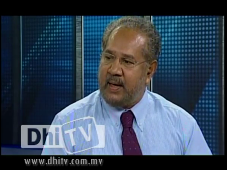
Sandhaanu DidiAppearing on opposition-aligned private broadcaster DhiTV last week, Sandhaanu Didi had alleged that the government was “operating under the influence of Christian priests” and had been “attempting to spread irreligious practices and principles in the country.”

In response, the President’s Office issued a statement on Thursday condemning the remarks as “racist, bigoted and anti-Semitic.”

“The DQP is playing politics with religion. They are siding with religious extremists to wage a campaign that is racist, anti-Semitic and deeply unpleasant, in an effort to damage the government. I condemn the DQP, its leader Dr Hassan Saeed, and the council members involved for their disgraceful behaviour” Zuhair said at last week’s press conference, where he announced the government’s decision to ask police to investigate the pair along with DhiTV.

Zuhair added that opposition parties were “stooping to the politics of the gutter… out of political desperation”, pointing to a string of victories in recent by-elections for the ruling Maldivian Democratic Party (MDP) “and the success of government policies, such as universal free health insurance, which was introduced on January 1.”

“The outburst by the DQP council members is the latest in a torrent of intolerant slurs made by opposition parties in recent weeks, in an apparently co-ordinated effort to undermine the government’s moderate Islamic stance,” the President’s Office statement reads.

On December 23, opposition parties and a coalition of NGOs organised a mass demonstration to ostensibly ‘Defend Islam’ and accuse the government of an hidden agenda for securalisation.

“Slander and bald-faced lies”

In his weekly radio address yesterday, President Nasheed insisted that the government “did not wish for the slightest disruption to freedom of expression” and would not react to criticism with police action.

“However, when deliberate slander is spread about the government to mislead the public – especially the false claim that the government is trying to introduce other religions in the Maldives – in my view, the government has a responsibility to clear its name and refute the allegations,” he explained, reiterating that neither the ruling party nor the government “would ever attempt to bring another religion into the country.”

He added that the government should take action against deliberate falsehoods spread to “create discord between the public and myself, my party or this administration and cloud their view of the government.”

Meanwhile at last week’s press conference, Press Secretary Zuhair noted that the former government carried out an investigation while Dr Hassan Saeed was in the cabinet into MDP’s sources of funding and foreign backers, which cleared the fledgling party of alleged ties to Christian missionaries.

After declaring “unconditional” support for candidate Nasheed ahead of the second round run-off of the October 2008 presidential election, Dr Hassan Saeed said at the closing rally of the campaign that the anti-Islamic allegations were “bald-faced lies.”

“The Maldivian government carried out efforts with funds from the Maldivian treasury, with money from the state budget and using experts from England to see if there was any connection between Mohamed Nasheed or MDP to Christianity,” he revealed.

“They carried out a thorough inquiry. That project looked into whether MDP received funds from foreign parties to spread Christianity. But what did the inquiry the Maldivian government carried out with Maldivian funds show? There is no connection between Mohamed Nasheed or MDP to Christianity.”

Dr Saeed’s running mate in 2008, former Foreign Minister Dr Ahmed Shaheed explained in an interview with Minivan News in June 2011 that the previous administration hired UK security and private investigation firm Sion Resources in 2007 for a surveillance operation dubbed ‘Operation Druid.’

“The [Gayoom] government may have wanted to see what was going on. What these operations did was try to see who was who. And a lot of the operations the government felt were against it came from Salisbury, and I think the government of the day felt justified in engaging a firm to look into what was going on,” Dr Shaheed revealed.

“We’re talking about people who they had deported from the Maldives for proselytisation, people involved in all sort of activities. They felt they needed to check on that, and what came out was a clean bill of health. Nothing untoward was happening, and these people [MDP members working in exile] were by and large bona fide.”

The accusation from the Gayoom campaign that MDP and Salisbury Cathedral were conspiring to blow up the Islamic centre and build a church was “just a mischievous suggestion, a very mischievous suggestion,” Dr Shaheed said.

“Hassan Saeed and I – the last election rally we had, October 7 2008 or thereabouts, the last rally in our campaign against Gayoom, at the time everyone was accusing each other of being non-Muslim, and this accusation that the MDP was non-Muslim was getting very loud,” he continued. “So we came on stage and said we were former government ministers and that we were aware about this allegation against MDP and that Gayoom had hired a firm to look into this allegation, and that their report had confirmed there was no such connection to MDP. Both of us said this on record.”

Likes(0)Dislikes(0)