Police considering legality of 300 arrests in wake of Criminal Court’s release of Gassan

The Maldives Police Service is reviewing the legality of a number of arrests made under article 46 of the constitution, after the Criminal Court ruled last night that the arrest of Gassan Maumoon, son of former President Maumoon Abdul Gayoom, was unlawful.

Police Sub-Inspector Ahmed Shiyam explained that police were studying the cases to determine whether the arrests were lawful in light of the Criminal Court precedent, and considering releasing the suspects.

Chief Judge Abdulla Mohamed ruled last night that Gassan was arrested in violation of article 46 of the constitution and a Supreme Court precedent establishing criminal justice procedures.

Article 46 states, “No person shall be arrested or detained for an offence unless the arresting officer observes the offence being committed, or has reasonable and probable grounds or evidence to believe the person has committed an offence or is about to commit an offence, or under the authority of an arrest warrant issued by the court.”

Gassan’s lawyers argued at court that as the former President’s son was taken into custody without an arrest warrant after he was summoned for questioning, the circumstances of his arrest does not fit the exceptions provided for in the constitution where suspects could be arrested without a court order.

Sub-Inspector Shiyam however said there were “dangerous criminals we have arrested following the same procedure for committing offences such as child molestation, drugs and assault and battery.”

Police were currently reviewing the cases of “over 300” suspects to determine if their arrests were constitutional, he said.

Responding to the legal arguments from Gassan’s lawyers at the Criminal Court hearing yesterday, Police Superintendent Mohamed Jinah said if Gassan’s arrest was unlawful, “every one police have arrested and brought before the court [for extension of detention] was arrested in violation of the constitution.”

Jinah insisted that the arrest was lawful as police had reasonable grounds to suspect Gassan had committed a crime and were prepared to submit early evidence for an extension of detention.

Speaking to Minivan News today, Progressive Party of Maldives (PPM) Spokesperson MP Ahmed Mahlouf said the police statement was intended to “put the lid on Gassan’s arrest,” which he said had drawn public anger towards the government.

Mahlouf noted that only the Criminal Court, High Court or Supreme Court could order the release of suspects held in remand detention and “not the President’s Office or Home Ministry.”

“And the only way to change a Criminal Court ruling is to appeal it at the High Court,” he said, adding that the Supreme Court precedent in July 2010 established that only the Prosecutor General could file such appeals.

The PPM also filed three complaints at the Police Integrity Commission (PIC) regarding Thursday’s disturbances, Mahlouf said, which involved the police reaction to the MDP protest outside the Supreme Court and police failure to intercede when MDP activists damaged the property of the former President.

The party also filed a complaint about the summons chit sent to Gassan Maumoon, he continued, which he argued was “unlawful” as the former President’s son had exercised his right to remain silent when he was first summoned on Saturday.

The PIC had invited PPM members for a meeting regarding the complaints at 12:00pm tomorrow, he said, adding that the commission had formed three committees to investigate the matter.

Two activists of the ruling Maldivian Democratic Party (MDP) arrested for their involvement in disturbances outside the former President’s residence, Endherimaage, last Thursday were meanwhile released from custody today.

The Criminal Court yesterday approved a five-day extension of detention for MDP activist Ilham. Following his release last night, Ilham’s lawyer Abdulla Haseen said Gassan was arrested on suspicion of endangering a person’s life while Ilham was arrested on suspicion of damaging personal property during Thursday’s protest.

But, said Haseen, while Ilham was handcuffed and had his detention extended by the court, Gassan was treated very differently.

Supporters of the former PPM attacked Housing Ministry’s State Minister Dr Mohamed Shareef yesterday when he arrived from a conference in Bandos while PPM activists were demonstrating outside the police headquarters.

Sub-Inspector Shiyam said today that no arrests had been made yet in connection with the attack, footage of which was shown on Villa Television yesterday. The PPM supporters also stormed into the Home Ministry and met with senior officials to complain of Gassan’s arrest.

No-confidence

President’s Office Press Secretary Mohamed Zuhair meanwhile told Minivan News that in the wake of yesterday’s Criminal Court ruling, “all the arrests made in the past using the same procedure will be unlawful.”

Zuhair revealed that a team of senior police officers met with Prosecutor General (PG) Ahmed Muiz today to discuss the implication of last night’s precedent.

“He did not speak on the issue and rather questioned the police about some past incidents that he asked police to investigate and told the police to leave the PG Office immediately,” Zuhair said.

Following the actions of the PG, said Zuhair, the executive believed the government could no longer work with him.

“We will file a no-confidence motion against him [in parliament] very soon,” he said.

PG Muiz was unavailable for comment today.

PPM Spokesperson Mahlouf said the party would do “everything we can to save the PG” and such targeting of independent institutions the government was displeased with was “unacceptable.”

Likes(1)Dislikes(0)

Parliament cancelled over convicted MPs’ attendance

Parliament was adjourned 15 minutes into the sitting yesterday after opposition MPs protested the presence of Independent MP for Kaashidhoo Ismail Abdul Hameed, who was convicted of corruption on August 29 and sentenced to one year and six months banishment.

Hameed had since appealed the Criminal Court verdict at the High Court, which held a first hearing yesterday.

Responding to points of order raised by MPs Ilham Ahmed, Ali Arif and Ahmed Mahlouf objecting to his presence in the chamber, Hameed said he was “on holiday” from October 2 to November 22.

“I don’t believe there is any legal obstacle to my attending the Majlis,” he said.

Speaker Abdulla Shahid said parliament had not informed the Kaashidhoo MP that he could not attend sittings, noting that Hameed had the right to appeal the Criminal Court verdict.

After a series of consecutive points of order from both opposition and ruling party MPs, Shahid adjourned the sitting to discuss the issue with parliamentary group leaders.

Parliament Secretary General Ahmed Mohamed confirmed to Minivan News that MPs were informed that today’s sitting was cancelled to allow the Speaker to resolve the dispute through dialogue with the Majority Leader and Minority Leader.

A decision had not yet been made on going ahead with tomorrow’s sitting, he said.

Under article 73(c)(3) of the constitution, MPs found guilty of a criminal offence “and sentenced to a term of more than twelve months” would be stripped of their seat.

Article 78 of the constitution meanwhile states that “whenever there is a vacancy among the members of The People’s Majlis, an election shall be held within sixty days from the date of the vacancy. A by-election shall not be held within six months prior to a general election.”

Brawl in committee room

MP Ilham AhmedMeanwhile, a brawl broke out between MPs of the ruling Maldivian Democratic Party (MDP) and opposition Progressive Party of Maldives (PPM) MPs at an Economic Committee meeting yesterday.

PPM Media Coordinator and MP for Vili-Male’ Ahmed Nihan told Minivan News that MDP MP Ibrahim Rasheed threw a glass at MP Ilham.

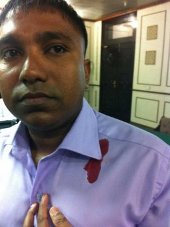
“Bonda hit Ilham with the glass when he said that the [committee] meeting will unlawful if it was continued with MP Abdul Hameed,” Nihan said. ”He was injured and was admitted to ADK hospital after his chest was continuously bleeding.”

MP for Maafanu South Ibrahim Rasheed however denied the allegations and accused Ilham of “misleading the public.”

”He made that up and it is a big lie,” Rasheed said. ”I did not hit him.”

Speaking to private broadcaster Villa TV from ADK hospital yesterday, Ilham said yesterday’s sitting became heated over the convicted MP’s presence and the matter of a motion without notice submitted by opposition MPs regarding the MDP protest outside the Supreme Court not being tabled in the agenda.

“After the sitting was adjourned, we went to the committee,” he explained. “Even though we’re not members of the Economic Committee, we do attend meetings and speak there. We can speak even though we’re not members. We just can’t participate in voting. I said this is unlawful [with Hameed in attendance] and committee meetings could only take place after this is solved.”

Ilham said his remarks led to acrimonious verbal sparring between MPs, during which Bonda got up and threw the glass at him.

Secretary General Ahmed Mohamed told Minivan News today that a police forensic team arrived at parliament shortly after the incident and commenced an investigation.

Likes(0)Dislikes(0)

Criminal Court rules Gassan arrest unlawful

Criminal Court Chief Judge Abdulla Mohamed ruled tonight that police arrested Gassan Maumoon in violation of the constitution and a Supreme Court precedent establishing criminal justice procedures after his lawyers filed an application for a writ of ‘habeas corpus’, or release from unlawful detention.

After the case was filed this afternoon, the court issued an order to the police to bring Gassan to the court before 4:00pm today.

Gassan’s legal team, including former Attorney General Azima Shukoor and former President Maumoon Abdul Gayoom’s lawyer Mohamed Waheed Ibrahim ‘Wadde’, argued that Gassan’s arrest after being summoned to police headquarters at 10:00am was in violation of article 46 of the constitution.

Article 46 states, “No person shall be arrested or detained for an offence unless the arresting officer observes the offence being committed, or has reasonable and probable grounds or evidence to believe the person has committed an offence or is about to commit an offence, or under the authority of an arrest warrant issued by the court.”

Gassan’s legal team also claimed procedural violations in the arrest based on the precedent established by a Supreme Court ruling (page 11 point 11) in July 2010 overturning a High Court ruling extending the arrest of MPs Abdulla Yameen and Gasim Ibrahim.

Azima argued that the precedent established that the burden of proof falls on the state before arresting suspects.

Noting that police did not seek a court order for Gassan’s arrest, which was the “established norm,” Azima said the circumstances of his arrest did not fall under exceptions provided for in the constitution where police could arrest suspects without an arrest warrant.

Gassan’s lawyers noted that he was arrested four days after the incident took place.

In the absence of a Criminal Procedures Act, said Azima, the precedent should be followed in interpreting article 46 of the constitution.

Moreover, she added, Gassan was arrested through “deception” as “my client did not present himself to police to be arrested.”

Gassan was first summoned for questioning last Saturday concerning disturbances outside his residence Endherimaage on Thursday during a protest by the ruling Maldivian Democratic Party (MDP).

The protesters were calling for judicial reform, alleging that the judiciary and the Judicial Services Commission (JSC) were subject to political manipulation by the opposition and members of the former government.

During the protest a 17-year-old boy was struck on the head with a wooden plank allegedly thrown from Endherimaage while protesters led by MDP MPs, councillors and senior members were outside the former President’s residence.

Responding to Azima’s arguments at court today, Police Superintendent Mohamed Jinah insisted that the arrest was lawful as police had reasonable grounds to suspect Gassan had committed a crime and were prepared to submit early evidence.

If Gassan’s arrest was unlawful, said Jinah, “everyone police have arrested and brought before the court [for extension of detention] was arrested in violation of the constitution.”

Jinah suggested that Gassan’s legal team was “concerned that we might present evidence” and that the legal argument bore “no weight.”

The top police attorney submitted documents containing early evidence for the judge’s considering, including a medical report of the injuries sustained by the 17-year-old, photos, witness statements and “evidence we collected from the scene.”

The evidence was submitted despite the hearing being held on the case filed by Gassan’s lawyers contesting the legality of his arrest. Police were due to bring the former President’s son before court at 7:00pm to determine if his detention could be extended.

Jinah said police had reason to believe the investigation could be compromised if Gassan was released from custody.

Although the early evidence was not shared with the defence counsels, Azima argued that witness statements were invalid as they would have come from “people participating in an unlawful assembly.”

When Azima contended that the police claims conflicted with media reports on Thursday’s incidents, Jinah noted that “different media reported the same incident in very different ways.”

Gassan’s lawyers meanwhile submitted as counter-evidence photographs and video footage showing an MDP protester carrying a wooden plank. The footage was first aired on private broadcaster DhiTV challenging the MDP’s contention that the wooden plank was hurled from a second floor balcony of Maafanu Endherigas.

Azima argued that the nature of the evidence submitted was not enough “to establish a causal link between the suspect and the crime.”

When Gassan’s lawyer Maumoon Hameed criticised police for not examining “publicly available video footage,” Jinah said police had requested video footage from media outlets as well as footage caught on private security cameras.

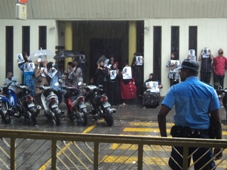
Supporters of the former President’s newly-formed Progressive Party of Maldives (PPM) were camped outside the Justice building for the duration of the hearing carrying “Free Gassan” placards and celebrated with loud cheering when Gassan emerged from court.

Later in the day, activists of the ruling party gathered to protest outside the Supreme Court behind police lines. A heavy police presence kept the rival protesters at opposite ends of the court building.

Likes(0)Dislikes(0)

Gassan summoned to Criminal Court

The Criminal Court has summoned Gassan Maumoon, son of former President Maumoon Abdul Gayoom, after his lawyers Aishath Azima Shukoor and Mohamed Waheed filed a case against the police claiming that his arrest Monday morning was unlawful.

Gassan was arrested and taken to Dhoonidhoo police custodial this morning after he allegedly dropped a large piece of wood on Maldivian Democratic Party (MDP) protesters gathered near his house on Thursday.

Today in court Gassan’s lawyers claimed that the arrest was unlawful and violated the Supreme Court’s procedure on arresting persons.

However, the police have submitted witness statements and evidence to court, and requested an extension of detention for further investigation.

Last Thursday 17 year-old Hussein Hassan was critically injured by a piece of wood while he was inside a group of MDP members protesting against manipulation of the judiciary by members of the former government. A spokesperson for Indira Gandhi Memorial Hospital (IGMH) later said his condition had stabilised.

MDP supporters alleged that Gassan had dropped the piece of wood that hit Hassan, while supporters of the former Presdient’s Progressive Party of Maldives (PPM) claimed it was thrown by MDP supporters.

PPM supporters gathered near the Criminal Court today calling for the immediate release of Gassan.

Protesters also attempted to break through police lines and enter the court area. However, leading PPM figures controlled the protesters and asked them to be quiet until the hearing had concluded.

Police today blocked the roads to the Criminal Court and have maintained control of the whole area.

The hearing started at 4:00pm this afternoon and was still continuing four hours later.

Likes(0)Dislikes(0)

PG asks police to provide details of protest response

The Prosecutor General’s (PG) office has asked the police to provide details of its response to the protest held by ruling Maldivian Democratic Party (MDP) outside the Supreme Court on Thursday, which later spread to the residence of the former President.

Prosecutor General Ahmed Muiz told Minivan he was unable to comment on the matter at this time.

However Police Sub-Inspector Ahmed Shiyam said this was the first time the PG had made such a request.

“They are requesting details of what happened,” Shiyam confirmed, but said the PG had not notified police of a potential course of action or what it was looking for.

Shiyam pointed out that demonstrations in certain areas, including courts and army gates, are prohibited by the Regulation on Assembly.

“Members of the Maldivian Democratic Party (MDP) and Dhivehi Rayithunge Party (DRP) have both gathered in these areas though, even though we have requested them not to. Some of them have gone to the army gates and the President’s gate as well, so occasionally we have to address the issue,” he said.

The police have been asked to provide the information before Wednesday this week.

On Thursday October 20 the MDP national council conducted an emergency meeting and approved a resolution to launch a protest against the judiciary, claiming judges were unduly influenced by the former President and his half-brother MP Abdulla Yameen.

The protesters gathered at the Supreme Court before marching towards the former President’s building Endherimaage, where violent clashes erupted between MDP activists and a few Gayoom supporters blocking the entrance to his residence.

Minivan News journalists at the scene also observed gravel, rocks, hot water and sharp metal raining down on protesters from the top floors or terrace of Endherimaage.

Several activists claimed they saw Gassan Maumoon, former President Gayoom’s son, throw stones and pour boiling hot water on the protesters. MDP activists meanwhile threw large stones at Endhirmaage and attempted to break down the door. Some windows of the house were smashed while a car parked outside was damaged.

A 17-year-old, identified as Hussein Hassan, was rushed to the Indira Gandhi Memorial Hospital (IGMH) with critical injuries after a block of wood apparently thrown from the building hit his head. IGMH later confirmed that the boy was conscious and his condition stable.

Police summoned Gassan Maumoon, son of the former President, for questioning on Saturday after a number of MDP members alleged they had seen him throw the block of wood from the balcony. Police subsequently arrested Gassan and took him to the prison island of Dhoonidhoo, and presented him at court this afternoon. The hearing is currently ongoing.

Likes(0)Dislikes(0)

Electronic voting depends on public awareness in Maldives

The Maldives has expressed support for electronic voting systems in India and Pakistan, and is taking steps to introduce Electronic Voting Machines (EVMs) to its own electoral process.

At an informal meeting of Electoral Commissioners from SAARC member countries in India, the Maldives joined Bhutan, Afghanistan, Nepal and Sri Lanka in praising India’s use of EVMs and indicated that “legal amendments would be thought of to see that EVMs were made popular to ensure free and fair polls in their countries,” Indian news outlet The Hindu reported yesterday.

Commissioners met to discuss Afghanistan’s voting procedures in light of waning financial and other aid from NATO allies.

Maldives Elections Commission President Fuad Thaufeeq said the commission, which is developing a proposal for Parliament regarding EVMs, has met with the Committee on Independent Commissions to discuss their implementation.

“So far, we have been getting information from many countries in Europe, South America and Asia which have used these. Regionally, India, Nepal, and Bhutan have used the machines and we are also getting advice from them. Hopefully the system will work, but some laws will have to be changed and the public must support the decision,” said Thaufeeq.

Prior to the 2008 Presidential election, India had offered to donate several hundred EVMs to the Maldives. “But it was the wrong time,” said Thaufeeq. “The machines India was using could not do print-outs. This year, they upgraded and added a verification process. I think it’s necessary for the Maldives to have a verification system,” he said.

Thaufeeq indicated that the commission may approach India’s High Commission to renew their offer of donations. Otherwise, he said machines will be chosen through a negotiation process with various companies, and bids may be solicited.

Electronic and internet voting systems have been used worldwide for decades, and have triggered much debate.

India first used electronic voting machines in 1982; in 2002, they became an election standard nation-wide. However, India’s 2009 elections were discredited when Omesh Saigal, an IIT alumnus and IAS officer publicly proved that the electronic voting system may have been rigged.

In 2006, the Netherlands’ General Intelligence and Security Service proved that electronic voting machines could be eavesdropped from up to 40 metres. EVMs were subsequently eliminated.

Since the 2000 presidential election, the United States has reported problems with electronic voting machines in a number of local and national elections. Mis-punched cards, security flaws, and touch screen malfunctions were some factors that have tipped votes over the past decade.

Internet voting was proposed for the Maldives’ Parliamentary elections as a means of cutting costs and confusion for Maldivians living abroad. Project Coordinator at NGO Transparency Maldives Aiman Rasheed said the motion was swiftly rejected by Parliament, and although Transparency has not been officially informed of the discussion, doubts that EVMs will be treated differently.

Observing that EVMs are acceptable under the right conditions, Rasheed explained that the advantages of using EVMs in the Maldives did not justify the disadvantages.

“In a large country with dense population centers, they can be useful,” he said. “But the Maldives is so small, and population areas are so widely spread out, with only 400 polling stations I don’t think that they would be a major improvement.”

Rasheed said the disadvantages of EVMs could have a significant political impact, and believed the public should be involved in the decision.

“I think Parliament and the Elections Commission should carefully consider the cost-benefit. Is the quick count worth the room that the new system with EVMs would leave for accusations of fraud or lack of transparency?” he said, noting that Maldivians tend to have a high “trust deficit”, and pointing out that Maldivian law does not allow for exit polls.

Building public trust is driving the dialogue over EVMs in the Maldives. Dhivehi Rayyithunge Party (DRP) Deputy Leader Ibrahim ‘Mavota’ Shareef  agreed with Rasheed’s assessment.

“There is a lot of suspicion about new innovations that people are not familiar with. If done correctly, and people are informed, then EVMs shouldn’t be a problem for democracy in the Maldives,” he said.

However, Shareef observed that “any electronic machine with passwords can be corrupted,” adding that corruption is a higher risk for small communities. He recommended the Elections Commission “prove it cannot be manipulated” by issuing public education programs through the media.

“There is no public participation in the Election Commission’s discussion right now. Many islanders are unaware of how these things work. Without building trust, there will always be suspicion,” he said.

Rasheed explained that the “trust deficit” was a symptom of a young democracy.

“The Maldives’ biggest issue is that it has only had three free elections, and those were very recent. The latest Parliamentary and Presidential elections did very well under the circumstances, but the local elections have definitely declined in terms of transparency.”

Rasheed said that during these elections, political parties and NGOs sent volunteers to observe the electoral process, promoting transparency. Although new legal framework was implemented a mere one-and-a-half months prior to the Presidential election, and three months prior to the Parliamentary elections, “they did quite well,” said Rasheed.

Local elections, which had 18 months to prepare, performed well administratively “but they did not do so well in terms of transparency,” said Rasheed.

MDP MP Eva Abdulla also believes that free, transparent elections must be routinised before electronic modifications are made to the electoral process.

“I’m not sure if we are willing to move away from the physical voting system. It’s only been three years since we began trusting independent voting procedures,” she said.

Abdulla believes that Maldivians are quick to absorb new technology, but doubts that the advantages of EVMs are relevant to the Maldives.

Previously, island geography meant that counting and recording votes could take several days. “Now, officials count the ballots in front of the people on the same day, and we have our results immediately,” said Abdullah.

The Elections Commission has a different impression of the situation.

According to Thaufeeq, the average five to six hours that manual voting procedures involve is too long, and the costs of employing workers to manage the polls is too high. He said that while the transparency of open counting is important, there are significant advantages to electronic voting.

“Responses from MPs and the general public has indicated that people are more ready today than they were three years back. People are more familiar with technology right now, an EVM is similar to an ATM, which everyone can use,” said Thaufeeq. “But above all, we want the approval of Parliament and the public, to be sure that everyone is aware and comfortable with the system.”

Public examinability of voting procedures has been identified as an essential factor of free elections by government and independent groups worldwide.

In 2007, California Secretary of State Debra Bowen commission a statewide “Top to Bottom review” of electronic voting systems. According the report, every mechanism contained at least one security flaw that would allow a single non-expert to compromise an entire election.

In 2009, the Federal Constitutional Court of Germany found that when using voting machines the “verification of the result must be possible by the citizen reliably and without any specialist knowledge of the subject.”

Although the Maldives’ plans for implementing EVMs are far from concrete, the sentiments behind the suggestion are strong.

“Historically, the Maldives has had close elections with little information, which has generated suspicion of fraud,” Rasheed said. “If people can’t see what is happening, it will feed the country’s rising trust deficit.”

Likes(0)Dislikes(0)

UN celebrates 66th anniversary

The United Nations (UN)’s Maldives office today marked the 66th anniversary of the UN’s founding with a ceremony and reception held in the UN’s Male’ compound.

Speaking at the ceremony, Vice President of the Maldives Dr Mohamed Waheed Hassan observed that the UN “is as relevant today as it was when it was first founded.”

Dr Waheed, himself a former UN employee with the UNICEF agency, noted that he had himself witnessed the organisation’s work in 16 of the 190 countries in which it had a presence.

In countries such as Yeman and Afghanistan, Dr Waheed recalled that he had seen friends “risk their lives to deliver food, medicine and books to remote parts of countries that even government officials rarely visit. I’ve worked with warlords who fear the UN because of the human rights it stands for.”

The UN had a mandate to protect people from their own government, if the government turned on its own population, he said.

“The world does not want another Bosnia or Rwanda. Libya was saved thanks to the work of the UN Security Council,” he noted.

Locally, new problems such as transnational crime, drug addiction, human trafficking, piracy, human rights challenges, climate change, “cannot be solved in isolation. Some are international issues – global problems needing global solutions,” Dr Waheed said.

Also speaking at the ceremony, acting UN Resident Coordinator Zeba Bukhari observed that despite a perception that the UN dealt primarily with peace and security, “most of its efforts and resources are actually devoted to improving the conditions of vulnerable population groups, full employment, and conditions of economic and social progress and development.”

Concrete examples in the Maldives, Bukhari noted, will include the support of electrification of islands through more efficient means and alternate energy, cost effective solutions to coastal management, water and sanitation, land use and resource management, reef systems management and waste management.

“All these efforts will be tied to better livelihoods and agriculture and fisheries opportunities, ‘green’ healthcare-related activities, disaster preparedness and mitigation measures, and greater environmental awareness especially at the community and school level,” she noted.

On October 26 the UN is due to launch a report marking the date the human population reaches seven billion. According to the report, the figure has implications for sustainable human development including climate change, food security, water and waste management, employment, and conflict and peace building.

“Some say our planet is too crowded. I say we are seven billion strong,” said UN Secretary General Ban Ki-Moon, in his UN Day address.

“We are living longer. More of our children survive. More and more of us live at peace, under democratic rule of law. As we have seen in this dramatic year, people everywhere are standing up for their rights and human freedoms,” he said.

“And yet, all this progress is under threat. From economic crisis. Rising joblessness and inequality. Climate change. Around the world, too many people live in fear. Too many people believe their governments and the global economy can no longer deliver for them. In these turbulent times, there is only one answer: unity of purpose.”

Likes(1)Dislikes(0)

Government misled by NDMC’s management of Moreway money

Senior members of Moreway Construction Company and the National Disaster Management Center (NDMC) have been implicated by employees of NDMC and the French Red Cross (FRC) for their alleged corrupt involvement in a 2005 Laamu Gan tsunami housing project.

“Moreway is a scapegoat for forgeries and fabrications committed by the Arif brothers Ahmed and Abdullah, and Mohamed ‘Dhigali’ Waheed,” alleged one member of the business community familiar with the individuals, who wishes to remain anonymous.

Dhigali is a former shareholder and current executive manager of Moreway Construction. Ahmed Arif owns Apollo Holdings Company, which has been linked to Moreway, while Abdullah Arif, formerly director of Moreway Arun Excello, today holds shares in Lotus Company.

The Anti-Corruption Commission (ACC) recently entered NDMC with police forensics experts to review files relating to a Rf18 million (US$1.16 million) payment issued to Moreway by the government in May. The ACC stopped a second payment of Rf15 million (US$973,000) in August on suspicion of corruption.

In 2005, the FRC tendered a US$7 million post-tsunami housing project for Laamu Gan, accepting bids from several companies, including Moreway, in a joint venture with Indian company Arun Excello and local company Aima. Although the project initially proposed 460 houses, complaints of insufficient conditions and finances prompted the FRC to reduce that number to 240.

NDMC Senior Project Manager Mohamed Waheed said Moreway’s complaints of insufficient financing and obstacles to construction prevented the company from fulfilling its contract, although at the time, claimed Waheed, imported materials were duty-free. A former employee of the French Red Cross, Adam, added that Red Cross site inspections and budget plans were nearly fool-proof. But “they were always demanding money from FRC, they had all kinds of excuses,” said Waheed.

Meanwhile, Arun Excello had abandoned the project mid-way due to frustrations with Moreway, incurring a loss of US$300,000.

Representatives at Arun Excello had not responded to inquiries at time of press.

After building 80 houses, Moreway’s contract was terminated by the FRC and the project handed over to Maldives Transport and Contracting Company (MTCC) under the government’s remit.

Moreway was subsequently sued by NDMC on behalf of the Maldivian government for losses incurred by the unfinished project. In November 2007, the Civil Court delivered a verdict requiring Moreway to pay US$2.3 million to the government and granting NDMC the right to sell Moreway property at their construction site if the money was not paid within one month.

Sources say the money, due four years ago, has not yet been paid.

“Misleading” letters

Although payments were released to Moreway this year by the Finance Ministry, Waheed claimed that the government has been misinformed.

On April 19, 2011, Deputy Minister of Housing and Environment Ahmed Zaki sent a letter to Finance Minister Ahmed Inaz stating that a sixth invoice submitted by Moreway in March 2007 had yet to be paid, and requested that the ministry release the funds.

In response, Inaz said budget constraints prevented the money being allocated to NDMC, “so, money is to be paid from the NDMC budget.”

Further letters obtained by Waheed illustrate government confusion around the issue. In what Waheed called “misleading letters” between the Finance Ministry and NDMC, NDMC personnel requested the government to pay expired contractor invoices for a project which it had not tendered. At Zaki’s suggestion, the Finance Ministry reallocated money for current housing projects in Dhuvaafaru and Vilufushi to facilitate these payments, which were made using the current dollar-rufiyaa exchange rate.

Although the first payment voucher, processed in May, required Mohamed Waheed’s authorisation, his name had been crossed out and replaced by Deputy Minister Adam Saaed’s, who authorised the voucher along with Zaki.

Asked why this had been done, Waheed speculated that “they thought I wouldn’t sign it, and since Saeed is a friend of Zaki’s they had him sign it. I don’t think he even knew about it, maybe he signed it without thinking much.”

Meanwhile, documents used to obtain these payments are in dubious standing. Waheed points out that only copies were submitted to the Finance Ministry. “Who will accept invoice copies these days? Not even a small child!”

FRC officials also pointed out that the invoices had long been considered invalid.

Emails exchanged between Waheed, FRC senior project manager Brett Campbell and FRC construction coordinator Xavier Chanraud confirmed that all legitimate invoices from Moreway had been paid in full by the time FRC closed its housing projects and left the Maldives.

Chanraud recently stated that, “The FRC has closed all of its housing projects in the Maldives years ago and has already paid 100 percent of its contracts value through NDMC, which includes all defect liability retentions to the contractors. I do not think those invoices are still eligible, especially if rejected four years ago by the NDMC for technical reasons.”

Campbell added that the Civil Court’s verdict against Moreway indicated that “not further payments were due to Moreway.”

In reference to requests for additional payments for access road construction, Campbell said those claims were “discussed at length” and “deemed to be a contractor’s cost.”

Then NDMC Chief Coordinator Abdulla Shahid allegedly rejected the invoices at the time on similar grounds.

“It is questionable how these invoices made headway into NDMC budget section [in 2011],” Waheed wrote in a statement. “These are not outstanding payments to Moreway as one would think and FRC does not recognise these invoices as pending.”

When the invoice for a second payment was authorised by Zaki and NDMC chief coordinator Sheikh Ilyas Hussain and submitted to the Finance Ministry, Inaz questioned its validity against Moreway’s pending debt to the government.

Zaki then took the invoice with comments from NDMC Finance Director Mohamed Shiyam’s desk and passed a new copy to someone else for processing, Waheed alleged. Copies of both invoices with clear discrepancies were shown to Minivan News in private interviews.

The Maldives’ current Red Cross affiliate office, the International Federation of Red Cross (IFRC), was unable to comment on the case.

A blind spot

Sources at NDMC and formerly the FRC agreed the previous regime’s corrupt reputation has left the current government with a blind spot.

“At the time, the government was too corrupt to get money for projects,” said Waheed. “So the FRC was funding the project, but after Moreway could not complete the project FRC left and the government stepped in.”

Government bias may have pervaded the project from the start, however. Moreway’s original bid was rejected over a fake bank guarantee, Waheed pointed out, and the company had to go to court to clear its name before re-submitting its bid.

“This is how things were done then, I don’t know why Moreway was selected but that was Gayoom’s regime,” he said.

Internal complications at the Red Cross were also rumored, although a source familiar with the operation could not confirm the reports.

For Adam, the central issue in the Moreway case is ignorance. “GoM does not understand the discrepancies in payments and procedures, and has not been properly informed of the project, so it is being charged for variations that were not approved by FRC,” he said.

According to Adam, the “local procedure” leaves project tendering and awarding to the Ministry and does not include consultants. It is “the only procedure Maldivians know,” and supports a “culture of embezzling state funds” whereby invoices are frequently submitted, rarely checked, and often paid.

FRC’s procedure is more meticulous and independent, Adam explained. Consultants are included in the bid review process, and officials at local and international FRC offices review projects alongside NDMC officials and consultants.

Had the government been more aware of FRC’s procedures, Adam said it would have noticed that the recently-paid invoice had not been signed by a consultant or passed through the review process at FRC.

The trickle-down effect

Distribution of the Rf18 million (US$110,000) is unclear. One source said it was obvious to anyone familiar with the business community that Dhigali “has profited personally, that he is a crooked businessman is known across the whole Maldives.”

A source familiar with the business community implicated Dhigali in a check fraud case involving companies Apollo and Lotus. The Arif brothers are currently shareholders in Lotus, and were allegedly issued a bad check by Apollo, in which Dhigali is a shareholder.

Other sources believe that anyone involved in processing the payments has also received a share.

The Arif brothers, said to have split associations with Dhigali earlier this year, were reportedly unaware that the payments were made. Ahmed Arif avoided scheduled interviews with Minivan News, and Dhigali did not respond to phone calls.

To date, Moreway’s debt of US$2.3 million has not been paid.

Breaking the Silence

“This is a big fraud and corruption case involving senior members at the government and at NDMC,” said Waheed, who said he suspects political tensions could make the ACC’s investigation difficult. “I’ve told Ilyas and Zaki not to do this. But Ilyas said he is helpless because he is not part of the ruling party. Zaki is MDP, though, and I think the two don’t want to have a conflict.”

While Waheed believes the ACC “is now more professional than before, and we should attach some faith to their investigation,” he chose not to report his findings to the commission.

Instead, he wrote to the President. “Because this involves so many government members I thought it was best to go to the government first, before reporting anything to an outside body. But when I spoke with them they were nervous, they didn’t want this thing to be talked about.”

Minister Inaz had not responded to phone calls at time of press, and Ilyas refused to speak to Minivan News. Deputy Minister Zaki denied all allegations.

ACC’s investigation of NDMC is currently underway.

Correciton: Previously, this article stated “Zaki then took the invoice with comments from Inaz’s desk and passed a new copy to someone else for processing.”

It should have read, “Zaki then took the invoice with comments from NDMC Finance Director Mohamed Shiyam’s desk and passed a new copy to someone else for processing.”

Likes(1)Dislikes(0)

MDP calls for justice for 17-year-old injured outside Endherimaage

The ruling Maldivian Democratic Party (MDP) has condemned “the uncivilised, cowardly and inhumane attack” on 17-year-old Hussein Hassan, Gaaf Dhaal Thinadhoo Semy, who was struck on the head with a wooden plank allegedly thrown from Maafanu Endherimaage, residence of former President Maumoon Abdul Gayoom.

An MDP protest against the judiciary last Thursday turned violent outside Endherimaage after the 17-year-old was injured from the object, which eyewitnesses claimed was hurled from the second floor balcony of the building while the protesters led by MDP MPs and senior officials were passing below.

In a press statement released today by the MDP parliamentary group, the ruling party said the left side of the boy’s brain was not properly functioning and he could not recall past memories as a result of the injury.

“The Maldivian Democratic Party urges all relevant authorities of the state to bring everyone who took part in this lowly, inhumane act to justice,” it reads. “MDP will be watching how the investigation is progressing very closely and the party would like to assure the family of the injured boy as well as our members that we will take all necessary legal action in this case.”

Minivan News journalists at the scene on Thursday observed gravel, stones, hot water and sharp metals raining down on the protesters from Endherimaage.

The protest quickly turned violent after the boy was rushed to Indira Gandhi Memorial Hospital (IGMH) by MDP MPs on a passing pickup near Athena cinema. MDP activists threw rocks at Endherimaage, smashed a window and attacked Gayoom supporters blocking the entrance.

Speaking at the MDP Haruge Friday night, former Chairwoman Mariya Ahmed Didi, who was in the front line of the protest march, said the wooden plank that injured the boy was with the police.

“They still haven’t apologised to the people for this,” she said. “This happened in broad daylight from that house [Endherimaage].”

Meanwhile, MDP MP Mohamed Musthafa called on Home Minister Hassan Afeef to resign from his post claiming the Home Ministry and law enforcement agencies were “failed institutions.”

“A wooden door was dropped from the building where former President was living, and Gassam Maumoon was summoned to the police headquarters and was allowed to walk away freely,” Musthafa said. “Letting him get away with it has showed us that the police and the Home Ministry has failed.”

Musthafa, who beat the former President’s son to win the Thimarafushi seat in a re-vote ordered by the High Court, alleged that Gassan was arrested in the UK for a hit-and-run accident where a British citizen died.

“There should be no protection or immunities for any son or daughter of former president because all of them are above 18,” Musthafa said. “Hassan Afeef was afraid of former President, he fears that he might lose his job or something.”

After Musthafa circulated a text message to MPs and Police Commissioner calling for Afeef’s “immediate resignation,”  he said Afeef later sent him a text saying “get lost.”

Afeef told Minivan News today that did not wish to comment on the issue.

Meanwhile, local daily Haveeru reports that according to the former President’s lawyer Mohamed Waheed Ibrahim ‘Wadde’, Gassan has been sent a summons chit to appear at the police headquarters at 10:00am tomorrow for further questioning.

Waheed claimed the wooden plank that injured the 17-year-old was thrown by an MDP protester.

After responding to the first summons, Gassan Maumoon told reporters outside police headquarters Saturday afternoon that he exercised the right to remain silent after “it appeared from some of their questions that they were accusing me.”

Likes(0)Dislikes(0)