Nexbis signals willingness to negotiate border control agreement

Mobile security system vendor Nexbis, which is behind the stalled build, operate and transfer agreement to upgrade the Maldives’ immigration system, has issued a statement welcoming the government’s decision to proceed with the project and said it is willing to negotiate the terms of the contract.

The upgrade was stalled earlier this year when the Anti-Corruption Commission (ACC) expressed concerns about the deal, claiming that there were “opportunities for corruption” during the bidding process.

“A number of further gross inaccuracies continue to be perpetrated, whether intentionally or through ignorance, particularly regarding the cost of the contract,” Nexbis said in its statement.

“Despite sensationalist claims in the media regarding [the tender process], the terms agreed to by the parties, or the suitability of the system being provided, Nexbis will be delivering a state-of-the-art, flexible and cost-effective security solution.”

Under the 20 year agreement, Nexbis levies a fee of US$2 from arriving and departing passengers in exchange for installing, maintaining and upgrading its immigration system, and a fee of US$15 for every work permit card.

“This means that neither the government nor the Maldivian public have to pay in exchange for a state-of-the-art border security protection,” Nexbis claimed.

The company said that “although the bid proposed a fee to be applied to all travellers including Maldivians”, the company waived the charges for Maldivians “as a goodwill gesture.”

“In addition Nexbis is providing a five percent revenue share to the government should passenger numbers grow. In stark contrast to some of the other bids, we have not requested a guaranteed minimum volume of passengers. Essentially the company must bear the cost risk should the number of visitors to the Maldives drop as has previously occurred during the tsunami and financial crisis.”

Immigration Controller Abdulla Shahid has expressed concern over both the cost and necessity of the project, calculating that with continued growth in tourist numbers Nexbis would be earning US$200 million in revenue over the 20 year lifespan of the agreement.

At five percent, royalties to the government would come to US$10 million, Shahid said, when there was little reason for the government not be earning the revenue itself by operating a system given by a donor country.

“Border control is not something we are unable to comprehend – it is a normal thing all over the world,” Shahid told Minivan News.

“There is no costing of the equipment Nexbis is installing – we don’t know how much it is costing to install, only how much we have to pay. We need to get everything out in the open.”

Nexbis meanwhile argues that “reasonable persons will likely realise that once the hidden costs after are taken into account and adjusted for inflation, the benefits and efficiencies of the Nexbis system will far outweigh the risk, inadequacies and uncertainties of any such alleged cheaper system.”

“This frees up the [Department of Immigration] from managing systems and securing the budget year in, year out to ensure the system is maintained. This will prevent interruption of service and avoid potential corruption as there will no longer be a need to purchase equipment every year.”

Shahid however estimates that maintaining a free system given by a donor country would cost at most several hundred thousand dollars a year, and said he was unsure as to why such an agreement had ever been signed.

“Airport charges are calculated based on government expenditure – such as the cost of the immigration counters. The US$18 collected as an airport tax is included in the ticket, and in the end [under this agreement] the amount for immigration will be going to Nexbis,” he said.

He further noted that despite Nexbis offering not to charge Maldivians for use of the service as a “goodwill gesture”, there was no mention in the contract that Maldivians would have to pay at the border: “the contract says every foreigner,” he said.

Shahid would not comment on the specifics of the pending negotiations with Nexbis, but said that the Immigration Department had the government’s full support in the matter.

Nexbis meanwhile said it had agreed to review the government’s additional requirements, “and have expressed our willingness to accommodate any such changes within commercially viable terms.”

“We have this requires some changes to the solution we ultimately provide, then it is within the scope of our agreement to accommodate these changes,” the company said.

Meanwhile, an ongoing police investigation into labour trafficking in the Maldives last week uncovered an industry worth an estimated US$123 million, eclipsing fishing (US$46 million in 2007) as the second greatest contributor of foreign currency to the Maldivian economy after tourism.

Police discovered several thousand passports confiscated from expatriate workers during a recent raid of 18 ‘paper companies’, created to fraudulently apply for work permit quotas. The imported workers, many of them illiterate and from rural Bangladesh, are then typically employed for a pittance under substandard conditions or else simply abandoned at the airport after having paid up to US$2000 to bogus recruitment agencies.

Likes(0)Dislikes(0)

Democratisation of Maldives is irreversible: President Nasheed

The democratisation of the Maldives through the burgeoning multi-party system cannot be reversed, President Mohamed Nasheed asserted in his Independence Day address.

“No government can last in this country anymore except through clearly stated policies, pledges made to the people and [based on] the extent that the pledges are fulfilled,” Nasheed said. “No greater independence nor a happier state than this could be seen from an independent country. We have definitely changed to that state.”

The type of political system found in a country, said Nasheed, was the “true foundation” for sustaining independence.

Although multi-party constitutional democracy in the Maldives was in its infancy, Nasheed continued, the hopes fostered through the new system promised “a much brighter future.”

Maldivians have proven that “anyone could aspire to become President,” he added.

After emerging as a nascent democracy post-2008, President Nasheed said that the Maldives was punching above its weight in the international arena.

“Especially in the area of human rights and environmental advocacy, the Maldives is by God’s will among the front rank,” he said. “It is unlikely that we will see a better, smoother transition to democracy than the example shown by Maldivians.”

President Nasheed praised and congratulated Maldivians for being forerunners to the Arab revolutions in Tunisia and Egypt as well as democratic change in other parts of the world.

Meanwhile former President Maumoon Abdul Gayoom issued a statement on Independence Day warning of “foreign influences” that could compromise economic independence, sovereignty and “independence of thought.”

Gayoom argued that while “enslavement of Maldivians” by foreign armies was unlikely given the vast changes that have taken place in the world, the undue influence of powerful external forces was a challenge to small states like the Maldives.

“In light of this reality, we have to renew efforts to strengthen and fortify the Maldives’ political and economic independence,” he said.

In his message to the nation, the former President said that preparations to celebrate 50 years of independence in 2015 as colourfully and joyfully as possible should begin now.

Likes(0)Dislikes(0)

Releasing of convicted criminals will not increase crime rate, says Zuhair

The impending release of close to 400 convicts will not result in a spike of crime rates in Male’, Press Secretary for the President Mohamed Zuhair insisted today, citing research conducted over the past few years.

Zuhair explained that based on the screening process the 400 prisoners to be pardoned were unlikely to become repeat offenders.

“Our statistics show that there will be nearly 400 convicted criminals that have been granted a second chance,” Zuhair said. “Out of the 119 people released on a previous occasion only two people had to be taken back to prison for committing an offence.”

Zuhair added that the inmates will be released on the condition that they would be returned to prison to complete the rest of their sentences if they committed any sort of offence in the next three years.

Apart from being hired for government jobs, the released inmates would be required to participate in rehabilitation programmes as well as national service programmes over the next two years.

In his address to the nation on Independence Day, President Mohamed Nasheed announced that close to 400 youth currently serving sentences would be offered “a second chance” and released from prison.

He explained that in classifying the 400 convicts to be freed, priority was given to inmates with serious illnesses and those who could pursue higher education or be trained to acquire new skills.

400 inmates represent almost half the Maafushi prison population in 2009.

“A rehabilitation programme will be established for those who meet the conditions and will be rejoining society under the second chance,” Nasheed said. “The basic purpose of this programme is to train them, find job opportunities for them and to ensure that they become people who are beneficial to their families.”

Speaking to press at the President’s Office today, Zuhair said that the government was grateful for the efforts of minority opposition Dhivehi Qaumee Party (DQP) to undermine the support President Nasheed has from the international community.

“They have said they will try and lessen the support President has in the international community and we are very grateful for that because the DQP has been working very hard as the opposition,” Zuhair said. “However the President has many invitations from other countries but he does not attend unless it is so important that it could not be dismissed.”

Zuhair said that the President had been scheduled to visit Seychelles, France, America and the UK this year on official trips which would be funded by the inviting nation.

On the allegations made by opposition parties that the government’s policies risked undue influence of foreign powers in the Maldives, Zuhair suggested that such claims sprang from the government’s decision to sign a concession agreement to hand over management of Male’ International Airport to Indian infrastructure giant GMR.

“Those who opposed to the agreement should have rather filed a lawsuit in court rather than protesting on the streets,” he said.

Likes(0)Dislikes(0)

Islamic Ministry, MDP religious council condemns Salaf’s taxation fatwa

Religious scholars of different political allegiances have moved to refute and condemn NGO Jammiyathul Salaf’s claim earlier this week that taxation is haram (forbidden) in Islam.

Deputy Islamic Minister Sheikh Mohamed Farooq told local media that there was no religious grounds to declare taxation prohibited.

“When you say something is forbidden in religion, it should be clear under what principle or rationale that it is forbidden,” he explained to newspaper Haveeru. “You can’t just declare something forbidden on a whim. You cannot say something is forbidden when it is not clearly and definitely forbidden.”

He added that Zakat (alms for the poor) were being collected as before and old forms of taxation, such as varuvaa and import duties were not prohibited in Islam either.

Sheikh Farooq condemned the issuance of such fatwas (religious edicts) “without considering” either its validity or social impact.

Meanwhile the ruling Maldivian Democratic Party’s (MDP) religious council condemned Salaf’s claims as an attempt to mislead the public over taxation.

“Human beings cannot forbid something Allah has allowed or allow something Allah has forbidden,” the council’s chair al-Hafiz Ahmed Zaki told the party’s website.

Hafiz Zaki explained that Islam specified steps to be followed before religious judgments or rulings could be made: “One cannot just arbitrarily declare something forbidden,” he said.

Zaki warned that such fatwas could lead to civil unrest and social divisions over religious issues. He said that Islam was a religion of moderation that did not encourage extreme actions.

Zaki urged the public and businessmen to clear any doubts with the concerned authorities instead of “listening to press releases issued by individuals soaked in self-interest.”

Meanwhile Adhaalath party spokesperson Sheikh Mohamed Shaheem Ali Saeed told Miadhu newspaper that taxation was practiced in many Islamic countries while there was consensus among scholars that it was not prohibited.

“There are narrations that have reached us that tax was taken by the state during the time of Caliph Umar. He collected tax from wealth,” he said.

Opposition Dhivehi Rayyithunge Party (DRP) MP Afrashim Ali, chair of the party’s religious council, meanwhile told private broadcaster DhiFM that there was no grounds to declare taxation forbidden in Islam.

However NGO Salaf insisted in its press release Monday that, “Without doubt, using a person’s property or profiting from the property without the consent of the owner is haram in Islam. Only the compulsory Zakat (alms for the poor) portion can be taxed from a Muslim’s property.”

The religious NGO contended that “formulating a law and taking people’s property whatever name it is done under is for a certainty haram.”

“Jamiyyathul Salaf would remind the Speaker of Parliament and all MPs that those who formulate such laws and those who assist them will without a doubt have to bear responsibility before Almighty Allah,” the Salaf statement warned.

It adds that there is consensus in the Islamic ummah (community) that “stealing property by compulsion with laws on taxes, duties and pension imposed on a Muslim’s property is definitely haram.”

Likes(0)Dislikes(0)

Ten flats awarded in first phase of Veshi Fahi Male’ housing project

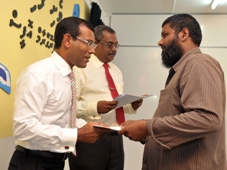
President Mohamed Nasheed presented documents of guarantee yesterday to ten recipients of flats in Hulhumale’ under the first phase of the “Veshi Fahi” Male’ de-congestion programme.

The documents were presented at a ceremony to open the new “Veshi Fahi” Male’ office to applicants under category A of the programme in exchange for small plots in the capital.

Speaking at the ceremony, Male’ City Councillor “Sarangu” Adam Manik, director of the Veshi Fahi programme, explained that the project was launched on November 10, 2010 to ease congestion in the capital and develop the Greater Male’ Region, composed of Hulhumale’, Vili-Male’, Thilafushi industrial island and Gulhifalhu.

“During the 30 years of the previous government, 682 plots [were awarded] in Male’ and Viligili and 1,060 flats were built in Male’ and Hulhumale’,” he said. “In the 30 months of the MDP [Maldivian Democratic Party] government, 500 plots were chosen from Hulhumale’ and the practical work of awarding 250 of those flat has begun today.”

Construction has meanwhile begun on 1,566 flats, Manik continued, including 1,000 housing units and 178 ‘Coral Ville’ flats in Hulhumale’ as well as 198 flats in Gaakoshi, 50 flats in Odeon and 90 flats in the old Arabiyya School site.

“For all these flats, construction is currently underway,” he said, inviting skeptics to “see for yourself.”

Veshi Fahi Male' de-congestion programmeIn his remarks at the ceremony, President Nasheed explained that Category A involves clearing small plots in Male’ “for planting trees or [to use] as a parking area or to clear the space for playing chess, cards or putting up a basket hoop or a dart board or to keep a rubbish bin.”

Nasheed observed that “like most new ideas we proposed” not many people supported the programme or believed it could be successful.

As concentration of one-third of the country’s population in Male’ has given rise to severe congestion and a host of social problems, Nasheed said that it was “absolutely necessary to find some way for the people of Male’.”

Approximately 125,000 people are believed to reside in about 16,000 households in Male’; the total number of households in the Maldives is estimated to be 46,000.

“That is a very small number considering the number of people who live in Male’,” he said. “Therefore we need to build more houses. We believe that the household is the main engine of development.”

Providing affordable housing was one of five key campaign pledges in the ruling party’s manifesto.

Nasheed meanwhile said that residents of Male’ who had mistakenly applied under Category A although they did not possess small plots for exchange would be carried over to the second category when applications are processed.

He added that winners of the 250 plots in Hulhumale’ designated for Category A applicants would also receive a housing loan from the Housing Development Corporation.

President Nasheed said that he expected construction of 500 flats in Male’ to completed within a year.

The government was presently conducting assessments and feasibility studies to connect the islands of Thilafushi, Gulhifalhu, Vilimale’, Male’ and Hulhumale’, Nasheed revealed.

“As you know, in a multi-party political system, there will be people who will try to argue the other side and show that it cannot be done,” he said.

“That is the way it should be. That is how we can build a good democracy. However [for the opposition to] muddle laws and attempt inside the People’s Majlis to obstruct these projects would be regrettable. I hope the people of the Maldives, and especially the people of Male’, will encourage their MPs to help us do this.”

Using a phrase coined by the opposition to mock his repeated pledges to build flats, Nasheed concluded his remarks by saying, “I am flat Dhonbe (elder brother).”

Likes(0)Dislikes(0)

President unveils Rf360m programme to guide 8,500 Maldivians into skilled employment

President Mohamed Nasheed unveiled a massive Rf360 million (US$23 million) national programme today with an ambitious target of training 8,500 Maldivians for skilled employment.

In his address to the nation on Independence Day, President Nasheed explained that the programme would involve the creation of a training framework, raising awareness of job opportunities, offering assistance for job seekers and strengthening capacity for enforcing the Employment Act.

“Under the national programme devised by the government to lead skilled Maldivian workers to the job market, Maldivians who are urgently needed for the domestic labour market will be trained,” he said. “God willing, 6,977 Maldivians trained for the construction industry as welders, masons, electricians and other [specialities] will enter the job market.”

Meanwhile 3,800 people are to be trained as “chefs, waiters, housekeepers, diving instructors” and for other specialised jobs in the tourism industry.

“In addition, God willing we will create 450 entirely new jobs for Maldivians in the social sector as nurses, pharmacists, seamstresses and sport instructors,” he said. “860 Maldivians in fisheries and agriculture and 400 for other fields such as accounting will be put to work.”

Of the 8,500 new workers the government hopes to guide to skilled employment, 3,940 will be trained directly by their would be employers, 3,795 by government training centres, and 760 in overseas training programmes.

“The purpose of this is to familiarise youth with the work environment and create interest among them,” he said. “Also to connect the youth in training with employers and provide training in the fullest sense in as short a period as possible.”

President Nasheed revealed that 27 percent of the Maldivian workforce – composed of 205,000 working age adults – was unemployed.

“As things stand, 1,600 local companies and 2,000 individuals employ and cover expenses for over 70,000 expatriates,” he said. “Half of these expatriates are trained and skilled in some field or other.”

In the past ten years, said Nasheed, employment of foreign workers by Maldivians has increased threefold. Imported workers now constitute a third of the country’s 350,000 population, while trafficking labourers is estimated to be a US$123 million industry.

Wayward youth

With the prevailing high unemployment rate among youth, Nasheed continued, large numbers of young Maldivians who were neither seeking higher education nor acquiring new skills were financially dependent on their families or parents.

In 2010, the O’ Level examinations pass rate in the Maldives was 35 percent, up from 27 percent in 2008, which leaves 65 percent of school leavers aged 16 to 18 with limited opportunities for either higher education or employment.

Nasheed meanwhile went on to say that leaving a large number of the country’s youth “in the darkness of the jail cell with their lives destroyed” was an obstacle to national development.

President Nasheed also announced that close to 400 youth currently serving sentences would be given “a second chance” and released from prison.

He explained that in classifying the 400 convicts to be freed, priority was given to inmates with serious illnesses and those who could pursue higher education or be trained to acquire new skills.

400 inmates represent almost half the Maafushi prison population in 2009.

“For those who meet the conditions, a rehabilitation programme will be established for those who will be rejoining society under the second chance,” Nasheed said. “The basic purpose of this programme is to train them, find job opportunities for them and to ensure that they become people who are beneficial to their families.”

Nasheed said that the government had considered the possible danger to society of releasing people convicted of offences ranging from drug abuse, theft and assault: “We have learned a lot from past experiences,” he said.

Convicts released through the programme will immediately be returned to jail if they are arrested for any offence in a three-year period, Nasheed added, after which their chances of parole or eligibility for clemency would be “narrowed.”

“Our vision for national development has been drawn after crunching all the numbers, after formulating policies and determining its parameters,” he said.

Likes(0)Dislikes(0)

Human trafficking worth US$123 million, authorities estimate

An ongoing police investigation into labour trafficking in the Maldives has uncovered an industry worth an estimated US$123 million, eclipsing fishing (US$46 million in 2007) as the second greatest contributor of foreign currency to the Maldivian economy after tourism.

The authorities’ findings echo those first raised by former Bangladeshi High Commissioner Dr Selina Mohsin, reported by Minivan News in August last year, and which saw the country placed on the US State Department’s Tier 2 watchlist for human trafficking.

However prior to the current investigation, ordered by President Mohamed Nasheed and which involved the military taking over immigration and human resources duties for a two week period, few facts were known about the Maldivian side of the operation.

“People have been creating fraudulent companies and using them to apply for fraudulent work permit quotas, and then diverting these quotas to keep bringing in illegal workers,” said President Nasheed’s Spokesperson, Mohamed Zuhair.

“A would-be worker [overseas] pays money and ends up here on fraudulent papers obtained by a bogus agent, from quotas at a non-existent company,” Zuhair said. “Sometimes they are expected to work for 3-4 years to make the payment – workers have told police that this is often as much as US$2000.”

Authorities currently estimated the industry to be worth US$123 million a year, he said.

Police Sub-Inspector Ahmed Shiyam told Minivan News that many illegal workers identified by police through the investigation – the majority from Bangladesh – had sold their land, their property and moved their families to pay the fees demanded by the bogus recruiters.

When they arrive they find the job a totally different prospect from what they were led to expect, he said.

“Sometimes there is no job and they are released straight onto the street. We found some people who had paid before coming – they arrived at the airport and nobody came to pick them up,” said Shiyam. ”The case is very serious – this is not the way things should be, and it has been going on for a long time.”

Zuhair said that in some cases workers brought to the Maldives were themselves recruited to help enlist others from their country – in addition to seven Maldivians, 12 expatriates have been arrested during the case so far.

Paper companies and ministerial corruption

The expansive investigation has seen 18 ‘paper companies’ raided by the police commercial crime unit, headed by Inspector Mohamed Riyaz, who revealed to the media last week that police had seized 4000 passports confiscated from trafficked workers.

Two of the seven bogus companies identified as trafficking workers, Ozone Investments Pvt Ltd and Arisco Maldives Pvt Ltd, had brought in 3000 workers between them.

Using the fake companies, the traffickers fraudulently obtained work permit quotas for non-existent projects from the Human Resources Ministry by stealing the identities of unwitting Maldivians, or even the deceased. Police had received many complaints about such forgeries from the confused third party, Riyaz told the media.

Moreover, many of the quotas requested from the Human Resources Ministry had been approved despite obvious warning signs such as the importing of construction workers for specialised IT projects, Riyaz said.

Zuhair told Minivan News that while he was unable to “point fingers” as the investigation was ongoing, the current findings implicated senior officials in both the Immigration Department and the Ministry of Human Resources.

In addition, the persistent use of fraudulent companies implied further scrutiny of the Ministry of Trade was required, Zuhair said.

Trade Minister Mahmoud Razee confirmed to Minivan News that the Ministry was providing information to police as requested. Establishing a company in the Maldives carried few requirements under existing laws, he explained, “and even before this we have been proposing amendments to company law to require additional clearances for directors, based on their records.”

Even for those individuals found guilty of the crime labour trafficking presently represents a violation of the Employment Act, and only carries a small fine.

Zuhair said punishment was a matter for the judiciary “and I’m confident justice will be done”. However he acknowledged that the greatest impact would come from exposing those involved: “The people involved will be named and shamed,” he pledged, which would limit their capacity for further fraud or criminal enterprise and hopefully ward off further victims.

The investigation was ordered by the President, he noted, as the Immigration Department and the Human Resources Ministry “were each accusing the other for the problem. The government has stepped in as a neutral party to conduct a holistic investigation, without incrimination.”

He said the government would need to “seek assistance” to deport the large numbers of illegal workers the investigation was likely to uncover.

“The origin countries also have a responsibility to repatriate their nationals,” he said.

Minivan News asked Zuhair why the government had only acted after several years of accusations that labor trafficking was prolific in the country – the US State Department recently renewed the Maldives’ position on the trafficking watch list for the second year running.

“The accusations have been apparent for the last few years, but the extent to which the situation has developed, and the lines between system error, human error and intentional fraud have been unclear. It has now become clearer,” he said.

Likes(0)Dislikes(0)

Cabinet to discuss request to rename Thinadhoo next week

The cabinet will discuss a request by the council of Thinadhoo in Gaaf Dhaal Atoll to rename the island ‘Havaru Thinadhoo’ at its meeting next week, Press Secretary Mohamed Zuhair confirmed today.

Zuhair said that legal advice has been sought following the request and that the cabinet will make a decision at its next meeting on Tuesday, August 3.

Speaking to Minivan News today, Thinadhoo Council Chair Ahmed Naseer said that the council sent a letter requesting the name change to President Mohamed Nasheed because “a lot of citizens asked it of us.”

“For hundreds of years the island was called Havaru Thinadhoo,” he explained. “And when the name was changed by former President Maumoon [Abdul Gayoom] in 1979, no reason was given for that decision and it was not requested by the people of Thinadhoo, either.”

Contrary to popular belief, said Naseer, Thinadhoo did not earn the title ‘Havaru’ for its its part in the short-lived secession of three southern atolls and subsequent depopulation by Prime Minister Ibrahim Nasir on February 4, 1962.

The term ‘Havaru’ originally referred to the six divisions or companies of the public of Male’, which functioned as militia or army units. The word has since earned the connotation of ‘mob.’

In the late 16th century, Sultan Mohamed Thakurufaanu sent the six militias or the ‘Havaru’ to recapture Thinadhoo upon learning that the islanders had re-converted to Buddhism.

Following their victory, the island was endowed to the six companies, which continued to exact an annual tax from islanders until the practice was abolished by Ibrahim Nasir when he became Prime Minister.

Thinadhoo MP Mohamed Gasam of the ruling Maldivian Democratic Party (MDP) meanwhile suggested that the “best way to decide the name change” would be through a public referendum.

“Some people in Thinadhoo want the name to be changed but others want it to stay the same,” he said. “There is some disagreement about this. We should find out what the people want.”

Councillor Naseer said that he had “no problem” with a referendum, but suggested that an election would be a costly affair.

“I think that even if there is an election [the name change proposition] is very likely to get passed,” said Naseer, who is also a member of the ruling party.

In the local council elections in February, the MDP made a clean sweep of the seven-seat Thinadhoo council.

Ibrahim Nasir International Airport

Thinadhoo Council Chair Naseer however insisted that the council’s request had “no connection whatsoever” to the announcement last week that the Male’ International Airport would be renamed ‘Ibrahim Nasir International Airport’ on Independence Day (July 26) in honour of the former President.

“We had been thinking about sending the letter [requesting the name change] for some time now, long before that announcement” he said, adding that the timing of the council’s letter was a “coincidence.”

MP Gasam meanwhile suggested that the council might have made the request last week as Independence Day would be an auspicious date for the change.

Naseer stressed that the letter to President Nasheed only sought legal advice as well as his opinion: “We would have no problem if the cabinet decided that changing the name would not be the right thing to do,” he said.

Asked about the renaming of the airport due to take place tomorrow, Naseer speculated that “no one who is from Thinadhoo” would support the change as the former President had ordered the “brutal destruction of the island” in 1962.

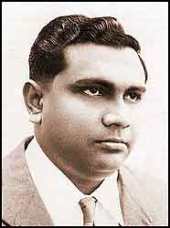
Meanwhile as the country prepares to celebrate its 46th Independence Day tomorrow – secured by Nasir on July 26, 1965 – local media reports that the former President’s eldest son, Ahmed Nasir, filed a case at the Supreme Court yesterday, appealing a High Court ruling in 1986 to confiscate the property and estates of his father.

The High Court at the time found that Nasir had misappropriated state funds and decided that his property and estates could be sold by the state to recoup the allegedly stolen money.

After resigning in 1978, Nasir moved to Singapore, where he passed away on November 22, 2008, just weeks after his successor Maumoon Abdul Gayoom was ousted in the country’s first multi-party election.

Nasir’s lawyer, “Gnaviyani” Ali Shareef Ibrahim, told Sun Online yesterday that neither the judicial system under Gayoom nor the prevailing political environment 25 years ago made such an appeal possible.

Under the old constitution, which did not feature separation of powers or independent institutions, the President was both head of state and supreme authority on justice, with the power to overrule verdicts and dismiss judges.

The Supreme Court of the Maldives was established in September 2008 following ratification of the new constitution on August 7, 2008.

Shareef explained that Nasir was sentenced in absentia while angry mobs, including school children, were protesting on the streets.

The Nasir family lawyer also alleged in comments made to newspaper Haveeru today that the new administration of Maumoon Abdul Gayoom began selling Nasir’s property before the High Court verdict on January 30, 1986.

“[Proceeds of the sales] were deposited at Nasir’s SBI [State Bank of India] account, which was frozen by the government,” he said. “When the verdict was delivered, they took all the money out.”

Shareef revealed that the appeal was lodged at the Supreme Court in May as regulations gave the highest court of appeal the discretion to hear such cases in spite of the length of time between the original verdict and the appeal.

The elderly lawyer claimed that the previous administration vilified Nasir by “spreading lies to make him out to be an enemy of the country, a mercenary, a corrupt person.”

“The state media was constantly mocking President Nasir and showing all sorts of cartoons of him,” he said. “[Nasir] did not return at the time because he feared for his life.”

Likes(0)Dislikes(0)

ACC highlights irregularities in finances of Maldives Entertainment Company

The Anti-Corruption Commission (ACC) has released findings of an investigation into the finances of the Maldives Entertainment Company Ltd (MECL), highlighting discrepancies and irregularities in the company’s financial records.

According to a press statement by the ACC on Thursday, the investigation of the 100 percent state-owned corporation was prompted by numerous complaints regarding its expenses, inventory and high salaries of board members.

“Even though records of expenditure were kept, the figures in the records and the actual amount withdrawn from the [corporation’s] bank account differs,” the ACC findings noted.

“While company records show that Rf676,262.95 (US$43,800) was spent, the bank account showed that Rf807,703.95 (US$52,300) was withdrawn for expenses. Therefore, Rf134,470 was withdrawn from the bank without any record [of how the money was spent].”

Discrepancies in income statements meanwhile revealed that Rf524,121 (US$33,900) worth of income was not entered into QuickBooks (accounting software) records.

Moreover, as a result of the corporation’s spending exceeding its revenue, MECL currently has outstanding debts amounting to Rf122,178.98 (US$7,900), owed to various parties for purchases and services.

“As a result of incomplete documentation and failure to properly maintain records of the company’s expenses and revenue, the legitimacy of the details of expenditure and revenue cannot be guaranteed,” the ACC findings noted.

Moreover, there was no record of the income generated or expenses incurred for a Boney M concert last year.

In addition, a list of assets transferred to the corporation upon its formation were not registered in its inventory.

The ACC findings noted that board members were paid salaries “disproportionate to the income [the corporation] generates through its limited resources.”

“While Rf1 million (US$64,850) was provided by the Finance Ministry in four installments as MECL’s capital and Rf250,000 was received for each installment, instead of spending the money for the company’s other expenses, the bulk of it was spent on salaries for board members,” the ACC found.

However the ACC discovered that among the board members only the Managing Director of the board was being paid a monthly salary at present, “[but] the company’s staff are being paid monthly salaries with no records of attendance.”

The ACC has informed the Finance Ministry as well as the corporation’s board to take remedial measures in connection with the findings.

The press statement however added that the ACC was continuing its inquiries as it had “noted matters that have to be further investigated.”

Likes(0)Dislikes(0)