“Ideology of Adhaalath party and DRP is very close”: Gayoom

The ideology of the main opposition Dhivehi Rayyithunge Party (DRP) and religious conservative Adhaalath party “is very close,” former President Maumoon Abdul Gayoom said at a rally Thursday night.

“Adhaalath party’s ideology and DRP’s ideology is very close,” he said. “That is because Adhaalath party’s main priority is securing Islam in the country, promoting Islam, reviving the spirit of Islam in the Maldives and ensuring that the country remains a 100 percent Muslim nation.”

Addressing supporters at the rally held to launch the Z-faction’s celebratory activities to mark the party’s sixth anniversary, Gayoom congratulated the party’s newly-elected leadership with Sheikh Imran Abdulla as President and Sheikh Mauroof Hussein as Vice-President, which had “embarked on a hopeful new stage.”

Gayoom added that DRP members “always wished Adhaalath party well.”

The Adhaalath party is currently part of the government under a coalition agreement with the ruling Maldivian Democratic Party (MDP), which gives the Islamic Ministry and its functions to the religious conservative party.

In the buildup to the 2008 presidential election, the party supported Jumhooree Party (JP) Leader Gasim Ibrahim’s candidacy and clashed with the DRP and then-President Gayoom over a number of religious issues, including the veiling of women and Gayoom’s treatment of local scholars.
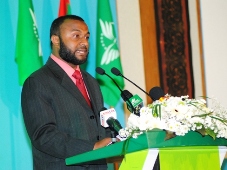
Sheikh Mohamed Shaheem Ali SaeedMeanwhile at the recently concluded Adhaalath party four-day national congress, former State Minister for Islamic Affairs Sheikh Mohamed Shaheem Ali Saeed told members that remaining in a coalition with the ruling party would be “a betrayal of the nation” if the government did not take “reform measures” suggested by Adhaalath.

He added that as the MDP had not honoured the coalition agreement to date, Adhaalath party “would have no choice but to reconsider” the alliance if the situation was not remedied through dialogue and discussion “within a sufficient period of time.”

In the meantime, Adhaalath party should study the “discord and divisions” in the country’s religious and political spheres as well as problems in the health and education sectors, suggested Shaheem, after which “it should officially be brought to the attention of the President and relevant authorities.”

Adhaalath does not support “the loss of the economy’s main gate [Male’ International Airport to Indian infrastructure giant GMR] to influential foreign parties” or alleged interference with the judiciary and disregard of decisions by independent commissions.

Shaheem urged the government to enact new regulations under the Protection of Religious Unity Act of 1994, which had been “agreed upon by 11 religious scholars, a police legal team, the President himself and three Attorneys General.”

Islamic Minister Dr Abdul Majeed Abdul Bari observed that disparaging Islam and “every kind of sinful behaviour forbidden in Islam” had become commonplace while political polarization and social ills multiplied.

Bari claimed that foreign parties were “working tirelessly” to introduce freedom of religion in the Maldives.

“We hear arguments of how non-Muslims should have the freedom to express their disbelief and how everyone should have the right to change religion,” he said.Adhaalath
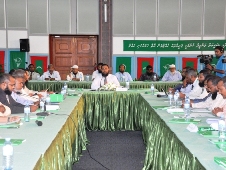
Adhaalath party President Sheikh Imran Abdulla meanwhile stated that the party’s “main objective” would be to reform youth with Islamic teachings.

The incoming president also contended that the government did not honour its coalition agreement with Adhaalath, adding that “it would not be wrong to say that we alone are still with the government.”

Of the allied parties in the MDP-led coalition that defeated Gayoom in October 2008, only Adhaalath party, the Vice-President’s Gaumee Ihthihaad Party (GIP) and the Maldives National Congress (MNC) remain.

Likes(0)Dislikes(0)

Z-DRP raises spectre of British imperialism and loss of Islamic identity

President Mohamed Nasheed was elected in 2008 “with the help of the British conservative party and imperial powers,” the Zaeem-faction of the opposition Dhivehi Rayyithunge Party (DRP) claimed in a video message Thursday night, featured during a rally held to launch the Z-faction’s autonomous activities to celebrate the party’s sixth anniversary.

“In the two years since this government came, 22 people were killed on the street, Islam was challenged and defied,” the video message intoned. “[The government] made drinking alcohol and using drugs commonplace, appointed drug users and convicts to senior posts, sold the country’s assets to foreigners, lost control of the economy, locked down the High Court, and members of the ruling party hijacked the Deputy Speaker of parliament along with opposition MPs.

“Sickness is commonplace and the health system has been demolished. In the meantime, leaders that Zaeem Maumoon [Abdul Gayoom] brought to the political arena have abandoned his ideology and are now trying to chart a new course for their ship away from him.”

Addressing supporters after the video presentation, former President Gayoom said that the DRP’s “greatest national duty” was “to ensure that the Maldives remains a 100 percent Muslim country,” with “full independence and sovereignty.”

“The independence of the country and our faith are very much related,” he said. “The Maldives will only remain a country with complete freedom, independence and sovereignty if it remains a 100 percent Muslim country.”

If that status should change, said Gayoom, “there is no doubt that our independence will be threatened as Maldivian history has taught us the lesson that every time we lost our independence it was because some group tried to turn the Maldivian people to the wrong religion.”

He stressed that allowing freedom of religion “in a tiny country like the Maldives with a small, homogenous population” would create “disagreement and division among the people and lead to bloodshed.”

“Enslavement”

The narrated video presentation – set to black and white reels of British monarchs and ships in the Male’ harbour – sketched a history of the Maldives’ “enslavement” under British colonialism and Indian Borah merchants to independence on July 26, 1965.

“In 1834, [Robert] Morseby came to the country on behalf the British governor in Bombay to draw [maritime] charts of the Maldives,” the narration began. “But the territorial chart wasn’t the only chart the English were drawing.

“They were drawing charts of our internal affairs and the economy, too. [They] connected Maldivians with the Borah traders who upheld the interests of British imperialism, and arranged for them to be permanently settled in Male’.”

The British then proceeded to “divide and rule,” sparking a feud between two royal families led by Athireege Ibrahim Didi and Kakaage Mohamed Rannabadeyri Kilegefaanu, both of whom had “significant political interest in the trade of the Borah.”

In late 1886, Ibrahim Didi or Dhoshimeyna Kilegefaanu deposed the reigning Sultan, who was replaced with Mohamed Mueenudeen III, known as Kuda Bandarain.

“It cannot be believed that the English played no part in the great atrocity that was the coup attempt through arson [Bodu Hulhu] in 1887,” the narrator states. “The leader of the coup, Ibrahim Dhoshimeyna Kilegefaanu, was a British citizen.”

Before heading out to set fires in Male’, the arsonists “performed black magic inside Velaanage” and ate the heart of a 15-year-old boy who had died that day.

“Eventually those who committed [the acts of arson] were found and caught,” the narration continued. “Ibrahim Dhoshimeyna Kilegefaanu and his accomplices were punished and banished. [But] before too long, the English meddled with the investigation and forced the Sultan to free Ibrahim Dhoshimeyna Kilegefaanu.”

The Maldives “became enslaved by the British” on December 16, 1887 when “the Sultan was intimidated and coerced into signing the protection agreement.”

“Empowerment”

The Z-DRP video message observed that the Maldives as a British protectorate was characterised by “poverty and the struggle for the throne by powerful families” as well as political instability and the secession of three southern atolls.

“As a consequence of the country becoming a British protectorate, after 87 years the Maldives was among the poorest five countries in the world,” the narrator explained. “The British could not bring democracy to the Maldives. There was no education system, no health system and no domestic economy. And justice was not served either.”

Former President Ibrahim Nasir secured independence in 1965 but “began his own business using state resources.”

“When Nasir left office in 1978, he owned seven resorts, numerous plots of land in Male’, a shipping line and counted a number of shops among his businesses,” the narrator claimed.

The condition of the Maldivian people “was changed by our national hero and proud Zaeem [beloved leader] of the Dhivehi Rayyithunge Party.”

The video message argued that the ex-President “empowered Maldivians spiritually, intellectually, socially and physiologically.”

“After empowering Maldivians upon these pillars through the service of a golden 30 years, he took the country out of the list of the world’s poorest states,” the narrator stated. “[Gayoom] introduced principles of modern democracy, separated powers of the state, and introduced a multi-party system [in 2005].”

“Now the situation has darkened again,” the Z-DRP warned. “But what the people still want, north and south, and all across the country, is the ideology [of Gayoom’s reign] that empowered them.”

“True independence”

Meanwhile in his speech Gayoom explained that true independence included “freedom of thought, economic freedom and cultural freedom as well.”

“Passing our economic affairs into the hands of foreigners, just saying that we have political freedom, is not ensuring independence at all,” he contended.

Democratic governance “is the best form of governance,” said Gayoom, and the reform agenda launched in 2004 “to bring modern democracy to the Maldives has, by the grace of God, been successful.”

“As a result of [the road map for reform] the Maldives has become a complete democracy,” he said. “A complete and perfect constitution was devised, independent institutions were established, political parties were formed, the fundamental rights of the Maldivian people were protected, justice was established. All this was done and complete before 2008.”

The new constitution was ratified on August 7, 2008, two months before Gayoom was ousted in the country’s first democratic multi-party election.

Gayoom however went on to say that “renewed efforts” were needed “to bring back democracy to the country.”

“I won’t go into too much detail on this,” he said. “However even as the video we just saw explained, the situation is deteriorating on a daily basis. The people are becoming impoverished and their rights are being violated.”

Likes(0)Dislikes(0)

“El Al will be a Trojan horse for Maldives”: George Galloway

The commencement of flights by Israeli national airline El Al to the country will be “a Trojan horse for the Maldives,” warns controversial British politician George Galloway.

In a video message aired at the Adhaalath party national congress that concluded last night, the former MP said that he was “deeply shocked” by the government’s decision to authorise the operation of Israeli national carrier in the Maldives on December 13.

“At a time when Arab doors are closing on Israel as a result of the Arab revolution, the idea that the Maldives, an entirely Muslim country, would open the door for El Al, the Israeli national carrier, and bring the Israeli flag into their country, and bring the Mossad and all the attendants who will come with it, is just absurd to me,” said Galloway.

He added that Israeli flights would be “a Trojan horse for the Maldives.”

“You will be bringing Israel into your country at a time when most civilised people are trying to get Israel out of their country,” he continued.

“So I very much hope the people of the Maldives will rally behind the campaign to stop this infiltration of the country by this Zionist settler state. The blood of the Palestinian people for 63 or 64 years now is on this project and nobody should want to share in this blood.”

In April this year, the religious conservative Adhaalath party threatened to terminate its coalition agreement with the ruling Maldivian Democratic Party (MDP) in protest if Israeli flights are allowed to commence flights to the country.

Transport Minister Adil Saleem however said in June that the airline would allow Maldivians to visit Masjid-al-Aqsa in Jerusalem, the third holiest site for Muslims.

Adil Saleem noted that 500 Maldivians had visited Israel this year and authorising El Al to operate flights to the country would provide a cheaper option for pilgrims.

Official figures meanwhile revealed that 433 Israeli tourists visited the Maldives in 2004, followed by 758 in 2005; 569 in 2006; 838 in 2007; 1307 in 2008; 1588 in 2009 and 1380 in 2010.

Likes(0)Dislikes(0)

Parliament committees reconstituted with over half the session consumed

MPs have been selected for standing committees today following yesterday’s 61-3 vote to approve a compromise over the reworked composition agreed upon by parliamentary group (PG) leaders.

The three dissenting votes were cast by Independent MPs Ahmed Amir and Ahmed “Redwave” Saleem along with Nolhivaram MP Mohamed Nasheed of the ruling Maldivian Democratic Party (MDP).

MPs of the Dhivehi Rayyithunge Party’s (DRP) Z-faction, Ahmed Mahlouf, Ilham Ahmed and Afrashim Ali, were notably chosen by the split main opposition party for the coveted ‘241’ Security Services Committee – the Z-DRP MPs disrupted last week’s sitting in protest of the previous compromise reached by PG leaders, which would have given the MDP a voting majority on the now-opposition controlled committee.

As a result of the drawn out dispute over committee composition – sparked by the defection of two opposition MPs to the ruling party in May – parliamentary committees have remained stalled since the current session began in June.

The second session of parliament this year is meanwhile due to end next month as Majlis breaks for recess at the end of August.

Apart from authority to summon state officials and conduct inquiries, parliamentary committees are tasked with reviewing and finalising legislation as well as evaluating the President’s nominees to the cabinet, independent institutions and foreign missions.

Four out of 14 bills proposed by the government as part of its economic reform package were sent to committee on Monday while debate on the rest is set to continue next week.

Among the economic reform legislation on the agenda today were proposed laws for business registration, real estate, inheritance, business partnerships and company rules as well as a bill to abolish the Foreign Investment Act of 1979.

Revised committee composition : –

1. Rules Committee five seats for the Maldivian Democratic Party (MDP); five seats for the Dhivehi Rayyithunge Party (DRP); one seat for People’s Alliance (PA); Eydhafushi MP Ahmed “Redwave” Saleem as the Independent MP

2. Public Accounts Committee five seats for MDP; four seats for DRP; one seat for PA; one seat for Dhivehi Qaumee Party (DQP)

3. Economics Committee – five seats for MDP; three seats for DRP; one seat for Jumhooree Party (JP); Meedhoo MP Ahmed “Sun Travel” Shiyam and Eydhafushi MP Ahmed “Redwave” Saleem as the Independent MPs

4. Social Affairs Committee – four seats for MDP; three seats for DRP; two seats for PA; one seat for JP; Velidhoo MP Ali Mohamed as the Independent MP

5. Independent Institutions Committee – five seats for MDP; four seats for DRP; one seat for PA; Kulhudhufushi South MP Mohamed Nasheed as the Independent MP

6. Government Oversight Committee – four seats for MDP; four seats for DRP; one seat PA; one seat for JP; one seat for DQP

7. National Development Committee – five seats for MDP; three seats for DRP; one seat for PA; Kudahuvadhoo MP Ahmed Amir and Kaashdihoo MP Ismail Abdul Hameed as the Independent MP

8. National Security Committee – five seats for MDP; three seats for DRP; one seat for PA; Dhuvafaru MP Mohamed Zubair and Guraidhoo MP Ibrahim Riza as the Independent MPs

9. General Affairs Committee – five seats for MDP; three seats for DRP; one seat for PA; Kudahuvadhoo MP Ahmed Amir and Dhuvafaru MP Mohamed Zubair

10. Petition Committee – five seats for MDP; three seats for DRP; one seat for PA; one seat for JP; Kaashidhoo MP Ismail Abdul Hameed as the Independent MP

11. Privileges Committee – five seats for MDP; three seats for DRP; one seat for PA; one seat for JP; Guraidhoo MP Ibrahim Riza as the Independent MP

12. Ethics Committee – five seats for MDP; four seats for DRP; one seat for PA; Velidhoo MP Ali Mohamed as the Independent MP

13. ‘241’ Security Services Committee * – five seats for MDP; three seats for DRP; one seat for PA; one seat for JP; one seat for DQP; Guraidhoo MP Ibrahim Riza and Kaashidhoo MP Ismail Abdul Hameed as the Independent MP

* Article 241 of the Constitution states, “A committee of the People’s Majlis shall be established to exercise continuing oversight of the operations of the security services. The committee shall include representation from all the different political parties within the People’s Majlis.” Unlike the other 12 standing committees, which has 11 seats, the 241 committee has 13 seats.

Likes(0)Dislikes(0)

Deputy Speaker Nazim appointed Opposition Parliamentary Group Leader

A new coalition of opposition MPs from the Peoples Alliance (PA), Dhivehi Rayyithunge Party (DRP)’s Z-Faction, Jumhoory Party (JP) and Dhivehi Qaumee Party (DQP) last night appointed the new group’s leader, deputy leaders, spokesperson and whips.

Deputy Speaker of Parliament and PA MP Ahmed Nazim was chosen as the leader of the Opposition Parliamentary Group.

DQP MP Riyaz Rasheed and Z-DRP MP Ilham Ahmed were appointed as deputy leaders of the parliamentary group while Z-DRP MP Ahmed Mahlouf was appointed spokesperson.

Z-DRP MP Hamdhoo Hameed was appointed as the “government watch” and PA MP Abdula Azeez Jamal Abu Bakur, Z-Faction MP Ali Arif, MP Ahmed Nihan, MP Abdul Muhsin, MP Mohamed Rafeeq and independent MP Ibrahim Riza were appointed as whips.

Deputy Leader of DRP Ahmed ‘Mavota’ Shareef meanwhile told Minivan News that the current political situation of the Maldives was very fluid.

“Today everyone needs power and to get that power one might do anything, be it out of the law or within the law,” Shareef said.

Shareef predicted that according to the way things were going, DRP MP Ahmed Thasmeen Ali “will not lose the position of minority leader in parliament.”

“We do not support the policy of the government, that is why DRP is here, and we will only support people that support the policy of DRP.”

Announcing the decision to create the new opposition parliamentary group, MP Mahlouf said Thasmeen was also welcome to join the opposition parliamentary group.

Thasmeen did not respond to Minivan News at time of press.

Likes(0)Dislikes(0)

Expenditure on political appointees two percent of state wage bill, says Finance Ministry

Expenditure on 244 political appointees in the executive branch is two percent of the state’s wage bill or Rf99 million (US$6.4 million) a year, according to official figures released by the Ministry of Finance and Treasury.

The Rf1.6 billion (US$103 million) of annual spending on 20,476 civil servants meanwhile accounts for 39 percent of total state expenditure on salaries and allowances, followed by 24 percent for uniformed bodies (5,949 police and army officers), 17 percent for local councils (1,091 elected councillors), 10 percent for independent institutions (1,904 employees) and five percent for the judiciary (1,461 employees).

Annual expenditure on parliament (211 employees) accounts for two percent while administrative staff at the President’s Office (186 employees) represent one percent of the total wage bill.

A press statement issued by the ministry today notes that the figures were made public because “misleading statements” were being made about government spending.

“The economy has been adversely affected as a result of the state budget deficit in past years,” it reads. “One thing to be noted is the significant increase of recurrent expenditure compared to revenue. Recurrent expenditure is 12 percent above the government income forecast for 2011. Moreover, 49 percent of the state’s recurrent expenditure is spent on salaries and allowances for state employees.”

“Tip of the iceberg”

Speaking to Minivan News today, MP Dr Abdulla Mausoom of the opposition Dhivehi Rayyithunge Party (DRP) said that expenditure on political appointees in the executive was “just the tip of the iceberg.”

“The whole country was corporatised,” he explained. “There’s a roads corporation and all sorts of corporations. The people appointed to the boards of these corporations are all purely political appointees. They were appointed directly by the President to promote a political agenda.”

He added that the corporations were created “to give political posts to [ruling Maldivian Democratic Party] MDP activists.”

Moreover, said Mausoom, the corporations have “taken millions of dollars in loans to give salaries to these MDP activists.”

“Some of these people are not qualified at all,” he claimed. “There are people who have been made Managing Directors who cannot even read an MoU [Memorandum of Understanding] written in English.”

Dr Mausoom argued that the majority of senior officials in the corporations were filling “useless posts.”

The Public Accounts Committee (PAC) of parliament had requested information about expenditure on corporations, he continued, but the figures had not been provided.

“Most of them don’t even show up at the office,” he said. “Every day between sunrise and sunset, a new post is created in these corporations.”

“Distortions”

Finance Minister Ahmed Inaz however dismissed Dr Mausoom’s contention as “an attempt to distort” the information made public today.

Inaz insisted that senior officials of corporatised entities were not paid salaries or allowances out of the government’s wage bill.

The Finance Minister explained that state-owned enterprises such as the State Trading Organisation (STO) were managed as businesses and paid their employees from income raised through their operations.

“Other corporations such as Dhiraagu pay dividends to the government,” he said.

While subsidies were granted to the State Electricity Company (STELCO), Inaz said that the government’s policy was to switch to targeted subsidies for the poor.

“What would happen if we suddenly brought a speeding motorcycle to a halt?” he asked, referring to public companies. “It will slide off the road and crash.”

On the cost of political appointees, the Finance Minister argued that two percent of the wage bill was “a negligible amount.”

“Say for example that we eliminated all political posts and only President Nasheed is left in the executive,” he said. “Reducing or eliminating two or three percent would not have a significant impact on state expenditure.”

Austerity battles

In August 2009, the government’s decision to introduce a raft of austerity measures – including unpopular pay cuts of up to 15 percent for civil servants to reign in the ballooning budget deficit – was met with fierce resistance from opposition parties.

The pay cuts sparked a protracted legal dispute between the Finance Ministry and the Civil Service Commission (CSC), which won a court case against the ministry in April 2010 to restore salaries to previous levels.

Meanwhile an internal World Bank report produced for the donor conference in May 2010 noted that increases to the salaries and allowances of government employees between 2006 and 2008 reached 66 percent, which was “by far the highest increase in compensation over a three year period to government employees of any country in the world.”

“Even before government revenues fell and when government revenues were at an all time high in 2008, the ratio of the wage bill to revenues at 46.5 percent was also at an all-time high (46.5 percent compared to an average of 38.1 percent between 2000 and 2007). When revenues plummeted in 2009, the share of the wage bill to revenues rose an astronomical 89 percent,” the report explains.

In April this year, the government launched a programme to incentive voluntary redundancy in the civil service.

Finance Minister Inaz told Minivan News in May that the programme “has to this date enrolled 800 people and already some of them have already been paid and moved out of the civil service. We hope over the next few weeks we will achieve our target of 1300.”

Inaz observed at the time that slimming down the civil service would not be easy: “The country’s employment has been totally dependent on the government. It is a very big change, and we have said we want the government to be a policy maker, a regulator, but not doing business, so jobs are created in the private sector.”

State wage expenditureAnnual expenditure on salaries and allowancesPercentage of total wage bill or expenditure on employees
Civil servants or employees under the executive (excluding political appointees and councillors)Rf1,596,029,00739 %
Uniformed bodiesRf1,001,489,48624 %
Political appointees in the executive branchRf99,178,9802 %
Administrative staff at the President’s OfficeRf27,326,7301 %
CouncilsRf717,250,03017 %
JudiciaryRf210,282,4635 %
People’s Majlis or legislative branchRf79,210,7182 %
Institutions dependent on state budgetsRf393,620,94310 %
Likes(0)Dislikes(0)

Tour giant funding project to raise resistance of coral reefs in the Maldives

Travel giant Kuoni, the International Union for the Conservation of Nature (IUCN) and local environmental consultancy Seamarc have launched a comprehensive project to protect coral reefs and address the impact of climate change in the Maldives.

Speaking at the launch of the project this week at the Nalahiya hotel in Male’, Kuoni’s Head of Corporate Responsibility Matthias Leisinger observed that “tourism is like fire. You can cook with it, but it can also burn your house down.”

Kuoni has conducted a similar project in Egypt, targeting the Red Sea. Such projects were, Leisinger said, investment by the company in the long-term sustainability of destinations and a tool well within the company’s business model.

The 100 year-old leisure travel operator employs 10,000 people across 40 countries, and had as a result of its breadth broadened its scope from travel and tour provision to “destination management”.

“Investment in corporate social responsibility is a long-term business tool,” Leisinger said. Tackling practices such as sex tourism, for instance, was also a way of protecting the company’s brand, he explained.

Ensuring that hotels had no waste on beach, that islands had infrastructure such as sewerage plants and that staff were treated fairly increased the quality of the company’s end product, which affected its bottom line, he explained.

One aspect of the project involves establishing waste management facilities on 10 inhabited islands near Kuoni resorts. According to the project synopsis, “islanders will be taught to segregate waste at household level and bins will be provided to store the waste separately until removal from the island. A once-off large clean up may need to be organised before implementation of the system as most islands have accumulated waste over time.”

As well as improving the environment of the local island and allowing the resort to tick one of its ‘corporate social responsibility’ boxes, the facilities will “reduce the waste that washes up on the shores of the resorts themselves.”

A key focus of the project is protection and management of the resorts’ housereefs, which are currently protected by law from all fishing activities apart from bait fishing, “and as such, these areas act as marine protected areas (MPA) by default.”

However few resorts employed marine biologists to manage the housereef and limit destructive activity, and many times the boundries were ambigious “which results in unacceptable use of the reefs by outsiders leading to conflicts between the resort and local people.”

Under the project, four resorts will trial an ‘MPA management plan’ involving ecologicial surveys and the use of a warden to “drive away intruders”.

The project will also include an extensive series of training sessions and workshops for resort staff and local communities, and including on the reporting and monitoring of coral bleaching.

Senior Advisor at IUCN Dr Ameer Abdulla explained that bleaching represented the expulsion of symbiotic plants from coral due to stress factors such as pollution, sudden changes in temperature and ocean acidification, making the coral vulnerable to algae.

“Eventually the reef disintegrates, with the loss of shoreline protection and tourism benefits,” he explained.

“A bleaching event in 1998 saw close to 100 percent mortality in some areas [of the Maldives],” he said. “It was 87 percent in the Great Barrier Reef in Australia, but because the area has been well managed the rate of recovery was very high.”

Tackling climate change was a broader problem requiring international effort, but local measures to reduce impacts and increase the resistance threshold of the reefs could “give the coral a fighting chance”, he explained.

Dr Abdulla noted concerns raised by dive staff at one resort that local fishermen had begun fishing for grouper on the resort’s house reef, but were unsure of their mandate and did not want to spark local conflicts.

A representative from the Ministry of Tourism, present at the launch, observed that such incidents were likely to increase “as stocks diminish elsewhere.”

The representative also noted new challenges arising with the changing market profile of tourism in the country – whereas visitors from European countries such as France and Germany responded well to requests to respect the natural environment, “the market is changing, and Chinese guests are walking on the reefs, catching and eating crabs… During a recent visit to Shanghai we tried to get the message across, but it’s a very different culture.”

A representative from the Marine Research Centre (MRC) retaliated that it was in the interests of the Tourism Ministry to legally mandate resorts “to take responsibility for the natural environment for the duration of the lease.”

Much of the country’s lucrative resort industry “remains very closed,” he observed.

Likes(0)Dislikes(0)

MP Yameen dismisses allegations of blackmarket oil trade with Burma

Minority opposition People’s Alliance (PA) Leader MP Abdulla Yameen called on the government today to investigate allegations of US$800 million worth of blackmarket oil trade by the State Trading Organisation (STO) while he was chairman of the state-owned enterprise.

During parliamentary debate on a resolution proposed by MP Mohamed Musthafa demanding an investigation into the allegations, Yameen conceded that STO did sell oil to Burma “but if you claim that the trade was illegal, you have to prove it first.”

“This was done by forming a company in a country where such matters are most closely monitored,” he said. “That company is audited by STO auditors. An illegal business would not be allowed to operate in Singapore. This was not a secret trade.”

Yameen added that STO senior officials alleged to be involved in the oil trade were still employed by the government: “They are now in high posts in the MDP,” he said.

“So if you dare to investigate this, by all means go ahead,” he continued. “I encourage that this be investigated. The other thing I want to say is that I have now become impatient. Even if they stack US$800 million worth of documents on one end of the scale, there is no way they would be able to prove [any wrongdoing].

“The documents are with the government. We did not take documents home with us when we left office,” he said.

Yameen, brother of former President Maumoon Abdul Gayoom and long-serving Trade Minister in his cabinet, claimed that the administration possessed a list of senior officials of the previous government who had purchased assets overseas.

“The government will have that list now,” he said. “Why is it that they won’t make it public? I know that this work was done under the World Bank’s stolen assets recovery programme [StAR]. This list will have people who are now helping this government, not anyone else. Why don’t you release the list?”

The MP for Mulaku claimed that the government has paid “over a million dollars” to forensic accounting firm Grant Thornton, without uncovering any evidence to implicate Yameen.

“In such investigations, forensic accountants are given two or  three weeks to complete their work,” he said. “[But] this has now been dragged out for over a year.”

Yameen said that he was “ready to sue” for defamation if a final report “under seal and signature of Grant Thornton” was made public.

“But there’s no way to file this suit because no official document has been released,” he continued. “All that’s been released are draft reports without any signature or seal that can be taken to court.”

Yameen added that “the US$800 million worth of trade was done with back-to-back LCs (lines of credit) in Singapore based on trust between one bank and another.”

“All the bank documentation is there,” he said, claiming that Grant Thornton had cleared out all the “invoices and documents” from STO Singapore so that “there’s not even one photocopy left.”

“How can eight or nine years worth of documents of a government company be taken like this?” he asked. “I know this for a fact.”

The right of individuals to be considered innocent until proven guilty was “a sacred provision” in the Maldivian constitution, he said.

During the heated debate that followed, Former Finance Minister Gasim Ibrahim urged the government to allow the allegations to be investigated either by police or the Anti-Corruption Commission (ACC) as “they are the institutions that are legally empowered to conduct investigations.”

“I don’t believe this case should be debated in parliament,” said Gasim, arguing that the constitution protected the rights of the accused.

MP Eva Abdulla of the ruling Maldivian Democratic Party (MDP) meanwhile observed that the audit report of the State Trading Organisation (STO) had noted that about Rf11 million (US$80,000) in local currency was released to Emerald Resort Pvt Ltd as loan facilities between April 1, 2003 to April 3, 2005 to be paid back in US dollars.

“The same report noted that STO imported medical equipment without a bidding process at a much higher price than [the equipment] was available for,” she continued.

Eva also referred to the audit reports of the Maldives Customs Service, which revealed that luxury yachting company Sultans of the Seas in 2007 had forged documents to evade import duties for a yacht.

“After that the audit report of the presidential palace Theemuge noted that Rf104 million was given out as assistance,” she said. “From that, 50,000 Singapore dollars were spent for medical assistance to the [former President’s] family members. And US$20,000 for a member of the People’s Majlis. And so on until Rf100 million was reached. It’s not just the US$800 million dollar case we want to investigate. We want this to be looked into.”

The MDP MP for Galolhu North revealed that the Presidential Commission was currently investigating over 25 similar cases of corruption and misappropriation of state funds by the former government.

“Honourable Speaker, whether it is me [facing corruption allegations], the Deputy Speaker, the leader of a fragmented and unraveling party, the brother of a deposed ruler, we want to make certain that these investigations will go ahead and that we can have justice,” she said. “We want to stop looking back as a nation and breathe freely. We can only do that when we face these cases of corruption and find out the truth.”

Likes(0)Dislikes(0)

Cabinet appoints sub-committee to investigate 2003 shooting at Maafushi jail

Cabinet has decided to investigate who gave the order to shoot inmates in Maafushi jail in September 2003, an incident in which three inmates died.

Further details were not mentioned, and Press Secretary for the President’s Office, Mohamed Zuhair, did not respond to Minivan News at time of press.

In June this year three of the 12 former prison guards sentenced to death – who were living at large – were arrested by police for the enforcement of their 25 year sentence.

During the trial, 13 guards were accused of murdering three inmates and all were found guilty of the crime and sentenced to death by the Criminal Court.

The 13th person, the head of the prison that time, was later pardoned by the High Court. Former President Maumoon Abdul Gayoom then used presidential privilege to commute the death sentences of the others to 25 year imprisonment.

Maafushi Jail ShootingState Home Minister Mohamed Naeem told Minivan News in June that the documents at the Home Ministry showed that the 12 officers were at first kept in Maafushi Prison until the new prison head sent a letter to the-then Home Minister Ahmed Thasmeen Ali – now the leader of the opposition – that it was unsafe for the 12 to be among the other inmates.

“They were then transferred to Dhoonidhoo prison, and after two months another letter was sent to Thasmeen from the then Deputy Police Commission saying that there were no lawful grounds for keeping convicts in Dhoonidhoo for the implementing of their verdicts,” he said. “And that was the end of the document trail. We do not know what Thasmeen said in reply, or how they managed to stay at large.”

Prison guards at Maafushi claimed to have shot the inmates to control a prison riot sparked by the custodial death of fellow inmate Evan Naseem, who allegedly died of injuries sustained during the brutal torture he was subjected to inside the prison. His death – and his family’s decision to display the body and his injuries – is considered a watershed moment in Maldivian politics that led to the ousting of the former President.

Likes(0)Dislikes(0)