The state has paid approximately MVR 500,000 (US$32,425) each as compensation to eight MPs appointed to parliament by former President Maumoon Abdul Gayoom, following a Supreme Court ruling in March that their removal was unconstitutional.
The Supreme Court ruled on March 13 that the removal of the eight presidential appointees in late 2008 by incoming President Mohamed Nasheed – who replaced the eight with his own appointees – was unconstitutional and ordered the state to compensate the MPs for salaries and allowances due for the remainder of the last parliamentary session of the 16th parliament.
The Supreme Court ruling had overruled judgments by the Civil Court and High Court.
Local daily Haveerureported yesterday that one MP had been paid MVR 407,000 (US$26,394) so far. The former MP, who wished to remain anonymous, was quoted as saying that the “Finance [Ministry] told some of the MPs that the amounts cannot be paid now due to the financial constraints of the state.”
“As far as I know, the state will pay them over a period,” the anonymous MP added.
The case was filed by former President Gayoom’s appointees Rozaina Adam and Ahmed Mahloof. While both were elected to the 17th parliament on a Dhivehi Rayyithunge Party (DRP) ticket, MP Mahloof left the DRP to join former President Gayoom’s Progressive Party of Maldives (PPM).
The case reached the Supreme Court one and a half years ago after the Civil Court and High Court ruled that the Nasheed administration had the legal authority to dismiss Gayoom appointees.
The Chinese government has donated RMB 500,000 (US$79,945) worth of office equipment to parliament during an official visit by a high-level delegation headed by Li Changchun, China’s fifth highest-ranking leader and member of the Standing Committee of the Political Bureau of the Communist Party of China Central Committee.
The delegation visited parliament on Saturday for a meeting with Speaker Abdulla Shahid. At the meeting, the dignitaries discussed the close diplomatic ties between the nations forged 40 years ago, noting that Sino-Maldives diplomatic relations have been a model for fostering mutual respect and friendship between big and small nations.
Vice President Mohamed Waheed Deen presented awards to winners of the newly introduced Civil Service Innovation Award at a ceremony on Sunday morning.
Among the recipients was the National Centre for Information Technology (NCIT) for introducing a “transport online system” and a “government e-letter management system” as well as the Islamic Ministry for its online Zakat fund system.
Awards in the Information Technology category were also given to the Ihandhoo School in Laamu Atoll Gan for its “performance appraisal online system” and the education unit for Haa Alif, Haa Dhaal and Shaviyani Atolls for its “office automation initiative.”
The award for cutting costs and economising went to the Centre for Continued Education for its “school-based professional development programme.”
According to the Civil Service Commission (CSC), over 9,000 driving licenses have been issued through the online transport system while the e-letter management system saved an estimated MVR 8.7 million from the 2011 budget.
As the award was the first of its kind, the CSC said it recognised programmes and projects carried out from 2008 to 2011.
Speaking at the function held at the Islamic Centre’s hall, Vice President Deen said that the wage system for civil servants must be revised, calling on all sectors to acknowledge the hard work of civil servants.
Deen commended the CSC for introducing the award in a bid to improve the quality of service provided to the public.
Police last night raided a house called Peach Melba in Henveiru ward, and arrested six women, four men and a minor, whose gender was not disclosed, after police discovered alcohol and police and army uniforms inside the residence.
According to a statement by police, officers raided the house in response to information reported to police, and arrested people inside the house.
Police officers discovered two bottles containing suspected alcohol, one empty alcohol bottle and glasses that were allegedly used to consume alcohol, police said.
A piece of cellophane containing suspected narcotics was also discovered after police searched a cigarette packet on the shoe rack inside the room.
Furthermore, police said some police and army uniforms were also found inside, although the residence was not home to anyone employed in the police or Maldives National Defence Force (MNDF).
According to local media, police found police Special Operations (SO) combat uniforms and both MNDF combat and normal uniforms.
Police have not identified the 10 arrested, but said they were aged between 19 and 37 while the minor arrested was 16 years-old, according to police.
The police Drug Enforcement Department (DED) is further investigating the case.
The Transport Authority has decided that Male’ will be a traffic free zone between 4:00pm and 10:00pm on Eid ul-Adha this coming Friday, reports Sun Online.
A similar plan was made for Eid ul-Fitr earlier this year, but was called off after the authority complained that it had not been consulted before Male’ City Council (MCC) made the announcement.
MCC Councillor Mohamed Abdul Kareem told Sun that the intention was to make the day more enjoyable for families.
The only vehicles in operation during these hours will be police and emergency vehicles as well as those used by the disabled.
Dhivehi Rayyithunge Party (DRP) MP Rozaina Adam leaked invoices and bills through Twitter on Friday, exposing the extravagant expenses of former President Maumoon Abdul Gayoom’s family out of the former presidential palace Theemuge’s budget allocated for helping the poor.
Responding to allegations of corruption against her father by supporters of former President Gayoom’s Progressive Party of Maldives (PPM), which were backed by PPM MP Ahmed Mahloof, MP Rozaina claimed that Mahloof was given SGD$28,000 out of the Theemuge budget for a “nose job”.
After suggesting that the MP for Thulusdhoo was “possessed by jinns,” MP Mahloof replied that he received assistance from the Theemuge budget for “a serious surgery,” adding, “it was not theft.”
Rozaina however went on to post photos of invoices from Theemuge for purchases of jewelry and other items as well as hotel bills from Singapore for Gayoom’s family and associates, challenging the PPM MP to defend the lavish expenses.
According to Rozaina, the invoices were sent to parliament’s Finance Committee this year attached to the Theemuge audit report for 2007 and 2008. Reviewing audit reports of state institutions is part of the powerful public accounts oversight committee’s mandate.
An invoice dated March 31, 2008 showed SGD$14,977 spent for trouser material (polyester viscose), which was authorised and signed by former Executive Director of the Presidential Palace Ismail Faiz.
Yet another invoice showed over SGD$28,000 paid out of the Theemuge account to the Grand Hyatt in Singapore.
“Yumna’s [Abdul Gayoom] hotel bill from the funds allocated to the Theemuge budget to help impoverished citizens,” MP Rozaina explained.
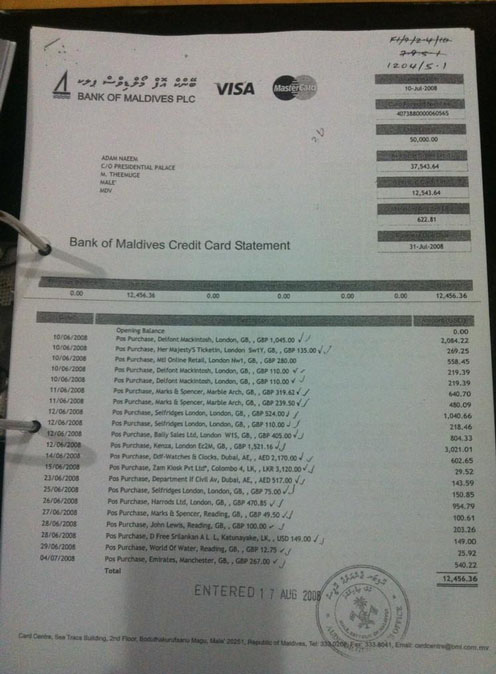
MP Rozaina also uploaded a credit card statement amounting to US$12,456 dated July 31, 2008 of a shopping spree in London.
“Documentary evidence”
Pressed by Twitter users as to why she had not spoken about the Theemuge expenses before, Rozaina tweeted, “I thought auditor general was politicising. He sent all the bills this year.”
“Previously it was just a report,” she added. “Documentary evidence was sent to the Majlis only this year.”
The MP for Thulusdhoo revealed that parliament’s Finance Committee was reviewing the Theemuge audit report.
MP Rozaina’s husband and DRP MP for Raa Atoll Alifushi, Mohamed Nashiz, is the deputy chair of the committee.
Speaking in parliament last week, MP Rozaina alleged that the Maldivian embassy in the UK spent funds out of its budget to hold a birthday party for Gassan Maumoon, youngest son of former President Gayoom.
Replying to former Transport Minister Adhil Saleem on Twitter, who encouraged her to “tell the world” as there was “no going back,” Rozaina tweeted: “I would never even think of going back. These people are criminals. Specially MAG’s [Maumoon Abdul Gayoom’s] good for nothing kids spending ppls [people’s] money.”
In September 2011, former President Gayoom left the DRP to form the PPM following an acrimonious split within the DRP and a public spat with his successor and former vice-presidential candidate, DRP Leader and MP for Baa Atoll Kendhoo Ahmed Thasmeen Ali, brother-in-law of MP Rozaina.
One of the leaked credit card statements
“In accordance with rules and regulations”
Meanwhile, the former President’s attorney, Ibrahim Waheed, released a press statement today countering Rozaina’s allegations. Waheed insisted that all expenditure out of Theemuge was “in accordance with the rules and regulations” and in line with the former presidential palace’s budget approved by parliament.
Waheed added that all records and documentation of expenditure were left at the palace files when the former president left office in November 2008. After President Mohamed Nasheed assumed the presidency, he moved the official presidential residence to Muleeage and relocated the Supreme Court and High Court to the former palace.
The statement from Gayoom’s lawyer went on to dismiss Rozaina’s allegations as “baseless” and “bald-faced lies.”
Waheed suggested that the DRP MPs’ accusations were motivated “out of jealousy” caused by the loss of support for her party and the growing strength of PPM, which was “as evident as the noon-day sun.”
The statement further claimed that the Presidential Commission formed by former President Nasheed to investigate corruption and misappropriation of funds – uncovered in over 30 audit reports – failed to find any wrongdoing by Gayoom.
Responding to the statement on Twitter today, Rozaina argued that although Gayoom was the highest authority in the land under the old “blue constitution,” public funds were “misused” when it was spent on the former President’s family and associates.
The report stated that 49 percent of the palace’s budget, equivalent to MVR 48.2 million (US$3,750,000 at the time), was diverted from the budget for the poor in 2007 and 52 percent, MVR 44.9 million (US$3,500,000), in 2008.
“We believe this is corruption and misappropriation of public funds,” the former Auditor General stated.
An examination of invoices revealed that funds intended for the poor were instead spent on medical trips to Singapore by “influential senior officials”.
This included their travel expenses, stay in expensive hotels, food, taxi fare, long-term apartment rental and medical check-ups.
More than SGD$ 2.3 million (US$1,500,000) was spent on one of Gayoom’s relatives and his family on trips to Singapore throughout 2007 and SGD$ 1.4 million (US$930,000) for another relative and his family for multiple trips to Singapore.
In March 2008, SGD$23,756 (US$16,000) was spent for a minister’s grandson to stay in a hotel in Singapore for 21 days; in April, SGD$50,022 (US$33,000) was spent on medical expenses for a friend of the president’s; and in July 2008, SGD$6,905 (US$4,600) was spent on two pairs of glasses for a minister and his wife.
US$13,000 in cash was given to the leader of an unnamed political party on different occasions throughout 2008.
The funds, spent by the Maldives Government Trade Centre (MGTC) in Singapore, were to be reimbursed by Theemuge.
Invoices and statements of the expenses revealed that most of the trips were arranged via a note or telephone call from Theemuge rather than through a formal procedure.
The invoices leaked by Rozaina showed that “verbal authorisation” was given by Theemuge senior officials.
“Therefore, as these expenses were made to gain the love, loyalty and support of the recipients, and since these expenses were not made for state purposes or for the benefit of all citizens, we note that these expenses were made unlawfully from the budget for personal benefit and gain,” the audit report stated.
The audit report further revealed that funds were unaccounted for in the construction of the presidential palace, which exceeded its budget by US$1.7 million. The total cost of the project amounted to MVR 207 million (US$17 million).
The Maldives’ first Ambassador to the United Arab Emirates, Ahmed Rasheed, has resigned for what the President’s Office has said are “personal reasons”.
President’s Office Spokesman Abbas Adil Riza explained that Rasheed had been appointed to the mission at the start of the year under the Nasheed government, after having previously been Chief of Protocol for the Foreign Ministry.
Abbas said that Rasheed’s family were strong supporters of the Maldivian Democratic Party (MDP), adding that Rasheed was related by marriage to former High Commissioner to the United Kingdom Dr Farahanaz Faisal.
Dr Faisal resigned from her post shortly after the resignation of President Mohamed Nasheed in February, as did the Maldives’ Ambassador to the United Nations Abdul Ghafoor Mohamed – then the country’s most senior diplomat.
Ibrahim Nasir International Airport (INIA) in Male’ has become the second duty free operator in the Asia Pacific region to sell a recently launched US$39,000 (MVR592,000) bottle of whisky, reflecting what one retailer said is the growing significance of the destination for providers of high-end luxury goods.
Earlier this month, resort chain Anantara announced it would be offering guests a limited edition elephant-harvested coffee – priced at US$1,100 per kilogram – to target high-end gourmet appeal.
While the sale and consumption of alcohol products outside of the country’s airport and resort properties is prohibited under local law, the Maldives National Chamber of Commerce and Industries (MNNCI) said there remained definite potential for local industry and crafts to profit in a market like INIA, despite the MNNCI’s “concerns” over the development.
According to the Moodie Report, an influential travel retail publication, one Chinese passenger travelling through INIA this month purchased the limited edition commemorative Balvenie Fifty whisky just nine days after it had gone on sale at the site. Only 88 bottles are said to have been produced.
“With the Maldives being a top luxury travel destination in the Indian Sub-Continent, we believe that Malé duty free can act as a gateway to the great collection of rare and vintage malts,” distiller William Grant and Sons’ Indian Sub-Continent Brand Development Manager Neeraj Sharma told the trade publication.
GMR, the Indian infrastructure group with a concession agreement to manage and develop the new airport terminal and retail facilities, has taken exclusive rights to certain duty free items to be sold at INIA.
However the GMR contract, which was drafted with assistance from International Finance Corporation (IFC), has come under intense criticism in the country’s political circles, with some key MPs and now government-aligned parties accusing the company of corruption and seeking to “enslave the nation and its economy”.
However, in the same week when INIA was selling the exclusive whisky to a passenger, local groups supporting a move to “re-nationalise” the airport continued to campaign to sway public opinion against the developer, releasing a large balloon in the capital adorned with the message “go home GMR”.
The government and GMR are presently involved in an arbitration case in Singapore concerning GMR’s levying of an airport development charge.
Authentically Maldivian
MNCCI Vice President Ishmael Asif said aside from selling exclusive duty free goods, local manufacturers of products such as wood carvings and traditional clothing could also benefit from operating in INIA. However, Asif stressed that local laws needed to be amended accordingly.
“There are no local laws right now protecting authentic Maldives products. The goods being sold as Maldivian often come from other countries and do not reflect our traditions and culture,” he claimed, pointing to the types of products sold in stores on busy retail streets like Chaandhanee Magu in Male’ as an example.
Asif claimed that legislation outlining quality and production standards could greatly boost the profitability and market for local techniques such as wood carvings of fish and dhonis (local boats) as well as smaller items like drums used in bodu beru – a local musical form combining rhythmic drumming and dancing.
According to the MNCCI, factories previously existed during the 1990’s specialising in such local woodworking techniques, which used paints and fabrics derived from local materials and colourings. Asif claimed that these factories were no longer in operation outside of some specialist operations supported by resorts based in Baa Atoll.
“We have been trying to work on a special logo that can be used to identify local Maldivian products, this is something that could be done and used at the airport,” said Asif.
The MNCCI added that in recent years, specialist retail groups had set up operations to try and provide authentic products to the country’s lucrative tourism trade, but had more recently struggled to maintain a property in the capital. The commerce group added that organisations such as the UN were now being sought to provide support to such enterprises to help maintain local cultural practices.
In terms of high-end luxury products, Asif added that traditionally INIA – formerly Male’ international Airport – had been viewed locally as a way to bring tourists to the country, rather than as a means of making money as a retail location.
“We are known [as a destination] for having expensive resorts, and the Maldives has tried to develop the best resorts in the world,” he claimed. “GMR seem to feel this is only a place for the elite, [while] we need to accommodate everyone.”
GMR said that as part of a redevelopment of the existing airport terminal, new restaurant properties providing fast food and Thai specialities – particularly popular with Maldivians – would be opened to both passengers and local people.
Yet despite the untapped retail potential for Maldivian products at INIA, the MNNCI said it held “concerns” over the airport agreement with GMR, which was signed with the previous government, and complained it had not been consulted about developing local retail potential.
Asif has previously said that the MNNCI held concerns about the impact of the GMR deal on local businesses, alleging that a planning council related to the infrastructure group’s bid had not been open to the public or its members.
He pointed to the case of local enterprises such as MVK Maldives Private Limited, which in December last year was ordered by the Civil Court to vacate the Alpha MVKB Duty Free shop based at INIA after its agreement had expired.
However, speaking to private broadcaster Raaje TV last month, former Economic Development Minister Mahmoud Razee, who worked with the previous government and international partners on the GMR agreement, denied the deal had resulted in local enterprises being kicked out.
“The privatisation policy does not itself kick others out. It is about honouring the contract. No one has actually been kicked out, but private parties have opportunities to participate. The issue that has always existed is getting cheap capital for small scale businesses,” he said at the time.
Razee claimed that the GMR deal reflected a commitment by the former government to pursue privatisation as outlined in the Maldivian Democratic Party’s (MDP’s) manifesto.
“Firstly, if or when anything is run like a business, private people are more skilled and efficient. They are far more competent and they work for profit unlike the government,” he claimed. “This means it requires less cost for the government, but needs more outside investment or capital. Private people are more skilled and efficient in terms of managing. The end product thus is more beneficial.”
Education in the Maldives is being held back by a lack of institutional support and too much student power, report teachers currently working within the system.
Anecdotal evidence from teachers working in the Male’ area suggests poor support from senior staff and insufficient pay, leading many teachers to consider leaving the profession.
Following last week’s annual Teachers Awards ceremony, President Dr Mohamed Waheed Hassan told local media that allowances and privileges for teachers would be reviewed in order to improve educational standards.
“The basic action to take, in order to improve the level of education, is to improve the standard of teachers. And increase the assistance provided to teachers. In order to encourage teachers, I will revise and work towards improving the allowances given to them,” Waheed told Sun Online.
In response to this, one teacher told Minivan News: “It’s about time they got reviewed. Teachers are badly paid and badly treated. Many teachers I know are leaving or looking to leave the profession.”
Former Education Minister under the previous government Shifa Mohamed explained that efforts had been made in the past to raise the standard of teachers by introducing a licensing system for better qualified teachers which would have become mandatory over time.
“We tried to establish a system with licensing for better qualified teachers,” said Shifa, arguing that teachers were motivated not just by wages, but the opportunity to develop.
Teachers – some of whom have experience working abroad – reported particular problems with a results orientated system, producing pupils without the appropriate life skills.
“Students have far too much power. If they don’t like the marks they have been given in an exam, they bully teachers into changing the marks,” one teacher said. “Teachers are marking up all students so that they appease them and the parents.
“The students are spoon-fed and don’t learn any of the life skills they’ll need, for example basic revision skills, how to read an article and summarise it, or how to take the key points from it,” the teacher told Minivan News.
The teachers also described problems caused by teachers being forced to supplement their income with additional tuition, often teaching children from within their own school – prompting a conflict of interests.
“It is known that a lot of the teachers only teach half the syllabus in class, forcing students to take on extra tuition,” commented one teacher.
“However, this is an error on both the government/schools side and the teacher’s side. The teachers aren’t getting paid enough so they have to supplement their salary with tuition,” the teacher explained.
Shilfa said the tuition issue was a long-term problem which had concerned the ministry for some time.
“It is a norm because it is a system based on marks, and we were trying to change that – there is pressure from parents [on teachers] to give good marks,” she said.
While one teacher explained that schools still offered opportunities for further training to staff via the Continuing Professional Development (CPD) scheme, at the time of press Minivan News was unable to obtain comment from the government on current policy.
Four different education officials, including senior appointments, failed to respond or referred Minivan News to other officials, who likewise failed to respond. One education official demanded Minivan News submit a request for comment in writing.
Wider impact
After last week’s award ceremony at Dharubaaruge, President Waheed said the implementation of a new curriculum as well as further training for teachers was needed to improve the education system.
Waheed also pointed to a gap in the system affecting school leavers.
“One of the biggest problems for youth today is that they have to stop studying when they reach Grade 10. They finish school at the age of 16,” said the President.
“My hope is that the education system is changed, such that every child gets to go to school until they are 18, and that they become productive and useful individuals,” he added.
This particular issue was highlighted by a recent report into gang culture in the country, produced by the Asia Foundation.
The report linked this so called ‘lost age group’ to unemployment and subsequent involvement in gang activities as a source of income.
State Minister of Education Imad Solih told the media last month that the country’s education system had failed, with detrimental repercussions for society as a whole.
He stated that, with the government’s annual investment of MVR 2.4 billion (US$156 million) on education, the outcome was unacceptable.
An Organisation for Economic Cooperation and Development (OECD) report released last December ranked the Maldives as number one in the Asia Pacific region on education spending as a percentage of GDP.
According to the report, Maldives spends the highest proportion of GDP on public education (8.1 percent) across the Asia/Pacific region, four times higher than countries such as Cambodia and Myanmar.
Despite the expenditure, Solih argued that the countrywide results of O’level and A’level examinations did not reflect the financial input to the education system, and that changes had to be brought to the sector including new plans and targets.
Solih also stated that the failure of the education system should not only remain a concern of the education sector alone, but political leaders, parliamentarians and the general public should also share the concerns.
“I urge everyone to set aside our political differences and to take a minute to think about the current education system,” he said.
 (0)Dislikes
 (0)
(0)