MDP MP Ibrahim Rasheed charged with assaulting police officer

The trial of Maldivian Democratic Party (MDP) MP Ibrahim Rasheed ‘Bonda’, charged with assaulting a police officer, commenced at the Criminal Court on Wednesday.

According to local media reports, the prosecution claimed that MP Rasheed obstructed police duty during an MDP protest on July 30, 2012 when police officers stopped a group of activists on motorbikes.

The MP for Maafanu South allegedly attempted to push the police back and struck an officer on the chest.

Three police officers at the scene witnessed the assault, the prosecuting attorney said.

At yesterday’s hearing, MP Rasheed pleaded not guilty and contended that the charge was politically motivated.

The MP also criticised the criminal justice system as flawed and requested permission to hire a foreign lawyer.

The judge reportedly assented and informed Rasheed to be present at the next trial date in three days with his lawyer.

Once bitten

Following the incident on July 30, MP Rasheed was arrested and placed under house arrest for five days in early August.

According to a statement by the MDP at the time, MP Rasheed was taken into custody at 12.30am from a popular cafe in the capital Male’ by “20 militarised police.”

“MP Ibrahim Rasheed was arrested under a warrant obtained by the police relating to an incident two days back on 30 July when it was reported that the MP was ‘bitten’ on his back by a policeman in the process of being arrested while participating in a protest rally,” the statement explained.

“The MP was released within a few hours on that day with two other MPs who were also ‘picked up’ with Hon Rasheed.”

Video footage meanwhile emerged on social media showing MP Rasheed’s arrest. A riot police officer appears to bite the MP behind his shoulders during the arrest.

Police however released a statement on July 31 denying that any injuries were caused during the arrest of the three MPs.

The police statement insisted that MP Rasheed’s claim to MDP-aligned private broadcaster Raajje TV that he was bitten by a police officer was “a false allegation.”

Police further claimed that the three MDP MPs resisted arrest, used obscene language and caused varying degrees of injury to police officers. Aside from MP Rasheed, MDP MPs Ahmed Easa and Mohamed Gasam were also taken into custody on July 30.

The statement also accused MP Rasheed of attempting to mislead the public regarding his arrest to bring the Maldives Police Service into disrepute, condemning the MDP MP’s remarks to the media.

The MDP statement meanwhile noted that MP Rasheed was severely beaten by riot police officers on February 8 during a violent crackdown on an MDP march across Male’.

“Hon Rasheed is among 10 MPs who have been the subject of police brutality that have gone unaddressed for the last six months in spite of repeated appeals by the Inter Parliamentary Union to investigate the matter,” the MDP statement added.

While no charges have been brought against the Special Operations (SO) officers caught on camera beating MP Rasheed on February 8, the People’s Majlis secretariat sent a letter to the Police Integrity Commission (PIC) requesting the police watchdog body to “speed up its investigation into the cases of violence against MPs on 8 February 2012.”

Last week, former chair of the PIC, Shahinda Ismail, resigned from the commission citing failure to hold the police accountable for acts of brutality.

Shahindha’s resignation followed the release of the second of three reports looking into incidents of police misconduct that surrounded February’s transfer of presidential power.

Likes(0)Dislikes(0)

State expenditure rises 13.5 percent for first eight months of 2012

State expenditure for January to August this year increased 13.5 percent on the same period last year, according to figures from the Department of Planning.

According to statistics from the Finance Ministry, the Maldives is facing a budget deficit of MVR 2.1 billion (US$136 million) on the back of revenue of MVR 7.7 billion (US$499 million), and expenditure of MVR 9.8 billion (US$635 million).

Meanwhile, revenue figures published by the Maldives Inland Revenue Authority (MIRA) for September showed an increase in revenue of 16 percent compared to the same month in 2011, however this was 2 percent less that expected.

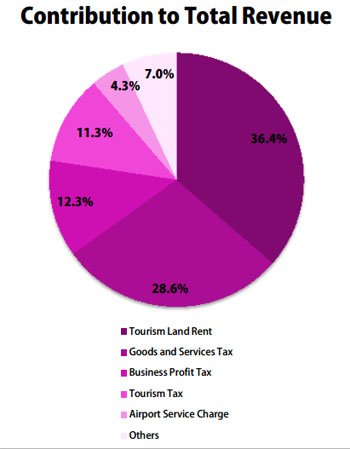
More than a third of total revenue (36.4 percent) came from tourism land rent, an increase of US$1.8 million on the previous year to 14.6 million, followed by the Goods and Services Tax (GST) which increased US$2.6 million to US$7.2 million – representing 28.6 percent of total revenue for the month.

Source: MIRA

The MIRA figures do not include import duties which are received by customs.

The Maldives Monetary Authority (MMA)’s September review observed that while an increase in tourism arrivals had registered improvements in both monthly and annual terms, real GDP growth was expected to fall to 5.5 percent in 2012, a fall of two percent on 2011.

“As per the latest government cashflow statement, the overall fiscal deficit of the government
worsened during Jan-Aug 2012 compared to the same period of 2011,” the MMA observed, predicting a higher than expected budget deficit for the year.

Fishing – the Maldives’ second largest industry after tourism and responsible for almost 40 percent of the country’s employment, has steadily declined in terms of both catch and export earnings. MIRA’s figures for US dollar earnings highlight the country’s near total-dependency on tourism as a means of earning foreign exchange.

Likes(0)Dislikes(0)

“Make them accountable”: young Maldivians talk democracy at documentary launch

Six local students – part of a nine person delegation that earlier this year visited key political institutions in the UK – were today invited to share their experiences and views of challenges facing the Maldives’ parliamentary system when compared to its counterparts around the world.

“In many other countries, if there is a hint of a scandal about an MP they will resign or find themselves pressured out,” said one of the female delegates. “Here, many take the attitude of ‘I don’t care’. We need to make [politicians] accountable.”

It was a response met with genial laughter during a discussion event held in the conference room of the Trader’s Hotel in Male’ this afternoon – a good natured meeting that at times seemed to belie the frank concerns raised by the young delegates.

Accountability was just one of the issues concerning democratic development noted by the six-person panel, who all spoke at the launch of a new documentary of their experiences at the ‘UK Youth Exchange’.

The project – run in conjunction with Democracy House and the British High Commission in Colombo – saw delegates travel to major UK cities to meet senior political figures and NGOs in order to better understand issues of democratic development across the Commonwealth.

The participants included Mohamed Axam Maumoon, Aishath Loona Moosa, Shahaadha Ahmed, Sharoona Adil, Shinah Saeed and Abdulla Shahid. The trip was also attended by Ibrahim Nawaf, Hassan Qassan and Muhaisina Hassan, who were not present at today’s launch.

The corresponding documentary titled ‘A study tour to London’, which is aimed to be aired and local television as well as across social media platforms at a later date, detailed a ten day visit to the UK cities of Bristol and London to experience UK and Commonwealth democratic institutions.

Participants also took part in workshops with the British Youth council, Young Muslims Advisory Group and the Commonwealth parliamentary association, as well as joining in “parliamentary-style” debates with UK school children.

Having since returned to the Maldives, the delegates raised concerns over the lack of a sense of ownership of the country, the limited educational opportunities outside of Male’, and gender inequality.

Another issue raised concerned civic education in areas such as privatisation, taxation, and public healthcare with the launch of Aasandha scheme earlier this year.

One of the participants highlighted problems with infrastructure development, bemoaning a seeming lack of public ownership among Maldivian people. He believed this had resulted from a lack of discussions and opportunities for the public to have their say in advocating how state developments were being decided.

“The youth here also have no dialogue with authorities,” he said. “No one feels the country belongs to us, be it land or infrastructure. There needs to be greater sense of ownership and responsibility.”

Other delegates raised fears over discrimination, particularly towards women working at the country’s resorts.

“There is a lot of discrimination here. It is seen as unacceptable for women to work at resorts. Why? Why should this be the case? There are lots of opportunities here,” she added.

Another delegate noted the need for reform of the country’s curriculum during the event, especially in order to take into account the changes the country had undergone since its first democratic elections were held back in 2008.

“All Maldivians should know about democracy. We need civic education,” he said.

The delegate queried how the entire country was being educated, criticising a lack of focus on critical thinking in areas such as privatisation, taxation and healthcare.

“Many people still don’t know what taxes are. What benefits there are from tax. What universal healthcare is. I could go on,” he added, to the amusement of the audience made up partly of dignitaries representing both the government and key civil society organisations including the UN and local media.

As part of the UK visit, two other participants talked of their experiences “shadowing” UK parliamentarians, claiming the country appeared to have a much stronger level of youth involvement within local governance.

“Here in the Maldives there is no youth involvement. The youth is seen as representing 18 to 35 year olds,” said one of the delegates.

“In other countries, youth are seen as representing the ages between 12 and 21, but here our parents require us to concentrate only on our studies, they do not see us as being mature enough [for politics],” they added.

The participants also spoke of the custom UK MPs had of visiting their constituencies to meet with the people they represent.

“I highly doubt MPs are visiting their constituencies here,” one of the delegates added.

“Different cultures and religions”

Among the dignitaries at the launch was Vice President Mohamed Waheed Deen, a resort owner and philanthropist, who thanked the British High Commission project for allowing the Maldivian delegates to “explore different cultures and religions in the cosmopolitan city of London.”

“You would be great teachers to our politicians,” he claimed in a speech addressing the concerns raised by the six delegates.

“These messages should go to our real politicians. I’m not a real politician. But I wish today that more MPs were here. I’m informed they were invited. It’s important to listen to people. The government are the servants of the people.”

Deen claimed that politicians in the country were failing to listen to the voting public, while he also bemoaned the attitudes in the country that blamed young people and gangs for crime and murder without considering factors leading them to commit such acts.

“The problem with leaders is we try too hard to stay in power, but we often forget about our successors,” he said. “We don’t create leaders for tomorrow.”

The vice president said he aimed to do his utmost to take each of the delegates’ concerns and address them in the cabinet, pointing especially to the need for political sciences, civic education programmes and an understanding of the country’s constitution.

“Otherwise, what are we teaching?” Deen asked, this time without laughter from the gathered audience.

Likes(0)Dislikes(0)

‘Penitentiary Department unable to execute sentences’: State Minister

State Minister for Home Affairs Mohamed Fayaz has outlined some of the issues concerning the Department of Penitentiary and Rehabilitation Services (DPRS) at a ceremony marking its 41st anniversary, reports Sun Online.

Fayaz said that the department was failing to execute court rulings, with less than 25 percent of 2000 people sentenced to prison behind bars when the current government took office in February.

He argued that punishments such as exile and house arrest were obsolete as island councils were refusing to accept convicts and the department did not have the resources to monitor those subsequently placed under house arrest.

“Councils do not accept exiles. We have no choice but to put them under house arrest. They go out into society, and commit more crimes. The commissioner complained to me, when the same person had to be brought in five times within one week. What can we do?” Sun reported Fayaz as saying.

Fayaz also raised the issue of prison capacity, saying that the maximum number of inmates the system can hold is 1100, whilst the current need is 2000.

“Criminals will not hesitate to commit crimes, if they know they will not be subjected to the due punishment,” he said.

Likes(0)Dislikes(0)

OPEC fund to provide loan for Addu hospital

The government has agreed a loan of US$8.4 million (MVR129.5 million) with OPEC Fund for International Development (OFID) to build a hospital in Hithadhoo, Sun Online reports.

OFID is a finance institution established by the group of petroleum exporting states to channel aid to less-developed nations, most often for vital infrastructure

Previous loan support from the fund was given to upgrade Male’ international airport in 1999, and again in 2005 to extend Wataniya’s telecoms coverage.

Sun reported that the loan had originally been agreed last year, at a slightly higher rate of interest, and that the repayment period was 20 years.

Minister of Finance and Treasury Abdulla Jihad told Sun that the Health Ministry would begin the search for contractors next week.

Likes(0)Dislikes(0)

National Security Committee to resume STO oil trade investigation

The National Security Committee has decided to resume its investigation into the alleged US$800 million illegal oil trade involving the State Trading Organisation (STO).

The scandal emerged last year after an Indian magazine described Abdulla Yameen -former head of the STO and half-brother of former President Maumoon Abdul Gayoom – as “the kingpin” of a scheme to buy subsidised oil through the STO’s branch in Singapore and sell it on through an entity called ‘Mocom Trading’ to the Burmese military junta, at a black market premium.,

Committee Chair Maldivian Democratic Party (MDP) Chairman ‘Reeko’ Moosa Manik said that information will be gathered from the Attorney General and the ACC, reported local media.

Yameen was summoned for questioning last by the committee last year, telling the members that he was not aware of Mocom’s activities.

In August, the MDP accused the government of calling a halt to the investigation after the Attorney General (AG) revealed that the government had received a bill of $10million from the forensic accounting firm Grant Thornton.

The MDP alleged was a penalty imposed for cancelling the firm’s investigation into the case.

Likes(0)Dislikes(0)

Transport minister to be summoned to committee over Israeli jet

Parliament’s National Security Committee has decided to summon Transport Minister Dr Ahmed Shamheed and senior officials of the Addu International Airport Company (AIAC) over the landing of a private Israeli jet in Gan, Addu City in May this year.

Newspaper Haveeru reported the committee’s chair MP “Reeko” Moosa Manik, chairperson of the Maldivian Democratic Party (MDP), as saying today that the officials were summoned in light of a resolution passed by parliament forbidding Israeli flights to land in the Maldives until the National Security Committee reached a decision on the issue.

Moosa added that the committee has not yet set a date to question the officials. The formerly ruling MDP presently has a voting majority in the National Security Committee.

Former Transport Minister Adil Saleem was questioned by the National Security Committee after the Deputy Leader of the Adhaalath Party, Dr Mauroof Hussain, alleged that the MDP government had decided to authorise Israeli national airline to fly to the Maldives and allow an Israeli military post to be established in the country.

Adil Saleem had denied the allegations when he was summoned to the committee.

Banning Israeli flights to the Maldives was among five demands made at a ‘mega-protest’ on December 23, organised by a coalition of eight parties and religious NGOs to ‘Defend Islam’ against the allegedly liberal policies of former President Mohamed Nasheed.

Following the change of government on February 7, the ruling coalition-dominated parliament passed a resolution on April 25 preventing Israeli national airline El Al from operating scheduled flights to the Maldives.

Likes(0)Dislikes(0)

Government conducting financial survey, and census in 2014

The government has decided to conduct a national census in 2014 while the Department for National Planning is currently conducting an economic survey to gauge the country’s productivity.

The last census was conducted in 2006 by the Ministry of Planning and Development after the 2005 census had been delayed after the previous year’s tsunami.

The first modern census in the Maldives was said to have been carried out in 1977.  Following this, the government conducted the survey once every five years from 1985.

The 2006 census required just under 3000 staff to conduct and collected data relating to the size, geographical distribution, and socio-economic characteristics of the population including age, sex, educational attainments, marital status, and employment.

Data relating to size, geographical distribution, and socioeconomic characteristics of the population such as age, sex, educational attainments, marital status, and employment. will be collected.

The 2006 census found the population to be 298,968 although the most recent statistics from the department give a figure of 330,652.

The Department of National Planning also revealed yesterday that the Planning Ministry’s five-yearly economic study has commenced.

The information gathered from establishments involved in economic activities, between now and next May, will be used to determine the country’s productivity as well as to re-base GDP, local media has reported.

Real GDP – which uses a base year to measure the growth of an economy, in order to take account of price changes – currently takes 2003 as the base year, although the last economic survey was conducted in 2007.

Nominal GDP suggests that the Maldivian economy has grown by 261 percent since 2003, while real GDP shows that the rate is just 174 percent.

The 2007 report suggested that the retail, manufacturing and hospitality were the country’s largest employers, provided jobs for 19, 18, 16, percent of the working age population, respectively.

Fishing, traditionally one of the country’s largest employers, only accounted for 7 percent of the workforce according to 2007’s data.

In financial terms, tourism continues to be the economy’s greatest source of income this year, with the most recent figures predicting that over 30 percent of real GDP will come directly from this sector in 2012.

The service sector as a whole is expected to account for just over 80 percent of 2012’s real GDP.

The Minister of Finance and Treasury Abdulla Jihad told the Majlis last month that this year’s budget deficit can be expected to be double the original estimate of MVR3billion (US$195million) – over 18 percent of nominal GDP.

Likes(0)Dislikes(0)

JP MP Jabir to file complaint against MP Muthalib over allegations of alcohol use

Jumhoree Party (JP) MP Abdulla Jabir has said he intends to file a complaint against MP Ibrahim Muthalib at parliament’s Privileges Committee for accusing him of carrying a bottle of alcohol.

During yesterday’s sitting of parliament, MP Muthalib, who joined the religious conservative Adhaalath Party last year, alleged that he had seen MP Jabir walking out of the Hilton Hotel “with a bottle of alcohol in one hand and his wife in the other.”

MP Jabir’s wife is Minister of Gender, Family and Human Rights, Dhiyana Saeed.

The Fares-Maathoda MP made the allegation during a debate on problems facing the fisheries industry.

MPs have immunity from prosecution or defamation suits for remarks made during parliamentary debates.

Muthalib accused Jabir, chairman of resort company Yacht Tours, of using his time during parliamentary debates to “mock” the Islamic Ministry, the Adhaalath Party, and Islam.

In response, MP Jabir raised a point of order and said he regretted that “the Fares-Maathoda MP, who will see his own face and shape when he stands in front of a mirror and know he looks like someone who has committed theft after being elected as an MP [and] just told a blatant lie about us.”

The MP for Kaafu Kaashidhoo also remarked that MP Muthalib lacked “any education for someone who pretends to be a religious scholar.”

Jabir alleged that MP Muthalib was once banished for forging a signature, calling him a “big thief”.

Muthalib has meanwhile denied the allegations in local media today. Both the JP and Adhaalath are part of the current ruling coalition led by President Dr Mohamed Waheed.

In the 2008 presidential election, Adhaalath Party backed JP presidential candidate and business magnate Gasim Ibrahim and formed a coalition with the Republican party.

Likes(0)Dislikes(0)