Evidence against Nazim consists only of 13 anonymised police statements

Evidence against former Defence Minister Mohamed Nazim consists only of statements by 13 anonymised police officers, defence lawyers claimed last night.

At a second hearing into an illegal weapons charge, Nazim’s lawyers insisted evidence had been fabricated, and asked the Criminal Court’s three-judge panel to examine the legality of the means used to obtain evidence.

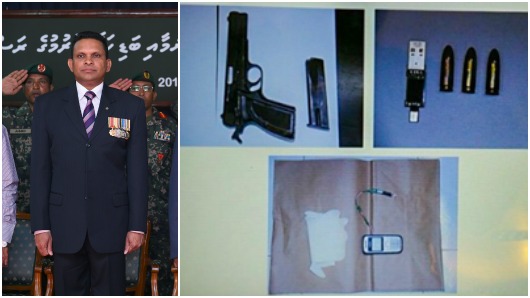
Nazim was charged with illegal weapons possession after police raided the then-defence minister’s apartment on January 18 and discovered a pistol and three bullets in a bedside drawer. Nazim was subsequently dismissed from the cabinet and arrested on additional charges of treason and terrorism.

Nazim’s lawyer Maumoon Hameed said some of the police statements were dated a year back, and argued anonymised witnesses would obstruct Nazim’s right to a free and fair trial as it would be impossible for the defence to determine if the officer had in fact been present on the scene during the raid.

But presiding Judge Abdul Bari Yoosuf told Hameed to focus on the content of the statements, and suggested judges would determine the authenticity of the witnesses.

Meanwhile, state prosecutors claimed it was necessary to anonymise witnesses to ensure their safety.

Major blunders

Hameed also pointed to what he called major blunders by state prosecutors, including a decision to withdraw charges against Nazim’s wife during the first hearing, allegedly in light of new information found in a pen drive confiscated during the raid.

According to prosecutors, the documents show Nazim was conspiring with opposition Jumhooree Party Leader Gasim Ibrahim’s Villa group to harm senior government officials.

State prosecutors were also forced to change charges from illegal weapons possession to importing and possessing illegal weapons midway through yesterday’s hearing due to an error in the charge sheet.

Noting that evidence obtained by unlawful means is inadmissible in court, Hameed contended the search warrant issued by Criminal Court Judge Abdulla Mohamed was unlawful.

Station Inspector Ahmed Azmath Abdulla had obtained the warrant on his superior’s orders, not on information he had received, Hameed said.

Further, there had been no police intelligence reports on the presence of illegal weapons at Nazim’s apartment, he alleged.

Police must scrutinise and verify information before obtaining a warrant that violates a citizen’s privacy, he added.

The bench, however, pointed to a High Court ruling in which the appellate court said it could not rule on the legality of the search warrant as the case was ongoing at the Criminal Court.

Hameed noted the High Court’s ruling ordered the Criminal Court to rule on the warrant’s legality during the trial. Judge Yoosuf said the defence’s request had been noted and asked Hameed to speak on the evidence itself.

Hameed also asked for an open and public trial in a larger hall, saying Nazim had no confidence in Prosecutor General Muhthaz Muhsin.

But judges said the trial was already public as media and members of the public were allowed to observe hearings. Ten reporters and ten members of the public were allowed into the courtroom.

Evidence

Hameed asked the state to provide additional information, including a video recording of the raid, forensic analysis reports, copies of data obtained from the pen drive, copies of the forms submitted to the Criminal Court to obtain the search warrant, statements by all police officers during the investigation, video recordings of interviews with Nazim, his family and his security officers, and lists of police officers on duty on the night of the raid.

The extensive list was necessary to determine if the evidence had been fabricated, he said.

State prosecutors said they would issue the requested documents upon further review.

Nazim’s family in a statement last week urged the international community to step up pressure on President Yameen’s administration, claiming “there is no hope that Nazim can expect a fair trial” due to a “notoriously politicised judiciary.”

“Nazim never expected to be where he is now. But he has fallen foul of a political conspiracy, one in which powerful forces within the Maldivian government have sought to destroy him and thus prevent him from challenging for the leadership of the ruling party,” Nazim’s family explained in a letter to the international community.

The Maldives Police Services have denied planting evidence and framing the former minister, insisting officers had acted professionally during the midnight raid.

The government has maintained the arrests and charges against Nazim demonstrate “no one is above the law,” and says it has no influence over the trial, claiming charges were initiated by an independent Prosecutor General and tried through an impartial judiciary.


Related to this story:

Ex-Defence Minister calls for an open, public trial

No hope for fair trial, says former defense minister’s family

Nazim accused of conspiring with Villa group to harm state officials

Ex defense minister’s wife charged with illegal weapons possession

Nazim remains in custody as High Court rejects appeal

Former Defence Minister Nazim remanded for 15 days

Police deny framing Nazim as former Commissioner alleges politicisation

No forensic evidence against Nazim, says legal team

Likes(1)Dislikes(0)

Nasheed ordered Judge Abdulla’s arrest, says Tholhath

Former President Mohamed Nasheed ordered the military to detain Criminal Court Chief Judge Abdulla Mohamed in January 2012, former Defence Minister Tholhath Ibrahim Kaleyfaanu told the Criminal Court last night.

At last night’s hearing of his trial on terrorism charges, Tholhath said the operation to arrest Judge Abdulla – dubbed ‘Liberty Shield’ – was initiated by Nasheed and carried out by then-Malé Area Commander Brigadier General Ibrahim Mohamed Didi, currently an opposition Maldivian Democratic Party (MDP) MP for mid-Hithadhoo constituency.

According to trial observers from the Maldivian Democracy Network (MDN), state prosecutors noted that Tholhath had confessed to initiating Operation Liberty Shield during a previous trial at the Hulhumalé Magistrate Court.

Asked whether Nasheed directly gave the order to Didi – bypassing the defence minister – Tholhath’s lawyer said details of the orders would be explained after the state presents its witnesses.

Tholhath insisted that Nasheed had ordered the judge’s detention on Girifushi Island.

Judge Abdulla’s arrest triggered a police and military mutiny forcing Nasheed’s resignation on February 7, 2012.

In January 2013, Tholhath told parliament’s Government Oversight Committee that Nasheed had not resigned “under duress” in a a coup d’etat. However, Tholhath had previously claimed that Nasheed’s life was in danger on February 7, 2012 and that the former president had no choice but to resign.

During the 2013 presidential campaign, Tholhath campaigned for Jumhooree Party Leader Gasim Ibrahim and later backed eventual winner Abdulla Yameen.

Terrorism trials

At last night’s hearing, Tholhath’s lawyer asked state prosecutors to clarify which offence the former minister was being charged with under Article 2 of the anti-terrorism law.

When the prosecutor explained that the offence was “enforced disappearance,” the lawyer asked whether the state has decided that the highest authority of the military gave orders that amounted to terrorism, and whether the state was suggesting the Maldives National Defence Force (MNDF) was a “terrorist organisation” if soldiers enforce their commanders’ orders.

The lawyer also asked why soldiers involved in the operation were not being charged as accomplices.

In reply, State Prosecutor Abdulla Rabiu said senior officers of the military “used the institution as a veil to commit this atrocity,” noting that senior officials would have had the opportunity to seek legal advice.

The defence lawyer said then-Home Minister Hassan Afeef informed Tholhath that the chief judge was a threat to national security as he was blocking corruption investigations, releasing dangerous criminals, and undermining the criminal justice system.

The lawyer also contended that the Human Rights Commission of Maldives’ (HRCM) investigation could not be admissible as the commission was not legally authorised to investigate acts of terrorism.

However, the prosecutor insisted that the HRCM Act confers powers on the commission to investigate terrorism.

After the judges ruled that the procedural issues were not an impediment to continuing the trial, both the prosecution and defence then submitted a list of evidentiary documents and witnesses, including senior officers of the police and military.

Adjourning the hearing, Judge Abdulla Didi said testimony from state witnesses would be heard at the next trial date.

At last night’s hearing of Nasheed’s trial, Judge Didi and Judge Abdul Bari Yoosuf ruled that there was no conflict of interest for the pair to preside over the trial, despite having testified as witnesses in the case’s investigation.

Along with Nasheed, Tholhath, and Didi, former Chief of Defence Forces Major General (Retired) Moosa Ali Jaleel and Colonel (Retired) Mohamed Ziyad are also on trial on terrorism charges over the chief judge’s arrest.

All five defendants have pleaded not guilty to the terrorism charges. The charges were filed under Article 2(b) of the Prevention of Terrorism Act of 1990, which criminalizes kidnappings, forced disappearances and abductions and carries a jail term of between 10 to 15 years.

At a hearing earlier this week, Jaleel denied any involvement in the judge’s arrest, claiming he neither received nor given any orders to take the chief judge into military custody.

Didi was meanwhile hospitalised on Sunday night after complaining of chest pains. His family told Minivan News today that the retired general would be flown overseas as soon as doctor’s give approval.


Related to this story

Judges Didi and Yousuf refuse to step down from Nasheed’s terrorism trial

Nasheed denies ordering Judge Abdulla arrest, granted three days to answer charges

Former President Nasheed arrives in court with arm in makeshift sling

Chief Judge “took entire criminal justice system in his fist”: Afeef

Likes(2)Dislikes(0)

Parliament sitting adjourned amidst opposition MPs’ protest

The first regular sitting of the Peoples Majlis for 2015 was adjourned shortly after it began amidst protests by opposition Maldivian Democratic Party (MDP) MPs.

MDP MPs called for the release of former President Mohamed Nasheed, who is currently in police custody until a surprise trial on terrorism charges conclude.

Speaker Abdulla Maseeh adjourned Majlis after forwarding the names of Moosa Ali Jaleel who has been appointed as Defence Minister by President Abdulla Yameen, Ahmed Saleem who has been appointed as Ambassador for Pakistan and Ahmed Akram who has been proposed by government as a member of Elections Commission to Majlis sub committees for further review.

Moosa Ali Jaleel was the Ambassador for Pakistan until he was appointed as Defence Minister after former Defence Minister Mohamed Nazim was removed from the post and charged with treason.

Jaleel is currently facing charges of terrorism for his role in the arrest of Criminal Court Chief judge Abdulla Mohamed along with former President Mohamed Nasheed, his Defence Minister Thalhat Ibrahim Kaleyfanu, former Male’ Area Commander of military MP Ibrahim Didi and ex Colonel Mohamed Ziyad.

Former Deputy Secretariat of Maldivian Democratic Party (MDP) Ahmed Akram was proposed as a member of Elections commission after the term of one member had expired. Akram is relative of former MDP President Moosa Manik’s wife.

Likes(1)Dislikes(0)

Businesses need an “economic tsar” or a “tyrant” to succeed, says President Yameen

An “economic tsar” or a “tyrant” is essential for a business to succeed, President Abdulla Yameen said at a ceremony held last night to celebrate local investment company Alia’s 50th anniversary.

While business decisions are made in boardrooms after considering social factors, President Yameen said economic decisions should be taken by “someone with an economic mindset.”

“Success for a business is to have an economic tsar or an economic tyrant leading it,” said Yameen, addressing Alia’s senior management.

Alia Group has remained successful for so long because it is a “strong family business,” Yameen suggested.

“There cannot be many owners in a business. Businesses will get suggestions from the board, but when it comes to decisions, if there is one person who makes the decisions, it is more efficient,” he added.

Alia – founded by the late Ali Abdulla, father of former first lady Laila Ibrahim – started out in the early 1960s as Alia carpentry, before expanding into the construction industry.

Ten years later, the company reached an agreement with Yamaha, and introduced the Yamaha outboard engine to the Maldives, still being widely used in the transportation industry.

President Yameen praised Ali Abdulla for his vision and forward thinking, adding that under his management Alia had transformed the construction industry whilst revolutionising sea transportation with the introduction of the Yamaha engine.

Economy and investments

Yameen went on to say that the government is aiming toward increasing the rate of economic growth in the Maldives.

“The GDP growth this year is estimated at eight percent or higher,” he said.

“This growth, when compared to other countries and our close neighbour’s sluggish two to three percent growth, is a very vibrant economic situation.”

Last year, the government enacted its its flagship Special Economic Zones (SEZs) Act, which President Yameen’s administration insists would attract large scale foreign direct investments.

While the government forecasts it will receive US$ 100 million as acquisition fees for the SEZs by August 2015, the opposition has criticised the lack of significant foreign investments despite assurances from the government.

Last night, Yameen said peace and stability in the Maldives together with the government’s policies would spark interest from potential foreign investors.

“If we are able to grab the attention of the investors, and with the current direction of the economy, there will be big infrastructure projects in the future,” said Yameen.

Such investments would provide opportunities for local construction companies and create employment opportunities for the youth, he said.

“Sovereign guarantee”

President Yameen last night reiterated the government’s pledge to provide sovereign guarantees on loans to develop new resorts, noting that that the tourism industry offers “lucrative” employment opportunities for youth.

The economy does not benefit if resort development on islands leased by the government remains stalled for eight or 12 years, Yameen said.

“The rent for the islands might go into MIRA [Maldives Inland Revenue Authority],” he continued.

“However, the opportunity cost of the eight years is much higher. Imagine the amount of dollars which would cumulate and roll through the resort if it had been developed.”

Last year, the cabinet’s economic council announced plans to remove import duty on construction material needed for the refurbishments of resorts, in order to stimulate resort development.

Correction: This article previously identified Alia’s founder as Ali Ibrahim. This is incorrect. Alia was founded by Ali Abdulla.


Related to this story

Foreign investments worth MVR9.8 billion expected in five years, says President Yameen

Parliament approves state budget for 2015 with 60 votes in favour

PPM celebrates SEZ bill with fireworks

INIA capacity will increase threefold with new runway and terminal, says economic council

Likes(5)Dislikes(0)

Maldives introduces injectable Inactivated Polio Vaccine

Maldives has introduced the injectable Inactivated Polio Vaccine (IPV) into its routine immunisation schedule, in a move to accelerate global eradication of polio.

The universal introduction of IPV is part of a global plan to eradicate polio and secure recent gains towards a polio-free world through stronger immunisation systems, a World health Organisation (WHO) statement explained.

“WHO and UNICEF have supported the Government of the Maldives to become the second country in South-East Asia to introduce IPV,” the statement read.

“The introduction of IPV to the routine immunisation schedule is a vital step in the journey to securing a polio-free world for all future generations to come,” Dr Akjemal Magtymova, WHO Representative to Maldives had said.

Maldives has been polio-free since 1981 with no indigenous cases detected since then. IPV introduction is the latest step by Maldives in its tremendous progress in improving child health and survival in the last decades, according to WHO.

Likes(1)Dislikes(0)

Adhaalth Party meets President Yameen to share concerns with political situation

Religious conservative Adhaalath Party met President Abdulla Yameen today to share the party’s concerns regarding the current political situation in the Maldives.

Speaking to reporters after the two-hour long meeting at the President’s Office, Adhaalath Party President Sheikh Imran Abdulla refused to reveal the concerns shared with the president at the meeting, where Adhaalath leadership members including Islamic Minister Dr Mohamed Shaheem and the party’s Vice President Dr Mauroof Hussein also took part.

Imran has been critical of the government on social media regarding the criminal prosecutions of former President Mohamed Nasheed and former Defence Minister Mohamed Nazim.

In a tweet following today’s meeting, Imran assured that the Adhaalath Party would not make a “financial deal”.

“I am certain before and now as well that Nazim was framed,” he tweeted.

In previous tweets, Imran said former President Maumoon Abdul Gayoom should be “ashamed” of the government’s treatment of Gasim Ibrahim as the Jumhooree Party (JP) leader decided to back President Yameen in the 2013 presidential election run-off after Gayoom “pleaded” with Gasim.

After yesterday’s presidential address – delivered in the face of protests by opposition MPs – Imran tweeted: “President Yameen is now feeling the bitterness of dissolving of the coalition that brought [him] to power.”

A day before Imran tweeted: “Adhaalath Party will come out to protest when there’s no other way.”

Likes(3)Dislikes(0)

MDA MP withdraws constitutional amendment on 65-year age limit to contest for presidency

Maldives Development Alliance (MDA) MP Mohamed Ismail has withdrawn an amendment to the constitution that would have barred Jumhooree Party (JP) Leader Gasim Ibrahim from contesting the presidency in 2018.

The move comes after Gasim met ‘Champa’ Mohamed Moosa ‘Uchchu’ and Tourism Minister Ahmed Adeeb at Moosa’s residence around 11pm last night.

The amendment proposed adding an age limit of 65 among the eligibility criteria for presidential candidates. Gasim would be 66 years of age in 2018.

“I withdrew the amendment today respecting the leaders of the ruling party’s request to remove the bill. I also thought that it would be in the best interest of the country at this time that I withdraw it,” Mohamed Ismail told Minivan News.

However, as a three quarters majority of the total membership of the People’s Majlis is required to amend the constitution, the votes of opposition Maldivian Democratic Party (MDP) MPs or JPs would be needed to reach the required 63 votes.

Adeeb – also deputy leader of the PPM – has confirmed on social media that the meeting took place.

“My meeting with honorable Gasim and honorable Uchu is confidential, so no comments to what we agreed or discussed,” he tweeted.

After news of the meeting was reported by local media, a small group of protesters greeted Gasim when he emerged from the meeting. “President [Mohamed] Nasheed is in jail,” they screamed.

Gasim told reporters after the meeting that the discussion was “about the political environment.”

The JP issued a press release this morning stating that Gasim’s meeting with Champa Moosa was a meeting “between friends”.

“As the two are businessmen, discussions concerning business also took place,” the press release stated.

The JP claimed that Adeeb arrived at Champa’s residence while the meeting with Gasim was ongoing.

Gasim told Adeeb to ask President Abdulla Yameen to withdraw “politically motivated” charges against former President Nasheed and former Defence Minister Mohamed Nazim, the JP said.

Gasim’s JP formed an alliance with MDP in February and launched nightly protests against the government’s alleged breaches of the constitution. Since former President Nasheed’s arrest, Gasim has called on Prosecutor General Muhthaz Muhsin to withdraw charges against the opposition leader and ex-defence minister in the interests of peace and stability.

The government has since seized several properties leased to Gasim’s Villa Group for alleged agreement violations. Last week, the Maldives Inland Revenue Authority (MIRA) gave a 30-day notice to Villa Group to pay US$100 million allegedly owed as unpaid rent and fines.

Moreover, at the first hearing of Nazim’s trial last week, State Prosecutor Adam Arif said documents on a pen drive confiscated from the then-defence minister’s apartment showed he was planning individual and joint operations, financed by the Villa Group, to cause bodily harm to “senior honourable state officials.”

Despite the JP’s claims to the contrary, local media reported last night – citing confidential sources – that Gasim asked Adeeb to withdraw the constitutional amendment and the pair discussed MIRA’s 30-day notice to Villa Group.

Gasim was also criticised by opposition supporters when he failed to return to the Maldives as promised ahead the MDP-JP mass rally on February 27. Gasim went to Colombo to brief diplomatic missions in Sri Lanka and claimed he could not return for the rally due to an appointment the following day with Sri Lankan President Maithripala Sirisena.

“As in the agreement between JP and MDP, Gasim will work to free former President Mohamed Nasheed and former Defence Minister Mohamed Nazim,” the JP insisted in its press release.


Related to this story

Villa Group ordered to pay US$100 million in 30 days

JP Leader Gasim meets Sri Lankan President Sirisena

10,000 protest in Malé, call for President Yameen’s resignation

Allegations of conspiracy with Nazim “deliberate fabrication,” says Gasim

Likes(1)Dislikes(0)

Judges Didi and Yoosuf refuse to step down from Nasheed’s terrorism trial

A three-judge Criminal Court panel has ruled it has no conflict of interest in overseeing former President Mohamed Nasheed’s terrorism trial, despite two of the three judges having testified as witnesses in the case’s investigation.

Nasheed is accused of ordering the abduction of Criminal Court Chief Judge Abdulla Mohamed in January 2012. If convicted under anti-terrorism laws, he faces a jail term between ten and 15 years.

The opposition leader’s lawyers tonight requested Judges Abdulla Didi and Abdul Bari Yoosuf step down from the bench.

Citing statements provided during a police and Human Rights Commission of Maldives (HRCM) investigation, lawyers said Judge Abdulla had first called Judge Yoosuf on receiving news of his impending arrest, while Didi had been present at the scene of the arrest.

But, Judges Didi, Bari and Sujau Usman unanimously ruled there were no legal barriers preventing them from passing judgment, stating legal norms allowed judges to choose between acting as a judge or a witness.

They subsequently prohibited either state prosecutors or Nasheed’s lawyers from naming them as witnesses in the ongoing trial.

The judges also overruled Nasheed’s second procedural issue, in which he contended Prosecutor General (PG) Muhthaz Muhsin’s decision to re-prosecute him—after withdrawing lesser charges of arbitrary detention in early February—was unlawful.

The third hearing in the terrorism trial concluded with state prosecutors and Nasheed naming witnesses and outlining key pieces of evidence.

Nasheed has named Muhsin as a defence witness. State prosecutors today assured the former president that Muhsin would step out from the trial if he is called to the witness stand.

Presiding Judge Didi also warned Nasheed’s lawyers against publicly implying the former president may not receive a free and fair trial, noting such comments amount to contempt of court.

Conflict of interest

Nasheed’s legal team contended judges must be free of bias and be perceived to be without a conflict of interest to ensure the former president a free and fair trial.

Didi and Yoosuf’s involvement in the investigations into Judge Abdulla’s arrest, and their long history of working together indicated a special relationship, lawyers argued.

Lawyers also questioned Muhsin’s motivation in re-prosecuting Nasheed, noting he too had worked with Judge Abdulla for years up until his appointment as Prosecutor General in July 2014. Muhsin had also testified during police and HRCM investigations, they said.

Noting Nasheed’s terrorism charges came after he had effectively been on trial for arbitrarily detaining Judge Abdulla for three years, lawyers said the PG‘s decision to file new and harsher charges on the same facts allows Muhsin to abuse the criminal justice system by depriving the accused of finality.

However, state prosecutors contended the PG’s power to withdraw, review and re-submit charges translated into authority to re-prosecute on new charges.

Muhsin had testified in his personal capacity, not as the Prosecutor General of the Maldives, they said.

Witnesses

After the judges overruled Nasheed’s procedural issues, the state presented a list of witnesses.

They include former Commissioner of Police Ahmed Faseeh, police officers Ismail Latheef, Ahmed Shakir, Mohamed Jamsheed and Abdul Mannan Yoosuf, Chief of Defense Forces Ahmed Shiyam, former Defense Minister Tholhath Ibrahim and Maldives National Defence Force (MNDF) officers Ali Shahid and Aishath Zeena.

State prosecutors also plan to submit a video of Judge Abdulla’s arrest, speeches made by Nasheed at a cabinet meeting, a meeting with the police and in public during January 2012.

But Nasheed’s lawyers said the Criminal Court had failed to provide them with key evidence including the arrest video, and some transcripts of Nasheed’s speeches.

But Judge Didi ordered lawyers to name defense witnesses, assuring them the court would provide the items as soon as possible, and would allow them to name new witnesses to counter the new evidence if the court deems it necessary.

In addition to Muhsin, Nasheed’s witnesses include former head of police’s Drug Enforcement Department Mohamed Jinah, former Home Minister Hassan Afeef, and former Finance Secretary Ahmed Mausoom.

Nasheed’s lawyers requested 30 days to prepare his defence in light of new evidence that had not yet been provided, but judges said they would inform Nasheed of the date for a new hearing on Tuesday (March 3).

Judges also refused to revise an earlier decision to place Nasheed in custody until the trial concluded. The former president had been denied the right to legal counsel at the time.

Nasheed’s administration had justified Judge Abdulla’s military detention claiming he had had allowed “his judicial decisions to be determined by political and personal affiliations,” and repeatedly released then-opposition figures brought before the court on serious crimes.


Related to this story

Nasheed denies ordering Judge Abdulla arrest, granted three days to answer charges

Former President Nasheed arrives in court with arm in makeshift sling

Nasheed denied right to appoint lawyer and appeal “arbitrary” arrest warrant, contend lawyers

Police arrest former President Mohamed Nasheed ahead of terrorism trial

Likes(2)Dislikes(0)