Maldives crisis requires international assistance: former Foreign Minister Dr Shaheed

“I do not believe that the constitutional and political crisis in the Maldives will be resolved without international assistance,” former Foreign Minister Dr Ahmed Shaheed has told Minivan News today.

Dr Shaheed – currently UN Special Rapporteur on Human Rights to Iran – said he wished to correct local media reports claiming he had called for neighbouring India to intervene militarily to restore democracy in the Maldives.

“It does not have to be force – it can even be good offices,” he said, accusing media of distorting his comments.

Progressive Party of Maldives vice presidential candidate Dr Mohamed Jameel Ahmed meanwhile told local media that the comments were evidence of the “hunger for power” within the Maldivian Democratic Party (MDP).

“Calling for the Indian military to come to Maldives, I believe it is proof that they want power even by sidelining the country’s independence and sovereignty, through whatever means possible,” Dr Jameel told Sun Online.

Tension is growing in Male’ after the Supreme Court ordered the security forces to forcibly prevent any state institutions proceeding with the constitutionally mandated presidential run-off.

The poll was required under Article 111 of the constitution to take place on Saturday (September 28).

Controversy has nonetheless arisen over Shaheed’s remarks on twitter over the past few days, in particular a post from last Thursday (September 26)

CMAG must suspend the Maldives from CW n request India to invoke R2P!

— ahmed shaheed (@ahmedshaheed) September 26, 2013

Initial misinterpretation, argued Shaheed, was a result of Adhaalath Party Vice President Dr Mauroof Hussain distorting a previous message in which he had stated that an Indian takeover would be preferable to one led by local ‘takfiris’ (Muslims who label other Muslims apostates).

Shaheed – noting that local media had run a second article in which he said corrected some of the mistakes made in the first – called on the Commonwealth to take a more proactive stance on the Maldives.

“My tweet on R2P was aimed at the Commonwealth, asking it to suspend Maldives from the Commonwealth and further asking it to invite India to play a more proactive role in restoring Constitutional authority in the Maldives.

“When the Supreme Court has been hijacked by thugs and bandits, the time has come for the Platonic question – who shall guard the guardians? The answer is CMAG, R2P and UN resolution 44/51,” said Dr Shaheed.

He called for a Commonwealth process, and noted that the R2P doctrine itself mandates a UN process, thereby ruling out any unilateral intervention.

Initiatives and resolutions

The R2P initiative is intended to address the international community’s failure to stop genocides, war crimes, ethnic cleansing and crimes against humanity. It views sovereignty as a responsibility rather than a right.

Former Foreign Minister Shaheed also suggested that UN resolution 44/51 could be invoked to invite Indian assistance to restore constitutional authority in the Maldives.

Resolution 44/51, which was introduced by the former Foreign Secretary Ibrahim Hussain Zaki in 1989, is titled ‘Protection and security of small island states’.

The Maldivian initiative was brought before the General Assembly after the attempted coup by Tamil mercenaries in Male’ the year before.

The resolution stated the General Assembly’s appeals to “relevant regional and international organisations to provide assistance when requested by small states for the strengthening of their security in accordance with the purposes and principles of the [UN] Charter.”

The subsequent paragraph also calls on the Secretary General to pay special attention to the security situation of small states.

UN Secretary General Ban Ki-moon had stated his concern about the Supreme Court’s decision ordering the postponement of the second round, given that the first round was “widely recognised as a success by international and domestic election observers.”

“The people of the Maldives have exhibited great patience and should have the opportunity, without undue delay, to exercise their vote,” he stated.

International processes

Expressing concern at recent events in the Maldives, the Commonwealth Ministerial Action Group (CMAG) last week “urged all those concerned to ensure that the second round of the election is held at the earliest possible date so that this constitutional requirement is met.”

Following last week’s CMAG meeting, Acting Foreign Minister Dr Mariyam Shakeela urged the group to “take matters in proper context, and not to over-react on delicate situations in member countries”.

Likes(0)Dislikes(0)

MP Ali Azim arrested on third consecutive night of MDP protests

Maldivian Democratic Party (MDP) supporters protested for the third consecutive day on Sunday (September 29), resulting in confrontations between the police and protesters with multiple arrests – including that of party parliament members.

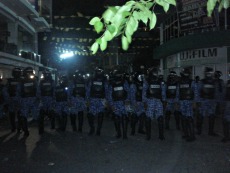
Protests began at around 2:00pm near the FDI Station on Fareedhee Magu – the closest protesters can go to the Supreme Court building, as the area remains cordoned off by police and military forces.

Crowds grew and thinned alternatively throughout a period of 12 hours, with the main confrontations occurring after 10:00pm.

Minivan News observed that earlier in the night the MNDF was in charge of security operations in the area. About 400 protesters, while playing campaign songs and chanting slogans – “Forward, forward, swiftly forward”, “Give us our right to vote”, “We don’t want to selectively follow parts of the constitution” – were peaceful.

Police, including Special Operations (SO) officers, took over security operations later in the night, around which time the atmosphere became more heated.

Leading the protest were MDP Vice Presidential Candidate Dr Mustafa Lutfi, MP Ali Azim, former foreign minister Ahmed Naseem, and former Attorney General Dhiyana Saeed.

MDP MP Ali Azim was addressing the protesters from a campaign truck close to the police barricades when SO officers took him under arrest. A video on social media shows SO officers run up to the parliament member, pull him off the truck and onto the ground before dragging him away through the crowd and past the line of barricades.

Eye witnesses say that police kicked him and hit him with batons prior to dragging him to their vehicle.

The MDP has today released a press statement saying that the party “harshly condemns the brutal arrest of Ali Azim”.

“This is an act to intimidate the people and a violation of freedoms provided in the constitution.”

Protesters threw stones and empty plastic bottles over the barricades into the police lines, while police used batons, pepper spray and a substance with a strong chemical smell which caused wheezing and difficulty in breathing.

“I don’t know what this is, but having felt the pain of being pepper-sprayed and teargassed, I can tell you this is a different substance. An irritant of some sort. It smarts so very bad and feels like I have sand in my eyes. My skin feels like it is peeling away and burned,” said a 34 year-old male protester affected by the substance during last night’s protests.

“Do I deserve this in return for asking for justice? For demanding an elected government?” he asked, while pouring Coca Cola over his face in an attempt to regain sight and take away some of the pain.

According to police media a total of eight arrests were made last night. Police denied that any substance or chemical besides pepper spray was used to control the protests.

“Nothing except pepper spray. No new chemicals were used,” the spokesperson stated.

Minivan News observed at least 13 male protesters being taken into police custody after snatch teams of SO officers went into crowds and chased them.

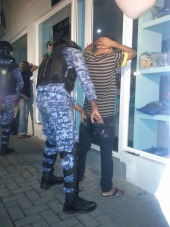
Many of the protesters were frisked in the presence of media behind police lines prior to being taken into the police vehicles – a practice which has not previously been observed at the protests following the February 7 controversial transfer of power.

After consecutive and frequent SO officer charges into the crowd, protesters thinned out around 1.45am, leaving a few dozen people standing by in small crowds, defiantly chanting “justice now”. Police left the area at approximately 2:00am when protests died down for the night.

The MDP has said that it will continue the protests and has called on the Human Rights Commission of Maldives (HRCM) and the prosecutor general to investigate the arrests of the DRP MP and other protesters.

MP Ali Azim was brought to court at 2.30pm this afternoon and his detention has been extended for seven days.

Meanwhile, police have said they are investigating four MDP MPs for contempt of court and threatening police, judges and their families. These are Feydhoo MP Alhan Fahmy, Malé MPs Imthiyaz Fahmy, Mohamed Rasheed (Bonda) and Reeko Moosa Manik.

Furthermore police arrested Malé MP Hamid Abdul Gafoor today to ensure his presence at a Criminal Court trial tomorrow on alleged possession of alcohol.

MDP MP Ali Waheed’s car was vandalised in the evening, and a motorcycle and car were torched at 3:00 am. The police also said wife of a policeman was hit by a motorcycle at noon. She is eight months pregnant.

MP Ali Azim arrested during Sunday night’s protests

Likes(0)Dislikes(0)

No evidence to prove Corporal Atheef brutalized MDP Chairperson on February 8 says PIC

The Police Integrity Commission (PIC) has ruled that it had not come across substantial evidence supporting the claims of opposition Maldivian Democratic Party (MDP) Chairperson ‘Reeko’ Moosa Manik being attacked by Corporal Mohamed Atheef  on February 8, 2012.

Last year on February 8, the MDP backed by thousands of its supporters took to the street in protest following the controversial ousting of the party – led government of former President Mohamed Nasheed.

The protest was met by a vigorous and a brutal crackdown by police officers – who the Human Rights Commission of Maldives (HRCM) stated were “emotionally hyped and charged”.

The HRCM in its investigative report into the events concluded that the police crackdown on the MDP march, which left dozens of demonstrators injured, was “brutal” and “without prior warning.”

Manik who was at the forefront of the demonstration was seen singled out by the enraged police and in videos that later became public showed him being dragged by police unconscious and severely injured.

In another video, he along with ousted President Nasheed and MP Mariya Ahmed Didi were seen dragged out of a ceramic shop in Male’ by the police while Nasheed was heard in the video pleading the police to not to torture the people.

However, in a case report sent to Corporal Mohamed Atheef – whom Moosa alleged was one of the police officers who attacked him – the PIC stated that the commission was not able to obtain sufficient evidence required to prosecute Corporal Atheef.

The local media outlets reported that Coporal Atheef was seen in pictures and videos that had come out in public later.

Corporal Atheef however had denied the allegations.

“On that very day, I was trying to protect Moosa Manik and escort him safely out of the area. I have never tortured a Maldivian citizen even before and even now. I shall never torture anyone,” Corporal Atheef told Minivan News.

Despite PIC’s decision, the prosecutor general had pressed charges against another police officer Mohamed Waheed for allegedly hitting Manik in the head with a metal canister on the same day.

Another officer, Ibrahim Faisal is facing charges for assaulting MP Mariya Ahmed Didi.

The PIC had previously said that it had been looking into complaints of police misconduct especially during protests.

Likes(1)Dislikes(0)

MDP call for a “people’s government” if no election by November 11

The Maldivian Democratic Party (MDP)  passed a resolution on Sunday (September 29), calling for the establishment of a people’s government headed by the party’s presidential candidate and former president Mohamed Nasheed, if no elected president is sworn in by the end of the current presidential term on November 11.

The resolution comes after the Maldives Police Services forcibly brought run-off preparations to a halt on Friday following a Supreme Court order to delay the second round of presidential elections in an ongoing case filed by third placed Jumhooree Party (JP) to annul the vote.

The MDP emerged as the front-runner with 45.45 percent of the vote in the first round of polls and was set to run against the Progressive Party of the Maldives (PPM), which won 25.35 percent in a second round on September 29.

The resolution, passed with unanimous approval of 78 members, says the party will continue its presidential campaign activities, will actively participate in peaceful political activity to get the right to vote, and is to establish a people’s government if a president is not sworn in by November 11.

“If no elected President is sworn in as per the constitution on 11 November 2013, then the MDP by virtue of the mandate given to them by the first round of the Presidential elections held on 7 September 2013, will work to establish a people’s Government headed by the MDP’s Presidential candidate, President Mohamed Nasheed,” the resolution read.

The party is to hold discussions with all state institutions and the international community to seek their support for the people’s government.

Further, the party has called for civil disobedience and will begin mass protests calling for the establishment of a people’s government, and will carry out political activity in Male’ and the atolls.

According to the resolution, MDP’s campaign offices and atolls will be reactivated and campaign officials are to travel across the country to continue with presidential campaign. Door-to-door activities are to restart.

The PPM’s legal advisor Mohamed Waheed Ibrahim yesterday said that the Supreme Court should decide who to hand the presidency to should presidential elections fail to take place by November 11.

Meanwhile, the Jumhooree Party has criticised the MDP’s resolution as “extremist and harmful” and says the MDP wants to “create strife and plunge the country into a behavioural war by bringing people from the atolls into Malé.”

In a statement released on Sunday, the party said it wants a speedy verdict in the Supreme Court case and said “the Jumhooree Coalition will obey any Supreme Court verdict that calls for a revote and ensures first round’s fraud is not repeated.”

The Maldives’ first round of polling has received praise from international and domestic observers, whilst the Supreme Court’s decision to delay polls has been met with global and domestic concern.

Likes(1)Dislikes(0)

Death threats force Elections Commission to seek police assistance

Ongoing death threats received by the Elections Commission (EC)’s permanent staff and polling station officials have prompted the commission to file a report with the Maldives Police Service (MPS) today.

A lack of state cooperation prevented the commission from holding a “free and fair [presidential election] vote without intimidation, aggression, undue influence or corruption” on September 28 as constitutionally-mandated, the (EC) announced on Friday night, shortly before it was surrounded by a police barricade.

Lack of police support, “some political parties” threatening to set ballot boxes on fire, and death threats made against Elections Commission members, staff, and officials involved in the voting process were highlighted as reasons for postponing the second round run-off, which would otherwise have taken place yesterday.

Special Operations police surrounded the EC secretariat on Friday, with orders from Police Commissioner Abdulla Riyaz to take over the building and ballot papers should it proceed with holding the election.

In addition to the MPS stating it would not cooperate with the EC and ceasing to providing security requested by the commission for the second round, police prevented EC staff and visitors from entering the secretariat on Friday. However, staff were later allowed to return after a series of phone calls between Riyaz and EC Chair Fuwad Thowfeek.

As of Thursday, the EC insisted that it was constitutionally mandated to hold the runoff within 21 days of the first round, in spite of an order from the Supreme Court to suspend the election indefinitely. This prompted Assistant Commissioner of Police Hassan Habeeb to call the Elections Commission Chair on Thursday night (September 26) and warn that police would not allow the election to take place.

Death threats continue

“It’s not just myself and my family, but Elections Commission staff, including most directors and even some heads of ballot boxes and other polling station staff who have received threatening messages that they and their families will be killed,” Elections Commission Chair Fuwad Thowfeek told Minivan News today.

“They are very much scared about the situation. Some are even afraid to come out of their homes. It’s very sad,” Thowfeek lamented.

“I hope we will be safe, we have been trying to follow the constitution,” he said.

Thowfeek said the EC had sent a report to the MPS detailing the threats, phone numbers the messages were sent from, and other relevant information.

He noted that the EC was still considering whether to send an official letter to the Telecommunications Authority regarding the death threats “because we are waiting for action to be taken through the MPS, since they have the authority to investigate.”

The following SMS was sent to EC and polling station officials yesterday:

“What you did to rig the vote near ballot boxes will be exposed. YOU resign. Or else even your family will be killed. Allah Akbar we are with the religion.”

On Thursday senior Election’s Commission staff received the following message around 6:00pm:

“We will kill anyone who allies with Fuwad Thowfeek against the Supreme Court order and the Maldivian constitution and continues with voting activities. Allah Akbar.”

Additionally, during an interview Minivan News conducted with Thowfeek last week, he noted that “some of us are getting threats from unknown people. I have received SMS messages saying ‘be careful when you come out on the street, you’ll be stabbed in the stomach’.”

Only the EC’s human resource section and other section heads of the commission have a list of all election officials and temporary staff, explained Thowfeek.

The commission had provided the four political party presidential candidate representatives with a list of all elections officials, including polling station staff, but that list did not include their phone or ID card numbers, he noted.

Police integrity

The Police Integrity Commission (PIC) called for the police to provide any assistance the EC requires to go ahead with the second round.

Earlier this month the PIC determined Police Commissioner Abdulla Riyaz violated the Police Act by posting a letter on Twitter urging police officers not to vote for former President Mohamed Nasheed and recommended administrative action be taken against the police chief.

Minivan News enquired with the PIC whether Commissioner Riyaz would be able to impartially issue orders to prevent the EC from conducting election preparations and holding the second round runoff, or whether the MPS – under his leadership – would be able to impartially investigate the death threats EC staff have been receiving.

PIC Director General Fathimath Sareera Ali Shareef told Minivan News today that she needed to consult with their legal department and would reply as soon as possible. She had not responded at time of press.

Elections Commission secure

Police meanwhile remained outside the Elections Commission until yesterday (Saturday) evening, guarding the secretariat and patrolling the road, noted Thowfeek.

“It was our request to have the police in front of the security room, on the ground floor [of the secretariat], and surrounding the building so nobody could enter from behind. They are keeping full security of the building for the protection of the commission and our own safety,” said Thowfeek.

The Elections Commission confirmed there was “no danger” its data could be tampered with because it remained “fully protected” and is being “closely monitored”.

The commission’s server was intentionally shut down on Friday night to prevent anyone from accessing data through a “remote medium”, explained Thowfeek.

Additionally, beginning Friday night, the EC established a rotational schedule to ensure staff are present in the EC’s secretariat 24 hours a day, seven days a week, “so there is no chance an outsider can get in” and tamper with any materials or data, he continued.

“Our own staff are present in the IT, security, and records section rooms – the most important places are constantly monitored,” said Thowfeek.

Police “misunderstanding”

Thowfeek also explained the “misunderstanding” between the MPS and the EC that led Special Operations police to surround the secretariat and prevent staff or visitors from entering, with orders from Police Commissioner Riyaz to take over the commission and arrest staff who disobeyed the Supreme Court order to halt presidential election preparations.

After a Raajje TV journalist called to enquire about the situation, Thowfeek explained to the reporter that “even staff and visitors were not allowed” to enter the EC.

This led Police Commissioner Riyaz to contact Thowfeek and explain that police were sent to protect the commission against any “angry people” trying to enter the EC and harm its staff, according to the EC Chair.

Riyaz also instructed Thowfeek “not to listen to stories from different people about the situation”.

Thowfeek then sent the EC’s Secretary General and Director General downstairs to confirm what was occurring. The commission’s IT and coordination section directors had been prevented from entering the building and police informed the Secretary General that visitors would not be allowed to enter on Saturday either.

The EC Chair again contacted Riyaz and explained that the action being taken by the special operations police differed from what the Police Commissioner had said the MPS officers would do.

Fifteen minutes later, Elections Commission staff with proper identification were allowed into the building and the commission was informed that invited visitors would be permitted to enter as well.

Minivan News had journalists present inside and outside the EC secretariat building throughout the events and did not observe protesters present at the time Special Operations police surrounded the building.

International observer visits

EC officials had previously planned to meet the British High Commissioner in the commission’s secretariat on Saturday, however after the EC’s Secretary General was informed by police Friday night they would not be able to hold the meeting in the commission, it was relocated to the High Commissioner’s hotel, explained Thowfeek.

“The British High Commissioner was here during the first round and commended our work,” said Thowfeek. “He came to see the second round and was disappointed when he found out it had been stopped.”

“He hoped for a quick solution and wished us [the EC] well,” he added.

A team of Nigerian election observers also arrived on Friday and were “very much disappointed” polling did not take place, explained Thowfeek. However, because they “made such a long trip” the EC has still been working with the West African observers and providing information about the electoral process.

The Danish Ambassador and the Commonwealth [observation group] Chair met with EC officials Friday, noted Thowfeek.

“We have had no news from any other [international election] observers,” he added.

Election not possible before November 11, says EC

Holding the second round – or another first round – of the presidential election will now “not be possible before November 11 within existing elections laws”, Thowfeek told Minivan News.

While the EC usually requires 60 days of preparation time for the whole process, “even if we don’t waste a single minute” 45 days will still be required before another presidential election can take place, he continued.

“We have to update the voter list, gazette it, receive complaints and input from the public regarding the list, see who will be present where on that date and allow them to re-register accordingly, add just-turned 18 year-olds and remove anyone who has died during the [voter registry updating] process, etc,” he noted.

Thowfeek explained that general and presidential elections law mandates specific periods of time are given for each step of the election preparation process, for example the voter registry must be published in the government gazette 45 days before polling, 10 days are given to submit complaints, and five days are provided to file cases of unaddressed complaints with the High Court.

“If special laws are made, then maybe it will be possible,” said Thowfeek.

“[Timetables within] the existing laws have to be rescheduled and another set of laws passed [before the November 11 constitutional election deadline],” he elaborated. “The other difficulty is that the Majlis is currently in recess. They may reconvene next week, but any law [passed] has to be ratified by the president.”

“We have just 42 days left before [the end of the presidential term on] November 11, so time is limited,” he added.

The date for the Supreme Court’s verdict in the Jumhooree Party’s case against the Elections Commission remained unscheduled at time of press.

HRCM and civil society support for elections

The Human Rights Commission of the Maldives (HRCM) has called on the Supreme Court and state institutions to ensure that Maldivians not be stripped of the right to vote, guaranteed by constitutional article 26 and the International Covenant on Civil and Political Rights (ICCPR), and to ensure that there would be an elections within the duration stated in the constitution.

HRCM also called on everyone not to pave way for unrest and to hasten all work that had to be done to uphold the constitution.

The commission also called on the EC to solve all the issues with the voters’ registration.

HRCM further called on the authorities to take legal action against those to pose death threats and threats of violence and also called on everyone to give high priority to national interest.

Yesterday Transparency Maldives appealed to all actors “especially the Supreme Court, to uphold the spirit of the Constitution and electoral deadlines and respect people’s electoral choice.”

The NGO expressed its “concern over the delay of the second round of elections and rising tensions as Transparency Maldives did not receive any reports that suggest systematic fraud in its nationwide observation and no credible evidence that supports such allegations has been made public.”

Transparency Maldives, the HRCM and the Maldivian Democracy Network observed the first round and praised the EC’s free and fair electoral process.

Global election support

Global condemnation followed the Supreme Court’s issuing of the injunction, with the UK, EU, and the Commonwealth specifically calling for the run-off to go ahead as scheduled.

International election observers unanimously commended the first round of polling, calling for losing parties to accept defeat and allow the second round to proceed as scheduled.

The Commonwealth’s human rights and democracy arm has since “expressed concern at developments” in the Maldives following the first round of elections.

Business as usual

The Election’s Commission is meanwhile “going ahead” with preparations for the upcoming local council and parliamentary elections.

“We are doing the work for local council elections to take place in December [2013], said Thowfeek.

“[Additionally] last night we issued one draft document for constituencies. According to the law, eight months before the existing term of Parliament expires, we have to check the population figures from various localities and [based on the data] create a report on how constituencies should be formed for the next election,” explained Thowfeek.

Currently there are 77 seats in the People’s Majlis, however 85 seats will be needed, he added.

The Parliamentary election is scheduled to take place on March 2014.

Likes(2)Dislikes(0)

PPM seeks to remove MPs from Majlis for contempt of court

The Progressive Party of the Maldives (PPM) has said it will seek to remove MPs from the People’s Majlis through the Supreme Court, for contempt of court over their challenging of the apex court’s  order to delay the second round of presidential polls.

Several MPs of the Maldivian Democratic Party (MDP) and Dhivehi Rayyithunge Party (DRP) have spoken out against a Supreme Court’s order to delay polls in an ongoing case filed by third placed Jumhooree Party (JP) to annul the vote. The court issued a second injunction on Friday ordering the security forces to halt the Elections Commission and other parties from proceeding with polls.

Following the second injunction, the police surrounded the Elections Commission on Friday and forcibly brought preparations for the runoff to a halt. The MDP won 45.45 percent in the first round and was set to compete with the PPM in runoff polls on Saturday.

Speaking to the press today, PPM’s legal advisor Mohamed Waheed Ibrahim said, “There is a dispute on whether [MPs] have lost their seats in parliament due to speaking out against Maldives’ Supreme Court’s order and defaming the Supreme Court, and other court’s judges. I would like to inform you we will file this case at the Supreme Court.”

Meanwhile, MDP MPs Alhan Fahmy and Imthiyaz Fahmy received police summons for an investigation into contempt of court. The police told Minivan News more MPs are under investigation, but declined to reveal names.

A police summons sent to Alhan and uploaded on Twitter states the MP is being investigated for “threatening judges and their families and contempt of court at a protest outside the Supreme Court on 23 September 2013.”

PPM’s legal advisor Waheed said the list of MPs they are seeking to disqualify from parliament “is long”. Furthermore, the PPM said it would not hesitate to file complaints against Speaker Abdulla Shahid if he had spoken out against the apex court’s order. Abdulla Shahid defected to the MDP in April.

Waheed also said the PPM believes the Supreme Court should decide who to hand the presidency to should presidential elections fail to take place by the end of the presidential term on November 11.

The MDP and its ally the DRP now control 39 out of 77 seats in the Majlis; a simple majority. The two parties passed a resolution on Monday ordering the EC to proceed with polls as planned, and called for the security forces to support the EC. However, the resolution was ignored in favor of the Supreme Court order.

The MDP has said it will utilise its simple majority to seek no-confidence motions against three ministers and the Prosecutor General.

In a statement on Saturday, the PPM has praised the Supreme Court’s election delay orders as a “giant stride forward in championing the constitutional rights of the Maldivian people.”

PPM contends that the court has sole and final jurisdiction to determine all disputes concerning presidential elections and is the final authority on interpretation of the constitution.

“Members of the MDP are breaking law and order continuously even now and spreading false information among the public, while also misguiding the international community,” the statement read.

The PPM has supported JP’s case to annul the vote, and has filed a separate case to delay polls to allow the party time to campaign.

The MDP has repeatedly criticised the Supreme Court for Justice Ali Hameed’s continued presence on the bench despite the leak of three sex videos in which Hameed appears to be fornicating with three different foreign women in a Colombo hotel room.

The UN Special Rapporteur for the Independence of Judges and Lawyers, Gabriela Knaul, in a damning report in May expressed concern over “inadequate and politicised” composition of the JSC and “shock” that members of the judiciary, including the Supreme Court, held memberships in political parties.

Likes(1)Dislikes(0)

Maldives foreign travel advisories updated after recent protests

The UK, Australia, Canada and China have updated their travel advisories on the Maldives, warning of intensifying political instability and encouraging their nationals to take care, especially in the capital city of Male’.

“Demonstrations have already started in the capital, Malé and on some non-resort islands. Further demonstrations are likely. Previous political demonstrations have led to violence and arrests. Friday afternoons are traditionally potential flashpoints,” stated the September 27 notice on the UK Foreign and Commonwealth Service’s travel advisory service.

The guidance urged visitors to keep away from demonstrations: “There is no indication at present that any political unrest will affect tourist resorts or airports, but if you have any concerns you should check with your hotel or tour operator,” the statement read.

The Australian alert on the government’s Smart Traveller website flagged Male’ yellow and urged travellers to “exercise a high degree of caution” in the capital due to “unresolved political tensions and risk of further unrest and violence.”

“Since February 2012, there have been regular political protests in Male, some of which have turned violent. The political environment remains uncertain and further violent clashes could occur. You should avoid public gatherings and protests, particularly in Male, as they may turn violent. Extra care should be taken when moving around Male’ after dark,” stated the advisory.

The Canadian alert urged travellers to “exercise a high degree of caution” due to civil unrest, stating that “the political situation is volatile following the indefinite postponement of the second round of presidential elections by the Supreme Court. Demonstrations by political parties are likely to occur.”

The Chinese advisory, updated on September 27, noted that while the Maldivian social order “is generally stable”, “partisan conflicts around the presidential elections are intensifying.”

The Chinese Embassy in the Maldives urged Chinese visitors – who make up 25 percent of all tourism arrivals – to monitor the local security situation, contact and confirm the hotel booking before departure, and avoid non-essential travel to Male’.

Friday’s protests were also extensively reported by Chinese state-run press agency, Xinhua.

The US Embassy in Colombo previously issued a travel notice to US citizens planning to travel to the Maldives, stating that the run-off presidential election previously scheduled for September 28 “has been postponed.”

“The U.S. Embassy recommends that US citizens exercise caution, avoid large crowds, and monitor media coverage of local events,” the advice read.

Tourism dependency

The vast majority of tourism to the country is through package tours and holidays, with guests arriving on the airport island of Hulhule and being taken by boat, seaplane or domestic air transfer directly to their resort islands without stepping foot on Male’.

The tourism industry’s traditional market has been the UK, Italy, Germany and Russia, however following the 2008 recession this market has been displaced with a surge in Chinese arrivals. Smaller but growing markets include the Middle East and Eastern Europe.

The Maldives is indirectly dependent on this luxury tourism industry for over 70 percent of its GDP and up to 90 percent of its foreign currency exchange. As small island nation with scarce natural resources and very little agriculture, the Maldives also has near-total reliance on imports, particularly for tourism commodities.

The Tourism Employment Association of the Maldives (TEAM) last week indicated that it would encourage its 5000 members to strike should the election be delayed, while the Maldives Port Workers Union (MPWU) went on strike today “to send a message to the government”.

While the political situation in Male on Sunday remained tense ahead of an expected but unscheduled Supreme Court verdict on the fate of the run-off election, protests over the past several days were confined to just several intersections in the capital.

Yesterday’s protest near Male’s main tourist street attracted small crowds of passing Chinese and German tourists who took photos of the rally. A group of four Germans, asked what they thought was happening, said “I don’t know, something to do with the flags?”

Tourism Minister Ahmed Adheeb told Minivan News yesterday that international media coverage of proposed strike action predicting “travel misery” for UK tourists travelling to resort was “irresponsible”, and challenged the veracity of reports such as that in the Independent’s travel section.

“The scuba dive tanks will stay empty, the pool towels unchanged, and there will be nobody on hand to mix a cocktail [should the protests go ahead],” wrote the paper’s Whitehall editor, Oliver Wright.

Likes(1)Dislikes(1)

Six protesters released on condition they don’t participate in protests for two months

The Criminal Court has released six persons arrested during the Maldivian Democratic Party (MDP) protest calling for presidential elections, on condition that they do not participate in protests for two months.

A police spokesperson today told Minivan News that, as of this morning nine protesters were in police custody.

”The court extended two person’s detention period to 15 days,” he said, adding that they were arrested on charges of objection to order and obstructing police duty.

In a statement issued last night (28 September) police said that a total 15 persons have been arrested following unrest in Male’ since September 23.

Police said three were arrested without any conditions, and that the court had extended the detention period of six persons.

Police Spokesperson said that last night seven others were arrested in addition to the 15 persons mention in the statement issued.

”15 is the total amount of persons that were arrested,” he said. ”Some of them have also been released without being taken to the court.”

MDP protesters took to the streets following an injunction issued by the Supreme Court regarding a case filed at the court by Jumhooree Party- led by unsuccessful first round candidate Gasim Ibrahim – to annul the poll on allegations that there had been major issues with the voter registration, and that the Elections Commission had changed votes.

After the Supreme Court issued the injunction, pro-MDP supporters have been protesting everyday near the Supreme Court and other areas of Male’.

MDP has also questioned the legitimacy of decisions made by the Supreme Court as certain judges on the bench have been accused of misdeeds, most notably Justice Ali Hameed who remaind subject to an ongoing investigations into leaked video tapes appearing to depict him engaging in sexual relations with foreign women.

Pairs of large white underpants – similar to those worn by the figure in the sex video – have become a common theme in the last week’s protests.

Likes(0)Dislikes(0)

Port workers strike to “send a message to the government”

The Maldives Ports Workers Union (MPWU) has taken strike action today following the Supreme Court’s decision – backed by the government – to postpone the second round of the presidential election.

“We are taking our constitutional right to give a message to the government,” said Ibrahim Khaleel, President of the Maldives Ports Workers Union.

Around 90 of the union’s 490 members opted not to come into work for today’s morning shift, though Khaleel pointed out that workers would return to work for the later shift.

“There is not much work there today, but next week we have a charter boat with more than 300 containers. If we are not given an election date, we will stop any future operations. We are just giving that message.”

“The ports union will do this again and again if they do not listen to us,” said Khaleel.

The Supreme Court is scheduled to give a verdict on its election annulment case today – filed by the Jumhooree Party (JP) after its defeat in the first round earlier this month.

After the Elections Commission expressed its intention to go ahead with the polls – scheduled for yesterday (September 28) – the court issued an order to security forces to halt proceedings by force if necessary.

Khaleel said a decision was made not to picket outside the ports today, alleging the port’s management “sent thugs” to attack union workers picketing the port earlier this year.

He argued that police protection had been requested on this prior occasion, but had not been forthcoming.

Both the MPWU and the Tourism Employees Association of Maldives (TEAM) joined forces in May this year to demand amendments to the recently enacted Freedom of Assembly Act.

Clause 24(7)b of the law prohibits any gatherings at the country’s ports, airports, or resorts, without police authorisation – a clause the unions have claimed effectively banned strike action.

After TEAM’s call for “prolonged strikes” last week should the presidential run-off be delayed, Minivan News has received reports of a number of politically motivated dismissals in some of the country’s resorts, in what some staff described as a “firing spree”.

Import dependency

Vice President of the Maldives National Chamber of Commerce and Industry (MNCCI) Ishmael Asif warned of the likely impact such strikes could have on the country.

“As a country that relies heavily on imports for all of its needs,  a ports strike could have severe impacts on business in the country,” he warned.

As small island state with with a land mass of only 115 square miles, the Maldives has near-total dependency upon imports for basic foodstuffs and commodities, as well as goods used to supply the country’s luxury tourism industry which is indirectly responsible for 90 percent of the economy.

The country’s “excessive reliance on imports” was discussed in a recent government report into economic diversification, which noted that the country’s current account deficit had grown to US$600 million (27 percent of GDP) in year 2012.

“The import dependency continues to grow. The CIF [cost, insurance, and freight] value of merchandise imports has increased from us$120 million in 1990 to us$1.5 billion in 2012,” read the report.

It also noted that the country imported over 90 percent of foods in 2012 – worth US$318.9 million –  resulting in “huge implications for food security as well as inflation.”

Male’s port – managed and administered by the Maldives Ports Ltd (MPL) company – handled 580 ships in 2012, processing over one million tonnes of freight.

Current MPL CEO Mohamed Latheef told Minivan News today that he was unaware of any strike activity.

The MPWU staged a small strike last year after it alleged the MPL had removed the workers’ television after they had used it to watch the Maldivian Democratic Party aligned Raajje TV. MPL claimed the disagreement was a misunderstanding.

That strike received high-profile backing from the International Transport Workers’ Federation (ITF).

Likes(0)Dislikes(0)