President receives five percent of votes, Nasheed to enter second round against Yameen

Additional reporting by Neil Merrett, Leah Malone, Ahmed Nazeer, Daniel Bosley, Ahmed Naish, Eleanor Johnstone, Mariyath Mohamed, Mohamed Naahee

Read Minivan News’ blogging of Saturday’s poll

Incumbent President of the Maldives Dr Mohamed Waheed Hassan Manik has been handed a resounding defeat in the first round of polls, with provisional results recording his ‘Forward with the nation’ coalition as receiving just 5.13 percent of the vote.

Waheed ran as an independent candidate due to controversy over whether his Gaumee Ithihaad Party (GIP) had the minimum 10,000 members needed for official recognition.

The incumbent stood in coalition with the Dhivehi Rayithunge Party (DRP).

Many of the DRP’s more than 21,000 members apparently declined to vote for the party, with the coalition receiving just 10,750 votes out of 209,495 polled.

The Maldivian Democratic Party (MDP) also suffered disappointment, painting almost every atoll yellow, but proving unable to achieve the 51 percent needed for the first round victory it had confidently predicted with cries of ‘Ehburun!’ (‘one round’).

With the vote split between three political adversaries, the MDP faced an uphill battle to achieve its goal, falling around 24 percent short of the 125,000 votes it claimed were pledged during its nationwide door-to-door campaign.

However, the MDP’s 95,244 votes represented a significant gain on its first round performance in 2008 of 44,293 votes (24.91 percent of the total vote in 2008).

The tightest race was that the for second place, with Progressive Party of the Maldives (PPM) candidate Abdulla Yameen at 25 percent – barely 1 percent ahead of rival pro-government candidate, resort tycoon Gasim Ibrahim.

Elections Commissioner Fuwad Thowfeek confirmed at a press conference held at 5:00am on Sunday ( September 8 ) that the commission will hold a run-off election on September 28, between Nasheed and Yameen.

However, the narrow margin separating Gasim and Yameen suggests the position of runner-up may be hotly contested.

A small group of Gasim supporters had gathered outside Dharubaruge early this morning in protest over what they claim were discrepancies between votes counted and eligible voters for several boxes. It was unclear if this data was taken directly from the elections commission, or from local media outlets – some of which reported erroneous figures throughout the day.

Thowfeek said the Commission’s complaints bureau was looking into those complaints that had been submitted, and would take necessary action where required.

The provisional results as of 5:00am on Sunday September 8 were:

  1. Gasim Ibrahim – 50,422 (24.07%)
  2. Mohamed Waheed – 10,750 (5.13%)
  3. Abdulla Yameen – 53,099 (25.35%)
  4. Mohamed Nasheed – 95,224 (45.45%)

Nasheed proved popular among resort workers with the MDP recording strong majorities in most resort ballot boxes.

On Bandos Island Resort, owned by Vice President Mohamed Waheed Deen, provisional results showed Nasheed leading with 136 votes, Yameen in second place with 81 votes, Gasim third with 39 votes and President Waheed in fourth place with 8 votes.

In Irufushi Resort, owned by MP Ahmed ‘Sun Travel Shiyam, whose Maldivian Development Alliance party is in coalition with the PPM, Nasheed won 59 votes to Yameen’s 38 votes and Gasim at third place with 6 votes and Waheed at fourth with 1 vote.

In Kuredhu Island Resort, owned by the government-aligned Champa family, Nasheed led with 50 votes, Yameen in second place with 33 votes, Gasim third with 14 votes and Waheed fourth with 1 vote.

Provisional results also showed former President Nasheed leading in overseas ballot boxes, suggesting strong support among the diaspora and students. Nasheed has 504 votes in Malaysia with Yameen in second place with 190, Gasim at 154, Waheed at 84 and 9 invalid votes.

In Singapore, Nasheed secured the most votes with 67, and Yameen at second place with 28 votes, Gasim third with 19 votes and Waheed fourth with 14 votes.

Voting peaceful

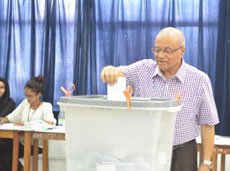
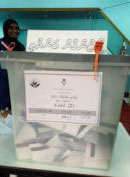
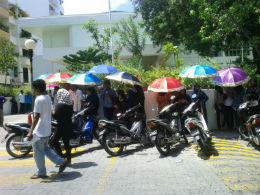
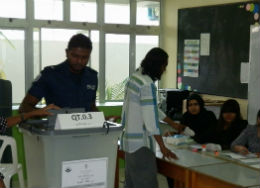
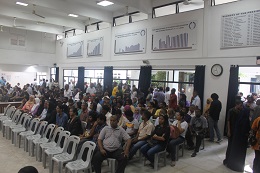
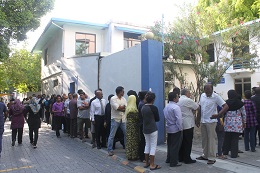
Voting took place peacefully throughout the day, with large numbers of voters lining up early due to fears concerns the polls would face disruption later in the day.

These appeared largely unfounded and polling closed at 4:00pm with only minor disruptions reported.

Elections Commissioner (EC) Fuwad Thowfeek acknowledged some difficulties in the morning with large numbers of people lining up to cast their ballots.

“We sent our officials to speed up the polling process in stations that had been identified as slow,” he said at a press conference today.

Complaints regarding voting received by the EC included some political parties continuing to campaign and photographs of some ballots taken illegally and circulated on social media.

239,593 people were eligible to vote, a 15 percent increase on the first election in 2008. Voter turnout was confirmed at 88.44 percent.

Vote counting

Vote counting proceeded smoothly at the beginning of the process, although blow-by-blow information was not always easy to obtain, with glacial official EC updates online, and otherwise very informative local media infographics in some cases reporting 102 percent voter turnout for much of the day.

The initial exit poll suggested over 200,000 people have voted, said Vice President of the Elections Commission Ahmed Fayaz, a turnout of over 83 percent.

Commissioner Fuwad Thowfeek said there were no major problems, although be acknowledged the commission had trouble closing two ballot boxes.

Police Spokesperson Chief Inspector Hassan Haneef advised Minivan News that EC officials at Majeedhiya School requested police presence at the polling station, but said officers did not remove the ballot box. “The EC removed the box in a vehicle, not police,” stated Haneef.

“What happened with the ballot box at Majeediyya School was dissent arising between some election officials and representatives from a candidate,” Thowfeek stated. “Some people questioned the check marks on ballot papers, and had disagreed over whether some marks are to be counted as valid votes.”

Transparency Maldives Communications Manager Aiman Rasheed said in 14.5 percent of ballot boxes where controversy occurred during counting, these would not have impacted the overall outcome of the first placed candidate.

“The incidents that have happened on election day will not have a material impact on the outcome of the election,” he said.

TM confidently called Nasheed’s progression to the second round, but could not call the runner up due to a margin of error larger than the difference between the vote counts of Yameen and Gasim.

According to Transparency’s statement:

  • 99.5 percent of polling stations had closed by 5:00pm
  • Only 0.2 percent of voters complained that their names were not on the voter registry, and 0.05 percent complained that they were unable to vote at polling stations
  • Voting was temporarily halted at 3.8 percent of polling stations, half of these interventions by the presiding officer. The remainder involved “an unruly voter or two, or an enthusiastic political party member”.
  • 1.4 percent had instances of violence, mostly minor, and election was otherwise largely peaceful
  • Police entered 18.8 percent of polling stations, 80 percent of the time at the invitation of the presiding officer
  • Candidates were well represented at polling stations – Gasim 73.7 percent, Waheed 29.6 percent, Yameen 74.2 percent, Nasheed 91.5 percent
  • Counting concluded without controversy at 85 percent of all polling stations, and only 0.22 percent of ballot papers were disputed by observers/candidates
  • 82.6 percent of polling stations reported assisted votes

Reactions

President Waheed’s Senior Advisor Teresa Wells said the incumbent would not be releasing an immediate statement, with a comment on his future plans ahead of a run off vote expected to be released on Sunday.

DRP Parliamentary Group Leader, Dr Abdulla Mausoom, this evening said the party would be “considering its options” ahead of the second round after the coalition’s poor polling.

The party earlier this year ruled out the possibility of forming a coalition with the PPM, however Dr Mausoom told Minivan News this evening that he did not wish to comment on whether this stance would force the DRP into an alliance with the MDP in a run-off vote on September 28.

Dr Mausoom welcomed what he said he been a “beautiful” election, praising authorities including the Elections Commission for their efforts.

“Although there were some reservations, Maldivians have held a free and fair election, with Dr Waheed also expressing his confidence for the EC. This was great to see,” he said.

MDP Youth Wing Leader Shauna Aminath said “with only five percent of the vote, it only confirms that Waheed is an un-elected coup-installed puppet.”

Other elements of the MDP appeared disappointed after failing to achieve a first round win. MDP Spokesperson and Henveiru South MP Hamid Abdul Ghafoor acknowledged during the counting that “we are not performing as expected – the race is very close.”

Senior MDP figure and former Minister for Housing and Environment, Mohamed Aslam, told Minivan News during the later stages of counting that the MDP was “preparing for a second round”.

” We didn’t get what we wanted from Male’,” he said, outside the Dharubaruge convention centre.

He anticipated that the MDP would face the PPM in the second round, saying that the party was not concerned about Gasim: “Yameen is not an idiot, Gasim is an idiot.”

He noted that the turnout was lower than expected, and anticipated even lower figures for the second round.

Progressive Party of the Maldives (PPM) MP Ahmed Nihan confirmed that senior officials from the party including presidential candidate Abdulla Yameen and his running meet Dr Mohamed Jameel Ahmed were presently meeting in Male’ to discuss second round plans.

MP Nihan said that the party would now look to meet with potential allies, and confirmed that every other candidate who stood in today’s election against Nasheed would be invited “to be on-board” in the run-off vote.

“It is quite clear we will be facing the MDP in the second round,” he said.

Nihan added that he expected for the PPM to make a statement on its support for the second round vote “sooner rather than later”, once talks were completed.

Jumhoree Party (JP) Spokesperson Moosa Ramiz said any possible decision on how the party contests the second round would be expected today.

“We are still waiting at the moment,” he said, adding that discussions need to be held between JP Leader Gasim Ibrahim and the party’s council before finalising any possible alliance.

Likes(0)Dislikes(0)

Maldives Decides 2013 – Provisional results declared

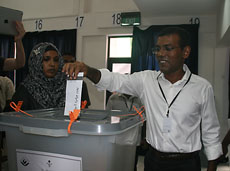
Polls opened early this morning across the Maldives to long queues of people, urged by their parties to vote early so as to avoid potential disruption later in the day.

Polling will close at 4:00pm this afternoon, and provisional results are expected to be available at 11:00pm this evening according to the Elections Commission.

The Maldives’ second democratic multi-party presidential election has 239,593 eligible to vote, a 15 percent increase on the first election in 2008.

Voting will take place at 459 ballot boxes stationed on local islands, resorts, and overseas Maldivian High Commissions and embassies in Singapore, London, Malaysia, Sri Lanka and both Trivandrum and New Delhi in India.

Former President Mohamed Nasheed, who controversially resigned from office on 7 February 2012 amid a police and military mutiny, is contesting the election against incumbent and former Vice President, Dr Mohamed Waheed Hassan Manik.

Also contesting the presidential election are Abdulla Yameen – half-brother of former autocratic President Maumoon Abdul Gayoom Gasim Ibrahim, a wealthy businessman and resort tycoon backed by the Islamist Adhaalath Party and the party of Waheed’s former Special Advisor, Dr Hassan Saeed.

To win the first round of the election a candidate requires more than 50 percent of the total turnout. If no candidate receives this many votes, then a second round run-off election between the top two candidates will be held on September 28.

Read more about the candidates, their policies and support bases at our 2013 Election Hub

For additional updates and pictures, see our Facebook page

This blog is no longer live

5:33 am – Elections Commissioner Fuwad Thowfeek has confirmed that the commission will hold a run-off election on September 28, between Nasheed and Yameen. He said the Commission’s complaints bureau was looking into those complaints that had been submitted, and would take necessary action where required.

Provisional results are confirmed:

Gasim Ibrahim – 50,422 (24.07%)

Mohamed Waheed – 10,750 (5.13%)

Abdulla Yameen – 53,099 (25.35%)

Mohamed Nasheed – 95,224 (45.45%)

4:30 am – The Elections Commission (EC) has yet to formally announce the provisional results as of 4:30am on Sunday morning, delaying its 11:00pm press conference by more than five hours. Provisional results available on the EC’s website suggest Nasheed will face a run-off election on September 28, most likely against Yameen.

However a the narrow margin separating Gasim and Yameen suggests the position of runner-up may be hotly contested. A small group of Gasim supporters have gathered outside Dharubaruge early this morning in protest over what they claim are discrepancies between votes counted and eligible voters for several boxes. It was unclear if this data was taken directly from the elections commission, or from local media outlets – some of which have reported erroneous figures throughout the day.

Elections officials were not responding.

Latest results on the EC’s website:

Gasim Ibrahim – 50,422 (24.07%)

Mohamed Waheed – 10,750 (5.13%)

Abdulla Yameen – 53,099 (25.35%)

Mohamed Nasheed – 95,224 (45.45%)

1:41 am – The Elections Commission has said it is recounting three ballot boxes and expects to hold a press conference to give provisional results at 2:00am.

1:38 am – Transparency Maldives Communications Manager Aiman Rasheed said in 14.5 percent of ballot boxes where controversy occurred during counting, these would not have impacted the overall outcome of the first placed candidate.

“The incidents that have happened on election day will not have a material impact on the outcome of the election,” he said.

1:13 am – Transparency Maldives praised its observer network, stating that 95 percent of its sample was reported within three hours of the polls closing. TM confidently called Nasheed’s progression to the second round, but could not call the runner up due to a margin of error larger than the difference between the vote counts of Yameen and Gasim.

According to Transparency’s statement:

  • 99.5 percent of polling stations had closed by 5:00pm
  • Only 0.2 percent of voters complained that their names were not on the voter registry, and 0.05% complained that they were unable to vote at polling stations
  • Voting was temporarily halted at 3.8 percent of polling stations, half of these interventions by the presiding officer. The remainder involved “an unruly voter or two, or an enthusiastic political party member”
  • 1.4% has instances of violence, but largely peaceful
  • Police entered 18.8 percent of polling stations, 80 percent of the time at the invitation of the presiding officer
  • Candidates well represented – Gasim 73.7 percent, Waheed 29.6 percent, Yameen 74.2%, Nasheed 91.5%
  • Counting concluded without controversy at 85 percent of all polling stations, and only 0.22% of ballot papers were disputed by observers/candidates
  • 82.6 percent of polling stations reported assisted votes

12:26 am – Transparency Maldives is due to give a press conference soon.

11:44 pm – The Elections Commission will announce provisional results some time between midnight and 1:00am, said EC President Thowfeek. The final results of the first round will be announced on 14 September.

11:40 pm – The EC has yet to calculate exact voter turnout, as a lack of internet connection and the inability of some officials to use the new web system had resulted in a lower than expected figure, stated EC VP Ahmed Fayaz. “We expect a minimum 82 percent voter turnout.”

11:39 pm – EC President Thowfeek said results are still coming in: “We have not yet received the complete results as of yet. Currently we have got 315 boxes. None of the candidates has so far got the required 50 percent +1 vote, but a lot of boxes still need to be verified. After that we can say whether a candidate can win from the first round,” he said.

11:37 pm – The initial exit poll suggests over 200,000 people have voted, said Vice President of the Elections Commission Ahmed Fayaz, a turnout of over 83 percent.

11:34 pm – The Elections Commission is holding a press conference. Commissioner Fuwad Thowfeek has said there have been no major problems, although has acknowledged the commission is having trouble closing two ballot boxes.

“What happened with the ballot box at Majeediyya School was dissent arising between some election officials and representatives from a candidate. Some people questioned the check marks on ballot papers, and had disagreed over whether some marks are to be counted as valid votes,” Thowfeek stated.

The second ballot box kept in Galolhu [ward of Male] “has been opened and counting is underway. We just got the confirmation,” he stated.

11:18 pm – Police Spokesperson Chief Inspector Hassan Haneef has advised Minivan News that police did not remove a ballot box from Majeedhiya School. Haneef said EC officials at Majeedhiya requested police presence at the polling station, but did not remove the ballot box. “The EC removed the box in a vehicle, not police,” stated Haneef.

11:02 pm – Jumhoree Party (JP) Spokesperson Moosa Ramiz has said that any possible decision on how the party contests the second round would be expected either late this evening or possibly tomorrow.

“We are still waiting at the moment,” he said, adding that discussions need to be held between JP Leader Gasim Ibrahim and the party’s council before finalising any possible alliance.

10:59 pm – Ballot boxes counted: Male – 93 out of 100; resorts – 38 out of 40; other areas – 7 of 9, reports state media MBCNews.

10:55 pm – The ballot box has been removed from Majeedhiya School in police vehicles. Police are now moving crowds away from the area.

10:54 pm – “We took so long because the EC wasn’t able to facilitate a meeting with the head EC official at this box,” Hassan Latheef has told media. “We have heard her side of the story.”

Latheef said the head official claimed that observers from all parties “may have moved away from their assigned places, and if this was the case, this might have been against the law.” He added that her report does not match those of observers, “and we will look into this detail.”

Latheef said that “if there are grounds for complaint we will do so with the EC at the earliest opportunity.”

10:44 pm – The Seenu Meedhoo ballot box, expected to have a large majority for MDP, has been sealed by police following observer objections to Elections Commission (EC) counting practices, Minivan News understands.

Observers and monitors raised procedural concerns with the head EC official Aishath Naseema when she allegedly miscounted votes, said one media monitor speaking on condition of anonymity. The source reports that the official refused to recount and continued to count, eventually ordering out all observers who were protesting her actions and announcing the results with police assistance.

Police have since sealed the ballot box without addressing the issues raised.

MDP lawyer and former youth minister Hassan Latheef is now meeting with Naseema at the ballot box. Approximately 150 individuals have gathered outside to observe proceedings.

10:36 pm – State television MBC News predicts a run-off election between MDP and PPM based on anticipated results from today’s polls: Nasheed 45%, Yameen 25%. Candidate Gasim Ibrahim is in a close third place with 24%.

At the time of the prediction, MBC News reported that there 26 boxes remain to be counted.

10:33 pm – Progressive Party of Maldives (PPM) MP Ahmed Nihan confirmed that senior officials from the party, including presidential candidate Abdulla Yameen and his running meet Dr Mohamed Jameel Ahmed, are presently meeting in Male’ to discuss second round plans.

PPM will look to meet with potential allies in the second round, Nihan said, adding that every other candidate who stood in today’s election against Nasheed would be invited “to be on-board” in the run-off vote.
“It is quite clear we will be facing the MDP in the second round,” he said.

Nihan expects the PPM to make a statement on its support for the second round vote “sooner rather than later”, once talks were completed with other parties.

10:30 pm – The Elections Commission reports that all boxes in Male have been reported to its offices. Senior Administration Official Fathima Zuhuzhi said that boxes will arrive from the atolls with officials tomorrow, but the numbers are being reported through official software.

The Elections Commission does not count ballots. It’s primary task is to compile information, and only those with specific permits are allowed access to the compilation room.

10:25 pm – Ballot boxes in London – the latest-open polling site world-wide – are officially closed, Television Maldives has tweeted.

10:17 pm – The Elections Commission’s Ballot Progress Reporting System is updated for the final time, recording 170,686 voters out of a possible 239,593 eligible voters–reflecting a 71.28 percent turnout.

Figures from local media, however, put the number of votes given for all four candidates at over 184,000 with more than 35 ballot boxes still to count.

10:00 pm – President Waheed’s Senior Advisor Teresa Wells said the incumbent would not be releasing a statement tonight, but that a comment on his plans ahead of a run-off vote would be released tomorrow.

9: 58 pm – Dhivehi Rayyithunge Party (DRP) Parliamentary Group Leader MP Dr Abdulla Mausoom hsa said that the party would be “considering its options” ahead of the second round after the “forward with the nation coalition” it was backing received a decidedly low percent of the popular vote.

Dr. Mausoom has told Minivan News that he does not wish to comment if the party’s stance would force its hand at lending support to the Maldivian Democratic Party (MDP) in a run-off election.

“I think the DRP as a party has very clear values and ideologies, we would look for the coalition that best represented these” he said, adding that the Elections Commission (EC) had executed a “beautiful” election.

“Although there were some reservations Maldivians have held a free and fair election, with Dr. Waheed also expressing his confidence for the EC. This was great to see,” he said.

9:56 pm – Ballot boxes are being delivered and checked in to the Elections Commission, where approximately 50 people have gathered.

9:02 pm – Former Housing Minister Mohamed Aslam has told Minivan News that the MDP are “preparing for a second round”.

“We didn’t get what we wanted from Male’,” he said outside Dharubaaruge.

Aslam anticipates that the MDP would face the PPM in the second round, saying that the party was not concerned about Gasim.

“Yameen is not an idiot, Gasim is an idiot.”

He noted that he had not seen a turnout this low, and anticipated lower figures for the second round.

8:56 pm – Initial results from Male’ ballot boxes show strong support for Nasheed in Galolhu and Henveiru wards.

8:52 pm – Preliminary ballot counting is now finishing at polling stations across Male’, with police remaining on duty at all stations. Residents remain indoors and clustered around radios to get the latest results.

8:28 pm – Male’ streets remain quiet while residents watch television indoors, anticipating the results of the final 100 ballot boxes.

8:04 pm – Ten police crowded into a Ahmadiyya School in Galolhu after a dispute between polling officials and an election observer over inaccurately marked ballots. The agitated observer had left by the time the police arrive, themselves leaving shortly after.

“Somebody called us, but I don’t know why – I don’t know why it’s necessary to come,” one officer said,

7:58 pm – Henveiru South MP Hamid Abdul Ghafoor told Minivan News that he was surprised by the way voting has been going in his Henveiru-south.

“We are not performing as expected – the race is very close,” he said, before comparing the Maldivian Democratic Party’s voting pattern to pro-Gayoom voting in this stage of the 2008 election.

6:45 pm – Nasheed is also proving popular among resort workers with strong majorities in most resort ballot boxes.

In Bandos Island Resort, owned by Vice President Mohamed Waheed Deen, provisional results show Nasheed leading with 136 votes, Yameen in second place with 81 votes, Gasim third with 39 votes and President Waheed in fourth place with 8 votes.

In Irufushi Resort, owned by MP Ahmed ‘Sun Travel Shiyam, whose Maldivian Development Alliance party is in coalition with the PPM, Nasheed has 59 votes to Yameen’s 38 votes and Gasim at third place with 6 votes and Waheed at fourth with 1 vote.

In Kuredhu Island Resort owned by the government-aligned Champa family, Nasheed leads with 50 votes, Yameen in second place with 33 votes, Gasim third with 14 votes and Waheed fourth with 1 vote.

6:30 pm – Provisional results show former President Nasheed leading in overseas ballot boxes, suggesting strong support among the diaspora and students. Nasheed has 504 votes in Malaysia with Yameen in second place with 190, Gasim at 154, Waheed at 84 and 9 invalid votes. In Singapore, Nasheed secured the most votes with 67, and Yameen at second place with 28 votes, Gasim third with 19 votes and Waheed fourth with 14 votes.

5:42 pm – State broadcaster Television Maldives (TVM) is tweeting live results at #MvElection13. So far:

Gasim 1608 (27%)
Waheed 203 (3%)
Yameen 1489 (25%)
Nasheed 2601 (44%)
Void 54 (1%)

5:33 pm – Latest from the EC’s site. Of 1574 votes counted (including 8 void), so far:

Gasim 19.35%
Waheed 16.28%
Yaeen 20.05%
Nasheed 44.32%

5:31 pm – The streets of Male are remarkably silent as people are glued to television sets watching the counting. Of the online sources of counting data the Elections Commission’s count site is the slowest to update, but the most official source of information. Haveeru News has a live infographic that is somewhat quicker.

5:09 pm – Counting is underway.

4:55 pm – Former President Maumoon Abdul Gayoom voted this morning at the CHSE.

4:52 pm – Voting on Inguraidhoo in Raa Atoll has been “calm” throughout the day, an island council source told Minivan News. Although the polls closed at 4:00pm, there is still a queue of people waiting to cast their vote. However, of 985 registered voters, 114 were “no shows”.

On Thulhaadhoo in Baa Atoll has also been “very calm”, according to an island source.

“Everything has gone pretty fine here, there have been no [negative] events,” a Kaafu Atoll, Himmafushi Island source told Minivan News.

4:35 pm – If it scores a win, the MDP in Addu Atoll will celebrate even at the risk of disturbances from opposing parties, reports Shahid.

“This is one and a half years of waiting, waiting, waiting and hard work,” he said, comparing the excitement around this election to the country’s first democratic election in 2008. “The people have got the taste of freedom, and of being proud to be a human being. They lost it, and now they want to regain it. That wasn’t there in 2008.”

4:25 pm – The majority of voters in Addu City have cast their ballot prior to the poll closing time of 4:00pm, and “in most cases it is almost done,” said former Immigration Controller Abdulla Shahid, stationed in the southern-most atoll.

The community is now gathering near the polls for the ballot counting to see that the process is smoothly executed. As people – primarily party leaders and young men – gather near Addu polling stations for the ballot count, Shahid observed that they are “pretty cooked up – they are excited and anxious to see how things go.”

He added that police are noticeably present across the atoll, and have erected blockades on the causeway linking Gan and Feydhoo “to keep an eye out.” The military presence is minimal present, but soldiers have been spotted driving around to survey activities.

4:22 pm – Social media is on fire this elections. Passionate voters are posting pictures of inked fingers and long queues with messages of support for their candidates. While many are proud of voting, and not holding back in showing their excitement over social media,a considerable number of people are tweeting their resentment towards the political polarisation of the country and their justifications for boycotting the vote. Follow the elections buzz online #mvelection.

4:17 pm – Elections Commission (EC) President Fuwad Thowfeek has said that there are no regulations prohibiting parties conducting exit polls outside polling areas.

Volunteers for the MDP have been carrying out such polls across the country today, leading to concerns from rival parties that they were campaigning in defiance of voting regulations.

4:15 pm – MDP MP and Spokesperson Hamid Abdul Ghafoor has said the opposition was “comfortable” with the day’s voting.

“I voted first thing this morning and I must say the whole thing looked quite organised. I’m quite happy with how it has gone, there has been an amazing turnout,” he said.

Earlier today, a group of JP supporters outside Majeediyaa School raised concerns to Minivan News about a number of people wearing yellow t-shirts outside polling stations carrying clipboards, questioning whether such “campaigning” is allowed on voting day.

Ghafoor confirmed that the party had employed a ‘voter protection program’ that utilised volunteers as observers, while other people were conducting exit polls outside polling stations around the country to help draw up data on the day’s voting.

He rejected claims the party’s ‘voter protection program’ was campaigning for the MDP.

“They are not in branded [MDP] t-shirts, they may be wearing yellow, but we have been working on getting people out to vote. We also have a minimum of two people per vote box outside polling areas [conducting exit polls],” he said, adding that data was then being uploaded to a central system online. “The problem is the opposition do not have a thorough understanding of democracy. I do not wish to be disrespectful, but this is standard election practice.”

4:00 pm – The deadline for polls to close has passed. Voting on many islands has already finished, however queues remain at many polling stations in Male’.

3:59 pm – A group of 10-15 people waiting a few feet away from a polling station in Male’ told Minivan News they were waiting for a party to show up and pay them to vote. “If a party wants us to vote for their candidate, they will come and pay. Otherwise, we are not voting.” said one of the group members.

3:56 pm – According to Haveeru, a young man who went to vote at a ballot box for the mid-Hithadhoo constituency in Male’ and allegedly photographed his ballot paper with his mobile phone has been taken into police custody.

The local daily is also reporting that 1,915 out of 2,099 voters registered to vote in Sri Lanka has cast their ballots. Most voters in Fuvahmulah have meanwhile cast their ballots and there are queues only at a few ballot boxes.

3:48 pm – The Election Commission has confirmed that its online ballot counter does not account for many boxes on resorts or local islands with poor internet access. 70 percent turnout has already been recorded, say officials.

3:46 pm – A person who attempted to vote twice in a ballot box at the Kangaroo Kids School in Addu City was taken away from the area by police upon request of the head EC official, according to police media.

3:45 pm – 33 year-old Faithimath Irene told Minivan News near Male’ City Hall that she had “nearly missed my chance to vote, but am delighted I got here before 4:00pm. I hope this election paves our way out of this damned good democracy.”

3:44 pm – “Voting is going fine. It’s actually calm, we haven’t seen any issues and the situation is the same in the other wards,” an island council official from Fuvahmulah’s Dhiguvaadu ward told Minivan News.

However he said there have been some issues regarding the placement of campaign banners near to the Dhiguvaadu ward polling station. Allegedly PPM members posted five campaign banners just outside the polling station – within the 100 foot boundary – at midnight last night, after the 6pm campaigning deadline, alleged the island council official. The MDP has issued complaints with the Elections Commission (EC) district complaints bureau over the matter.

Meanwhile, EC officials who arrived on the island this morning took issue with an MDP campaign banner that the island council official claims was put up outside the 100 foot boundary on Thursday September 5.

3:35 pm – “Technical issues” with the EC website are being resolved, the EC said at the press briefing.

3:34 pm – With less than 30 minutes to go before polls close at 4:00pm, queues are still strong at Male’s polling stations.

3:23 pm – Some 136,236 people have cast their ballots so far, the Elections Commission (EC) has revealed at an ongoing press briefing.

EC Chair Fuwad Thowfeek said there have been no serious issues with voting apart from delays caused by long queues at some polling stations. He added that arrangements have been made for inmates to vote.

Fuwad also said that the EC was aware that some campaign activities, such as phone calls, are still going on and that measures would be taken against those responsible.

The Deputy Chair of the EC revealed that turnout has reached 70 percent including those currently queued at polling stations.

3:16 pm – “I don’t think there have been any disturbances on Kulhudhuffushi [in Haa Dhaal Atoll], we haven’t received any complaints [of that nature],” said Rishan Nasheed, an Elections Commission Complaints Bureau official from the told Minivan News.

However there have been many complaints regarding voters names not included on the registry lists. “When we’ve re-checked, these voters are actually on lists for other polling stations on Kulhudhuffushi,” said Rishan. “This year voting boxes were placed in different locations and many people did not check to verify their polling station location.” She explained that this issue has not prevented anyone from voting.

3:13 pm – “The opening of the polls was smooth, and the administrative preparation and execution went well,” Transparency Maldives announced at its 1:00 pm press conference.

“99.5 percent of all polling stations [were] open by 8:30 am and 83 percent of polling stations [were] open within the first 10 minutes of the required opening time.”

Transparency Maldives has deployed over 400 observers over 20 atolls. It is one of four observer groups observing today’s presidential election.

Among indicators gathered, Transparency reported that queue controllers were absent from 4.1 percent of polling stations, and station controllers were absent from 7.2 percent of observed stations. 98.2 percent of polling stations met standards to ensure voter privacy.

Two or more candidate/party observers were present at 82.4 percent of all observed stations; one observer was present at 13.6 percent of polling stations. 4.1 percent of stations had not candidate/party observer. Police were present at 95 percent of the observed polling stations.

3:09 pm – Reports coming in from the islands:

On Thinadhoo in the country’s south, one of the islands flagged as a potential hotspot should voting go awry, a resident said “Everything is going very smoothly and voting is about 45 percent complete.”

“It is very peaceful [on the island] and voting is almost completed, we’re at about 90 percent,” Mox Fahumee, MDP Campaign Manager from Kanditheemu Island in Shaviyani Atoll.

“The voting process is going very quickly [this election] because people actually want to vote this time,” he said.

Voting has nearly been completed on most islands in the Kanditheemu constituency – Bilefahi, Noomera, Goidhoo, and Feydhoo – and the process has been peaceful on those islands as well.

Elderly voters have had some issues voting on Gan in Laamu Atoll, as many want help casting their ballot, however Elections Commission officials are not allowing any outside party to provide assistance
unless the voters are “blind or armless”, an Island Council official told Minivan News.

3:04 pm – Speaking to Minivan News while waiting to vote at Iskandhar School in Male’ this morning, an 18 year-old male voter employed in the Maldives Police Service (MPS) in a non-uniformed role said he anticipated voting would continue peacefully.

However, the first time voter did not rule out potential clashes between rivals once results were known: “Whichever party wins, it will be the other ones who will be causing trouble. This is politics after all,” he said.

3:02 pm – Mohamed Didi, a 54 year-old man from Addu Atoll who has lived in Male’ the last 20 years, said he did not anticipate violence on the strength of the large number of people peacefully casting their ballots across the capital.

“I do not think there will be violence, there are so many people out voting,” he said, while overlooking the line of voters outside Majeediyaa School, where he said a large number of re-registered voters originally from Addu Atoll would be casting their ballot.

2:39 pm – “Despite this unbearable heat I’ve been in this queue for at least three hours,” said 28 year-old Muhammed. “I will cast my vote and contribute to washing out baaghees.”

2:36 pm – 68 year old Mohamed Waheed told Minivan News in front of the Kalafaanu school polling station: “It is a good thing that we are having elections as due, despite the events of last year. But the EC should have better organised things, kept more counters at booths where more people vote. I share MDP’s ideology and have voted accordingly. However I am now giving away umbrella for shade for all citizens queued here to vote since the early hours.”

2:28 pm – A voter from the Machangoalhi North constituency who voted in CHSE told Minivan News that her aunt, who had voted before her, had her name on the EC list with a red dot next to it instead of being crossed out. Asked why, the EC official said a person with a face veil had attempted to vote under the name. According to the voter, her aunt does not wear the burqa. She said the EC official claimed not to recall the first voter, apart from stating that she wore the burqa, and said she and her aunt planned to lodge a complaint with the EC.

2:10 pm – Police have arrested four people in Gaaf Dhaal Thinadhoo on suspicion of selling stolen ID cards, according to police media. The case is under investigation by the Thinadhoo Police Station.

1:48 pm – Ashraf Ibrahim, 30, from Gaaf Dhaal Madaveli: “As I see it this vote will end in the first round. The democratic party will have a sweeping win.”

Mohamed, 28, says, “Despite this unbearable heat, I’ve been in this queue for at least three hours. I will cast my vote and contribute to washing out the baaghees (traitors).”

1:43 pm – Jumhoree Party Deputy Leader Dr Ibrahim Didi has told Minivan News that presidential candidate MP Gasim Ibrahim had cast his ballot around 7:45 am this morning at the Maafannu Madharusaa in Male’.

Dr Didi added that the party had been encouraged by what it believed had been a “high turnout” among the public – perhaps higher than in 2008’s election.

“We believe that some 80 to 90 percent of registered votes already cast on islands here,” he said. “In general, I think we have seen and fair election. The only thing [the party] has noticed is a few names are not appearing on the voter’s list.”

Dr Didi said the party was not presently certain if the difficulties had arisen due to an error on the voter’s part by re-registering to vote on a specific island, or whether it was an error by the Election’s Commission (EC).

Despite some concerns previously raised over the requirements of the re-registration process by political parties ahead of polling, the EC last month confirmed that more than 50,000 voters had successfully re-registered to cast their ballots today.

1:35 pm – Maldivian Absolute Security Advanced Pvt Ltd security firm officials dressed in black ties, dress shirts, and trousers have been seen by Minivan News outside polling places and driving around Male’ on motorcycles. One of the security guards told Minivan News they were hired by the government to provide general election security.

The situation at most polling places in Male’ is the same – very long lines and primarily Maldivian observers from various institutions assessing the situation. Minivan News has observed police stationed outside polling places in groups ranging from two to four officers, however none were observed within 100 feet of ballot boxes – unless they were casting their votes.

Some MDP volunteers at Jamaludeen School are concerned because only one Elections Commission team was present and as a result individuals are waiting for at least 45 minutes before casting their ballots. A polling station official at Thaajuddeen School told Minivan News that the queue to vote has been “nonstop since polls opened” at 7:30am.

“This is the most people I’ve ever seen [come to vote].” He noted that despite the large crowds there have been no disturbances and there are “no issues yet” with police, “they’ve been coordinating well.”

1:32 pm – “The police Quick Rescue Team has resolved a dispute between two families in Faafu Feeali and returned an ID card to its owner,” according to police media.

1:05 pm – MDP running mate Dr Mustafa Lutfi declared: “I have cast my vote. I’m happy with how the EC has organised matters regarding this election. My hope is that things proceed peacefully like this and are concluded in a fair and transparent manner.”

12:59 pm – Almost half of all eligible voters have either cast their vote or are queued to do so, according to Elections Commission statistics.

12:52 pm – An Australian surf instructor living on the island of Thulusdhoo, Tim Southall, told Minivan News polling day had so far been among the most peaceful 24 hours on the island this year.

Amber Coontz, a US teacher and surfing enthusiast also living and working on the island, said she had been given a similar impression. “No problems, drama or cursed coconuts to speak of,” she said, referring to recent international media coverage of the election build up.

12:48 pm – “Problems that occurred in the voting queue” that caused a disruption to voting in Gaaf Dhaal Nadella has been resolved and voting has resumed peacefully, according to police media.

12:43 pm – Hussan Shahid, a 33 year-old guest house operator on the island of Thulusdhoo in North Male’ Atoll has said that as opposed to the country’s first multi-party democratic vote in 2008, polling was being held peacefully this afternoon.

Shahid said that the island, which he described as being a very close community with an estimated population of 1,500 people, had been holding peaceful campaigning in the build up to today’s vote – claiming rival parties had even assisted each other in recent months.

“The island is very quiet and I think everyone is waiting for the result. We are a very close population, but there seem to be a lot of resort [workers] voting here too,” he said. “I hope nothing goes bad here, we are a quiet island. There are only two parties here – the yellow party (MDP) and the blue party (President Dr Mohamed Waheed’s) ‘forward with the nation coalition’.”

Shahid claimed that the island was believed to be largely in support of President Waheed.

12:41 pm – Voting has resumed in Gaaf Alif Maamendhoo following a minor disruption caused by a voter attempting to get to the top of the queue half an hour ago, according to police media.

12:37 pm – 24 year-old Mohamed Azmeel voted at Jamaluddeen School: “After two years of authoritarian rule this is the first time we get to have our say.”

12:34 pm – Presidential Candidate Abdulla Yameen called today’s election a “watershed” after voting near the National University in Male, the Times of India reports.

“Things have gone so wrong the last four-five years. It is absolutely imperative that we change for the better this time,” he said.

12:20 pm – Elections Commission (EC) President Fuwad Thowfeek has told Minivan News that all polling is going to plan at present.

“As of now a total of 96, 318 have voted,” he said.

12:15 pm – The Human Rights Commission of Maldives has said in a press statement that 57 officials are observing voting at 25 ballot boxes in Male’ and the atolls.

11:50 am – The Maldives Police Service (MPS) has said on its website that voting has been “generally peaceful” in atolls across the country with no conflicts identified so far by division commanders.

Police have confirmed that voting was however delayed on the island on the island of Dhiggaru in Meemu Atoll and did not commence until 9:12am over allegations of individuals trying to break the queue.

Police Spokesperson Chief Inspector Hassan Haneef asked for any specific inquiries to be forwarded to the Elections Commission (EC).

11:53 am – Shaarih, 33, in line near the customs area: “Impossible to sum up so shortly this mix of sentiments I have. To put it best, what’s in my mind is: ‘Let’s do this! Let’s win back our country.'”

11:50 am – 19 year old Rauha Ahmed said: “I hate politics. I hate standing in queues. I’m only here because my mom was throwing a fit.”

11:43 am – Abdul Raheem, 67, is waiting in line: “I am voting who I have always voted for. We need to elect a man with experience in running the country. Youngsters took over for the past few years and look at how our social fabric has been torn to bits. If children as young as 18 are not allowed to vote, as they don’t have mature thinking yet, we’d have a better chance of maintaining a peaceful regime.”

11:38 am – Aisthath Sharafnaz, 35, is also in the queue outside the Customs Building: “I’m standing here a little worried, but hoping I’ll get to vote. It’s been over a year since we last had an elected government.”

11:35 am – 57 year old Abdulla Ali, waiting in line outside the Customs Building, said “I am very happy today as citizens are getting to exercise their right to elect a leader of their choice. I’ll accept the outcome regardless of who wins.”

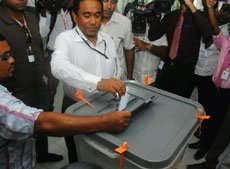
11:33 am – Former President and Maldivian Democratic Party (MDP) candidate Mohamed Nasheed has voted in Male.

11:23 am –49 year old Gasim supporter, Fathimath Zoona, said she is “feeling very anxious. I am heading to vote now, in the hope of being able to live in a peaceful society again after recent years.”

11:20 am – Sun Online has reported an incident between two families in between two families in Faafu Feeali after a man allegedly hid his wife’s national ID card.

11:16 am – Consular officials in Thiruvananthapuram, India, have expressed surprise at the high number of Maldivians who have registered to vote there, reports Rejith Balakrishnan for the Times of India.

“Consulate authorities said that citizens have started giving importance to politics since the peculiar political scenario is directly affecting their lives here. Most Maldivians come to Kerala for educational and medical purposes,”

Ibrahim Azeem, an attache at the consulate, told the Times that many people that voters had become less apathetic, becoming more keen to exercise their rights.

10:51 am – Observing voters outside Majeediyaa School in Male’ this morning, Jumhoree Party (JP) supporter Adam Naseer said he had not seen or heard any trouble in the capital today.

Naseer added that he did not expect a first round victory for any candidate n today’s polls, expressing hope JP candidate Gasim Ibrahim would then secure a second round victory in a run off election.

“We see this as a semi-final,” he explained.

A group of his fellow party supporters also raise concerns to Minivan News about a number of people wearing yellow t-shirts – the colour of the opposition Maldivian Democratic Party (MDP) – outside polling stations carrying clipboards, questioning whether such “campaigning” is allowed on voting day.

10:30 am – The Elections Commission (EC) has said that voter turnout exceeds expectations, and projects that 80 percent of eligible voters will cast their ballots before the close of polls at 4:00 pm, reports Haveeru.

10:47 am – Progressive Party of Maldives vice presidential candidate Dr Mohamed Jameel Ahmed tolds Minivan News he was the first person to cast his vote at Arabiyya School in Male’ at 7:30am this morning

“I am very upbeat and hopeful that our ticket will go ahead and win this election.  The nation deserves a fresh pair to lead it for the next five years and fulfill the aspiration of our people” he said.  “I am sure that this nation will survive the challenges it faces both economic and social to take the country to the glory of development and economic success.”

10:46 am – Former Immigration Controller Abdullah Shahid voted at 7:30am this morning in Addu Atoll, where he reports that polls are functioning smoothly; “Almost 45 percent of voters have voted in some areas [of Addu]”, he said. “We are hearing that approximately 70 percent of Feydhoo constituency on Male has voted.”

After voting, men and youth are reportedly gathering in party camps and cafes in Addu.

10:45 am – “I don’t think any of these candidates are suitable, however I cast a valid vote for one of them. Let’s see if this brings any change for the better,” said 22 year-old Rooya Hussain, after voting at the Centre for Higher Secondary Education (CHSE).

10:41 am – Three hours after polling opened, and more than 27 percent of eligible voters have cast their votes.

10:40 am – PPM Presidential Candidate Abdulla Yameen has voted in Male.

10:25 am – Progressive Party of Maldives (PPM) MP Ahmed Nihan has spoke of a “harmonious” atmosphere between rival in his constituency of Villimale’, where six ballot boxes have been stationed today.

“We held a coffee session with members of the MDP and JP, I can say there is much more harmony that in 2008,” he added.

However, Nihan said he had raised a complaint with monitors over allegations that voters queing to cast their ballot have continuing to receive recorded messages urging them to vote for Jumhoree Party (JP) candfidate MP Gasim Ibrahim – despite a deadline for campaigning having passed.

10:18 am – MDP supporters on Guraidhoo Island in Kaafu Atoll reportedly began lining up to vote at 2:00pm yesterday, after rumours began circulating of a buried fanditha (black magic) coconut buried at the front of the queue.

It is thought the candiate chosen by the first person standing over the coconut and then voting would have their chosen candidate picked by all remaining voters.

“We don’t believe in these things, but some MDP supporters waited just in case,” said a 25 year old Guraidhoo resident. “We will never let PPM [use black magic].”

10:18 am – Queues of up to one hour reported at polling booths as one fifth of the electorate have cast their ballot.

10:10 am – Rasal Taxis, a cab firm based in the ‘raalhugandu’ area of Male’ said all its drivers were working for the company today, and not any particular party.

One driver told Minivan News that the MDP had hired him for the entire day for MVR5000 (US$324) – saying he was paid MVR2000 (US$129) for the same service in 2008 during the last election.

9:55 am – Taking respite between polling stations at the Republic Monument in Male’, 33 year-old taxi driver Asif tells Minivan News that the election has meant good business for the capital’s cabbies.

“Today, parties are booking taxis to get their voters to the poll. They are making lots of money,” he said.

Asif, who started his shift at 7:15am – shortly before polling commenced – said he had not personally taken any money from a party today. He added that he would be driving up until 4:30pm once the days polling has finished.

Asif added that after a seemingly peaceful start to voting in the capital, he hoped the calm would continue into the night: “I don’t like to think there might be violence afterwards,” he adds.

9:45 am – “It’s my first time voting and I’m excited about it,” said a 20 year-old voter, waiting in line. “I think it’s a important I do my part for my country.”

9:40 am – Over 18 percent of registered voters have already cast their votes according to the Election Commission’s Ballot Progress Reporting System.

9:35 am – “I’ve been waiting for 19 f***ing months for this day, so I got here as early as I could. It’s my way of standing up to the coup,” said 39 year-old Ismail Shiyaz, ahead of casting his vote at a polling station in Male.

8:45 am – Two men in their mid-40s were proud of their right to vote in this election.

“[This election] is very important for our future,” said one man after voting at Ameeniya School. He observed that “2008 was a bit hectic, but this year is really calm.”

Another man who was waiting to vote said, “I need to follow my duties. I have to vote…this is important for the future of our country.” While he was wary of disruptions, he said that, “we think about the vote peacefully.”

8:30 am – President Waheed, Gasim and Defence Minister Nazim have voted. Nasheed is confirmed to be voting at 11:00am.

8:25 am – “I am excited about this election because it is quite challenging, and what we are expecting is support for MDP (Maldivian Democratic Party). We’re excited to see who is going to win,” said one 54-year-old male voter. He expects proceedings to be peaceful.

8:25 am – A 33-year-old woman who voted in the 2008 election said she hopes for a strong turnout at the polls. “I think more people will come out for this election because people were new to the concept of democracy [in 2008]. People are more aware this time,” she said, adding that she had her “fingers crossed” for a peaceful election.

8:20 am – The line to vote outside of Centre for Higher Secondary Education in Male’ stretched two blocks by 8:00 am this morning. Two 21-year-old first-time voters said they were “totally excited” to be voting in this election. Although they were not sure what to expect inside the voting area, they were “confident” that the proceedings would go as planned.

7:50 am – Queues of people snaked through Kalaafaanu School in Male as hundreds of people lined up to vote. Dozens of police were present – many voting themselves – and crowds were quiet and peaceful

7:30 am – Polls opened in Male’ to quiet streets, but long queues of voters.

Likes(0)Dislikes(0)

Campaigns conclude as Maldives prepares for watershed polls

The Maldives’ second-ever multi-party democratic presidential election will take place tomorrow (September 7).  With the campaigning deadline set at 6:00pm today, party supporters in the tens of thousands were out in full force to make every last second count.

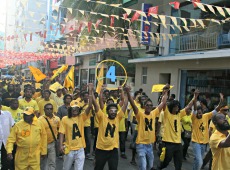
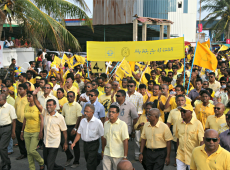
Events were held throughout the country for the Maldivian Democratic Party (MDP)’s final campaign push to re-elect former President Mohamed Nasheed- although none surpassed the scale and energy of the final march through the nation’s capital island Male’.

The carnival atmosphere was charged with nervous energy as MDP supporters bedecked in yellow, sporting a variety of Nasheed-themed t-shirts gathered near the tsunami monument before beginning their final campaign parade.

Despite rumours running rampant that hired thugs, police, and military would clash with MDP supporters, creating unrest as an excuse to declare a state of emergency and thwart the scheduled election, the MDP’s march was peaceful.

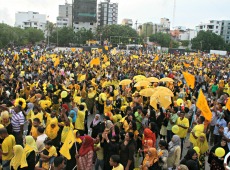
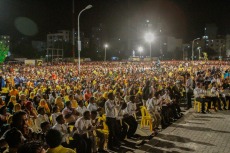
Jovial supporters in their thousands danced, cheered, and even ran their way along Male’s thoroughfares. Participants of the march surpassed MDP’s eighth anniversary parade, with people packed the entire length and width of Majeedhee Magu, Male’s nearly two kilometre-long thoroughfare.

Voices from the parade

The streets were also lined with supporters and spectators, while people could be seen hanging from their balconies, almost all with smart phones and cameras to capture the spectacle.

“I’m very excited to vote tomorrow – Nasheed is going to win” said 18 year-old first-time voter Ishan.

It seemed like every MDP supporter Minivan News spoke to was confident of Nasheed winning the first round, and holding up the number four, symbolic of Nasheed’s placement on the voter ballot.

“Tomorrow will surely be a victory,” said 23 year-old Edam. “Ehburun (one round) for sure,” added 24 year-old Ahu.

“For 30 years we suffered under Maumoon, but ‘Raees’ (President) Nasheed did so many things for us – he brought development, social security, and freedom,” she continued.

“Anni only had three years [in office] because of the coup – he deserves at least two more,” added her 30 year-old female friend.

Lorries interspersed between the MDP supporters carried live bands performing political rock songs, while others blasted techno music that remixed dance beats with phrases from former Nasheed’s speeches.

The lyrics are well known with even small children singing along, dancing on the sidewalks, and marching with their parents in the parade.

As with previous MDP protest marches and campaign walks, a variety of demographics were represented – participants and spectators alike – including children, youth, the elderly, disabled, women and men, organised into groups, some carrying giant MDP flags, while others waved yellow ribbons, fans or pom poms.

Even opposition party supporters were seen peeking out from campaign ‘haruge’ (headquarters), while some traffic and special operations police gathered on the balcony and at the entrance of their station to watch the passing parade.

The march ended on a high note after circling around the capital to end back at the Tsunami Monument with Nasheed addressing thousands of his enthusiastic supporters.

Tomorrow’s vote will provide MDP’s supporters a chance for catharsis, coming almost 20 months after the former president controversially resigned from power on February 7, 2012.

“Voting tomorrow is important because we want change. We want peace and all this turmoil to end,” said a 32-year old woman. “Once Nasheed is elected everything will get back to normal.”

Jumhoree Party campaigning

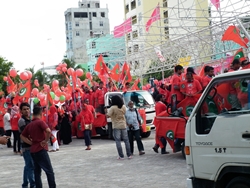
The Jumhoree Party (JP) concluded its own election campaign with a march commencing at the artificial beach area of Male’ shortly before 5:00pm this evening.

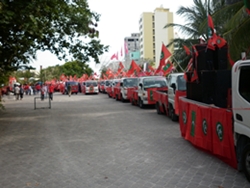
Hundreds of supporters draped in red – the party’s colour – rode atop some three dozen trucks as the rally set off around the capital to support JP candidate MP Gasim Ibrahim.

Hundreds of JP supporters prepare to embark on final rally before polling

In one truck, populated almost exclusively by cheering young women – some wearing headscarves, others not – the group exclaimed their reason for participating.

“Of all four candidates Gasim is the best,” explained one young sitting in the back of the truck to loud cheers from her fellow passengers. “He’s the best,” they reiterated in unison.

Further down the JP’s campaign convoy, in a somewhat more somber truck carrying a group of middle aged men, Minivan News asked why they chose to support the JP’s candidate, an MP and resort and media tycoon.

Looking at first perplexed by such a question, one middle-aged gentleman responded matter of factually: “There is no one else.”

Show of strength

JP Policy Secretary Mohamed Ajmal today told Minivan News today that the party’s march was designed as a show of strength by supporters before all campaigning is legally mandated to finish at 6:00pm.

With campaigning finished, he said the party was presently sending some 480 observers to islands across the country alongside the international observers from organisations such as the Commonwealth.

A convoy of trucks set to carry JP supporters

“Situations of violence”

Ajmal said that although JP was confident of peaceful polls tomorrow, he claimed the party was concerned there might be “situations” of possible violence should the opposition MDP lose.

“We do not want problems, our leader the honourable Gasim Ibrahim has supported equal opportunities for [former President] Nasheed to participate in this election,” he said. “We believe that violence could be triggered across the country though.”

Ajmal claimed that with MDP representatives and supporters currently facing alleged corruption cases totaling MVR4.7 billion (US$307 million) filed by the auditor general, the stakes would be high for tomorrow’s election.

The MDP has continued to maintain that state prosecutors have singled out opposition party members since the last year’s change in government, this week accusing Prosecutor General (PG) Ahmed Muizz of sacrificing his impartiality in return for job security.

The current government came to power on February 7, 2012, after former President Nasheed controversially resigned from office following a mutiny by sections of the police and military in a series of events the MDP has alleged was a “coup d’etat.”

Considering the nature of the power transfer, Ajmal said that the JP, which the governing coalition after the power transfer , would have “no problems” in the MDP potentially returning to power, despite the party “hating [Nasheed’s] attitude of responding to the people”.

“We know not enough people will support Nasheed this time. His party supporters alone are not significant enough to win,” added Ajmal.

Opting not to hold a rally ahead of tomorrow’s polling, incumbent President Dr Mohamed Waheed instead visited a ‘jagaha’ (meeting hall) established by his ‘forward with the nation’ coalition to campaign by phone from 5:15pm after conducting a number of tours of the country in recent months.

The Progressive Party of the Maldives (PPM) concluded its campaign with an event on the nearby island of Vilimale, attended by running mate Dr Mohamed Jameel and over 600 people, according to PPM MP Ahmed Nihan.

The event was also intended to officially inaugurate a PPM office on the island.

Polling opens tomorrow at 7:30am and closes at 4:00pm. 239,593 people are registered to vote in the 2013 presidential election, according to the final register. This is a 15 percent increase (31,000 people) on 2008’s 209,294 eligible voters.

Of these, 65,745 voters have registered to vote at a location other than their home island. Voting will occur at 459 ballot boxes stationed on local islands, resorts, and overseas Maldivian High Commissions.

Registration can be easily checked using the EC’s 1414 SMS system: text 1414 in the format ‘VIS [National ID #]’

Likes(0)Dislikes(0)

Q&A: President Dr Mohamed Waheed

President Dr Mohamed Waheed assumed the presidency after the controversial resignation of his predecessor, Mohamed Nasheed, on February 7, 2012. He will tomorrow face his former running-mate in the country’s second ever multi-party presidential election.

Appearing relaxed in the tranquil surroundings of Muleeage, Waheed took time before Friday prayers to talk about the country, his time in office, and Saturday’s poll.

Daniel Bosley: How are you feeling going into tomorrow’s election?

President Dr Mohamed Waheed: Actually, I’m quite happy and I feel peaceful because two years ago it was a little bit hard to imagine how we could come to this point where we have a peaceful election. I’m confident that this will be one of the best elections in our country’s history. This is the second democratic election and the Election Commission is trying its best to hold a free and fair election, because it’s not only the responsibility of the Elections Commission to do this. A free and fair election is possible only when all the political actors make an effort to make it a free and fair election – and not try to make it more difficult than it already is. But I’m generally confident that we will have a transparent, free, and fair election tomorrow.

DB: You are well known for having a liberal background – Stanford educated, experience at the United Nations, liberal views under former President Nasheed openly expressed – and yet soon after coming to power, you told your supporters “you are all my mujahideen”. What was your motivation for that kind of rhetoric?

MW: Okay, that wasn’t right because we used the word ‘jihad’, I never used the word ‘mujahideen’ to begin with. The word ‘jihad’ is used in Maldives for various contexts – everybody uses it – even my finance minister is called Jihad. Really, it’s a term in our language that is interchangeably used for suffering, for sacrifice, for struggle. All these three meanings come, so if you want to say ‘our struggle’ you will say ‘our jihad’. So it was used in that context, but of course because it connotes very sensitive meanings in the international media, some people picked it up and used it against us.

DB: What are your general thoughts on politicisation of Islam in the Maldives?

MW: Maldives is a 100 percent Muslim country – a Sunni Muslim country. It’s generally more liberal than many other Islamic countries. Religion and politics have never been separate in this country. It has always been part and parcel of the political process. Religious scholars have always played an important role in government in this country. So, in that sense, it is hard for us immediately to achieve a secular state. We have to have the imagination and the creativity to come up with a political system that can also count in the values of our society. So the challenge that we face today is to walk together – to blend together – the traditional Maldivian and Islamic values along with liberal values which have their roots predominantly in the West. So, trying to do this is not easy and it’s not going to happen overnight.

It will come through the education system. Young people will grow up to become the majority of our society, [and] will have to embrace the new values. This is why I always say that liberal education is so important, but only if we have enough of it. Our universities don’t teach courses in world history, in philosophy – and I’ve been arguing that this is so important. Ultimately, the democracy that we want to achieve is one in which people can speak freely on all matters, including religious matters, and to be able to discuss issues freely. Because Islam also has given a very strong moral basis, an ethical basis – the way you treat your elders, the way you treat your children, how you behave yourself in society, the use of cleanliness – a lot of these thing are already there and they are part of the social fabric of Maldives. That is why it is so important to maintain the fabric that we have while we bring in the new values. For people like us who have spent most of our time in Western universities, sometimes we don’t understand the importance of the traditional values system. But that’s what makes Maldives a unique place, that’s what makes Maldivians what they are, and that’s really a challenge. We are trying to move forward with democracy and because it’s the early years of democracy, it’s difficult.

DB: Have you found it difficult to lead without being part of a mainstream party? Do you think that it’s hard for a president in the Maldives at this time to negotiate consensus with other parties?

MW: Very good question. This is why I have chosen a running mate who is from the second largest political party and that party also has members of parliament. My sense of this election is like the 2008 election – it will probably be a coalition that will win this election. So there are other political parties who will probably join and we will have a workable majority in the parliament. It has been difficult not just for me, it has been difficult for my predecessor President Nasheed, it was also difficult for President Gayoom because, in our democratic march forward, there is this tension within the executive and the legislature, and that tension has been there – I don’t think it is going to disappear immediately but we need to work out a working relationship between the executive and the legislative branches of the government.

DB: Soon after you came to power your former political advisor, Dr Hassan Saeed, described you as ‘politically the weakest person in the government’, and you yourself said last November that everybody was running the state as they pleased. What do you say to those who argue that you have overseen a lame duck presidency?

MW: You see, I don’t think that’s not completely correct because a lame-duck government is not able to do the kind of things that we have done. If you just look at the development programmes, we have continued to provide all the support, the social services, that this government has planned – all of them have been implemented. The elderly people have received their regular allowances, the single mothers received their allowances, all the government employees get their salaries – all of these things are happening. On top of that, we have had a very ambitious infrastructure development programme. Fifty islands’ harbour projects are going on. We have highly ambitious renewable energy programme. We have acquired about US$200 million in pledges for the introduction of renewable energy into the country. Thirty islands will be almost 100 percent renewable energy. We started making the roads of many islands – we have started new roads of 66 km over the last two years. We used to have, until last year, the lowest higher-education enrolment in any developed country outside of sub-Saharan Africa. Today, any student who wants to go into higher education, who has enrolment in a university or college, has access to financial aid. So, you couldn’t do these things if you are a lame-duck president, but we are not the only country in which the executive branch is deferred to with legislation – we see that in bigger countries in the western hemisphere.

DB: If you could look back at February 7 and the surrounding period, is there anything you would do differently?

MW: Yes, I wish President Nasheed and I were able to have better communication. That would have been something I would have liked. But unfortunately it didn’t happen for whatever reason.

DB: What specifically can you mention that occurred on the day, or the preceding days?

MW: Not just the day itself, but also prior to that we should have worked much more closely. We were not able to work closely partly because a lot of the MDP [Maldivian Democratic Party] activists – MDP senior people – felt that I couldn’t be trusted because I refused to join the MDP. I was one of the founding members of the MDP but, for various reasons, I had to leave it and then I was reluctant to go back in under pressure. There would have been a possibility for me to join the MDP if they didn’t push too hard. But, because of those things our communications were not good. I think this could have been avoided and I’m sure senior MDP people would tell you the same.

DB: Following the investigation of the transfer of power, the CoNI report called for reform of the police and the judiciary. What concrete steps have you taken in the past 12 months to bring about these reforms?

MW: One was about police brutality, there were allegations of police brutality, and the CoNI report called for investigation and we specifically asked the Police Integrity Commission to look into this. There were cases of excessive use of force and these were investigated and some cases have been already tried. There were recommendations about institutional strengthening, particularly the judiciary and others, but this last two years have been so difficult, it has really not been easy for us to embark on that. Courses of institution building – I think this is what used to be done after the elections with a consensus. There is a fairly comprehensive proposal that government has drawn up on institutional reform and institutional strengthening. I wanted to have a national conference on this but we couldn’t get all the political parties to buy into it. It’s really important that political parties be part of that process so that we all work together for the common objective of strengthening the judiciary and others. That also goes for parliament – parliament is also not functioning ideally, and anybody who’s seen me delivering my presidential address would know.

DB: You have spoken about the mistreatment of your family members under former President Maumoon Abdul Gayoom – you mentioned your mother being dragged through the streets and spat upon – something you said you would never forget. But then you invited Gayoom and many members of his family back into the government. How can you explain that? Do you think it’s possible to rule the country without Gayoom’s consent?

MW: Yes, it’s possible to run the government without Gayoom’s consent – absolutely. Me and my family have these issues – but those are family and personal issues. As president of this country, I have to rise above my personal feeling. I know some of my family is not happy with it but as president you are looking at the complete record of a person. When Gayoom came to be be president, we didn’t have education in all the islands, we had only very young tourism industry, we didn’t have regional hospitals, we didn’t have so many educated people in this country. So, the man did something for this country, but he was also very brutal. He continues to have a following – why do you think [Abdulla] Yameen has been getting traction in his political career – not because Yameen is so popular, it’s because of Gayoom and in 2008 election also, if you remember, he actually got more votes in the second round than the first one. So, the man is important in local politics but that doesn’t mean that any government that comes to power has to have his consent or has to listen to him. This is not there anymore. The man served his country, his service has been recognised, it’s time for him to retire.

DB: Without judicial reform, do you think you could govern easily with Gayoom’s apparent control of the courts?

MW: Gayoom is not the only one in this country. We will continue to support the judiciary to function effectively. I think we are emphasising Gayoom’s role in this too much – I don’t think he has that kind of control over the judiciary.

Likes(0)Dislikes(0)

Comment: Consolidating democracy

“A truth that many political parties active in the Maldives accept is that the MDP is unmatched when it comes to election campaigns,” declared a Haveeru report or op-ed published on April 21, 2013. The high praise was surprising coming from a publication that is not known to favour the Maldivian Democratic Party.

It was a sign of shifting political tides. The report appeared a day after the MDP held the largest rally by a political party in the country’s history to celebrate the signing of Speaker of Parliament Abdulla Shahid. Grudging acknowledgment of the MDP’s grassroots support, innovation and enterprise was a common sentiment in the aftermath of the mass rally.

The most significant observation in the Haveeru report, to my mind, was this: “MDP is the party that introduced many democratic concepts [to the Maldives].” The author observed that it was the MDP that introduced “door to door campaigning,” “manifesto,” “haruge and campaign jagaha (meeting halls)” into the local vocabulary. Other political parties have since followed in the footsteps of the pioneering party by adopting these phrases.

The MDP was born out of a pro-democracy movement in the wake of unprecedented civil unrest in September 2003, which was precipitated by a custodial death exposed to the public and fatal shooting of inmates. The movement culminated in the election of Mohamed Nasheed as president in October 2008, ending a 30-year autocracy and heralding a new dawn for the Maldives with unheard-of levels of freedom of expression and civil liberties.

As a voter in tomorrow’s historic election, the considerations for choosing a candidate sadly remain much the same as in 2008. Five years ago, a majority reached the conclusion that Nasheed was the only choice. Apart from Ibrahim Ismail ‘Ibra,’ he was the only candidate with genuine democratic credentials. The others could not be trusted to dismantle the autocratic status quo.

The dictatorship of President Maumoon Abdul Gayoom was characterised by repression, torture, nepotism, wanton corruption, income inequality and self-serving Islamo-nationalist propaganda on state media. If Gayoom was re-elected and emboldened with a mandate, the fear was that he would crush the opposition and jail its leaders or force them into exile. An independent auditor general would not dare reveal illegal expenditure, the judiciary would remain under his thumb, and the nefarious security forces would once again be used to stifle dissent.

As for the rest, including current presidential candidate Gasim Ibrahim and his running mate Dr Hassan Saeed, they lost credibility to speak of democracy by perpetrating the televised coup d’etat on February 7, 2012 and because of their disgraceful behaviour while in opposition: relentless efforts to topple the government, blocking the Nasheed administration at every turn, obstructing essential tax reforms, deliberately sabotaging the economy and whipping up religious hatred. Their commitment to stability and democratic processes was on display at the Republic Square on the day we lost our hard-won democracy.

I believe the overriding issue of this election is saying no to the coup and police brutality. What is at stake here is a second chance at consolidating democracy. According to the “two-turnover test” of political scientist Samuel Huntington, an emergent democracy must undergo two peaceful transfers of power to become stable. The February 7 coup threatened a complete authoritarian reversal and imperilled the fraught transition. If the coup had not happened, tomorrow’s election would take the Maldives closer to a functioning democracy regardless of the winner. As it stands, the only hope is a victory for the democratic party.

It is for this reason that voters cannot afford to be apathetic. In established democracies such as the UK or US, a liberal could arguably rationalise non-participation in the political process if the choice is “voting for the lesser evil.”

The same cannot be said of the Maldives. It is harder to justify withholding support to the most liberal president we are likely to see in our lifetime when the other candidates represent a cabal of authoritarian loyalists, oligarchs and Islamists that employed mutinous security forces to overthrow the first democratically-elected government.

In other words, the possibility of coup perpetrators winning the election should be part of the equation for voters unconvinced by Nasheed. This election is bigger than one person. Idealists who cannot bring themselves to vote for Nasheed should consider the consequences of the alternative and take a long view: living in a police state ten years from now where the Islamist party has revamped the education curriculum. Whatever issue you have with Nasheed will seem petty then.

The track record of the coup government speaks for itself as a sign of things to come under “Baaghee” rule. Consider the following before you cast your ballot tomorrow,

* In the first 24 hours, the same Specialist Operations (SO) police officers who instigated the coup d’etat with a violent mutiny baton charged an MDP march, leaving dozens of unarmed civilians in the ICU with head injuries.

* Al Jazeera reported that “the police and military charged, beating demonstrators as they ran – women, the elderly, dozens left nursing their wounds.”

* In the wake of the brutal crackdown, the SO officers bore down on the capital’s two main hospitals and arrested dozens of people visiting their injured friends and relatives. The BBC reported “a baton charge by police on crowds gathered outside one of the main hospitals.”

* The toothless and politically-compromised Human Rights Commission of the Maldives was forced to acknowledge that the crackdown was “brutal” and “without warning.”

* Amnesty International observed in May 2012 that failure to prosecute police officers accused of human rights violations and “serious failings in the justice system entrenched impunity.”

* In a report titled “The Other Side of Paradise: A Human Rights Crisis in the Maldives,” Amnesty International warned that “the country is slipping back into the old pattern of repression and injustice.”

* In June this year, the police disciplinary board decided not to take any administrative action, such as suspension, against five officers facing criminal prosecution over police brutality on February 8, 2012. In the most egregious case of impunity, a staff sergeant who was caught on tape kicking a fallen protester was promoted despite the Police Integrity Commission forwarding a case against the officer for prosecution in May 2012.

* Pressed on police brutality, the California liberal Dr Mohamed Waheed Hassan dismissed it as “a matter of opinion.”

* The Maldives was dropped from Freedom House’s list of electoral democracies “due to the forcible removal of democratically elected president Mohamed Nasheed, violence perpetrated against him and his party, the suspension of the parliament’s summer session, and the role of the military in facilitating these events.”

* The Maldives plummeted to 103rd in the Reporters Without Borders Press Freedom Index, a return to pre-2008 levels after climbing to 51st in 2009. I can personally testify to the state of press freedom in the aftermath of the coup. On August 30, 2012, I was arrested for the crime of pointing a camera at SO officers.

* Weeks after coming to power, the new government rewarded resort tycoons by allowing extended resort leases to be paid in instalments rather than upfront or in a lump sum at the end of the lease. The Maldives Inland Revenue Authority (MIRA) revealed in April 2012 that revenue collected in March was 37.9 percent lower than the projected revenue “mainly due to the unrealised revenue from the Lease Extension Period.” The lost revenue amounted to MVR352 million (US$23 million).

* Despite an ongoing budget crisis, the government had the funds to promote more than 1000 officers, hire 110 new officers, seek recruits for a “special constabulary” reserve force, introduce a loan scheme for police officers, make arrangements for officers and their families to receive cheap accommodations and medical treatment in Sri Lanka and award 600 flats to police and military officers.

* In January 2013, former chief of police intelligence, Chief Superintendent Mohamed ‘MC’ Hameed revealed to a parliamentary committee that 1,112 officers were promoted the previous year despite only 600 forms being submitted under the normal promotion procedure. “What we saw was that officers with a disciplinary record from the floor to the ceiling were given promotion by the executive board,” Hameed told MPs.

* In late November 2012, the Finance Ministry revealed that GDP growth of the tourism industry had flatlined in 2012 to 0.7 percent, falling from 15.8 percent in 2010 and 9.1 percent in 2011. Economic growth meanwhile slowed to an anaemic 3.5 percent, significantly down from 7.1 percent growth in 2010 and 7 percent in 2011.

* In February 2012, the new administration abolished the Maldives Volunteer Corps.

* The public sector wage bill skyrocketed 37 percent in 2013 with MVR1.3 billion in additional recurrent expenditure, including a 14 percent hike in military spending and plans to hire 864 new staff for the security services.

* “[The coup perpetrators] have destroyed US$2-3 billion worth of investment and condemned the country to an unstable economic future based upon diesel”: Mike Mason in June 2012.

* In June this year, the government accused UN Special Rapporteur on the Independence of Judges and Lawyers of undermining “national jurisdiction and the court system.”

* In November 2012, the President’s Office Spokesperson publicly insulted the Indian High Commissioner, sparking a diplomatic incident and souring relations with India.

* In the next month, the government arbitrarily terminated a concession agreement with the GMR-MAHB consortium to manage and develop the Ibrahim Nasir International Airport, a move that arguably shattered investor confidence and could force the country to pay the GMR US$1.4 billion as compensation.

* In December 2012, the pro-government majority in parliament passed a draconian law that restricts freedom of assembly.

* Also in December 2012, it emerged that the Maldives would be omitted from Transparency International’s global Corruption Perception Index (CPI) due to “insufficient data.”

All comment pieces are the sole view of the author and do not reflect the editorial policy of Minivan News. If you would like to write an opinion piece, please send proposals to [email protected]

Likes(0)Dislikes(0)

Development is our only objective, Nasheed addresses pre-election rally

The Maldivian Democratic Party (MDP) has estimates that over 10,000 supporters were in attendance on Thursday night as it held its final major rally prior to the Saturday (September 7) presidential election in capital city Male’.

The rally started with a set of video interviews with members of the general public, who shared their reasons for supporting MDP presidential candidate, and former president, Mohamed Nasheed.

As the first speaker at the rally, the MDP’s vice presidential candidate Dr Mustafa Lutfi stated that “Saturday will be the historical day when we citizens re-establish the democracy that was taken away from us”.

“Nasheed is neither a relative, nor an old friend of mine. He used to be just a name I heard. However, today I have for him the deepest respect and love I would have for a hero of the nation.”

“He has been working since 1990 to gain human rights and democracy for us citizens of Maldives. He continued with the struggle for freedom despite being jailed, tortured, placed under house arrest and being placed in solitary confinement. And even when his democratic government was toppled in the February 7 coup, he took a step back and then with more might is walking forward with us again to regain democracy,” Lutfi continued.

The only other speaker at the rally was the presidential candidate himself.

“MDP is a party that takes steps forward. We are here to establish a people’s government. We believe the people of this country deserve far better than they have today. We are here to develop the Maldives,” Nasheed said addressed the large gathering of supporters.

“In the past 18 months, I have slept in 343 different beds. We have visited all the islands of Maldives. We have met with many Maldivian citizens. We know the sentiments of the Maldivian people. We have stepped forward to make the dreams of the Maldivian people a reality. We will win this election in the first round, in a single round,” he said, prompting loud applause from the crowd.
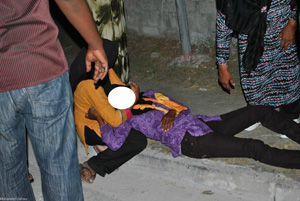
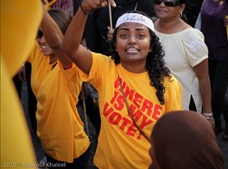

“We are calling on the people to roll up your sleeves and come with us to develop the country. Development of this country is our only aim, our only objective,” Nasheed continued.

“A nation is developed through doing particular things at a particular time in a certain manner. These things can be known through putting forward criticism and conducting peaceful political activities by competitive parties in a multi-party system. The biggest obstacle to this country’s development was the habit of torture and brutality exercised in this country’s past against anyone who expressed differences in opinion. We are here to overcome this obstacle. We will win the elections in one round,” he stated.

“You can push us down onto the ground and force us to eat sand, but we will stand up again. We will not step back. We will bring good governance to the people. Our courage cannot be deterred. We will develop this country, we will build the whole nation,” Nasheed concluded his speech.

Former State Minister of Islamic Affairs during Nasheed’s administration, Sheikh Hussain Rasheed, concluded the rally with a prayer, joined in by the thousands of supporters gathered at the rally.

After the speeches were delivered and the prayer recited, the party then held a laser show, with some of the images depicting themes related to the party and its policies, along with campaign songs by various artists from around the country.

Likes(0)Dislikes(0)

Comment: Who will best protect our children?

This article first appeared on DhivehiSitee’s Election 2013 hub. Republished with permission.

What kind of a country do you want your children to grow up in? What are the values you want them to have? What does it mean to be a citizen of the Maldives? Why would your children be proud to be Maldivian?

As the Maldives prepares for Presidential elections, scheduled for 7 September 2013, political parties promise the population many policies geared to advance social progress and economic growth: more job opportunities, technologically advanced health care services, better access to education, and a reduction in poverty.

At face value they all pledge a promising future. Nonetheless as active citizens, it is important to analyse them in terms of their effectiveness given that the Maldives is a small island developing state and shares many characteristics with other such states: grappling with security issues, both internal security – gang violence, drug use, child sexual abuse – and external – global warming and sea level rise, tsunamis, recession in tourism source countries – and the smallness and remoteness creating high costs associated to goods and services.

From a total population of 330,652 about 43 percent are under 18 years. It is the children of our nation who one day will steer our country into the prosperous, fair and tolerant society we all seek.

For that reason alone, they deserve nothing else but our very best efforts towards a society where they can grow up free from poverty, abuse and fear and with high standards of health, safety and education. While this is a generational task that will keep future Maldivian governments occupied for years to come, it is important in every election to ensure we do not lose sight of this.

An unpublished UNICEF report in 2007 recommended the government to establish a comprehensive social protection system including access to social housing and special assistance for the unemployed in order to prevent a crash in the child protection system.

With the ratification of 2008 constitution, Maldivians (Dhivehin) now have a better understanding of their right to social protection (haqq al-damān ijtimā’ī) and its benefits, mainly credited to efforts of the Maldivian Democratic Party administration with its aim to eliminate of the feudal practice of begging for assistance by the poor.

All political parties cover the Right to Education (haqq al-Ta’līm), the Right to Work (haqq al-‘Amal) and the Right to Social Protection (haqq al-damān ijtimā’ī) in varying levels.

Twenty percent of girls and 11 percent of boys in secondary school have experienced sexual abuse during their childhood as established by a study conducted by UNICEF in 2009. Many of those accessing drug rehabilitation report a history of childhood abuse.

It is evident that in order to tackle drug abuse in the Maldives, it is important to address issues such as child abuse. Child protection is a contentious area where the state has to intervene in the private sphere of the family, often balancing children’s rights and parents’ rights. Even so, to realize the prosperous future we seek, any government should be willing to proactively protect its children and families.

Fundamentally, we should ask ourselves, who would be willing to do this for us? Answers to these questions come through examination of past practices, current atmosphere and pledges.

For a child protection system to be effective and sustainable it needs to be supported by effective legislation and social policy, integrated infrastructures, institutions, therapeutic services, trained professionals such as judges, lawyers, policemen, doctors, teachers and social workers, strategic resource allocation, financial investment, and a well-informed and supportive general public. Research shows that the wealth of a country alone does not achieve effective child protection. Maldives should aim to attain effective child protection through affordable means.

Vaudhu (Pledge)

Jumhooree Party

The Jumhoree Party does not explicitly state that they will provide universal health care insurance but promises that when the allocated amount dedicated to an individual is exhausted the government would cover the shortfall.

It remains unclear if the party intends to reinstate all the benefits introduced during former President Nasheed’s Administration, whether it would be a comprehensive system with universal benefits or whether it would meet the needs of only the most vulnerable. Jumhooree party’s presidential candidate on various public platforms has proved unsuccessful to elaborate on this.

Additionally, the introduction of a holistic tax system (vasha jehi) that will fund social protection and government services leaves individuals unsure of the percentages on income tax that might be levied on them and whether we would be able to accommodate this burden with the rise in costs of living.

In relation to housing, the party asserts that the government will provide housing for every newlywed couple. Apart from this, the party has expressed no other policy relating to housing and hence neglects the majority that already struggle to meet their housing needs.

In Male’, it is usual that one household occupies only one room, so several households reside in a house. This room, or one-household-unit, usually contains a kitchen, toilet facilities and sleeping arrangements. A UNICEF study in 2007 found that that couples that inhabit these households struggled to meet their needs of intimacy especially those with children.

This overcrowding often leads people to take shifts to sleep. This in turn leads adolescents to sleep during the day to let younger children sleep during the night. These adolescents are then sometimes forced to spend time on the streets at night, getting into gang activities and drugs and missing school.

While these are the only two promises pertaining to social protection the party focuses largely on developing the tourism sector by creating opportunities to opening a further 70 resorts where work has been suspended, open three new schools for Hotel and Catering, to “make millionaires into billionaires”, and to build an international Transhipment Port on Kulhudhufushi [Island in Kaafu Atoll].

While these goals are important and aspirational, more than half the population continue to live below the poverty line preventing them from accessing appropriate healthcare, education and employment opportunities.

The party proposes to increase job opportunities for the indigenous population with the aim of reducing the expat population. However, how this is going to be achieved has not been explained yet.

In relation to market opportunities for local products the Jumhooree party promises to increase the production of fish canning with 100 fishing boats a year to match the increased production. The party proposes to offer short and long term farming courses but does not express how they intend to create job opportunities in this area.

Overall, the policies of Jumhooree party does not outline an extensive social policy and risk that the gap between the rich and the poor will increase further and fail to reach those that require social protection.

Progressive Party of the Maldives (PPM)

PPM offers a number of social protection measures that are child focused: a mechanism for supporting single mothers with childcare subsidies, acquiring the rightful share of assets that was attained during the marriage in occasion of divorce, create Internet-based work for women to assist them to work from home, establish a system by which persons with disabilities and the elderly can lead a life without discrimination and have equal access to services.

While, it is important to create opportunities for Internet-based work at home this excludes the majority of women living in the rural areas of the Maldives without easy access to modern computers. PPM has not announced any policy addressing opportunities for rural women.

Additionally, the party asserts their objective to bridge the gap between the urban centre Male’ and the rural Maldives by establishing services that are at the same level as Male’ in all the islands. This is a policy that aims at equality, however its feasibility and how this is going to be achieved remains to be communicated.

Although a newly registered party, most of PPM’s policy makers belong to President Maumoon Abdul Gayoom’s administration responsible for 30 years before losing the election in 2008. Despite a number of economic and social advancements during these 30 years, the gap between the rich and poor, urban and rural populations widened. Many relied on handouts from the wealthy or writing directly to the President if they required traveling abroad for health.

PPM’s policies promise to further women’s rights, but lack a commitment to investigate the systematic torture documented by the Human Rights Agency REDRESS in 2012. Without taking necessary action against the aggressors the new promises lack credibility. Further its leadership had proved lethargic in advancement of the social protection system at the helm of power and this casts a very reasonable doubt in its ability to fulfill it now.

PPM asserts that they will establish extra security and protective mechanisms for the police force and the military, which suggests an increase in the defense and police budget. Research has shown that increased defense spending often leads to lower levels of child protection.

Maldivian Democratic Party (MDP)

Awareness among the population about the benefits of social policies grew during the 3 years of President Nasheed’s administration when a strong emphasis was laid on social protection with a total budget allocation of MVR 1,250,203,404 (US$81 million) in 2011 alone. This spending in the social sector was the highest recorded in Maldivian history (Statistical Yearbook 2010).

This protection extends to protection of children in general. The budget included welfare assistance, a national health insurance, single foster parent allowances as well as several subsidies for housing.

MDP’s objective is to reduce the gap between the “haves” and the “have nots”. In a 2010 survey, “Assessment of the Elderly receiving “Madana” and the Pension”, 73 percent of the elderly reported that their relationship with their children had improved as they can take care of their own needs and some reported having assisted to setting up savings account for their grandchildren, while also indirectly improving children’s lives.

MDP along with PPM has has expressed intentions to reform the judiciary. However, MDP is the only party that provides specific plans how to achieve this. The judiciary plays a crucial role because judgements that pertain to children can work in the best interests of the child or against it. The International Commission of Jurists (ICJ) in 2011 found breaches of the separation of powers – executive, legislative and judiciary.

Islamic law lays importance on making the judiciary accountable for its conduct. Neglecting this office therefore places the “body of Muslims in a state of sin, as they are enjoined to support this office, or to support those who endeavour to maintain it.”[1] Islamic law also emphasises the honesty and piety of judges.[2]

The youth policy of the MDP focuses on engaging with the whole youth population without discrimination. It covers various aspects of cultural and artistic life, which is crucial for increasing the connection to the culture of the Maldives that has made us unique. It also encourages a sense of inclusiveness and ensures that academically ‘weak’ children and youth are not marginalized and form an integral part of society.

In its Right to Work policy, the party proposes a right to fair wages, a right to employment, work and accident liability for loss, a right to fair work regime and leisure. This promotes equality and tolerance.

The housing policy introduced between 2008 and 2012 has instilled the importance of working towards owning ones own property. It encourages citizens to take responsibility for their own future and to build their family. For those who are unable to afford housing, subsidies were offered to reach a point that made it possible to buy. It creates opportunity for those individual who do not have the possibility to inherit land. Provisions for those who are most vulnerable through the social housing policy have further strengthened this policy.

MDP’s policy on strengthening family ties is central to children’s rights and child protection. This policy ensures that government efforts were not only concentrated on tertiary interventions (protection from abuse) but building families and preventing breakdown.

Prior to Nasheed’s administration children were removed from their families prematurely and placed in residential state care facilities. This practice increased incidences where parents gave up on children too quickly, deprived them of their right to grow up in a family environment and at the same time increased state spending.

MDP had put in many measures to reduce removing children prematurely by increasing social work assistance and providing social protection benefits. Valuing the family unit is fundamental in Islamic law and hence this policy not only mirrored our religious values but strengthened the right to a healthy family environment as afforded by the UN Convention on the Rights of the Child. Even taking into consideration these policies, there is still a long way to go. Yet it is safe to assume that the path is right.

Waheed coalition

The coalition government has been characterized by widespread, systematic and institutionalized brutality. The level of mass aggression by the state party in recent history of Maldives has never been as severe as today. Many women and men suffered direct physical and sexual assaults. Testimonies from many victims have been documented and presented to the International Covenant on Civil and Political Rights (ICCPR) Committee in 2012.

Neither the state structures nor the Human Rights Commission have acknowledged the brutality or taken steps against those responsible; instead many police officers were rewarded with promotions and extra benefits. Children internalising the violence from the state party perpetrated on innocent civilians by those who are meant to protect them have caused long-lasting psychological damage.

Additionally, the Coalition government has discontinued social protection benefits that were established by President Nasheed. The government also proposed a 14 percent increase in the defense budget in 2012. All these factors are not conducive to effective child protection.

It is maybe for these reasons that the Coalition’s promises present a confusing mixture of social protection policies. What is most concerning, as far as children are concerned, is the promise to establish three extra shelters for children and for women who suffer domestic violence.

Family and Child Protection Services receive on average seven cases per week on issues relating to minor family conflict, behavioural issues or various forms of abuse. Most cases are not considered in the extreme categories requiring immediate removal of children into State care. Even if cases that require removal into state care, it is in child’s best interest to reintegrate them with a family as soon as possible.

On 17 August 2013, The Economist, in its article “Children’s Homes – The Nanny State” published figures around the world illustrating that institutions are being closed and family-based care is being favoured. This global movement is due to the fact that children who grow up in institutions are far more likely to offend, end up in prisons, develop adjustment issues and so on.

The Maldives does not need more institutions, especially with limited experience and services in place for resocialisation back into the community. This policy alone outweighs the other policies as this policy assumes that more and more children need to be institutionalised and there will be an increase in women being abused. There is no attention on preventing such incidences.

Conclusions

The above discussions show that the Jumhooree Party focuses largely on economic gains, PPM focuses on conservative provisions of welfare where individuals continue relying on the government, Coalition government believes that there will be an increase in children requiring institutional care, and MDP emphasises balance of economic growth and social protection. It is advisable that all parties would benefit from developing policies relating to mental health, as currently the systems in place are grossly insufficient.

The increasing budget deficit has been a struggle for the Maldives. The Majlis Budget Committee estimated the Maldives budget to reach 27% of the GDP by the end of 2012. In response, the International Monetary Fund (IMF) has warned that the country ‘risks running out of reserves and miring the country in poverty.’[3] Therefore to bring about the change we seek, we need to start looking at the evidence on the ground.

Most parties, apart from MDP, from the policies announced, have promised policies without considering the already existing deficit. What we need is a sustainable mechanism through existing means to fill the void. Not aspirational pledges that risk debilitating the state. Although every individual wants the future to be prosperous, fanciful pledges or going into further debt is not what the population deserves. The society and its children deserve to be built on constructive, not destructive, policies and pledges. We need to start acting upon a code of ethics that benefit the larger social needs, relationships and groups rather than one based on individual needs and relationships.

It is time that we take the moral step of progress and set the good of many before the interests of the few and be concerned for the welfare of the community without hope of an individual return.

Dr Mariya Ali is a former Deputy Minister of Health and Family, with a 20 year background in child welfare in the Maldives

All comment pieces are the sole view of the author and do not reflect the editorial policy of Minivan News. If you would like to write an opinion piece, please send proposals to [email protected]

[1] El-Shafi, H. A. L., (2003), “Judicial Training in Islamic Jurisprudence”, in Haleem, A. M., Sherif, O. A., & Daniels, K., (Eds) (2003), Criminal Justice in Islam: Judicial Procedure in Sharia, I.B.Tauris, p. 168

[2] ICJ, supra note 19, p. 169; Velezinee, A., (2012), Constitution Breach by the Judicial Service Commission, Hijack of the Judiciary, and link to 7 February 2012 Coup d’ etat.

[3]Bosley, D., (7th May 2012), “IMF predicts dire consequences if deficit reduction fails”, Minivan News.

Likes(0)Dislikes(0)

Comment: Changing cheerleaders into leaders

Less than 48 hours is left before the ballot boxes open. On Saturday (September 7), the Maldives will choose its next president. The personalities and policies of four presidential hopefuls may differ from each other, but all do share one thing in common – they are all men.

And where are the women? They are standing behind their men.

Though no woman has a spot in the presidential race – dominated by four male candidates and their running mates – women have undoubtedly become an inextricable part of the elections.

As campaigning intensified over the past months, women and girls have been busy sewing more flags than they can count, cooking massive pots of Bondibaiy (sweetened rice) and spicy fish to quench the hunger brought on by mass rallies, and walking day and night to knock every door in order to win votes for their candidates.

Women are  also seen taking the front line at every political demonstration or march around the island – donning blazing yellow burqas, glittering pink t-shirts, or bright red blouses – colours synonymous with their candidate’s parties. Without the female presence, political events would have neither the same magnitude nor diversity as currently seen.

Participation of women of all ages is a highlight of this, the second ever multiparty presidential elections to be hosted in the country.

Out of all the major political parties contesting in this year’s elections, the Maldivian Democratic Party (MDP) stands out in particular for the scores of women that are participating in party’s events.

“Women have become a very important part of our campaign. Women are mostly involved in door to door campaigning – talking to the people, collecting crucial information we need for policy making and campaigning.” says Aminath Shauna, leader of MDP’s youth wing. “Most of the patch agents and campaign team is largely women.”

The MDP is contesting to regain power, following the controversial end to its three year old government after the resignation of former President Mohamed Nasheed on February 7 last year. The party vehemently contends that Nasheed was forced to resign in a coup.

In the wake of Nasheed’s resignation, massive protests led by his supporters against the new regime were suppressed using force and dozens were severely injured in the process – many of them women and girls.

A peaceful sit down demonstration by MDP female supporters outside the President’s Office was dispersed with water canons, while several women were beaten on the southern atoll of Addu – where women took the streets to protest against what they call a “coup government”.

Woman injured during a police crackdown of pro-Nasheed protests in Addu

But, since February 7, female supporters of Nasheed have braved their way against pepper spray, batons and water cannons and continued to take lead in an army of yellow supporters, determined to fight till end to bring Nasheed back to power.

Shauna believes that this unwavering support by women is a result of policies adopted by the MDP’s short-lived government which mostly “benefited women”.

“If you look into the social protection program over 100,000 people directly benefited from it. It was largely spent on elderly, single parents who are mostly women. Also programs such as Hunaru [vocational education] and Second Chance program [rehabilitation and reintegration of inmates] largely accepted by women because, although women do not bring income to the family, its women who make household decisions and look after the elderly parents, take them to hospital and look after the children. So the person who really understood and felt the benefits of these programs were women,” Shauna observed.

During the campaigns, two out of four presidential candidates have  announced women specific policies; including daycare centres, flexible working hours, online jobs and reserved seats, among other things.

Though MDP claims to hold the policies benefiting women, the party is one of the two that has not prioritised a policy towards achieving gender equality and improving women’s rights- one the  few remanining development goals the country has so far failed to achieve due to widespread violence against women and  low representation of women in political and economic life.

Second is Jumhoory Party’s Gasim Ibrahim. The party speaks of introducing a pregnancy allowance and ensure gynaecology services on every islands as policy on women. For a party backed by Islamist party Adhaalath which believes in strict enforcement of Sharia and patriarchal dominance within public and domestic spheres, having no progressive policies on women is unsurprising.

But why does MDP, a party which asserts to be an alternative to the rest, holding egalitarian and moderate views does not have a policy specifically aimed at women? The party has never been recognised for its suitable policies for women. In fact, MDP’s record of gender policies during its short-lived three year term does not score well either.

Take the issue of domestic abuse and gender-based violence in the country. With every one in three woman estimated to be a victim of physical or sexual abuse, it is one of the biggest challenge women face across all islands. However, Nasheed’s government and its parliamentary group failed to step up in bringing any necessary legal reforms while its rivals were instrumental in drafting, promoting and passing domestic violence and child abuse legislations.

Unemployment among women is double that of males, however, no day care centres, flexible working hours or economic policies specifically targeted to reducing female unemployment were introduced. Research suggests reasons behind female and male unemployment differs with young women finding more difficult to find work due to early marriage, household responsibilities, societal attitude.

Maldives holds the record of one of the highest divorce rates in the world with almost every one in two marriages falling apart. This often leaves women struggling to raise children under extreme financial hardship. The single parent allowance, despite the temporary relief it brings, is merely a band-aid solution for these families. Economic emancipation remains unachieved.

Meanwhile, women also continued to remain as a minority at state decision making level under Nasheed’s era. Any point in time, Nasheed’s cabinet were dominated by men and his female appointees made up less than a quarter of all political positions.

His party followed same track, or even worse.

Currently, women hold 5 seats in 77 member parliament and only 57 out of 1091 local councils.

MDP secured full seats in the city councils of Addu and Male’ – two of the most populated areas – but none of them were sadly women. The party did not take any public initiative in encouraging female candidates to these elected posts. They simply embarked on making laws, building cities and running the state without an equal say of women who make up half of the country.

But perhaps, this elections is a harbinger for change.

This week, Nasheed sat down with women to listen to their woes. He promised that his economic and social policies are targeted, though not directly, towards addressing the most serious problems women face. Including housing, jobs, education and healthcare.

However, he stopped short of promising women an equal representation in his government or party.

Several women are throwing their support behind Nasheed because they also believe in the values of equality and justice he preaches. Perhaps, it needs to be put into practice a little better.

A good place to start would be within the party itself.

Mariyam Zulfa, who served as Tourism Minister during last months of Nasheed’s rule recently gave a subtle warning to MDP’s main rival, Abdulla Yameen of PPM.

“Yameen please don’t have your eye on 2018, thats gonna be a year for women, we have waited patiently enough, like Hillary Clinton,” she posted on Facebook.

This status echoes an important message – MDP women are ready  to climb to the top rung of the political ladder.

But, amid an environment of highly competitive and machiavellian men jostling for power, women often find themselves at crossroads. Whether to challenge the male dominance and risk losing or just be happy with the little voice she has. Choosing the latter also makes it easier to juggle the personal life often sacrificed by women pursuing a career.

MDP Youth Wing leader Shauna at an anti-coup protest

Shauna is one the few young women who has bravely made it to the top tier of MDP, and she shared the challenges women face on the field.

“One of the reasons why we do not see women in elected posts is because women do not have access to campaign finance. We do not see many women in government senior posts because simply there is not policy that promotes it – working hours are not flexible for women with families, senior posts mean a lot of time and commitment. Working environment and hours do not give this women any flexibility. Harassment exists at all levels in the Maldives and there must be an end to that for more women to take up senior posts.” she explained.

These are problems can be resolved by changing  MDP’s current gender mainstreaming policies to a more direct women empowerment strategies such us quotas for women, setting up a budget for funding female candidates, running political leadership training programs. When more women take part in decision making, the diversity of opinions and ideas leads to better results in developing the country.

MDP also has continued to voice against rising extremism and the resulting backlash in women’s role in public life.

“There is also a movement towards conservative Islam that is a threat for women in politics and social sphere.” Shauna observes. “If there is no counter movement to conservative views of Islam, I do not think we can have a female president anytime soon.”

There is no better way in countering extremism than encouraging those subjugated by it to be free and exercise their power. Several women have already put their faith and support behind the party. It is time for Nasheed and his party to return the favour and let women have the equal space they deserves.

Should MDP hesitate, it is bound to create rifts through its existing female support base. But for now, women cheering for Nasheed seems to have his back.

All comment pieces are the sole view of the author and do not reflect the editorial policy of Minivan News. If you would like to write an opinion piece, please send proposals to [email protected].

Likes(0)Dislikes(0)

Cursed coconuts on Fuvahmulah allegedly used to disrupt elections

Additional reporting by Ahmed Nazeer

Coconuts with black magic spells are allegedly being used to sway voters’ political party allegiance and incite confrontations between Maldivian Democratic Party (MDP) supporters and police on Fuvahmulah, ahead of Saturday’s Presidential Election.

A ‘kurumba’ (young coconut) suspected to have a ‘fanditha’ (black magic) curse, with Arabic writing and suspicious symbols burned into the husk, was found in the garden of a home located in Fuvahmulah’s Dhiguvaadu ward yesterday (September 4), a source from Dhiguvaadu ward told Minivan News today.

The woman who found the suspicious coconut in the early hours of the morning intended to inform the police, however the homeowners – “hard core” Progressive Party of the Maldives (PPM) supporters – told her not to do anything until an expert investigated the coconut first, said the source.

“Neighbors supporting President Mohamed Waheed’s Gaumee Ihthihad Party (GIP) live in the area, so they heard about the fanditha coconut and wanted to create problems, so they contacted the police,” the source continued.

“MDP and PPM have been running strong campaigns and have many supporters in the area, however GIP only has about 15 members,” the source noted.

“Since GIP has very few supporters, they are trying to redirect attention away from the other political parties to gain votes,” alleged the source. “GIP has told PPM that MDP planted the fanditha coconut, however they are telling MDP that PPM is responsible.”

“Neighbors a few houses away were awake around 3:00am that night and did not notice any suspicious activity,” said the source.

The source believes that GIP, PPM and Jumhoree Party (JP) supporters are trying incite unrest among MDP activists on Fuvahmulah – especially GIP by involving the police in the fanditha coconut incident.

MDP supporters on Fuvahmulah remain very upset about the violent police crackdown that happened after the controversial transition of power in February 2012, according to the source.

“When MDP activists see local police they are not good with them, they do not keep calm, there is always a huge scene, shouting, etc.,” the source explained.

“[However,] these days MDP [Island] Councilors are trying to the max to keep supporters calm,” the source continued.

“And the situation is very calm right now. It [the fanditha coconut incident] was nothing huge, just a very simple thing,” the source said. “There won’t be any impact on voting.”

Fuvahmulah police did not want to get involved in the black magic incident, instead they preferred to allow the family to take action independently, a police source told Minivan News today.

“If we get involved, it will turn into a big thing,” said the police source, in reference to inciting unrest among MDP supporters.

However, local media reported that police took possession of the black magic coconut.

The Maldives Police Service was not responding to calls at time of press.

Black magic sabotage

A black magic practitioner from Fuvahmulah allegedly cast spells on five yellow young coconuts – kurumba can also be green or orange – and gave them to another man to deliver to a specific key location, a Fuvahmulah island council source told Minivan News today.

The island council source alleged a person named *Easa cast a spell on five coconuts and gave them to *Moosa to deliver. However, Moosa left the coconuts on his bed covered with a sheet before going to work.

“Moosa’s wife was not told about the cursed coconuts, so she was shocked to find coconuts on their bed and called the police immediately,” said the island council source. “The police went over to the house and took the coconuts.”

“She thought MDP had cast the black magic spells because the coconuts were yellow,’’ the island council source explained. “Once Moosa found out what his wife had done, he told her it was very bad that she had reported it to police.’’

Moosa and his wife then went to get the cursed coconuts back from the police, but police refused to return them, according to the island council source.

The island council source noted that Easa made a typographical error when cursing the coconuts. The coconut curse says to “get rid of [PPM presidential candidate Abdulla] Yameen”, but was supposed to read “get benefits from Yameen”.

Furthermore, during the 2008 presidential election Easa also started practicing black magic a month before the election day, noted the island council source.

“Every day after dawn prayer he went to the beach and did black magic stuff. He also went near the polling station and threw cursed objects at people,’’ said the island council source. “[But] Easa’s spells did not work the last time.”

“This hasn’t been taken too seriously by the islanders, but the MDP supporters are very concerned,’’ the island council source said.

No arrests have been made in connection with the case, the source added.

Earlier this week, police summoned a white magic practitioner to evaluate a young coconut believed to have been cursed by a black magic spell, after it was found near the Guraidhoo Island presidential election polling station in Kaafu Atoll.

*Names have been changed

Spiritual healing

This is the second cursed coconut incident reported in as many days, related to the presidential election. To better understand this “very common practice”, Minivan News spoke with Spiritual Healers of the Maldives President and Exorcist, Ajnaadh Ali.

“During elections black magic is used to gain votes and make people ill,” explained Ali.

Ali suspects a spell was read over the Fuvahmulah fanditha coconut instead of inscribed, because the coconut reads “May Allah protect us from Abdulla Yameen”.

The black magic spell cast to influence voting “is a spell of separation. It’s the same idea as a love spell. It can either bring people together or split them apart,” Ali noted. “The black magic will attack them mentally, by demanding the individual think a certain way even if they would normally know something is bad. It makes them blind in the mind.”

“While any object can be used, because coconuts represent a life structure (like eggs) they use those objects to make the spell powerful, with the advice of the devil,” noted Ali.

“There is a long history of the practice in the Maldives, but it is still very common nowadays on every island,” he continued. “There is a lack of knowledge regarding the religion. Some people who do black magic think it’s right because the Quran is used.”

“In Dhivehi, fanditha means magic – black or white – but the way it is practiced is what makes it good or bad. Black magic is when people worship or invoke jins or devils to cause harm to others,” Ali explained.

“Black magic is practiced by misusing the Quran, chanting or writing verses and the names of devils or jins (spirits) to summon their help. It cannot be done unless someone has some disbelief of Allah,” he continued. “It it also disrespectful of the Quran.”

The best protection against black magic is reading Quranic verses, particularly the last two chapters of the Quran, said Ali. ‘Ruqyah’ is a form of white magic, specifically an Islamic exorcism where Quranic verses are read and prayers recited to heal.”

“Ruqyah will neutralise black magic to rid of the evil eye or any other spiritual matter, like jin possessions or mental illness,” he explained.

It can also be conducted for the benefit of worshipping Allah, he added.

“Any Muslim can practice ruqyah by themselves, however its more effective if they have knowledge of jins and the Quran. Also, they must be following the religion,” he noted.

The five pillars of Islam are prayer, fasting, alms for the poor, pilgrimage to Mecca, and declaring belief in one God, Allah.

A 1979 law requires persons wishing to practice fanditha to “write and seek approval from the Ministry of Health.”

Likes(2)Dislikes(0)