Leaked Grant Thorton report reveals beneficiaries of BML’s risky pre-2008 lending

Additional reporting by JJ Robinson

A leaked draft of a report into the Bank of Maldives’ (BML) lending practices prior to 2008 has identified those behind potentially destabilising breaches of both BML and Maldives Monetary Authority (MMA) guidelines.

The asset recovery investigation by forensic accounting company Grant Thornton, drawing on the 2008 Attorney General’s report on BML, concludes that it would have been “impossible for the [BML] board to not have been influenced” in the granting of significant exposures in the form of credit to a select coterie of Gayoom-era affiliates.

The document reveals well-connected individuals bypassing BML rules regarding the handling of non-performing assets, with a number of large companies belonging to politically-active businessmen continuing to receive credit despite failing to satisfactorily meet previous repayment obligations.

“The large exposures that BML held, were in the main, due to members of the board or their relatives,” the report found.

“Due to the fact that the largest exposures of the bank were from Board members and/or their families, it would be unrealistic for the Board to provide any clear independent review of the banking facilities provided, and would in [our] view form conflict of interest issues for those Board Members involved,” it added.

The report names a number of individuals and business groups who benefitted from the state bank’s loan and overdraft facilities towards the end of Maumoon Abdul Gayoom’s 30 year tenure as head of state.

The government was handed a US$10million (MVR 154.2 million) invoice from Grant Thornton last year in what former Foreign Minister Dr Ahmed Shaheed told Minivan News was a penalty fee for stopping the investigation initiated under Gayoom’s successor Mohamed Nasheed.

Prior to the alleged request from the current government to halt the investigation, Grant Thornton had uncovered evidence of an alleged US$800 million oil trade involving former head of the State Trading Organisation (STO) and current presidential hopeful Abdulla Yameen. Shaheed alleged that the accounting firm was contracted to receive a percentage of any assets recovered as a result of its work.

The private parties named in Grant Thorton’s BML assessment include the Sun Group, Lily Group, Sultans of the Seas, VA Group, Afeef Group, Villa Group, Thasmeen Ali, VB Group, and Rainbow.

“Many of the above parties benefited from loans that were used to assist in purchasing leases for resorts, related tourism businesses etc, of which would not have been achieved without the connections held by certain individuals,” the report said.

The report also makes particular mention of the role of Ibrahim Gasim, both Finance Minister and non-executive BML board member at the time of the majority of cases documented within the Grant Thornton report.

Gasim, who is also standing as the Jumhoree Party (JP) presidential candidate in next month’s election, would have been responsible for the appointment of the majority of the BML board at this time.

Grant Thornton’s report revealed that Gasim’s Villa Group had been loaned MVR481,299,571 (US$37,601,520) as of October 31st 2008, representing 32.4 percent of the bank’s entire capital.

This represents one of a number of examples of such exposure featured in the report, despite the Bank’s acquiescence in 2006 to an MMA request to reduce any credit guaranteed to individual or related group borrowers to 30 percent of overall capital.

After repeated lobbying, the MMA increased this amount to 40 percent. Grant Thornton suggested that this extension request was due to the fact that a number of the groups mentioned in its report were already exceeding the original lower limit.

In rejecting one of BML’s requests for an increased credit exposure limit, the MMA wrote that “such concentration of credit is far in excess of the legal lending limits of the bank and it could seriously threaten the bank’s position, and the stability of the whole financial sector,” the leaked document stated.

Even with this increase, Sun Group is reported to have exceeded this limit after January 2008, with loans and overdraft facilities reaching  MVR 607,345,442 (US$46,879,400) as of 31 October 2008.

“This amounted to 40.8 percent of the Bank’s capital as at 31 October 2008,” the report observed.

Loans and overdraft facilities provided to Afeef Group totalled MVR 245,123,414 (US$19,150,266) as of October 31, 2008 – approximately 16.5 percent of BML’s total capital at the time.

Sun Group Chairman and majority shareholder Ahmed Shiyam’s Maldivian Development Alliance (MDA) meanwhile this week announced its decision to form a coalition the Progressive Party of Maldives (PPM), headed by former President Gayoom.

Alterations to BML’s internal loan approval mechanisms for board members in May 2007 resulted in the bypassing of the bank’s Credit Committee.

“This effectively meant that those Board Members that had applied for credit facilities were approving their own loans,” stated the draft report.

BML board members complicit in self-approving their own credit lines include Mohamed Ahmed Didi (Sultans Group shareholder), Ahmed Hamza (Director of the VA Group), and Gasim (Chairman of the Villa Group).

Director Mohamed Adil also features prominently, being cited in one particular example of a board meeting in which he approved the re-financing of the Sultan Group’s debt at the same time as being the group’s major director/shareholder.

BML’s recovery

In the intervening years, BML wrote off multiple toxic non-performing assets and returned to profitability, largely by outright ceasing to pay dividends to shareholders for almost five years.

The Bank’s board approved a MVR 50 million (US$3.23 million) interim dividend to shareholders in July 2013, the first since 2008.

“This marks the end of a painful and challenging journey that began in 2009 when the bank reported record level non-performing loans. However, in recent years Bank of Maldives has reported record level earnings and operating profit and the company returned to profit in 2012,” read a statement from BML.

BML’s former CEO Peter Horton, a UK banker appointed in February 2011 with extensive experience tackling distressed portfolios and problem lending across Africa as part of Barclay’s corporate turnaround team, resigned in August 2013 to head up Bermuda Commercial Bank.

“The profitability and dividend payment will be sustainable going forward,” said Horton in the bank’s July statement. “This is an interim dividend and at MVR 9.29 [a share] for the half year places us in a strong position to pay the highest full year dividend in the Bank’s recent history at year end”.

Download the leaked GT report

Likes(0)Dislikes(0)

Vice President should not be a “spare part”: Waheed

President Dr Mohamed Waheed last night told state broadcaster Television Maldives (TVM) that a vice-president should not be treated like a “spare part”.

Speaking in the second of a series of TVM interviews with next month’s presidential candidates, the incumbent president stated his belief that the vice president ought to have more responsibility.

“I believe that changes are needed. A vice president should not be a spare part that replaces the president if he resigns or passes away. The people choose a vice president after careful consideration. They vote for two people, the president and the vice president, on the same ticket,” President Waheed said.

Waheed assumed office on February 7, 2012, after being elevated from his position as vice-president to Mohamed Nasheed. President Nasheed resigned amidst chaotic scenes as police mutinied following weeks of anti-government agitation.

Waheed told his interviewer, Leeza Laurella, that Nasheed had reneged on a prior agreement to hand the vice-president powers over foreign policy – giving preference to fellow Maldivian Democratic Party (MDP) members.

Soon after Waheed assumed the presidency, his frustration with his previous role was described by his then-special advisor Dr Hassan Saeed in a leaked audio recording.

“There was no major role for President Waheed in the previous government. Very many days [spent] bored in the office… When an educated man like him whiles the day away being like this, going on the Internet… really it is sad. This is how Waheed was,” said Dr Saeed.

Prior to his political career, Dr Waheed was notable for being the first Maldivian to gain a doctorate as well as being the first person to appear on Maldivian Television, anchoring TVM’s first broadcast in 1978.

After a short period as a member of the People’s Majlis, Waheed spent a number of years working for UNICEF, eventually becoming Deputy Regional Director for South Asia.

Role in February 7

Responding to the repeated accusations that he did not fulfil his responsibilities in supporting President Nasheed during the February 2012 crisis, Waheed told his interviewer that Nasheed had not asked for his counsel.

“President Nasheed did not call me. If he wanted to talk to me, he could have asked the SPG (Special Protection Group), the same group that protects us both. He could have handed me the phone through them, could he not?”

Maintaining that the events of February 7 marked the final stages of a conspiracy in which Waheed was complicit, the MDP have repeatedly accused Waheed of failing to fulfill his duties as second in command.

Mentioning a late night meeting with anti-Nasheed figures just days before the transfer of power, Waheed told TVM that Nasheed had been informed of the meeting and all normal procedures followed.

MDP MP Mariya Didi manwhile published a report in June 2012 arguing that Waheed’s failure to fully discuss this meeting with the rest of the cabinet represented a violation of his responsibilities as the vice-president.

Waheed had been open on a number of previous occasions regarding his marginalisation in the decision making process, in 2010 describing the Nasheed administration as a “one man show”.

Nasheed will stand against Waheed in September’s poll, having chosen Dr Musthafa Luthfy as his running mate. When making the announcement, the MDP stipulated that Luthfy would call an election immediately should Nasheed be “killed or incapacitated” rather than assuming the presidency himself.

Siyaasath

Waheed yesterday explained that he had chosen his current running-mate, Dhivehi Rayithunge Party (DRP) leader Thasmeen Ali as he is “well-mannered and keeps his word”.

During the interview he also denied that he had described the Adhaalath Party as containing extremist elements – comments which prompted the religious party to leave Waheed’s ‘forward with the nation’ coalition in June, later allying with the Jumhoree Party (JP).

Yesterday’s interview, the second in a series featuring all the presidential hopefuls, followed Friday’s combative encounter with Jumhoree Coalition candidate Ibrahim Gasim.

Following Gasim’s discussion with Laurella, JP deputy leader Ilham Ahmed told local media that the JP would be considering a boycott of the station. Ilham argued that, contrary to the shows title – with ‘siyaasath’ meaning ‘policy’ – the presenter asked Gasim a series of personal questions in an attempt to damage his reputation.

“This was done with the intention of demeaning a person under a systematic plan. We don’t believe that this could have been done under press freedom,” he explained to reporters from Haveeru. “We have seen TVM going after Gasim.”

Ilham also insisted that the show had made repeated attempts to make Gasim appear “odd”.

The Maldives Broadcasting Corporation (MBC) defended its station, telling local media that Gasim’s TVM interview was conducted within its editorial policy.

It was announced in June that TVM would be scheduling a presidential debate featuring all four candidates for September 1.

Likes(0)Dislikes(0)

State developments to recommence by 2014 after Nasheed administration’s bills settled: President Waheed

President Dr Mohamed Waheed has claimed the country will be in a position to restart development projects next year as a result of his government repaying millions of US Dollars in bills incurred through the previous administration’s borrowing.

The government announced it would be suspending state-financed development projects in April after exhausting its annual budget for recurrent expenditure (including salaries, allowances and administration costs) in the first quarter of 2013.

The current government has continued throughout the last year to try and establish loan and credit facilities with foreign nations and banks for the stated purpose of “budget support”.

However, speaking during a campaign rally in Noonu Atoll this weekend, President Waheed was quoted by Sun Online as claiming that unpaid bills arising from the government of former President Mohamed Nasheed had now been settled, with no expense expected to be carried over to the 2014 budget as result.

“We have been through a very difficult time over the past two years. We could not do several things, not because we didn’t want to do them. The previous government left the country bankrupt,” he said during the rally.

“The money necessary to buy medicine for our children, the money necessary to repair the school building, the money necessary to repair the harbour of this island – all this money had to be repaid, the unpaid bills for work done by citizens, had to be paid.”

Finance Minister Abdulla Jihad and Minister of Economic Development Ahmed Mohamed were not responding to calls today, while Minivan News was awaiting a response from President Waheed’s Senior Advisor Teresa Wells at time of press.

Former administration’s borrowings

Ahmed Nazim, head of the Parliamentary Financial Committee and MP for the government-aligned Progressive Party of Maldives (PPM), said that former President Nasheed has undertaken “short-term borrowings” during his time in office.

He added that this borrowing included “US$200 million bond” sold to the Indian government with a maturity of one year that was later extended to 24 months.

Nasheed controversially resigned from office on February 7, 2012, following a mutiny by sections of the police and military.

Following the change in government, Nazim said that the Waheed administration had paid US$100 million and “settled the full payment” after Indian authorities requested the country be reimbursed by February 2013.

“Since this was a substantial component of the total foreign debt, [foreign borrowing] has come down because of this,” he said.

Asked whether the committee believed President Waheed had managed to reduce total state borrowing and spending since coming to power, Nazim said he would respond by tomorrow ( August 18 ) after having time to study relevant statistics.

In 2012, President Waheed reportedly said he would not resort to borrowing from foreign governments in order to finance government activities.

However, the government has since sought a number of foreign loans to supplement the state budget.

Earlier this month, the state requested parliament approve a US$29.4 million loan from the Bank of Ceylon to finance the 2013 budget approved by parliament.

In July, the President’s Office confirmed discussions had been held with Saudi Arabia, seeking a long-term, low interest credit facility of US$300 million to help overcome “fiscal problems” facing the nation.

Supplementary finance plans

Finance Minister Jihad claimed back in December 2012 that the MVR 15.3 billion (US$992 million) state budget approved by parliament might not last until the end of 2013 – requiring supplementary finance for the state.

In April 2013, Jihad sought authorisation from parliament to divert MVR 650 million (US$42 million) allocated for infrastructure projects in the budget to cover recurrent expenditures.

Jihad warned that government offices and independent institutions might be unable to pay salaries or electricity and phone bills if funds were not transferred from the MVR 1.8 billion (US$117 million) Public Sector Investment Programme (PSIP).

“Reckless financial management”: MDP

In July, Maldivian Democratic Party (MDP) MP and Spokesperson Hamid Abdul Ghafoor said that the heavily partisan parliament now effectively controlled state finances as a result of former opposition politicians – now part of President Waheed’s government – imposing tighter spending restrictions on former President Mohamed Nasheed’s administration.

The opposition party also accused the current government of reckless financial management, pointing to a potential US$1.4 billion compensation bill facing the state after it decided last year to abruptly terminate a US$511 million airport development contract agreed with infrastructure group GMR.

Likes(0)Dislikes(0)

Adhaalath Party “curses” Nasheed, accuses MDP of increasing support through black magic

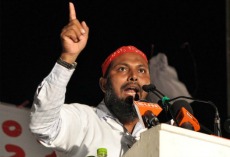
Religious conservative Adhaalath Party leader Sheikh Imran Abdulla has accused Maldivian Democratic Party (MDP) presidential candidate and former President Mohamed Nasheed of using black magic to garner support for the party.

“As a result of bringing in people from India, Sri Lanka, and various parts of the Maldives to perform black magic for [Nasheed], and then casting spells on food and feeding them to the masses, Nasheed has caused large numbers of people to become blind towards all his wrongdoings, and to imagine characteristics of being democratic and pro-development in him, and to be deluded into thinking they are in absolute support of him while in reality they are in a crazed state of enchantment and therefore run behind him,” Imran said, addressing the Jumhoree Coalition’s first major rally in the capital.

“Nasheed’s followers are anti-Islamic people like him and huge criminals. The rest are people under the influence of his black magic. Most people are bewitched and under black magic spells. This is the state of this country,” he said.

“Nasheed is doubtless an agent – one who has been rather well trained – sent in by enemies of Islam and our nationalism,” Imran continued. “A vote cast for Nasheed is an act which will facilitate the eradication of Islam from this country and will hurl us into a state of slavery.”

He furthermore alleged that during Nasheed’s time as President, he had “forced alcohol down the throats of Maldivians”, erased Islam, sold national assets and gave the profits to his “cronies”, and had himself “hidden away in his pockets US$16 million by giving away the airport to GMR”.

Moving away from his religion-based rhetoric, Sheikh Imran then spoke of Chinese superstitions as his justification of why people should not vote for Nasheed.
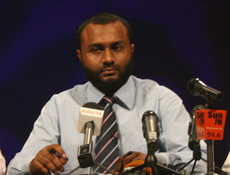
“In matters involving luck, the Chinese would never opt for number four,” he stated.

“If Nasheed approaches the 1 billion people of China as Candidate Number Four and asks for their vote, he will not be able to get a single vote,” he said.

Imran also spoke of how Nasheed is “spending billions on his campaign while he does not own any major assets or businesses in the country”. Imran then accused Nasheed of accepting funding for his campaigns from “foreign churches aiming to spread anti-Islam propaganda”.

Towards the end of his speech, Imran admitted that he “tends to levy a lot of criticism against Nasheed”, and said that this was not due to any personal grudges against the candidate.

“I have to speak against Nasheed because of the things he has done in these past several years; because of his anti-Islamic policies and anti-Islamic activities. Because I do not wish for a man like to him to become the head of state,” he continued to explain.

“Unlike other candidates, I must speak of Nasheed more openly as even the Quran instructs us to enlighten those who are ignorant and do not know any better.”

The religious conservative party’s leader also criticised the other two candidates contesting against Jumhooree Coalition candidate and businessman Gasim Ibrahim in the upcoming September 7 elections.

Referring to Progressive Party of Maldives (PPM) presidential candidate Abdulla Yameen, Imran said that Yameen had failed in engaging with the public or garnering any support for himself. He alleged that as a result, Yameen had ended up having to bring out his half-brother and former President Maumoon Abdul Gayyoom to campaign for him and PPM instead.

Imran then spoke of President Mohamed Waheed Hassan, alleging he had been unable to maintain the initial “wide coalition” that he had formed as a result of “having chosen the wrong running mate at the wrong time”.

“Although Waheed was leading the race with the largest support base when talk of presidential elections first began, he no longer has the guarantee that he can even manage to get a simple five percent of the votes this election,” Imran said.

In the same week, Adhaalath Party member and current Islamic Affairs Minister Sheikh Shaheem Ali Saeed said that he had repeatedly performed prayers from the time Nasheed was elected President wishing for an end to his time in government, asking “Allah to curse Nasheed by setting dogs on him”.

“Every time I kneeled down in prayer, I repeatedly prayed a ‘dua’ performed by Prophet Mohamed (pbuh) against a man who had spit in his face,” Shaheem said, at a Jumhooree Coalition rally held on Mahibadhoo, stating that this was the first time he had prayed for the toppling of a government.

“The Prophet made this prayer against a man who spat on his face. What happened as a result is, the man was away somewhere on a trip. Then while he was asleep, a man-eating dog came and sniffed at people. Once the dog found this particular man, it attacked him and completely ripped him apart,” Shaheem stated.

Adhaalath Party had previously entered a coalition with Waheed’s Gaumee Ihthihaadh Party (GIP), which has appointed Dhivehi Rayyithunge Party (DRP) leader Thasmeen Ali as Waheed’s running mate.

They later left the coalition and defected to Jumhooree Gulhun, backing resort tycoon Gasim Ibrahim and his running mate, Dhivehi Qaumee Party (DQP) leader Dr. Hassan Saeed.

The Jumhooree Coalition now consists of the Jumhooree Party, the Dhivehi Qaumee Party, Adhaalath Party and PPM’s former interim Deputy Leader Umar Naseer and his supporters.

Politicians use ‘religion’ as a tool to play with hearts: Nasheed

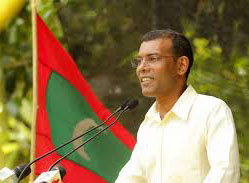
“As Islam is deeply embedded in the hearts of Maldivians, some politicians are bringing out religion as a political tool to try and tamper with our hearts,” Nasheed said, speaking at the MDP’s rally held in Sri Lanka on Saturday.

Nasheed stated that at different times during the political changes of the past years, various politicians, as well as people who present themselves as religious scholars, have used religion for the purpose of furthering political gain.
Nasheed stated that some political figures who present themselves as “religious scholars” are people who do no more than “slaughter camels or bind leather books”.

“The people of Maldives are now aware of all this. We have seen how the coup regime and the long 30 year regime before that is and has been maintained. The people have rolled up their sleeves and begun work to take the Maldives to a far better place,” Nasheed said.

Adhaalath has displayed nothing but hypocrisy for the past years: PPM MP Nihan

“Imran is obviously wrong about our presidential candidate and his campaign strategies,” PPM MP Ahmed Nihan, said in response to Imran’s criticisms of the party’s presidential candidate Abdulla Yameen.

“There are two political ideologies in Maldives: that of former President Nasheed, and of former President Maumoon. They are the champions of Maldivian democracy and reform,” Nihan said.

“Our party is open about the differences in opinion between PPM and MDP about the levels of contribution these two presidents have made to the democracy movement, but that doesn’t undermine the commendable work done by either of them. Who is Imran to talk about this? The Adhaalath party made no contribution whatsoever to either the reform movement or the efforts to establish democratic governance here,” Nihan retorted.

“In the past seven years, the Adhaalath Party has displayed nothing but record levels of hypocrisy. They are responsible for destroying the healthy competitive political spirit in the country by behaving like a commodity on sale, selling themselves to whichever party offers them a higher price. The PPM has never entered an alliance with them,” he continued.

“Leave aside Imran’s criticisms of Yameen – who is he to call Nasheed an anti-Islamic person? His party’s coalition, Jumhuri Gulhun, has set up a campaign station in my constituency Villimale’ on a plot of government land which has long since been walled away for the purpose of building a mosque. They have set up speakers and are playing campaign songs on a holy plot of land reserved to make a mosque, and still have the nerve to call others ‘laadheenee’ (irreligious)?” Nihan stated.

GIP Spokesperson Abbas Adil Riza stated that Imran was making up excuses while he very well knew the truth of the matter.

“Sheikh Imran knows better than anyone else that the Adhaalath Party did not leave the GIP coalition due to any issues with Dr Waheed’s choice of running mate. They left because we were unable to give them as much money as they asked for their campaign activities,” Riza said.

Likes(0)Dislikes(0)

Maldives Police Service launch election operation

The Maldives Police Service (MPS) has begun sending large numbers of police officers to the islands in preparation for the upcoming presidential election.

The MPS launched ‘Operation Blue Waves’ at 6:00pm on August 15 and will continue it “until voting ends and the elected president is officially sworn in”. The stated objective of the operation is “making the presidential elections proceed peacefully”.

The second-ever democratic presidential election in the Maldives is scheduled for September 7, while the second-round runoff will take place (if necessary) October 28, followed by the newly elected president taking the oath of office November 11.

‘Operation Blue Waves’ priorities include “stopping campaign members from breaking any campaign laws as well as stopping any incident that may occur”.

The MPS has stated that a large number of police officers from Male’ and the atolls are participating in the operation.

While normal patrolling will continue in Male’, additional police officers will also be deployed under ‘Operation Blue Waves’ to “maintain peace” by patrolling the capital in two shifts.

The MPS has begun sending officers to the islands Saturday (August 17), with police teams sent to most central and southern atolls, including Faafu, Dhaalu, Meemu, Thaa, Laamu, and Huvadhoo Atolls, as well as Fuvahmulah and Addu City.

Additionally, police officers who have recently completed the Police Recruitment Training Course on Vaanee in Dhaalu Atoll, are to be deployed in the atolls north of Male’.

Meanwhile, police are to be deployed from Male’ to the northern atolls today (August 18).

Prior to launching ‘Operation Blue Waves’ the police had several discussion meetings with the Elections Commission (EC) regarding the “assistance police can offer”, Police Spokesperson Chief Inspector Hassan Haneef told Minivan News Thursday (August 15).

Haneef explained the proposed MPS elections assistance included: providing security for EC heads and officials, election offices, candidates and their running mates; stationing police officers on every inhabited island; making voting arrangements for incarcerated individuals; curbing criminal offenses; and establishing protocols for incidents that might occur during elections.

The MPS plans to maintain peaceful law and order and public safety during the election by “increasing the visibility of police actions during elections, as per the rules regarding the presidential election”, said Haneef.

There will be a “police presence on every island where vote boxes are to be kept”, he noted.

“Police teams will be stationed 100 feet away from the ballot boxes in normal situations,” Haneef continued. Officers will also “attend criminal offences whether they occur at the vote centre, or otherwise”.

Police have been trained for “various possible scenarios” and “units to act during emergency situations will be kept on alert,” he explained.

“[Additionally,] discussions have been held between the MPS and Maldives National Defence Force (MNDF) to establish protocols for joint operations to bring back order,” Haneef added.

Elections Commission regulations

Currently the EC is drafting a document to articulate what the MPS’ mandate will be during the September 7 presidential elections, which is to be made public this week.

EC President Fuwad Thowfeek outlined some of the key regulations related to concerns regarding police interference with elections while speaking with Minivan News in July.

“Police cannot stand within a 100 foot radius of the ballot box,” Thowfeek confirmed.

“Police can enter the area only if the Head of Polling Station requests their assistance to control any criminal activity that goes beyond his control,” he continued.

“The role of the police will be to assist the Elections Commission in keeping peace and public safety,” he added.

Last week, EC Vice President Ahmed Fayaz further explained to Minivan News that while the commission has requested the MPS play a supporting role to help ensure peaceful, free and fair elections take place, police officers cannot intervene without a specific EC request.

“Police can intervene only at the request of the Elections Commission staff,” said Fayaz.

“The police are playing a support role and support will be requested [by EC officials] in case anything happens that would prevent a smooth election,” he continued.

“We have requested police provide assistance on every single island that will have ballot boxes,” he added.

The MPS mandate regarding elections is limited to enforcing law and order and monitoring the situation on each island, Fayaz noted.

MPS manipulating election: MDP

Meanwhile, the Maldivian Democratic Party (MDP) has continued to accuse both the government and senior police officials of trying to undermine free and fair elections, alleging the institution was actively seeking lists detailing the country’s deceased in an attempts to try and rig voting.

Earlier this month, MDP MP and Spokesperson Hamid Abdul Ghafoor claimed that concerns about police trying to seek the details of deceased nationals reflected the party’s wider suspicions that senior figures in the MPS were trying to use their influence to manipulate the election.

Ghafoor said one key concern had been an announcement back in June that staff at the Department of National Registration were refusing to continue issuing national identity cards 94 days before elections, complaining of a malfunctioning air conditioning unit.

Yesterday (August 17) the EC revealed that 38 people’s names have been fraudulently re-registered to vote outside of their home towns in next month’s presidential poll.

However, earlier this month the EC rejected any possibility that the identities of deceased citizens could be used to fraudulently vote in the upcoming election.

Former President Mohamed Nasheed also emphasised his concerns about police influencing September’s presidential election results while speaking at an MDP campaign rally in July.

“According to information I am getting, [Police Commissioner] Abdulla Riyaz is instructing police officers to barge into polling stations upon his signal, after two individuals enter and create a scene,” Nasheed declared.

The second method by which the police will attempt to ruin the elections is intervening during the vote counting process, after claiming that difficulties are being experienced, such as the election being “rigged”, Nasheed alleged.

The MDP maintains that its presidential candidate Mohamed Nasheed resigned on February 7, 2012 in a coup d’etat instigated by mutinying police officers of the Special Operations (SO) command.

Likes(2)Dislikes(1)

Local exhibition highlights Maldivian made merchandise

From shoes, bags, and clothes made in Maldives, to locally grown fruits and vegetables – a variety of local products and services were on display at the “Dhivehinge Fannu” (Maldivian talents) exhibition organised by the Economic Ministry.

The three day exhibition opened at the Art Gallery on Thursday is part of the ministry’s efforts to promote local brands of goods and services.

“We wanted to bring the locally produced goods and services provided by Maldivian businesses and individuals under one roof” says Aminath Asma, Assistant Manager of Sales Marketing of Asaree Services, the event’s planner.

Around 20 different exhibitors including large and small businesses, non-profit organisations, and individuals are participating this year said Asma, adding that the Ramadan and Eid holidays had overshadowed their efforts to get parties to sign-up for the exhibition, affecting the number of participants.

“But, we are still happy with the turnout and in next two years we will increase efforts to get more businesses to join.” she added.

Taste of Maldives

The most successful stalls at the exhibition seemed to be the one’s displaying Maldivian tuna products.

Among other things, visitors had the chance to try out samples of barbecued tuna, crispy tuna sticks, and Rihaakuru – a traditional thick fish-based paste eaten by almost every Maldivian.

Next to the stalls of big fish processing companies such as MIFCO (Maldives Industrial Fishing Company), individuals running home-made businesses making small finger foods – mainly made from tuna – were also bravely marketing their products.

One of the ladies selling home-made Rihaakuru pointed to the jars on her table and said:

“Our Rihaakuru is much better than MIFCO’s products. Everyone knows it.”

At the exhibition Minivan News also came to learn about Maavahi island – an uninhabited island in the north where local vegetables and fruits are grown to supply both resorts and the domestic market.

A garden-like Maavahi stall displayed a wide range of fruits and vegetables including lettuce, chillies, pumpkins, dragon fruits, papaya, bananas, and mangoes.

Due to the geographical disadvantages of dry climate conditions and infertile soil, the Maldives has never had a large agricultural sector and almost all the food products – besides tuna – are imported for domestic consumption and resort supply.

According to the Maavahi stall manager, they have been using hydroponic technology and also fertilisers to increase their productivity and overcome the natural disadvantages.

“However, we still don’t have the production capacity to match the demand” the official pointed out.

Very “special” products

Among the exhibitors, two stalls run by the Ministry of Gender and Family and the Care Society of the Maldives also stood out. They displayed a collection of beautiful handicrafts and artwork including paintings and picture frames made by children and elderly people with special needs.

“It takes lot of handwork and time for the children to make these things,” said an official from Care Society, a non-government organisation supporting rights of special needs people and providing educational and training services.

Meanwhile, the lady at gender ministry’s stall noted that they did not have sufficient funds to market these “special products by special needs people”.

“So we mostly rely on exhibitions such as these to market and sell it,” she added.

Among other exhibitors, custom made shoes, bags, and slippers made by local company ‘Slippers’ were on display. According to the shop owners, they import leather, fur, and other raw materials before manufacturing the items in the Maldives.

Clothes, cakes, andcultural artifacts made by Maldivian’s were also items on display at the exhibition.

Likes(0)Dislikes(0)

Budget shortfall leads Maldives to seek $US29.4 million Bank of Ceylon loan

President Mohamed Waheed has requested parliament approval to obtain a US$29.4 million loan from the Bank of Ceylon to finance the government’s budget and manage cash flow.

The Ministry of Finance and Treasury is seeking to secure the loan as a way to “enforce” the 2013 budget approved by parliament, stated a letter from the President’s Office read during a parliament session held on Tuesday (August 13).

The Finance Ministry informed the President’s Office that the Bank of Ceylon would provide the Maldives’ government a loan of US$29.4 million, at a six percent interest rate, to be repaid within six years in monthly payments of US$490,000, according to local media.

The Government of Maldives believes the short term loan offers “good terms” and will provide the support necessary to finance the state budget and cash flow. The President’s Office letter also noted that the graduation of the Maldives from least developed country status has made it “extremely difficult” to obtain loans with low interest rates.

Previously, upon parliament’s approval of the 2013 budget, it was agreed that the state could not take out loans with interest rates that exceed seven percent.

The President’s Office Bank of Ceylon loan request has been forwarded to parliament’s finance committee.

Foreign loans for “fiscal problems”

In 2012, President Waheed reportedly said he would not resort to borrowing from foreign governments in order to finance government activities.

“I will not try to run the government by securing huge loans from foreign parties. We are trying to spend from what we earn,” he was reported to have told the people of Nilandhoo Island.

However, the government has sought a number of foreign loans to supplement the state budget.

Last month, the government confirmed it was in discussions with Saudi Arabia, seeking a long-term, low interest credit facility of US$300 million to help overcome “fiscal problems”.

President’s Office Spokesperson Masood Imad confirmed President Waheed had held discussions with senior Saudi Arabian dignitaries including Crown Prince Salman bin Abdulaziz Al Saud over the proposed credit facility, during his recent visit to the country.

“The president has initiated the talks so it is just a matter of working out the details now,” Masood said, explaining that the funds would be used for “budget support” and development projects.

In September 2012, President Waheed told Reuters that China will grant the Maldives US$500 million (MVR7.7billion) in loans during his state visit to the country.
The loans, equal to nearly one quarter of the Maldives’ GDP, would include $150 million (MVR2.3billion) for housing and infrastructure, with another $350million (MVR5.4billion) from the Export-Import Bank of China, reported Reuters.

China’s aid was hoped to provide an immediate salve to the government’s financial ailments, which at the time included a MVR 9.1 billion ($590million) budget deficit.

Additionally, the government was seeking a US$25 million state loan from India required to support the state budget for the remainder of 2012. The loan was delayed after the Maldives’ government failed to submit the requested paperwork, a diplomatic source from the Indian High Commission in the Maldives previously revealed.

The US$25 million loan was agreed as part of the $US100 million standby credit facility signed with Prime Minister Manmohan Singh in November 2011.

It is not clear whether the foreign loans from India and China have been received, or whether parliament has approved the state obtaining loans from Saudi Arabia or Sri Lanka’s Bank of Ceylon.

Finance Minister Abdulla Jihad as well as Deputy Speaker, Parliamentary Financial Committee Head, and People’s Alliance (PA) MP Ahmed Nazim were not responding to calls at time of press.

Failure to fill budgetary gaps

Finance Minister Abdulla Jihad claimed back in late December 2012 that the MVR 15.3 billion (US$992 million) state budget approved by parliament might not last until the end of 2013 – requiring supplementary finance for the state.

In April 2013, Jihad sought authorisation from parliament to divert MVR 650 million (US$42 million) allocated for infrastructure projects in the budget to cover recurrent expenditures.

Jihad warned that government offices and independent institutions might be unable to pay salaries orelectricity and phone bills if funds were not transferred from the MVR 1.8 billion (US$117 million) Public Sector Investment Programme (PSIP).

Earlier in April, Jihad also announced that the government had decided to delay all new development projects that were to be financed out of the state budget due to shortfalls in revenue.

The decision to suspend new projects was revealed after Housing Minister Dr Mohamed Muiz told local media at the time that he had been instructed not to commence any further infrastructure projects included in the 2013 budget, such as harbour construction or land reclamation.

“Reckless financial management”: MDP

In July, Maldivian Democratic Party (MDP) MP and Spokesperson Hamid Abdul Ghafoor said that the heavily partisan parliament now effectively controlled state finances as a result of former opposition politicians – now part of President Waheed’s government – imposing tighter spending restrictions on former President Mohamed Nasheed’s administration.

Ghafoor argued that with the MDP failing to recognise the legitimacy of the present government due to the controversial transfer of power last February, he did not believe there would be support for approving the credit agreement with Saudi Arabia due to the government’s existing extravagant borrowing levels.

The party accused the current government of reckless financial management, pointing to a potential US$1.4 billion compensation bill facing the state for deciding last year to abruptly terminate a US$511 million airport development contract agreed with infrastructure group GMR.

The compensation claim amounts to four times that of the Maldives’ current state reserves should it be awarded by a Singapore court overhearing arbitration hearings between GMR and the government.

“Since we do not see this government as legitimate, we do not see why we should support them,” he said. “They have put us into debt with their handling of the airport development and another bill for a border control system.”

Earlier in July, Malaysian security firm Nexbis invoiced the Department of Immigration and Emigration for US$2.8 million (MVR 43 million) for the installation and operation of its border control system technology in the country, in line with a concession agreement signed in 2010.

Likes(3)Dislikes(1)

JP claims many more MPs set to join party after presidential election

The Jumhoree Party (JP) has said “many more MPs” are expected to pledge support to its leader, MP Gasim Ibrahim, following the conclusion of the upcoming presidential election – claiming an unspecified number have already pledged to work with the party.

The claims were made as the JP, held its first major event in the capital in order to publicise an election alliance formed with the religious conservative Adhaalath Party and the Dhivehi Qaumee Party (DQP).

Minivan News witnessed several thousand people in attendance at yesterday’s event, which saw several speakers including Gasim take to a specially constructed stage to address supporters and confirm that MP Ahmed Rasheed has switched to the party from the Progressive Party of Maldives (PPM).

The rally was held in the same location, where the MDP staged a meeting on Monday (August 12) to bring several thousand supporters together both as a show of strength and to commemorate the 12th anniversary of Black Friday in 2004.

Both parties events this week appeared to have been similarly attended, with MDP sources estimating that around 6000 seats had been set out for supporters during its rally.

“Major event”

With the election scheduled for September 7 – three weeks from today – JP Policy Secretary Mohamed Ajmal said that yesterday’s rally was planned as a “major event” to show the support base behind the Jumhoree coalition.

Speaking during the event, Gasim dismissed criticisms of his wealth by rival candidates in the election, adding that none of his competitors could be described as poor men.

He also pledged with his hand on the Quran that he would not take the smallest amount of funds from the public “against the constitution”.

Other speakers during the event slammed former President Mohamed Nasheed, accusing his administration of irreligious policies.

According to customs records for 2011, Gasim’s Villa Hotels chain – including the Royal, Paradise, Sun, and Holiday Island resorts, in 2011 imported approximately 121,234.51 litres of beer, 2048 litres of whiskey, 3684 litres of vodka and 219.96 kilograms of pork sausages, among other commodities restricted to islands classified as ‘uninhabited’ in the Maldives.

Speaking today, Ajmal claimed the party unofficially estimated some 10,000 to 15,000 attended the event, with some 20,000 supporters said to have been invited – although he believed not all had been able to travel from across the country.

He added that the JP had not itself provided boats to bring supporters to Male’ for the rally, opting instead to provide fuel for transportation and some unspecified “facilities” for supporters when they reached the capital.

MP switch

With MP Ahmed Rasheed having now joined the JP, Ajmal claimed that many more parliamentarians were “trying to work” with the party, though declined to give further details to media at time of press.

“These names have not yet been finalised. Because of the political situation at present, we will wait until after the election, though there are many MPs working with us,” he said today.

In the build up to next month’s scheduled voting, Ajmal said the JP had several further campaign plans that would be divulged at a later date.

He added that the JP remained confident it would achieve a comfortable second round election victory should no candidate obtain 51 per cent of the first round of voting.

However, Ajmal said that based on the strength of the country’s internal polling and research, there was growing optimism that Gasim could claim the presidency during the first round on the strength of what it perceived was growing grass roots support across the country.

“Our vice presidential candidate Dr Hassan Saeed said last night that it was reasonable to believe that if we work hard and continue with our great momentum, we might achieve 51 percent [in the first round],” he said.

PPM anticipates two candidate contest

Despite the JP’s confidence ahead of the election, the government-aligned PPM earlier this month maintained that former President Mohamed Nasheed of the MDP and its candidate, Abdulla Yameen, were the only two candidates capable of winning the election.

PPM MP Ahmed Nihan at the time dismissed any notion that the JP posed a threat to its own presidential campaign, accusing Gasim of using his financial power to buy support during his campaigning that would not translate to actual votes on polling day.

The MDP meanwhile has this week reiterated its belief that a first round victory was possible, with the PPM receiving the second largest number of votes, while expecting President Dr Mohamed Waheed and Gasim to finish in third and fourth place.

“The PPM I believe will come second because it is led by the former President Maumoon Abdul Gayoom. He will obviously have loyal supporters,” MDP MP Hamid Abdul Ghafoor said this week.

“But it may be a different story when it comes to recruiting their young support base. Apart from Gayoom, both Gasim and even Waheed are using money to get votes.”

Ghafoor described the current election politics as a battle between the past and the future, claiming the MDP’s three opponents were proxies of former President Gayoom’s 30 year reign and had nothing new to offer to the people.

Sources within President Waheed’s ‘forward with the nation’ coalition have over the last week also expressed confidence of being able to obtain a first round election win despite expressing concern over a “money game” it alleged was being played by certain candidates.

Likes(1)Dislikes(0)

Comment: Mutiny in the Supreme Court

Just three weeks to the Maldives’ presidential elections scheduled for September 7, Chief Justice Ahmed Faiz Hussain has announced a mutiny in the Supreme Court!

In a statement issued on Thursday, the Chief Justice declared an injunction order issued by the “Supreme Court majority” of four judges on Thursday to be unlawful, issued without due process by the secret collusion of four members of the seven member bench, without the knowledge of himself and two other justices.

The injunction order is to stop the appointment of a Civil Service Commission (CSC) member to replace the disgraced CSC Chair Mohamed Fahmy Hassan, who was removed from office and CSC membership by the Majlis earlier this year for sexual assault of a staff member. He continued to sit in the office despite the removal, while politicians haggled and MPs pointed the finger at each other and outside to explain his impunity and the absence of rule of law.

No one appeared to understand that it is the Majlis that has the power to appoint and remove CSC members, with the CSC Act having been amended in 2010 for Majlis to take full powers of appointment, oversight and removal of CSC members, or that squatting in public office after removal is a crime.

Also unnoticed, or deliberately ignored in public discussion, are the wider connections of the Fahmy case to the silent coup and the hijack of the judiciary in 2010 with the CSC Chair being an ex-officio member of the Judicial Service Commission (JSC), and the serious and dangerous implications of the Supreme Court mutiny on the upcoming elections.

Discussed in the Maldives on political platforms, media, social media and other public fora is “bad man Fahmy” – the removed CSC Chair at the centre of the controversy; “bad man Ali Hameed” – the Supreme Court justice who has continued to sit on the bench protected by both the JSC and Majlis despite his public expose in the sex tapes scandal where he is seen having sex with multiple foreign women in a Colombo hotel room; and “bad man Abdulla Saeed” – the interim, self declared “Chief Justice” who is said to “lead the majority in the Supreme Court”.

Democracy, in the Maldives, is simplified to a struggle between The Majority and The Minority, with majority by any means deciding all, be it in the Majlis, the High Court, the Supreme Court or elsewhere. Democratic principles and standards, due process and rule of law, transparency and accountability, are all dismissed, the focus of all being on majority building by any means to have their way.

The report of the UN Special Rapporteur on the Independence of Judges and Lawyers issued in May 2013 Ms Gabriella Knaul, highlights the critical issues in Maldives engagement with democracy, and provides insight into the coup of February 7, 2012 like no other report, but remains ignored by government, opposition, civil society and other actors.

Precedent: Mutiny in the High Court

On January 21, 2010 a similar mutiny took place in the High Court, in my opinion the first of the many mutinies that had eventually led to the coup of Feb 7, 2012 and the fall of legitimate government with the forced resignation of President Mohamed Nasheed, the first President elected through democratic process.

The High Court mutiny attacked the JSC, removed the JSC Chair who was the then Chief Judge of the High Court, Abdul Ghani Mohamed, and delivered the Commission to the then Vice Chair of the JSC, now removed Justice of the interim Supreme Court, Mujthaaz Fahmy, who had cleverly manipulated the Commission, committed high treason using public office and the powers of JSC, hoodwinked the public, and delivered the full judiciary intact to former President Maumoon Abdul Gayoom and his allies.

The High Court mutiny was never investigated by the JSC despite a unanimous decision in the Commission in January 2010; the modus operandi of Mujthaaz Fahmy being to give in when challenged in a public display of concession and going behind the back to corrupt any decision he did not agree with.

The first Inquiry Committee appointed by the JSC to investigate the High Court Mutiny never sat, and I, a JSC member at the time, was informed by the Commission that it was due to the non appearance of Inquiry Committee member, then interim Supreme Court Justice, Ahmed Faiz Hussain – now the same Chief Justice who has declared that “the majority” has gone behind his back and there is a mutiny in the Supreme Court.

The Inquiry Committee never sat, and there was no investigation or action against the judges in the High Court mutiny, and eventually they were rewarded with lifetime appointments to the Supreme Court under the careful management of the Majlis majority. The removed interim Justice Mujthaz Fahmy was rewarded for life by the Majlis.

Ironically, but to no surprise, those in the Supreme Court mutiny today are the same “judges” in the High Court mutiny of January 21, 2010, who were appointed to the Supreme Court on August 10, 2010 in a political deal reached by the political leaders and the sitting interim Supreme Court who had by then declared themselves permanent.

The international community itself played by the politicians without a single independent observer to comment, had itself played a role pushing for “calm” and haste over due process and trust, ignoring the politics of it all, and the serious and lasting negative impact on democracy in the Maldives.

The Maldives is today more an active crime scene than a State, and whilst free and fair elections are a necessary first step to come out of the current situation, return to Constitutional rule, and rebuilding the democratic State we failed to build in the first attempt, there is little reason to expect a smooth electoral process.

The final word on the results of the September 7, 2013 elections will surely come from Court and not votes; and it is imperative that the political leaders and the international community come to an agreement on an alternative dispute resolution mechanism leaving the corrupted judiciary out of the process.

Ignoring the serious issues, hoping for the best, and relying on the possible goodwill of the judges given the power of numbers voting, is, unfortunately, no guarantee.

Aishath Velezinee (@Velezinee on twitter) is an independent democracy activist and writer. She was the Editor of Adduvas Weekly 2005-07 and served on the Maldives’ Judicial Service Commission (2009-11). She claims the Commission she sat on breached constitution in transition; and advocates for redress of Article 285, and a full overhaul of the judiciary as a necessary step for democracy consolidation.

All comment pieces are the sole view of the author and do not reflect the editorial policy of Minivan News. If you would like to write an opinion piece, please send proposals to [email protected]

Likes(1)Dislikes(0)