Police call for public vigilance over allegations of criminals posing as officers

The Maldives Police Service (MPS) has alleged that criminals have been posing as police officers in Addu City for the last two weeks in order to commit robberies.

In light of the allegations, authorities are warning members of the public to request the ID of any officer approaching them for questioning or to conduct a search.

However, Addu City Council today alleged that it had not been informed of any cases where thieves were posing as police in the municipality, but had received multiple complaints of plain clothes officers searching people and private property without a warrant or ID.

A police media official confirmed that investigations were presently under way in Addu City into several separate incidents where individuals claiming to be officers searched members of the public in the street or at their homes before robbing them of valuables.

Police are working to identify those who are posing as police in order to commit robberies, though no arrests have been made so far, the official continued.

However, police claim that no complaints have been lodged regarding reports of officers refusing to show their identification when requested by the public in Addu City.

In an official statement published yesterday (June 15), police reiterated that all genuine officers – even those on duty in plain clothes – are required to carry their police identification. The public was therefore encouraged to ask officers to see such documentation when they were being searched or questioned.

The robberies were suspected of having been committed as part of attempts to defame the reputation of the police in Addu as officers continue with an operation designed to curb crime in the city, the statement added.

As part of this operation, a task force consisting of 50 Special Operations (SO) police arrived in the atoll on January 17, 2013 and were supposed to remain only until April 17 this year, Addu City Council has previously claimed. However, these SO force have remained in Addu City, targeting those allegedly involved in drug and gang issues.

Council’s uncertainty claims

Addressing the police warning today, Addu City Mayor Abdulla Sodig said he had not been contacted by authorities or received complaints of criminals disguising themselves as police officers to steal from the public.

However, Sodig said that with his office receiving complaints about officers allegedly forcing their way into homes to conduct searches without uniforms, warrants or identification, it was increasingly difficult for the public to verify real police in the city.

“We never get complaints about thieves breaking into properties disguised in police uniform,” he alleged. “We have received complaints that the SO perform searches of people and property without their ID or uniform. Also, people have been beaten, threatened, abused, abducted and locked up without relatives being informed.”

Sodig argued that on the back of allegations that certain police officers were conducting their duties without wearing uniforms or providing their ID, local thieves had found themselves able to exploit public uncertainty to perform robberies.

“Some people have issued complaints with us and the PIC. These are not fake police officers, they are genuine officers who are refusing to show their ID and stopping anyone on the street they like,” he claimed. “They are going out without their uniforms on to conduct searches. People here know they are ‘star force’ [SO] Police.”

The ‘star force’ was a name previously given to the police SO unit during the latter stages of former President Maumoon Abdul Gayoom’s 30 years as head of state.

Sodig claimed that in the past, the city council had been informed by police of any special criminal operations being conducted by officers. However, he claimed Addu City Council had presently received no information concerning the allegations of fraudulent officers operating in Addu.

“Police do not concentrate on thieves or drug users, rather they focus on political party members and activists,” he alleged.

Minivan News was awaiting a response from the Police Integrity Commission (PIC) at time of press.

Arrest allegations

Last month, Mayor Sodig claimed 50 people were arrested in advance of a visit by President Dr Mohamed Waheed to Addu City, alleging that “90 percent of those taken in were MDP (Maldivian Democratic Party) supporters”.

Police however denied making the arrests.

As part of an ongoing police operation in Addu to “keep the peace”, “lots of people were taken into custody and were released after their information was collected”, a police media official who spoke with Minivan News initially stated.

The same official later refuted the statement, claiming that only one person was arrested in Addu City on May 7.

Addu City Council had said it had previously requested police “provide extra strength to increase numbers to about 30 per station.”

Likes(0)Dislikes(0)

High Court concludes hearings of Deputy Speaker Nazim’s case ahead of final verdict

The High Court today concluded hearing witness statements in the state’s appeal of Deputy Speaker of Parliament Ahmed Nazim acquittal by the Criminal Court on charges of corruption, ahead of delivering a final verdict at a later date.

Nazim stands accused of receiving more than US$400,000 through fraudulent transactions made by a company he was found to own.

At today’s hearing, the prosecution lawyer noted that the Criminal Court had previously dismissed the testimonies of witnesses submitted by the state against Nazim. The High Court would now decide on whether to take the witness statements into account before a final verdict on the case is delivered.

The Criminal Court ruled in February last year that the witnesses submitted to the court were all staffs at a company called NAMIRA, which is owned by Nazim and at the centre of the alleged corruption.  The court concluded at the time that staff involved in the alleged fraud could not be presented as witnesses and dismissed their statements.

At today’s hearing, the prosecution lawyer was reported as stating to the court that it was apparent that staff at NAMIRA had not benefited at all from the alleged corruption. The lawyer argued that they therefore would not have had any involvement in the case had they not been asked by Nazim himself.

Before concluding today’s hearing, the presiding judge announced that unless the court required clarification on any further details of the trial, a verdict on the case would be delivered during the next hearing.

Deputy Speaker Nazim was not responding to calls at time of press.

In late 2009, Nazim was charged with multiple counts of conspiracy to defraud the former Atolls Ministry.

However, in February 2012, the Criminal Court dismissed the case against Nazim and ruled that there were no grounds to prosecute him.

The alleged corruption at the centre of the trial – first flagged in an audit report released in early 2009 – involved paper companies allegedly set up by the defendant to win bids for projects worth several hundred thousands dollars.

The case began in late 2009, after police uncovered evidence that implicated Nazim in a number of fraudulent transactions.

At a press conference in August 2009, Chief Inspector Ismail Atheef said police had uncovered evidence that implicated Nazim in fraudulent transactions worth over US$260,000 (Mrf 3,446,950).

Police exhibited numerous quotations, agreements, tender documents, receipts, bank statements and forged cheques proving that Nazim received over US$400,000 in the case.

A hard disk seized during a raid of Nazim’s office in May 2009, allegedly contained copies of forged documents and bogus letter heads.

Police further alleged that MP ‘Red Wave’ Saleem actively assisted from the atoll ministry. Meanwhile, Nazim’s wife, Zeenath Abdullah, was accused of abusing her position as a manager of the Bank of Maldives’ Villingili branch to deposit proceeds from the scheme.

Likes(0)Dislikes(0)

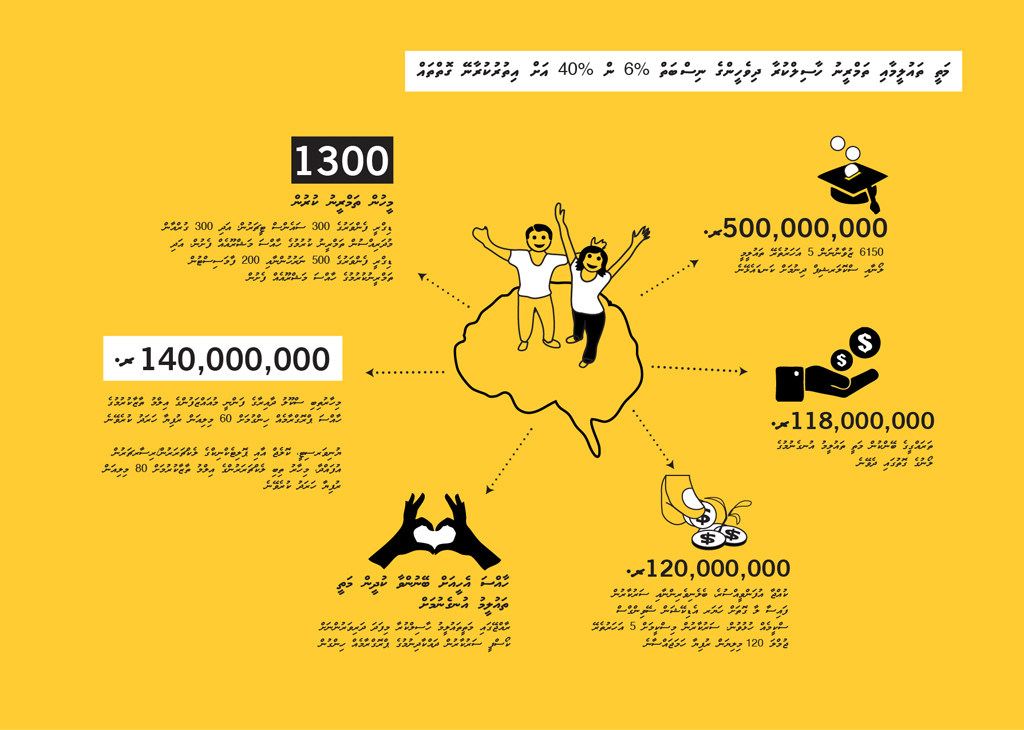
MDP launches higher education policy, pledges raising enrolment rate to 40 percent

The Maldivian Democratic Party (MDP) unveiled its higher education policy in simultaneous events across 19 islands and two cities on Friday (June 14), pledging to raise the enrolment rate from six percent of school leavers to 40 percent in the next five years.

Launching the policy in the island of Naifaru in Lhaviyani atoll, former President Mohamed Nasheed said that the MDP’s objective was to usher in “a golden age” for higher education in the Maldives.

“We cannot let students finish their education after they complete O’ Levels. A student who wants to pursue higher education, even if he barely passed, will have that opportunity,” the MDP presidential candidate said.

The government would allocate MVR 500 million (US$ 32.5 million) in five years to issue student loans, provide scholarships and conduct training programmes, Nasheed said.

He added that island councils would be tasked with assessing the types of scholarships and higher education opportunities most needed for development of the island.

The Maldives shares its six percent enrolment with Somalia and Bangladesh, while developed countries such as South Korea have a rate higher than 90 percent. Neighbouring Sri Lanka meanwhile has a 15 percent enrolment in post-secondary education.

The MDP proposes in its sixth “mini-manifesto” to introduce an education fund, provide student loans with long-term repayment schemes, open new universities, colleges and institutes with campuses across the country, and conduct skills training programmes.

The party’s policy targets include the construction of two hostels or dormitories in the Male’ region, improving the Islamic studies faculty, establishing an Information Technology College, and setting up institutes for boat building, maritime training, medicine, fisheries and sports under public-private partnership (PPP) projects.

Other targets include inaugurating an education savings scheme with the government to match deposits by parents, providing plots of land to private education institutes, giving grants for financially-disadvantaged students, securing opportunities for 2,000 students to study medicine, covering course fees for students with special needs and issuing MVR 118 million (US$ 7 million) worth of student loans from a development bank during the next five years.

According to the policy, the monthly repayment for the student loans would not exceed eight percent of a borrower’s monthly income.

Moreover, the policy proposes upgrading the polytechnic institute to ISO 900 standard and establishing new faculties at the National University.

In addition to the proposed higher education opportunities, the policy also includes special projects to train 300 science teachers, 300 Quran teachers, 500 nurses and 200 pharmacists as well as an MVR 80 million programme for the improvement of lecturers.

The ‘Hunaru‘ skills training programme meanwhile targets the creation of 17,350 jobs.

On the MDP’s achievements during its three years in government, the mini-manifesto noted that the country’s first national university was inaugurated in February 2011, the first national polytechnic institute was opened in April 2010, a research center was established in Faafu Magoodhoo in collaboration with Italy’s Milano-Bicaco University, a TIVET (technical and vocational education training) authority was set up, a ‘Hunaru’ programme was commenced to train 8,500 workers in late 2011 and four private colleges were registered.

In addition, the government resumed work on a new building for the National University’s hospitality faculty, opened a hostel at the Kulhudhufushi campus, issued student loans worth MVR 300 million, facilitated significant increases in the number of scholarships offered by friendly nations, secured more than 60 tuition-free scholarships from the Bangalore Garden City College and compiled a report with World Bank aid on proposals for providing opportunities for post-secondary education.

Last week, President Dr Mohamed Waheed pledged to establish a housing policy for the people of Male’ as part of his campaign for the upcoming presidential election.

Likes(0)Dislikes(0)

Council will respect sister-city agreement with Taiwanese city of Kaosiung: Mayor Manik

Male City Council Mayor Ali Manik has said the council will respect its sister-city agreement with Kaosiung City in Taiwan, despite the government’s denouncement of the move.

Following the signing of the agreement in Male’ on June 9 with a delegation from Kaosiung, the Maldives’ Ministry of Foreign Affairs issued a statement reaffirming its “commitment and support to China’s national unity and to the one-China Policy.”

“The Maldives’ firm conviction of one-China policy is guided by the principles of respect for sovereignty, territorial integrity and non-interference in the internal affairs of states and considers Taiwan as an integral part of the People’s Republic of China,” the government stated.

“This is an agreement between cities, not countries,” said Mayor Manik. “Our constitution does not say anything about not being able to make such agreements.”

“The attorney general has said we need to get permission from the president. This is not true. We don’t have to get permission. That is not in the constitution,” he added.

Following the signing of the sister-city agreement and the delegations inspection of Male, Manik said Kaosiung would report on the kind of assistance the city would be able to provide, such as technical assistance with waste management, roads, infrastructure, education and training.

“We ask the government not to obstruct us from doing something that is for the benefit of Male. [The agreement] is not illegal,” Manik said.

The agreement came about after the council met Kaosiung officials, including the Deputy Mayor, during a local councils conference held in Hyderabad in India last year.

That led to an invitation for a delegation from Male’ City Council to visit Kaosiung in November 2012, for which the host city provided tickets and accommodation, Manik said.

Male City Council is dominated by the opposition Maldivian Democratic Party (MDP), the leader of which contends he was ousted in a coup on February 7 2012 by current President Mohamed Waheed. The bitter political polarisation has put the council at loggerheads with the Maldivian government for more than a year.

The Taiwanese Ministry of Foreign Affairs (MOFA) has meanwhile disputed allegations that the Maldivian government’s decision to reject the agreement was made under Chinese pressure.

During a MOFA press conference reported by the China Post, spokesperson Anna Kao noted that Taiwanese cities had established sister-city ties with cities around the world without incident, and suggested that politics should not interfere with such exchanges.

“We urge the Maldivian government to respect its cities’ efforts to advance ties and business and people-to-people exchanges with Taiwanese cities,” said Kao.

Likes(0)Dislikes(0)

Maamendhoo Island Council calls for football funding to combat violence, drug abuse

A lack of support from the Ministry of Youth and Sports for youth activities, particularly football, on Maamendhoo Island in Laamu Atoll has resulted in violence and drug use according to the island council’s president.

“The government has not provided funds for youth sports or activities here, it’s very sad,” Maamendhoo Island Council President Ali Shifaz told Minivan News, during a visit to the island.

“Football, and other sports, are very important because we need our youth to be away from bad habits,” Shifaz explained.

“Youth getting involved in drugs and fighting is a big issue, but normally football players don’t get involved in those things,” he continued. “They have no other time for drugs and fights.”

“For the last two or three months there have been no fights because of football. It’s a good way to compete and Maamendhoo is very peaceful as a result,” Shifaz noted.

Ultimately, problems ebb and flow depending on the support for youth activities the island receives, explained Shifaz.

“Eighty percent of the island’s youth play football, therefore we need to have a big effort to support them,” he added.

Unfortunately, fighting between youth from Maamendhoo with young people of nearby islands has become a problem because positive activities are not being funded and supported on those islands either, according to Shifaz.

In early 2012 Nasheed pledged to flatten football ground, put up fences, build a basketball court behind the stadium, and a bashee court for the women, explained Shifaz.

The football ground was recently built on Maamendhoo, however the island has also requested a youth centre – with ‘garlando’ (foosball) and billiards – be built so other youth who do not play football will have activities that prevent them from engaging in ‘bad habits’.

“I’m involved with an NGO here and I hate to say it but now our NGOs are not working properly, because they are not getting what they need to function in a proper way,” Shifaz lamented.

Lack of footballs

“They have very good players, I was very impressed,” former Victory Sports Club coach Abul ‘Abjee’ Jaleel told Minivan News.

“If youth team wants anything we discuss with the Island Council and they call the Ministry of Youth and Sports,” said Maamendhoo football player Mohamed ‘Kalho’ Nasheed.

“Before during [former President Mohamed] Nasheed’s time the ministry provided funding, but now we don’t get anything,” he explained.

“To buy balls the players contributed their own money. The sports team really collaborates,” he continued.

Previously the Maamendhoo football players only had one ball, but have managed to buy eight. They have also arranged a coach to come about three times a week, but there are no funds for his equipment either.

“There also used to be an atoll football competition, but this year there has been nothing,” Kalho lamented.

Youth and Sports Ministry response

“Maamendhoo happens to be the first island we helped after we assumed office early last year,” Youth and Sports Minister Mohamed Hussein ‘Mundu’ Shareef told Minivan News.

“The ministry contributed MVR 80,000 (US$5200) for the construction of the Maamendhoo football ground which was completed last year,” said Shareef. “So the allegations [that Maamendhoo is not receiving support from the Ministry] are rubbish.”

“Rather than complaining they should be pleased,” he added. “It was a long-pending pledge by Nasheed to develop the football ground which was not delivered.”

“It is a petty political problem or they have a short term memory,” said Shareef. “There are no pending requests from Maamendhoo, if there were it would be a different story.”

Shareef explained that he made it a point to review and implement all the pending pledges and corresponding paperwork for the sake of continuity.

“It’s not the fault of the youth that the government changed,” said Shareef. “We don’t differentiate between big and small islands or look at the political leanings of the island councils.”

In the past 15 to 16 months the Youth and Sports Ministry has helped 87 islands, which account for half the population, according to Shareef.

“There is not a single island we have not touched,” he declared.

The entire Youth and Sports Ministry’s budget for the past year was MVR 60 million (US$3,911,340), with MVR 20 million (US$ 1,303,780) allocated to associations – of which 19 are sports associations, according to Shareef.

Previously, MVR 2 million (US$ 130,378) was the total infrastructure budget, which the government quadrupled to MVR 8 million (US$ 521,512) this year, Shareef claimed.

Island football grounds are legally properties of the respective island councils and the Ministry funds the island councils, which are ultimately responsible for the development and maintenance of the grounds, Shareef explained.

Likes(1)Dislikes(0)

Elections Commission confident of resolving all voter registry issues

The Maldives Elections Commission (EC) has said it remains confident it will have resolved all 2,279 complaints raised by the public over the recently published list of eligible voters, in line with today’s deadline (June 14).

EC President Fuad Thaufeeq told Minivan News that the commission’s work amending the voter registry had so far gone “better than expected”, with all submissions received from the public amended. However, he conceded that challenges still remained in notifying all the complainants about the changes made to the list, as required by regulations.

“The challenge we have experienced so far is delivering the message to all the people who made these complaints that the requested changes have been made,” he said. “It is proving a bit difficult, though our staff are working very hard, in some cases up until 10:00pm at night to get hold of them.”

Transparency Maldives has meanwhile said that it has received only one significant complaint at present regarding outdated voter registry information, adding that all other complaints raised were small and sporadic in scale. However, the NGO said it continued to advocate a simplification of the present law on making further changes to the voter registry.

Thaufeeq said the corrected voter registry will then be published on either June 15 or June 16 in the government gazette and on the EC’s own website.

“What happens next?”

According to Transparency Maldives, anyone who has registered complaints with the EC regarding data on the voter registry will have five days to file a complaint with the High Court should they wish to appeal any decision made by the commission.

Under law, the High Court is then required to rule on any such appeal within 15 days.

Upon publication by the EC of the amended voter registry, any Maldives national over 18 will then be given a further 10 days to lodge any complaints concerning changes made to the list, the NGO added.

Transparency Maldives said the final process would be voter re-registration, where members of the public will be required to confirm or change their present permanent residence either in the country or abroad to confirm where they wish to vote.

The NGO emphasised that this stage will be critically important, as a person from an outer atoll presently living in Male’ will be required to return to their home island unless they re-register their new location with the EC.

A date for voter re-registration to begin has yet to be decided by the EC.

Simplification

Transparency Maldives Project Director Aiman Rasheed said the NGO had so far received only one significant compliant about the registry, which was made by members of Fuvahmulah council concerning the amount of outdated details of islanders on the list.

“The last time we spoke to the EC we raised this issue and they had a rational explanation for what had occurred. It seemed that people who moved house on the island or left for Male’ had not been updated,” he said.

Aiman said the EC had dealt with the issues where possible, with other corrections expected to be made during the re-registration process that will be announced at a later date.

“Apart from this, there have been no major complaints beyond some small, sporadic issues,” he added.

Aiman said that with an estimated 25 percent of the population living away from their registered address in the Maldives, re-registraton was expected to be a much larger issue towards ensuring the vote to everyone in the country eligible to do so.

He argued that the NGO still believed the voter registration could be simplified by requesting the public to check their permanent address at the same time as other details on the registry.

“The argument against this has been from the section of the population employed as fishermen, as they do not know where they will be later on in the year. It was therefore easier for them to wait nearer to the election,” Aiman said. “There is a challenge there, but we still feel [voter registration] should be simplified. This is of course not the EC’s fault though, this relates to the law.”

Likes(0)Dislikes(0)

President Waheed met with angry protests during “bittersweet” campaign trip to Thinadhoo

President Mohamed Waheed’s maiden campaign trip to Thinadhoo in Gaaf Dhaal Atoll was met by hundreds of angry protesters who came out in opposition to the government’s heavy crackdown on the island following Waheed’s controversial ascension to power on February 7.

President Waheed has launched his presidential campaign under the slogan “forward with the nation”, after unveiling Ahmed Thasmeen Ali – leader of government-aligned Dhivehi Rayyithunge Party (DRP) – as his running mate.

Waheed is backed by what he contends is a “broad-coalition” of political parties including his own party Gaumee Iththihaadh Party (GIP), the DRP, Dhivehi Qaumee Party (DQP) and religiously conservative Adaalath Party (AP).

At present, Waheed and Thasmeen will be standing against former President Maumoon Abdul Gayoom’s Progressive Party of Maldives (PPM) candidate Yameen Abdul Gayoom – Gayoom’s half brother, and opposition Maldivian Democratic Party (MDP) candidate former President Mohamed Nasheed.

He is also expected to face a candidate from the government-aligned Jumhoree Party (JP), presently led by MP Gasim Ibrahim.

Following the scuffle on Thinadhoo – Waheed’s mother’s home island – the President expressed frustration over the incident on social media service Twitter, in which he blamed Nasheed and the MDP and declared that such actions “do not bear well for a free and fair election”.

Speaking to local newspaper Haveeru, Waheed’s party Gaumee Iththihaadh Party (GIP) spokesperson Abbas Adil Riza alleged a group of MDP supporters came out to protest against Waheed. Some protesters also assaulted MP Ibrahim Muthalib from the Adhaalath Party, he alleged.

Riza claimed that Muthalib was saved from the protesters after the police intervened and calmed the situation.

According to media reports, objects including water bottles were also seen thrown at Waheed.

Thinadhoo saw some of the strongest reactions to the February 8 crackdown on protesters in Male’, with government offices and police stations destroyed across the island. Islanders were also reported to have blockaded the arrival of police reinforcements for days afterwards.

Police eventually arrested 17 people and later sent the names of 108 persons involved in the demonstrations for prosecution.

Family members no longer speak to me: President Waheed

Speaking at a campaign rally on the island, Waheed conceded that several family members including those residing on the island no longer spoke with him after the controversial transfer of power on February 7, 2012.

Waheed acknowledged that one of the main reasons why some of his family members had deserted him was that he was now working closely with those who had strong affiliations with former President Maumoon Abdul Gayoom’s 30-year autocratic regime. He said noted that his detractors included his own brothers and sisters, as well as cousins and nephews.

“It feels like they are trying to say that their brother doesn’t love them that much – and that is why he is working with people who we hate,” Waheed observed.

Waheed also spoke to the islanders about how his mother was subjected to torture and inhumane treatment following her mild criticism of Gayoom’s regime.

“As you would all know, back [during Gayoom’s regime] the political environment was such that criticising the government was a big crime. My mother while watching the TV said that Gayoom had lied. After that it was a very bitter experience,” he recalled.

“The poor lady was dragged to court, people gathered around her on the streets and pulled her hair, spat on her and committed other derogatory acts at that time in Male’.”

Waheed claimed that his mother never had any involvement in local politics and admitted that none of his family members would forget how Gayoom’s regime treated his mother.

Waheed said that despite this, the circumstances following the controversial resignation of former President Nasheed required him to take over the presidency. For that reason, Waheed said he had invited all political parties in the country to join his government.

“Among these [members of political parties] included those who caused such grief to my family. It is not that I don’t know who these people are, or that I chose to work with them. What was best for the country at that moment was for me to set aside my personal vengeance and to prioritise the country before my personal emotions,” he contended.

“Some of my family members could not take that. The result was that some of them, to this date, do not speak with me. Some of them even live in this island,” he said.

“Arriving in Thinadhoo gives me a bitter-sweet taste,” he added.

February 7

Nasheed’s arrest of Chief Judge of Criminal Court Abdulla Mohamed led to 22-days of continuous anti-government protests initiated by religious scholars and opposition leaders. This culminated in a police and military mutiny and the controversial stepping-down of former President Mohamed Nasheed on February 7, 2012.

Waheed – who was then vice-president – had shortly before the resignation publicly come out against Nasheed and joined the revolt, meeting key opposition party members in his residence at late hours the previous week.

Less than four hours after Nasheed resigned, Waheed took oath as the President, dismissed all Nasheed’s ministers and formed a coalition government with Nasheed’s political opponents.

Following the regime change, thousands of demonstrators came out in protest. Police retaliated with a brutal crackdown in front of international media.

The protests quickly spread across the country leading to arson attacks against government offices and the police stations.

“In essence, my statement is very small… I was forced to resign. I resigned under duress. I was threatened. If I did not resign within a stipulated period it would endanger mine and my family’s life. I understood they were going to harm a number of other citizens, party members. They were going to literally sack the town. I felt that I had no other option, other than to resign,” Nasheed told the Commission of National Inquiry (CNI) that later investigated the transfer of power.

Despite the claim, the Commonwealth-backed CNI which included Waheed’s three hand-picked members, a Singaporean judge chosen by the government and a single representative from Nasheed who resigned in protest, dismissed allegations of a coup.

Subsequent legal analysis of the CNI final report by a team of high-profile Sri Lankan lawyers – including the country’s former Attorney General – accused the commission of exceeding its mandate, selectively gathering and acting upon evidence, and failing to adequately address the fundamental issue with which it was charged: determining whether former President Mohamed Nasheed resigned under duress.

Waheed has repeatedly dismissed the allegations and police have threatened to arrest anyone calling them ‘Baaghee’ (‘traitor’).

Likes(0)Dislikes(0)

Civil Court issues injunction blocking JSC from further action against Chief High Court Judge

The Civil Court has issued a temporary injunction ordering its own watchdog body, the Judicial Service Commission (JSC), not to take any further action against Chief Judge of High Court Ahmed Shareef until it rules on a case concerning his suspension.

The new injunction issued by the Civil Court orders the JSC not to take any action against Chief Judge Shareef that would undermine his rights. The order will take effect until proceedings in the case filed by Chief Judge Shareef conclude.

Chief Judge Shareef’s lawyers originally requested the Civil Court invalidate JSC’s suspension but the court there was no reason to issue such an injunction.

In May the JSC ‘indefinitely suspended’ the Chief Judge over a complaint filed against the judge last year.

During a press conference held by the commission to announce its decision, JSC Chair and Supreme Court Justice Adam Mohamed Abdulla insisted that the disciplinary action had no relation to the ongoing High Court case filed by former President Mohamed Nasheed contesting the legitimacy of the Hulhumale’ Magistrate Court bench, appointed by the JSC.

According to Justice Adam Mohamed, the suspension was a “precautionary” measure while investigation of the complaint was proceeding.

“There are no legal grounds to stop looking into a complaint submitted [to the commission] or halt proceedings,” he said.

Shortly after the suspension, attorneys representing the High Court Chief Judge led by former Attorney General and President of Maldives Bar Association Husnu Al Suood filed a lawsuit at the Civil Court challenging the suspension.

Suood said Chief Judge Shareef had been suspended in contradiction of existing laws, and the decision undermined the independence a judge requires in executing his legal duties.

He said the Chief Judge’s team of counsels will plead in court that the decision by the JSC was an attempt to unduly exercise influence over judges. He also added that once the case is registered at the Civil Court, a request will be made at the Supreme Court to take over the case, as has been the previous practice.

“That is not a small thing when you get a suspension after one year. Suspending a country’s Chief High Court Judge  is not a small thing,” Suood told local media.

He also said the JSC’s passing a motion to suspend the judge with a vote of just three members – two of whom represented the executive – led to presumption that the vote had been influenced.

According to local media reports, the call for an indefinite suspension of the Chief Judge was proposed to the JSC by the incumbent Attorney General Aishath Bisham – who is yet to receive parliament’s consent following her appointment – and was passed by the vote of three members out of the 10-member commission.

“There is reason to believe this decision had political motives behind it,” Suood claimed at the time.

Likes(0)Dislikes(0)

Government paid Baroness Scotland £50,000 in excess of agreed consultancy fee

The government paid former UK Attorney General and member of the House of Lords, Baroness Patricia Scotland, £50,000 (MVR1.25 million) in excess of an agreed fee for legal advice concerning the Maldives’ suspension from the Commonwealth Ministerial Action Group (CMAG), the 2012 audit report of the Attorney General’s Office (AGO) has revealed.

The audit report (Dhivehi) made public yesterday (June 11) revealed that a terms of reference (ToR) to hire an unnamed foreign legal expert was signed by the AGO on May 28, 2012, after the Maldives was suspended from CMAG – the Commonwealth’s human rights and democracy arm – and placed on its formal agenda following former President Mohamed Nasheed’s allegation that he resigned “under duress” on February 7, 2012 amid a violent mutiny by sections of the police and military.

Auditors discovered that the legal expert – revealed in the media at the time to be Baroness Scotland – was paid £50,000 without signing a formal agreement in addition to a consultancy fee of £75,000 (MVR 1.81 million) agreed upon in the ToR.

“The Attorney General’s Office informed [auditors] that the fee paid in excess of the agreed upon fee was for further advisory and drafting work that was required,” the audit report stated. “However, we note that this additional legal advice could not be discerned [from any documentation].”

As the additional fee was 66 percent of the consultancy fee included in the ToR, “this office believes that the work could not be done without both parties signing an agreement in accordance with section 8.22 of the public finance regulations.”

Section 8.22 stipulates that consultancy work needs to assigned on the basis of a contract with specific terms mutually agreed upon.

Auditor General Niyaz Ibrahim therefore recommended legal action against the responsible officials as the excess amount was paid in violation of article 47(b) of the Public Finance Act.

The audit report also noted that the AGO spent MVR108,902 (US$7,062) on plane tickets and accommodation for Baroness Scotland and her assistant for a visit to the Maldives, despite the lack of provisions for the expenses in the ToR.

The Auditor General’s Office recommended that such expenses for amenities along with fees for any additional work should be stated in the contract.

The report also revealed that the AGO spent MVR 16.9 million (US$1 million) in excess of the annual budget for the office approved by parliament.

A total of MVR 16.3 million was spent with approval from the finance ministry for consultancy work by foreign legal experts, the report noted.

The Auditor General’s Office contended that the expenditure in excess of the approved budget was in violation of article 96(c) of the constitution, the Public Finance Act, and public finance regulations.

Article 96(c) of the constitution states, “No supplementary expenditures shall be added to an approved budget without further approval by the People’s Majlis. Expenditures included in the budget shall be applied solely for the specified purpose.”

Among the cases for which the AGO sought foreign legal assistance were the termination of a concession agreement with Indian infrastructure giant GMR to develop the international airport, disputes concerning a border control agreement with Malaysian firm Nexbis and payments owed for the “Maldives Asset Tracing, Recovery and Repatriation Engagement” investigation launched in 2010 by the now-dissolved Presidential Commission.

The audit report revealed that a ToR was signed with a Singaporean law firm on March 1, 2012 for legal assistance concerning the contract disputes involving GMR and Nexbis.

Following the cancellation of the concession agreement with GMR, the law firm was retained under a second ToR for the arbitration process currently ongoing in Singapore.

The audit found that neither the fee nor expenses for the lawyers were stipulated in the ToR as required under section 8.22 of the public finance regulations.

Instead, the Singaporean law firm was to bill the AGO for its services at a price of its choosing, the report stated.

The AGO paid the firm a total of MVR 7.1 million (US$460,440) in 2012 for legal assistance and other expenses.

A British lawyer was also hired in November 2012 until the conclusion of the arbitration process involving the GMR contract without signing an agreement stipulating the price as required by the public finance regulations.

The AGO paid the lawyer MVR 1.2 million (US$77,821) in 2012.

The Auditor General recommended legal action against the responsible officials at the AGO in accordance with article 48 of the Public Finance Act.

Among other cases flagged in the audit report as ostensible violations of public finance law, auditors discovered that the AGO spent MVR 76,810 (US$4,981) for purchases and services without approval from senior officials as required by section 8.05 of the public finance regulations.

Moreover, the AGO bought airplane tickets worth MVR 45,994 (US$2,982) without seeking prices from at least three parties as required by section 5.03 of the public finance regulations.

Baroness Scotland

In August 2012, Minivan News obtained the terms of reference document for the contract, which was signed by then-Deputy Attorney General, Aishath Bisham, who succeeded Aishath Azima Shukoor in April 2013.

The leaked document also included a letter in Dhivehi sent from the Attorney General’s office to Finance Minister Abdulla Jihad requesting authorisation for Baroness Scotland’s “unprecedented work/expense” following her visit to the Maldives.

“There was no contract made. With this letter we ask if attached terms of reference are sufficient as a contract,” the AGO wrote.

Following media reports in the UK, then-Attorney General Azima insisted that the expenses for Baroness Scotland were made out of the proper budget code with approval from the finance ministry.

Baroness Scotland came under fire in the UK press after the story emerged in the Daily MailThe Mail established that the peer and former Attorney General had not listed the payment from the Maldives on the House of Lords’ register of members’ interests.

“Her entry says she has set up a firm to provide ‘private consultancy services’ but says it is ‘not trading at present’,” the Daily Mail reported.

In a statement, Baroness Scotland confirmed she had been “instructed by the Attorney General of the Maldives to give legal advice”, and slammed the leak of the terms of reference and “all communications passing between myself and the Attorney General, whether written or oral, pertaining to the nature and extent of that advice, as confidential and legally privileged.”

She additionally claimed to have been approached by both the government and the opposition, and said she had accepted an invitation to chair a roundtable “at which all parties are to be invited.”

“I am a senior barrister with specific expertise in the area of constitutional law, criminal and civil law reform, and am skilled in mediation,” she explained.

Baroness Scotland was previously scrutinised by the UK press in 2009 after she was found to have been employing an illegal immigrant as a housekeeper in her London home.

As the story emerged, MPs from the UK’s Conservative Party – which has long backed Nasheed and the Maldivian Democratic Party (MDP) – seized the opportunity to attack the former UK Labour Party Cabinet Minister.

Conservative MP Karen Lumley told the Daily Mail that is was “disgusting that a former British attorney-general should take a well-paid job advising the new regime, which has no democratic mandate. President Nasheed was overthrown in a coup and the Maldives is now very unstable. Many of my friends there have been arrested by the new regime.”

Conservative MP John Glen told the paper that Baroness Scotland should “hang her head in shame”.

“What happened in the Maldives was a military coup,” he said, adding that it was “outrageous” that the former AG should be “advising a regime responsible for ousting a democratically-elected president.”

Former Maldives High Commissioner to the UK, Dr Farahanaz Faizal, described the government’s employment of Baroness Scotland as “absolutely shocking. If the government wanted legal advice to support the AG’s Office, the proper way is to request the UK government bilaterally.”

“To think that someone of her calibre would undertake an assignment to check if Foreign Ministers of Australia, Canada, Bangladesh, Jamaica, and others of CMAG had acted against their mandate is disgraceful,” Dr Faizal said.
Likes(0)Dislikes(0)