“It’s not as friendly as it used to be”: the price of politics on Maalhos

Eid brings Muslims worldwide together in a shared sense of celebration. It is also a litmus test for change.

Earlier this year councils were elected for the first time on Maldivian islands. Although they allegedly give islands a larger voice in the national dialogue, in some places the shift has rearranged community life.

“The activities are less common – women don’t play and men do less for Eid,” said Haleema Adam, a Maalhos resident.

Her daughter Nazeera attributed the shift to the advent of multi-party democracy.

“The democracy and party systems created divisions, now people don’t always agree on things,” she said. “Now, people make distinctions by party lines. They still go to the celebrations and help cook for big events, but it’s not as friendly as it used to be. If [our family] plans a party, the others won’t come,” she said.

In keeping with most reports from Maldivian islands, Maalhos residents do not find solutions in aggression. “They don’t show anger in the face,” said Nazeera. “But in the heart it’s there, so they don’t want to play at Eid.”

Eid activities are a favored pastime – ask most islanders on Maalhos about the festivities and they will smile as they recollect a favorite food, game or performance. Yet as young people move to Male’ and technology becomes more accessible, the strongest memories seem to rest with the elderly.

At Ramazan, a conche shell is traditionally blown to signal to other islands that the holiday is being observed. Lately, television and radio have eliminated the need, and therefore the tradition.

Electricity has been a useful advent, however. According to Nazeera, boys and girls no longer have to wait for a full moon to play gon kulhun, a night time game of tag and capture.

Aneesa Adam has many grandchildren, and has lived on Maalhos for most of her life. She remembers a swing that was traditionally hung from a tall palm tree before Eid prayer and used by children throughout the holiday.

“Now, the really tall palm trees have gone,” she said. “They were cut down to build the jetty. A nearby resort bought the trees and in exchange built our jetty.”

The game of fankulhun, a palm leaf version of dodge ball played by women, has fallen in the wake of uncompromising fashions. “Now, we’re too fashionable, too western to play those running games,” said Aminath Nasiha. Another girl gestured to her hijaab.

The changes in Eid traditions are most noticeable by women, who note that activities faded with the rise of Islamic fundamentalism.

“Religious people don’t like activities that gather men and women together. Those who are in charge of the activities have also become more religious, so they can decide what happens,” said Haleema. “Islanders like the activities, women especially, but most have stopped with religion. We don’t like the change.”

“We used to have Women’s day and Fisherman’s day and all those days,” said Haleema. “The women would cook and we’d bring the food in a keyn (large dish) to the school, because it was the only communal space big enough for everyone to gather.” She said the practice stopped four years ago when sheikhs disapproved.

Maalhos residents used to cook on the 40th day after a death to remember the life of the deceased. “We thought it was a Muslim tradition, but now they are saying it is a waste and not good,” said one resident.

Mosques have been gradually segregated over the years, but now women report being told to pray at home. Maalhos has four mosques, two for men and two for women.

Entertainment has been restricted as well. Haleema said local authorities oppose concerts and dance shows as well as a variety of traditional activities. On a quiet island, few options remain.

Several sports-based games featuring women are less common, or are played on a quieter level within families or household units. Women interviewed said they used to play bodu beru, a traditional drumming music still featured at most events. None could explain why they had stopped.

At a bodu beru celebration this Eid girls encouraged onlooking foreigners to dance. When asked if they would join, most girls gestured to their hijaab or burqa and shrugged. “You should have come two years ago, I was dancing then, oh!” said one girl. “But then I took up this [burqa], and that changed.”

“It’s just not very comfortable to dance with this long dress,” said another.

Likes(0)Dislikes(0)

Five lessons for the Arab Spring learned in the Maldives: Time

“Observers of the Arab Spring are wondering what will become of these revolutions once the euphoria subsides and the struggle over democracy grows apace,” writes Jyoti Thottam for Time Magazine.

“There is one corner of South Asia where these questions hit particularly close to home.

In October 2008, voters in this 100 percent Sunni Muslim nation decisively threw out Maumoon Gayoom, the man who had ruled the Maldives for 30 years, making him Asia’s longest-serving ruler. The 41-year-old Nasheed, a human rights activist and longtime critic of the regime, became president, riding a euphoric wave of idealism. As one of his allies told my colleague Ishaan Tharoor, ‘We are not interested in revenge. Now is the time to look to our future.’

So what’s happened to the Maldives since then? On a visit there earlier this year, I found a country that was roiled with protests over rising prices and joblessness, where many people were deeply uneasy about the new prominence enjoyed by Islamists and where the former dictator’s presence still loomed large.

“Despite those challenges, its new democracy is firmly in place. Every country will take its own path, but there are some useful lessons.

1. Don’t be afraid of the Islamists.

In the Maldives, the conservative Islamist Adhaalath Party was until recently a key political ally of Nasheed’s government. The partnership, while it lasted, wasn’t easy. To keep the Islamists happy, for example, Nasheed did little to change the country’s extremely punitive apostasy laws. In an interview with me in Malé, Ahmed Shaheed, a top foreign policy official in Nasheed’s government, explained the rationale for working with the Islamists — their grassroots appeal: ‘That’s where the mullahs excel. On a daily basis they talk to them, five daily prayers, other events, in constant touch with them and as Muslim people who want to know about Islam, about rituals and so on so there is a lot of contact between the mullahs and these lot.’

It turned out that their popular support in local elections wasn’t as strong as anticipated. But the Islamists aren’t just a political force; they’ve also been pushing for the establishment of religious schools, and for expanding the extensive links between madrassas in Pakistan and students from the Maldives.

For all those reasons, Nasheed wanted to keep the Islamists involved in the political process, rather than allowing them to develop into a separate, unaccountable power center. At least for now, the strategy seems to be working. I spoke to Ibrahim Fauzee, head of the extremely conservative Islamic Foundation of the Maldives and a former inmate of Guantanamo Bay (he was picked up in Pakistan in 2002 and repatriated without charges after three years). He does not, however, challenge the legitimacy of Nasheed’s government. He told me: ‘Now we have much more freedom, because we are opening our eyes to the world, following democracy. The nation is going to accept democracy. It’s encouraging us to promote religious activities. We can hold programs. Before, it’s not easy to arrange events in open areas.’

Those events and programs sometimes make liberal Maldivians shudder. The radical preacher Zakir Naik (said to have inspired the accused would-be American militant Najibullah Zazi) spoke to a crowd of thousands in Malé last year, at the invitation of the Islamic Foundation. The real test will come now, with the Adhaalath Party in the opposition.

2. Do worry about the economy.

During the first week of May, the capital city of Malé went through a week of nightly protests, in which young people filled the narrow streets to express their anger over the government’s decision to partially float the rufiyaa (the local currency), a move that led to a sudden drop in its value and a spike in prices. Many in the government suspected that the protests were organized by opposition parties; whether that’s true of not, it was a wake-up call for the government.

‘It was ironic because in the Middle East we saw people wanting to bring down dictators, and here it is the other way round,’ press secretary Mohamed Zuhair told me. ‘We have already brought down the dictator. Probably what happens here might play out in the Middle East.’

3. Be ready for ghosts.

After he was ousted from power, former president Gayoom wasn’t killed or exiled; he still lives in the capital, Malé, and is still a leader of the Progressive Party of the Maldives. He may never be elected president again, but he still wields an enormous amount of influence – most Maldivians have never known any other leader. Even officials in the government sometimes find it hard to hide their animosity toward the man whom they blame for decades of human rights abuses. When a dictator rules for 30 years, his support networks don’t dry up overnight.

4. Expect pragmatic foreign policy.

During Gayoom’s rule, foreign policy was largely put to the service of keeping him in power. In 1988, when faced with a coup d’etat, Gayoom invited the Indian military in to help him. India obligingly sent in paratroopers and put down the rebellion within a matter of hours, further strengthening the Gayoom regime’s ties with India. Of course, that didn’t stop him from also courting Pakistan — where thousands of Maldivians students have studied in madrassas. Since the new government came to office, those two relationships are still by far the most important. India is the acknowledged regional superpower, although its economic support is now much more important than its military support. And until the Maldives expands and improves its schools, devout Maldivian families will continue to send their children to Pakistani madrassas in the absence of any better option.

5. Create strong institutions, not just governments.

Perhaps the most important lesson — one that I heard over and over in my conversations with Maldivians — is that after dramatic political change, a country has to turn its attention to civil society. The nature of any authoritarian regime is that it extends itself into every institution — from schools to the media to the police and judiciary. The hard work of the post-revolution revolutionaries is taking those institutions back and making them truly independent.

One of the most inspiring people I met was Aminath Arif, founder of the Salaam School and a longtime campaigner for education and women’s rights. She was full of creative ideas to improve the skills and employability of young people in the Maldives so the all-important tourism industry wouldn’t need to bring in so many guest workers. She even supported the radical idea of relocating most of the country’s populations to the two largest islands, to make it more feasible for the government to build bigger, better primary schools. Sadly, she died in July after suffering burns in an accident. Her work, and that of the Maldives’ new democracy, continues.”

Read more

Likes(0)Dislikes(0)

President opens cultural centre in Hithadhoo

President Mohamed Nasheed opened a cultural centre in Hithadhoo of Addu City yesterday, which exhibits aspects of Maldivian culture and tradition.

The President attended the opening of the centre following Eid prayers in Feydhoo, after which he toured the joint islands and extended Eid greetings to the public.

Nasheed also cut a special cake at a breakfast in Maradhoo to celebrate the SAARC summit.

In an interview with Adduonline later in the day, Nasheed said the establishment of infrastructure in Addu City was part of a larger development scheme for the southernmost atoll.

Aside from participating in a Addu City State Square cleaning programme in the afternoon, the President and First Lady took a bicycle tour of the recently completed Hithadhoo main road.

Meanwhile in his weekly radio address on Friday, President Nasheed praised the “impeccable preparations” by the “patriotic citizens” of Addu City, expressing gratitude to the public as well as officers of the Maldives National Defence Force (MNDF) and Maldives Police Service (MPS) for their efforts.

Likes(0)Dislikes(0)

Police forwards case against Gassan Maumoon for prosecution

Police have concluded its investigation into Mohamed Gassan Maumoon, son of former President Maumoon Abdul Gayoom, allegedly throwing a 5-foot plank at protesters outside his residence and critically injuring a 17-year-old and sent the case for prosecution.

Cases against activists of the ruling Maldivian Democratic Party (MDP) were also sent to the Prosecutor General’s Office (PGO) for allegedly damaging private property during the protest on October 20.

Likes(0)Dislikes(0)

STO expresses interest in holding events at Equatorial Convention Centre

The State Trading Organisation (STO) has expressed interest in holdings its events at the newly-built Equatorial Convention Centre (ECC) in Hithadhoo, according to newspaper Haveeru.

STO Managing Director Shahid Ali said the ECC could be used for several events and functions.

“We intend to hold our next Dealers Meeting and the Makita Fair at the convention centre,” he said.

The EXX could be marketed in a similar manner to the Bandaranaike Memorial International Conference Hall (BMIHC) in the Sri Lanka, Shahid said.

Likes(0)Dislikes(0)

Police conducting special operation for Eid holidays

Police are conducting a special operation during the ongoing Eid holidays to maintain security in the capital Male’ while a large portion of the population is out of the island.

The operation involves questioning people who are out after midnight and checking vehicles as well as providing security to closed office buildings.

Police have appealed to the public to take extra precaution to keep homes and offices safe during the holiday.

Likes(0)Dislikes(0)

Palm pyre, koadi and coloured water: Maalhos celebrates Eid

While government officials flock to Addu for international convention SAARC and Male’ residents enjoy a calm holiday atmosphere, islands across the Maldives are welcoming family and friends home for Eid celebrations.

The island of Maalhos in Arif Atoll has been preparing since last week.

Male’-based residents who arrived last Thursday, November 3 spent the following day and evening preparing curries, rice, poppadums and juices for those cousins, children and guests hitching an overnight fishing dhoni from Male’ on Saturday, November 5.

November 6 began with an unofficial sunrise burning of a palm pyre on a beach facing several nearby islands, a traditional signal that Maalhos is celebrating Eid.

Residents later flocked to an extended morning prayer, filling Maalhos’ four gender-distinct mosques. Afterwards the traditional exchange of invitations to eat at neighbors’ houses began, and doors, kitchens and tables became communal property as grandmothers and aunts shuttled dishes and glasses of fruit juice from hand to hand.

A quiet island of population 800, Maalhos actually houses 200-300 people at any given time – most residents live in Male’ or work at sea. During Eid, however, a steady stream of school children, adolescents and mothers-to-be bring gossip and activity into the island streets and homes.

When asked how Eid days compare to typical Maalhos days, most interviewed replied, “It’s the same. We don’t do much, we are just here.” What is their favorite part of Eid? “Food!,” said many, listing favorites such as mahdu (a Maldivian cake), bondi bai (a round rice sweet) and kashi key, a fruit which falls from trees at bowling ball size and is commonly exported for sale in Male’.

One islander observed that Maalhos has shed some of its traditional Eid practices, but maintained that “it’s a very fun holiday, we have food and play. We like to see the traditional cultural games and hear Maldivian music, like bodu beru.”

Eid holidays last one week beginning November 5, however festivities are condensed into the first four days.

In addition to the first days’ morning torch, Maalhos’ youth flirtatiously ambushed each other with sacks and bottles of red water on their way to the sea. Those wearing white walked at their own risk.

In the late afternoon, married and unmarried men challenged each other to a friendly football match near the harbor; women will carry out their own game later today.

Late in the evening, a procession of men dressed as women and old sages paraded through the streets amidst clouds of flour tossed by onlookers (vedhumaa dhiun). Following young male dancers to the island’s president, the leader requested permission to “play” on the second day of Eid. A bodu beru group performed by the harbor in the evening’s finale.

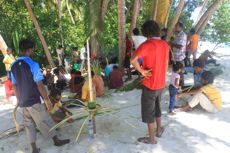
Today, males of all ages assembled by the beach to build the traditional koadi, an array of coconuts, papayas, flowers and coconut palm leaves inscribed with raivaru (poems) recounting local romances and juicy gossip.

“It’s a tradition, but it’s just for fun,” said Koki, a Maalhos girl home for the school holidays. “They march the koadi through the streets with bodu beru and then put it on a girl’s head and chase her. Everyone tries to destroy the koadi by tearing off the palm leaves and passing around the poems.”

Women and children greeted the male procession by tossing sacks and vats of colored water over house walls. Afterwards, procession members paraded Maalhos’ streets with their own colored waters, chasing girls into their houses.

Although Maalhos will not host activities for the next two days of Eid, an islander said the island’s traditions are similar to those of other Maldivian islands.

“I don’t know why we don’t do these celebrations any more, I think nowadays many things are changing,” said islander. A few girls nearby suggested that religion was a factor. He said there was more than just religion, but concluded that “on Maalhos, it will be quiet except for maybe a concert or a football game.”

Traditionally, the third day of Eid is marked with a mahdi and bodumas, a large fish constructed from palm leaves and paraded around the island. Day four is designated for black mali, or people who paint themselves in black and throw black balls at residents, wearing only palm leaf skirts.

Many say Eid’s rhythm isn’t a far cry from the average Maalhos day. A quiet island whose population has mostly migrated to Male’, its holiday habits suggest a strong focus on communal stability rather than a need for razzle dazzle. Minivan’s repeated inquiries about the history of Eid festivities consistently yielded a satisfying, simple response: “It’s tradition, it’s just for fun.”

Likes(0)Dislikes(0)

“I wanted to get rid of Gayoom at any cost”: Abdulla Luthufee’s Sri Lankan interview

Sri Lankan newspaper The Island has published a two-part interview with Abdulla Luthufee, a Maldivian businessman once sentenced to death for his role in the 1988 coup attempt.

“I wanted to get rid of [former President Maumoon Abdul] Gayoom at any cost. As the election process in my country never gave a reasonable opportunity to the opposition, I felt an outside force should be used to oust Gayoom,” The Island reported Luthufee as saying, on the 23rd anniversary of the November 3 coup attempt.

“Due to my close association with the then PLOTE (People’s Liberation Organization of Tamil Eelam) leader Uma Maheswaran, I negotiated for the deployment of an 80-member strong PLOTE raiding party. In fact, we discussed the sea-borne raid since 1987 after the deployment of the Indian Peace Keeping Force in the Northern and Eastern Provinces of Sri Lanka in line with the July 1987 Indo-Lanka peace accord.”

Eighty Tamil mercenaries land on Male’ on November 3, 1988, and quickly took over the airport. However they were caught in a shoot out with military forces in Male’ and were forced to retreat after India deployed 1600 paratroopers to the Maldives on Gayoom’s request.

“Luthufee and another Maldivian had joined a heavily-armed PLOTE contingent on the night of October 29, 1988 on the Mollikulam beach,” writes Sri Lankan journalist Shamindra Ferdinando.

“They left the north-western shores at about 8.30am in two 40-foot long fishing trawlers. Luthufee had the support of several key persons in the Maldivian military, ex-Major Abbas Ibrahim, ex-Corporal Abdulla Shahid and Umaru Jamaal. The trawlers reached Male at 4:30am on November 3, 1988, and having secured the beach without a fight, the group divided into over half a dozen groups and moved to specific targets, including the army barracks, the President’s house and the Deputy Defence Minister’s residence,” Ferdinando writes.

Despite Luthufee’s professed confidence that the coup would be bloodless, nineteen were killed in heavy fighting after the plan fell apart when the PLOTE contingent tasked with taking over the army barracks opened fire on the base rather than entering through a lightly-guarded entry point.

“Had they entered the barracks, the majority [inside] would have thrown their weight behind us. We lost the group leader, and thereby the initiative,” Ferdinando reported Luthufee as saying.

“I didn’t want to kill anyone. I believed those loyal to Gayoom would give up quickly. They wouldn’t have been a match for the experienced PLOTE cadres. Unfortunately, due to hasty action on the part of the group tasked with seizing the army barracks, we gave the game away.”

Further support from rebels already in Male’ failed to materialise, “and the absence of their support made us vulnerable and automatically strengthened Gayoom’s position. But still we could have achieved our military objectives if those assigned to seize Gayoom had succeeded.”

Gayoom eluded the PLOTE team sent to his residence, and was able to contact the Maldivian ambassador in Colombo, Ahmad Abdulla “and Ali Manisha, his Singapore-based advisor.”

The-then Sri Lankan government offered elite troops to quell the coup attempt. Gayoom also reportedly requested assistance from both the UK and US governments.

Then US State Department spokesman Charles Redman told US media at the time that the Maldivian government had asked for assistance in putting down the coup attempt, prompting it to establish a working group to monitor the events.

“The United States and India want to protect the interests of the Maldives government because this is an elected government subject to attack and it has requested assistance,” Redman said at the time.

However eventually it was India that was able to quickly deploy paratroopers and force the rebels to flee.

“We didn’t have a way to escape as we allowed the trawlers to leave as we were confident of seizing control. There was total chaos,” Luthufee told The Island.

“During gun battles we lost two PLOTE personnel, while several received gunshot injuries. We retreated towards the Male’ harbour as Indian paratroopers landed in the capital. We didn’t have any other option other than to seize the Maldivian vessel, MV Progress Light. We got away at about 11am and left the bodies of two PLOTE cadres killed in action. Three PLOTE personnel trying to get away in a rubber dingy were captured.”

The retreating PLOTE group took a small group of hostages, including serving Transport Minister Ahmed Mujuthaba and his wife, and attempted to flee towards Java in Indonesia via waters between India and Sri Lanka.

“We believed the presence of hostages, particularly a minister and his wife, gave us an advantage over those pursuing us,” Luthufee told The Island. “An Indian military helicopter maintained constant surveillance, while we proceeded towards our target. But on the following day at about 4:30pm our radar picked up two objects, and we knew the Indian navy was on its way to intercept us. One of the vessels, subsequently identified as INS Gadavari fired at our ship, though it didn’t cause any serious damage. We kept on course. They contacted us over the ship’s radio and demanded the immediate surrender or face the consequences. A five-member Maldivian defence team, including Major Adam Saheer, was on the Indian warship.”

The pursuing vessel demanded that the fleeing rebels set course for either an Indian or Maldivian port.

“We refused to give in. We demanded mid-sea negotiations to settle the dispute. The Indians started firing at our ship at the behest of the Maldivians onboard their vessel. The PLOTE commander got in touch with their headquarters in Sri Lanka and sought instructions. They received instructions to execute one hostage and throw his body to the sea. In spite of the Maldivian minister in captivity making a desperate bid to avoid the execution of one of the hostages, the PLOTE took one person to the deck and shot him. They threw the body [overboard] and the Indians recovered it. The remaining hostages volunteered to come on the main deck in a bid to discourage the Indians from firing at us. But the Maldivians onboard the Indian warship wanted all of us killed,” Luthufee claimed.

INS Gadavari gave the rebels three hours to surrender unconditionally “or face the consequences.”

“We didn’t stop but proceeded towards Sri Lankan waters. We were about 30 nautical miles away from our position when the Indians opened up with big guns. The minister was among the persons hit during the initial fire. We didn’t fire back as Indian ships were out of the range of our guns. I directed the Filipino engineer to stop the engine. As I was watching him killing the engine, he was hit. We were ordered to jump into the sea and were rescued by the Indians immediately after we raised a white flag.”

Luthufee told The Island he was blindfolded and locked in a toilet on board the Indian vessel as the warships turned back towards Male’, leaving the MV Progress Light to sink behind them.

Speaking to Minivan News in November 2010, South Asian security expert Professor Stephen Cohen recalled his time at the US State Department and noted US involvement in tracking suspected players in the failed 1988 coup.

“It’s a little known fact,” he said. “A passing American vessel transiting in the area picked up the escaping ship and pointed [the pursuers] towards it. I had only just left the State Department but I heard about it. It was a pivotal moment in the country’s history, and its purpose was never quite clear.”
The INS Gadavari reached Male’ to a waiting crowd of Indian journalists a senior military officials, Luthufee recalls, and their presence “prevented Gayoom loyalists from harming us.”

According to The Island’s story, Luthufee was first taken before Gayoom and then to another island, where he was interrogated by Indian intelligence.

“I had an opportunity to tell Indian intelligence what was going on in my country. I have no doubt the Indians realized that the vast majority of people hated Gayoom and his cronies. I won the confidence of the Indians and I have no doubt those in charge of handling the Maldivian issue quickly recognized the need for reforms. Gayoom resented the Indian attitude and moved me to another prison on a different island, where I was held for 11 months,” Luthufee was reported as saying.

Once the Indian witnesses had departed he alleged he was tortured and humiliated in custody. He along with Ex-Major Abbas Ibrahim, ex-Corporal Abdulla Shahid, Ahmed Nasir and 12 captured Tamils received the death penalty, while three others received prison terms: Umaru Jamaal Sikka, Ahmed Ismail Maniku, and Mohamed Naeem.

“Under Gayoom the Maldivian judiciary was nothing but a farce. It was a tool in the hands of Gayoom and his cronies, who used and abused Maldivian law to pursue their agenda. They sought to consolidate their power at the expense of the freedom of the ordinary Maldivians, the vast majority of whom lived a simple life,” Luthufee was reported as saying.

Luthufee credited his survival to the intervention of Indian head of state Rajiv Gandhi, who reportedly summoned Gayoom to New Delhi on September 16, 1989, less than a month after the death sentences were passed, and demanded that they be repealed .

“All of us are grateful to those Indian intelligence officers for briefing the Indian political leadership regarding the Maldivian political crisis. Thanks to them, Gayoom couldn’t deceive the Indian leader,” Luthufee told The Island.

“Gayoom flew back to Male on September 17, 1989. Obviously, he was a dejected man. He declared that he didn’t want to shed anymore blood in Male and commuted capital punishment imposed on us to life imprisonment. We were moved to special cells, which were surrounded by a steel fence at the same facility where we were held. Gayoom’s men enjoyed torturing prisoners. They were rewarded by their masters for being beastly to their fellow countrymen.

Luthufee was reported in The Island as expressing no regret for his role in the failed coup.

“Even now, Gayoom is not happy being an ordinary Maldivian. The ousted leader wanted power at any cost and was trying to undermine the present leader. Maldivians should be cautious of those seeking to play politics at their expense.”

Read the article as it originally appeared in The Island:

Part one (English)
Part two (English)

Likes(0)Dislikes(0)

Jesus on SAARC banners, reports Sun Online

Banners and posters put up at the Ibrahim Nasir International Airport to promote the SAARC summit in Addu City feature the image of Jesus Christ, reports Sun Online.

The online paper reported that it received a number of calls complaining about the Christian imagery.

The visual art set to the theme of ‘Building Bridges’ was designed by local company Mooinc Pvt Ltd.

Mooinc Creative Director Ali Saeed said the designs were based on five themes approved by the cabinet to depict the culture and religion of the eight SAARC nations, where some 10 religions are practiced.

Under Religious Unity Regulations published by the government in September, it is illegal to propagate any other religion other than Islam, to carry or display in public books on religions other than Islam, and the translation into Dhivehi language such books and writings on other religions. Proselytising by foreigners remains punishable by deportation.

The regulations interpret the Religious Unity Act passed by parliament in 1994, which carries a 2-5 year prison sentence for its violation.

An Indian teacher working in Raa Atoll was arrested and deported in October for possession of Christian imagery and a Bible, after another teacher contacted police after finding hymn videos on the desktop of a school laptop.

Kokkattu claimed he had allegedly transferred the files from his personal flash drive by accident.

Kokkattu’s subsequent detention drew media attention in India, and the Global Council of Indian Christians (GCIC) demanded the Indian government seek an apology from the Maldives for Kokkattu’s treatment.

“The lack of justice and the degree of religious intolerance in the Maldives is reflected by the actions of the Maldives government,” GCIC President Sajan K George told Asia News. “This is the worst form of religious persecution. The Indian government should demand an apology for the shabby treatment inflicted on one of its citizens.”

George called Kokkattu’s case evidence of the Maldives’ paradoxical nature. He said the Maldives “claims to be a major tourist destination, yet arrests innocent people,” George said. “This shows its intolerance and discrimination towards non-Muslims as well as its restrictions on freedom of conscience and religion.”

Likes(0)Dislikes(0)