Search for missing Japanese husband persists

Maldivian authorities are working with the Japanese Embassy in Colombo to find the husband of the Japanese woman whose body washed up at the Adaaran Huduranfushi Island Resort last week.

A female body found on August 21 was confirmed to belong to the Japanese woman, age 28, who went missing from the resort with her husband, age 37, on August 17, reports Haveeru.

Local police officials said the body had decomposed after several days in the water, and DNA tests were needed to confirm it’s identity.

Preliminary investigations show drowning as a cause of death. There was no clear indication of foul play.

Management at Adaaran Huduranfushi discovered that the couple had gone missing after they missed two consecutive meals. Resort management immediately notified local authorities, who launched a search for the couple.

Likes(0)Dislikes(0)

Three MNDF officers arrested on robbery charges

Police have arrested three officers of the Maldives National Defence Force (MNDF) accused of entering an expatriate residence in Male’ in army uniform and robbing the Bangladeshi workers with threats of violence.

Lance Corporal Ali Ibrahim, 26, of Lhaviyani Hinnavaru Aaramuge, and Private Hussein Mahir, 23, of Laamu Mundhoo Finifenmaage, were taken into custody Monday night with stolen cash.

Police Sub-Inspector Ahmed Shiyam told Minivan News today that the third suspect, Saad Ibrahim, of Kaafu Gaafaru Noovina, was arrested yesterday after conducting a search for the accomplice.

All three were working at the MNDF coastguard. Ali Ibrahim, who joined the force in November 2004, was employed at coastguard operations while Hussein Mahir, who joined in June 2008, was a security officer at the coastguard building.

In a statement on Tuesday (August 30), the MNDF said it was “working with the police to take the harshest legal action possible” against the errant officers.

According to local media reports, the three officers robbed the expatriate workers living in Maafanu Pink Rose on Fareedhee Magu on a number of occasions during Ramadan.

Newspaper Haveeru reported that the uniformed officers entered the house on three consecutive nights and took Rf30,000 (US$1,945), Rf24,000 (US$1,556) and Rf12,000 (US$778) respectively.

The two officers were reportedly confronted by members of the public on the third night, who informed the police.

Likes(0)Dislikes(0)

STO plans new storage facility in Haa Alif atoll

The National Planning Council has approved the State Trading Organisation (STO)’s plan to build an oil storage facility on an unidentified island in the north’s Haa Alif atoll.

The facility would cover 600 square metres and contain over 200 tons of oil, reports Haveeru. It is said to be 10 times the size of a similar facility at Funadhoo.

STO’s Managing Director, Shahid Ali said studies show the project would benefit the Maldivian economy. He said it has already drawn the interest of foreign investors.

The project is awaiting approval from the Cabinet.

Likes(0)Dislikes(0)

DRP Deputy Leader “disappointed” in party, considers resignation

Dhivehi Rayyithunge Party (DRP) Deputy Leader Ilham Ahmed may resign from his post, reports Haveeru.

MP Ilham Ahmed, of Gemanfushi, is allegedly disappointed with some of the DRP’s internal matters. Ilham told Haveeru that party leader Ahmed Thasmeen Ali appeared to be too close with the government, and said tax reform was one area of concern.

Ilham said he would decide whether to resign in the next 2-3 days.

Former President Maumoon Abdul Gayoom, who Ilham allegedly supports, has given the same deadline for his announcement of a new political party.

Likes(0)Dislikes(0)

Six surfing legends compete for trophy in inaugural Maldives comp

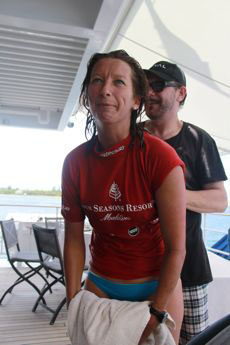
Australian surf legend Mark ‘Occy’ Occhilupo narrowly defeated seven-times female world champion Layne Beachley yesterday in the single fin division of the Four Seasons Maldives Surfing Champions Trophy.

Beachley knocked out two-time world champion Damien Hardman in the semi-final, while Occy defeated world longboard champion Josh Constable to go on to face Beachley.

The first day of the invitational event saw the six surf legends – Occy, Beachley, Constable, and Hardman, as well as four-time world champion Mark Richards and Nat Young, compete at the Sultans break near Four Season’s Kuda Huraa resort.

“This morning I surfed with Mark Richards and I kept on falling off in front of him and he said ‘I’m hexing you’, but it was the pressure of competing against my idol,” said Occy, following his win.

Speaking to Minivan News between heats, Beachley explained that it was unusual for female surfers to compete against men at such an elite level of the sport.

“The ability and depth of skill has really improved in women’s surfing and has helped bridge the gap in performance [at the professional level], but it’s not really fair to pit a lightweight boxer against a heavyweight,” she said. “One big difference is that our hips get in the way when we turn – it’s an anatomical disadvantage. It’s not a worry for recreational surfers but it matters at a professional level because women can never have the technical finesse of the top guys.”

Despite the camaraderie between the champions there was, Beachley noted, a very strong competitive undercurrent.

“When you’re surrounded by world champions there is a mutual respect because we know what it takes, but when we’re paddling out no one’s there to lose,” she said.

“It’s very competitive. No guy wants to lose to a girl. The boys are amped. Their pumped up, even if they’re pretending to play it down.”

Female professional surfers, Beachley observed, tended to take not just the sport but also their responsibility as role models for other female surfers very seriously, and most were “well-spoken ambassadors.”

Beachley herself was on a board at Manly beach in Sydney Australia by age four, competing in mens heats at 15 and turning professional just a year later. By the age of 20 she was ranked sixth in the world, and in 1998 went on to win the world championship for six consecutive years.

“I always took pride in training harder than anyone else. I would be doing boxing, swimming, dune running, weights and yoga. I had a very strict cross-training regime,” she told Minivan News.

Beachley's husband, INXS sax/guitarist Kirk Pengilly, gives his wife a quick massage between waves

Asked about developing the female surfing scene in the Maldives, Beachley suggested that female surfers should “band together, and make sure the guys understand that girls have as much right to be in the water as them. Then work your way up the food chain. Don’t cry victim, it’s not the best way to get respect. Instead show tenacity and confidence and let the guys know it.”

Beginner surfers, she noted, faced not just the technical challenges of learning the sport but also the unspoken etiquette and rules that could only be passed on by other surfers.

“Beginner surfers really need to utilise a surf school,” Beachley said, “not only to because they teach the fundamentals but also the unspoken etiquette. One of the problems with surfing is that the rules are unspoken.”

In contrast to many famously territorial surf destinations, Beachley said the Maldives had a reputation for hospitality and the breaks for being “playful, fun, user friendly, more relaxing and peaceful than places like Indonesia and Tahiti.”

The country’s reef breaks, she said, were more predictable than beach breaks in that they followed a certain shape, and were easier to read.

“With beaches you have to quickly adapt to changes. The advantage to a beach break is that a sandy bottom is softer to land on,” she laughed.

Local surfer ‘Bongo’ was on hand during the Four Seasons competition to help out with conditions.

“Sultans is a right-hander, a very good wave for beginners and intermediate surfers. It has an easy takeoff and a slow first section, with time for 1-2 turns, and a nice barrel inside. On a big day it’s still a challenge. I like hollow right-handers, because I’m a natural footer,” he said.

The day saw offshore winds and 2-3 foot waves, “clean and glassy”, according to Bongo.

The competition, he predicted, would be “good for tourism” given the international publicity the big names would generate.

“Apart from that, we’re lucky to be out here seeing the legends of surfing ripping,” he said.

The Maldives has “2-3 guys like Ibu and Issay who might be able to bust a few aerial maneuvers and maybe challenge these guys, but Occy is tough competition,” he said.

“There’s also the matter of the handicap in the scoring system – older guys get more time in the heats, so I reckon the younger surfers stand no chance.”

He acknowledged that the Maldives had few female surfers dedicated to the sport, “which is really sad.”

“We’ve had a few girls try out, and some of them did very well. The problem is that it’s not easy for them to be out surfing every day, and you take a lot of bumps in a shallow reef break. All surf breaks in the Maldives are reef breaks, which makes it difficult for beginners.”

Despite the laid-back reputation of the sport, surfing remains largely a male-dominated sport with a reputation for being fiercely territorial and hostile for beginners. This was less of a problem in the Maldives given the seclusion of most breaks and the country’s dependence on tourism, he suggested.

“The locals are much more laid back than other places like Hawaii or South Africa, you don’t see scenes like the Hui or Black Shorts here. It’s mainly because all these breaks are secluded and the country is dependent on tourism – everyone is really friendly,” Bongo said.

Dhonveli’s Pasta Point and Huduranfushi’s breaks were exclusive for tourists, he said, “although if we want to surf them we just need to give the resorts a ring and ask. There’s no problem for local surfers.”

Modern surfing was famously introduced to the Maldives by Australian national Tony Hussain Hind, who was shipwrecked in the country but on his departure saw so many perfect surf breaks that he turned around and made the Maldives his home.

“He introduced modern surfing, but before that locals would body surf using planks of wood,” Bongo said. “Really, the full history of surfing in the Maldives is unknown.”

The Four Seasons Maldives Surfing Champions Trophy continues over the next few days with the double fin and triple fin events.

Likes(0)Dislikes(0)

Eid ul-Fitr celebrated in the Maldives

The Maldives celebrated Eid ul-Fitr this week with prayer by day and parties by night. After a month of fasting for Ramadan, residents appear to be enjoying the capital island’s festive, social atmosphere.

The Islamic Ministry announced that Tuesday, August 30 was Eid ul-Fitr this year, and Male’ residents woke early on Tuesday morning to the sounds of heavy metal playing near the tsunami memorial. By late morning, the music had stopped and people were moving among houses and shops and a relaxed holiday atmosphere settled over the usually bustling city.

As ordered by the government, all private vehicles were parked and quiet between 3:30pm and 10:30pm. The traffic ordinance made it possible for residents to walk comfortably in the streets on a day when most of Male’ comes out for a stroll or to see the festivities.

The Islamic Ministry extended prayer space from the Islamic Center to Jetty 1 on Male’s northern side. Women could pray in extended space between the Dhiraagu head office to the Friday Mosque Minaret. Men were allowed to occupy all other areas.

Many Male residents traveled to home islands for Eid this year. But those who stayed enjoyed a range of sports, music and cultural activities.

Lagoons Sports Club organised “Maali Neshun” and “Bodumas Beynun”, Maldivian sporting events, on Boduthakurufaanu Magu and Ameenee Magu on Tuesday afternoon.

In “Maali Neshun”, masked participants dressed in ash and palm leaves walked Male’s roads and frightened parade onlookers in jest.

Two fishermen in “Bodumas Beynun” used magic, or fanditha, to catch a large woven fish.

In the evening, Male’s youth and married couples were to be found in hoards at the live music show in the Raalhugandu area, which was sponsored by local telecommunications company Dhiraagu.

Local bands such as 1knightstand, Harubee, and MNDF Cops Band took the stage alongside solo artists like Unoosha and Easa. The concert, which featured a range of musical tastes from soft rock to metal, rap and ska, began around 10 pm and continued past 2 in the morning.

Just around the corner near Bodufungandu Magu, palm tree road blocks protected a street rave featuring drums and traditional dancers. Young people and families were seen, and heard, celebrating into the late hours of the night.

The five-day period of Eid continues through Sunday. Although business is expected to return to its normal, pre-Ramadan state on Monday, Maldivians are looking forward to a second, longer Eid celebration before the end of the year.

Likes(1)Dislikes(0)

Q&A: Imam Mohamad Bashar Arafat

Imam Mohamad Bashar Arafat is the President of the Islamic Affairs Council in Maryland and founder of Civilisations Exchange & Cooperation Foundation (CECF). Born and raised in Damascus, Imam Arafat was an Imam in Damascus in the 80’s before moving to United States and continuing his work there. He has taught Islamic Studies and comparative religion in various universities in the States and is currently teaching in the college of Notre Dame of Maryland. Imam Arafat talks to Minivan News about whether there is room for individual cultures within Islam.

Minivan News: In recent years there has been a lot of debate about whether the concept of different cultures is compatible with Islam. Do you think there is room for diverse cultures within Islam?

Mohamad Bashar Arafat: In the past 50 years or so there has been an effort by certain countries to influence other countries with their own school of thought, their culture and their tradition. This created a lot of tension between Muslim communities. During my travel to different continents, I have come across this problem with students from Asia, Africa and the Middle East, who talk about this issue. This imposing of a specific culture is something that contradicts the true teachings of the Quran.

The Quran, first of all, gives people the freedom to worship, the freedom to choose their own religion, right or wrong. Allah says ‘there is no compulsion in religion’. So, even when it comes to religion itself, Allah is saying you should not force people to adopt it. Then what about culture, dress or certain ways of life or even songs?

This is a problem we did not see in the lives of the early Muslims that spread out of Arabia in the 7th century AD. They didn’t ask Syrians to change their culture or Egyptians to change theirs as long as it did not contradict the teachings of Quran and the core principles of Islam.

MN: Were there instances in the early days of Islam where a cultural practice contradicted the teachings of the Quran?

MBA: Yes. For example, in Egypt, during the time of the Second Caliph of Islam, Omar ibn al-Khattab, an issue arose over the tradition of ritual sacrifice of a girl to the Nile River. Amr ibn al-A’as, a companion of the Prophet Muhammad and the military commander who lead the conquest of Egypt, wrote to the Caliph.

He explained that Egyptians have a tradition of sacrificing a beautiful girl to the Nile every year and believed that this would get the Nile to flood and overflow onto their parched land. Amr refused permission for the sacrifice, however he wrote that the Egyptians were getting upset over this as the land had little water and the crops were failing. The Caliph praised his actions and sent a paper addressed to the Nile saying, ‘If you flow on your own, then we don’t need your water, but if you are flowing by Allah, we pray to Him to keep you flowing.’ Amr was asked to throw the paper into the Nile as a symbolic gesture for the people to put their trust in Allah. The Nile flooded that year and the practice of sacrifice was stopped. The point of this incident is that in cultural matters, where a person is going to be harmed or where it’s contradictory to Quranic teachings, it should not be practiced.

The Quran created a standard for basic human rights and understanding such that no matter what your culture is, people cannot be harmed or killed as sacrifices to obtain good luck. We cannot deny the basic human right to life in the name of culture. Likewise cultures that associate days of the year in celebration of drinking or eating pork, which is in contradiction with Islamic teachings, should not be continued. The Quran came to curb these cultural practices and improve them. But other than that, when it comes to certain behaviors, folklores and even group dances such as the ones that do not have mixing between men and women, which are in the DNA of societies like Egypt, they are acceptable practices.

Travel through Muslim countries in Ramadan and you will see the cultural diversity in the types of food eaten, clothing worn and ways they honor Ramadan. We should celebrate this diversity and the beauty of Muslims around the world, which varies from country to country in their color, languages and accents, shapes and architectural preferences. Muslims in China have their own cultural flavor, even when it comes to the structure of their mosques.

MN: What about one’s choice of clothing?

MBA: When it comes to clothing, Muslims in Arabia have the Jalaabiyya and the Abbaya, which is part of their culture. The Prophet Mohamad (PBUH) was an Arab. If someone wanted to dress like that out of love for Allah’s Prophet (PBUH) and wanted to dress his children that way, it’s fine, but to impose that on others is wrong. In recent years we started noticing indirect pressure on people and especially on new Muslims – those who have not read a lot or gone deeper into the spirit of the religion. The pressure is to wear his Jalaabiyya a certain way, smile a certain way or even talk in a certain manner, and the same Hadeeth (tradition of the Prophet) is repeated.

The Quran, revealed in Arabic to an Arab in Arabia, is particularly instructive. Despite this, the Quran imparts stories and information about an array of cultures and customs. It tells us about the Egyptians, the Pharaoh and the stories of King Suleiman. It talks of magic carpets and about how the jinn (supernatural creatures) served Suleiman. The Quran talks to us about foods of different people, about other civilisations, and even speaks to us about people of Hell. It is not exclusively a compendium of dogmatic do’s and don’ts; instead it is a treasure trove of cultural, historical, ethical, spiritual, and civilisational information.

The Quran has inspired people, their behavior and even Muslim architectural style. Their cultural diversity is what makes Muslims around the world unique. When you go to Hajj, or pilgrimage in Mecca, you will see Muslims from around the world and can identify them by the unique way they are dressed. You can see that she is from Malaysia, Africa or other regions. The Prophet (PBUH) used to receive garments as gifts from other areas and he wore them. There is a hadeeth about the Prophet (PBUH) wearing an Omani garment, which shows that the Prophet (PBUH) appreciated gifts from other cultures.

MN: How do we differentiate between cultural practices of that time, and ways of living that we have to follow?

MBA: The Sunnah (way the Prophet lived his life) about praying and fasting should be observed. Those that talk about people’s eating habits, like saying the Prophet used to eat with his hands, so you should discard cutlery, is not right. During his time, there was no cutlery. Instead, he taught a proper and hygienic way of eating out of one main serving dish – to use only three fingers and eat from the spot closest to oneself only. Each culture is special and valid in its own practices.

Whether or not they use cutlery does not determine their worth. It is wrong to look down on people when it comes to such. When it comes to breaking the fast, there are certain things the Prophet said to do or recommended, and these we should follow. But when there is no emphasis on other things, it is up to the people to do it the way they want. There are things the Prophet liked to do personally such as fasting on Mondays and Thursdays or fasting for three days in the middle of the month. He liked to do it that way, but nothing exists that prevents us from not doing it.

There is the example of how once when the Prophet (PBUH) and his companions were eating together; the host put a plate of lizard as part of the “meal.” The Prophet (PBUH) asked what it was and when told, he pushed the plate away. One of his companions, Khalid Ibn Waleed, said, “Oh Prophet, is this forbidden?” The Prophet (PBUH) said, “No, I don’t like it, I am not used to it.” Khalid then pulled the plate closer and started eating it.

Some Muslims eat shellfish, while others don’t. As long as there is no prohibition on the food from the Qur’an and the Sunnah, you can eat and indulge in whatever food your culture is accustomed to. Islam’s etiquette about food is that one should not eat until one is hungry and when he eats he should not overindulge.

MN: Give us an example of a time in early days of Islam when there was diverse opinion on issues?

MBA: When the Prophet (PBUH) passed away, the companions spread to other countries. This eventually gave birth to two schools of thought, the Ahl Al Ra’ee (School of Opinion) and the Ahl Al Hadeeth (School of Hadeeth). In areas where there were few companions or people who met them, people would reflect upon issues and come up with their own fatwas, or legal opinions, based on the guidelines of the Shari’ah. They used to be in Iraq. In places like Medina many companions and people lived, who met the Prophet and remembered his life. They relied more on Hadeeth. This shows the diversity in Islam and those from the two schools of thought did not speak badly about one another and differences of opinions were respected.

Nowadays the issue of music is contentious; there are those who say all music is forbidden, those in the middle and others, who are all the way to the left. Keep in mind that during the Prophet’s time, people were taken with the love of the Prophet and no one would think of music and other things because their hearts were filled with something much higher. Music used to be associated with dance, mixing of men and women, drinking and all kinds of vices. It depends on which kind of music you are talking about. Is it music that leads you to haram, or unlawful practices, or is it music that you hear in the news today? Is it a kind of music, which will lead you to forget your Quranic duties and fill your heart more than the love of Allah?

The dress of women is another issue, in certain Middle Eastern countries women cover their entire bodies, while in Africa where it’s really hot, the dress is not as conservative.

Likewise, we see in one school of thought, that of al-Imam Malik is more lenient in certain issues than the School of al-Imam Ahmad Ibn Hanbal, who is stricter. Muslims, who live in the dessert, have characteristics and a culture that are different than those who live in Syria where there are far more trees and water and natural beauty. Even the opinions of scholars living in tough environments are stricter. Environment, culture, and beauty impact people and we see this in the way Muslims live and behave.

MN: It was traditional in the Maldives until very recently to celebrate Prophet Mohamed’s (PBUH) birthday with huge communal feasts. However there has been a drive to stop this practice on the grounds that celebrating birthdays are unIslamic. What is your opinion on this?

MBA: This is another issue; the celebration of the Prophet’s birthday was something that was not practiced by the Prophet (PBUH) or his companions. It was something that started in Egypt during the time of the Fatimid dynasty.

They were the ones who started celebrating the Prophet’s birthday. Yes it’s a bidaah (innovation), but it’s a good bidaah. You are inviting the entire community to make salaah upon the Prophet, to chant, sing and praise the Prophet’s life and character (PBUH). It’s also important to see what people do in terms of celebration; if it’s not contradictory to Islam, then it is fine.

As a boy, I remember that I used to wait for this celebration. For me, it meant having candy and lots of food, but it also brought me to the adults that were sitting and chanting songs about the prophet. When people get together for the celebrations, it’s a reminder to the younger generation about the life of the Prophet (PBUH).

Allah tells us in the Quran to constantly remember the Prophet (PBUH), his devotion and his struggle.
Celebrating the “birthdays” of other people are cultural practices. It was not the culture in Middle East, and so the Prophet (PBUH) and his companions did not practice it. If you want to celebrate it, it is up to you. It is not forbidden like alcohol. It’s a cultural practice, not a religious one.

I celebrate the birthday of my children sometimes. They live in America and see other children having birthday parties. We have parties to celebrate, but we also read the Quran and memorise a chapter for that day. In Lebanon, it’s a tradition to celebrate birthdays with fireworks. Today we have to understand what is religious and what is cultural. If you want to do something that is OK Islamically, just make sure there is nothing wrong done while you are doing it.

Likes(0)Dislikes(0)

Comment: Parliament is laughing at you

What a laugh the Majlis is having at the people’s expense. If voting to give themselves the extra MRF20,000 (US$1300) was like spitting people in the face, having the pay cheque backdated is like rubbing the polity’s face in the MPs’ bejewelled excrement.

For what is this money being rewarded? For emotional distress caused by having to bend to the people’s will for eight arduous months? Has life really been that tough on MRF60,000 US$(3900) a month that MPs need financial redress for their suffering?

It really must have been difficult coming up to Ramadan, having to forgo one or many of all those pre-Ramadan MP necessities. No pre-fasting trips to Bangkok, no spiritual rejuvenation trips to Sri Lanka, no shopping trips to Malaysia, no tri-annual holiday abroad for the parliamentary off spring.

Having had to endure a month in which the prices from fish to furniture have gone beyond the common man’s reach, the collective empathy of the people are no doubt with the Majlis.

Kudos to the 17 who have said they do not want the allowance.  Most fascinating, though, are the 16 who abstained. Would the allowance have been possible without them?

How complex and nuanced a question is: do you think you deserve the MRF20,000 a month at a time of grave national debt? It requires a simple yes or no answer – you are either with the people or you are not. Sitting on the fence on this question is even more self-serving than those who voted to keep the allowance – at least they were honest.

And then there are the MPs who are speaking out against the proposed income tax. On the grounds that it applies only to a small percentage of the population! Taxing the small percentage of the mega rich who have this country in a stranglehold, and letting the poor escape the burden – that is the purpose of it, one would have thought. In some MPs’ books, taxes should be equal – this is some people’s understanding of democracy, alas.

The avarice in the parliament is widespread, and its connections to big money are many. On the day of the salary vote at the Public Accounts Committee, its Chairman Ahmed ‘Jangiya’ [Panties] Nazim was in court for allegedly embezzling money from the public coffers to the tune of US$400,000.

If MPs stuck the polity’s face in their excrement, the Criminal Court’s decision to ban the media from MP Nazim’s court hearings buried the public in shallow graves dug in the same matter.

The accused is the Deputy Speaker of Parliament, the man who chairs the meetings at which decisions are made on how public accounts are to be balanced. He stands charged with fraud. If this is not a matter of public interest, then what is?

And what does the Criminal Court’s justification for the decision to ban the media even mean? Article 42 of the Constitution, to which the Court referred in its decision, says courts can only exercise their discretion to exclude the media if doing otherwise would disrupt public order, public morality or national security. None of these issues are at play here.

If the Criminal Court’s decision to gag the media refers to ‘other special circumstances where publicity would prejudice the interests of justice’ as said in Article 42, what the Court is effectively saying is that it is open to suggestion by every lowly hack out there.

The ‘democratic norms’, only according to which the discretionary powers in Article 42 are to be exercised, has long established that dangers of prejudice by media criticism arises where a jury is involved – not in cases where judges are sitting alone.

Unlike a jury of 12 ordinary people, judges – assumed to have achieved higher levels of education and higher levels of ethics and morality than ordinary people – are seen as above outside influence, and able to make a ruling based solely on the evidence before him.

By saying the court cannot come to a fair and impartial ruling because of what is being said in the media, it is clearly admitting that the judge sitting alone is easily influenced and cannot be trusted.

Perhaps balancing the people’s right to freedom of expression with an accused person’s right to a fair trial was not a module covered in the Sentencing Certificate?

The media should be in an uproar over this gagging order. Apart from a statement from the Media Council, however, there has been nothing.

Where is the Maldives Journalists Association with their usual indignation? Where is the Maldives National Journalists Association? Where are the highly paid members of the Broadcasting Commission? Where is the burgeoning ‘free press’?

Will the real Fourth Estate please stand up?

All comment pieces are the sole view of the author and do not reflect the editorial policy of Minivan News. If you would like to write an opinion piece, please send proposals to [email protected]

Likes(1)Dislikes(0)

Former President Gayoom to lead new party

The breakaway Z-faction of the opposition Dhivehi Rayyithunge Party (DRP) is to form a new political party to be led by former President Maumoon Abdul Gayoom, reports Haveeru.

An unnamed official from the ‘Zaeem faction’ told Haveeru that a majority of the Z-DRP council and opposition parliamentary group members supported the creation of a new party at a meeting last night that took place at Gayoom’s new office in Male’.

“All the members except two or three supported creating a new political party. All the members supported the idea of Maumoon heading the party,” the member said. “It has been decided that the Zaeem [Gayoom] would announce the decision within 2-3 days.”

MP Ahmed Mahlouf, spokesperson of the opposition parliamentary group that began functioning independently of the DRP last month, told Minivan News this week that discussions on forming a new party were at an advanced stage.

Factional strife within the DRP following the uncontested election of Ahmed Thasmeen Ali in March 2010 publicly erupted in a brawl between supporters of the embattled leader and dismissed Deputy Leader Umar Naseer in a televised rally on December 14, 2010.

Following months of allegations and counter-allegations in the media, in March this year, Gayoom fired off a 12-page letter condemning Thasmeen’s leadership of the main opposition party and accusing the DRP Leader of “acting dictatorially.”

Likes(0)Dislikes(0)