Is it too late to save the Maldives from climate change and Islamic extremism?: UK Independent

“Three years ago, thanks to its enterprising president, the Maldives was leading a global climate change response,” writes Simon Usborne for the UK’s Independent newspaper.

“Now, that president is out of office, living under armed guard, and watching his country wilt under the threat of extremism and rising sea levels.”

“What went wrong? How did a fêted president once compared to Nelson Mandela go from Cameron’s guestlist to a safehouse in Malé, and what does it mean for his country’s perilous position in the race to slow down climate change?

To answer these questions, I came to meet the former president as well as journalists and activists who warn that politics and religious extremism are not only threatening democracy and lives here but, as one editor puts it, ‘forcing the environmental issue on to the fossil-fuelled back burner’.”

Read more

Likes(1)Dislikes(0)

MDA Leader Siyam acquitted of alcohol smuggling charges

Government-aligned Maldives Development Alliance (MDA) Leader Ahmed ‘Sun’ Siyam Mohamed was acquitted of alcohol possession and smuggling charges by the Criminal Court on Thursday (December 4).

Chief Judge Abdulla Mohamed found the resort tycoon not guilty on the grounds that due process was not followed in accordance with the Maldives Customs Act.

The MP for Dhaalu Meedhoo was charged with smuggling and possession of alcohol in November 2013 after a ‘Johnny Walker Black’ bottle was found in his luggage at the airport upon returning from Sri Lanka in March 2012.

In June, two witnesses for the prosecution testified to finding a bottle of alcohol in Siyam’s luggage.

While the customs officers testified that they discovered the bottle when Siyam’s bag was screened, a Maldives Airports Company Ltd (MACL) staff member who handled the luggage said they were unaware of its contents prior to screening.

However, Siyam’s lawyer argued that the MP was being framed, noting that according to the prosecution’s witnesses the luggage was not searched in his presence.

Following multiple delays and cancellations of hearings, Chief Judge Abdulla Mohamed took over the case from Judge Ahmed Sameer Abdul Aziz in May after Siyam claimed the latter’s “hand gestures and facial expressions” indicated a personal grudge against him which could lead to an unfair trial.

Siyam wrote to both the chief judge and the Supreme Court requesting the removal of Judge Sameer from his case.

Responding to criticism of the court for providing preferential treatment to the coalition leader, Judge Abdulla declared at a ceremony in September that the court would provide VIP treatment and escort persons facing trial in and out through the back door in circumstances where it sees fit.

Siyam was reportedly escorted in and out of the backdoor when he arrived at the court for a trial date and was also seated in a separate area.

The penalty for alcohol possession in the penal code is either a fine of between MVR1,000 to MVR3,000 or imprisonment, banishment or house arrest for up to three years.

Under Article 73 of the constitution, an MP convicted of a criminal offence and sentenced to more than one year in prison will lose his or her seat in parliament.

Siyam’s MDA formed an alliance with the now-ruling Progressive Party of Maldives (PPM) in August to back PPM presidential candidate Abdulla Yameen.

In March 2012, an audio clip of a conversation between Siyam and Yameen was leaked on social media, in which the pair aired grievances against PPM leader and former President Maumoon Abdul Gayoom.


Related to this story

Chief Judge Abdulla Mohamed takes over Sun Siyam’s case

Sun Siyam’s alcohol possession trial delayed again

Likes(1)Dislikes(0)

Indian aircraft arrives to ease Malé water crisis

Additional reporting by Mariyath Mohamed, Ismail Humaam Hamid, and Ahmed Naish

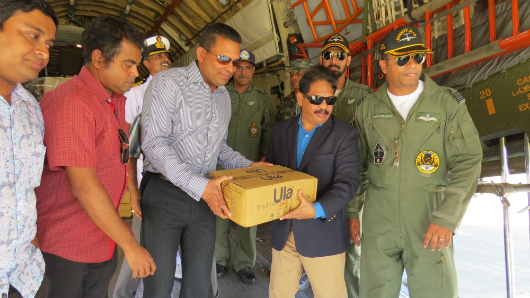
An Indian aircraft has landed  in the Maldives capital Malé to alleviate in the continuing water crisis, as the government reveals it could take between three and five days to restore the capital’s water supply.

The first flight landed at Ibrahim Nasir International Airport at 1:15pm, with two additional flights expected to bring a total of 100 tonnes of fresh water for the people 130,000 inhabitants of  the Maldives’ capital.

Minister of Defence Colonel (retired) Mohamed Nazim has announced that damage to the Malé Water and Sewerage Company’s (MWSC) reverse osmosis plant could mean it is five days before  normal service can  be resumed.

The capital has been without water for 24 hours after a fire at the MWSC caused extensive damage to the reverse osmosis plant, upon which the capital is dependent for desalinated water.

Indian Minister of External Affairs Sushma Swaraj has said that Indian Prime Minister Narendra Modi has promised to do all he can to help the Maldives, after pleas from her Maldivian counterpart.

A statement from the Maldives Ministry of Foreign Affairs this afternoon has stated tha India, Sri Lanka, the USA and China have pledged assistance.

As well as the flight from India, two Indian ships with desalinating capabilities and one from the US naval vessel are headed to the Maldives, while water is being brought on every flight from Sri Lanka, explained the ministry.

“The president, the people and the foreign minister of Maldives expresses their gratitude to all nations assisting the Maldives is these harsh times,” read the statement.

The Indian High Commission in the Maldives has confirmed that INS Sukanya will arrive in Malé tonight, equipped with two reverse osmosis plants in order to produce water “round the clock”.

“Mindful of the strong friendly and close relations between India and Maldives, India reacted with alacrity and promptness to the request from Maldives for timely provision of water,” said the high commission, revealing that the second flight in expected at 3:40pm.

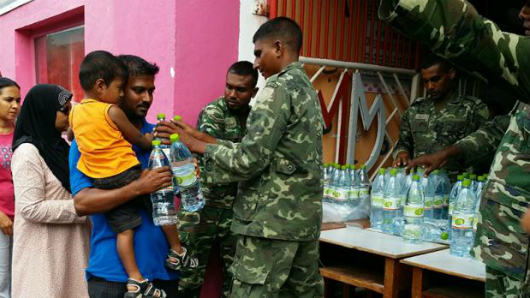
Large queues quickly formed outside shops yesterday evening as the demand for bottled water prompted the government to declare the situation a disaster, with the Maldives National Defence Force (MNDF) giving water away at ten designated distribution points.

Home Minister Umar Naseer has said that current reserves have been exhausted, with more fresh water expected from MWSC at 6pm today.

Nazim told the press that authorities were confident supply could be resumed for one in every six hours, while the MNDF has told Haveeru that over 77,000 litres had been brought from water plants in Hulhumalé, Thilafushi, and Thulusdhoo.

After reports that some shops had drastically increased the price of bottled water, the Ministry of Economic Development is said to have warned of severe consequences for retailers hiking prices.

Though some unrest was reported in one store early yesterday evening, police have said no additional incidents were reported overnight, though rumours of some of the capital’s foreign workers being ejected from water lines have spread.

Both the home minister and Minister of Tourism Ahmed Adeeb have issued tweets saying that water will be distributed to all without discrimination.

Former President and Leader of the ruling Progressive Party of Maldives Maumoon Abdul Gayoom has called upon Maldivians to stay calm until the crisis passes. President Abdulla Yameen – currently out of the country on unofficial business – has not yet commented on the situation.

Despite an announcement that water supply would be resumed between 8 and 9pm yesterday evening, the only rain many residents received came in the form of heavy downpour just after 8pm.

As many rushed to collect rainwater – prompting reports of a rush on the sale of buckets – the Health Protection Authority (HPA) has urged caution.

“We request all Malé citizens to take extreme caution when collecting and drinking rain water. All sorts of impurities will be present in water overflow water in roofs. Ensure the water is safe to drink by boiling the water,” Haveeru reported a HPA statement as reading.

The home minister – part of a task force of ministers assigned to deal with the problem – has this morning shared pictures of replacement parts being taken to the MWSC, stating that Singapore’s Hitachi company will assist with the repairs.

Water shortages have become increasingly common in outlying parts of the Maldives, with low-lying islands unable to rely on contaminated ground water supplies.

The crowded capital has long relied on desalinated water, with well-water in the capital unfit for consumption and only utilised for the flushing of toilets in a small number of residences.


Related to this story

Malé water supply cut after fire at MWSC

Alifushi still without water as more islands request emergency water

Ihavandhoo islanders to pray for rain after twelve month drought

Likes(3)Dislikes(0)

Anti-smuggling MoU signed between police

The Maldives National Defence Force has today signed an MoU with the police and customs services to tackle the smuggling of illegal items via large containers.

The MoU will establish a special task force, reported local media, with Commissioner General Zuhoor noting that agreement was signed in collaboration with the United Nation’s office on Drugs and Crime (UNODC) and World Customs Organisation (WCO).

A statement from police reported Zuhoor as saying that the agreement would assist in identifying and confiscating drugs, weapons, and other material which might lead to terrorism, coming in through containers.

The Maldives’ main port in Malé handles over 50,000 containers every year.

Likes(1)Dislikes(0)

New Maldives Media Council leadership take oaths

The Maldives Media Council has today appointed a new chair and deputy chair  after months of dispute over the media watchdog’s leadership.

Mohamed Asif and Ahmed Shareef Nafis were appointed to the chair and deputy chair positions, respectively after standing unopposed, reports Haveeru.

The appointment of Abdulla Muaz as president in February was quickly overturned after fellow council members ruled that his selection had not followed due process.

Additionally, plans to hold MMC elections on September were postponed by the home ministry due to the eligibility of inactive media organisations – prompting a re-registration process.

The fifteen member council consists of 8 members from the public and 7 from the media – all of whom have now been selected. The council is tasked with ensuring freedom of media and enforcing ethical guidelines.

Source: Haveeru

Likes(1)Dislikes(0)

Malé water supply cut after fire at MWSC

Malé Water and Sewerages Company (MWSC) has cut off all water supplies in the capital Malé after underground cables connecting the switch room and generator caught fire.

Local media reported MWSC – the sole provider of clean desalinated water in the capital – as saying that the water services had to be cut off in order to control the damage and that the service was employing all available means to restart the service within the next few hours.

The company has announced that water will be made available temporarily between 8pm – 9pm this evening, and again between 8am and 9pm tomorrow.

Minister of Defence Colonel (Retired) Mohamed Nazim has declared the situation a disaster, setting up a task force and distributing free water via local shops. Local media has begun to report long queues forming outside shops to buy water as well as the price being increased in certain stores.

Police have confirmed one shopkeeper has been attacked, with Vaguthu reporting the assault as resulting from a failure to sell customers the desired amount of water.

Maldives National Defense Force (MNDF) spokesperson Major Hussain Ali told Minivan News that the fire was reported to the fire and rescue department at around 1.40pm.

“MNDF officers were on the scene shortly and started working on controlling the fire. The fire was completely extinguished at around 3.25pm,” said Major Hussain.

An MNDF press statement detailing the incident read that the firemen on scene removed some of the ducts in order determine the source of the fire and that a separate team were then called to clear the thick smoke observed in the area.

Police confirmed that they are now investigating the cause of the fire.

MWSC does not rely on electricity generated by State Electric Company but instead operates its own generators to provide electricity for the desalination plant.

Most households in the capital rely on MWSC for their daily water needs, with well water – the traditional method of acquiring water – having become unhygienic due to poor drainage and leakage of contaminants into groundwater.

*story updated at 8:15pm

Likes(3)Dislikes(0)

5,530 trained in Maldives’ largest ever ICT programme

The Indian government along with the Ministry of Education have trained 5,530 individuals in 42 islands as part of the Maldives largest ever ICT education programme.

The ‘Technology for the Future of the Next Gen’ project was conducted with US$5.3 million in Indian aid and implemented by India’s NIIT Ltd educational services company in association with Electrical Engineering Equipment Company (EEEC) of Chennai, India.

“Capacity building has been and shall remain the cornerstone of our bilateral relationship. I am sure when the seafarers of both countries fished together in the Indian Ocean several millennia back, they exchanged a tip or two about the best fishing practices,” said Indian High Commissioner Rajeev Shahare at the programme’s closing ceremony today.

“This sharing of knowledge and expertise has continued through several centuries and today India offers one of the most comprehensive training programs for Maldivians.”

Shahare said that the programme – aimed at improving the skills of teachers and providing vocational training for youth – had covered one out of every three Maldivian teachers as well as and 2,500 youngsters since January 2011.

As well as revealing positive feedback from participants, a project summary cited the Maldives Police Commissioner Hussein Waheed as saying that the crime rate had dropped by 80 to 90 percent in the atolls where the youth training was conducted.

Education Minister Dr Aishath Shaheem expressed gratitude towards Indian government for the project, highlighting the importance of such programmes to provide teachers with adequate IT skills.

Haa Dhaalu Kulhuduffushi saw the highest teacher participation with 287 teachers, while Haa Alifu Dhihdhoo saw the highest overall participation in the project with 575 participants – 401 of them receiving vocational IT training.

“Now I can create different type of teaching aids and use them effectively in my teaching. This eventually helps my student understand complex topics very easily,” read the testimony of Aminath Shahidha of Haa Dhaalu Kumundhoo School.

In his speech, the Indian high commissioner also pointed out the importance of the upcoming year, which marks the golden jubilee of Maldivian independence and 50 years since the establishment of diplomatic relations between the two countries.

Shahare noted that an MoU had recently been signed between the Maldives Civil Service Commission and the Administrative Staff College of India, Hyderabad for training of Maldivian civil servants on a regular basis in India.

Training opportunities in Indian continue to be made available to the Maldivian security services, said Shahare, adding that over 5000 Maldivian students educated in India over the past decade was one of the “pillars of the strong people-to-people contacts between the two countries”.

An Indian-built tourism training faculty was opened in Malé earlier this, while the high commissioner revealed plans for similar facilities for the Maldives police and the Maldives National Defence Force.

Indian National Security Adviser Ajit Doval visited the Maldives earlier this week, discussing security and defence issues with government leaders as well as pledging expeditious action on all agreed steps to supply petroleum products to Maldives.


Related to this story

Tourism faculty and naval craft to be handed over during Indian minister’s visit

India – Maldives Friendship Festival kicks off

India to conduct third medical camp this year, in Huvadhoo atoll

Likes(4)Dislikes(0)

Nasheed calls proposed changes to Supreme Court bench unconstitutional

Former President Mohamed Nasheed has called the plans to reduce the number of judges on the Supreme Court bench from seven to five unconstitutional.

While speaking to the press before departing for a Maldivian Democratic Party (MDP) rallys in Haa Dhaalu Atoll, Nasheed accused President Abdulla Yameen of trying to stack the bench in his favor.

“The constitution states the required procedure to bring changes to the bench of the Supreme Court. After extensive legal council we have deliberated that the proposed changes would be unconstitutional,” said Nasheed.

The amendments brought to the parliament by MDP MP Ibrahim ‘Mavota’ Shareef have been rejected by the party after the its national executive council convened and voted that the amendments were against its policies.

Speaking about the amendments, MDP Parliamentary Group Leader Ibrahim ‘Ibu’ Mohamed Solih said Shareef had not consulted the party before he submitted the changes.

However, the ruling Progressive Party of Maldives (PPM) has signaled the party’s support for the amendments with parliamentary group leader Ahmed Nihan said all ruling party MPs would support the proposal and that the PPM would welcome judicial reform.

Presenting the bill to the parliament Shareef said that he believed the number of judges on the apex court was too high for a country the size of the Maldives.

Nasheed had previously said that changing the number of judges on the Supreme Court bench would not amount to judicial reform.

Meanwhile, MDP MP ‘Reeko’ Moosa Manik – who has announced intentions to contest in the MDP’s 2018 presidential primary – appealed for pro-government MPs to cooperate with the party’s efforts to reform the judiciary.

Moosa described the formation of the current Supreme Court bench as a “shameful” political bargain between the MDP and then–opposition parties in 2010.

Nihan praised both Shareef and Moosa and suggested that the number of judges on the apex court was worth considering.

Former President Nasheed also reiterated party concerns with the annual state budget for the upcoming year which the party has previously labelled as aimless and serving only for administrative purposes.

The Supreme Court has recently been involved in numerous controversies both in and out of the court room.

Earlier this year, the Supreme Court used a ‘suo moto’ proceeding – allowing the Court to act as both the plaintiff and the judge – against the Elections Comission (EC).

EC president Fuwad Thowfeek and Vice President Ahmed Fayaz were subsequently charged with contempt of court and disobedience to order, being sentenced to six months in jail after the court used testimony given in the People’s Majlis independent commission’s oversight committee.

More recently, the court employed a similar ‘suo moto’ proceeding against the Human Rights Commission of the Maldives (HRCM) after it criticised the judiciary in its Universal Periodic Review (UPR) for the UN Human Rights Council.

The court charged the HRCM with undermining the constitution and sovereignty of the Maldives by spreading lies about the judiciary.  It said that the UPR submission– based on a 2013 report by the UN Special Rapporteur for Independence of Judges and Lawyers Gabriela Knaul – was “poorly researched”, “irresponsible” and “dangerous”.

Knaul’s report had detailed the pressing need for judicial reform, noting that the five-member transitional Supreme Court had been replaced by a seven-member permanent bench in 2010 with “no legal or constitutional basis”.

June this year also saw Judge Ali Hameed – a sitting judge at the Supreme Court – cleared of a sex tape scandal after three recordings surfaced allegedly showing Ali Hameed engaging in sexual acts with three different woman.

Likes(3)Dislikes(0)

MDP, JP MPs propose 19 amendments to 2015 budget

Opposition Maldivian Democratic Party (MDP) MPs and Jumhooree Party (JP) MPs submitted 19 amendments at yesterday’s sitting of parliament to the record MVR24.3 billion (US$1.5 billion) state budget for 2015.

Among the MDP’s nine amendments were scrapping plans to impose a 10 percent import duty on staple foodstuff and oil and allocating MVR100 million (US$6.4 million) and MVR75 million (US$4.8 million) respectively to provide subsidies for fishermen and farmers.

Other proposals included adding persons with disabilities and single parents as categories eligible for government subsidies to the poor and requiring the finance ministry to submit quarterly reports to parliament every three months concerning the implementation of the budget.

The minority party has issued a three-line whip for its MPs to vote against the budget if none of the proposed revisions are passed.

The JP’s 10 amendments meanwhile included providing MVR50 million (US$3.2 million) in subsidies to fishermen and MVR40 million (US$2.5 million) to farmers, ensuring sufficient funds for local councils and allocating MVR5 million (US$324,254) out of the contingency budget for local NGOs that provide education and training to persons with special needs.

The party also proposed conducting a survey to determine discrepancies in salary and allowances among state employees.

The 19 amendments were proposed after Progressive Party of Maldives (PPM) MP Ahmed Nihan – chair of the budget review committee – presented a report prepared by the committee following its review process

While the committee had passed the budgetlast week without significant changes to revenue or expenditure, pro-government MPs proposed a number of recommendations to reduce recurrent expenditure.

However, amendments proposed by MDP and JP MPs during the budget review process did not pass at the committee.

Reflecting its combined 48-seat majority in the 85-member house, PPM and coalition partner Maldives Development Alliance MPs held a voting majority on the committee.

During yesterday’s debate on the budget committee report, JP Leader Gasim Ibrahim warned that introducing new taxes could damage the economy and the tourism industry.

The business tycoon claimed that Seychelles and Mauritius “went bankrupt” when tourists stopped visiting due to excessive taxation.

Occupancy rates at Maldivian resorts declined in November as a result of imposing the reintroduced US$8 bed tax along with a 12 percent Tourism Goods and Services Tax (T-GST), Gasim contended.

Industry insiders recently told Minivan News that the high-end resorts would struggle to deal with any additional taxation following the recent rise of T-GST.

According to the Maldives Monetary Authority’s monthly economic review for October, however, the occupancy rate during the month remained unchanged at 81 percent compared to the same period last year.

In October 2014, total bednights rose marginally in annual terms while the average duration of stay decreased slightly and stood at 6.0 days,” the central bank noted.

Gasim meanwhile said the JP would vote for the budget despite misgivings, which included lack of funds for establishing pre-schools and insufficient funds allocated for independent institutions and the judiciary.

Adjourning yesterday’s sitting, Speaker Abdulla Maseeh Mohamed announced that the amendments would be put to a vote next Tuesday ahead of a final vote on the 2015 budget.


Related to this story

Finance minister presents record MVR24.3 billion state budget to parliament

MPs quiz finance minister about revenue raising measures

Committee passes budget, recommends constitutional amendment to reduce independent commissions

MDP parliamentary group issues three-line whip against proposed 2015 budget

Likes(1)Dislikes(0)