Maldives foreign travel advisories updated after recent protests

The UK, Australia, Canada and China have updated their travel advisories on the Maldives, warning of intensifying political instability and encouraging their nationals to take care, especially in the capital city of Male’.

“Demonstrations have already started in the capital, Malé and on some non-resort islands. Further demonstrations are likely. Previous political demonstrations have led to violence and arrests. Friday afternoons are traditionally potential flashpoints,” stated the September 27 notice on the UK Foreign and Commonwealth Service’s travel advisory service.

The guidance urged visitors to keep away from demonstrations: “There is no indication at present that any political unrest will affect tourist resorts or airports, but if you have any concerns you should check with your hotel or tour operator,” the statement read.

The Australian alert on the government’s Smart Traveller website flagged Male’ yellow and urged travellers to “exercise a high degree of caution” in the capital due to “unresolved political tensions and risk of further unrest and violence.”

“Since February 2012, there have been regular political protests in Male, some of which have turned violent. The political environment remains uncertain and further violent clashes could occur. You should avoid public gatherings and protests, particularly in Male, as they may turn violent. Extra care should be taken when moving around Male’ after dark,” stated the advisory.

The Canadian alert urged travellers to “exercise a high degree of caution” due to civil unrest, stating that “the political situation is volatile following the indefinite postponement of the second round of presidential elections by the Supreme Court. Demonstrations by political parties are likely to occur.”

The Chinese advisory, updated on September 27, noted that while the Maldivian social order “is generally stable”, “partisan conflicts around the presidential elections are intensifying.”

The Chinese Embassy in the Maldives urged Chinese visitors – who make up 25 percent of all tourism arrivals – to monitor the local security situation, contact and confirm the hotel booking before departure, and avoid non-essential travel to Male’.

Friday’s protests were also extensively reported by Chinese state-run press agency, Xinhua.

The US Embassy in Colombo previously issued a travel notice to US citizens planning to travel to the Maldives, stating that the run-off presidential election previously scheduled for September 28 “has been postponed.”

“The U.S. Embassy recommends that US citizens exercise caution, avoid large crowds, and monitor media coverage of local events,” the advice read.

Tourism dependency

The vast majority of tourism to the country is through package tours and holidays, with guests arriving on the airport island of Hulhule and being taken by boat, seaplane or domestic air transfer directly to their resort islands without stepping foot on Male’.

The tourism industry’s traditional market has been the UK, Italy, Germany and Russia, however following the 2008 recession this market has been displaced with a surge in Chinese arrivals. Smaller but growing markets include the Middle East and Eastern Europe.

The Maldives is indirectly dependent on this luxury tourism industry for over 70 percent of its GDP and up to 90 percent of its foreign currency exchange. As small island nation with scarce natural resources and very little agriculture, the Maldives also has near-total reliance on imports, particularly for tourism commodities.

The Tourism Employment Association of the Maldives (TEAM) last week indicated that it would encourage its 5000 members to strike should the election be delayed, while the Maldives Port Workers Union (MPWU) went on strike today “to send a message to the government”.

While the political situation in Male on Sunday remained tense ahead of an expected but unscheduled Supreme Court verdict on the fate of the run-off election, protests over the past several days were confined to just several intersections in the capital.

Yesterday’s protest near Male’s main tourist street attracted small crowds of passing Chinese and German tourists who took photos of the rally. A group of four Germans, asked what they thought was happening, said “I don’t know, something to do with the flags?”

Tourism Minister Ahmed Adheeb told Minivan News yesterday that international media coverage of proposed strike action predicting “travel misery” for UK tourists travelling to resort was “irresponsible”, and challenged the veracity of reports such as that in the Independent’s travel section.

“The scuba dive tanks will stay empty, the pool towels unchanged, and there will be nobody on hand to mix a cocktail [should the protests go ahead],” wrote the paper’s Whitehall editor, Oliver Wright.

Likes(1)Dislikes(1)

Man arrested for molesting 17 year old girl

Police yesterday (28 September) arrested a man from the island of Manadhoo in Noonu Atoll on charges of molesting a 17 year-old girl in the island.

Police said that the man, 39 years old, said that he was arrested after an arrest warrant was obtained while the man was on the island.

According to police, Lhohi Magistrate Court in Noonu Atoll have extended the man’s detention period to 15 days for the investigation of the case.

Likes(0)Dislikes(0)

Police officer attacked by a group in Male

Police have said that an officer was attacked last night at about 12:15am by a group of people.

According to police, the group attacked the officer while he was on duty walking near FDI photo studio on Fareedhee Magu.

Police said the officer was injured and his phone was also damaged in the incident.

The police are now looking for suspects involved in the case.

Local media also reported an officer being struck by a motorcyclist on Lonuziyaarai Magu.

Likes(0)Dislikes(0)

Human Rights Commission calls for constitutional election date

The Human Rights Commission of Maldives (HRCM) has called on the Supreme Court and state institutions to ensure that Maldivians will not be denied the right to vote guaranteed by the constitution’s Article 26 and the International Convent on Civil and Political Rights.

It also called upon these institutions to ensure there will be an election within the duration stated in the constitution.

The HRCM also called on everyone not to pave way for unrest and to hasten all work that has to be done to uphold the constitution.

The commission also called on EC to solve all the issues with the voters’ registration.

HRCM called on the authorities to take legal action against those to pose death threats and threats of violence, calling on everyone to give high priority to national interest.

Likes(0)Dislikes(0)

Island creation could counteract effect of sea level rise: Nature World News

“The creation of new islands could make up for the loss of land in the Maldives due to sea level rise, a study published in the journal Geology suggests,” reports Tamarra Kemsley for Nature World News.

“Regional island building consists of lagoons filling with sand taken from the surrounding coral reefs. As this happens, plant and animal life take root.

By studying the history and timing of this process throughout the area, researchers concluded that the continued accumulation of sand within the reefs found inside Maldivian atolls offer an opportunity for future island development.

Smaller reefs where the lagoons are nearly filled in, the study showed, are most likely to give way to islands — a process that could happen within 100 years if provided with enough sand.

The findings further suggested that these smaller islands could then grow into structures that could then be inhabited even as sea level rise reduces the land available on other islands.”

Read more

Likes(0)Dislikes(0)

Six protesters released on condition they don’t participate in protests for two months

The Criminal Court has released six persons arrested during the Maldivian Democratic Party (MDP) protest calling for presidential elections, on condition that they do not participate in protests for two months.

A police spokesperson today told Minivan News that, as of this morning nine protesters were in police custody.

”The court extended two person’s detention period to 15 days,” he said, adding that they were arrested on charges of objection to order and obstructing police duty.

In a statement issued last night (28 September) police said that a total 15 persons have been arrested following unrest in Male’ since September 23.

Police said three were arrested without any conditions, and that the court had extended the detention period of six persons.

Police Spokesperson said that last night seven others were arrested in addition to the 15 persons mention in the statement issued.

”15 is the total amount of persons that were arrested,” he said. ”Some of them have also been released without being taken to the court.”

MDP protesters took to the streets following an injunction issued by the Supreme Court regarding a case filed at the court by Jumhooree Party- led by unsuccessful first round candidate Gasim Ibrahim – to annul the poll on allegations that there had been major issues with the voter registration, and that the Elections Commission had changed votes.

After the Supreme Court issued the injunction, pro-MDP supporters have been protesting everyday near the Supreme Court and other areas of Male’.

MDP has also questioned the legitimacy of decisions made by the Supreme Court as certain judges on the bench have been accused of misdeeds, most notably Justice Ali Hameed who remaind subject to an ongoing investigations into leaked video tapes appearing to depict him engaging in sexual relations with foreign women.

Pairs of large white underpants – similar to those worn by the figure in the sex video – have become a common theme in the last week’s protests.

Likes(0)Dislikes(0)

Port workers strike to “send a message to the government”

The Maldives Ports Workers Union (MPWU) has taken strike action today following the Supreme Court’s decision – backed by the government – to postpone the second round of the presidential election.

“We are taking our constitutional right to give a message to the government,” said Ibrahim Khaleel, President of the Maldives Ports Workers Union.

Around 90 of the union’s 490 members opted not to come into work for today’s morning shift, though Khaleel pointed out that workers would return to work for the later shift.

“There is not much work there today, but next week we have a charter boat with more than 300 containers. If we are not given an election date, we will stop any future operations. We are just giving that message.”

“The ports union will do this again and again if they do not listen to us,” said Khaleel.

The Supreme Court is scheduled to give a verdict on its election annulment case today – filed by the Jumhooree Party (JP) after its defeat in the first round earlier this month.

After the Elections Commission expressed its intention to go ahead with the polls – scheduled for yesterday (September 28) – the court issued an order to security forces to halt proceedings by force if necessary.

Khaleel said a decision was made not to picket outside the ports today, alleging the port’s management “sent thugs” to attack union workers picketing the port earlier this year.

He argued that police protection had been requested on this prior occasion, but had not been forthcoming.

Both the MPWU and the Tourism Employees Association of Maldives (TEAM) joined forces in May this year to demand amendments to the recently enacted Freedom of Assembly Act.

Clause 24(7)b of the law prohibits any gatherings at the country’s ports, airports, or resorts, without police authorisation – a clause the unions have claimed effectively banned strike action.

After TEAM’s call for “prolonged strikes” last week should the presidential run-off be delayed, Minivan News has received reports of a number of politically motivated dismissals in some of the country’s resorts, in what some staff described as a “firing spree”.

Import dependency

Vice President of the Maldives National Chamber of Commerce and Industry (MNCCI) Ishmael Asif warned of the likely impact such strikes could have on the country.

“As a country that relies heavily on imports for all of its needs,  a ports strike could have severe impacts on business in the country,” he warned.

As small island state with with a land mass of only 115 square miles, the Maldives has near-total dependency upon imports for basic foodstuffs and commodities, as well as goods used to supply the country’s luxury tourism industry which is indirectly responsible for 90 percent of the economy.

The country’s “excessive reliance on imports” was discussed in a recent government report into economic diversification, which noted that the country’s current account deficit had grown to US$600 million (27 percent of GDP) in year 2012.

“The import dependency continues to grow. The CIF [cost, insurance, and freight] value of merchandise imports has increased from us$120 million in 1990 to us$1.5 billion in 2012,” read the report.

It also noted that the country imported over 90 percent of foods in 2012 – worth US$318.9 million –  resulting in “huge implications for food security as well as inflation.”

Male’s port – managed and administered by the Maldives Ports Ltd (MPL) company – handled 580 ships in 2012, processing over one million tonnes of freight.

Current MPL CEO Mohamed Latheef told Minivan News today that he was unaware of any strike activity.

The MPWU staged a small strike last year after it alleged the MPL had removed the workers’ television after they had used it to watch the Maldivian Democratic Party aligned Raajje TV. MPL claimed the disagreement was a misunderstanding.

That strike received high-profile backing from the International Transport Workers’ Federation (ITF).

Likes(0)Dislikes(0)

Comment: When you’re voteless in the Maldives, resistance is not futile

This article first appeared on Dhivehi Sitee. Republished with permission.

Saturday dawned as crisp, sunny and beautiful as any other day in the Maldives. The clear blue skies belied the dark cloud that descended over a majority of the country’s population after the beleaguered Elections Commission announced shortly before midnight on Friday that the Supreme Court, and other allied state institutions, had left it with no choice but to call off the second round.

What the Elections Commission has been forced to call off is hope — the expectation that democracy will be restored in the Maldives on 11 November 2013.

For 19 long months, a majority of Maldivians have dedicated most of their lives to winning back democracy from the authoritarian gang that came to power on 7 February 2012. The fight has been all-consuming and has affected every single Maldivian one way or another.

In the immediate aftermath of the coup came the violent confrontations with the security forces. Hundreds were beaten up, arbitrarily arrested, detained without charge, and ordered to obey, or else. Basic human rights—freedom of assembly and expression—were rolled back. Foreign ties were broken coldly, with little care for international norms or the inevitable consequences. The economy suffered blow after blow, leading to bankruptcy with little hope for recovery in the foreseeable future.

Working with unscrupulous ‘religious scholars’, intense nationalism was promoted in parallel with virulent xenophobia against any foreign actor that promoted democracy. Ties with autocratic regimes were fostered, along with relations with international gangsters known for drug trafficking and money laundering. National assets were sold off and deals made with unscrupulous foreign governments that spoke democracy but acted with nothing but their own national interest in mind. Unexplained murders, gang-related crimes, drug abuse and sexual offences increased exponentially.

The international community’s decision to condone the coup and endorse it as ‘a legitimate transfer of power’ was a major blow, but not enough to kill the Maldivian people’s desire for democratic governance. In the face of intense pressure from the international community to obey, to put stability before rights, to follow ‘the democratic process’, combined with brutal force by domestic authorities, the street protests could not be sustained. But supporters of democracy did not give up. Led by Mohamed Nasheed and the Maldivian Democratic Party, Maldivians channeled their frustrated hopes into campaigning for a democratic election instead of protesting on the streets.

MDP’s presidential campaign has been an exemplary democratic exercise – the ‘costed and budgeted’ manifesto it brought out in August this year is the embodiment of a majority of Maldivians’ hopes and dreams for the future. It is based on views and opinions gathered from people on every inhabited island and it envisions a future in which the Maldivian people will, at long last, be empowered to work for their own socio-economic progress under a government that a majority of them have elected of their own free choice. Of course, it is naive to think that every desire would be fulfilled, but at least everyone was asked what they wanted, everyone had a say, and everyone could take ownership of their own future. No such bottom-up exercise has ever been conducted in the long authoritarian history of the Maldives.

On 7 September, 88 percent of the electorate turned out to vote. 45.45 percent of them voted for Mohamed Nasheed, 25.35 percent for Abdulla Yameen, 24.07 percent for Gasim Ibrahim, and 5.13 percent for Mohamed Waheed. Nasheed did not get the 50 percent plus one needed for an outright win, but the Maldivian map, from north to south, was all yellow at the end of voting that day. Most people in all atolls bar two want a democratic government led by Nasheed.

The authoritarians know this, always did. Plan B was there from the start – let them have their vote if they must, but the results will always be ours, as we want it. Over a thousand observers, local and foreign, verified the election as free and fair. Except for minor errors, expected in any election anywhere in the world, it went without a hitch. Only 25 percent of the Maldivian people want Maumoon Abdul Gayoom’s autocratic rule to continue. That’s when the stubborn septuagenarian called in all the stops and brought into full play the dregs of dictatorship that continued to infect Maldivian democracy throughout the three years or so it lasted.

Gayoom has played his old house-boy Gasim well. Taking full advantage of Gasim’s indignation about not having received the votes he paid for, Gayoom has dictated most of the Supreme Court bench – the most corrupt of the many corrupt state institutions – to rule in Gasim’s favour, bringing the Maldives to where it is today: a constitutional vacuum into which Gayoom can effortlessly step in and ‘rescue’ us from ourselves. If Gasim thinks that Gayoom will let him take the president’s oath on November 11, he is an even bigger fool than he has repeatedly shown himself to be.

The Supreme Court did not just issue an injunction against the second round, it also ordered the security forces to act against anyone who tries to go ahead with the polls. One can only imagine the elation of the baton-happy coup-Police Commissioner Abdulla Riyaz who immediately deployed his forces to the Elections Commission, sealing the Commissioner and staff off from interaction with anyone local or foreign.

Efforts for mediation by the international community were not just prevented by the police, but strongly criticised by Gayoom’s minions. With his daughter at the helm of foreign relations as the State Minister of Foreign Affairs, it summoned India’s High Commissioner for a good telling-off for attempting to help disenfranchised Maldivians. The government has not stopped spurning the international community since, and will not stop until it becomes clear to everybody – at long last – that Gayoom and his followers will not allow democracy in the Maldives, whatever it takes.

The truth of the matter is, and has been since 7 February 2012, is that there will be no election in the Maldives as long as Nasheed, the champion of the Maldivian democratic movement, is in the running. So the focus has now returned to the farcical prosecution of Nasheed, through the very courts that have proved again and again that they are neither independent nor respectful of the ‘judicial process’. The machinations are fully underway to annul the first round and put Nasheed behind bars before calling fresh elections, if there are to be any. Reports say Gayoom himself is planning to run if and when new elections are held, his ‘economist’ brother having failed to live up to family expectations by not being able to garner much support.

Having lived under Gayoom for most of their lives, a majority of Maldivians remain oblivious to the fact that indefinitely delaying the elections is a robbery of their fundamental right to vote, and not just that of MDP members or supporters of Nasheed. Their gloating about the cancellation of the election is both sad and sickening. They will do everything in their power to help bring Gayoom, and their own enslavement, back to life.

For the rest of Maldivians, the only choice left is to refuse to obey. Power, contrary to popular belief, is not something that can be taken away by force. It can only be given away, by the people, if we so decide.

Resisting a full-fledged authoritarian reversal has been a long hard slog that has taken a heavy emotional, financial and social toll on all of us. Sustaining the resistance will be difficult, and all out civil disobedience would be even harder; but do it we must, if we are to be in control of our own destiny. What we must keep in mind is: nobody can govern us without our consent. It is within our power not to give it.

Dr Azra Naseem has a PhD in International Relations

All comment pieces are the sole view of the author and do not reflect the editorial policy of Minivan News. If you would like to write an opinion piece, please send proposals to [email protected]

Likes(3)Dislikes(0)

CMAG expresses “concern at developments” in the Maldives following first round of polling

The Commonwealth’s human rights and democracy arm has “expressed concern at developments” in the Maldives following the first round of elections.

The Supreme Court last week suspended the run-off election indefinitely after the third-placed candidate with 24.07 percent, Gasim Ibrahim, demanded the vote be annulled alleging widespread electoral fraud and declared “God Willing, Gasim will be President on November 11″.

The party of second-placed candidate Abdulla Yameen – the Progressive Party of the Maldives (PPM) which attained 25.35 percent of the vote behind front-runner Mohamed Nasheed’s 45.45 percent – backed Gasim’s court case. Attorney General Azima Shukoor – formerly Yameen’s lawyer – also intervened against the Elections Commission (EC). A verdict is expected at the next hearing.

The Commonwealth Ministerial Action Group (CMAG) on Friday meanwhile noted that its election observation team had determined the September 7 polls were “a credible electoral process and met the standards for democratic elections to which Maldives has committed itself.”

“Ministers further noted that national and other international observers had concluded that the 7 September election was competently administered, and that the Maldivian people had been free to express their will through the ballot,” CMAG stated.

“In this context, CMAG Ministers expressed concern at developments since the declaration of results of the first round poll, with one unsuccessful party having filed a case with the Supreme Court to annul the first round of the election because of alleged electoral fraud, and the Supreme Court subsequently issuing an injunction to delay the second round of the election until a court ruling is delivered in that case,” the statement read.

“Noting that, under the Constitution of Maldives, a new President is required to be sworn in by 11 November 2013, CMAG Ministers urged all those concerned to ensure that the second round of the election is held at the earliest possible date so that this constitutional requirement is met,” the statement added.

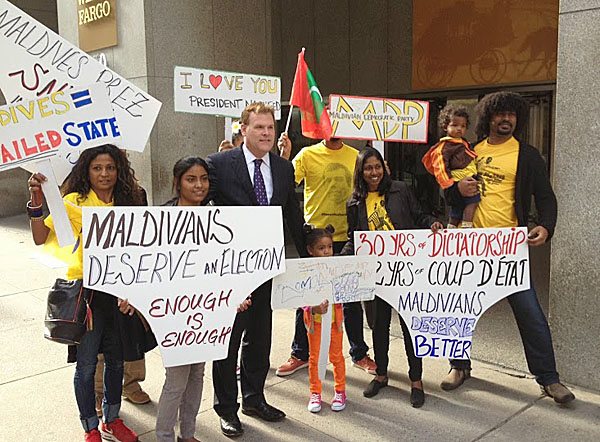
Following CMAG’s meeting in New York on Friday, Canadian Foreign Minister John Baird joined Maldivian pro-democracy demonstrators outside the Australian consulate.

Following the Supreme Court’s indefinite suspension of the election last week, Baird in a statement had warned the delay was “troublesome and can only lead to more instability”, and pushed for the Maldives to be put on CMAG’s formal agenda.

Canadian Foreign Minister John Baird with Maldivian demonstrators

Government responds

The Maldivian Foreign Ministry meanwhile put out a statement noting “media speculation” that the Maldives could be placed on the group’s agenda.

“The current political situation in the Maldives is one in which the Government is upholding constitutional supremacy, and the rule of law. Therefore, questions about placing the Maldives on the formal agenda of the CMAG are nothing more than speculations and have no basis,” the statement read.

Acting Minister of Foreign Affairs Dr Mariyam Shakeela represented the Maldives at the CMAG meeting, “and advocated on the need for reforming the Group in order to make the body a more effective and credible one that can help, not hamper, democracy consolidation in the Commonwealth member countries,” the statement read.

“The Minister also highlighted on the need for the CMAG to take matters in proper context, and not to over-react on delicate situations in member countries,” it added.

Following the meeting, Minister Shakeela “expressed pleasure about the deliberations and noted that as a member of the CMAG, the Maldives believes that the Group’s credibility can only be maintained if careful, considered, and impartial decisions are made on critical issues of importance relating to members of the Commonwealth.”

Deputy Leader of Gasim’s Jumhooree Party, Dr Ibrahim Didi, was meanwhile quoted in Sun Online as calling on CMAG not to “enslave or threaten” the Maldives.

“We are ready to leave the Commonwealth if necessary,” Sun reported Didi as saying.

“Some Maldivians think we will starve if we leave the Commonwealth. But this won’t happen. Some people think it is a big organisation and that if they cut assistance we will starve. The Commonwealth have only given us a few diploma courses,” he stated.

Indian High Commissioner summoned

The Maldivian government has also summoned Indian High Commissioner Rajeev Shahare to express what Sun Online reported was “discontent” over the High Commissioner’s meeting with Elections Commissioner (EC) Fuwad Thowfeek on Friday.

Shahare met with Thowfeek at the EC shortly before the building was surround by police, carrying orders to take over the building and ballot papers should EC staff continue with preparations for holding Saturday’s scheduled election.

Sun reported a Foreign Ministry official as stating that Shahare met with officials at 7:00pm on Friday.

“We had a meeting with the Indian High Commissioner [Friday] night, but we cannot reveal details of the meeting,” Sun quoted the official as saying.

Likes(1)Dislikes(0)