Legal status of penal code thrown into doubt

The new penal code is now in force despite parliament delaying its enforcement to July 16, the state human rights watchdog and prominent lawyers have contended .

A provision for postponing implementation of the new penal code was included in an amendment bill passed on April 12, a day before the new law was due to come into force.

The new penal code was ratified on April 13, 2014 with a one-year period for preparation.

The bill changed the date of enforcement from April 13 this year to July 16.

However, the bill stated that the amendments – including the provision for postponement – “will come into force starting from July 16, 2015.”

The provision for postponement was therefore inconsequential as it has not become law, the Human Rights Commission of Maldives (HRCM) and lawyers Maumoon Hameed and Shaheen Hameed argued.

By following the old penal code, Maumoon Hameed said the state is presently enforcing “a law that does not exist.”

The HRCM wrote to the attorney general and prosecutor general last week seeking clarification of the legal dispute, saying it is unclear which criminal law the police, prosecutors, and courts are presently following.

The commission said it was “extremely concerned” about resulting human rights violations in the investigative and judicial processes.

Prosecutor general Muhthaz Muhsin told Minivan News that “as a common rule the old penal code would be in force now”.

“I cannot say anything specifically about the issue until the office has responded to the HRCM’s letter. Also, it is not my role to criticise laws but rather uphold it,” he said.

Former Chief Justice Ahmed Faiz meanwhile dismissed the legal questions surrounding the penal code as an unjustifiably narrow approach in interpreting the law.

He said the “amendment makes it clear that the new penal code will come into effect starting July 16.”

“The amendment will also become part of the law. So the penal code now states the date it would come in to effect. We cannot simply single out one article and interpret the whole law. I think it’s quite clear,” he told Minivan News.

However, lawyers Maumoon Hameed and Shaheen Hameed insisted that the new penal code has replaced the old law.

There are presently no obstacles to enforcing the new penal code, Maumoon Hameed told Minivan News today.

“The new penal code states the old law would be dissolved when the latter law comes into effect. So I believe that the state is implementing a law that does not exist,” Hameed said.

Shaheen Hameed, former deputy speaker of parliament, also said he believes “the new penal code is in effect now”.

The current penal code was adopted in the 1960s and has been widely criticised as outdated, draconian and unsuited to the 2008 constitution.

The main opposition Maldivian Democratic Party had said the postponement was a “politically motivated attempt to continue using the current penal code as a means to harass and intimidate the opposition.”

Under the new code, the punishment for protesters who do not have a criminal record will be less severe as judges are required to take mitigating factors into consideration under new sentencing procedures.

However, the ruling party said more time was needed to raise public awareness and address concerns of religious scholars.

Likes(2)Dislikes(0)

Government accuses Amnesty of colluding with MDP to tarnish Maldives’ image

The government has accused Amnesty International of tarnishing the Maldives’ image in collusion with the opposition, dismissing its concerns of a crackdown on human rights as “preposterous fabrications with zero truth”.

Amnesty’s observations of a “rapidly deteriorating” human rights situation are “fallacious”, contended foreign minister Dunya Maumoon, accusing the organisation of seeking to “undermine and defame the Maldives judiciary and its national institutions.”

“The general human rights situation in the Maldives has been improving steadily especially following the reform agenda launched in 2004 leading to the ushering in of a modern constitution in 2008,” she insisted in a statement on Friday.

“Additional impetus has been seen during President [Abdulla] Yameen’s government in terms of promotion and protection of human rights.”

The enactment of 18 pieces of legislation under the current administration is “an unparalleled record in the history of the Maldives,” she added.

Amnesty had said in a report last week that the government is cracking down on peaceful protests, stifling dissent, and “abusing the judicial system” to imprison opposition politicians.

“Ludicrous”

Amnesty’s allegation of police attacking peaceful protesters “is ludicrous and an absolute lie”, Dunya said.

The nightly anti-government protests staged by the opposition coalition in the capital “attract an extremely small crowd, and the police are able to control the protest well and ensure peace and security for all citizens of Malé.”

“The opposition MDP have however, by contrast, in the past been responsible for systematic acts of arson and other violent acts,” the ministry claimed.

MDP spokesperson Imthiyaz Fahmy told Minivan News today that Dunya was speaking on behalf of the Gayoom family. Dunya is the daughter of ex-president Maumoon Abdul Gayoom and niece of president Yameen.

“Foreign minister Dunya Maumoon sounds like North Korea when she keeps rejecting any concern raised by any international organisation, be it Amnesty, the Commonwealth, European Union, United Nations or even concerns raised by friendly countries,” he said.

“This says it all. The government has no intention at all to protect human rights in the country and come into line with the internationally recognised standards.”

Engagement

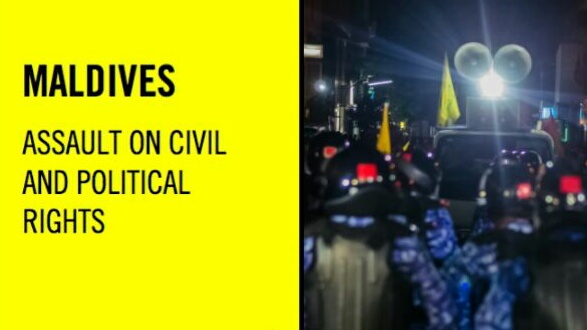
Amnesty’s briefing report titled ‘Assault on civil and political rights’ was released after a delegation conducted a fact-finding mission in the Maldives from April 17 to 22.

The delegation said it sought meetings with government officials and a visit to Dhoonidhoo detention centre to meet ex-president Nasheed, but the foreign ministry offered to facilitate the meetings in May.

However, Dunya said the delegation visited the Maldives on April 27 despite a mutual agreement to schedule a visit for May and “choose to meet with only officials and supporters of former President Nasheed’s opposition Maldivian Democratic Party (MDP).”

The ministry said it has facilitated visits to Nasheed in prison by the International Committee of the Red Cross, the Commonwealth, and the Office of the High Commissioner for Human Rights. 

“The government of Maldives maintains its engagement first policy and continues to hold constructive dialogue with its international partners, including international non-governmental organisations that are serious about and value such dialogue,” it said.

“Sham trial”

After launching the briefing at a press conference in Delhi last Thursday, Abbas Faiz, Amnesty International’s Maldives researcher, said Nasheed’s imprisonment “came after a sham trial.”

“It is disturbing how far the Maldives government has co-opted the judiciary as a tool to cement its own hold on power,” he said.

Nasheed was sentenced to 13 years in prison last month after a 19-day trial widely criticised by foreign governments and the UN for its apparent lack of due process.

However, the foreign ministry said Amnesty’s accusations about Nasheed’s trial are “without any basis.”

Nasheed was sentenced for the “abduction and enforced disappearance” of criminal court chief judge Abdulla Mohamed in January 2012.

“President Nasheed has been tried, convicted and sentenced for this heinous crime as per Maldivian laws,” the ministry said.

“His rights were assured to him and he chose not to appeal the verdict or sentence of Criminal Court. Amnesty through its baseless allegations once again seeks to undermine and defame the Maldives judiciary and its national institutions.”

Amnesty had said it “welcomes the investigation of alleged past human rights abuses committed in the Maldives, but the organisation remains concerned that the case pursued against Mohamed Nasheed was politically motivated and selective” as human rights abuses under both the current and previous presidents remain unaddressed.

“Amnesty International is also concerned that the outcome of the trial appeared to have been predetermined to procure a conviction against Nasheed even before the trial began,” the briefing stated.

Likes(3)Dislikes(0)

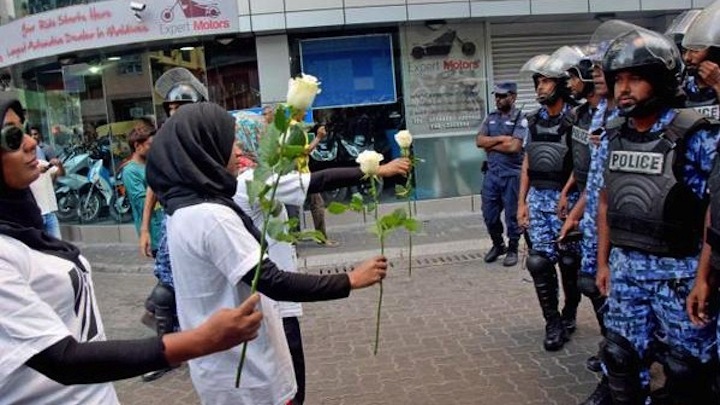
‘Peace offering’ met with pepper spray and arrests

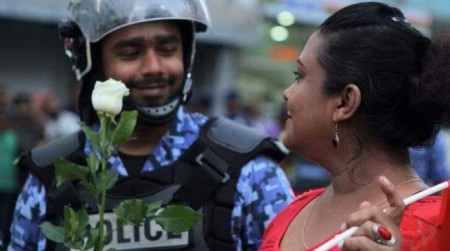
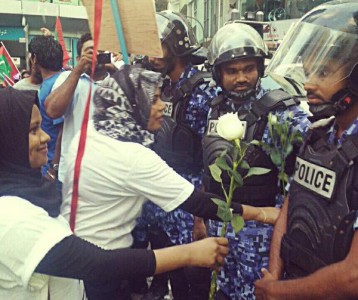
Three activists were arrested from a youth-led opposition protest march yesterday after making a “peace offering” of white roses to riot police.

Specialist Operations (SO) police officers blocked the march at Orchid Magu, issued warnings of dispersal by force, and used pepper spray against protesters after the roses were laid at their feet, Mohamed Azmeel, president of the main opposition Maldivian Democratic Party’s (MDP) youth wing, told Minivan News today.

“White roses are used everywhere in the world as a peace offering. A group of youth offered white roses to police to show that we are peaceful. But they didn’t accept and pepper sprayed us,” he said.

He noted that the three activists taken into custody were among the group that offered roses to police.

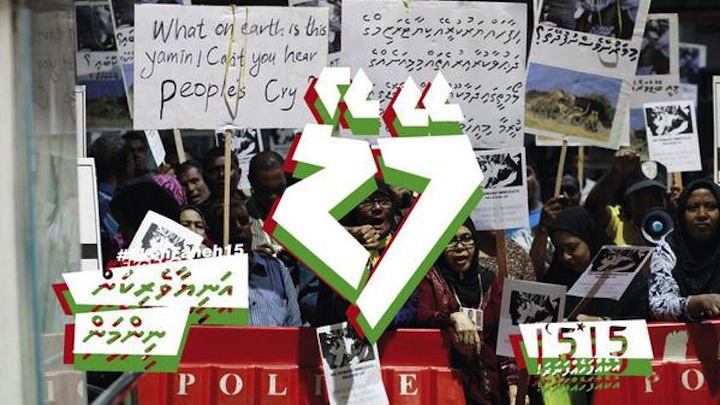
The protest march dubbed ‘Heylaa’ (Wake Up) was organised by youth activists of the opposition alliance, made up of the MDP, the religious conservative Adhaalath Party, and the Jumhooree Party, with the aim of “bringing an end to brutality”.

The alliance has been staging nightly protests in Malé against what they call the government’s persecution of opposition political leaders. Former president Mohamed Nasheed and ex-defence minister Mohamed Nazim were sentenced last month to 13 years and 11 years in jail, respectively, on terrorism and weapon smuggling charges.

At least 140 protesters have been arrested since February. The MDP has previously accused SO officers of instigating a “coup d’etat” in February 2012 that led to then-president Nasheed’s resignation and of using excessive force against protesters.

The MDP youth wing has said protesters wore white t-shirts yesterday to “symbolise peace and friendship” while the white roses were offered to show that protesters were not seeking a violent confrontation.

Azmeel said he did not understand why police had to use pepper spray or make arrests as protesters did not attempt to break police lines.

He noted that police had not put up barricades on Orchid Magu.

A police media official said the three men were arrested for “disobeying orders” and “obstructing police duty.”

One protester was released “after giving advice” last night, he said, and police have not decided whether to seek extension of remand detention for the pair still under arrest.

Azmeel insisted that the march was peaceful and that protesters did not disobey orders.

“Disobeying orders would be crossing a barricade or refusing to take a route they showed. But none of that occurred there,” he said.

At least 150 youth led the march on Friday afternoon, Azmeel said, which began around 4:30pm at the Usfasgandu area and made its way west on the capital’s main thoroughfare, Majeedhee Magu.

The protest march stopped at various locations where youth leaders made speeches, he noted, adding that police had told protesters not to stop.

The march ended with a prayer for the safety of opposition leader Nasheed and other detainees.

Azmeel said the purpose of the march was “to raise concerns of youth and raise our voices.” The march was part of opposition activities in the run-up to a mass anti-government rally planned for May 1.

Last week, tourism minister Ahmed Adeeb challenged the opposition to a confrontation on May 1, prompting fears of a stand-off and civil unrest.

0_1429950246rose3_news

CDXWDevUsAAIy3O

Likes(2)Dislikes(0)

MDP MP appeals for Indian pressure to release Nasheed

An opposition Maldivian Democratic Party (MDP) MP has appealed for Indian prime minister Narendra Modi’s help to secure the release of imprisoned ex-president Mohamed Nasheed.

The disappearance of Minivan News journalist Ahmed Rilwan, death threats against journalists and human rights defenders, and an arson attack against opposition-aligned Raajje TV are “symptomatic of the Maldives’ slide into tyranny,” MP Eva Abdulla wrote in a letter to the Indian prime minister.

“I hope you can use your good offices to pressure the Maldivian government to release President Nasheed and other political prisoners, return to rule of law, uphold the constitution and protect the basic human rights of all Maldivians,” reads the letter sent on April 22.

Eva’s appeal was echoed by Amnesty International last week, which warned that the human rights situation in the Maldives is “rapidly deteriorating” with the government cracking down on peaceful protests, stifling dissent, and imprisoning opposition politicians.

Raghu Menon, Amnesty International India’s advocacy coordinator, said India as a regional power “has a responsibility to work towards a human rights-friendly environment in the Maldives.”

The ruling coalition has previously condemned calls for Indian intervention as “irresponsible”.

“Urging India to intervene in a sovereign nation’s internal affairs is a betrayal of our constitution. Its results will be bitter, especially on the Maldivian public,” majority leader of parliament Ahmed Nihan told Minivan News after Nasheed urged India before his arrest in February to ensure the security of opposition politicians.

Foreign minister Dunya Maumoon has also expressed confidence that India “will not intervene in domestic politics of Maldives.”

Following Nasheed’s arrest and prosecution on controversial terrorism charges, Modi dropped the Maldives from a tour of Indian Ocean neighbours in early March.

Nasheed was sentenced to 13 years in prison last month on terrorism charges related to the military’s detention of a judge during his tenure. The 19-day trial was widely criticised by foreign governments, the UN, and Amnesty International for its apparent lack of due process.

“Slide towards dictatorship”

Rilwan’s disappearance on August 8 in a suspected abduction “highlights the nature of today’s Maldives, where the rule by fear has taken the place of rule of law,” Eva wrote.

The government’s commitment to finding Rilwan was “questionable” as president Abdulla Yameen refused to comment on the disappearance.

“Of the many human rights abuses that have taken place in the Maldives, Rilwan’s has resonated across the country for its encapsulation of every fear within our society,” she said, adding that the disappearance came after “months of intimidation against journalists, civil society, and independent institutions.”

The public was still awaiting answers, she continued, as police have not “credibly” investigated the murder of former MP Afrasheem Ali, the attempted murder of Raajje TV journalist Ibrahim Waheed ‘Asward’, and the torching of Raajje TV’s studios.

Eva accused the current administration of using its parliamentary majority to “crush dissent, eliminate political opposition and make laws to facilitate executive and judicial tyranny” and offering immunity from prosecution to violent gangs that operate with impunity.

“An impunity and patronage the government makes no attempt to hide,” she added.

She further contended that “confessions through torture, show trials, and state sponsored violence” of the autocratic past have returned under president Yameen.

However, Eva said “Maldivians refuse to be cowed by president Yameen’s authoritarian tactics” and have taken to the streets to protest against “the slide towards dictatorship.”

“In tightening its grip, the regime appears to be losing it,” she suggested.

“More political parties, politicians and activists are leaving the regime and joining the opposition coalition.”

The Indian government has “the power to make a difference in the Maldives” and had been crucial to the success of the democratic reform movement that culminated in the adoption of a rights-based constitution and multi-party elections in 2008.

“The movement cannot end yet, we have come too far to leave this conflict to our children,” she wrote.

“So we ask India’s help again. I believe it is in India’s interest to see the Maldives return to the democratic path. We cannot afford another failed Muslim democracy, nor a front of instability in the Indian Ocean.”

Likes(3)Dislikes(0)

Faris Maumoon secures PPM ticket for Dhiggaru by-election

Former president Maumoon Abdul Gayoom’s son, Ahmed Faris Maumoon, has secured the ruling party’s ticket to contest the upcoming by-election for the vacant Dhiggaru constituency parliament seat.

Faris won a primary of the Progressive Party of Maldives (PPM) held yesterday after competing against Meemu atoll council president Moosa Naseer.

Faris won the contest with 288 votes (66.98 percent) while Naseer received 140 votes (32.71). A total of 428 valid ballots were cast.

Polling took place in four of the five islands that make up the Dhiggaru constituency in Meemu atoll as well as in Malé.

Faris is a nephew of president Abdulla Yameen and a state minister at the ministry of economic development. His father, ex-president Gayoom, is also the leader of the PPM.

Three other candidates who initially sought the ruling party’s ticket withdrew their candidacies last week, including Meemu atoll councillor Moosa Naseer Ahmed and deputy environment minister Mohamed Hanim.

A primary of the Maldivian Democratic Party (MDP) is due to take place tomorrow to select a candidate to represent the main opposition party in the by-election.

The by-election, triggered by a 25-year jail sentence handed down to former ruling party MP Ahmed Nazim, is scheduled to take place on June 6.

Contestants must file candidacy papers at the Elections Commission before the end of April.

Likes(2)Dislikes(0)

Two men sentenced to life imprisonment for murder

Two men have been sentenced to life imprisonment over the murder of a 65-year-old man in May 2012.

Ahmed Naushad, 30, and Mohamed Faisal, 29, were found guilty on Thursday (April 23) of causing the death of Hassan Abubakuru during a robbery on the island of Maafaru in Noonu atoll.

The pair along with a minor were accused of breaking into Abubakuru’s residence after midnight on May 29 and tying up the elderly man in his bed.

The criminal court said the pair’s statements during the police interrogation, witness testimony at trial, and the prosecution’s evidence were sufficient to prove guilt beyond reasonable doubt.

However, the juvenile court had acquitted the 17-year-old charged in relation to the murder, citing lack of evidence.

maafaru77Police said Abubakuru died after Faisal gagged the victim with a t-shirt and covered his face with a pillow while Naushad and the minor tied his hands and feet with insulation tape.

Abubakuru’s death was among ten murders that occurred in 2012. The authorities have faced criticism for the lack of convictions for murder, which has been blamed on failings in the criminal justice system.


Likes(1)Dislikes(0)

Government dismisses ‘slanderous’ allegation of plot to assassinate Nasheed

The government has dismissed allegations of a plot by senior officials to assassinate imprisoned ex-president Mohamed Nasheed as “slanderous.”

The Maldivian Democratic Party (MDP) said today that credible sources have informed the main opposition party and Nasheed’s family that a senior government official has recently obtained powerful anaesthetics drugs to use against the opposition leader.

“If bringing in medicine for treatment to a prison where president Nasheed is being kept is considered as intended to harm an inmate, that is a big joke,” president’s office spokesperson Ibrahim Muaz Ali told Minivan News today.

The allegation is baseless and “slanderous,” he added. Muaz suggested the MDP should file cases with the relevant authorities.

Nasheed is serving a 13-year jail sentence relating to the military’s detention of a judge during his administration.

Following his transfer from police custody to a low security jail on Tuesday, Nasheed’s lawyers expressed concern with the police’s failure to inform the former president’s legal team or his family.

Former first lady Laila Ali appealed to president Abdulla Yameen for assurances of Nasheed’s safety last month, saying she had received information from credible sources of a likely attempt on his life.

Home minister Umar Naseer has previously said the government “guarantees the safety, welfare and protection of former president Mohamed Nasheed while in custody.”

Commissioner of prisons Mohamed Husham told Minivan News that a special team is in charge of ensuring Nasheed’s security, including a specially trained officer.

“If we receive information of such a threat we take action for the inmate’s safety. But some people may try to take advantage if details of such procedures are shared with the public,” he said.

The MDP claimed a senior government official obtained anaesthesia medicine, including chloroform, from an official in the health sector some days ago.

An official from the health ministry, who wished to remain anonymous, told Minivan News that anaesthetic drugs were controlled substances and special permits were required before the medicine is released.

The drugs are mainly used by specialist doctors to induce loss of consciousness for surgeries and records are kept of the inventory, the official said.

Meanwhile, responding to Muaz’s remarks, MDP spokesperson Imthiyaz Fahmy said Nasheed’s trial is considered “a worldwide joke”.

The government broke all domestic and international rules in unfairly sentencing Nasheed, he contended, adding that the information came from a reliable source.

“We cannot believe such rule breakers will not do this. When it comes to such matters we do not know what they may or may not do,” he said.

“This country is run through state-sponsored terrorism. Impunity and lawlessness prevail. This is the kind of government ruling us today. So as long as this government is in power anything is possible.”

Imthiyaz said international best practice requires the state to inform an inmate’s lawyer or family before transfer to a different prison.

The MDP also called on the Human Rights Commission of the Maldives, relevant authorities, friendly nations, and international organisations to take steps to ensure the safety of the former president.

Human rights commissioner Ahmed Tholal told Minivan News that members of the commission have visited the ‘Asseyri’ jail in Himmafushi for an inspection.

The members checked Nasheed’s cell and ensured that he was being treated in accordance with prison regulations.

While the members noted some problems, Tholal said the situation overall was “not bad.”

“We do take threats against people who are under state custody seriously and we are going to do everything we can with regard to such threats,” he said.

Likes(3)Dislikes(0)

Opposition invites civil society to join anti-government May Day rally

The opposition alliance has invited civil society groups and worker’s associations to join its anti-government May Day mass rally.

NGOs and civil society organisations have a responsibility to bring an end to the alleged injustices of the current administration, former deputy gender minister Sidhaatha Shareef told the press today.

“The civil society is the fourth power of the state. But today we see the government narrowing their rights to make them useless,” said Sidhatha, a senior member of the religious conservative Adhaalath Party.

The ‘Maldivians against brutality’ alliance, made up of the main opposition Maldivian Democratic Party (MDP), the Adhaalath Party (AP) and leaders of business tycoon Gasim Ibrahim’s Jumhoory Party (JP) claims at least 25,000 people will take part in the May Day protest.

Leaders of the alliance have been traveling across the country to rally support ahead of the demonstration, issuing stern warnings to the government and urging opposition supporters to converge on the capital on May 1.

Political tensions have been running high since the sentencing of former president Mohamed Nasheed and ex-defence defence minister Mohamed Nazim to 13 years and 11 years in jail, respectively.

Earlier this week, tourism minister Ahmed Adeeb challenged the opposition to a confrontation on May 1, prompting fears of a stand-off and civil unrest.

Mauroof Zakir, secretary general of the Tourism Employment Association of Maldives (TEAM), told Minivan News that the group will consider accepting the invitation after internal discussions.

“TEAM will analyse what would be the benefits of us joining in the rally. We will look into what the employees of the tourism industry will get from joining them,” he said.

“It is possible TEAM will decide on participating after discussions.”

The influential NGO is currently preparing a petition – with more than 5,000 signatures to date – demanding implementation of the government’s pledges to distribute resort shares to employees and establish a US$600 minimum wage.

Teachers Association of Maldives (TAM) said it will not participate in the opposition rally, stating it would affect their credibility as an association free of political influence.

“TAM is currently working on solving problems through negotiations. We wouldn’t want to be seen as an association sided with a political party or influenced by politicians,” said Ali Nazim, the secretary general of TAM.

Meanwhile, Sobah Rasheed, a senior JP member, said at today’s press conference that the political parties and the civil society are working towards a common goal.

“Today, both the civil society and the political parties are working to protect our human rights, to secure our civil rights which are increasingly being diminished by this dictatorial regime,” he said.

“This does not make the NGOs political but rather they are playing a crucial role in saving the nation.”

The government has been “brutal” in consolidating powers, contended former MDP MP Ahmed Easa, a former president of TEAM.

“Everyone knows that the civil service commission is ruled inside the president’s office. That is also brutality. Someone has to stand up for the rights of the civil servants. Trade unions, local NGOs and the political parties have a responsibility to fight for their rights,” he said.

Likes(2)Dislikes(0)

Maldives human rights situation ‘rapidly deteriorating’

The human rights situation in the Maldives is “rapidly deteriorating” with the government cracking down on peaceful protests, stifling dissent, and imprisoning opposition politicians, Amnesty International has said.

A delegation from the international human rights organisation conducted a fact-finding mission in the Maldives from April 17 to 22 and released a briefing report titled ‘Assault on civil and political rights’ today.

“There’s a climate of fear spreading in the Maldives, as safeguards on human rights are increasingly eroded. The authorities have a growing track record of silencing critical voices by any means necessary – be it through the police, the judicial system, or outright threats and harassment. This must end immediately,” said Abbas Faiz, Amnesty International’s Maldives researcher, after launching the briefing at a press conference in New Delhi, India.

“The international community must wake up and realise that behind the façade of a tourist paradise, there is a dark trend in the Maldives where the human rights situation is rapidly deteriorating.”

Raghu Menon, Amnesty International India’s advocacy coordinator, who was part of the fact-finding mission, said India as a regional power “has a responsibility to work towards a human rights-friendly environment in the Maldives.”

The delegation also sought meetings with government officials this week, but were offered meetings in May.

President’s office spokesperson Ibrahim Muaz Ali told Minivan News today that he did not wish to comment on the report.

“The government has invited various international organisations. So they will come and reveal [information about] their work. The government does not have to respond to each report. The government will take the initiative and respond in cases where it believes it has to,” he said.

The delegation also requested a visit to the Dhoonidhoo detention centre to meet former president Mohamed Nasheed and other detainees, but the foreign ministry offered to facilitate a visit in May.

Faiz meanwhile called on the government to “immediately end its disturbing crackdown on human rights.”

“Political tensions are already at a boiling point, and further harassment and attacks on those opposing the authorities will only make the situation spiral out of control,” he warned.

“The international community cannot turn a blind eye to what is happening in the Maldives. The upcoming UN [Universal Period Review] session in Geneva in May is a key moment to push the Maldives authorities to immediately take concrete action to improve the country’s human rights situation.”

Crackdown

Amnesty said the government was “abusing the judicial system” to imprison political opponents, including opposition leader Nasheed, ex-defence minister Mohamed Nazim, and former ruling party MP Ahmed Nazim.

“Mohamed Nasheed’s imprisonment came after a sham trial, but he is far from the only one locked up on trumped-up charges and after unfair trials. It is disturbing how far the Maldives government has co-opted the judiciary as a tool to cement its own hold on power,” said Faiz.

Amnesty also noted that at least 140 people have been arrested from opposition protests since February, with the court releasing several protesters on the condition that they do not attend protests for 30 to 60 days.

The opposition, human rights NGOS, and the prosecutor general have said the condition is unconstitutional as freedom of assembly is a fundamental right.

“Additionally, police have imposed far-ranging restrictions on where and when protests in the Maldives capital Male can take place,” Amnesty said.

“Demonstrations are only allowed in certain areas far away from official buildings, contrary to international law and standards.”

The briefing also noted increasing threats and attacks against journalists, civil society organisations, and human rights defenders, adding that police have not “meaningfully” investigated threatening text messages or phone calls.

Amnesty said that “vigilante religious groups allegedly in cahoots with the police have in recent years stepped up kidnappings and attacks on social gatherings, in particular against those accused of promoting ‘atheism.'”

“This year, such gangs have in connivance with police attacked peaceful demonstrators, yet no one has been brought to justice for these attacks.”

The briefing also noted that the Supreme Court last year charged the Human Rights Commission of the Maldives (HRCM) with “high treason and undermining the constitution” following the state watchdog’s submission on the state of human rights in the Maldives to the UPR.

Meanwhile, in an op-ed published on The New York Times this week, Mariyam Shiuna, executive director of local NGO Transparency Maldives, observed that “political persecution has intensified, civil society is silenced and media intimidation has become the norm.”

“The international community needs to put pressure on the government to halt its crackdown on opponents and dissidents from all parts of the political sphere. Without basic freedoms and space for dissent the Maldives is slipping back to the dark days of dictatorship,” she wrote.

Likes(2)Dislikes(0)