The opposition Maldivian Democratic Party (MDP) has condemned attacks on police officers and called for peaceful protest, in a statement released on Friday.
According to the police, four uniformed officers have been attacked in the past week, sustaining injuries that required hospital treatment.
The most recent attack took place on Thursday night near Malé city’s carnival area. A police officer on traffic patrol was stabbed in the back of his neck, and has now been flown abroad for treatment, police have reported.
Three men armed with knives entered another police officer’s house on Wednesday, but the police officer was unharmed, police said. A total of 16 have been arrested over these attacks.
The MDP said it recognizes “high levels of public animosity towards police officers with regards to their involvement in the February 7 coup, overthrowing the first democratically elected Government in the Maldives, and their subsequent brutal crackdown on unarmed civilians”.
Former President Mohamed Nasheed resigned on February 7 after the army joined a police mutiny. Nasheed later claimed he was forced to resign under duress. He led a march through Malé city on February 8, which MDP claims was dispersed with brutal force.
However, the MDP urged the public to express themselves through peaceful protest. Further, the party expressed concern over police’s alleged attempts to frame the MDP in relation to attacks on police.
President Mohamed Waheed Hassan has accused Nasheed’s supporters of attacks on police officers on Twitter. A President’s Office statement on 19 March also accused “sympathisers of MDP” of torching the Auction Shop in Malé.
The MDP claimed women detained on 19 March were sexually harassed. “This includes demanding some women detained on Monday, 19 March, to strip and squat a number of times while under police custody, and the use of inappropriate language,” the statement read.
“The MDP would like to remind the Police of their responsibility in upholding the law, and respecting the fundamental rights of all those detained,” the statement said.
The party noted an increase in the use of Stop and Search powers and condemned it as “a form of intimidation against MDP activists,” and called on the police to follow “appropriate behavior” as outlined in the Police Powers Act.
Police spokesperson Hassan Haneef said all search procedures were conducted according to the law, and denied sexual harassment claims. He also said the public can lodge complaints with the Human Rights Commission and Police Integrity Commission if they had been mistreated.
Thursday night saw the UK Premier of “The Island President” as part of the Human Rights Watch Film Festival in London. After the screening Mark Lynas, former Climate Advisor to the previous President Mohamed Nasheed, helped make up a panel of experts who fielded questions from the audience.
“The debate was very much focused around what has happened since the film was made, with the coup and the new government being installed. People were very concerned about the former president’s welfare, and what it means for him to be back in opposition fighting for democracy after having apparently won the battle earlier in the film,” said Mr Lynas.
Human Rights Watch, the independent human rights organisation describes its film festival thusly: “Through our Human Rights Watch Film Festival we bear witness to human rights violations and create a forum for courageous individuals on both sides of the lens to empower audiences with the knowledge that personal commitment can make a difference.”
The personal commitment on display was that of former President Mohamed Nasheed, whose efforts to win the Presidency and to raise international awareness of climate change were documented in the critically acclaimed film.
The film debuted to packed audiences in the Maldives in November and is scheduled for showings across the United States throughout March and April.
The expert panel also included the former Envoy for Science and Technology, Ahmed Moosa; and the Guardian’s Head of Environment, Damien Carrington.
Renewable commitment?
As with most public events concerning the Maldives recently, home and abroad, the event was accompanied by opposition lobbyists who dispensed pro-democracy literature outside the theatre.
After the sold-out audience had seen the film, the ensuing discussion revealed their concerns about the effects that political turmoil would have on the Maldives’ environmental ambitions.
Current President Dr Mohamed Waheed Hassan recently reaffirmed his commitment to environmental projects during his opening of the People’s Majlis, and also at a ceremony celebrating a renewable energy project supported by the Japanese government.
“We have been campaigning for the last couple of years that we would like the world community to come to an understanding, an agreement, to reduce emissions so that the CO2 levels in the atmosphere would be reduced to 350 parts per million,” said President Waheed.
“We will work with other small island countries, and low lying countries, to keep the low carbon development agenda at the forefront of the international developmental discourse over the next years as well. Our commitment to this will continue to be strong and unwavering.”
Lynas however expressed great concern to Minivan News about the likelihood of similar investments in the Maldives continuing to flourish in the current political climate: “Donors will turn away because of the political instability, and investors likewise.”
Lynas lamented the negative effects the change of political power has had on such projects.
“Back in February we were literally days from signing a major investment plan with the World Bank before the coup happened – this would have leveraged potentially hundreds of millions of dollars, and we were about the begin the process of transforming several islands towards renewable power from the sun,” said Mr Lynas.
“This whole unfortunate saga could set the country back 10 years or more, and undo most of the work that we have all devoted years of our lives trying to pursue.”
Nasheed is hortly to head to the United States, where the film’s release is sure to draw significant media attention to the Maldives political problems as much as its environmental ones.
In an article posted on the website of the NGO Responding to Climate Change, the author posits the question, “Could they have chosen a better time to release this film?”
Whilst the UK government professed its commitment to the India-brokered road map talks in the UK’s House of Lords this week, in less official forums MPs appeared to have reached a damning verdict on the current Maldives administration, discussing punitive measures and demanding apologies for perceived sleights.
Lord Howell of the Foreign and Commonwealth Office (FCO) avoided any conclusive statements in the face of questions from the House regarding the legitimacy of President Mohamed Waheed Hassan’s government, promising only support for the work of the Commonwealth and the Commission of National Inquiry.
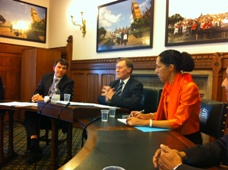
This followed a meeting the day before of members of the All Party Parliamentary Group (APPG) on the Maldives who used offices provided by the UK Parliament to hold a meeting entitled “Democracy Derailed: Political turmoil in the Maldives”. A source present during the meeting has given Minivan News their full account of the discussion.
The source, who wished to remain anonymous, said that those who spoke about the current situation in the country were the MP for Salisbury, John Glenn; Queen’s Counsel, Sir Ivan Lawrence; former Foreign Minister for the Maldives government and current UN Special Rapporteur on Iran, Dr Ahmed Shaheed, and former Deputy Health Minister Mariya Ali.
Also said to have contributed to the panel were Helen Grant MP, Mike Gapes MP, and former Maldives High Commissioner to the UK Dr Farahanaz Faizal.
Dr Faizal has actively opposed the current administration since resigning from her position, shortly after the departure of former President Mohamed Nasheed. She has since remained in the UK, working on behalf of the Maldivian Democratic Party (MDP) in raising awareness of perceived human rights abuses and democratic failings in the Maldives.
The former Deputy High Commissioner and brother to President Dr Mohamed Waheed Hassan, Naushad Waheed, was also present as were Maldivian students and families from the UK. Representatives of civil society organisations including the Commonwealth Human Rights Initiative and Third World Solidarity were also in attendance.
Chairman David Amess reportedly opened the meeting by expressing his disappointment that the Maldives government had declined to send a representative from the UK High Commission, despite being offered the opportunity to do so.
This has been disputed by Acting High Commissioner to the UK, Ahmed Shiaan, who claimed that the UK High Commission had received no official invitation.
The MP from Salisbury, John Glenn, expressed “no doubt” that there had been a coup d’etat in the Maldives, our source reports.
“[The] democratic will of the people of Maldives has been tossed aside,” Glenn is alleged to have told the group before mentioning his distress at the comments recently aimed at both the UK and the Commonwealth by the Maldives’ new governing coalition.
Glenn’s Salisbury constituency served as the base for former President Mohamed Nasheed during his exile in the UK. The Friends of Maldives (FOM) organisation, responsible for a recent travel advisory which pleads with tourists to avoid any resorts associated with alleged coup conspirators, is based in Salisbury.
Strained relations
Perceived interference from the Commonwealth, whose Secretariat is based in London and whose figurehead remains Queen Elizabeth II, has attracted scathing criticism recently in the Maldives.
Dhivehi Qaumee Party (DQP) MP Riyaz Rasheed accused the Commonwealth Ministerial Action Group (CMAG) as having been “bought by the Maldivian Democratic Party (MDP)” after it had urged the current government to establish its legitimacy with early elections.
CMAG released a strongly worded statement last week, arguing that the “the earliest possible expression of the will of the people was required to establish universal faith in the legitimacy of those who govern the country.”
That the group had seen a “lack of progress” in this respect caused it to express “disappointment and deep concern.”
Special Envoy Sir Donald McKinnon, who departed on Friday, attended the Opening Session of the People’s Majlis on 19 March, emphasised the need for parliament to “function effectively so that parliamentarians can return to debating issues of national interest.”
President’s spokesperson Abbas Adil Riza last week went as far as to suggest to Minivan News that the Maldives may consider its position in the Commonwealth, although the reporting of his statement was later dismissed by Abbas in other media as “politically motivated”.
Addressing the all party group, Sir Ivan Lawrence is said to have spoken of his lack of faith in the Maldives’ judicial system, based on his visits to the country during the Maumoon Gayoom era.
“It is now surely important for the same international community that helped to bring about the first democracy, to underline the importance to the new regime of holding speedy free and fair elections, so that power may be restored as quickly as possible to the people of the Maldives,” Sir Lawrence purportedly quoted from a letter he had recently sent to UK newspaper, The Times.
Mariya Ali is alleged to have discussed human rights violations in the Maldives as well as police brutality, before giving the floor to Dr Shaheed who is reported to have suggested that the Gayoom coterie lost their grip on power as a result of attempts to placate the international community.
Dr Shaheed apparently expressed his opinion that they were unlikely to repeat this mistake, citing Dunyha Maumoon’s comments regarding “civil war” as evidence of this resolve. Shaheed stated that the current government will not hold early elections, but rather will work to enfeeble the opposition MDP between now and the scheduled poll date.
Shaheed is also said to have expressed his concern that the independently minded Election Commissioner Fuad Thaufeeq would now be targeted by the current government due to his reputation for impartiality.
Insult and injury
The debate is also said to have included mention of the recent insults leveled at the Queen, the Commonwealth, and the UK government.
During DQP MP Riyaz’s diatribe on DhiTV, he argued that the British public had funded the MDP in return for the establishment of churches in the Maldives and also that they hated the Maldives for gaining independence from Britain.
“The English hate us. Why? Because Ibrahim Nasir saved us from slavery and brought us independence, since then what have the English done for us?” he said.
Riyaz then turned his attention to the Queen herself, “After 50 years, the English Queen, she is physically challenged. But she is still Queen, and if she wants she can remove the Prime Minister. Where is democracy? Where is democracy? That is not a democracy.”
In agreement with the opinion of a member of the public in attendance, David Amess is reported to have said that the government of Maldives should issue a full apology for Riyaz’s outburst and, in concurrence with the other members of the APPG, he argued that the issue should be brought before Parliament.
Additionally, Amess is reputed to have stated his feeling that the attendance of President Waheed at the Queen’s Jubilee celebrations this year would be inappropriate.
Minivan News has obtained video footage of this section of the discussion and can confirm an unidentified voice from off-camera suggesting an early-day motion regarding this topic.
Early day motions are a tool used by MPs in the House of Commons to introduce a subject for discussion. They are often used to publicise certain events or subjects and to gauge the level of parliamentary support for such motions.
Finally, the meeting is said to have moved on to punitive measures. The alleged consensus was that European travel bans had greater potential to damage those alleged to be behind a coup. The option of resort boycotts was dismissed as too damaging to the Maldives’ economic lifeblood.
The video footage received also includes Mr Amess’s concluding statements and so the following quote can be confirmed:
“Ladies and gentlemen, we started off our meeting asking has democracy been derailed, is there political turmoil in the Maldives? Well, listening to the contributors before us this afternoon, the answer to the first part is ‘yes’. Political turmoil in the Maldives? Again we’ve heard the answer, ‘yes’.”
Official comments
The validity of this meeting has been questioned by the Acting High Commissioner, Ahmed Shiaan.
“This was not a UK parliamentary initiated event. If this was an official APPG event, we should have been invited. It is very disappointing,” said Shiaan, “[If it were] they would have to get our perspective, even the Foreign and Commonwealth Office [FCO] wasn’t invited.”
Shiaan pointed out that the discussion initiated in the House of Lords on March 22, at which the FCO was represented, should receive more prominence as it better represents the official line of the government.
When Lord Howell of the FCO was in the Lords about the potential suspension of the Maldives from the Commonwealth, his response was that this decision was up to the whole of the Commonwealth to decide upon, not just one member.
“We must move to encourage democratic elections, and that is what is proposed in the India-brokered plan, which we welcome and support,” said Lord Howell.
One member of the House asked if Lord Howell felt the government was doing enough to ensure an independent international enquiry after what was regarded by some as a coup.
“We do not recognise this as a coup, although obviously there has been a change,” replied Lord Howell, “We still need to establish the full circumstances of what occurred and we hope that the commission of inquiry will do that.”
Lord Howell was also anxious to make clear the view of the FCO that the Maldives remained a safe tourist destination. “At the moment we do not judge that there is any danger in the tourist areas.”
Next, Lord Howell was asked what steps CMAG might take if they were not successful in pushing for early elections, to which he responded:
“If they are not, of course we would have a new and more difficult situation that would require further resolution and effort. For the moment, we concentrate on following the plan which the Indians have so helpfully brokered.”
Dhivehi Qaumee Party (DQP) MP Riyaz Rasheed, part of the new governing coalition, accuses the Commonwealth of seeking to build a church in the Maldives, Special Envoy Sir Donald McKinnon of taking bribes from the MDP, and the Queen of being “physically challenged”:
Stop this nonsense, you can only push propaganda so far.
The people confronting the police on the streets of Male’ everyday are not ‘thugs’. They are people from all over Maldives, they are young they are old. They are rich, they are poor. They are pious, they are indifferent. They are liberal, they are conservative. They are educated, they are fishermen. They are students, they are teachers, husbands, wives. They all believe in one thing: their right to elect their leader as citizens of a democracy.
These are the people who are out on the streets, fighting with the police and kicking up a riot. Because their right to be governed democratically has been taken away from them.
Stop this nonsense about ‘what of the poor police’? There is a fundamental flaw in the argument that ‘they [police] are just ordinary people, too.’ Vast differences exist between a civilian and a policeman on duty. Police are trained to control their impulses, to withstand anger, to repel provocation, to use weapons. Ordinary people are not. The public pays the police not to hurt them but to protect them.
Within twenty four hours of the new regime’s assumption of power, people were being brutally beaten by the police. The force of their violence has been a constant presence since 8 February. It is a threat that hovers in the air, unspoken. Always present.
With every mass protest on the streets of Male’, the police have come down harder, their violence more ruthless. Using pepper-spray and tear-gas has become the norm. The police charge at people with all their might, and without warning shoot tear-gas canisters into the people. They have put one woman’s burugaa on fire, smashed the head open of another and choked plenty.
Stop this nonsense about using ‘minimum force’, there is nothing minimal about the force with which the police come at you. You only have to feel their batons pointed at you and hear the filth they shout at you to know the level of violent force aimed at you by these men in uniform. They come in hordes, they pepper-spray at random, often pausing to take people’s sun-glasses off before spraying them straight in the eye. They crack open skulls without hesitation.
There is wanton cruelty, gratuitous violence. And there is a feeling of ferocious rage emanating from them as they hunt people down. These are not police running after an out-of–control people, these are police charging into people with the intention of intimidating, hitting, hurting, violating. The police are seeking to break them in, make them docile and prime them to be subjects of a dictatorship.
Like in all situations of conflict, women have been heavily victimised and subjected to gender-based violence. Police have partially undressed women on the streets, revealing their flesh in ways that compromise their privacy and mock the Islamic modesty her buruga is meant to convey.
There have been reports of women’s breasts being violently molested, or specifically targeted for physical assault. Unarmed women have been handcuffed and dragged to the island of Dhoonidhoo and detained without charge. ‘Unity Government’ MPs, like Red Wave Saleem, pontificate on television equating the women protesting with ‘women working in brothels.’
Stop the nonsense about this being a democracy, it cannot be one with an authoritarian government in power.
There can be no democracy where senior officials are being purged from government because they belong to a particular political party. There cannot be a democracy where the president is publicly campaigning, using state funds, for a parliament contender that is not even a member of his own party. There is no democracy where the president uses military force to pave his path to the parliament; where the president can only travel within the country by clearing off all streets everyone except his supporters.
Most importantly, there cannot be a democracy where questions remain unanswered about how the first democratically elected government of the country came to an end.
Stop this nonsense about colour, about ‘MDP people’, about whether it is unladylike for women to shout on the streets. The choice Maldivians face today is much bigger, stark. Democracy or autocracy. If early elections are held, it may put the transition back on track back on track, but if we let this government continue in its campaign to legitimise itself until 2013, by hook or by crook, there would be no going back. It will be too late for democracy.
At the rate the new government is reversing all policies that released people from the system of patronage built over a thirty-year dictatorship, people will soon be caught yet again in the same shackles of abject dependency on the Dear Leader that kept us subservient for those three decades.
If people don’t want this to happen, we must join the struggle to ensure this robbery of our fundamental right to govern ourselves is not covered up through false legitimisation. We shouldn’t let political colour blind us to the truth: democracy is in danger in the Maldives. If we believe in it, we must fight for it.
If dictatorship is what you want, don’t do anything. If not, do something.
All comment pieces are the sole view of the author and do not reflect the editorial policy of Minivan News. If you would like to write an opinion piece, please send proposals to [email protected]
The Ministry of Education has ordered schools to revise grade 7 Social Studies textbook, and add the following statement:
“President Nasheed resigned on 7 February 2012 after three years and two months in office. Hence, according to the constitution, vice-president Dr Mohamed Waheed Hassan Manik was sworn in as president.”
The opposition Maldivian Democratic Party condemned the move citing the party’s continued concerns over Waheed’s legitimacy. President Mohamed Nasheed claimed the February 7 transfer of power was a coup d’état.
International bodies, including the EU and the Commonwealth, have called for a speedy investigation into the transfer of power. The statement can be found here.
Forty Somali castaways under the custody of Maldivian authorities have recently refused to return home despite arrangements that were made for their safe repatriation, Minivan News has learned.
According to a top government official, who spoke to Minivan News on condition of total anonymity, the government had devoted “immeasurable amount of time and effort” over the past three years to safely repatriate several Somali nationals who have been discovered in Maldivian waters in dinghies lost at sea.
Many were found in frail health conditions due to dehydration and malnourishment, and had to undergo long treatments before being transferred to Dhoonidhoo Detention Center, where they were provided temporary refuge until negotiations on repatriation were finalised.
“However, after all their identities were verified, passports and a chartered flight was arranged for their safe transportation, they refused to go back to Somalia,” said the source, who has worked closely with the case.
“The United Nations High Commissioner for Refugees (UNHCR)’s delegation arrived in Maldives to confirm their preference because no refugee can be repatriated without consent under the international conventions,” he said. “So the delegation asked them one question – Are you willing to go? All of them said ‘no!'” he recalled.
He observed that the Maldives cannot resort to the option of forced repatriation as Somalia is recognised as a unsafe state.
Maldives has not ratified the 1951 Refugee Convention or its 1967 Protocol citing “financial and technical capacity constraints” but the convention prohibits all states, regardless of whether they have acceded it, from returning a “refugee to a territory where his or her life or freedom is threatened”.
“So the project is now a big failure,” he concluded, adding that the Maldives can face “increasing pressures from the international community if it continue with the forced repatriation.”
Minivan News could not get a comment from the foreign ministry at the time of press on how the state intends to move forward in solving the repatriation block.
Authorities have earlier echoed concerns over the increased financial burden to the state in providing shelter to the Somalis, who are said to be now in good health and actively involved in prison-based agricultural projects.
A Maldivian expert on combating human trafficking meanwhile noted in an interview to Minivan News that “if repatriation does not work out, the only legal solution would be for Maldives to sign the international conventions on refugees and Rights of Migrant Workers Families and accept the Somalis as refugees, and provide necessary protection granted under these conventions.”
“The Maldives will be pressured to sign the conventions. But, the question is are we ready to face that? We are already in a crisis with the current 100,000 expatriate population in the country which accounts to one third of the Malidives population. If these conventions are passed, it means, the expat population will be doubled or tripled,” he warned. “Are Maldivians willing to become a minority in their own country?” he asked.
Male’ City Council has given the area behind Dharubaaruge to Maldivian Democratic Party (MDP) to conduct political activities, after the police dismantled ‘Justice Square’ (the Tsunami Monument area) on Monday.
Deputy Mayor of the Council Ahmed Falah today confirmed to Minivan News that the land has been given to the MDP for three months to conduct political activities.
‘’We gave the land because last Monday terrorists attacked the Justice Square at the end of Lonuziyaarai street,’’ Falah claimed.
Male’ Mayor ‘Maizan’ Ali Manik said he did not wish to say anything about it because several media outlets had been misquoting him recently.
Former President Office Undersecretary Ibrahim Rasheed ‘Hoara Ibbe’ told Minivan News that tonight there will be a MDP rally at the ‘Usgandu’.
‘’MDP will be continue having meetings and conducting other political activities in any land we get and we will do it peacefully,’’ he said.
He said he regretted that police superiors have been sending low-ranking officers to attack MDP properties and persons and later blaming them, saying that their superiors did not know anything about it.
‘’They brought this day through a coup, and they are creating more violence to uphold the coup they brought,’’ he said, referring to the actions of the police.
Rasheed also said he was expecting that the suit against the security forces will be concluded next week.
The Justice Square or the tsunami monument area was also used by the MDP with the authority of the council.
However the current Attorney General Azima Shukoor declared that the land was not under the council and that it was under Housing Ministry.
A while after her statement, hundreds of police and military officers with batons and tear gas guns appeared in the area in full riot gear and ordered everyone in the area to leave immediately.
The area was then completely cleared of all trace of the MDP, from yellow flags to political graffiti on the sea wall. Police have been monitoring the area and occasionally ordering people visiting to leave.
The President’s Office has raised questions over former President Mohamed Nasheed’s eligibility for constitutionally-provided immunity and privileges.
Article 128 guarantees “the highest honour, dignity, protection, financial privileges and other privileges” to any person who has served in the office of the president and stepped down without committing any offenses.
However, President Mohamed Waheed Hassan’s spokesperson Abbas Adil Riza said Nasheed’s eligibility was in question since he had not completed a full-five year term. Nasheed resigned in his fourth year of office, an act he later claimed was “under duress”.
Riza pointed to Article 3 (a) of the Former Presidents’ Immunity and Privileges Act, which affords a monthly allowance of RF 50,000 (USD 3243) for a president who has served one term, and Rf 75,000 for a president who has served two terms (USD 4864).
Riza said the clause specifies that a president has to complete a five-year term in order to be eligible for financial benefits.
But Nasheed’s former Legal Affairs Secretary Hisaan Hussein said the constitution overrides the Former Presidents’ Immunity and Privileges Act, and said Nasheed had a “right” to immunity and privileges.
Further, Article 12 of the Immunity and Privileges Act, interprets former president to be one “who stepped down after completion of term or resigned from office” without committing an unlawful act, she noted.
Even if the government’s concerns were valid, a full term is specified only with regards to financial benefits, and not in clauses relating to accommodation allowances, health care coverage, security, and travel arrangements, she said. Yet, except for the provision of security, the government had refused to extend any privileges to Nasheed, Hisaan said.
Riza said President Waheed had only arranged for Nasheed’s security “through special privileges afforded to the President.”
International bodies have expressed concerns over Nasheed’s safety, after Criminal Court Judge Abdulla Mohamed issued a court order for Nasheed’s arrest following Nasheed’s resignation on February 7.
The Maldives National Defense Forces (MNDF) had held Judge Abdulla in military detention for three weeks prior to Nasheed’s resignation. The order was never acted upon.
The Human Rights Commission of the Maldives (HRCM) summoned Nasheed on Wednesday for questioning regarding his role in Judge Abdulla’s detention.
Riza said the President’s Office has now requested legal advice from the Attorney General Azima Shukoor on providing immunity and privileges to Nasheed. “As soon as we get legal advice, we will proceed,” he said.
Minivan News was unable to contact Shukoor at time of press.
In addition to monthly financial allowances, the Former Presidents’ Immunity and Privileges Act provides for a monthly accommodation allowance up to Rf 50,000 (US$3243). The President and his/her spouse are also entitled health care coverage, security and travel assistance.
Further, if a former president wishes to conduct charitable work, the act allows for an allowance of Rf 175,000 (US$11,349) to cover overhead costs.
Maumoon Abdul Gayoom, who served as president from 1979- 2008, set up the nonprofit Maumoon Foundation in 2010. The organisation’s stated aims are to assist the poor and needy. It awarded nine scholarships for higher education abroad in 2011.
Police have forwarded a case against the driver of a quad-bike that crashed and killed two passengers on Kuredu Island Resort to the Prosecutor General (PG)’s office.
The recently-married British couple from West Yorkshire, Emma and Jonathan Gray, were riding on the quad-bike as passengers when it collided with a tree around 4:00am on August 6, 2011. The pair had been married for just seven days and had a six-month old son, Jake.
Police subsequently identified the driver as 23 year-old Swedish national Filip Eugen Petre, the son of a shareholder of the company that operates the resort, who was employed by the company as a trainee guest relations officer.
Petre, who was injured in the crash, was charged under section 88 (d) of the penal code, Police Sub-Inspector Hassan Haneef told Minivan News today. He confirmed that Petre was in the Maldives and was free to move about, “although his passport has been retained.”
The section cited broadly refers to “Disobedience to order authorised by Sharia or law”. Article (d) reads that “Where such disobedience resulted in the death of a person the offender shall be subjected to punishment described by Islamic Law.”
UK media reporting the charges have noted that the maximum extent of these punishments include the death penalty, however while this sentence is still given by the courts it is usually commuted to up to 25 years imprisonment and was last implemented in 1953: Hakim Didi, by firing squad, on charges of practicing black magic.
Several MPs in parliament, including Jumhoree Party (JP) MP Ibrahim Muthalib and Maldivian Democratic Party (MDP) MP Ahmed Rasheed have previously submitted amendments to the relevant Clemency Act demanding that such sentences be carried out if upheld at Supreme Court level, however they have not been passed.
The prospect of Petre facing such a penalty was “shocking. It’s absolutely horrendous,” Jonathan’s mother Cath Davies told the Halifax Courier.
“We never expected there to be an outcome like this. It’s good they have dealt with it. It’s great they have investigated it properly. But I wouldn’t want it to be carried out. It’s not going to bring Jay and Emma back. It’s not going to make us feel any better. It doesn’t seem right. I just find it quite abhorrent,” she told the paper.
“It’s not like he set out to maliciously hurt or kill them. He never intended it. What happened was a tragic accident and not the result of wilful or malicious intention.”
Hearing of the charges had “brought back all the events that happened and what we have gone through since,” she said.
“We don’t want to keep revisiting these things. We want to move on and we want to remember Jay and Emma for the lovely couple they were and not always being brought back to the tragic event that ended their lives,” she said.
Following the incident in 2011, Filip’s father Lars Petre provided a statement to Minivan News in which he described the accident as “by far the most tragic event in my life, and words cannot describe how saddened we are. I and my family are deeply concerned with errors on some of the media reports and we are also deeply saddened by some accusations made at my son.”
“My son Filip Petre (23 years) was taking the two guests home, to the other side of the island, when he experienced some difficulties with the bike, and crashed headlong into a tree on the road. The crash took two lives and badly injured my son.
“He fell unconscious with the crash and woke up some time later to find the two deceased also lying on the road. He immediately called for help and worked alongside with the doctor who arrived to try and save the victims of the crash, while he was bleeding himself.
“The quad bike which my son was driving was registered and my son Filip is licensed to drive such vehicles. My son Filip and his brother Tom (who was the first to arrive at the scene of the accident with the doctor), the management and staff of Kuredhu have been cooperating with the police investigation fully, and I give every assurance that they will continue to do so in the future.
“We understand the grief of the families who lost their loved ones in the accident, and we also respect the duty of the Maldives Police Service to investigate the matter. However the fact remains that what happened on August 6 is an accident, a very tragic fatal event, which my son no anyone else had the power to change.”
 (0)Dislikes
 (0)
(0)