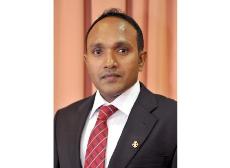
Supreme Court Judge’s sex-tape probe stalled as Criminal Court fails to provide warrants

The police have been unable to proceed with the investigation into the alleged sex-tape scandal of the Supreme Court Judge Ali Hameed, after the  Criminal Court failed to respond to police requests for warrants, reports local newspaper Haveeru.

An official from the Judicial Services Commission (JSC) – which is constitutionally mandated to oversee the judiciary – was quoted in the paper as stating that it had received a letter from the police noting that the Criminal Court’s failure to respond to requests for two warrants – made three months ago – had forced them to halt the investigation.

According to the unnamed official, the warrants sought by the police included authorisation for the police to take a facial photograph of Judge Hameed for comparative analysis with the videos relating to him, and a second warrant requesting the court’s permission to search his residence.

In a bid to verify the claim, Minivan News contacted the Criminal Court’s Media Official Mohamed Manik. When asked about the case, Manik told Minivan News that he would call back after reading the Haveeru article, though he not responding to further calls at the time of press.

Spy-cam footage allegedly depicting the Supreme Court Judge indulging in different sexual acts with multiple foreign women surfaced on local media last July.

The case rose to prominence once more after the Supreme Court’s decision to annul the first round of the presidential elections in October. Images and symbols depicting scenes from the sex-tape formed a prominent part of protests against the court’s repeated interference in the election.

The videos appeared shortly after a film – also involving Judge Hameed – began circulating on social media in which the Supreme Court Judge appeared to be discussing political influence in the judiciary with a local businessman.

The videos came after the arrest of Ahmed Faiz – a council member of former President Dr Mohamed Waheed’s Gaumee Ihthihaad Party (GIP) and the then-Project Advisor at the Housing Ministry – while he was allegedly trying to sell a sex-tape of the judge.

The public circulation of the videos and widespread media coverage on the scandal prompted both a police and a JSC investigation into the matter.

The then-Commissioner of Police Abdulla Riyaz has previously confirmed to local media that the police had been probing the case.

Police subsequently summoned Judge Hameed for questioning in the same month as part of its investigation into the video.

“We are currently investigating two cases concerning the video. One is the case of those who had been using the video to blackmail the people in it, and the other concerns the content of the video,” the spokesperson said at the time.

However, apart from the summoning the police remained largely silent on the matter.

The JSC – whose mandate includes looking into the disciplinary issues and ethical conduct of Judges – also formulated a five member sub-committee to probe into the matter.

The initial members of the committee included JSC Vice-Chair Abdulla Didi, commission members Latheefa Gasim, Ahmed Rasheed and two lawyers outside the JSC – Mohamed Anil and Hussain Siraj.

However, following Anil’s appointment to cabinet as the new Attorney General, he was promptly replaced by veteran lawyer and President of Maldives Bar Association Husnu Al Suood.

Minivan News attempted to contact Police Media officials and the JSC Spokesperson but they were not responding to calls at time of press.

Likes(1)Dislikes(0)

Comment: President Yameen begins well, yet road-blocks remain

True to his public commitment on election to the nation’s highest office, Maldivian President Abdulla Yameen has extended an arm of all-round reconciliation. The MDP opposition, whose nominee and former President Mohamed Nasheed lost the polls by a narrow margin, has also risen to the occasion. Yet it will require all their collective will and commitment to stay the course, with scheduled elections to local councils and the parliament possibly occasioning a return to political adversity, if not unacceptable hostility.

Symbolising the reconciliation was the prompt MDP withdrawal of the no-trust motion against Deputy Speaker in Parliament, Ahmed Nazim who belongs to President Yameen’s Progressive Party of Maldives (PPM). As if by cue, the government side rendered a similar move against Speaker Abdulla Shahid ineffectual. President Yameen had to silence murmurs of protest from the PPM camp after two party MPs withdrew from the no-trust move against the speaker. It sent out ‘confusing signals’ but only for a while. The murmurs have died down and the reconciliation has held.

A more significant concession to the opposition was the resignation of Commissioner of Police Abdulla Riyaz – the nation’s top cop. The MDP was critical of his role in the controversial power-transfer of 7 February 2012, when President Nasheed quit and his Vice-President Dr Mohamed Waheed took over as per existing constitutional provisions. The party was unhappy with the functioning of Riyaz even afterward.

Armed forces at bay

Addressing larger issues and concerns, the new government has proposed to bring up a bill before the People’s Majlis, proposing disciplinary action and procedure against errant personnel of the Maldivian National Defence Force (MNDF).

Both during the pre-democratisation era and afterward, the MNDF has been in the eye of political storms. Frequent transfers and summary dismissals – caused possibly by the over-politicisation and political misuse of the forces – were not wholly uncommon. It will surprise any student of military history that Maldives does not have a disciplinary law for the armed forces. It is hoped that the new law would address not only individual acts of ‘indiscipline’ but also ‘institutional lapses’, protecting the MNDF hierarchy from political acts of avoidable transfers and demotions, and continually testing their ‘loyalty’ to the State (read: ‘loyalty’ to the person of the incumbent president).

Despite bifurcation of the National Security Service (NSS) into the MNDF and the Maldives Police Service, presidents – both during pre-democratisation era and afterward – have been known to have commanded the former to execute what were patently illegal acts of arrests and the like. Anyway, under the bifurcation formula, such arrests fell within the mandated responsibilities of the police, which unlike the MNDF was directly answerable to the nation’s judiciary.

However, the current efforts come on the heels of the Yameen Government dismissing at least eight MNDF officials in two groups, on charges of ‘spreading hatred’. It was said that some of the dismissed officials, including two seniors in the rank of Brigadier-General – one of them demoted – were identified with what could be described as ‘independent’ or ‘anti-government’ campaign since the power-transfer of 2012.

The MDP’s Nasheed has promptly criticised the dismissals. It remains to be seen how the party reacts to the issue and the promised new bill – in parliament and outside. While defending the dismissals, the Defence Ministry has said that it was in consultation with authorities on initiating legal action against those making such criticisms. Both the MDP charges and the caution about possible action are remnants from the past, and have the potential to rock the ‘reconciliation boat’ in more ways than one.

One solution could be to address issues futuristically as a nation, to see if and how the uniformed services could be ‘de-politicised’ completely, as is prevalent in many matured democracies.

Responsive to internal compulsions

Responsive to internal compulsions of the PPM-led coalition from the second round, Yameen named Umar Naseer – who had contested against him for the PPM presidential nomination, taking his subsequent defeat to the courts – as the all-important Home Minister. Naseer had sided with Jumhooree Party (JP) presidential hopeful Gasim Ibrahim, yet throughout the campaign seemed not to have resorted to political or personal attacks against the PPM and its leadership. He is a JP nominee in the cabinet.

Unlike the observed approach of predecessors, President Yameen seems to be keen on sharing official responsibilities with Vice-President, Dr Mohamed Jameel Ahmed – a PhD holder in criminal law from the UK. That was an issue over which President Nasheed and Vice-President Waheed differed, for instance, contributing in no small measure to the subsequent controversies.

At the time, supporters of President Nasheed had argued that under the ‘US model’ adopted by Maldives, the vice-president was a stand-in for the president should the office fall vacant, and did not otherwise have any constitutional responsibilities. In the Yameen dispensation, Vice-President Jameel discussed the ‘visa issue’ with Indian High Commissioner Rajeev Sahare, indicating that he had a portfolio to call his own, thus sharing and shouldering part-responsibilities of his president.

Consensual economic policy?

Based on the parliamentary poll results of 2009, President Nasheed declared that there were only two major political parties in the country – namely, his MDP and the one led President Maumoon Abdul Gayoom, his predecessor for 30 long years. On issues and common concerns of the nation, it did not translate into a ‘bi-partisan approach’ to policy-making or programme-identification. The reasons were too many, including less-talked-about ideological differences within the Gayoom-led Dhivehi Rayyathunge Party (DRP) and the breakaway PPM.

By boldly talking about ‘lean government’ and slashing government expenditure even in his first news conference after election, President Yameen has adopted a policy otherwise close to the MDP’s heart. He straightaway offered to cut his presidential pay by half and ordered the recall of the 2014 Budget from Parliament, with directions to the Finance Ministry to cut down projections by MVR1billion.

Following in the footsteps of President Nasheed, President Yameen has also called for a review of pays and/or perks at all levels of government and ‘Independent Institutions’ under the constitution. In a nation with little job opportunities, the state provides employment to over 10 per cent of the population. The pay bill recorded a two-thirds hike in the last two years of the Gayoom presidency (2006-08).

It remains to be seen if President Yameen will be able to proceed on the same road. Before him President Nasheed found himself balancing the 20-percent cut in pay and staff with ‘freebies’ for select constituencies, and lifting the artificially pegging of the Maldivian ‘ruffiya’ against the US dollar – all proving politically unpopular. The Nasheed dispensation could not also resist the political temptation of creating elected, full-time island councillors, with pay and perks, adding to the Treasury’s woes. President Yameen has called for a review of the scheme, as had been promised when he was in the opposition in parliament.

Visible road-blocks

For all the good intentions and better equations that President Yameen is striving to achieve with the MDP opposition and allies alike, it is inevitable that the political road ahead is strewn with bumps and pot-holes. Even before the ink on the presidential polls dried, the Election Commission had scheduled nation-wide local council polls for 18 March, followed by the all-important parliamentary polls on 22 March.

In ordinary circumstances, the heat generated by the presidential polls does not inspire confidence in the current reconciliation process. For the street-smart MDP, the upcoming polls are a healthy way to re-energise their cadre, demoralised by the results of the presidential election. For President Yameen, he will have to extend the electability of his leadership beyond the immediate self, which ‘coalition calculus’ alone made possible.

For now, President Yameen is unlikely to leave party and coalition politics to the care of President Gayoom, the PPM chief and his half-brother. His government and leadership cannot escape the burden of any reverses, particularly on the coalition front. It will be more so in the upcoming elections to parliament, where already the MDP coalition has a majority.

Incidentally, President Nasheed did not have the parliamentary majority that his government sorely needed when in office. They could manage it only after the 2013 presidential polls were well under way, the Supreme Court having annulled the first-round elections of 7 September. The DRP, which President Gayoom had founded only to leave to form the PPM, has since joined the MDP coalition with seven or eight MPs to call its own. But its electoral contribution, as witnessed during the presidential poll, was next-to-nothing.

The JP can be expected to demand its pound of flesh in seat-sharing talks within the government, for the 23 per cent first-round Gasim vote-share that was ‘transferred’ to Yameen in the second-round of the presidential polls. Otherwise, the party has been reacting cautiously to post-poll initiatives of President Yameen. The JP seems to have adapted itself the role of a ‘political watch-dog’, otherwise the role of the MDP, which has promised to show how a ‘responsible opposition should conduct itself’.

Another ‘second-round partner’ of President Yameen – the religion-centric Adhaalath Party (AP) has since indicated its intention to go it alone in the local council polls and the parliamentary elections. The party is now a partner in the Yameen Government, though its decision to go it alone in crucial polls is akin to its past record. In 2008, the party supported the MDP in the second round presidential polls and partnered with the subsequent Nasheed Government until pulling out and taking to the streets on ‘Islam-related issues’.

Though the AP may not win many parliamentary seats, it can make a dent on the local council front, more so than it did in earlier polls. The party can also make a difference in ‘marginal seats’ in the parliamentary elections. This should be a cause of concern for the ruling coalition. Some of the AP’s ideological positions could yet be cause for political concern within the new government and its leadership.

Early checks on hand

Ahead of the twin polls to the local councils and parliament in the first quarter of the New Year, December promises to be a crucial and critical month for Yameen presidency. The parliament should vote for the revised 2014 budget before the year is out. Speaker Shahid has also scheduled parliamentary approval for Yameen’s cabinet appointees for 29 December.

The Yameen cabinet features nominees that the MDP had frowned upon for their alleged role in 2012 ‘power-transfer’. Adapting the US model to suit the prevailing mood of the Gayoom era, the Maldivian Constitution provides not only for the Majlis to clear individual cabinet ministers – it also empowers the Majlis to recall individual Ministers at will and vote them out.

The democratisation era has already had its quota of controversies surrounding delayed parliamentary approval, denied approval, recall and vote-outs. The MDP’s Nasheed has declared that the party does not believe in a coalition arrangement and will vote only for President Yameen’s government – as the 48 percent voters who cast their lot with him too believed. Translated, it could mean that the MDP may clear the five PPM members of the cabinet, and hold back confirmation for the other 10, who represent the Yameen government’s ‘coalition interests’.

The next five years of rule, President Yameen may be faced with the possibility of ministers’ recall, and not only during immediate ‘confirmation proceedings. Unless the MDP leadership intervenes, it is not unlikely that the proceedings of the party-controlled ‘Government Oversight Committee’ of Parliament – which would initiate the ‘confirmation proceedings’ – could witness fireworks. How it translates into floor-level operation/cooperation in the house as a whole will remain to be seen during the long run-up to the parliamentary polls in March.

All this would render it imperative for Yameen’s government and the ruling coalition to go all-out to ensure a parliamentary majority in the president’s favour. The MDP for now has promised parliamentary support for policies similar to its own, but how far the promise holds remains to be seen in the context of ground-level political realities. Throughout, the MDP leadership would have to carry the ‘politically sensitive’ cadres with it, should they not risk further demoralisation of the rank and file.

MP jailed for ‘contempt’ – and freed

An early sign of post-poll reconciliation involved the Yameen leadership encouraging MDP parliamentarian Hamid Abdul Ghafoor to end his month-long ‘refuge’ in parliament and move home, to escape six-month imprisonment for ‘contempt of court’. Home Minister Umar Naser had said at the time that the government will do what is possible within the existing law. He even justified ‘house-stay’ for Ghafoor, explaining that the Government did not have resources to produce him in Parliament from a nearby island prison, three or four times a day to participate in the proceedings.

The Supreme Court has since ruled that parliamentary privileges amounting to violation of court orders would not hold in law. The government has since been left with little option but to send Ghafoor to prison for contempt. It is unclear, however, if and how the government would proceed against Ghafoor and other MDP leaders, arrested and charged with consumption of alcohol and drugs when President Waheed was in office.

The MDP promptly condemned the Hamid’s imprisonment. “This does not bode well for co-operation or compromise between the opposition and the ruling administration,” the party said, referring to Yameen’s post-poll commitment to be ‘President of all Maldivians’. The MDP claimed that the ‘courts are in control of the Executive’, and Nasheed himself claimed that the government could now arrest opposition MPs on the eve of crucial votes in parliament.

It may be recalled that almost throughout the shortened presidency of Nasheed, the MDP had claimed that the judiciary was opposed to the executive. The government was locked with parliament and the judiciary over the make-up of the Supreme Court bench under the constitution, leading and contributing to the MNDF lock-down of the court’s premises for a day, under presidential orders. It may be pertinent that any wholesale revisit of the post-democratisation government processes, if undertaken, will have to address issues such as the one flagged by the Hamid case, to see how other nations handle such issues.

For now, however, in a turn of events that has the potential to cement post-poll reconciliation efforts, the High Court overturned the lower court sentencing of Hamid, MP. In doing so, the High Court judge cited his written apology to the trial court for not honouring the summons the first time. The High Court also pointed out that the trial court order was not covered by the post-facto subsequent Supreme Court judgment.

MP Hamid was promptly freed from prison after the High Court verdict was known. It now remains to be seen if the State will go on to appeal against the High Court order. Technicalities and legal possibilities not with-standing, the next course of the Hamid contempt cas will be a marker of Yameen’s commitment to political reconciliation.

‘Judge Abdulla case’

Sooner rather than later, the Yameen government will also have to make a call on the criminal case pending against President Nasheed in the Judge Abdulla abduction case. This was again a case initiated by the Waheed presidency but with the PPM, JP and others lending political support. If resurrected, the case has the potential to become a ‘live issue’ for the twin elections ahead. It has a greater potential to derail the step-by-step process of national reconciliation, on which the Yameen presidency and the MDP are participating enthusiastically.

Faced with the theoretical possibility of disqualification from contesting the presidential polls, Nasheed had promised to stand trial after the elections. It is both a critical and sensitive issue for the MDP in particular, but it also has the potential to blow up into a political controversy within the ruling coalition and the nation as a whole, particularly in the midst of high-spirited election campaigns.

President Yameen will require all his political ingenuity and persuasive powers to carry the coalition and/or the nation in whichever decision he takes on the matter. To do so without distracting from his current efforts at national reconciliation and reviving the fallen economy are tasks that will no doubt be time and energy-consuming.

President Nasheed has promptly denied social media rumours that he would be contesting the parliamentary polls. Even as the MDP is busy preparing to face the new polls, it should be working to re-position Nasheed in the internal scheme of things. The party and the leader are inseparable. The party now seems to need the leader more than the other way round – or, so it seems. The party will need to keep Nasheed relevant to its internal and external political schemes for the foreseeable future.

The Judge Abdulla case and the like are thus as much political opportunities as they are personal inconveniences to President Nasheed. Needless to recall that it may have been the decision of the Nasheed presidency to summon predecessor Gayoom to a police station for questioning on issues purportedly pertaining to the latter’s days in office that changed the course of Maldivian history. President Yameen declared on his election that there would be ‘no witch-hunting’ of the MDP regime. But whether he meant to include personal cases against individuals then in office was/is unclear.

Nor is it clear how much the government can do in the matter of cases that are already pending before various courts. Yet such a line will not convince anyone, home or abroad, with a potential to re-launch an avoidable cycle all over again. However, the MDP would also be under the strain of having to win most seats in the two rounds of upcoming polls – and at the same time reassuring Maldivians that they are not there to try and torpedo the Yameen presidency at the first available opportunity.

The writer is a Senior Fellow at the Observer Research Foundation

All comment pieces are the sole view of the author and do not reflect the editorial policy of Minivan News. If you would like to write an opinion piece, please send proposals to [email protected]

Likes(0)Dislikes(0)

DRP announces rebrand effort

The Dhivehi Rayyithunge Party (DRP) has called for submissions for a new party color, logo and slogan in an effort to re-brand its image.

Once the largest political party in the Maldives, the DRP’s strength has declined radically after founder and former President Maumoon Abdul Gayoom’s split from the party in 2011.

The party’s elected council has now been dissolved with the leadership’s defection to the opposition Maldivian Democratic Party (MDP) and government aligned Jumhooree Party (JP).

Acting leader and MP ‘Colonel’ Mohamed Nasheed has previously described the party as now being in the “ICU”, accusing the party’s leadership of leaving behind MVR10million in debt (US$ 64,5161) and abandoning the party with its data and assets.

Speaking to the press yesterday, Nasheed said the party would offer MVR200,000 (US$ 12903) for the re-brand effort. Applications will be accepted up until December 15.

Nasheed said the party’s current color blue is not visible from afar. Furthermore, the current logo of a coconut frond and boat on a blue backdrop is complex, and hence, difficult to duplicate and print on campaign materials. The new logo must not contain more than three colors, and must retain its original content even if re-sized.

The new logo, slogan and color will be approved and new leadership elected during the party’s next congress.

Meanwhile, the DRP is undergoing an internal audit and has called for any party to whom the DRP owes money for materials or services rendered to come forward within 10 days with the necessary documents to prove the claim.

Nasheed has also pledged to offer the annulled position of “Supreme Leader” to former President Gayoom.

The title was annulled during the party’s April 2013 congress with a 602-10 vote.

Nasheed said he believed Gayoom had retired from politics and must be honored as DRP’s founder for “historical purposes.”

“We believe his sacrifice in founding the party must be recognized,” he said.

Recognising former leader Ahmed Thasmeen Ali’s services to the party, Nasheed said he excluded Thasmeen in his criticism of the party’s former leadership and from accusations of stealing from the party.

The party intends win the mayorship of Male’ City Council and win at least 15 seats in parliament, Nasheed said.

Nasheed defected from the MDP to join the DRP in March this year claiming that the MDP is undisciplined.

According to the Elections Commission the DRP has 19,038 registered members at present.

Likes(0)Dislikes(0)

Minister of Home Affairs orders the removal of “any material inciting hatred towards police”

Minister of Home Affairs Umar Naseer stated on Monday night that he had granted an order to police to remove any material which could be interpreted as “inciting hatred towards police”.

“I have notified every police officer and police station in the country of this order. I have ordered the removal of any material that may incite hatred towards the police – whether it is text, a drawing, a poster or a billboard – that is found in any area of the Maldives at any time.”

The Home Minister’s announcement was made during an event held in honour of retired Commissioner of Police Abdulla Riyaz, who has left the services to pursue a political career.

“For a long time now, there have been attempts of different levels to ruin the reputation of the police force and to create hatred amongst the public for this institution. This is something that has been done in other countries too. But the thing is, peace and stability have never been established in such countries,” Umar said.

Umar pledged to make the police force an institution which is loved and respected by all citizens.

Calling on educated youth to join the police forces, the Home Minister said that it is through employing young, capable, educated persons that the police force can be further strengthened and developed.

The Home Minister further pledged to “destroy gateways through which drugs are brought into the country”, as well as to eradicate all such networks.

The biggest problem faced by the Maldivian society is the issue of drug abuse, he suggested, stating that he had already begun to take necessary measures to eradicate such networks in the near future.

He promised that the police would play a huge role in the operation, and opined that it would be near impossible to bring down other crime levels without first handling the issue of illicit drug sale and abuse.

“We are coming out on a war against the issue of drugs. I hope we will get your full cooperation in these efforts. We will completely destroy drug trade networks,” he told the gathered officers.

Newly appointed Commissioner of Police Hussain Waheed, meanwhile, advised the police to speak “gently and caringly” when addressing citizens, and to maintain equal treatment to everyone.

He then said that police should become an entity which rids the community of the currently spreading “hatred and discord”, and that is should aim to bring back unity amongst the people.

“Aim to enforce law, not gaining popularity”: VP Jameel tells police

During the same event last night, Vice President Dr Mohamed Jameel Ahmed stated that the police’s primary objective should be to ensure that they impartially enforce law, rather than whether or not they are garnering support and popularity.


Jameel stated that there are complaints that some of the police stationed in atolls work differently from the norms, saying that this leads to public disapproval and gives rise to concerns. He said that there should be no discrimination in the enforcement of law.

“Those who are mandated to enforce the law must not question the fundamentals of the law itself. Police must not question the substance of a law. It is not the police who decides whether or not the substance of a given law is solid. The law is already passed, and the police’s duty is only to enforce it,” Jameel said.

“If the citizens are being disturbed due to a loud speaker, you must be able to stop the loud speaker. If citizens are getting harassed on the street in a manner that disturbs them, and there is a law banning such action, you should be able to stop it. If there are laws made to assist the people, the police must be able to enforce it. I hope you will work in that manner,” he stated.

Jameel said that, although at a low level, it had previously come to his notice that police officers had acted on their own accord in certain cases, despite actions to be taken being specifically stated in law. He said that such actions had inhibited the growth and development of the institution.

He added that it was only when crime rates go down and stability is maintained that the police can be considered as having fulfilled their mandate to its fullest. He further called on the police to help the government implement a social protection system, saying that one of the strongest pleas of the public is to remove the political polarisation and to establish unity and oneness among the people.

Likes(1)Dislikes(0)

Maldives absent from Corruption Perceptions Index for second consecutive year

The Maldives has again failed to appear on Transparency International’s Corruption Perceptions Index (CPI) after the anti-corruption organisation was unable to secure the minimum required information necessary.

“We didn’t make the index as the required minimum of three sources of information was not received by TI,” explained Transparency Maldives’ Advocacy and Communications Manager Aiman Rasheed.

The CPI scores are base on a minimum of three expert sources – usually from international organisations with expertise in governance of business climate analysis. Examples include the World Bank, International Monetary Fund, Global Insight, or the Asian Development Bank.

Transparency International was only able to obtain information from two sources for this year’s list.

Asked if he thought the absence of the Maldives from the CPI for a second year would have a negative impact on perceptions of the country, Rasheed was dubious.

“My honest opinion is that it can hardly get any worse, we’re already in the bottom of the pile. The developments in 2012 and 2013 do not appear to have improved the public sector in terms of reducing corruption and empowering those who fight corruption,” he said.

He did admit, however, that the Maldives failing to appear on the index for two straight years would raise questions, though he stressed that multiple organisations involved in the collection and analysis of the required data made the assignation of blame to individual bodies unhelpful.

“The problem is that Maldives is a small country and the interactions of international institutions – from which the data is derived – may be limited, as well as the required information may not have been obtained in time, or the data that eventually do come through may not be utilized due to data quality,” continued Rasheed.

After moving up to 134th (of 182 listed states) in the 2011 index, the Maldives did not appear on the 2012 list.

Following the Maldives 2011 appearance in the list, Rasheed described the corruption in the Maldives as “grand corruption” when compared to smaller lever problems elsewhere in the region.

“In the Maldives there is corruption across the judiciary, parliament and members of the executive, all of it interlinked, and a systemic failure of the systems in place to address this. That why we score so low.”

The interference of the judiciary in this year’s presidential elections was roundly criticised internationally after the initial poll was annulled following a questionable Supreme Court ruling regarding fraudulent votes.

This year’s lists consists of just 175 states, with Denmark , Finland and New Zealand taking the top spots for the third year running.

The two positions at the bottom of the table were again occupied by North Korea and Somalia, again for the third consecutive year.

The CPI measures perceived levels of public sector corruption across the globe and is the most widely used indicator of corruption used worldwide.

Likes(0)Dislikes(0)

Police honour retired Commissioner Abdulla Riyaz ahead of his move into politics

The Maldives Police Services held an event on Monday night honouring retired Commissioner of Police Abdulla Riyaz.

“If the police are once again made to do political work, the leadership will doubtless fail again. The police institution must be larger than the government or any other entity,” Riyaz advised the hundreds of serving officers in attendance.

Riyaz – appointed after the controversial transfer of power in February 2012 – stated that his plans to move into a political career are in order to build trust in this area too.

“The police must not be seen to be an institution that just protects the government. The police is an institution that serves all citizens and implements lawful orders and norms. We have to be answerable to the government. We have to be accountable to the parliament”.

Riyaz stated that, when he had assumed responsibilities of the police commissioner on the night of February 8, 2012, the police leadership of the time had “failed and hence, people’s perceptions of the police had completely changed”.

He asserted that one of his first objectives after assuming the post was to ensure that the police was freed from all external influences and went back to working independently and professionally.

Riyaz further stated that police had remained steadfast in the face of wrongful allegations and perceptions of their work, while emphasizing that during his time as commissioner he had “never made a decision or issued an order with the intention of inflicting harm or harassment to any specific individual”.

“When Amnesty International released a report with false statements against us, I personally made a phone call to their president. In response to every one of these statements, we sent a statement clarifying the truth of the matter.”

“When I first took up the post, I was reluctant to even claim my pay as there was so much murder being committed. However, due to the work done unitedly, god willing we haven’t seen a major death this year,” Riyaz said.

February, 2012

Riyaz spoke in detail about his role in the controversial transfer of power on February 7, 2012.

The retired commissioner – who had at the time been relieved of his duties as a police officer – stated on Monday night that he had gone there on the day with “good intentions because [he] could not bear to sit home and watch the situation the police and soldiers were in”.

He added that he had contacted both the current Defence Minister Mohamed Nazim and former Deputy Minister of Home Affairs Mohamed Fayaz via phone prior to going there.

Stating that he had prioritized national interest above all, Riyaz claimed that he had accepted the post of police commissioner because his country needed him.

“Police were desiring a leadership that would not issue unlawful orders. Many asked me why I was going back to this institution, including my wife. But I decided that I cannot turn my back to the nation at the time it needed me most.”

Riyaz ended his speech by “seeking forgiveness from any police officer of citizen I may have inconvenienced during my time as commissioner of police”.

“Although I am leaving behind life as a police officer and entering politics, I will always defend this institution. There is no institution I can love as much as I do the police.”

He added that Vice Presidentv Dr Mohamed Jameel Ahmed had been the first to advise him to enter the political arena.

Appreciation from the state

“The happiest day that I have come across so far is the day when a new president was elected on November 16, the second round of the presidential election. What made me happiest about it is that we were assured that a government has been established which will not undermine or disrespect important state institutions like the police, the military, the judiciary and other entities,” he said.

“And that this is a government which will protect the religious unity of this nation and ensure that expensive state assets are not sold out to foreign companies,” he continued.

“The fact that Maldivian citizens voted in a Jumhooree Party and Progressive Party of Maldives government proves that the events that happened on February 7 [2012] was not a coup d’etat,” he stated.

Other speakers at the event, including Vice President Jameel, Home Minister Umar Naseer and current Police Commissioner Hussain Waheed commended Riyaz for his work.

Home Minister Umar described Riyaz as an assertive and sharp-minded officer who had brought commendable development to the institution.

Current Commissioner of Police Hussain Waheed stated that Riyaz had stood up to defend the police institution even when faced with “immense pressure, criticism and threats against [police officers’] families”.

“Even as police were referred to with various hateful names, and even some officers’ lives were taken, our brother Riyaz was working tirelessly in our defence.”

Likes(0)Dislikes(0)

Raajje TV arson suspect arrested after manhunt

The Maldives Police Services have arrested Mohamed Meeaadh – 35 years old, – on suspicion of torching and destroying opposition-aligned broadcaster Raajje TV’s headquarters on October 7.

A manhunt was called for Meeaadh in mid October. On receiving a tip off, the police obtained a court warrant to search Henveiru Roasary Light house. He was apprehended hiding alone in a ground floor room at 11:50pm last night.

According to the police, Meeaadh is also on the run from a separate drug related sentence. In November 2012, the Criminal Court had sentenced Meeaad in absentia to ten years in jail for illegal possession of prescription drugs.

The police have previously arrested 7 adults and a minor for suspected involvement in the arson attack. The unnamed adults include a 24 year old, a 20 year old, two 22 year olds, and two 18 year olds. The minor is 17 years old.

The police have urged the public to forward any information regarding the attack and have pledged to provide protection to informers.

CCTV footage of the attack shows six masked men armed with machetes and iron rods breaking through a reinforced steel grill and a second wooden door before dousing the station’s control room and lobby with petrol. The ensuing fire destroyed the station’s offices, control room, computer system, and broadcasting and transmission equipment.

The station returned to air the same day on donated equipment.

Further footage shows an additional six masked men breaking and entering the building located next to the BKT Builing where Raajje TV’s offices are located. Raajje TV has said it believes the six men were attempting to find the station’s second studios.

Reporters Without Borders (RSF) condemned the police for failure to defend the station despite Raajje TV’s repeated requests for police protection, and the forwarding of a specific threat the previous evening.

Raajje TV has continuously received threats since the controversial transfer of power in February 2012.

The police have recently concluded a Supreme Court ordered investigation into a report which criticized the Supreme Court and the judiciary. Police have this week asked the Prosecutor General to press charges against both the News Head of Raajje Television Ibrahim ‘Asward’ Waheed and the Deputy Chief Executive Officer of the Station Abdulla Yameen Rasheed.

In July 2012, the police and the President’s Office had said it would not cooperate with the TV station, blocking the station from President’s Office’s press conferences and denying police protection at protests.

The Civil Court has since ruled that the police and President’s Office’s decisions to ostracize the station were both unconstitutional.

In August 2012, critical cables in the station’s control room were cut, terminating the station’s broadcast. Several Raajje TV journalists have also reported arbitrary arrests and assaults.

In February 2013, men wielding iron rods on motorbikes assaulted Asward leaving him with near near-fatal head injuries.

According to Raajje TV the station had an audience of at least 95,000 people, one of the largest shares of Maldivian media. It reaches India and Sri Lanka and is also streamed online.

Likes(0)Dislikes(0)

Media Council slams Defense Ministry over threats to media

The Maldives Media Council (MMC) has expressed concern over the Ministry of Defense’s threatening the media for criticizing the dismissal of nine soldiers.

In a statement on Saturday, the Ministry of Defense threatened to take action against any party who criticized the ministry’s “routine” disciplinary actions.

The MMC – an elected 15 member council with media and public representatives – said the ministry’s statement infringes on freedom of the press and stressed that the freedom of press cannot be limited any more than is stated in the constitution.

The council appealed to the Defense Ministry to forward media complaints to the council instead of taking direct action against media outlets and reminded the Defense Ministry that the MMC is the legally authorized body to discipline any media.

Opposition Maldivian Democratic Party (MDP) has also criticized the “politically motivated and unjust” dismissal of nine high-ranking officers at the Maldives National Defense Forces (MNDF).

The nine were dismissed on charges of sowing discord within the military during the political tension surrounding the annulment, cancellation and delay of several round of presidential polls.

At the time, 17 high ranking officers signed a letter expressing concern over delay of polls and the repercussions in the absence of a president elect by the end of the presidential term on November 11.

Shortly afterwards, 73 mid ranking officers circulated an appeal calling on fellow soldiers not to obey “unlawful” orders issued by former President Dr Mohamed Waheed Hassan or his political appointees following the expiry of the presidential term.

The MMC has recently expressed concern with the Supreme Court asking the police to investigate a report aired by opposition aligned private broadcaster Raajje TV.

The police on Sunday sent case documents to the Prosecutor General’s office and requested charges be filed.

The military deployed soldiers to protect media outlets in October after masked men torched Raajje TV’s headquarters. The fire completely destroyed the station’s offices.

Likes(0)Dislikes(0)

Political Parties prepare to contest in Local Council Election

In preparation for the Local Council Election scheduled for January 18, 2014, political parties have begun preparations for contesting the elections that will decide island, atoll and city councillors for the next three years.

Progressive Party of Maldives

Progressive Party of Maldives (PPM) has announced the party will be contesting for a total of 627 seats. This includes 533 seats in island councils, 84 seats in atoll councils and 10 seats in city councils.

Local media has reported that the PPM will be taking applications from members wishing to contest in the elections till today (December 1). Unlike the rest of the contesting parties, the ruling party requires that each contestant pays an application fee of MVR 100 (USD 6.5). Contestants must also be members who have been on the party register from before September 30, 2013.

The party further states that it plans to hold primaries where necessary on December 4, adding that primaries will only be held if more contestants than the number decided upon by the PPM leadership submit applications.

In the instance that primaries are held, the results will be announced by December 5.

PPM MP Ahmed Nihan and Spokesperson and MP Ahmed Mahloof were not responding to calls at the time of press.

Jumhooree Party

Jumhooree Party (JP)’s Local Council Election Steering Committee Manager “KD” Ibrahim Didi stated that the party will be contesting for over 340 council seats.

“The leadership of the ‘Gulhifaivaa Ihthihaadh’ [United Coalition – the current ruling coalition consisting of PPM, MDA, JP and AP] has held deliberations on which coalition partner will be contesting in specific constituencies. We have almost reached a consensus now. However, there are still some seats where parties are deliberating with each other to swap or bring other minor changes,” Didi explained.

Didi stated that the deadline for applications of contestants end at 6pm on December 2, saying “it’s going quite speedily today. I think we’ll have enough applicants by the end of the day.”

Asked if the party plans to hold primaries, Didi responded, “It looks like we may have to hold primaries after all. Similar to, I believe, the othercontesting parties, JP also wants to bring out the most qualified, capable people we can possibly find to contest in this election.”

“We tried very hard to avoid having to hold primaries, by settling this through discussions and by trying to avoid any reasons for discord.”

“Despite these attempts, there are still about ten areas in which we will have to hold primaries as there are more than one candidate. But then, that is the nature of what happens in a democracy, I suppose,” he continued.

On November 26, JP Leader Gasim Ibrahim stated in a party rally that they had sent a letter to the PPM’s leader and former President Maumoon Abdul Gayoom asking for clarification of which constituencies the party can contest in for the local council election.

Gasim had further said then that the government had thus far failed to allocate the promised state positions to the party, adding that he believed this could be due to the government being “hectically engaged in other governance matters”. He said that in addition to parliament and local council seats, the party had asked the PPM leader about what other state positions would be granted to them.

“Our President Abdulla Yameen is an experienced man. Maumoon, too, is a person who has far more political experience than seen otherwise in the history of the Maldives. They will certainly not act in a way which will deprive us of benefits,” Gasim is quoted as saying in local media.

“What we have to say to party members and supporters is that we will present to you whatever we get”.

Maldivian Development Alliance

“All candidates that contest from our side will be brought out as representatives of the unity coalition. As a whole, we will contest in every island of every atoll,” Maldivian Development Alliance (MDA) Deputy Leader Ali Mauroof stated.

“The coalition is currently holding deliberations on the matter. However, MDA will be contesting especially for seats in the island of Hoarafushi in Haa Alif Atoll, Madaveli in Gaaf Dhaal Atoll, as well as the majority of islands in Noonu and Dhaalu atolls,” he said.

“We will have to hold primaries if there are more contestants than our number of seats. However, we are of the mindset that we will try to solve this through discussion and deliberation.”

Mauroof said that the party will work in alignment with its coalition partners and other parties that supported them in the presidential elections.

“The relationship between the coalition partners remain strong and we will go forward united to win this election,” he stated.

Adhaalath Party

In contradiction to the other members of the unity coalition who have agreed to run jointly in the election, Adhaalath Party(AP) has announced that it will contest separately.

AP is quoted in local media as saying that the party will be bringing out a “very high” number of contestants for the local council elections.

According to these reports, AP leader Sheikh Imran Abdulla stated that by the end of November, 104 members have applied to contest in the local council election.

Imran further said then that although the AP is running separately, it will extend cooperation to coalition candidates where needed.

AP leader Sheikh Imran Abdulla, and Sheikh Shaheem Ali Saeed were not responding to calls at the time of press.

Maldivian Democratic Party

Maldivian Democratic Party (MDP)’s coordinator for the local council elections Ibrahim Waheed said that the party is contesting for approximately 95% of the seats in the January election.

“We are holding primaries in the areas where more than one candidate have applied. This amounts to about 70 to 80% of the constituencies. While some parties are saying otherwise, we believe it is important that the final candidate be decided upon through holding primaries. If, like some others, a candidate is chosen through discussion and not votes in a primary, then it will not at all reflect the will of the people,” Ibrahim said.

“We are now working on sending statements to those who won in last Saturday’s primaries, as well as those in areas where there was no other candidates contesting, so that they can run in the party’s name. We believe all the primaries will be done, and the administrative work around it will be completed by December 8,” he explained.

Ibrahim further pointed out that candidates from the party have been facing a number of challenges.

“The small time frame that the courts have given to clear people’s records of offences have proven to be a huge inconvenience,” he said.

“The procedure is such that for the final application to the EC, the form contains sections that need to be filled by the courts, the penitentiary department and other offices located in Male’, and then again by the council offices in the island where a candidate is contesting for. The geographical situation makes this very complicated,” he continued.

“The other thing is that, all offices including the High Court and Supreme Court accept the application forms of the Elections Commission. However, the Criminal Court and Ablo Ghazi [Criminal Court Chief Judge Abdulla Mohamed] seem to be above the apex court even.”

“They insist that candidates submit a separate form issued by them, which further slows down the process and increases complexity of the matter. The EC informed us that the Criminal Court has in official terms agreed to accept the commission’s forms, however that is not what is happening in reality,” he said.

Elections Commission Secretary General Asim Abdul Sattar’s phone was switched off at the time of press.

Likes(0)Dislikes(0)