Elections Commission Head warns a compromised Nasheed trial could create doubt over election integrity

President of the Elections Commission (EC) Fuad Thaufeeq has expressed concern over former President Mohamed Nasheed’s decision to take refuge in the Indian High Commission.

Former President Nasheed sought refuge last Wednesday claiming his security was compromised and that the government was intending to arrest and convict him to prevent him contesting the 2013 presidential elections.

Speaking to local media, the elections commission chief said it was deeply concerning to see the presidential candidate of the largest political party seeking refuge from a diplomatic office.

Thaufeeq said Nasheed was a former President and ought to receive the privileges entitled to a former president as stipulated in the law.

“Firstly, Nasheed is a former president, secondly he a presidential candidate of a political party. Thirdly, he represents the largest political party in the country. Each of these factors carries significant weight,” Thaufeeq said.

He said the Elections Commission would do everything it could to find a solution for all the parties involved, including the former president.

Thaufeeq said Nasheed should get a fair trial in accordance with the constitution and the law, and that such a trial should not be politically motivated.

The President of the Elections Commission warned that if Nasheed’s trial proved to be a tool to bar him from contesting the scheduled presidential elections, it would cast doubt over the integrity of the election.

“Even if it is Abdulla Yameen or Umar Naseer or Gasim Ibrahim or Mohamed Nasheed or even Ahmed Thasmeen Ali, these people have all announced they will contest the elections. If one of them happens to be on trial, that trial must be free and fair,” he told local newspaper Haveeru.

The Elections Commission has announced that the election will take place on September 7.

Nasheed is being tried for his controversial detention of Chief Judge of the Criminal Court Abdulla Mohamed, during his final days in office in January 2012.

Nasheed sought refuge in the Indian High Commission ahead of the second hearing of his ongoing criminal trial, after an order was issued by the magistrate court to place him under police custody.

After entering the High Commission, Nasheed tweeted: “Mindful of my own security and stability in the Indian Ocean, I have taken refuge at the Indian High Commission in Maldives.”

Rumours of Nasheed’s imminent arrest began to circulate on Tuesday (February 12) ahead of the scheduled hearing, prompting his supporters to camp in the narrow alley outside his family home in Male’.

Following the Indian High Commission’s decision to take Nasheed in, police failed to produce him stating they did not have the jurisdiction to enter the premises, citing the protections of the Vienna convention to which the Maldives is signatory.  The hearing was subsequently cancelled in his absence.

The government of President Dr Mohamed Waheed Hassan Manik expressed concern over the move and accused India of meddling with its domestic affairs.

Speaking to local newspaper Haveeru on Thursday (February 14), Home Minister Mohamed Jameel said attempts by any country to prevent a person from facing charges pressed by an independent Prosecutor General (PG), could be described as interfering with domestic matters of a sovereign state.

In a tweet on Wednesday, Jameel implied that India was meddling in the Maldives’ internal affairs: “What’s happening now gives us an indication of the extent and level of interest some countries prepared to take in our internal matters,” he said.

“I would strongly urge everyone to let our institutions deal with the challenges, allow Maldives to uphold rule of law,” he tweeted.

statement released by India’s Ministry of External Affairs following the development called on the government of Maldives to facilitate an inclusive election in which all political party leaders could take part.

“Now that the President of the Election Commission of Maldives has announced that Presidential elections would be held on 7 September 2013, it is necessary that the Presidential nominees of recognised political parties be free to participate in the elections without any hindrance. Prevention of participation by political leaders in the contest would call into question the integrity of the electoral process, thereby perpetuating the current political instability in Maldives,” read the statement.

The United States, United Kingdom, UN, EU and Commonwealth have all followed India‘s lead and stressed the need for the next presidential election to be an inclusive election.

Nasheed’s Maldivian Democratic Party (MDP) has maintained that the charges are a politically-motivated attempt to prevent him contesting the 2013 elections.

Likes(0)Dislikes(0)

UN Special Rapporteur on Independence of Judges and Lawyers arrives in the Maldives

The UN Special Rapporteur on the Independence of Judges and Lawyers, Gabriela Knaul, arrived in the Maldives on Saturday (February 16) for a visit scheduled to last until February 24.

During her visit, Knaul will “examine measures taken to ensure the independence of the judiciary, prosecutors and lawyers, as well as their protection, and the obstacles encountered for an adequate, impartial and independent administration of justice”, the UN said in a statement.

Knaul, a judge from Brazil, will then submit her report and recommendations to the government and the UN Human Rights Council.

In its concluding statement following the Maldives’ Universal Periodic Review in 2012, the UN Human Rights Committee expressed concern that the composition and functioning of the Judicial Service Commission (JSC) “seriously compromises the realisation of measures to ensure the independence of the Judiciary as well as its impartiality and integrity.”

“The Committee is also concerned that such a situation undermines the judicial protection of human rights and fundamental freedoms in the [Maldives]. The [Maldives] should take effective measures to reform the composition and the functioning of the Judicial Service Commission (JSC),” the UN report stated.

“It should also guarantee its independence and facilitate the impartiality and integrity of the Judiciary, so as to effectively protect human rights through the judicial process,” it added.

Although unrelated, Knaul’s visit comes days after former President Mohamed Nasheed sought refuge from a court summons inside the Indian High Commission in Male’.

The Hulhumale’ Magistrate Court, which is trying Nasheed for his detention of Chief Criminal Court Judge Abdulla Mohamed during his final days in office, was created by the Judicial Services Commission (JSC).

The JSC, which includes several of Nasheed’s direct political opponents including rival presidential candidate Gasim Ibrahim, also appointed the three-member panel of judges overhearing Nasheed’s trial.

Parliament’s Independent Institutions Oversight Committee had declared that the JSC’s creation of the Hulhumale’ Magistrate Court was unconstitutional.

However, the Supreme Court declared parliament overruled, issuing a statement that “no institution should meddle with the business of the courts”, and claiming that as it held authority over “constitutional and legal affairs” it would “not allow such interference to take place.”

“The judiciary established under the constitution is an independent and impartial institution and that all public institutions shall protect and uphold this independence and impartiality and therefore no institution shall interfere or influence the functioning of the courts,” the Supreme Court stated.

A subsequent request by the JSC that the Supreme Court bench rule on the court’s legitimacy resulted in a four to three vote in favour. The casting vote was made by Supreme Court Judge Adam Mohamed, also President of the JSC.

A troubled judiciary

Besides the UN Human Rights Committee, numerous international organisations and reports have challenged the political independence of the JSC and the judiciary.

A report by independent observers of the Nasheed trial from the UK Bar Human Rights Committee concluded that “a primary motivation behind the present trial is a desire by those in power to exclude Mr Nasheed from standing in the 2013 elections, and notes international opinion that this would not be a positive outcome for the Maldives.”

A report by the International Committee of Jurists (ICJ) in February 2011 found that many judges were lacking in qualifications and independent attitude.

“How often do ordinary Maldivians look to the courts for justice? Is there a sense that ‘We [Maldivians] have an independent judiciary that is capable of resolving problems?’ I think the answer is no,” surmised Roger Normand, former Director of the ICJ’s Asia Pacific operations at the time.

“Historically, [independent resolution] has not been the role of judges [in the Maldives]. Judges were an outcome or a product of the executive power. This is not a controversial statement, this is an outline of what their legal role was in the previous [government],” Normand said.

The ICJ was highly critical of the the JSC, which it said was “unable to carry out its functions” to impartially vet and reappoint judges on the basis of qualification and background.

“To date, JSC decision-making has been perceived as being inappropriately influenced by a polarised political environment,” Normand said.

Former JSC member and whistleblower Aishath Velezinee first raised problems in the judiciary and JSC in August 2010.

“My experience, from being part of the complaints committee in the JSC, is that whenever a complaint is received, we have two judges on the complaints committee who will defend the [accused] judge, trashing the complainant, and talk about ‘taking action’ against these people ‘who are picking on judges’,” said Velezinee, in a 2010 interview.

“Then they will put out a press release: ‘Nobody should interfere with work of judges.’ Their interpretation is that ‘nobody should criticise us. We are above and beyond the law.’”

She was subsequently stabbed three times in the back in broad daylight on Male’s main tourist street in January 2011.

A more recent report produced by local NGO the Raajje Foundation and supported by the UNDP and the US State Department, noted that the JSC’s mission under the 2008 constitution to ensure the new judiciary was was clean, competent, and protected from political influence, “has sadly gone unfulfilled.”

“The courts have essentially been able to capture the JSC so as to ensure that the old judiciary remained in place under the new constitutional order,” the report noted, predicting the most likely national outcome a cycle of failed states.

President Dr Mohamed Waheed Hassan Manik has insisted on the government’s independence of the judiciary, stating that the court case “”has nothing to do with my government. Upholding the rule of law means nobody is above the law. I would like to assure the people of Maldives that the law and order will be maintained,” he said, in a statement on Sunday.

“My government has upheld the rule of law and respected all independent institutions. I am pleased to note that unlike in the past, within the last year, the President has not interfered in the work of the judiciary, the police, or the independent commissions,” Waheed’s statement read.

Meanwhile, Home Minister Mohamed Jameel – formerly Justice Minister under the 30 year autocracy of Maumoon Abdul Gayoom – told local media that it was “crucial [the judiciary] conclude the case against Nasheed before the approaching presidential elections, in the interests of the nation and to maintain peace in it.”

“Every single day that goes by without the case being concluded contributes to creating doubt in the Maldivian people’s minds about the judiciary,” Jameel said.

Likes(2)Dislikes(0)

Statement accusing Mulay of interference was forged, says JSC

The High Commission of India in the Maldives has expressed disappointment with the Agence France-Presse (AFP) newswire after it published a story on what the high commission claimed was a “forged” media statement from the Judicial Service Commission (JSC).

The statement, with JSC header and dubbed an ‘official translation’, said the JSC “regrets the interference of the High Commissioner of India in Maldives in his personal capacity with the judicial process of the Maldives, by keeping former President Mohamed Nasheed within the diplomatic confines  of the High Commission thereby impeding the due process of the Law.

“We appreciate the official stand of the Indian Government to refrain from interfering with the internal affairs of Maldives and respect independence of the judiciary,” read the statement.

It was emailed from an anonymous gmail account, [email protected].

The High Commission of India issued a press release on Sunday (February 17) admonishing the AFP for circulating the report based on the false JSC statement.

“The High Commission expresses its disappointment that a respected news agency like AFP has chosen to give undue publicity to such a cheap gimmick against the High Commissioner in the current sensitive atmosphere, without even bothering to check the veracity of the said letter with the JSC or High Commission of India in Male’,” the statement read.

The high commission statement was accompanied with an email from the JSC Secretariat denying having issued the release.

JSC Secretary General Aboobakuru Mohamed said the letterhead was “forged” and the statement was “false”.

“Regarding the issue of sheltering by the Maldivian ex-president, Mr Mohamed Nasheed within the compound of the High Commision of India, Male’, Maldives, we, the Judicial Service Commission (JSC) of Maldives, categorically deny issuing any statement on this regard,” the statement said.

The Indian High Commission called on AFP “to immediately retract its report and issue an apology prominently for the damage caused to the reputation and good will of the High Commissioner and the Indian Mission.”

Various new outlets have reported senior Maldivian government officials echoing the sentiment of the “forged” JSC statement: “The fact of the matter is that some individual Indian diplomats are interfering in our internal affairs. This must stop,” a senior government official told AFP, asking not to be named.

Maldives-India relations

Indian High Commissioner D M Mulay was meanwhile summoned to the Ministry of Foreign Affairs on Sunday (February 17) – the first time a high commissioner has been summoned by the ministry according to local media.

Mulay reportedly delivered a brief diplomatic note discussing the Indian government’s accommodation of Nasheed.

“We have not interfered with Maldivian politics and have no intention of even doing so. India also wants the Maldives’ judicial process to go on. We also want stability and peace in the Maldives. We want political reconciliation through peaceful dialogue,” Mulay told local media afterwards.

Following India’s initial warning that a failure to allow all political leaders to contest the elections would call into question the integrity of the electoral process and perpetuate instability, the Ministry of Foreign Affairs Ministry declared it was “unfortunate that the government of India has decided to comment on the types of candidates that could contest the upcoming Presidential Elections in the Maldives scheduled for September 2013.”

Local newspaper Haveeru quoted an unnamed government official as stating that the “political atmosphere in the Maldives would reach a boiling point” if India allowed it.

Meanwhile, President Waheed Hassan Manik  promised to promote democracy and maintain law and order in a statement issued Saturday (February 16).

He emphasised his “dismay” that Nasheed had sought refuge in the High Commission, instead of heeding his court summons, which expired on February 13.

“There is no reason for him to remain in the High Commission and to instigate street violence. The court order has nothing to do with my government. Upholding the rule of law means nobody is above the law,” Waheed said.

President’s Office Media Secretary Masood Imad implied that India was trying to fuel political turmoil in the Maldives.

“Mulay should take direct responsibility for the fresh unrest and violence in the capital,” he told local media.

Home Minister Mohamed Jameel Ahmed has also expressed his disappointment over the Indian government’s decision to provide refuge to Nasheed in the Indian High Commission.

Nasheed’s trial

Former President Mohamed Nasheed failed to attend the Hulhumale’ Magistrate Court hearing on February 10, resulting in a court order for police to produce Nasheed for trial regarding his controversial detention of Chief Judge of the Criminal Court Abdulla Mohamed in January 2012.

In response to rumours of Nasheed’s imminent arrest, he entered the Indian High Commission on February 13 seeking India’s assistance.

His Maldivian Democratic Party (MDP) maintain that the charges – based on his detaining Chief Judge of the Criminal Court Abdulla Mohamed during his final days in office – are a politically-motivated attempt to prevent him contesting the 2013 elections.

Likes(0)Dislikes(0)

Comment: India an unreliable friend

On 7 February 2012, somebody in the Indian High Commission – located barely a few meters away from the scene where mutinying cops brought down the first elected government in Maldivian history – gave some astoundingly poor advice to somebody in New Delhi, and what followed was one of the worst diplomatic blunders by India in recent memory.

The tear gas clouds had barely settled when Indian Prime Minister Dr Manmohan Singh sent his ‘warm felicitations’ and became the first country to recognise Vice President Mohamed Waheed’s newly installed government – a coalition of radical Islamists and far right nationalists led by former dictator Maumoon Abdul Gayoom’s party.

The United States and other Western powers would follow India’s lead in recognising the new regime, and – even as Maldivian democrats watched in disbelief – a major wrong that should have been straightened out was instead set firmly crooked.

The next day, the regime police continued targeted attacks on MDP leaders and activists. MPs were beaten half to death and lay unconscious on the pavements. Mohamed Nasheed, the first elected President of the Republic, was roughed up on the streets by uniformed men and was seen bleeding from the forehead. Scores of civilians were publicly brutalised and hundreds of pro-democracy demonstrators were arrested while India naively pursued relations with the new regime.

Over one year later, the cycle of violence and unrest continues on the streets of Male’, as pro-democracy protesters clash with regime police. The latest confrontations started after President Nasheed, in a dramatic turn of events last Thursday, sought refuge inside the Indian High Commission following the Waheed regime’s renewed efforts to arrest him and convict him in what is essentially a kangaroo court.

Once again, all eyes are on India, keenly observing if there will be a repeat of the ghastly diplomatic miscalculations of last year.

A series of unfortunate decisions

The gamble in 2012 was this: in return for the recognition of his regime, Waheed had pledged to honour major Indian investments in the Maldives, including the $500 million investment by Indian infrastructure company GMR in the country’s main international airport. As senior Indian diplomat G Parthasarathy confirmed in a recent televised debate, India had also been given assurances that there would be inclusive, free and fair elections.

Once again, somebody in India’s MEA should have easily flagged that Waheed, being a political nonentity, could hardly be held to his word. As the tinpot leader of a party whose very existence – with merely 3000 odd members – is an exercise in vanity, Waheed hasn’t a prayer of being nominated, much less winning an election, and is destined to be discarded into political oblivion before the end of this year.

And yet, India went with his assurances even as the the regime’s extremist allies took out motorcades around the streets of the capital, demanding GMR’s exit and, for the first time in recent Maldivian history, spreading radical anti-Indian propaganda over loud megaphones.

Sure enough, with the same belligerence and arrogance that characterised their early diatribes against the CMAG and EU, the regime thumbed their nose at India, and the GMR deal was scrapped without the slightest courtesy and amid a barrage of heavy anti-Indian rhetoric propagated by radical regime allies like the DQP and the Adhaalath Party.

India’s big gamble failed, and the aspiring superpower was left with egg on its face as Waheed’s spokesperson Abbas Adil Riza publicly slandered the Indian ambassador, calling him a ‘traitor’ and an ‘enemy of the Maldives’. Furthermore, the regime that was legitimised with Indian support would proceed to cozy up to rival power China, with regime actors going so far as to lambast India while on Chinese soil.

Eliminating Nasheed

In the bargain, India also lost favour with former ally Nasheed – whose government had gone out of its way to align with them. From plugging the Maldives into the Indian coastal security grid, to seeking Indian investments in his much celebrated environmental, energy and infrastructure projects, to unilaterally sharing intelligence on religious radicals operating in the country, Nasheed was thoroughly a friend of India in every imaginable sense until India, with remarkable urgency, dumped him and rushed to Waheed’s aid in 2012.

Having scrapped the GMR deal in an ugly fashion, the Waheed regime also backtracked on the second assurance of conducting early, inclusive elections.

Observers of Maldivian politics would recollect that Umar Naseer, Vice President of Gayoom’s political party, had specifically stated in an interview immediately after the February 7 coup d’etat, that Nasheed would not be a part of the next elections.

The regime’s Home Minister Mohamed Jameel has been unable to hide his deep frustration over the overwhelming international pressure that has so far thwarted his concerted attempts to eliminate Nasheed from the political scene ahead of the elections.

Mohamed Nasheed, the lifelong democratic activist, is easily the only MDP leader who commands popular nationwide grassroots support and absolute loyalty of his party activists, making him the last remaining obstacle for the Gayoom network – of which Waheed is the nominal puppet head – to permanently dismantle the country’s nascent democracy and reestablish the old order.

It would be pertinent at this moment to recall that the Waheed’s former Human Rights Minister Dhiyana Saeed, as well as former Military and Police Intelligence Chiefs have independently revealed the existence of opposition plots to assassinate President Nasheed while he was still in power.

With the change of guard on February 7 last year, that has become unnecessary. With the country’s runaway judiciary and security forces firmly under their grip, there is not much to stop the Waheed regime from eliminating him ‘legally’ and ‘by the book’. And this, evidently, is the plan that is currently in place.

Your friendly neighbourhood democracy

Simply put, there is a zero percent chance of an inclusive, fair or free elections being held in the Maldives with the current regime in power.

Faced with this conundrum, Maldivian democrats as well as Indian analysts appear to be looking towards India as the saviour to back Nasheed, who – in a frantic Hail Mary move – is now holed up at the Indian Embassy.

The question is: Why should Maldivian democrats trust India?

There is little reason to expect India to step into the internal affairs of the Maldives for the sake of grand concepts like freedom or democracy in the neighborhood.

One feels that despite the rise of nationalist and Islamist radicals, and the runaway judiciary, and the reversal of democracy in the neighbourhood, and the creation of a police state in the Maldives, what really inspired India’s change of heart about the Waheed regime was the loss of its economic investments. In other words, had GMR not been thrown out, India would have likely continued to turn a blind eye to the regime’s systematic dismantling of democracy in the Maldives.

Perhaps, having been rudely rebuffed by the Waheed regime that has now chosen to align with China, India is merely invoking the patron saint of lost causes by turning to Nasheed.

For the average Maldivian, however, the power struggles between the two large regional powers are a matter of less importance than having a working economy, a functioning judiciary, an expectation of justice, a representative government, and freedom from a familiar brutal police state that has reared its head again after a 3 year slumber.

The solution to these problems have to necessarily be local. Far from relying on foreign intervention, the MDP needs to campaign and educate and rally the public behind the goals of judicial overhaul and peaceful civil disobedience for change.

While one must acknowledge the invaluable assistance from theiInternational community in forcing the iron-fisted Gayoom to bow down before the people and ushering in the democratic transition in the last decade, the truth is that sustaining a democracy is a task that is best accomplished at home.

Not India’s war

The playwright George Bernard Shaw said in the early 1900’s, “Democracy is a device that ensures we shall be governed no better than we deserve”.

The harsh truth is that the Waheed regime has survived for over an year – despite the reckless trampling over citizens rights, the outright hostility towards the free media, the excessive brutality and the total impunity – only because the Maldivian public has allowed this injustice to take place.

Appearing on The Daily Show, President Nasheed quipped about the Americans following India’s lead in legitimising the coup: “I wonder if it is an intelligent thing to outsource your foreign policy”

Likewise, it is perhaps lazy and counter-productive for Maldivians to outsource the task of nation building to a neighbouring country that has its own vested interests. Indeed, this is perhaps one of the primary lessons that Maldivian democrats should take away from the experience of the February 7 coup. What has been stolen from the Maldivian citizens must be reclaimed by the Maldivian citizens. The responsibility for safeguarding our democracy remains ours and ours alone.

While India intervention could certainly make the task of restoring democracy exponentially easier, it nevertheless remains an objective that needs to be met regardless of India’s stand on the matter.

And yet, as a liberal, democratic Maldivian citizen, one hopes that New Delhi might one day realise that propping up military and Islamist backed anti-democratic forces in its immediate neighborhood will never serve India’s interests – either in the short term or the long term.

All comment pieces are the sole view of the author and do not reflect the editorial policy of Minivan News. If you would like to write an opinion piece, please send proposals to [email protected]

Likes(0)Dislikes(0)

Protesters clash with security forces

Additional reporting by Mariyath Mohamed, Neil Merrett.

Thousands of supporters of former President Mohamed Nasheed marched through the streets of Male’ on Friday night, clashing with security forces until the early hours of the Saturday morning.

Minivan News observed a column of at least 5000 demonstrators marching through the city shortly before 10:00pm.  The demonstrators were accompanied by three pickup trucks playing party songs and a recorded speech by Nasheed.

The former President has been inside the Indian High Commission since Wednesday afternoon after he sought refuge from a court warrant ordering police to present him before the Hulhumale’ Magistrate Court.

Nasheed and his party have maintained that the charges – of illegally detaining Chief Criminal Court Judge Abdulla Mohamed prior to his controversial resignation on February 7, 2012 – are a politically-motivated attempt to prevent him from contesting presidential elections scheduled for later this year.

Protesters reached the restricted area near President Dr Mohamed Waheed Hassan Manik’s residence and were were blocked by a line of Maldives National Defence Force (MNDF) officers.

Protesters shook a bus that had been parked in front of MNDF until the driver stepped out, and then pushed it through the MNDF lines. The protesters were were pushed back after the MNDF line formed up again.  At this point, demonstrators were witnessed throwing objects at the officers.

Special Operations riot police arrived on the scene from a side street, conducting a baton charge without warning. Minivan News heard one masked riot policeman yell at the MNDF line: “If you’re not going to hit anybody why don’t you just go home?”

Police conducted baton charges into the crowd and detained a number of people, including Nasheed’s representative on the Commission of National Inquiry (CoNI) Ahmed Saeed, former Home Minister Hassan Afeef, and former Defence Minister Ameen Faisal.

Police Sub-Inspector Hassan Haneef confirmed 55 people were arrested including four women and one minor. Seven police were injured “severely”, he added.

At one stage, Minivan News heard a dozen discharges of what sounded like some kind of firearm, prompting a number of demonstrators to panic and disperse.

Riot police had been deployed with rubber bullet guns, however Haneef said these were not used.

“We responded with proportionate force given the situation,” he said.

Around 11:00pm on the road in front of the Salsa Royal restaurant, Minivan News observed a small group of supporters from a government-aligned political party urging police to “beat and kill” MDP supporters.

A female Minivan News journalist wearing press identification was hit on the back twice with a police baton, after the group called on police to “kill the Minivan bitch”.

As the protest escalated, senior MDP officials began leading protesters away from police lines. One group of women were yelling “We don’t want to go. We will die only once. We will fight.”

Minivan News observed one man on the ground, apparently unconscious.

Shortly before midnight, police used an irritant of some kind to disperse protesters, who were pushed back to the main street Majeedee Magu and regrouped at the southern end of the tourist strip.

Minivan News spoke to a resident of a nearby building, a woman in her early 60s, who said she had been sprayed directly in the face with pepper spray.  She  claimed that police had attempted to force their way into her house before she managed to close the door.

A middle-aged female relative of the woman from the same house told Minivan News, “She only panicked and tried to close the door when police attempt tried to barge in. I yelled at police to get out, and that they couldn’t just force their way into a private residence. Police then pepper-sprayed her while yelling ‘shut up, we can get in to any place we want’. They used much more vulgar language, of course.”

Shortly before midnight, the majority of the demonstrators who had gathered ahead of police lines on Chandhanee Magu moved back along the capital’s main strip of Majeedhee Magu to regroup and continue chants heckling the police and government.

Meanwhile, outside the Indian High Commission building at the centre of the week’s main political developments, there was near silence save for a small numbers of police at various checkpoints and groups of tourists making for their hotels.

The peace lasted for a few minutes until demonstrators began to arrive back on Sosun Magu on approach to the parliament building. Protesters began shining laser pointers at a small number of gathered officers guarding the street leading up to parliament, while a group of young men carried off police barricades and threatened some uniformed officers.

A small number of glass bottles and other missiles were thrown at police before riot officers reappeared and charged, pushing demonstrators and curious onlookers back up Sosun Magu. Minivan News observed a group of individuals hurling glass and bricks at officers in the build up to the baton charges.

Down an alleyway, Minivan News observed six or seven riot officers dragging a man on his back towards Sosun Magu before carrying him off to be arrested.

Protesters who had been forced back down the road were later observed by Minivan News returning to the area to collect their sandals, discarded when riot officers began baton charges to clear the area.

As the scene moved further down Sosun Magu, officers were heckled from balconies, many crowded with five or six people shouting at officers below.

Meanwhile, some residents, watching from their doorsteps on ground level were warned by police to remain in their buildings and avoid coming out onto the streets.

Protester hospitalised

At around 12:45am, a 32-year-old woman was admitted to ADK hospital after riot police arrested her in a side street from Orchid Magu.  The woman’s family alleged officers had hit her with batons on her neck and hands.

The girl was identified as Zeenath Zaki, the niece of former Home Minister Hassan Afeef who was arrested during the protests.

“At the moment she is okay, however doctors are keeping her in hospital while they carry out their investigation,” said the woman’s younger brother, Aalim Zaki.

Doctors had originally wanted to carry out a CT scan, however the woman had refused,” Aalim said.

“The ADK doctors have told us that once they conclude their investigation she will be discharged from hospital,” Aalim said.

Police Spokesperson Hassan Haneef said that the woman had been in the protest when police entered the crowd and that minimum force had been used to detain her.

“At the time, the situation was not like a normal protest. People were throwing stones at police officers and so we went by procedure and charged into the protest,” he said.

“At the time, we used minimum force. She was arrested and was shouting and crying before she became unconscious. At that point, we took her to ADK hospital,” Haneef said.

Haneef said allegations that police had put a substance into the woman’s mouth were “totally untrue”.

A small group of protesters including members of her family came to the ADK hospital shortly after she was admitted, as rumours spread that a protester had been seriously hurt.

Minivan News observed that a group of police Special Operation (SO) officers were also present.

Around 15 minutes later, a large group of male and female protesters came into the hospital and demanded to know what had happened to the woman.

Speaking to Minivan News, a member of family said that Zeenath had suffered an epileptic seizure while she was taken to police custody.

“She used to get fits when she was young. But she has not had a fit for a very long time after she took medication. But last night when she was in police custody, she had a fit. It is likely that the cause of the fit was due to police beatings,” the family member alleged.

Police response

In a statement, police claimed “groups of people led by members of the Maldivian Democratic Party (MDP) and supporters of President Nasheed have attempted to create unrest within the society both day and night. They have been attempting to create disorder and chaos amongst the society,” police stated.

“[This group] under the claim of freedom of expression and assembly have taken to the streets and are repeatedly seen indulging in unlawful activities, including throwing objects towards the police, forcing their way through police lines, obstructing police duty and inflicting damage on police property such as police barricades.

“It has also been noticed that some media outlets covering the protests are giving absolutely false information about police actions to public, thereby creating hatred and anger towards the police service. As the circumstances remain such, these protests cannot by any way be described as peaceful protests or protests carried out within the boundaries of the law,” the police statement concluded.

None of the demonstrators arrested had been released at time of press.

Sub-Inspector Haneef said “all allegations raised in the media concerning police using excessive force would be investigated internally.”

No officers were believed to have used excessive force at time of press, he said.

EU, Commonwealth issue statements

The UN, US, UK and now the EU and the Commonwealth have joined India in urging restraint on both sides, and “inclusive” elections in September.

Yesterday, EU High Representative Catherine Ashton said she was following the latest developments “with concern” and “called on all parties to refrain from actions or statements which are liable to inflame the political climate in the country.”

“I underline the urgent need to resume dialogue between the parties, so as to ensure that the presidential elections set for September 2013 are credible, transparent, inclusive and fully representative of the wishes of all Maldivians, and so that the reforms identified by the Commission of National Inquiry in August 2012 can be rapidly implemented,” she said in a statement.

The Commonwealth stated that Secretary-General Kamalesh Sharma had contacted President Waheed and “stressed the national importance of inclusive and credible presidential elections.”

“This requires that chosen candidates of political parties are able to contest the elections freely on a level playing field,” the Commonwealth stated.

In response to the international statements, the Maldives’ Foreign Ministry issued a statement emphasising that the political situation remained “calm and normal”, “and does not warrant other countries and international organisations to issue statements characterising the situation in any other light.”

The Foreign Ministry insisted that the judiciary and prosecutor general were independent, and said the court case against Nasheed “would have thus proceeded, and be where it is today, even if Mr Nasheed remained as president.”

“The government also has full faith in the ability of the Independent Elections Commission to decide the eligibility of various candidates contesting the elections and in organising the electoral process in accordance with the Constitution and the laws of the Maldives,” the government added.

“Public statements by other countries and international organisations that favour a particular candidate are seen by the people of the Maldives as attempts to influence the outcome of the elections in the Maldives,” the ministry said.

Likes(0)Dislikes(0)

Disappointment over low government turnout at One Billion Rising event

Organisers at One Billion Rising in the Maldives have expressed disappointment over the number government officials who failed to attend the event, aimed at ending violence towards women.

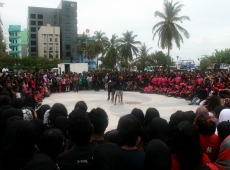
The international campaign was launched in the Maldives on Thursday (February 14) by NGO Hope for Women at Jumhooree Maidhaan in Male’.

The One Billion Rising campaign began after research revealed that one in three women around the world will be raped or beaten in their lifetime.

The gathering in Male’ featured live music and dance performances, and saw many young men and women in the crowds dancing together.

Despite the event’s popularity with youth in Male’, Chair of Hope for Women, Aneesa Ahmed, said the poor turnout from government officials “showed their lack of commitment” in tackling the issue of violence against women.

“We have been working alongside the Ministry of Gender, Family and Human Rights, and they have invited all government agencies and ministries, but I have hardly seen any of them here,” she said.

“I really don’t know what to say – the commitment is just not there. In the last few years nothing has really been done to help this particular cause,” Aneesa said.

Speaking to Minivan News, President’s Office Media Secretary Masood Imad said that the government was a broad entity consisting of many ministries and that he had not been aware of any specific invite to members of the government.

“As I understand, Acting Minister of Gender, Family and Human Rights] Dr Mariyam Shakeela attended. Some other ladies from the the government were there,” he said.

Masood said a member of staff from the President’s Office had also attended the event, as he had “skipped a meeting he was supposed to attend”.

Last month a study by Human Rights Commission of the Maldives (HRCM) found that support for women’s equality in the country had experienced a “significant drop”.

The report found that fewer respondents – compared to the 2005 survey – believed that women should have equal rights to men.

Aneesa said that the event was aimed towards the younger generation in the Maldives as they do not possess the “prejudices” elderly people have in regard to equality.

“I am particularly happy because there were so many young people here, it is very encouraging. These people will stand up against violence, they are going to be a very strong force.

“In the past few years we have this increasing influence of conservatism in the country and because of this the older generation are more cautious about coming to such an event. Things like dancing, as you see today, we are not supposed to do this,” Aneesa added.

Speaking at the event, Heat Health and Fitness Managing Director Aishath Afra Mohamed spoke about her concerns regarding violence against women in the Maldives.

“Some men are trying to keep their wives in the house, they don’t want women to work and socialise with their friends. They are very possessive.

“The rate of violence is going up and women are keeping quiet about it here. But this event is good to see, the more we make light of the matter, the better it will be,” Afra added.

Likes(0)Dislikes(0)

Construction chief not ruling out “organised crime” behind foreign worker surge

Almost half the employees in the Maldives’ construction industry are unregistered, the head of the Maldives Association of Construction Industry (MACI) has told Minivan News.

MACI President Mohamed Ali Janah said an estimated 40 percent of the foreign employees in the sector were thought not to be legally registered.

Considering these numbers, Janah said he could not rule out the involvement of organised crime in certain employment agencies, which supply a large amount of foreign labour to building sites in the Maldives.

Earlier this month, the Human Rights Commission of Maldives (HRCM) accused state and private sector employers in the country of lacking consistency in their efforts to address human trafficking.

The government – for its part – recently launched a ‘blue ribbon’ campaign with the aim of raising awareness of the rights of foreign workers, while also ratifying eight “fundamental” International Labour Organisation (ILO) conventions.

However, local independent institutions in the Maldives say the country is yet to ratify a core convention on protecting migrant worker rights, while no legislation is in place to punish those involved in smuggling workers.

Migrant worker demand

Janah claimed that 95 percent of construction groups operating in the country were Maldivian owned. However, as the country’s second largest industry on a GDP basis, the vast majority of employees in the sector were migrant workers, he said.

“We employ a huge workforce of some 60,000 to 70,000 people,” Janah explained. “Of these people, sadly we have 40,000 to 50,000 who are expatriates. We estimate there are some 15,000 to 20,000 Maldivian staff,  which includes management through to the supply chain.”

Of these migrant labourers, Janah said only some 30,000 were registered as construction workers.

“There are no records of where [these workers] come from. This is something we need to correct,” he said.

Highlighting the huge growth in the country’s unregistered migrant workforce, Janah said that in 2003 there were just 3000 foreign employees working illegally.

“At the time we thought that number was too high. Today, it has exceeded 50,000. This is hearsay. We don’t have the right statistics on this, it could be 100,000, but who knows,” he said. “The truth is that the economy is thriving because of these people,” Janah added.

Employee “mismanagement”

Over the last decade, MACI has said it has sought to advocate against the growth of illegal labour and mismanagement of foreign labourers by the construction industry.

A lack of Maldivian workers looking for jobs in the industry meant that the sector – as with many of the country’s prominent industries – was dependent on skilled and unskilled workers from abroad.

The Maldives could learn from how other thriving construction markets were dealing with the exploitation of foreign work forces, he said.

“The Maldives is experiencing what Singapore and some Middle Eastern countries experienced in the 1990’s, which is a huge influx of an unmanageable immigrant workforce that is not registered,” he explained.

“I cannot call them illegal immigrants or something like that. But I also wouldn’t rule out that organised crime is involved in this. This is being done with the support of several agencies in [several] countries and needs to be addressed – this is something respective governments need to look into.”

Aside from the construction industry, Janah also called for greater regulation of third party employment agencies that were often responsible for registering and providing foreign staff to building companies in the Maldives.

“[These agencies] pay a nominal fee to register themselves, yet they do millions of rufiyaa in business. They should pay a security deposit themselves in case something goes wrong,” he said.

Janah claimed said his own Maldives-based construction group, Alysen Services Pvt Ltd, had now opted against using third party agencies in favour of its own HR department. He said some eight to nine million rufiya was spent on deposits for foreign workers.

Accepting that employment agencies were vital to meeting the country’s workforce needs, he said MACI recommended its members look at the track record of these companies to limit the likelihood that the staff they were hiring were victims of human trafficking.

“Our advice is that employees themselves should not be charged any fees themselves by agencies to come here to work,” he said, a policy recommended to all MACI members as the best way to avoid association with organised crime.

Managing the workforce

However, Janah contended that managing the country’s foreign labour market was not something the industry could do alone, adding that government involvement was vital.

He pointed to a need to learn from different construction models not just in the region but internationally, pointing to other nations that have worked to legitimise foreign workers by requiring individual construction projects to be registered with local authorities.

With this registry in place, Janah said construction workers would then be required to be attached to a legitimate project in the country.

He also pointed to attempts by the former and present governments to provide an amnesty for unregistered workers in line with a similar scheme run in Dubai.

However, Janah stressed that Dubai’s amnesty was followed by a much stricter policy on migrant workers including the use of a “proper border control system”.

By comparison, he noted that successive administrations in the Maldives had failed to address human trafficking problems before implementing such an amnesty.

“The problem is that the government just adds rule after rule without addressing [immigration] problems,” Janah said, claiming that companies legitimately employing foreign workers were being forced to pay for the mistakes of others.

“There is collateral damage as a result of these policies. Many companies are suffering from the [work] permit issue.”

MACI contended that the worker quota system employed by Maldivian authorities in recent years made it possible to register a business as a construction company, even without fulfilling the “basic criteria” required of such an enterprise.

He said authorities should require construction companies to be registered not just as a business entity at the Ministry of Economic Development, but also with the Ministry of Housing.

However, the MACI president concluded that much more work needed to be done by the construction industry itself to try and curb the practice of unregistered workers to ensure they were not being made the victims of human trafficking.

“A lot more work needs to be done by industry. Companies who are entering the industry should not take short-cuts and must adhere to rules,” he said.

Janah added that a failure to address these concerns would not be feasible for the country in the long run, particularly with the amount of US dollars leaving the country as remittances.

“We need these workers,” Janah said. “But can we manage with less if we are more efficient?”

Janah also reiterated concerns raised by the Immigration Department and President Dr Mohamed Waheed Hassan Manik that a continued influx of unregistered and illegal workers could see the migrant population outgrow the indigenous Maldives population if unchecked.

Earlier this month, a Maldivian trade union alleged corrupt immigration practices and the use of unregulated employment agencies by private and state employers were limiting efforts to curb abuse of migrant workers and prevent illegal practices such as retaining staff passports.

The comments were made as a source with knowledge of the current immigration system also told Minivan News that the practice of retaining passports – a long-standing habit of Maldivian employers – was a key contributor to human trafficking in the country.

Meanwhile, back in January, a Malaysian IT company at the centre of legal wrangling over a deal to provide a border control system (BCS) to the Maldivian government alleged “criminal elements” could be behind efforts to scupper the agreement.

Likes(0)Dislikes(0)

US, UK, UN call for restraint, “inclusive” presidential elections

Foreign governments and international bodies have taken India’s lead, expressing concern over the political instability in the Maldives and emphasising the importance of all parties being able to put forward the candidates of their choice in the upcoming elections.

“Now that the President of the Election Commission of Maldives has announced that Presidential elections would be held on 7 September 2013, it is necessary that the Presidential nominees of recognised political parties be free to participate in the elections without any hindrance,” stated India’s Ministry of External Affairs (MEA) on Wednesday, after former President Mohamed Nasheed sought refuge in its High Commission.

“Prevention of participation by political leaders in the contest would call into question the integrity of the electoral process, thereby perpetuating the current political instability in Maldives,” the MEA stated.

The United States Embassy in Colombo urged “all sides to remain calm, reject the use of violence, and avoid rhetoric that could increase tensions.”

“Former President Nasheed must be accorded due process under the law regarding his pending court cases,” the US Embassy said in a statement.

“We urge that the Presidential elections scheduled for September 7, 2013 be free, fair, credible, transparent and inclusive. The integrity of and public confidence in the Maldivian electoral process must be maintained.

“Accordingly, we note that all parties participating in these elections should be able to put forward the candidate of their choice. We continue to urge all parties to chart a way forward that respects Maldivian democratic institutions, the rule of law, human rights and fundamental freedoms,” the US added.

The UK issued a statement similarly calling for calm and restraint.

“During FCO Minister Alistair Burt’s recent visit to Maldives, he said it was vital that the country move decisively towards free, fair and inclusive Presidential elections. He also stressed the importance of all parties being able to participate in elections with the candidate of their choice. It is important for all parties to avoid taking action which could lead to doubt over the integrity of the electoral process and contribute to continuing instability,” the UK’s Foreign and Commonwealth Office stated.

The UN Secretary General’s office stated that it was “monitoring the developments with concern”, and urged “all political actors to exercise restraint, renew their commitment to the constitution and work toward creating conducive conditions for fair, peaceful and inclusive elections.”

“All parties contesting the September 7 presidential elections should be able to field the candidates of their choice in accordance with the rule of law and the constitution,” the UN stated.

Transparency Maldives (TM), which will locally be conducting an extensive program of election monitoring, meanwhile expressed “deep concern over the continuing political polarisations and tensions that have strained the democratic gains from the past elections,” and called for all sides to “guarantee and sustain an environment conducive for free and fair and fully inclusive elections.”

“As such, there is an immediate need for the political and State leadership to resort to a process of negotiations towards addressing the challenges for free and fair and fully inclusive elections. At the heart of such a process should be showing leadership and a spirit of compromise that we saw during the pre-election and post-election period of the 2008 Presidential Elections,” Transparency stated.

Government speaks to India

Following India’s initial warning that a failure to allow all political leaders to contest the elections would call into question the integrity of the electoral process and perpetuate instability, the Maldives Ministry of Foreign Affairs Ministry declared it was “unfortunate that the Government of India has decided to comment on the types of candidates that could contest the upcoming Presidential Elections in the Maldives scheduled for September 2013.”

“The independent Elections Commission has not, as of date, announced the candidates for the elections. Furthermore the Government firmly believes that the Elections Commission of Maldives is fully capable of evaluating and deciding eligibility of nominees in the elections and carrying forward a credible electoral process. To presume otherwise would be undermining the democratic institutions of the country and the progress achieved by the Maldives in consolidating its democracy,” the Foreign Ministry said in a statement.

Nasheed’s on-going trial “is a matter handled by two independent State institutions, namely the Prosecutor General and the judiciary. Like any other democratic country, the executive branch of the Government of Maldives cannot, under the Constitution of the Maldives, interfere with the independence of the judiciary, and will indeed ensure that the independence of the judiciary is always upheld.”

Home Minister Mohamed Jameel was more direct, telling local media yesterday that any attempts by another country to prevent a person from facing charges pressed by an independent Prosecutor General, could be described as interfering domestic matters of a sovereign state.

Jameel – formerly Justice Minister under Gayoom’s government – maintained that the charges levied against the opposition Maldivian Democratic Party (MDP) presidential candidate were serious as they involved the “abduction of a senior judge”.

India’s Minister of External Affairs Salman Khurshid meanwhile spoke to his Maldivian counterpart Dr Samad Abdulla on Thursday (February 14).

Samad told Khurshid there were no court summons pending for Nasheed “but in the instance that such a summons is issued, Nasheed will have to attend the hearing.”

“Samad also said that it is unacceptable for any person to speak against this, as this is in accordance with the constitution of the Maldives,” read a translated statement from the Ministry of Foreign Affairs.

According to the MEA, Khurshid told Samad that India “has broad based contacts with all political parties and democratic institutions in the Maldives, without interfering in the internal affairs of the country”, as part of its “commitment to multi-party democracy.”

“India has stressed in the past that it would like to see free, fair, credible and inclusive elections leading up to a stable, peaceful and prosperous Maldives. India would be happy to work with the Government and all political parties in the facilitation of this objective,” the MEA stated.

Samad had assured Khurshid that the Maldivian government “would do its utmost to prevent any precipitate act that adversely affects the atmosphere for a free and fair democratic process and rule of law,” the MEA added.

Situation on the ground

Some protests took place on Thursday evening and there were reports of three arrests, less than those recorded the previous evening, which saw 16 arrests from a crowd of 1500 people.

Maldivian Democratic Party (MDP) Spokesperson Hamid Abdul Ghafoor said the party was planning protests on Friday evening from 9:00pm.

Nasheed has called for an interim caretaker government in the lead up to the elections. He remains inside the Indian High Commission, despite the government’s insistence he is free to move around after a warrant for his arrest issued by the Hulhumale Magistrate Court expired with the cancellation of Wednesday’s trial hearing.

“It is difficult to say [how long Nasheed will remain inside] because the situation is so fluid,” said Ghafoor.

“I don’t think he will stay any longer than he needs to. The focus is on finding an interim solution. The party has advised him not to leave. It is unthinkable for him to step outside, as he will be killed. None of us feel safe right now. We have no other choice,” he said.

Ghafoor said the party did not consider the Hulhumale’ court’s independence from the government or its independence, despite the government’s insistence to the contrary.

The Hulhumale’ Magistrate Court was created by the Judicial Services Commission (JSC) in violation of the Judicature Act, the MDP contend. The JSC has also appointed the three-member panel of judges hearing Nasheed’s case at the court.

“We do not trust warrants from this court,” Ghafoor said. “During the Supreme Court’s 4:3 decision favouring the legitimacy of the Hulhumale Magistrate Court, Supreme Court Judge Adam Mohamed went to the Supreme Court as an appellant. He is head of the JSC, he threw the casting vote in the Supreme Court decision, and the judiciary accepts this,” Ghafoor said.

“[Government-aligned] Jumhoree Party leader and resort owner Gasim Ibrahim is also a member of the JSC, which appointed the panel of judges. Gasim is a rival presidential candidate to Nasheed,” Ghafoor noted.

“This country is set to explode unless India helps us.”

Likes(0)Dislikes(0)

High Court concludes city council’s appeal into ownership of MDP protest site

The High Court on February 13 concluded an appeal by Male’ City Council (MCC) over the ownership of the ‘Usfasgandu’ land plot in the capital, leased to the opposition Maldivian Democratic Party (MDP).

The court is expected to rule on the appeal during the next hearing of the trial, which has yet to be scheduled.

The council’s High Court appeal followed a case filed by the Housing Ministry at the Civil Court ordering the MCC to hand over the land in seven days. The plot of land has been used by the MDP as a base for protests in Male’ for much of last year.

Lawyers from the Attorney General’s told the court that the MCC had given the land to a political party that was supposed to be used for social and leisure purposes.

The MCC claimed that had not been given adequate opportunity by the lower court to present its defense before the ruling to hand over the land was made.

According to local media present at the court, the AG’s lawyers claimed it was the duty of the council to prove their innocence in the matter.

The presiding judges said a verdict would be delivered at the next hearing unless the court needed to further clarify the matter.

The Male’ City Council gave the land to the MDP after its protest site near the tsunami monument area was dismantled by military and police on March 19, 2012.  The camp was dismantled the same day President Dr Mohamed Waheed delivered his presidential speech to the parliament, amid protests inside and outside the parliament chamber.

In May 2012, the Maldives’ cabinet ordered the Usfasgandu site be handed over from the MDP-dominated council to the jurisdiction of the government’s Ministry of Housing.

Following what it called the “non-compliance” of the MCC in handing over the area, police were asked to intervene and “take over”.

A chain of appeals eventually led to the MDP being evicted from the site and cordoned off by police on the orders of the High Court.

Police has previously raided the site on the morning of May 29, 2012, after obtaining a search warrant from the Criminal Court.

The reasons for the search as stated on the warrant included: “suspected criminal activity”, “damage to public property”, and “suspected black magic performed in the area”.

Under ‘evidence’, the warrant alleged that people in the Usfasgandu area verbally abused police officers and damaged a police vehicle on April 20, obstructed a Maldives National Defence Force (MNDF) exercise of May 9, and on May 25 “MDP protesters threw a cursed rooster at MNDF officers.”

Likes(0)Dislikes(0)