India should stop meddling with Maldives’ domestic matters, says Home Minister Jameel

Home Minister Mohamed Jameel Ahmed has expressed his disappointment over the Indian government’s decision to provide refuge to former President Mohamed Nasheed in the Indian High Commission.

The former President was due to attend a hearing regarding his detention of Chief Judge of the Criminal Court Judge Abdulla Mohamed in January 2012.

Instead of appearing in court, Nasheed sought refuge in the Indian High Commission, claiming his trial was politically motivated and an attempt to bar him from running in presidential elections scheduled this year.

Speaking to local newspaper Haveeru, Jameel said that attempts by any country to prevent a person from facing charges pressed by an independent Prosecutor General (PG), could be described as interfering domestic matters of a sovereign state.

He said the charges levied against the opposition Maldivian Democratic Party (MDP) presidential candidate were serious as they involved the “abduction of a senior judge”.

In January 2012 while in power, Nasheed’s Home Minister Hassan Afeef wrote to the Defense Ministry requesting the judge be detained as he posed a threat to both the country’s national security and the criminal justice system.

The judge had previously obtained an injunction from the Civil Court against his further investigation by the judicial watchdog, which had complied.

The Maldives National Defense Force (MNDF) subsequently arrested Judge Abdulla and placed him in military detention on Girifushi – a military training centre near Male’, also used for Nasheed’s famous underwater cabinet meeting in 2009.

In an attempt to give a legal justification for the involvement of the armed forces during the arrest, the former Home Minister alleged the judge had “taken the entire criminal justice system in his fist”, and posed a threat to “public order, safety and national security”.

After his sudden resignation on February 2012, Nasheed is now facing criminal charges for violating Article 81 of the Penal Code, which states that the detention of a government employee who has not been found guilty of a crime is illegal.

Jameel – a former Justice Minister under President Maumoon Abdul Gayoom’s 30 year autocracy – has previously said it was “crucial to conclude the case against Nasheed before the approaching presidential elections, in the interests of the nation and to maintain peace in it.”

“Every single day that goes by without the case being concluded contributes to creating doubt in the Maldivian people’s minds about the judiciary,” the home minister said at the time.

Nasheed’s Maldivian Democratic Party (MDP)’s contended that the charge against its presidential candidate was a desperate attempt by the government to destroy its political opponents and bar Nasheed from contesting the scheduled elections.

The UK Bar Human Rights Commission – which is has been observing Nasheed’s trial – concurred in its recent report, agreeing that the trial was politically motivated.

“BHRC is concerned that a primary motivation behind the present trial is a desire by those in power to exclude Mr Nasheed from standing in the 2013 elections, and notes international opinion that this would not be a positive outcome for the Maldives,” the report stated.

However Home Minister Jameel has disputed the MDP’s claims, arguing that the trial was not politically motivated but a sincere attempt by the current government to uphold the rule of law.

Expressing his frustration over Nasheed’s presence in the Indian High Commission, Jameel said he had “never previously seen the international community trying to protect a convict or an individual who is being tried in a court of law”.

“I describe this action [by Indian High commission] as very unusual,” he said. “For example, it would be very unusual for a murderer to seek refuge in a diplomatic office.”

Jameel said the country needed assistance from the international community to look into the arrest of the judge, and “not to protect an individual who stands charged with a serious crime”.

Tweeting last night, the Home Minister implied that India was meddling in the Maldives’ internal affairs: “What’s happening now gives us an indication of the extent and level of interest some countries prepared to take in our internal matters,” he said.

“I would strongly urge everyone to let our institutions deal with the challenges, and allow the Maldives to uphold rule of law,” he tweeted.

Jameel was not responding to calls at time of press.

In a statement released by Ministry of External Affairs, the Indian government called on its regional counterpart to strictly adhere to “democratic principles and the rule of law, thereby paving the way for free, fair, credible and inclusive elections”.

“Following the arrest warrant issued against him by the Hulhumale’ Magistrate Court, the former Maldivian President Mohamed Nasheed, who is a candidate for the Presidential elections in Maldives scheduled for September 2013, is in the Indian High Commission and has sought India’s assistance. We are in touch with the relevant Maldivian authorities to resolve the situation,” the statement read.

“Now that the President of the Election Commission of Maldives has announced that Presidential elections would be held on 7 September 2013, it is necessary that the Presidential nominees of recognised political parties be free to participate in the elections without any hindrance.

“Prevention of participation by political leaders in the contest would call into question the integrity of the electoral process, thereby perpetuating the current political instability in Maldives,” it added.

India’s Ministry of External Affairs concluded its statement by contending it was “not in the interest” of the Maldives or the region to prevent any candidate from contesting the country’s presidential elections later this year.

“India would call upon the government and all political parties in Maldives to avoid any actions that would vitiate the political atmosphere in the Maldives,” its statement read.

In a statement released by the office of the former President, Nasheed welcomed the Indian statement.

“The events of the past year – the mass arrests, the police brutality, the politically motivated trials – demonstrate that Dr Waheed cannot be trusted to hold a free and fair election. Waheed should do the right thing and resign from office. An interim, caretaker government should be established that can lead the Maldives to genuinely free and fair elections, in which all candidates are freely able to compete,” he said.

Nasheed in the statement also reiterated his belief that that his trial was “a politically motivated sham” and said the Hulhumale Magistrate Court – established to hear his case – was illegal and created “with the sole purpose of disqualifying me from standing in the presidential elections”.

Likes(0)Dislikes(0)

Police arrest 16 protesters during demonstrations by Nasheed supporters

Protesters supporting the former Maldivian President gathered last night at an intersection near the Indian High Commission where Mohamed Nasheed has sought refuge from police seeking his arrest.

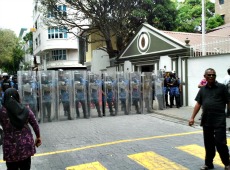
Riot police took up position outside the diplomatic premises shortly after 1:00pm yesterday, blocking the street outside to pedestrians and placing checkpoints in adjoining streets.

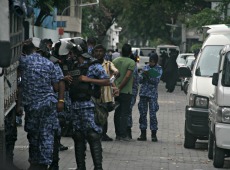
The street outside the High Commission was clear aside from a small group of police, including Special Operations officers and piles of riot shields.

Down the road, the crowd at the Sosun Magu junction were blocked by a line of police, and had reached an estimated 1500 people by around 10:45pm. Police entered the crowd and arrested several protesters, after glass bottles and temporary barricades were thrown into the police line.

As the day’s protests drew to an end last night, the area surrounding the Indian High Commission building on Ameer Ahmed Magu was in near silence after being cordoned off by police.  Minivan News observed at the time a minimal police presence across the street,  despite the diplomatic drama earlier in the day that had been covered throughout international media.

Further down the road towards the opposition demonstration, remnants of glass bottles that had been hurled at police earlier in the evening were the only visible sign of scuffles between law enforcement officers and Nasheed supporters.

Meanwhile, shortly before the protests concluded at around midnight, protesters who attempted to force their way through to the parliament building were met by police charges.

Police later announced they had arrested 16 people during Wednesday’s protests, including one minor and one female.

According to police, 11 of those arrested were on charges of obstructing police duty, breaking police cordons, entering closed areas and threatening police.

Authorities said the woman and one man arrested were intoxicated and had tried to enter restricted areas, as well as throwing water bottles and stones at police. No injuries were reported.

The courts had released two of those detained at time of press.

Maldivian Democratic Party (MDP) MPs and protest leaders called a halt to the protest around midnight, vowing to gather in the area every night while the former President remains in the High Commission.

Meanwhile, from inside the commission, former President Nasheed issued a statement calling on President Mohamed Waheed to step down from office and make way for an interim government that would oversee free and fair presidential elections.

“The events of the past year – the mass arrests, the police brutality, the politically motivated trials – demonstrate that Dr Waheed cannot be trusted to hold a free and fair election. Waheed should do the right thing and resign from office. An interim, caretaker government should be established that can lead the Maldives to genuinely free and fair elections, in which all candidates are freely able to compete,” said Nasheed.

He labelled his ongoing trial “a politically motivated sham” and said the Hulhumale’ Magistrate Court – established to hear his case – was illegal and created “with the sole purpose of disqualifying me from standing in the presidential elections.”

“The fate of Maldivian democracy hangs in the balance. The Maldivian people must not be robbed of their democratic right to elect a leader of their choosing,” he added.

In a statement, police accused Nasheed’s supporters of “voicing out their hatred towards police and spreading untruthful rumors of police trying to arrest Nasheed unlawfully, despite the Hulhumale’ Court’s court order.”

“The Maldives Police Service strongly condemns the spreading of incorrect rumors and assures the general public that police will stand to implement lawful court orders,” the statement read.

Sub Inspector Hassan Haneef would not confirm whether police would arrest the former President were he to step outside the Indian High Commission, and was unclear as to whether the court warrant to present the former President was still valid after the trial hearing was cancelled yesterday in Nasheed’s absence.

“Ex-president Nasheed is inside the Indian High Commission. It is not a question of arresting him, but making sure he is secure,” Haneef said, adding that school children were being allowed to move freely through the area this morning.

Correction: An earlier version of this article included a tweet from a Twitter account attributed to PPM MP Yameen Abdul Gayoom. Minivan News has been unable to establish the authenticity of this twitter account, and has removed the quote.

Likes(0)Dislikes(0)

Comment: What after Nasheed’s ‘refuge’ in Indian mission?

The comparison sounds curious, though not odious. Possibly taking a leaf out of Wikileaks boss Julain Assange’s tactic, former Maldives President Mohamed Nasheed has ‘taken refuge’ in the Indian High Commission in the national capital of Male, expressing concern over his personal ‘security’ and ‘regional stability’.

The comparison should however stop there, as Ecuador has since granted political asylum in its London Embassy, to help Assange avert arrest and deportation to face a criminal trial. No such request seems to have been made by Nasheed to India, nor has a situation seemed to have emerged for New Delhi to consider any such request at the moment.

“Mindful of my own security and stability in the Indian Ocean, I have taken refuge at the Indian High Commission in Maldives,” Nasheed tweeted a day after the suburban Hulhumale’ criminal court issued an arrest warrant for him to be produced before it. The warrant followed Nasheed not appearing before the court on Sunday, February 10, for standing trial on the charge of ordering the illegal arrest of Criminal Court Chief Justice Abdulla Mohammed on January 16 last year, when he was the President.

Nasheed had been to India after obtaining court’s permission and had overstayed the period during the previous visit, with his lawyers seeking further time from the three-Judge bench. Incidentally, this is the second time in five months that Nasheed had not appeared before the trial court when summoned. On October 1, the day he was to appear before the court, he proceeded on a long campaign tour of the southern atolls. The court later ordered his appearance, and had the police arrest him from a southern island, and let him off after recording his forced appearance.

The current development has raised a number of issues, legal, political and diplomatic. With presidential polls due in September this year, Nasheed would be disqualified from contesting the same if the court ordered his imprisonment or banishment for three years. The alternative penalty is MVR 2,000. The fine does not attract disqualification but an imprisonment of over a year does.

Despite all-round apprehensions about an inevitable term of imprisonment for Nasheed and the other three accused, the trial had not reached the substantive stage, for the defence team to hazard a guess about the possible quantum of punishment. The best case scenario for Nasheed would be his exoneration of the charges against him. In context, the prosecution would have to prove to the complete satisfaction of the trial and appeals courts that the orders for Judge Abdulla’s arrest were issued by President Nasheed personally, and they were patently illegal.

Questions also remain about the possibility of the case running its full course before the Election Commission puts the poll process in motion, in July this year.

As in all democracies, there is a three-stage judicial process, involving the High Court and the Supreme Court at the appellate levels. In between, Nasheed’s defence has also been taking up procedural issues at every turn. Interlocutory petitions on his behalf have not found much favour with the appeal courts, but the intervening time involved in the process has meant that the trial and the appeal stage may elude the deadline for the elections.

The legal issue at this stage also involves the wisdom of Nasheed’s defence possibly concluding that the arrest and production of Nasheed before the trial court would entail his imminent imprisonment. If so, it is unclear if the courts would have ordered a jail term for Nasheed, whether to restrict his movement, pending the disposal of the case, or for contempt of court. There may have been a case for the court to declare him as a ‘habitual condemnor’, given that this is the second instance of the kind.

According to media reports, the Hulhumale’ court, however, has since withdrawn the arrest warrant against Nasheed. It is also unclear if the court would want to hand down any prison term, endangering Nasheed’s freedom of movement, pending the conclusion of the trial stage. This has meant that the Hulhumale’ court, in a single stroke, may have removed Nasheed’s apprehensions about personal security, at least until the disposal of the case, either at the trial stage or at the final appeals stage.

It is also unclear if either the prosecution would seek court directions to enforce Nasheed’s continued presence and cooperation from now on, or if the judges would suo motu issue binding orders. With the two-day Maldivian official weekend falling on Friday and Saturday (February 15-16), the next move of the Government, the police and the prosecution would also be watched with interest. The possibilities are many, if one considered the judicial and legal options before the various players, including Nasheed.

Indian position

Through a series of statements on February 13, New Delhi confirmed Nasheed’s presence in the Indian High Commission in Male, and his seeking ‘Indian assistance’. The statement said India was in touch with Maldivian authorities in the matter, and wanted the government in Male to ensure that the elections were free and fair, and that there was no bar on candidates were not barred from contesting the presidential polls.

In an obvious reaction to the Indian statement, the Maldivian Foreign Ministry promised to ensure the immunity of resident missions of foreign countries in Male, implying that the police would not violate what is legally ‘Indian territory’ to detain Nasheed and produce him before the Hulhumale’ court. It made a pointed reference to the independence of Maldivian judiciary, about which there was no mention in the Indian statement.

According to local media reports, Government officials, in tweeted messages, claimed that India had ‘interfered’ with the domestic affairs of the country and also the judicial processes.

The Indian concern in the matter seems to flow from the substantial, if not proven majority support-base that Nasheed and the MDP enjoys within Maldives, and the wisdom of not allowing him to contest the presidency, over a pending court case. Any domestic unrest of the kind that marked Nasheed’s exit from the presidency in February last year could have consequences for political stability in Maldives – and by extension, the immediate Indian Ocean neighbourhood.

Indications are that political Maldives is as polarized for and against Nasheed this time round as it was around incumbent President Maumoon Abdul Gayoom ahead of the first-ever multi-party presidential polls in the country in 2008. How the nation and its 242,000 voters in the country would view the ‘stability question’ and equate it to the support-base of the MDP and vote for Nasheed’s candidacy, remains to be seen. This can also have consequences to political stability nearer home, for the region and bilateral relations with India.

From within the Indian High Commission, Nasheed has reiterated his earlier demand, asking President Waheed to demit office and allow an interim administration to take over, to ensure free and fair elections for the highest constitutional office in the country. As critics point out, this also has consequences. With parliamentary polls due in May next year, will there be a similar demand by different sections of the nation’s divided polity that the new President, elected this year, and his own Vice-President, too should quit office, to ensure free and fair elections, then as is being demanded now.

Incidentally, the constitution provides for Parliament Speaker to be President for two months and conduct fresh polls from the high office, should the incumbent, along with his Vice-President, to quit office, or otherwise fall vacant. This is the possibility that Nasheed has stressed in terms of ensuring a free and fair poll for the presidency, at present. However, the Constitution does not provide for a similar situation ahead of the parliamentary polls. The argument is that what is good for the presidential polls should be good also for the parliamentary elections. Or is it?

The writer is a Senior Fellow at the Observer Research Foundation

All comment pieces are the sole view of the author and do not reflect the editorial policy of Minivan News. If you would like to write an opinion piece, please send proposals to [email protected]

Likes(0)Dislikes(0)

India backs inclusive elections, as former President takes refuge in High Commission

The Indian government has confirmed that former President Mohamed Nasheed has requested India’s assistance after police sought to arrest him and present him to the Hulhumale’ Magistrate Court this afternoon.

Nasheed had previously missed a court hearing scheduled for February 10, which was cancelled in his absence. His Maldivian Democratic Party (MDP) maintain that the charges – based on his detaining Chief Judge of the Criminal Court Abdulla Mohamed during his final days in office – are a politically-motivated attempt to prevent him contesting the 2013 elections.

Rumours of Nasheed’s imminent arrest began to circulate on Tuesday (February 12) ahead of a scheduled hearing at 4:00pm the following day, prompting his supporters to camp in the narrow alley outside his family home in Male’.

By this morning, Nasheed entered the Indian High Commission, purportedly to “seek advice” from High Commissioner D M Mulay.

Shortly after 1:00pm, riot police blocked off the street outside the High Commission, as Nasheed’s supporters began to gather at the barricades.

The former President subsequently tweeted: “Mindful of my own security and stability in the Indian Ocean, I have taken refuge at the Indian High Commission in Maldives.”

“As a close and friendly neighbour, India has expressed concern over the ongoing political instability in Maldives and called upon the government and all political parties to adhere strictly to democratic principles and the rule of law, thereby paving the way for free, fair, credible and inclusive elections,” the Indian Government said in a statement this evening.

“Following the arrest warrant issued against him by the Hulhumale’ Magistrate Court, the former Maldivian President Mohamed Nasheed, who is a candidate for the Presidential elections in Maldives scheduled for September 2013, is in the Indian High Commission and has sought India’s assistance. We are in touch with the relevant Maldivian authorities to resolve the situation,” the statement added.

“Now that the President of the Election Commission of Maldives has announced that Presidential elections would be held on 7 September 2013, it is necessary that the Presidential nominees of recognised political parties be free to participate in the elections without any hindrance. Prevention of participation by political leaders in the contest would call into question the integrity of the electoral process, thereby perpetuating the current political instability in Maldives.”

India’s Ministry of External Affairs concluded its statement by contending it was “not in the interest” of the Maldives or the region to prevent any candidate from contesting the country’s presidential elections later this year.

“India would call upon the government and all political parties in Maldives to avoid any actions that would vitiate the political atmosphere in the Maldives,” its statement read.

In a tweet this afternoon, Home Minister Dr Mohamed Jameel implied that India was  meddling in the Maldives’ internal affairs: “What’s happening now gives us an indication of the extent and level of interest some countries prepared to take in our internal matters,” he said.

“I would strongly urge everyone to let our institutions deal with the challenges, allow Maldives to uphold rule of law,” he tweeted.

The Home Minister – also formerly Justice Minister during the Maldives’ 30 year autocracy – recently urged the courts “to conclude the case against Nasheed before the approaching presidential elections, in the interests of the nation and to maintain peace in it.”

“Every single day that goes by without the case being concluded contributes to creating doubt in the Maldivian people’s minds about the judiciary,” the home minister stated at the time.

The Maldives Ministry of Foreign Affairs issued a statement today in response to media reports that Nasheed had “sought refuge” in the High Commission, following the court’s issuing of an arrest warrant.

“Upon contacting, the High Commission of India confirmed President Nasheed’s presence at the Chancery and informed that he was present there for a meeting with the High Commissioner,” read the statement.

“The Ministry confirms that the government of Maldives will uphold and respect its obligations under international law with regard to diplomatic immunities and privileges granted to resident diplomatic missions. The Government is confident that all parties concerned, including the High Commission of India, will respect the laws of the Maldives and judicial independence as prescribed in the Constitution.”

Protests building

Minivan News observed crowds growing around the barricades at Sosun Magu. Shortly after 6:00pm, the crowd of around 700 people was charged and scattered by a group of 30 Special Operations officers in riot gear.

Former Minister of Housing and Environment in Nasheed’s government, Mohamed Aslam, has confirmed that the MDP’s National Council had today approved “direct action” against the government, notably a campaign of widespread civil disobedience.

“The whole situation is very fluid right now. Nothing will be ruled out,” he said. “What we are demanding is a transitional government, as well as free and fair elections that would include [former President] Nasheed.”

Aslam said that following a march of more than 10,000 in the capital on Friday (February 8 ) showed Nasheed had widespread popular support for contesting the elections.

Reports on social media meanwhile suggested that Nasheed’s luggage was being transferred to the Indian High Commission at time of press.

Disputed court case

Nasheed and his legal team have disputed both the charges against him, and the legitimacy of the Hulhumale’ Magistrate Court. The latter was created by the Judicial Services Commission (JSC). Nasheed’s lawyers have argued therefore that the court has no legal or constitutional authority.

Nasheed’s team raised these points in the first hearing of the case, stalling the process with a run of appeals and assorted injunctions.

Eventually the JSC asked the seven-member Supreme Court bench to rule on the court’s legitimacy, which it did in December 2012.  The court’s legitimacy was approved by four judges to three.

Former Attorney General Husnu al Suood observed at the time that Supreme Court Judge Adam Mohamed Abdulla should not have participated in the vote as he was also the President of the JSC, which therefore amounted to “presumption of bias”.

Meanwhile, the JSC appointed a three-member panel of judges to oversee the trial of the former president.

The Commission’s members include two of Nasheed’s direct political opponents, including Speaker of Parliament Abdulla Shahid – Deputy of the government-aligned Dhivehi Rayithunge Party (DRP) – and Gasim Ibrahim, a resort tycoon, media owner, MP and leader of the Jumhoree Party (JP), also a member of the governing coalition.

Numerous international organisations and reports have challenged the political independence of the JSC and the judiciary.

One recent report produced by local NGO the Raajje Foundation and supported by the UNDP and the US State Department, noted that the JSC’s mission under the 2008 constitution to ensure the new judiciary was was clean, competent, and protected from political influence, “has sadly gone unfulfilled.”

“The courts have essentially been able to capture the JSC so as to ensure that the old judiciary remained in place under the new constitutional order,” the report noted, predicting that the most likely scenario for the Maldives’ future was a cycle of failed governments.

Minivan News will continue live updates on the unfolding situation here

Likes(0)Dislikes(0)

Nasheed “seeking advice” in Indian High Commission following court order for his arrest

Police have been issued a court order to produce former President Mohamed Nasheed at the Hulhumale’ Magistrate Court ahead of his trial, scheduled at 4:00pm today.

The former President, who is due to attend a hearing regarding his detention of Chief Judge of the Criminal Court Judge Abdulla Mohamed in January 2012, was inside the Indian High Commission at 1:00pm this afternoon following the announcement of the court order.

Police had set up barricades around the High Commission area at time of press.

Police Spokesperson Sub Inspector Hassan Haneef today confirmed that police had received an order to produce the former president at the Hulhumale’ Magistrate Court.

“We have received the order and we will be trying to carry it out in accordance with the Maldivian constitution and the order itself,” Haneef said.

The court summons follows Nasheed’s failure to attend his previously scheduled trial hearing at Hulhumale’ Magistrate Court on February 10.

The former President was on an official visit to India after being granted permission to depart the country by the court. Despite his permitted travel period expiring on February 9, Nasheed arrived back in Male’ on February 11.

Maldivian Democratic Party (MDP) MP Mohamed Rasheed at 1:00pm said the former President was inside the Indian High Commission in Male’, “seeking advice” after news of the court order calling for his arrest was made public on Tuesday night.

“He went to the hospital in Male’ this morning and then returned back to his home. After a few minutes he went to the Indian High Commission with a couple of MDP MPs.

“[Nasheed’s] lawyers are not around at the moment, but from what I know they are attempting to appeal the order at the High Court,” Rasheed said.

Last night Maldivian Democratic Party (MDP) members camped outside the former President’s residence in order to prevent police from entering the narrow street where Nasheed lives.

MDP Spokesperson Hamid Abdul Ghafoor claimed  police had intended to arrest Nasheed in secret in order to present him at his court hearing today.

“They [Police] were going to pounce on Nasheed, but we received intelligence about it and let people know what was happening,” Ghafoor said.

“This is pre-2008 procedures. At least one hundred people were outside Nasheed’s residence last night throughout the night,” Hamid told Minivan News today.

Minivan News observed crowds of supporters still filling the street this morning at around 10:30am.

LIVE UPDATES: Refresh page for latest

1:15pm: The Maldivian Democratic Party (MDP) have issued a statement condemning the arrest warrant for Nasheed.

“The MDP reiterates its belief that the arrest warrant and the charges against him are politically motivated and calls on the international community to remain vigilant and immediately intervene to ensure a free and fair trial for President Nasheed,” the party said.

“President Nasheed’s legal team was informed by the Maldives Police Services that the court order was issued to arrest President Nasheed and summon him to the court on 13 February 2013. However, the court has not yet informed him or his legal team of the scheduled hearing.”

1:39pm: Maldives Police Service (MPS) were standing outside the Indian High Commission building in Male’.

The second hearing of the case was scheduled on 10th February 2013 while President Nasheed was on an official visit to India and was unable to return to Male’ due to a medical emergency.

The lawyers informed the court in writing as stated in the court’s regulations. According to the regulations, if the accused is unable to attend the hearing and after informing the court, documentation must be provided to the court within 2 working days.

While time frame to produce the documents has not even passed, and when the documents were being processed, the court issued an arrest warrant on President Nasheed on 11th February 2013. The courts also have an option to fine the accused (MVR 75) for failing to appear before court.

1:59pm: ‘MDP News’ Twitter feed shows woman being apprehended by police outside the High Commission building.
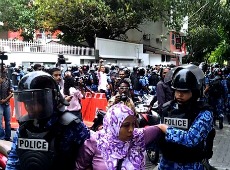
“This highlights, once again, how biased the Hulhumale’ Magistrate Court is against President Nasheed. This illegal court has no interest in the rule of law, it exists merely to serve the political aims of its paymasters. This trial is a thinly veiled attempt by Dr Wadeed, in cahoots with his friends in the judiciary, to prevent President Nasheed from contesting in the upcoming presidential elections. The regime is fearful of President Nasheed’s popularity, so they are pulling out all the stops to prevent his name appearing on the ballot paper. These forceful measures by the Court are contrary to their usual practice,” said MDP MP Hamid Abdul Ghafoor.

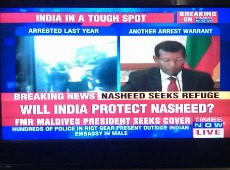
2:43pm: Indian media ‘Times Now Live’ asks: “Will India protect Nasheed?”

3:30pm: Nasheed has tweeted confirming that he is seeking refuge in the Indian High Commission: “Mindful of my own security and stability in the Indian Ocean, I have taken refuge at the Indian High Commission in Maldives.”

Minivan News observed around 200 people gathered near the police barricades. The crowd appeared non-violent but the atmosphere was tense.

3:54pm: Indian media is reporting the Indian government as denying that Nasheed has sought refuge.

4:05pm: Minivan News has observed a police officer armed with a rubber bullet gun deployed outside the High Commission.

4:10pm: MDP MP Ghafoor has said Nasheed is discussing “a transition arrangement, where we can have a free and fair election in September.”

“We have a scenario now we can’t move ahead without a mediator. We prefer India because it is our neighbour and a democratic nation,” he said.

4:23pm: Minivan News understands that no formal request for refuge or asylum has been made at this stage.

4:26pm: An appeal hearing was cancelled after a summoning chit was not able to be delivered to Nasheed.

4:27pm: Riot police appear to have pulled a man out of the crowd and arrested him.

4:49pm: MDP MP and spokesperson Hamid Abdul Ghafoor has said he was not aware how long the former president planned to remain in the Indian High Commission building.

“This is the safest place for him to be until a solution is found,” he claimed. “I would speculate that a transitional arrangement for fresh elections is being sought.”

Without providing specific examples of how Nasheed’s life was in danger, MP Ghafoor contended there had been threats against the former president going back to when he was first elected in 2008.

“Right now we have militarised Special Operations (SO) police officers running the show. I do not believe [Nasheed] is safe,” he claimed. “50,000 MDP members do not trust the police either.”

After Nasheed was previously taken into police custody ahead of a court hearing back in October 2012, the former president was not reported to have been physically mistreated by authorities during his transfer to Dhoonidhoo detention facility.

President’s Office Media Secretary Masood Imad said at the time that despite allegations raised by the MDP concerning the alleged use of excessive force by police to seize the former president, authorities had insisted officers had acted with restraint.

“I’m told [Nasheed] asked for a box of cigarettes [in custody], a request that [officers] granted.  He was given Benson and Hedges as I understand,” Masood previously told Minivan News.

Ghafoor also alleged that SO officers also this week entered the home of Parliamentary Speaker Abdulla Shahid in what he claimed was an attempt to intimidate the Majlis representative.

Speaker Shahid was not responding to calls from Minivan News at time of press.

The Maldives Police Service has vehemently denied allegations it had threatened Shahid in a statement published Saturday (February 9).

5:16pm: Nasheed’s trial hearing scheduled for 4:00pm today has been cancelled after he failed to attend at the specified time.  The Department of Judicial Administration (DJA) confirmed the cancellation. It has yet to be rescheduled.
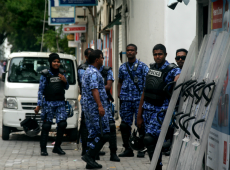
5:37pm: Home Minister Dr Mohamed Jameel has tweeted accusing India of meddling in Maldives’ internal affairs:

5:43pm: RaajjeTV reports that the government is to begin negotiating with the Indian High Commission.

5:53pm: President’s Office Media Secretary Masood Imad has said there has been no contact between the government and the Indian High Commission in Male’ today.

“All I know right know is that Mr Nasheed is in a meeting with Indian High Commissioner Dnyaneshwar M Mulay,” he said. Masood added that a message had been sent to the Ministry of Foreign Affairs confirming a meeting between former President Nasheed and the high commissioner was taking place.

6:16pm: Local media has reported that the Indian naval vessel ‘Kalpei’ has arrived in the country as part of a joint operation being conducted with the Maldives National Defence Force (MNDF).

The ship is said to be taking part in a five day maritime security program that will see it help patrol the Maldives’ Exclusive Economic Zone (EEZ), according to the Sun Online news service.

6:58pm: Mohamed Aslam, former Minister of Housing and Environment in Nasheed’s government, has confirmed that the opposition MDP’s National Council has today approved taking “direct action” against the government.

Aslam said the term ‘direct action’ related to a wide programme of civil disobedience, rather than one specific strategy. “The whole situation is very fluid right now. Nothing will be ruled out,” he said.

“What we are demanding is a transitional government, as well as free and fair elections that would include [former President] Nasheed.”

Aslam claimed that following a march in the capital conducted by MDP supporters on Friday (February 8), there remained widespread public support for Nasheed to contest elections scheduled for September this year.

However, he stopped short of declaring the day’s developments a “turning point” in the party’s calls for early elections. “We always hope that we have reached a turning point, whether it is today or tomorrow,” Aslam said.

7:19: WikiLeaks tweets that Nasheed has done a ‘Julian Assange’ – a reference to the whistleblowing website’s founder who sought refuge in Ecuador’s embassy in London in a bid to avoid extradition to Sweden.

7:30pm: Official Spokesperson for the Ministry of Foreign Affairs Ibrahim Muaz Ali has told Minivan News that it will not be seeking discussions with the Indian High Commission in Male’ over Nasheed’s presence on its property today.

“We have contacted the commission today. [Indian] Officials confirmed [Nasheed’s] presence and that he had come for a meeting with the high commissioner,” the spokesperson added.

Muaz said that although Nasheed had appeared to have deliberately sought to avoid his trial hearing today, the Foreign Ministry “did not think” there was a need to hold talks on the matter with Indian officials.

7:40pm: Reports on social media suggest that Nasheed’s luggage has been transferred to the Indian High Commission building in Male’. Photo by Ranreendhoo Maldives.

10:10pm: Minivan News has observed more people beginning to gather at the barricades. Crowd is chanting “money money, yes sir” and “baaghee Waheed, hang him”.

One glass bottle has been thrown over the barricade by protesters. Police look like they are preparing to charge.

10:15pm: Bottle was allegedly thrown from Majeediyya School. Police have now entered the crowd.

10:23: Minivan News observed around 700 to 800 hundred people currently at the barricades.

10:25: Former President Nasheed has called for President Mohamed Waheed Hassan Manik to step down from office and an interim arrangement to be established that would oversee a free and fair presidential election in the Maldives.

“The events of the past year – the mass arrests, the police brutality, the politically motivated trials – demonstrate that Dr Waheed cannot be trusted to hold a free and fair election. Waheed should do the right thing and resign from office. An interim, caretaker government should be established that can lead the Maldives to genuinely free and fair elections, in which all candidates are freely able to compete,” President Nasheed said.

President Nasheed labelled his ongoing trial “a politically motivated sham” and said the Hulhumale’ Magistrates Court – established to hear his case – was illegal and created “with the sole purpose of disqualifying me from standing in the presidential elections.”

President Nasheed said he could not hope to be afforded a fair trial and accused Waheed of “ruling down the barrel of a gun.”

President Nasheed added that “the fate of Maldivian democracy hangs in the balance” and said that “the Maldivian people must not be robbed of their democratic right to elect a leader of their choosing.”

10:42pm: Minivan News has observed around 1,500 now gathered on Sosun Magu.  MDP representatives have vowed to be there “every night” while Nasheed remains in the high commission building.
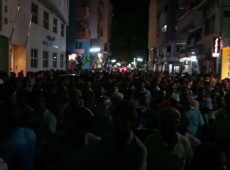
11:15pm: Several MDP MPs have pledged a first-round victory for Nasheed. Speakers addressing the crowd can be heard from the other end of Sosun Magu, however there is near silence outside the Indian High Commission on Ameer Ahmed Magu, Minivan News has witnessed.

Only the shards from two smashed bottles thrown at police earlier in evening indicate any sign of conflict, while further up Ameer Ahmed Magu, a handful of officers are stationed across the road from the high commission.

11:55pm: Minivan News has observed protesters throwing bottles at police.  Temporary barricades were also hurled at officers as protesters tried to make their way up to the People’s Majlis from Sosun Magu.

11:57pm: Protesters trying to make their way to parliament are met by police charges.

February 14, 00:01am: Protest is officially announced at an end for the night.

Likes(0)Dislikes(0)

Government claims “remarkable success” in democracy, good governance and rule of law

The President’s Office has claimed the government has achieved “remarkable success” during its first year in power.

February 7, 2013, marked the one year anniversary of the government of President Mohamed Waheed Hassan, following his controversial ascension to power.

Former President Mohamed Nasheed suddenly resigned on February 7 last year, following 22 days of continuous anti-government protests sparked after the Chief Judge of Criminal Court was placed under military detention.  The demonstrations were later backed by mutinying sections of the police and military.

Within a few hours following the chaos, Nasheed’s then Vice President Waheed – to whom the opposition had pledged their allegiance weeks before – assumed power and formed a “unity government” with the protesting politicians.

In a publication (Dhivehi) released on the President’s Office website last Thursday, under the title ‘One year for the National Unity Government’, the office highlighted its achievements in 10 different areas. These included: democracy and good governance, upholding of law, building a safe society, economic development, employment opportunities, education, health, fight against drugs, transport system and housing development.

Democracy and good governance

Under democracy and good governance, the President’s office claimed that the Commonwealth-backed Commission of National Inquiry (CNI)’s report on the transfer of power had defeated the Maldivian Democratic Party (MDP)’s claims challenging the legitimacy of the government.

Following the transfer of power, the opposition MDP had claimed that former President Nasheed’s government was toppled in a bloodless coup d’état and that his resignation was obtained under duress.

The CNI was formed to look into the circumstances surrounding the transfer of power.  The Commonwealth-led national inquiry panel in its report concluded that the transfer of power that took place on February 7, 2012 was legitimate.

“A national unity government was formed, a roadmap of how the government would be run was established on February 16, 2012, and successfully ran the government for one year,” the pamphlet stated.

However, during Parliament’s Executive Oversight Committee (EOC)’s reviewing of the CNI report, senior police and military officials during Nasheed’s administration – including former Chief of Defense Force retired Major General Moosa Ali Jaleel and former Commissioner of Police Ahmed Faseeh – disputed that their evidence was included in the report, and told the parliamentary committee that Nasheed had no choice but to resign, suggesting that his resignation was obtained under duress.

“I fully believe that President [Nasheed] resigned under duress,” Faseeh told the committee at the time.

Recalling the events, former Commissioner Faseeh told the committee he had done everything he could to control the situation but said there came a point when the officers had openly mutinied and disobeyed his orders.

The former military intelligence head also alleged that Nasheed’s resignation and transfer of power involved unlawful elements and had all the hallmarks of a coup d’état.

“Academically speaking, the events on February 7 fulfilled all the essentials of a coup. It involved all the features of a coup that are widely accepted around the world. Some of the elements take place before the toppling of a president. Others take place spontaneously,” Brigadier General Ahmed Nilam said. He was subsequently suspended.

President Waheed’s former Human Rights Minister Fathimath Dhiyana Saeed, in her personal memoir on the controversial transfer of power, alleged that Waheed had a role in the controversial toppling of Nasheed.  She also claimed that the then vice-president had prior knowledge of what would possibly happen in February.

Battle against CMAG

The President’s Office in the publication also detailed the decision of the Commonwealth Ministerial Action Group (CMAG) to remove “the Maldives from its formal agenda” after it was put there following the controversial transfer of power.

In September 2012, following the findings of the CNI, the Commonwealth’s human rights and democracy arm removed the Maldives from its formal agenda and placed it under “Matters of Interest to CMAG”.

The government also claimed it had reduced the number of political appointees below that of former President Mohamed Nasheed’s administration, which resulted in savings of MVR 2 million (US$ 129,701.68) per month.

“Efforts were carried out to broaden the role of the civil service and strengthen the functionality of the government,” it stated.

“To close down all doors to corruption, [the government] for the first time in history, established and enacted a code of conduct for political appointees during their course of employment,” it added.

Under democracy and good governance, the publication also highlighted that the Maldives had won the position of vice chairmanship of United Nations (UN) Human Rights Council and the vice chairmanship of the annual assembly of International Renewable Energy Institute (IREI), to be held this year.

Upholding of law

The government highlighted its success on upholding the rule law, claimed that it had established a free state broadcasting service by handing over Television Maldives (TVM) and Voice of Maldives (VOM) radio station to the Maldives Broadcasting Corporation (MBC) – formerly the Maldives National Broadcasting Corporation (MNBC) one and Raajje Radio – thereby running the government without a government-funded media.

Video footage taken during the storming of MNBC on February 7,2012 revealed that a mutinying police officer used a firearm to break down the gates of the station headquarters in capital Male’,  allowing dozens of police and military forces (MNDF) as well as some civilians in plain clothes to forcefully take over the station – approximately two hours before former president Mohamed Nasheed resigned from office.

The publication also stated that the government had abolished the National Administration Offices and had transferred its responsibilities to the local councils.

“The lands that were withheld by the central government were given to local councils in a transparent and responsible manner,” it read.

In July 2012, President Waheed’s government announced that it would be taking over “some responsibilities” assigned to the elected Male’ City Council (MCC).

A press statement released by the President’s Office at the time said the decision had been taken on the advice of cabinet to take back some services that are currently provided by the MCC.

The statement read: “Despite the legal system of the country [dictating] that several services given from the government to the public are delegated to local councils under the Decentralization Act, the decision of the President with the consultation of the cabinet, comes at a time where several of these local councils are failing to provide these services”.

Establishing a peaceful society

The government, under the heading, “establishing of a peaceful society”, claimed it had eradicated violence and established law and order within society.

“License given to cafes, shops and boutiques to operate 24 hours a day were revoked and more police were added to patrol duty which brought down crime rate,” the report claimed.

It also claimed that 60 police stations carried out more than 1000 operations to seek out law breakers, and during the course 215 out of 437 prisoners released by the former government’s rehabilitation and training program “Second Chance” were arrested at crime scenes and sent back to jail.

Despite these claims, the year 2012 recorded a significant rise in murder cases including a veteran lawyer and a member of parliament.

Murders in 2012 included: Member of Parliament Dr Afrasheem Ali murdered at his residence, lawyer Ahmed Najeeb found murdered and mutilated in a house, Lance Corporal Adam Haleem murdered while on his way to duty, Hassan Aboobakuru, 65 years, murdered in Manafaru Island, Abdulla Muheeth  mistakenly killed by a gang, 16 year old  Mohamed Arham found murdered inside the park behind Kulliyathul Dhirasathul Islamiyya, and a Bangladeshi expatriate worker found murdered in a building in Male.

“Prison space was increased,” the government said, adding “No prisoner was pardoned as per the power vested in the president under the Clemency Act.”

Presidents Office Spokespersons Ahmed ‘Topy’ Thaufeeq and Masood Imad were not responding at time of press.

Likes(0)Dislikes(0)

Islamic Ministry claims Christians, Freemasons secretly working to “eradicate” Islam in the Maldives

Minister of Islamic Affairs Sheikh Mohamed Shaheem Ali Saeed has warned that Christians and Freemasons are working to “create doubts” on Islam within the hearts of young Maldivians.

Local media reported the Islamic Minister as claiming there is a “strong psychological war” conducted by “various Christian organisations” to “wipe out” Islam from the Maldives.

Shaheem further claimed that the Freemasons – a secretive society originating from Europe – was carrying out activities “in secret” within the Maldives.

Shaheem was speaking at a ceremony to mark the 886th anniversary of the Maldives’ conversion to Islam from Buddhism, in accordance to the legend taught in Maldivian schools.

“Various Christian organisations and missionaries are strongly involved and active in our society. They are working within us and outside, trying to create doubts on Islam within the hearts of young people,” Shaheem declared.

“We have got a lot to do to strengthen Islamic faith through the national curriculum. We have to clarify the doubts being cast in the hearts of young generation. We can only overcome this through unified collaboration,” the Minister added.

President Mohamed Waheed Hassan Manik meanwhile expressed similar sentiment to the Islamic Minister, asking the public to be cautious of activities being carried out to allow other faiths into the country.

Waheed said the Maldives had remained an independent and sovereign nation because it was a “100 percent Islamic state”, and that the “unity and brotherly bond” between people was the result of Islam.

“It saddens me to say that despite the existence of such a bond, today we’re seeing a little weakening of that bond. We need to seriously think about this, especially when the introduction of multi-party politics has resulted in deterioration of familial bonds and social well being,” he said, in his address.

Waheed said it was important for people create love towards Islam and strengthening Islamic faith, as the country celebrates the day the Maldives embraced Islam.

President’s Office Media Secretary Masood Imad meanwhile told Minivan News that the government had not been made aware that undercover Freemason organisations or Christian missionaries were operating in the country in an attempt to undermine Islam.

Massod added that the matter would be better forwarded to the Ministry of Islamic Affairs for clarification.

“We try to keep out of these matters,” he said.

Sheikh Shaheem and leader of the government aligned Adhaalath Party, Sheikh Imran Abdulla, were not responding to calls at time of press.

The story of how Maldives embraced Islam

The legend of how the nation converted to Islam is one that is still taught to children studying in Maldivian schools.

According to the story, an evil demon named ‘Rannamaari’ appeared from the sea on the first of every month, and would only leave the islanders alone after the sacrifice of a virgin girl.

Every month the islanders selected a girl to be sacrificed for the demon, only to discover her body on the beach the following morning.

This continued until one day a Muslim traveller named Abul Barakathul Yousuful Baru Bary arrived in Male’ and happened to stay in the house of the next virgin girl selected for sacrifice.

As he saw the whole family weeping in sorrow he asked what was going on, and learnt about the procedure..

He then decided to disguise himself as the virgin girl and go to the temple instead. The following morning the islanders found him alive and reciting the verses of the Quran.

The King and his people were impressed that the demon never appeared after that incident, and decided to embrace Islam from that day onwards.

The story itself is now dismissed by the young generation as a myth, with many people believing instead that it was the King himself allegedly raping and murdering the virgin girls every month.

Likes(0)Dislikes(0)

“Nations say it will be difficult to accept elections if I cannot contest”: former President Nasheed

Former President and Maldivian Democratic Party (MDP) presidential candidate Mohamed Nasheed has claimed that India does not wish for the Maldives to have a presidential elections in which any party’s candidate is barred from contesting.

The former President, who returned today from an official visit to the country, said India was concerned that this may lead to unrest in the island nation.

“India wishes for peace in the Maldives. And they see that the way to achieve this is through holding elections after establishing an interim administration,” he claimed.

“Nations are telling me in very clear terms that it will be difficult for them to accept election results if I am barred from contesting,” Nasheed said, speaking to local media upon his arrival from India on Monday afternoon.

Responding to questions as to why he had failed to attend his hearing in the Hulhumale’ Court  scheduled for Sunday, he responded that he “did not believe the trial can be carried on.”

Nasheed was due to attend the second court hearing at the Hulhumale Magistrate Court regarding his controversial arrest of the Criminal Court Chief Judge Abdulla Mohamed.

Nasheed insisted that his trial can be put off until after the elections, citing the case of former Italian Prime Minister Silvio Berlusconi’s trial being postponed until after the country’s elections.

“Those are judicial procedures. That is the norm. That is how the world sees it. If elections in the Maldives are held in any other way, very few in the international sphere will accept the result,” Nasheed said.

Nasheed said that weakened relations between India and Maldives could be strengthened by renewing the agreement for airport development with Indian infrastructure giant GMR.

The developer was given a seven day eviction notice in late November 2012, after the government declared its contract void.

“As I see it, the GMR contract will be renewed before this year’s elections,” Nasheed stated.

Nasheed said that despite the government’s repeated assertions that the Maldives’ relationship with India remained unaffected, ties were becoming increasingly weakened. He said Maldivian citizens were facing more and more difficulties as bilateral ties with India continued to slump.

Although Nasheed did not name any Indian officials, he claimed to have met with relevant authorities in India and held discussions on restrengthening bilateral ties between the two countries.

“If we are unable to improve ties, it’s not just visa issues we will be faced with. We might need to deal with difficulties in obtaining much of the construction material or food items we import from India,” said Nasheed.

Nasheed also stated that he would be travelling abroad at the end of February, having accepting an invitation from the Commonwealth Secretary General, and to Denmark under an invitation from the state.

Hundreds of MDP supporters gathered near the jetty and at the airport to greet Nasheed on his arrival.

Minivan News observed that police had cordoned off many of the main roads leading to the jetty area.

An MDP representative claimed a number of MDP members were arrested at the site of the gathering.

Police Media Official Sub Inspector Hassan Haneef was not responding to calls at the time of press.

Likes(0)Dislikes(0)

Hulhumale Magistrate Court schedules trials of former Defense Minister and other senior military officials

The Hulhumale Magistrate Court has scheduled hearings against former Defense Minister Tholhath Ibrahim Kaleyfaanu, former Maldives National Defense Force (MNDF) Male Area Commander (retired) Brigadier General Ibrahim Mohamed Didi and Colonel Mohamed Ziyad.

All three are facing the same charges as former President Mohamed Nasheed, concerning the former administration’s arrest of Chief Judge of the Criminal Court, Abdulla Mohamed, in January 2012.

Department of Judicial Administration (DJA) official, Mohamed Zahir, told Minivan News that the hearings are to take place from next week.

According to Zahir, Tholthath’s trial is scheduled to take place on February 16, while both retired Brigadier General Didi and Colonel Ziyad’s trial will be held on February 25.

Zahir said that a date has not yet been set for Nasheed’s hearing.

Nasheed meanwhile failed to appear in court for his scheduled hearing on Sunday. Nasheed was on an official visit to India and arrived back in the Maldives this afternoon. The hearing was cancelled in Nasheed’s absence.

Zahir told Minivan News that the bench would meet to decide on a date to hold the hearings.

Background

An investigation led by the Human Rights Commission of the Maldives (HRCM), on the order of the Prosecutor General (PG), found that the former President was the “highest authority liable” for the military-led detention of Criminal Court Chief Judge Abdulla Mohamed.

Along with Nasheed, the report concluded that the former Defence Minister, Tholhath, was a second key figure responsible for the decision to detain Judge Abdulla.

The commission stated that the judge was not physically harmed during the 22-day detention at the military training island of Girifushi.

However, the HRCM did claim that the government had “violated his human dignity” and made attempts to manipulate the judge through a psychologist who visited him at the facility where he was detained.

In July 2012, the PG filed charges based on the findings of the HRCM investigation.  The accused stand charged with violating Article 81 of the Penal Code, which states that the detention of a government employee who has not been found guilty of a crime is illegal.

If found guilty, parties may face a jail sentence or banishment for three years or a MVR 3000 fine (US$193.5) at the discretion of the judge.

The PG pressed charges against Nasheed in the Hulhumale’ Magistrate Court on the grounds that holding the trial in Male’ at the Criminal Court represented a conflict of interest on behalf of Chief Judge Abdulla Mohamed, whom the case concerned.

The Judicial Service Commission (JSC) appointed a three-member panel of judges to oversee the trial of the former president.

The Commission’s members include two of Nasheed’s direct political opponents, including Speaker of Parliament Abdulla Shahid – Deputy of the government-aligned Dhivehi Rayithunge Party (DRP) – and Gasim Ibrahim, a resort tycoon, media owner, MP and leader of the Jumhoree Party (JP), also a member of the governing coalition.

During the first hearing of Nasheed’s trial, his legal team challenged the legitimacy of the court and several other inconsistencies, however was this was dismissed.

Nasheed’s legal team then appealed the matter in the High Court. Despite its initial rejection, the High Court subsequently accepted the team’s appeal over the procedural points and issued a injunction on the case.

Following the JSC’s request that it look into the legality of the magistrate court, the Supreme Court ruled that the magistrate court was formed in accordance with the law and therefore could operate normally.

Meanwhile, High Court upheld the rulings of Hulhumale Magistrate Court in the appeal case filed by Nasheed’s legal team, and ordered the court to proceed with the hearings.

Arrest of the judge

The chief judge was detained by the military after he opened the court outside normal hours and ordered the immediate release of current Home Minister and deputy leader of the Dhivehi Quamee Party (DQP), Dr Mohamed Jameel.

Jameel had been arrested after the President’s Office requested an investigation into “slanderous” allegations he made that the government was working under the influence of “Jews and Christian priests” to weaken Islam in the Maldives.

Nasheed’s Home Minister Hassan Afeef sought to justify the arrest claiming that the judge had taken the country’s “entire criminal justice system in his fist“.

Afeef meanwhile listed 14 cases of obstruction of police duty by Judge Abdulla, including withholding warrants for up to four days, ordering police to conduct unlawful investigations and disregarding decisions by higher courts.

Afeef also accused the judge of “deliberately” holding up cases involving opposition figures, and barring media from corruption trials.

Likes(0)Dislikes(0)