No police involvement in motorcyclist’s death: Police Integrity Commission

The Police Integrity Commission (PIC) has concluded its investigation into the death of Abdulla Gasim Ibrahim and determined that his death was not due to police negligence, or due the use of disproportionate or unwarranted force.

Abdulla Gasim Ibrahim died following an incident outside the Justice Building on August 17 last year, in which an officer attempted to stop a fleeing motorcyclist and passenger by stepping in front of the vehicle and appearing to strike the riders with his baton.

Leaked CCTV footage of the incident shows the motorcyclist and his passenger colliding with Gasim, who was parked on the side of the road, resulting in his death. The police officer then leaves the scene, as others arrive and bundle Gasim into a police vehicle. Police made no mention of police involvement at the time of the incident.

Following the release of the CCTV footage, Commissioner of Police Abdulla Riyaz  told Parliament’s Executive Oversight Committee that the Police Standards Command had concluded that Constable Moosa Shamil – the officer seen in the leaked video footage of Gasim’s death – had used the baton to stop a suspected criminal in accordance with regulations.

The PIC statement listed six reasons as to why the commission agreed with the police service’s conclusion.

Firstly, it stated “there is reason to believe from the movements of the two policemen who stopped the motorcycle, that they came out in front of the Justice Building 20 seconds before the accident occurred, having received an instruction to stop a fleeing motorcycle.”

The statement then said that since the motorcycle was suspected to be stolen property, section 4 (c) paragraph 2 of “the Regulation Governing the Utilisation of all Lawful Powers and Discretions of the Police” allowed the policeman to attempt to stop the vehicle.

However, initial police reports only stated that the men had a stolen mobile phone in their possession. The motorcycle was said to be stolen property only in December 2012, after the case against the motorist and his passenger was sent to the Prosecutor General’s Office.

The PIC also justified the use of the baton to stop the speeding vehicle driven by “someone showing disobedience”, citing section 2(b), 2(c) and 3(d) of the “Regulation Governing the Holding and Use of the Baton.”

Furthermore, “having examined the video footage, it is not certain whether the baton used by the policeman came into contact with [the riders] on the motorcycle, and where it is deemed that there was contact, it is believed that the contact would have been on the back of the person sitting at the backseat of the motorcycle; and that no identification was made to confirm that the speed or the movement of the motorcycle altered because of any police movement.”

The last point noted on PIC’s statement read: “having examined the video footage received by the Commission, it is known that Abdulla Gasim stopped the motorcycle behind the policemen after the policemen had gone to the centre of the road; and therefore given that the attention of the policemen at that moment was on what was happening in front, there is no room to find that the policemen were aware that Gasim was standing where he stood, as a spectator.”

“No hope of justice when police investigate themselves”: Gasim’s widow

“There is no hope of justice when it is the police themselves who are investigating their actions,” Gasim’s widow, Naseema Khaleel, told Minivan News, adding that she was “appalled” by the PIC’s conclusion.

“These are things that even a mere child won’t accept. In the leaked video I can the seen the policeman standing in front of the motorcycle and swinging his baton. How, then, can the PIC say that it would have hit the passenger, and that too on his back?

“And as for the speed and direction of the motorcycle not being altered after the driver was hit with the baton – the video doubtless says otherwise. Judging by these observations by the PIC which go against the video evidence, it seems they perhaps watched a completely different video,” Naseema said.

She referred to where the report described Gasim as a “spectator” who had stopped at the scene.

“The report calls Gasim a spectator who stopped there out of curiosity. I found that most hurtful. According to this country’s regulations, when there is a vehicle approaching from behind with its sirens blasting, drivers are to move to the side of the road. That’s what Gasim did. He wasn’t waiting around to pry,” Naseema said.

Naseema said that she felt that along with Constable Moosa Shamil, he other officers who were seen in the leaked video to be active on the scene ought to be questioned about the day’s events for a more complete investigation.

Parliamentary investigation

Parliament’s Executive Oversight Committee has meanwhile decided to summon Constable Moosa Shamil for questioning.

“We believe that since Constable Shamil is alleged of having committed this act, we must give him an opportunity to speak in his defence. This is why we are summoning him,”said Chair of the Committee, Maldivian Democratic Party (MDP) MP Ali Waheed.

In view of Naseema’s remarks, Ali Waheed said that the committee had not previously thought to summon the other policemen at the scene.

“If members in the committee feel there is need for further deliberation, we will proceed as such. Speaking with the other officers there is an option we will take into consideration.”

Waheed said that if the committee felt it necessary, the parliament regulations allowed them to summon the PIC in relation to the matter they were investigating.

“Now that the PIC has also reached a conclusion, we will be looking into that too. We will be setting the schedule for these meetings soon,” Waheed said.

The committee summoned Gasim’s family on January 29. At the meeting, Gasim’s son Mohamed Gais said police had summoned him to obtain a statement in relation to his father’s death.

“The only question the police asked was if I wanted the death penalty to be given to the person responsible for my father’s death. I told them no, we want them to pay damages instead,” Gais said.

Naseema stated at the meeting that in spite of police having denied involvement, in light of the information available, she felt the police were still responsible for the death of her husband.

Police cover-up

Article 41(c) of the Police Act states that the Maldives Police Service should inform the PIC upon the occurrence of death or infliction of grave bodily injury to a person due to the use of force by a police officer.

Asked in December if police had in accordance with the said article notified PIC of the incident, PIC Director General Fathimath Sarira stated: “Police have notified the commission about the accident in a phone call. Although, when we first heard of the case, it was only said that a speeding motorcycle had collided with a parked one and led to a death. But then later, we got the footage too.”

Police Media Official Sub Inspector Hassan Haneef told Minivan News in January that police had not mentioned the involvement of Constable Shamil to either the PIC or the public because “Initially even I knew of it as an accident. We wouldn’t know all the details at once. We learn facts as the investigation moves forward. It was portrayed as a cover-up in coverage, but we say it was an accident as that is what our investigations state it is.”

With regard to the PIC report, Minivan News asked Haneef if Constable Shamil had acted “having received an instruction to stop a fleeing motorcycle”, and if so how it was possible that police had not initially known of the police involvement as he had previously stated.

“Yes, he was responding to instructions and communication was made through our walkie-talkies. We had reports of the robbery and the accident as two separate incidents,” Haneef said.

PIC President Abdulla Waheed’s phone was switched off and Director General Fathimath Sarira was not responding to calls at time of press.

Likes(0)Dislikes(0)

High Court to rule in appeal on Hulhumale’ court legitimacy

The High Court is expected to rule Monday (February 4) on a Maldivian Democratic Party (MDP) appeal against the Supreme Court’s decision to back the legitimacy of the Hulhumale’ Magistrate Court.

Former President Mohamed Nasheed, who is currently facing charges in the Hulhumale’ court over the detention of Criminal Court Chief Judge Abdulla Mohamed, today appealed against the legitimacy of the legal body alongside lawyers from the MDP.

Nasheed’s legal team have claimed that the Supreme Court ruling legitimising the Hulhumale’ court could be ignored by a lower legal body in the country, if oversights were made in the original verdict.

The High Court hearing follows attempts by the MDP to file a Civil Court case against serving Home Minister Dr Mohamed Jameel Ahmed over allegations he had sought to influence the judiciary against the former president.

Dr Jameel was himself arrested under the Nasheed administration last year after the President’s Office requested an investigation into so-called “slanderous” allegations he made that the government was working under the influence of “Jews and Christian priests” to weaken Islam in the Maldives.

Minivan News was awaiting a response from Jameel at time of press.

“Per incuriam”

According to MDP spokesperson and MP Hamid Abdul Ghafoor, Nasheed’s legal team today invoked the principal of “per incuriam”, whereby an order from a superior court could be ignored in cases where “oversights” where found in the legal body’s ruling.

“In this regard, there are many precedents where the High Court has ruled against the Supreme Court,” he claimed, without specifying examples.

Hamid contended that rather than arguing the appeal hearing on just a legal technicality, the principal of “per incuriam” was relevant to what he claimed were the questionable grounds by which the Hulhumale’-based court was founded.

“The existence of Hulhumale’ magistrate Court is illegal. Our lawyers have submitted proof such as letters by former President Maumoon Abdul Gayoom showing this,” he claimed.

Nasheed came under international criticism last year after detaining Criminal Court Chief Judge Abdulla Mohamed. The arrest followed his successful blocking of investigations into his alleged misconduct by the judicial watchdog and quashing of his own police summons.

The former government also accused the judge of political bias, obstructing police, stalling cases, having links with organised crime and “taking the entire criminal justice system in his fist” to protect key figures of the former dictatorship from human rights and corruption cases.

Nasheed’s government faced ongoing protests following the detention that led to his controversial resignation on February 7, 2012.

The MDP has maintained that the charges against Nasheed, which would potentially see him facing possible imprisonment or being banned from running for office in elections scheduled for later this year, were politically motivated.

Nasheed, who also spoke at the trial, observed that the chief presiding judge at the hearing had formerly served under Home Minister Dr Jameel during his tenure at the now defunct Ministry of Justice, during the autocratic rule of former President Gayoom. The MDP alleged that the judge, having previously reported to directly to Dr Jameel during his time as justice minister, had a conflict of interest.

Appeal aim

Hamid claimed that should the appeal be upheld by the High Court, the invalidation of the Hulhumale’ Magistrates Court would also call into question the nature of the charges against former President Nasheed.

He claimed additionally that the state was “on the back foot” in the case, with the Prosecutor General’s (PG’s) Office not contesting the issue today during the hearing.

Hamid added that Attorney General Azima Shukoor and a representative for the court watchdog, the Judicial Services Commission (JSC), had also declined to turn up for the hearing.

He was critical however of the chief judge providing the MDP just 20 minutes with which to present the opposition’s case against the legitimacy of the Hulhumale’ court.

The three presiding judges are expected to deliver a verdict on the appeal by tomorrow.

Action against home minister

Meanwhile, President of MDP’s Male’ City Branch Mohamed Rasheed Hussain ‘Bigey’ filed a case at the Civil Court Thursday (January 31) concerning Home Minister Dr Jameel’s comments regarding the trial of former President Mohamed Nasheed.

The case, which has been accepted by the court, is currently in the process of registration.

“We are submitting this case to the Civil Court requesting that they order current Minister of Home Affairs Mohamed Jameel Ahmed to stop making remarks to local media that will stand in the way of judges presiding over cases fairly and in a manner free of influence,” Hussain said.

Aishath Leesha, the lawyer representing the MDP in the case, claimed that the home minister’s comments concerning an ongoing case were outlawed not only under the Judicature Act and Judges Act, but by previous Supreme Court rulings and the Maldives constitution.

“Hence, we are asking the court to declare that neither Jameel nor anyone else can make comments of this nature,” Leesha said.

Dr Jameel was reported in local media as stating that it was “crucial to conclude the case against Nasheed before the approaching presidential elections, in the interests of the nation and to maintain peace in it.”

He alleged that delays to the trial were due to “various reasons”, and would very likely have “adverse effects on the political and social fabric of the nation”.

“If things happen this way, people will start believing that it was due to the failure to address some issues in the Maldives’ judicial system, which need to be looked into. And in my opinion, the courts will have to take responsibility for this,” Jameel said in his interview with news website Haveeru.

Expressing concern that it would be an “extremely worrisome matter” if people started speculating that the reason for the delay in prosecuting Nasheed was that the country’s judiciary was not performing to par, Jameel said, “Every single day that goes by without the case being concluded contributes to creating doubt in the Maldivian people’s minds about the judiciary.”

http://minivannewsarchive.com/politics/mdp-accuses-home-minister-of-influencing-former-presidents-trial-52062
Likes(0)Dislikes(0)

EC schedules presidential elections for September 7, but warns of funding shortfall

President of the Elections Commission (EC) Fuad Thaufeeq has said the commission will be unable to hold a presidential election this year without sufficient funding.

Speaking to Minivan News, Thaufeeq said holding the nationwide elections would cost between MVR 55-60 million (US$3.57-3.89 million). However, he expressed concern that the commission’s current budget would be insufficient.

“With the current budget given to the Elections Commission, I am afraid we may not be able to hold the elections. The commission has raised concerns with the Finance Minister, the President’s Office and Parliament’s Public Finance Committee,” he said.

According to the EC president, Finance Minister Abdulla Jihad told the commission to carry out its work with the current budget allocated, claiming that the government would “somehow find a way” to provide financial support to the commission.

However, the commission is yet to receive any additional funds, Thaufeeq added.

“The constitution is very clear. It is a constitutional duty to hold presidential elections every five years. I really do hope the authorities would somehow be able to support us in fulfilling this constitutional duty,” he said.

Thaufeeq confirmed reports circulating in local media that presidential elections would be held on September 7, and that preparations were under-way under finance provided from within the currently available budget. If required, a second round of elections will be held on September 28.

“ The decision to hold presidential elections in September was agreed by the members of the commission,” he said.

Asked if budget difficulties threatened the fairness of the election, Thaufeeq acknowledged a shortfall may “slightly have an impact”, but said the commission would do everything it could to ensure the elections were free and fair.

“We have set standards and procedures. We will go in accordance with those. But yes, the budget difficulties may slightly impact the elections. But we assure the public that we will do everything we can to ensure that elections are free and fair,” he said.

“Fully committed”, tweets President Waheed

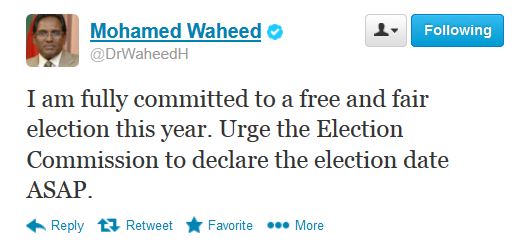
Following his meeting with UK Parliamentary Under-Secretary of State Alistar Burt, President Mohamed Waheed Hassan announced his commitment towards a free and fair election on Twitter.

In his tweet he called upon the elections commission to “declare the election date as soon as possible”.

“I am fully committed to a free and fair election this year. Urge the Election Commission to declare the election date ASAP,” Waheed tweeted.

Asked about Thaufeeq’s concerns, Finance Minister Abdulla Jihad told Minivan News that the government was “working on it”.

“We will provide sufficient funds to hold elections. There is no question about it,” he said.

In April 2012, the US government pledged to provide  US$500,000 (Rf7.7 million) as assistance for an elections program intended to support Maldivian institutions in ensuring a free and fair presidential election.

Chargé d’Affaires of the US Embassy in Colombo, Valerie Fowler, said at the time that the funding would be made available from July 2012.

The US would lend any support, including technical assistance, to ensure the next presidential election in the Maldives is conducted “smoothly and observed the rule of law”, Fowler said.

“Through USAID we are in the process of starting an election program that will assist Maldivian institutions in ensuring a free and fair presidential election. We have allocated US$500,000 to start that process and anticipate that we can begin as soon as July 2012,” she noted at the time.

Asked about the US assistance program, Thaufeeq said that he had only heard of it through the media, and that no government authority had discussed it with the commission.

President’s Office Spokesperson Masood Imad was not responding to call at time of press.

Likes(0)Dislikes(0)

No “definitive answer” from US delegation over government’s failure to act on CoNI recommendations: MDP

The US delegation who visited the Maldives last week gave no “definitive answer” to political issues raised by former President Mohamed Nasheed, the party has said.

The delegation, consisting of Deputy Assistant Secretary of State James Moore, Deputy Assistant Secretary of Defense Vikram Singh and Deputy Assistant Secretary of State Jane Zimmerman, met with the former president on Thursday (January 31).

According to local media, Nasheed informed the delegates that the present government had failed to act upon the recommendations made in the Commission of National Inquiry (CoNI) report, claiming there had been a “lack of effort” to reform the judiciary.

However, MDP Spokesman Hamid Abdul Ghafoor said the US delegation were unable to answer the issues raised by Nasheed, and that their interest was focused on the implementation of free and fair elections later this year.

“The issue was a difficult question for them and we could not get a straight answer. Their purpose was to highlight the importance of implementing free and fair elections over here, but we wanted to find out how aligned they were with other issues,” Ghafoor added.

According to local media, the US delegation was set to meet various political parties and senior government officials to discuss the current political situation in the Maldives.

Issues including labour laws and the protection of worker’s rights were also a topic of discussion between Nasheed and the delegates, local media reported.

James R Moore is a Deputy Assistant Secretary of State in the Bureau of South and Central Asian Affairs since September 2010, and previously the Deputy Chief of Mission of the US Embassy in Colombo from 2006 to 2009.

Jane B Zimmerman is a Deputy Assistant Secretary of State in the Bureau of Democracy, Human Rights, and Labor, responsible for South and Central Asia, the Western Hemisphere, and International Religious Freedom.

Vikram J Singh is Deputy Assistant Secretary of Defence for South and Southeast Asia within the Office of the Assistant Secretary of Defence for Asian and Pacific Security Affairs.

Singh also serves as the principal adviser to senior leadership within the Department of Defence for all policy matters pertaining to development and implementation of defence strategies and plans for the region.

Likes(0)Dislikes(0)

Kun’burudhoo development hampered by bureaucracy, insufficient budget

The council of the island of Kun’burudhoo in Alif Dhaal Atoll is struggling to meet its mandate of bringing development to its population of just over 500 people, a problem they say is increased due to insufficient annual budget.

The Council President Mohamed Azmy, who was voted in as an independent candidate, echoed the concerns of atoll councils and the Local Government Authority(LGA) that the biggest challenge faced by the council was the lack of adequate funding.

“Last year’s budget covered nothing more than salaries and some stationery for the office. And this year, we have received an even lower budget,” Azmy said. “To add to this, the Decentralisation Act overlaps with other stronger laws and this in the end inhibits us from fundraising through other means.”

Azmy said the Ministry of Finance had notified island councils in late 2012 that any earnings of the councils are to be considered part of the state budget and must be deposited with the Maldives Inland Revenue Authority (MIRA).

Council Member Ahmed Ashraf, from the Maldivian Democratic Party (MDP), added that the past year’s budget had proved insufficient to maintain the office’s phone and fax lines, or to establish a work space for any of the council members besides the President.

“This is our work space,” Ashraf said, gesturing at a ‘joali’, a set of reclining seats, placed outside the office. “It’s impossible to work productively in conditions such as these. There is so much we are mandated to do for our island, but how will we achieve it unless the state can provide us with resources or at least the autonomy to raise funds ourselves?”

The councillors stated that despite a period of almost three years having passed since the local council elections, the LGA had still not transferred the government-owned lands, which can be used to generate income, to the jurisdiction of the council, citing administrative delays as a cause.

Relocation: President suggests Hulhumale’

President Mohamed Waheed Hassan pledged to address the major concerns of the council during a meeting held January 9.

Speaking of the small size of the island, and the ensuing lack of natural resources and difficulty in providing basic services, Waheed suggested relocating of the island’s population.

Vice President of the Council Mohamed Adam stated that the people of Kun’burudhoo had some demands if they were to be relocated, and that they would only accept the idea on condition that they were moved to a more developed island with a better standard of living.

“We haven’t released any land to individuals in over 30 years. Now there are large families sharing homes here and living standards are decreasing day by day,” Adam said, also pointing out the less than adequate health and education facilities.

The council said Waheed spoke of possibly moving the island’s people to Hulhumale’ during the second phase of its development or to the island of Maafushi, another island close to the capital city of Male’.

President’s Office Spokesperson Ahmed Thaufeeq denied that any mention of specific islands had been made during the time.

“Relocating smaller populations to larger islands is part of this government’s plan. However, we have not yet identified specifically which island will be relocated where. Moving people to Hulhumale’ is definitely not in our plans yet. I have no knowledge of any such plans,” he said.

Adam said that the council was aware that Waheed, as he had promised in the meeting, had approached the Health Ministry asking them to deal with the issues at the island’s health centre.

“It’s a level two health centre. Normally, centres at this tier have approximately 15 staff. In our case, we only have one doctor, one nurse, one community health officer, one administrative staff and one labourer. It’s extremely difficult to cater to people’s needs,” Azmy said. “We hope the health ministry responds to this in a timely manner.”

“There’s also the matter of our mosque. We closed it down last August when we discovered human remains on the premises. Now the ladies’ mosque is open for general use, but this cannot remain a permanent solution. We did put this matter forward to Waheed too,” Azmy continued.

The final issue the council took to the President was the matter of erosion and the damaged revetments of the recently constructed jetty.

The Maldives Transport and Contracting Company (MTCC) constructed the jetty in 2009 during Nasheed’s administration.

“This island has been facing the problem of erosion for years. When Nasheed came to power, he kept his pledge and constructed this jetty for us. Now, the jetty is showing signs of wear and tear. We are speaking with the government to find a way to deal with this before matters worsen, but there’s a confusion as to who has to take responsibility,” Azmy said.

Adam said according to the government, the MTCC had not officially handed over the jetty to the government to date.

“If we try to repair this ourselves, it might end up as us acting illegally. Unless this jetty is officially handed over, we ourselves can do nothing about it,” Adam said.

Thaufeeq said that the matter was currently being discussed with MTCC. He stated that the government was working to solve the issue as soon as possible.

“Of the four issues discussed at the meeting, the only action we’ve seen so far from the government is the letter sent to the Health Ministry. There’s been no news on anything else, but I hope what was said at the meeting does translate into action soon,” Adam said.

Waste dumped into sea

“Land erosion has always been a huge problem on this island. After the jetty was built, the erosion is now occurring on the eastern side of the island, opposite from where we had the problem before,” Ashraf said.

Besides soil erosion, the second biggest issue was pollution of the seas. The island does not have any waste management system.

“We leave waste management up to the households. There is a designated area where households burn their waste, but food items and other such waste often just get dumped into the sea,” Adam said.

“I understand that the environment is a very fragile thing. Nevertheless, I don’t see how we can ask the people to not dispose of their waste in the sea unless we can show them alternative means.”

Azmy said plans had been set in place to build a garbage site on the island during the previous administration, but that the council had heard no news about the project after the change in government.

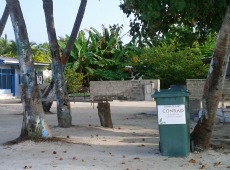
Meanwhile, a number of large dustbins have been placed along the road adjacent to the jetty, bearing the logo of Conrad Maldives Rangali Island.

“Conrad donated those dustbins. The people are only allowed to throw waste like tins, bottles and packets into it. We at the council arrange its disposal. It’s strictly not for household waste,” Ashraf explained.

“Waste management is a massive problem which our government needs to deal with. The Environment Ministry is drafting up a plan to deal with the issue. There are currently mechanisms being put in place to manage waste in Male’, and we will do the same for big and small islands across the country in time,” Thaufeeg said, in response to the matter.

Likes(0)Dislikes(0)

Opposition condemns “arbitrary arrest” of 15 protesters during anti-government demonstration

Police on Friday have arrested 15 Maldivian Democratic Party (MDP) activists at the party’s protest site ‘Usfasgandu’, during an anti-government demonstration.

Police said the demonstrators were arrested on charges of “breaking the police barricades” and “obstructing police duty”.

The police had previously cordoned off the party’s protest site  after the High Court ordered police to repossess the area until it delivered a verdict in an ownership dispute between Male’ City Council (MCC) and the Housing Ministry.

Over a thousand MDP demonstrators took to the streets of Male’ on Friday, calling for President Mohamed Waheed Hassan to immediately step down along with other government figures including Defense Minister Mohamed Nazim and Commissioner of Police Abdulla Riyaz.

The demonstration was led by senior figures of the party including former Chairperson MP Mariya Ahmed Didi and several ministers of the former government, who repeated the call for a caretaker-administration prior to scheduled presidential elections on September 9.

“The Maldives Police Service on strictest terms condemn the act of obstruction of police duty while this service was executing the order of High Court to cordon off the area,” read the police statement. Police said that out of the 15 arrested, two had been female protesters.

Speaking to Minivan News, police media official sub-Inspector Hassan Haneef said police had only arrested protesters who broke through police lines.

“We only arrested the people who broke the police line and entered the area. We did not target any political figures nor did we see which party the arrested individuals belonged to,” he said.

The arrested demonstrators were presented to court this afternoon, which extended the detention period of the protesters by five days.

Minivan News understands that among those currently in police custody include Male’ City Councilor Mohamed Falah and MDP Youth Wing President Aminath Shauna.

A protester who was present at the time disputed police allegations that demonstrators broke through police lines.

“We were just standing behind the barricades when they came in, we didn’t even move or run. We just stayed there, we didn’t even call them ‘baaghee’ (traitor) but we kept on telling them they should give a proper reason for arresting a person, they just can’t take people for no reason,” the protester told Minivan News.

Demonstrators kept questioning the police as to why they were making the arrests when none of them had crossed the police line.

“We kept on asking what the [the arrested protesters] had done. After taking in a few protesters, they came towards us and took Shauna. They came towards her and said she had to come with them whether she liked it or not. Two to three of us were holding her when they took her,” she added.

Meanwhile, the MDP in a statement called for immediate release of its members claiming the activists were arrested for their “illustrious work to defend freedom of assembly and freedom of expression” in the country.

“The MDP condemns in the strongest terms the police swoop into the rally as a politically motivated and premeditated illegal incursion to arrest a specific target list of highly dedicated party workers.

“Eyewitness reports have established that today’s foray also was characterised by high-handedness and needless force typical to the Police Special Operations squads in the clutches of a usurper police commissioner and usurper government,” read the statement.

The party also condemned “false reporting” of the incident by some local media outlets, who claimed that protesters “had breached police lines”, which the party alleged were “outright lies”.

Speaking to Minivan News, MDP Spokesperson MP Imthiyaz Fahmy suggested the arrests were a result of lack of a mechanism to hold the police officers accountable for arbitrary arrests.

“There is absolutely no way to hold the police accountable,” he said. “They know that everything will be settled once they take the protester to court. The Human Rights Commission of Maldives (HRCM) and the Police Integrity Commission (PIC)’s failure to hold the officers accountable means they can take full advantage of their impunity.”

Fahmy also dismissed claims made by police that those arrested had broken police lines.

“While I was there a group of police barged into the protest and randomly arrested a few people after looking at their faces. We did not break the police line. That is an outright lie,” he added.

If police can be held accountable for their actions, Fahmy said such arrests would not take place and freedom to carry out peaceful political activities would not be compromised.

After weeks of quiet in Male’, the MDP resumed their protests against the government on January 22,  led by former President Mohamed Nasheed.

Nasheed during the demonstration called on parliament to create an interim, caretaker administration “which can lead the country towards a genuinely free and fair presidential election in which all candidates are able to freely compete.”

MDP Spokesperson MP Hamid Abdul Ghafoor told Minivan News at the time that the party planned to hold more assemblies and protests in next coming months around Male’.

“The MDP have been off the streets some time, we have taken a break. Now we are back. We have too many options and ideas opening up and people need to know what’s going on,” Ghafoor said.

Likes(0)Dislikes(0)

Elections commission disbursing politcial party funds

Political parties will receive funds disbursed by the Elections Commission (EC) this week, according to local media.

Secretary General of EC Asim Abdul Sattar told Sun Online that the Finance Ministry was facing “difficulties” because of the high number of vouchers received at the beginning of the year, which is why funds had not previously been distributed.

According to EC Member Ali Mohamed Manik, seven political parties have had funds withheld because they have not held any political activities or submitted “up-to-standard” audit reports.

The Maldives presently has 16 registered political parties, however only eight meet the requirements for actively holding political events and having at least 3,000 registered members, states local media.

Party funding:

  • Maldivian Democratic Party (MDP): MVR 3.6 million (US$233,280);
  • Progressive Party of Maldives (PPM) MVR 1.98 million (US$128,304);
  • Dhivehi Rayyithunge Party (DRP) MVR 1.9 million (US$123,120);
  • Jumhooree Party (JP) MVR 1.2 million (US$77,760);
  • Adhaalath Party (AP) MVR 794,000 (US$51,451);
  • Maldives Development Alliance (MDA) MVR 624,000 (US$40,435);
  • Gaumee Itthihad MVR 608,000 (US$39,398);
  • Dhivehi Qaumee Party (DQP) MVR 529,000 (US$34,279); and
  • Maldives National Congress (MNC) MVR 478,000 (US$ 30,974).
Likes(1)Dislikes(0)

“Come and contest. This time, we will defeat you in a single round”: Nasheed challenges Gayoom

The Maldivian Democratic Party held a several thousand strong rally on Wednesday night despite a police takeover of Usfasgandu, the party’s rally ground in Male’, and a warning from Minister of Home Affairs Mohamed Jameel that the police would not allow the rally to be held in the area.

Police cordoned off the main rally ground and surrounding streets, with MDP members and supporters standing just beyond police lines. The rally was held adjacent to the protest site.

Crowds gathered an hour before the scheduled start of the rally and heated verbal exchanges took place between the protestors and approximately thirty police officers at the location. Minivan News observed two protesters being led away by police. However Police Media Official Sub Inspector Hassan Haneef said that no arrests were made in the area.

First a Maldivian, then a police officer

Many speakers at Wednesday night’s rally called on the police to step down and cooperate with the citizens, saying they were “first a Maldivian and then a police officer”.

“You should be ashamed to stay there in uniform when you are being used as political weapons,” said MP Ali Waheed, addressing the police officers.

Former MDP Chairperson Mariya Ahmed Didi called on police to back down, saying the party members would not step back until they had guaranteed their freedoms and rights.

“We don’t care how big a power tries to tell us this is not a coup, whether it be the Commonwealth or the UN. We have no doubts about what we saw with our own eyes. We have no doubts about which shoes, which batons have been beating us,” Mariya said.

“No member of MDP will go back to their homes before we rid this country of this culture of violence.”

Both Mariya and Nasheed stated that the party’s intention was not to protect the rally grounds, but rather the rights of the citizens.

“It is not Usfasgandu that we are trying to defend, nor any other land either. We are here to protect freedom of expression, freedom of assembly and the right to peaceful political activity. We will do this until our last breath,” Nasheed said.

“Take down these police lines,” Nasheed addressed the police. “There is no one in this country who can come out against the citizens of this country, to hold them back or restrict them. I call on the police and soldiers to step back now.”

“Maumoon is deceiving Yameen and Ilyas again”: Nasheed

Nasheed once again accused current President Mohamed Waheed Hassan of participating in planning a coup with former President Maumoon Abdul Gayoom.

“There is one thing I must say to my former Vice President Waheed. You cannot forever eat the world with deceit. You can only do so for a short while,” Nasheed said.

“If you think that by taking the lead to plan a coup with former President Maumoon Abdul Gayoom you people will succeed in getting this country back in your clutches, then you are very much mistaken. We will not let that happen.”

Speaking of the Progressive Party of Maldives (PPM), Nasheed said the party was absorbed in in-fighting while MDP was conducting its door-to-door campaign. He alleged that Gayoom was “once again deceiving his brother Abdulla Yameen and brother-in-law Ilyas Ibrahim” by feigning refusal to run in the presidential elections.

“Maumoon has been pulling the wool over Abdulla Yameen’s eyes for a good 15 years now, telling him he won’t be running for president,” Nasheed said.

“He creates rifts between Yameen and Ilyas, and then, in the name of peace making, takes the reigns himself. He has been doing this for ages, and will do so again. Come and contest. We will defeat you again. This time, we will defeat you in a single round,” Nasheed said.

At the end of his speech, Nasheed made reference to the recent allegations plans of assassination plots against him.

“You can plan to poison me, you can plan to shoot me, you can conspire to do anything at all. But the final will is not that of Jameel, Waheed or Saeed. Accept it, the final will is that of Almighty God,” Nasheed said.

“None of you must be mistaken, be it the judges or the police and army. I am repeatedly saying that on the 11th of November 2013, it will once again be me who is sworn in as President of this nation.”

Police have closed off the MDP rally grounds following an order from High Court released Wednesday, stating the area shall be kept under the care of the police and not used for any purpose until the court reaches a verdict on the matter.

Likes(0)Dislikes(0)

High Court brings forward Nasheed’s appeal case

The High Court has brought forward former President Mohamed Nasheed’s appeal case, now scheduled for Sunday.

Nasheed is being tried in the Hulhumale’ Magistrate Court for the controversial detention of Chief Judge of Criminal Court Judge Abdulla Mohamed in January 2012.

The former President’s legal team lodged the appeal challenging the Hulhumale’ Magistrate Court’s ruling on three procedural issues raised during the court’s first hearing held October 9.

Speaking to Minivan News, MP Mariya Ahmed Didi confirmed the legal team had been informed of the decision to move the hearing.

“I understand from President Nasheed’s lawyers that they have received summons for February 3, as Nasheed had requested to depart the country the afternoon after the hearing. As far as I understand no particular reason was cited,” she said.

Didi however expressed concern over the High Court taking decisions on such short notice, stating that as Nasheed received legal council from abroad, such sudden changes in scheduling were inconvenient.

“These are Queens Counciler’s and their schedules are set in advance.  It is not possible to reschedule at such short notice. We have requested the High Court to bear with us on that,” she said.

Didi contended it was imperative that Nasheed be given “all opportunities to defend himself as a defendant in a criminal trial”. Nasheed “should not be an exception to that,” she said.

Spokesperson for the Department of Judicial Administration (DJA) Latheefa Gasim was not responding.

Meanwhile, Nasheed’s legal team has also sought an opportunity to highlight in court the Supreme Court’s ruling concerning the legitimacy of the Hulhumale’ Magistrate Court.

The Supreme Court has declared that Hulhumale’ Magistrate Court is legitimate and can operate as a court of law, following the Judicial Service Commission (JSC)’s request that it clarify the court’s legality.

MP Mariya said Nasheed’s legal team was of the opinion that the issue decided in the Supreme Court was different from the issue put before the High Court by the legal team.

“We hope the High Court will give our lawyers the opportunity to explain the distinction and consider all issues before they give a judgment on the matter,” she said.

Following the Prosecutor General (PG)’s decision to press charges against Nasheed in the Hulhumale’ Magistrate Court instead of Criminal Court, Nasheed’s legal team initially challenged the legitimacy of the Hulhumale’ court arguing that it was created in violation of the Judicature Act.

The team raised the issue during the first hearings of the trial, along with other procedural inconsistencies, but all were rejected. They later appealed the case in the High Court along with other procedural issues.

Despite its initial rejection of the procedural points, the High Court later accepted all points made by Nasheed’s legal team except that concerning the legitimacy of the Hulhumale’ Magistrate Court. It later issued an injunction ordering the magistrate court to suspend Nasheed’s trial until a decision on the procedural points raised by Nasheed’s legal team was reached.

Controversies

The case has been subject to controversy after Nasheed’s party  claimed the trial was a politically motivated attempt to bar Nasheed from contesting in the next presidential elections.

The UK Bar Human Rights Committee (BHRC) in a recent report concluded that the charges against Nasheed appeared to be a politically motivated attempt to bar the Maldivian Democratic Party (MDP) candidate from the 2013 presidential elections.

“BHRC is concerned that a primary motivation behind the present trial is a desire by those in power to exclude Mr Nasheed from standing in the 2013 elections, and notes international opinion that this would not be a positive outcome for the Maldives,” the report stated.

The report observed that the detention of the judge was “not a simple case of abuse of power”.

“Rather, the underlying narrative of the situation is that of a president desperate to bring change to a new democracy after decades of oppression, and finding himself thwarted by the inability of the organs of state set up by the constitution to deliver much needed reform,” the report stated.

Referring to “the large number of international reports” that have found the Maldivian judiciary to be flawed, the BHRC noted that the Judicial Service Commission (JSC) “failed in its twin tasks of ensuring that the judiciary has the appropriate experience and qualifications, and in bringing to book the judges who fail to fully and fairly implement the rule of law”.

“Implicit in these criticisms is that Mr Nasheed cannot be guaranteed a fair trial,” the report concluded.

Arrest of the judge

Chief Judge of the Criminal Court Abdulla Mohamed was taken into military detention of January 16, 2012 at the request of then Home Minister Hassan Afeef on the grounds that the judge posed a threat to national security.

The judge had successfully blocked investigation of his misconduct by the judicial watchdog and quashed his own police summons.

Abdulla Mohamed had “taken the entire criminal justice system in his fist,” Afeef said, accusing him of obstructing high-profile corruption cases, releasing murder suspects, colluding with drug traffickers, and barring media from corruption trials.

Judge Abdulla “hijacked the whole court” by deciding that he alone could issue search warrants, Afeef contended, and had arbitrarily suspended court officers.

The arrest triggered series of anti-governmental protests that eventually led to the sudden resignation of then President Nasheed on February 7, 2012.

Likes(0)Dislikes(0)