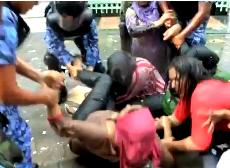
US awards Aneesa Ahmed ‘International Woman of Courage’ award

Former Minister of Gender and Family Aneesa Ahmed has become the second Maldivian woman to win the prestigious ‘International Women of Courage Award’ presented by the US Secretary of State to honor the courage of extraordinary women worldwide who have played transformative roles in their societies.

Since the establishment of the award in 2007 by the former Secretary of State Condoleezza Rice, 46 women from 34 different countries – including Former ruling Maldivian Democratic Party MDP Chairperson and MP Mariya Ahmed Didi – have been honored for the exceptional courage and leadership shown in advocating for women’s rights and empowerment, often at great personal risk.

According to the state department’s website entry on the 2012 winners, Aneesa is recognised for being a ‘staunch advocate for ending gender-based violence (GBV) in the Maldives’.

The statement on Aneesa read; “While serving as Deputy Minister of Women’s Affairs, she raised the issue of domestic violence at a time when the subject was taboo. After leaving the government, she founded the NGO Hope for Women and began conducting sessions on GBV with students, Maldives Police Services, and other front line workers”.

The department had further noted her courage for speaking out against female genital mutilation after some religious scholars identified it as a practice supported by Islam on national radio last year. The statement added; “By openly discussing issues like these and promoting awareness through her NGO, Ms. Ahmed plays a key role in bringing these issues into public discourse and pressing the government to take action.”

Minivan News could not reach Aneesa at the time of press as she is currently in the US to attend the Awarding ceremony due to take place on Thursday night, 9:00pm local time.

Secretary of State Hillary Rodham Clinton will host ceremony with special guest First Lady Michelle Obama while other dignitaries include the Ambassador-at-Large for Global Women’s Issues Melanne Verveer, Leymah Gbowee and Tawakkol Karman, both 2011 Nobel Peace Prize Laureates.

2007 award recipient Mariya Ahmed Didi said she was “thrilled that a Maldivian woman has been awarded the US Secretary of State International Woman of Courage for the second time.”

“As a nurse and midwife [Aneesa] was known to be committed and kind to her patients. As a Deputy Minister and subsequently the Minister for Gender she was committed to furthering the rights of women. As a parliamentarian and as the leader of the DRP’s Parliamentary Group she had foresight and understanding that kept the group together. As a person committed to [former President Maumoon Abdul] Gayoom, there is none second to Aneesa.”

International Women’s Day comes in the Maldives following a week in which water cannon was used to disperse a women’s sit down protest outside the President’s Office, and in which Amnesty International condemned abrutal security forces crackdown on a group of 20 female MDP supporters in Addu Atoll. One woman who was beaten repeatedly on the breast by an MNDF officer told Amnesty that they were repeatedly shouting they would see to it that she “would never breast feed again.”

Mariya observed that “the way Maldivian women had come out to protest against the brutality of the Waheed regime has shown that all Maldivian women are ‘women of courage’. They are resilient and determined to not allow their sons and daughters to die in Maldivian jails, as was seen in the 30 year rule of the Gayoom dictatorship. The 30 days of Vice President Waheed’s rule has shown Maldivians that authoritarian rule is here and very much to stay.”

Woman face ongoing challenges

As the International Women’s Day is celebrated on March 8 with the UN theme for 2012 “Empower Rural Women – End Hunger and Poverty – the Human Rights Commission of the Maldives (HRCM) has highlighted the under-representation of women in the remote islands of the Maldives.

In a statement released on Thursday the commission expressed its concern over the “alarming level” of discrimination rural women face worldwide ” and added that it is “upsetting that the situation in Maldives is similar”

“The upsetting thing is that several counties still does not recognize the importance of women’s participation in the decision making process.” The statement further reads, “On the Maldivian islands significant work has been done by women, yet it is seen as an obligation and thus does not receive the appreciation and the recognition they deserve. However, because of their society benefits so much,” HRCM statement said.

Meanwhile, Maldives is yet to achieve gender quality goal of the Millenium Development Goals.

“Gender disparity exists in secondary and tertiary education as well as in labour force participation and the national parliament,” according to the UN Maldives fact sheet on MDG’s.

Currently, five out of the 77 MP’s are women while the representation in the elected councils are significantly low.

In an earlier interview with Minivan News, following Aneesa’s decision to retire from her political career and parliament in 2009, she observed the challenges for women in entering politics in Maldives.

“There are many restrictions on women candidates. For instance financial support, especially these days when there is so much of money politicking. Women don’t have that the wealth so they need to be supported, financially supported and also their families will have to give them support. Unless they have an understanding and supportive husband, it’s going to be difficult,” Aneesa explained.

“And then again the whole attitude, the mindset of people will need to be changed. We still have the majority of the people with the mindset that women cant perform in public in the same way as men and women dont have the intelligence or the capacity to be members of parliament or public figures,” she further added.

Meanwhile, the importance of working forward in eliminating the gender based violence has also been recognised by the stakeholders who identify it as one the biggest challenges the Maldivian women today face.

According to the Gender Department’s statistics, one in three women between the age 15-49 in the Maldives have suffered from abuse – mostly from partners or within the family.

Both women rights NGOs and the UN have stressed on several occassions to pass the Anti-Domestic Violence Bill, which has been stalled in the parliament for over a year now.

Likes(0)Dislikes(0)

President Waheed appoints seven state ministers, including Gayoom’s son

President Mohamed Waheed Hassan has appointed seven state ministers for various ministries in a ceremony held in the President’s office yesterday.

The newly appointed state ministers were Imad Solih as the Minister of State for Education, Fuad Gasim as the Minister of State for Fisheries and Agriculture, Ahmed Shameem and Mariyam Mizna Shareef as Ministers of State for Tourism, Arts and Culture, Abdulla Ameen as the Minister of State for Economic Development, Gassan Maumoon as the Minister of State for Human Resources, Youth and Sports and Sheikh Mohamed Didi as the Minister of State for Islamic Affairs.

Gassan Maumoon, appointed Minister of State for Human Resources, Youth and Sport, is the son of former President Maumoon Abdul Gayoom. Gassan also contested in the last parliamentary elections under a DRP ticket against the recently unseated MDP MP Musthafa. Gassan lost the election twice, after the Elections Commission held the election for a second time after the first election was declared invalid.

The Criminal Court in October 2011 ruled that the arrest of Gassan was unlawful, after he was summoned for questioning in connection with an injury sustained by an MDP protester outside his residence Endherimaage.

During the incident, a 17-year-old boy was struck on the head with a wooden plank allegedly thrown from Endherimaage, while protesters led by MDP MPs, councillors and senior members were marching by the former President’s residence. Police submitted documents containing early evidence for the judge’s considering, including a medical report of the injuries sustained by the 17-year-old, photos, witness statements and “evidence we collected from the scene.”

Gassan’s legal team, including current Attorney General Azima Shukoor, argued that witness statements were invalid as they would have come from “people participating in an unlawful assembly.”

Police argued at the time that if Gassan’s arrest was unlawful, “everyone police have ever arrested and brought before the court [for extension of detention] have been arrested in violation of the constitution”, and suggested that Gassan’s legal team was “concerned that we might present evidence” and that the legal argument bore “no weight.”

Imad Solih, appointed as the state minister of education, is currently the deputy leader of Dr Hassan Saeed’s Dhivehi Qaumee Party (DQP) and was a former presidential appointee to the People’s Special Majlis during the time when the constitution was drafted.

Gasim, appointed as the state minister for fisheries and agriculture, is the current secretary general and a council member of business tycoon and politician Gasim Ibrahim’s Jumhoree Party (JP).

Shameem, the newly appointed State Minister for Tourism, Arts and Culture, is a senior member and a council member of Dr Munavvar’s political party, the Maldives Reform Movement. Shameem is also the brother of the Human Rights Commission member Dr Ali Shameem.

Ameen, appointed as the Minister of State for Economic Development, is the current Secretary General of Dr Hassan Saeed’s DQP.

Mariyam Mizna Shareef, who was made state minister for tourism, arts and culture, is the daughter of DRP deputy leader Ahmed Shareef.

Sheikh Mohamed Didi, appointed as the State Minister for Islamic Affairs, is the President of the Civil Alliance, an umbrella coalition of NGOs behind the December 23 movement in defence of Islam. Didi also played a pivotal role in organising the 23 December Islamic rally and has been working with the opposition during the tenure of President Nasheed.

President Waheed, speaking to the newly appointed state ministers, expressed confidence in the new appointees and that he had no doubt in that they would serve the nation with best of their capacities.

MDP Spokesperson Imthiyas Fahumy said: ” Gassan is not at all experienced in working in such a position. What is happening right now is exactly what happened during Gayoom’s regime.”

“We are day-by-day seeing that Waheed does not have full power over this government. Someone else from Maumoon’s end is controlling this. Those who were involved in this coup are getting the positions,” Fahumy said.

Likes(0)Dislikes(0)

Amnesty condemns use of excessive force on demonstrators, following police raid on protest

Amnesty International has condemned the use of excessive force by police against 300 Maldivian Democratic Party (MDP) supporters in the Lonuziyaarai Kolhu (tsunami monument area) early on March 7.

The MDP yesterday accused police of attacking demostrators and vandalising the ongoing protest, after they pursued a group of youths to the area suspected of vandalism and threatening police.

During the raid on the MDP camp, “at least six protesters were injured, some seriously, when combined police and military officers attacked around 300 MDP protesters – part of a wider pattern of attacks, documented by Amnesty, on supporters of the political party of the ousted former President Mohamed Nasheed,” the human rights group said in a statement.

One of the victims told Amnesty “[the police] grabbed hold of my hair and pulled me up, shouting they would teach me a lesson for demonstrating against the new President.”

Among the six protesters injured was a 16 year-old boy who was placed in the custody of the Child Protection Unit, said Amnesty. The organisation was refused permission to visit him.

“People who were peacefully exercising their right to protest were beaten on the head with batons, kicked and sprayed with pepper spray. This use of excessive force violates human rights standards,” said Amnesty International’s researcher Abbas Faiz, who is documenting the human rights situation in Maldives.

“The Maldives authorities must clearly announce, and demonstrate, that they do not tolerate retaliatory raids by the police against protesters. Police and military must not act outside the law,” Faiz said.

“When police officers act like political opponents towards demonstrators, they erode respect for the rule of law and cast doubt on their impartiality as officers of justice,” he added.

Amnesty called on police to make public the number of people who had required medical treatment following their arrest.

“Credible sources have told Amnesty that the police and military arrested more than a dozen people during their raid on the MDP rally. They arrested some more people in the hospital after they had gone to receive medical treatment for their injuries. The detainees were taken to police detention centres in Malé, and were later transferred to Dhoonidhoo, an island close to Malé which is the main detention centre.”

Police Spokesperson Sub-Inspector Ahmed Shiyam yesterday told Minivan News that police had pursued a group of young men armed with knives, who had vandalised police stations and threatened officers before retreating to the MDP protest area.

Police stopped at the edge of the open area and requested backup, but by the time it arrived word had spread that police were about to raid the protest site and MDP supporters had arrived to protect the area.

“When police entered the [camp] to arrest the suspects forcefully, everyone in the area became hostile to police. There was a huge confrontation,” Shiyam said added.

“This was a very serious thing and we are sad that it happened,” Shiyam said. “We have no interest in doing anything [to the MDP camp], and we don’t want to have a confrontation. But people are coming out of the area, committing acts of violence, and going back there to hide, which is not something to be accepted.”

Elements of the police and military were complicit in the ousting of former President Mohamed Nasheed, who contends that he was forced to resign by security forces “under duress” in a bloodless coup.

Likes(0)Dislikes(0)

MDP calls for compromise amid ongoing political standoff

The Maldivian Democratic Party (MDP) is open to compromise in its position on the opening of parliament, the party has said, in its pursuit of an early election date.

“[The MDP] have to compromise as well. It should not be expected that during negotiations that only one side will make all the efforts to compromise,” said the MDP’s Parliamentary Group Leader Ibu Solih yesterday.

In a conciliatory statement, Solih said: “Just look at what happened last week. [The government] said that a date for an early election will not be settled until the parliament is opened, while we maintained that the parliament cannot be opened until a date is set. Both sides wanted their way.”

He continued to posit national welfare as the paramount concern during the current political upheavals: “Finding a way to co-exist should be of fundamental importance right now.”

President’s Office Spokesman Abbas Adil Riza said that the all-party talks would continue when the convener Ahmed Mujuthaba returns next week. Riza himself represented the Jumhoree Party (JP) of resort owner Gasim Ibrahim at the recent round of talks, and spoke of the need to find common legislative ground before fresh elections.

“Let parliament function and politicians be politicians,” said Riza. “We cannot allow extreme elements to take control.” Riza stated that the JP wanted assurances that the democratic processes that many people had worked hard to cultivate “would be allowed to function properly before it could support fresh elections.”

“We must not return to square one,” he continued, as he emphasised the need for clearer methods, situated on common ground, to resolve procedural deadlocks. He cited the PPM’s displeasure with the Electoral Commission and the MDPs unhappiness with the Judicial Services Commission as examples of this systemic conflict.

“Having nearly brought the democratic process to a standstill… let us legitimise the process,” he said.

Committee of National Inquiry (CNI)

Transparency Maldives Project Director Aiman Rasheed reported that a meeting between NGOs and the CNI today was candid and contained much “positive energy”.

Today’s meeting was attended by a number of local groups including the Maldivian Democracy Network, the Maldives NGO Federation and Democracy House.

“The inquiry is an opportunity for unity… It is a collaborative civil society effort,” Rasheed said. He emphasised the popular theme of better dialogue between parties.

Several parties on the side of the new government, the Dhivehi Rayyithunge Party (DRP), Progressive Party of the Maldives (PPM) and the Adhaalath Party (AP) last week walked away from the India-mediated roadmap talks  after MDP MPs blocked the entry of Parliamentary Speaker, Abullah Shahid, to the People’s Majlis. The CNI has been presented by India as an important of  path to political reconciliation in the Maldives.

President Dr Mohamed Waheed Hassan earlier in the week wrote to all parties urging a renewal of their commitment to the all party talks “in the best interest of the nation.”

During the meeting between the CNI and the representatives of Maldivian civil society,  the issue of time constraints on the newly formed investigative body were also highlighted. Whilst time is needed to adequately staff and establish working procedures, Rasheed said he believed time was “a luxury” that could be ill-afforded.

The CNI has asked the Foreign Ministry to expedite its normal procedures in contacting the United Nations. International participation has been strongly advocated both domestically and internationally to safeguard the transparency of the inquiry process.

Following the MDPs recent claims of witness intimidation – including of police officers willing to speak to the inquiry – CNI members were candid about the challenges faced, acknowledging that witness protection would be an important issue.

The President spoke to local television station DhiTV this week, stating his intention to work tirelessly to unite the divided country.

In a subsequent statement on the President’s Office website, Dr Waheed said “satisfactory results could not be achieved if I attempted to work alone.”

“What we have witnessed over the past three years was the decisions of a single individual being imposed on all,” Dr Waheed claimed.

Likes(2)Dislikes(0)

Government assures Transparency Maldives of willingness to accept international assistance in inquiry

President Dr Mohamed Waheed Hassan has assured Transparency Maldives of his willingness to include international groups in the inquiry into the events surrounding his accession to the presidency.

In a meeting with the local NGO, President Waheed and Attorney General Azima Shukoor also welcomed requests for increased transparency in the workings of the Committee of National Inquiry (CNI) which is charged with looking into the legality and legitimacy of the transfer of presidential power.

Transparency Maldives Project Director Aiman Rasheed emerged from the meeting confident that Dr Waheed would respect the importance of transparency and accountability in the inquiry process.

Rasheed told Minivan News that Dr Waheed saw an independent and transparent process as the way forward, and recognised that an enquiry which did not have the support of the people would only further political discontent.

The inclusion of international experts in any such inquiry has been urged by numerous international actors as well as the party of  former President Nasheed. The Commonwealth Ministerial Action Committee (CMAG), in a statement released after its own inconclusive enquiry into recent events, had strongly recommended an international element to any future investigation, “as mutually agreed to by political parties in Maldives.”

The largest party in the People’s Majlis, Nasheed’s Maldivian Democratic Party (MDP), yesterday criticised the CNI for “dragging its feet” on the issue, in what it said was “a clear violation” of the wishes of the international community.

“The MDP hopes that the international community will immediately call on the Dr Waheed regime and the CNI to commit to significant international assistance in the investigation,” the party said in a statement.

MDP said it had received reports of that members of the police force willing to talk to the CNI were facing intimidation. MDP International Affairs Spokesperson Hamid Abdul Ghafoor said he believed that such reports only increased the need for international experts, including witness protection specialists, to help bring investigations to a successful conclusion. Ghafoor has previously drawn unfavourable comparisons between this investigation and the 2003 Maafushi jail enquiry whose independence was questioned and whose outcome was censored.

The CNI currently consists of three members: Ismail Shafeeu, former minister of defence and national security during President Maumoon Abdul Gayyoom’s administration; Dr Ali Fawaz Shareef, Deputy Vice Chancellor at Maldives National University; and Dr Ibrahim Yasir, former Director General of Health Services.

One member of the commission has already been reappointed. Dr Ali Fawaz Shareef replaced Ahmed Mujuthaba, who said his position as the convener of the all-party consultative meetings was a conflict of interest.

Transparency Maldives, which is scheduled to meet the CNI tomorrow with three other NGOs, including the Maldivian Democracy Network, Maldives NGO Federation and Democracy House, has been active in raising awareness of the detrimental impact corruption and opaque governance on society.

The group’s current projects include Parliament Watch, a program that aims to increase public scrutiny of the procedures and processes used in the People’s Majlis, and the CRINIS Project advocating for changes to political party financing transparency. Others include the Right to Information Project, creating demand for right to information for greater transparency and accountability, the Decentralisation Project promoting accountability and increasing citizen engagement in local governments, and Advocacy and Legal Advice Centres Project, helping victims of corruption with the legal systems in place.

It has also produced reports on media, and conducted surveys on corruption perception. In pursuit of its stated goals of justice and democracy it asked the President to consider allowing it observer status on the CNI. It also requested that the CNI’s findings be made public.

Likes(2)Dislikes(0)

MMA accepts MDP MP Musthafa’s BCCI debt after the court rejected the money

The Civil Court has refused to accept payment of the debt it had ordered paid by Maldivian Democratic Party (MDP) MP Mohamed Musthafa, after the ruling against him was last week upheld by the Supreme Court.

The case had been filed against him by Progressive Party of the Maldives (PPM) Deptuy Leader Umar Naseer, and the ruling meant that Musthafa was disqualified as an MP for the former ruling party, forcing a by-election in his seat of Thimarafushi.

Musthafa this morning sent a person to pay the debt to the court – a loan of US$31,231.66 (Rf 481,952) borrowed from the now defunct Bank of Credit and Commerce International (BCCI).

The Civil Court has confirmed that a person had sought to pay the debt on Musthafa’s behalf, after the Supreme Court ruling did not mention that the money was to be paid to the former ‘Madhanee’, or Civil, Court.

Until President Nasheed signed the Judicature Act into law last year, the official name of the Civil Court had been Madhanee Court – ‘madhanee’ being the Arabic word for ‘civil’.

MDP MP Musthafa today told Minivan News that he had been trying to pay the money every day since losing the caase last Friday, but said the court had not accepted it.

‘’Today I thought I would inform that media and send someone to the court to pay the money, and the court did not accept it again,’’ Musthafa said. ‘’I wrote a letter to the court but they did not respond to it.’’

Later today, Musthafa said the Civil Court registrar had called him and met with him, and said the Supreme Court’s ruling did not specify who the recipient of the money was to be, and that the Civil Court did not know what they should do with it, Musthafa said.

‘’The Supreme Court told me to get assistance from the Maldives Monetary Authority (MMA) and the Attorney General,’’ he said. ‘’So then I sent the money to the MMA, and the MMA has received the money.’’

He also said that tomorrow he will file a case in the Civil Court asking the court to order the MMA to pay him the US$500,000 that the BCCI was obliged to pay Musthafa, in a separate case concerning the supply of meat and other goods.

‘’They have today proved that the MMA are the live parent of BCCI [despite BCCI being defunct],’’ he said. ‘’This is funny to me – because when they have to pay me something owed by BCCI, they deny they are the live parent, but when I have something to pay to BCCI they become the live parent of BCCI.’’

In November last year Musthafa threatened legal action against the Maldives Monetary Authority (MMA) if it did not pay the US$500,000 that BCCI owed his company Seafood International, alleging that the sum was due to be paid to his company according to a 1991 London court ruling.

Citing MMA as the “live branch of BCCI in the Maldives,” Musthafa previously stated that “the debt of a dead person has to be paid by a living legal parent.”

Likes(0)Dislikes(0)

Police arrest 13 in violent clash at MDP camp, after police stations vandalised

Police arrested 13 people after clashing with demonstrators at the Maldivian Democratic Party (MDP)’s ongoing protest early on Wednesday morning.

The MDP accused police of vandalising the MDP’s protest camp near the tsunami monument and attacking the party’s supporters at 2:45am in the morning.

However police have said they were pursuing a a group of young people on motorcycles who had attacked police buildings that evening, before retreating to the MDP camp

An MDP supporter who witnessed the incident told Minivan News that the police arrived after a group of young people opened a ‘Youth Jagaha’ near the tsunami monument, and then left on motorcycles to ride around the streets.

“They apparently vandalised some police stations during the motorbike ride, and then the police came and attacked the protest camp,’’ he said. ‘’Police destroyed our podium in the area and the sound system, as well as chairs and other property,’’ he claimed.

One young person was thrown into the sea wall and was subsequently taken to hospital.

Police said a group of men armed with knives vandalised police stations in Male’, threatening officers in the traffic police station with knives and destroying a computer monitor. The group also threatened officers inside the Police Iskandhar Koshi.

Sub-Inspector Ahmed Shiyam told Minivan News that police had followed the group to the area on the side of the tsunami monument park furthest from the MDP camp, near the army medical centre, where they had been attacked.

“Police called for backup and by the time the pickup arrived, people were there with stones,” Shiyam said. “When police entered the [camp] to arrest the suspects forcefully, everyone in the area became hostile to police. There was a huge confrontation,” he added.

Several police officers sustained injuries, none serious, he said. Police arrested 13 people and withdrew from the area.

“This was a very serious thing and we are sad that it happened,” Shiyam said. “We have no interest in doing anything [to the MDP camp], and we don’t want to have a confrontation. But people are coming out of the area, committing acts of violence, and going back there to hide, which is not something to be accepted.”

Police had asked organisers of the protest to take responsibility for the actions of those gathered there, he added.

MDP supporters have held an ongoing protest near the tsunami monument, dubbing it ‘justice square’, following the resignation of former President Mohamed Nasheed in what they contend was a coup d’état.

MDP supporters have been sleeping and gathering in the area since Nasheed’s resignation, reportedly under duress.

The party has meanwhile released  pictures of injured protesters and vandalism of the square.

Likes(0)Dislikes(0)

Security forces use water cannon on MDP women’s sit-down protest

The Maldives National Defence Force (MNDF) and police used a salt water cannons to break up a gathering of nearly 100 female supporters of Maldivian Democratic Party (MDP) outside President Office on Tuesday afternoon.

The women marched to the President Office around 3:15pm to deliver a set of letters requesting President Dr Mohamed Waheed Hassan to resign, while the rest of the female demonstrators sat down outside the office holding boards bearing slogans including “Where is my vote?” and “Justice now”.

The women from all ages continued to call for President Waheed’s resignation while the police and MNDF on the scene ordered the women to leave the area.

Video footage circulating over the social media then show that the police aimed a high-pressure salt water cannon at the crowd for at least five minutes, but this did little to deter the women, who were then physically picked up by policewomen. Others were pushed back by policemen armed with shields.

Several eye witnesses alleged to Minivan News that “some policeman groped the female demonstrators, tore their clothes and used foul language” during the removal.

“Two women’s clothes were torn from the shoulders when the policemen tried to grab them. One woman’s veil was taken off and I saw her shouting at the police,” one of the demonstrator told Minivan News over the phone.

Another eye witness reported seeing a woman who was “dragged by her feet” after she refused to leave. “The women tried to shove him off and cover her body because her blouse was torn, but the policeman grabbed her hands,” the source claimed.

Several women were seeing resisting arrest while the policewomen attempted to grab some of the women hosed down by the salt water. Although, the crowds were dispersed from the President Office, the women continued to voice their discontent on the nearby streets until nightfall.

Police media official, Sub-Inspector Ahmed Shiyam, told Minivan  News that female protesters forcibly crossed the police cordons and  “intimidated the police”.

Police Commissioner Abdulla Riyaz at a press conference yesterday had vowed that police would “become feared by the most dreaded criminals”.

“[The women] forcibly crossed into the area near the President Office after intimidating the police guards at the cordon blocking the area. They were ordered to leave the area repeatedly before the police used force to remove them,” Shiyam said.

Responding to allegations that police used excessive force to subdue the gathering, Shiyam said “If anyone has any complaints they can follow the due process and file a complaint.”

“What we used was water. It is the least brutal force used to disperse a gathering,” he further added.

Speaking to Minivan News today, former Tourism Minister Dr Mariyam Zulfa said that before the protest outside the President Office nearly 500 female MDP supporters went to the Human Rights Commission of the Maldives (HRCM) to file a complaint over the police brutality.

She claimed the commission has so far failed to take any action.

“As we were coming back some went to the President Office to deliver letters to request Waheed  resign. So while they did that, we sat down to peacefully protest. However, almost immediately police came and used a high pressure water hose,” said Dr  Zulfa, who was also at the sit-down demonstration.

“There is no way to end this brutality,” she said. “The international community has failed to see this day after day. Anywhere else in the world this would be a shameless military coup.”

Meanwhile, later in the evening HRCM had issued  a press statement condemning the police for using “excessive force” against the women while controlling today’s demonstration.

The commission also urged the police to to respect the people  right to peaceful demonstration and asked them to refrain from any actions that will harm the dignity of women.

Women have been at the front line in MDP’s political movement to bring early elections, since the party’s candidate, former President Mohamed Nasheed was deposed in what the party calls a bloodless coup.

Recently, Amnesty International has also condemned attacks on a group of MDP women supporters in Addu Atoll by the security forces, after obtaining testimonies from victims of a crackdown on demonstrators at a rally during the recent visit to the MDP stronghold by new President.

Likes(0)Dislikes(0)

Government’s changes to resort lease payments will cost Maldives US$135 million: MDP

The new government’s decision to allow extended resort leases to be paid in installments, rather than upfront at the end of the lease, will immediately take US$135 million of the country’s coffers, the Maldivian Democratic Party (MDP) has claimed.

New Tourism Minister Ahmed Adheeb was not responding at time of press. Former Tourism Minister Dr Mariyam Zulfa explained that Nasheed’s government had offered resorts the option of extending resort lease periods from 25 to up to 50 years.

“Under the regulations the resort lease period was extended to 50 years, with a clause that this would cost US$100,000 every year. But the regulations left open to interpretation how this was to be collected,” she said.

“The Nasheed government had requested that those resorts extending to a 50 year lease pay in a lump sum,” she said, “but while I was Tourism Minister, Gasim Ibrahim and Ahmed ‘Redwave’ Saleem kept pressuring me to let them pay on a yearly basis. They didn’t want to give any money to the government, and soon after the government changed they got what they wanted. [The installments] will only be payable at the end of the current lease periods – it is a huge loss to the treasury.”

According to the MDP, 25 parties had paid the new lease under Nasheed’s government, while a further 90 parties had signed up to extend the lease.

“Some of the resorts wanted it because it increased the value of the property, and therefore increased the value of the government’s asset,” Dr Zulfa explained. “Properties with a 50 year lease paid up front are much more attractive to investors, and encourage development.”

Dr Zulfa contended that not only did the change in policy forgo the country future earnings, “but now they’ve taken a sovereign loan of US$50 million – Tourism Minister Ahmed Adheeb was boasting about it on his Facebook page.”

“They said they need it to finance the budget shortfall – but what shortfall? There was no shortfall – not until they gave this loophole to the coup people who now won’t have to pay anything. They don’t care about the common people – infrastructure projects all over the country have stopped and contractors have been sent home. People [on the islands] are angry, upset and despairing,” Zulfa claimed.

Secretary General of the Maldives Association of Tourism Industry (MATI), ‘Sim’ Mohamed Ibrahim, said he couldn’t speculate on the impact of the decision, but said that negotiations to pay leases in advance had begun during Gayoom’s tenure as President.

“Resorts were willing to pay the government in advance for extensions of their lease,” he explained. “It was not just for development, but because it increases the value of a property and gives investors confidence. We recognized in good faith at the time that the government was in serious need of a cash injection.”

“Obviously, some people don’t agree with that. This came into effect during Nasheed’s government, which argued that if the lease was going to be paid annually, it would be renewed annually. Obviously the interpretations of the law are different.”

Likes(0)Dislikes(0)