Former President and Leader of Progressive Party of the Maldives (PPM) Maumoon Abdul Gayoom has claimed “I had no role in the change of government”, while dismissing the accusations of his involvement in the ousting of his successor Mohamed Nasheed on February 7 as “baseless rumors”.
Nasheed’s Maldivian Democratic Party (MDP) alleges that Gayoom was at the centre organising what the party insists was a bloodless coup d’état in which elements of police and Maldives National Defence Force (MNDF) were bribed to align with then-opposition demonstrators led by Gayoom’s PPM party forcing Nasheed to resign on February 7.
However, after returning to Maldives on Monday night from an unofficial trip to Malaysia, Gayoom defended himself claiming that “I had never attempted to over throw Nasheed’s government illegally or outside legal bounds”.
“I had no role in the change of government and such rumours are baseless,” Gayoom further claimed.
However, he noted that his party had protested within the legal bounds to resist unlawful acts of the government.
Meanwhile, Gayoom – whose 30-year-old rule came to an end after he lost the country’s first multiparty elections to Nasheed in 2008 – objected to MDP’s calls for early elections citing that the constitution gives “no room” for it.
He quoted the constitution’s stipulations which state elections must be held once in every five years or it shall be called if both the President and the Vice-President resign simultaneously or their offices become vacant at the same time.
Furthermore, noting that if the President resigns for any reason the constitution allows the Vice President to assume office and continue the remainder of his predecessor’s term – Gayoom said, “Waheed has been sworn in constitutionally”.
“Therefore, there is no room for an [early] election according to the constitution and in my opinion neither does politically.” Gayoom concluded, pledging full support to Waheed’s administration which is now run by a cabinet stacked with majority Gayoom loyalists.
Thousand of supporters of Gayoom gathered at the Republican Square and on the streets to welcome Gayoom, while Minivan News observed that security was elevated in the area and Gayoom was taken to his residence in a defence force car.
Commissioner of Police Abdullah Riyaz has outlined the Maldives Police Service (MPS)’s new operational priorities for 2012, and introduced newly appointed Deputy Commissioner of Police Hussein Waheed.
At a press conference yesterday, Riyaz said the new priorities of the police included prevention of drug trafficking, prevention of organised and violent crimes, road safety monitoring and counter-terrorism.
Riyaz said he would try to make the police into an institution “feared by the most dreaded criminals”.
“We will try our best to identify the criminals and ensure they are being tried for their charges with proper evidence,” he said.
Riyaz also said that political parties were accusing the police of “baseless accusations” and advised them to refrain from doing so.
“We would welcome peaceful protests. We will cooperate as well but when protesters resort to violence, damaging private and public property, the police will have to disperse the crowds. We are here to maintain the peace and order of the country,” he said.
“The police are the authorities that have to control demonstrations and questions are always asked about the way protests and demonstrations are controlled, especially by those on the receiving end,” he said.
He called upon parliament to make a law on protesting so that it would be a lot easier for the police to perform their duties under such a law.
Riyaz also highlighted the importance of passing of laws that were vital for the police work: “We ask parliament to pass the bills concerning the duties of the police such as an Evidence Act, Criminal Procedure Act and the Penal Code,” he said. Those bills have stalled at committee stage, in some cases for over a year.
Riyaz said that police were given the full operational independence and insisted that “none of the political figures or the government are trying to influence the police institution.”
He also said that he was trying to assign police officers to the islands after the February 8 arson attacks on police buildings, following a violent police crackdown on demonstrators in Male’.
Riyaz also said it was better if the Human Rights Commission (HRCM) and Police Intergrity Commission (PIC) investigated the events that unfolded on February 8.
Riyaz brushed off all the allegations that some police had come out to control the protests after consuming alchohol as “baseless nonsense”, and said that police were being linked to alcohol because they had been investigating a lot of alcohol cases.
Riyaz was Assistant Commissioner under Nasheed’s government prior to his dismissal in 2010. Asked about the legality of the appointment of a civilian to the post of Commissioner of Police – position usually given to ranked officers – Riyaz said that he had been appointed according to the rules under the police act.
“I was discharged from my duties while I was an assistant commissioner. After the change of government, I was asked to join the police force as they said the government required my services and had requested me to join,” he said Riyaz.
“I was reinstated to the same position I was before, and I was appointed to the Commissioner of Police afterwards,” continued Riyaz.
He praised newly appointed deputy police commissioner Waheed, stating that the Waheed was a “very experienced serviceman” and had done police training abroad. Riyaz assured that he would get full support from Waheed and that under their leadership, the police would “win the people’s trust.”
Deputy Commissioner of Police, Waheed, said that he will give full support to the commissioner and assured that he would remain committed and loyal.
Local newspaper Haveeru has published an audio recording on its website of a dispute between Independent MP Ahmed ‘Sun’ Shiyam and leader of the Jumhoory Party (JP) ‘Burma’ Gasim Ibrahim, both also resort owners.
In the audio clip, Shiyam alleges that whenever he started a business, Gasim and Dhivehi Rayyithunge Party (DRP) leader Ahmed Thasmeen Ali, when they were in cabinet, obstructed him.
Shiyam also alleges that all the rights to do business were given to Gasim and Thasmeen at the time, and complains that he did not have similar rights.
He also reminds Gasim of the things former President Maumoon Abdul Gayoom had done to Gasim. However, Gasim replies that he only accepted the position of finance minister under Gayoom after the former president begged him to accept it.
Ahmed Shiyam: If Maumoon has done the things that he did to Gasim to me, today also I would have been behind him.
Gasim Ibrahim: Shiyam is going crazy. What has Maumoon done for me?
Shiyam: What hasn’t he done for you? He let you sign the Maldivian currency, he appointed you as the Finance Minister. So what hasn’t he done for you?
Gasim: That’s what you think.
Shiyam: He made you the Speaker of the Special Majlis.
Gasim: Hey let me tell you, only those who know it knows it Shiyam. Although you were near [Gayoom], you do not know it right.
Third voice: He [Gasim] was jailed [by Gayoom].
Shiyam: Why was [he] jailed? Because he brought the 12th and 13th [Black Friday, a crackdown on a protest in 2004 by the National Security Service].
Gasim: Who was it that brought the 12th and 13th? Shiyam you are not ready to come out and talk about politics. [People laugh]
Gasim: I did everything for Maumoon after he begged me. He took me to the President’s Office for five days in July 2005. Ask that Mohamed Hussain how many times [Gayoom] called me to offer the [finance] minister’s position on July 26, independence day?
But I said ‘no, no I don’t want it’. [He offered me] the minister’s position. I said I did not want it, I did not want itat all. That was after I came out of jail. I said I did not want it, I wanted to work for reform.
After I returned Dr Hassan Saeed [then Attorney General], Dr Ahmed Shaheed [then Foreign Minister] and Justice Mohamed Jameel [then Justice Minister] were always around me. The President’s two [sons or daughters] came to my house and waited for four or five hours on different days to talk to me. When I couldn’t get rid of them I said I had two obligations for them: one was to continue the reform. I knew they wouldn’t spare me and even if I got a little bit away from it they would get rid of me.
I know it because I know who they are. So I said there are two conditions: one is to continue the reform agenda and that if they stopped it, I would leave them immediately. The other is to keep all the staff of the Finance Ministry without moving them elsewhere, as I know how their agenda will be. So [I told them] if it went to the worst case I am not a well-educated person so I will need educated people and I have a brain so I know how to do it.
I told them that the staffs should be there the way I want, and after they pledged to fulfill the both conditions I said all right, I will accept your offer. My friends at the that time told me not to do it, the country’s situation is like this and that but I did not listen to them. Two of my friends told me like that but I did not listen to them. Why did I go? I did not join them because I wanted to do many things, there would be nothing that I did when I was there or nothing that I gained.
Shiyam: I believe that when you people were in the cabinet, while Gasim and Thasmeen was in the cabinet, the rights given to citizens to do business was given all to them and whenever I started something you guys obstructed me.
Gasim: You have such a crooked mind Shiyam.
Shiyam: No this is just experience.
Gasim (furious): We don’t care about you man. You know we don’t care about you. Who are you? This man always comes up with something like this. You can’t do everything you want, there are laws and principles.
Shiyam: You did not do everything according to the laws and principles. You did not have your lands and things according to the laws and principles.
President Dr Mohamed Waheed Hassan has appointed Dr Abdul Samad Abdulla as Minister of Foreign Affairs and Abdulla Jihad as Minister of Finance and Treasury.
Dr Abdul Samad Abdulla was Gayoom’s Envoy to Bangladesh and is a member of Gayoom’s Progressive Party of the Maldives (PPM), and was observed by Minivan News inside the parliament chamber on March 1 during the obstruction of President Waheed’s presidential address by Maldivian Democratic Party (MDP) MPs.
Abdulla Jihad was previously a member of the Civil Service Commission. He resigned from the post today.
Jihad was Gayoom’s last finance minister prior to the election of Mohamed Nasheed in 2008, and was appointed to the CSC in 2010. In their transfer of executive functions to the Majlis, the DRP-PA amended the Civil Service Commission Act to remove the President’s prerogative of nominating members.
Jihad replaced Jumhoree Party (JP) leader Gasim Ibrahim as Finance Minister on July 15, 2008, after Gasim quit to launch his presidential campaign and stating that he did not want to be blamed for economic collapse. Jihad was MMA governor prior to his appointment as finance minister.
The appointment ceremony was held on Monday afternoon at the President’s Office, where the two ministers took their oath of Office before the Supreme Court Judge Abdulla Areef.
Four people have been arrested following violent clashes with police near the house of Defence Minister Mohamed Nazim on Sunday night.
At around 12:45am a group of protesters left the ongoing Maldivian Democratic Party (MDP) demonstration at the tsunami monument and headed towards Republic Square.
Police had blocked most routes to the republican square blocked with barricades and officers with riot shields by the time demonstrators arrived.
A group of 200 protesters began gathering near the Velaanaage office building and a further group of 150 near Traders Hotel, although there was no indication of violence. More protesters began to gather against police barricades near the coastguard building.
Around 1:15 am protesters reportedly headed towards Chaandhanee Magu and Orchid Magu Junction near the Reefside Shop. When Minivan News arrived police and MNDF had blocked the route to Republican square, but no protesters showed up.
Instead, a group of protesters had gathered near the defence minister’s residence in Maafannu ward near the Nalahiya Hotel.
An eyewitness told Minivan News that police clashed with a group of youths outside the hotel.
“The violence was very bad,” he said. “Only a few police came to the area. The crowd was throwing big stones [at the police]. The squad was split and had to retreat. ”
A police vehicle at the scene was damaged and had its windscreen smashed.
Police Sub-Inspector Ahmed Shiyam said a police vehicle was damaged and 4-5 officers sustained injuries, none of them serious.
“The situation is controllable. Some people in the crowd became violent,” he said, adding that four arrests were made.
Police have summoned former Defense Minister Tholhath Ibrahim to for questioning over former President Mohamed Nasheed’s arrest of Criminal Court Chief Justice Abdulla Mohamed.
Former Undersecretary of the President’s Office Ibrahim Rasheed ‘Hoara Ibee’ has also been summoned for questioning to over alcohol bottles police reportedly discovered inside Presidential Residence Muleeage, on the day of the police mutiny.
Rasheed today told Minivan News that he was summoned to police and asked about the bottles, and that he answered the police questions.
‘’I told them that the area where they found the items can be accessed by anyone who enters Muleeage so nobody could be certain who they belonged to,’’ Rasheed said. ‘’We believe there was police mutiny in February 7 – the day they claimed to have found those bottles – and we are not sure whether it was the police or the Maldives National Defence Force (MNDF) who were in control of Muleeage that day.’’
Rasheed said ‘’I think their main objective is to destroy our reputation, it’s what they have always been doing, so we expect more allegations.’’
Tholhath confirmed to Minivan News that he was questioned about the arrest of Judge Abdulla Mohamed.
Police Sub-Inspector Ahmed Shiyam also confirmed that the pair were summoned for questioning over some cases reported to police.
He said that as the investigation was still not concluded, police could not give further details.
Criminal Court Chief Judge Abdulla Mohamed was arrested by the MNDF on the evening of Monday, January 16, in compliance with a police request.
The judge’s whereabouts were not revealed until January 18. The MNDF had acknowledged receipt but not replied to Supreme Court orders to release the judge.
Prosecutor General (PG) Ahmed Muizz joined the High and Supreme Courts in condemning the MNDF’s role in the arrest as unlawful, and requesting that the judge be released. Former President Mohamed Nasheed has maintained that he was upholding the constitution in the arrest of the judge, following the failure of both parliament and the judicial services commission to adequately investigate him, after the Chief Judge in September 2011 had the civil court issue an injunction against his further investigation by the judicial watchdog.
Opposition political parties held a series of protests which culminated on the morning of February 7 with the resignation of Nasheed – allegedly under duress – and the handover of the presidency to Vice President Dr Mohamed Waheed Hassan.
The same day, MNDF and police officers claimed to have found alcohol bottles and hash oil in the presidential residence.
President of the Elections Commission (EC), Fuad Thaufeeq has said regulation under which political parties operate in the Maldives is too vague, when it comes to their requirements of party activity and membership.
Thaufeeq told Minivan News that the commission has drafted and submitted a bill dictating the operation of political parties in the Maldives.
Thaufeeq highlighted loopholes in the existing regulation on political parties, originally introduced by presidential decree by former president Maumoon Abdul Gayyoom in 2005.
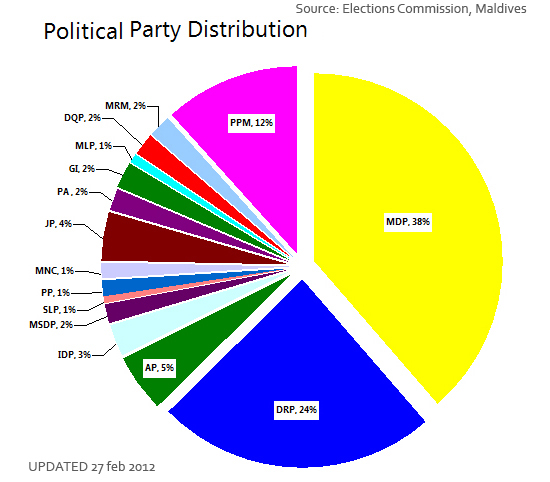
The largest party in the Maldives is the Maldivian Democratic Party (MDP) of former President Mohamed Nasheed, following an acrimonious split of the Dhivehi Rayithunge Party (DRP) in late 2010 and the formation of an offshoot party, the Progressive Party of the Maldives (PPM), by Gayoom the following year.
DRP remains the second largest party in the country, and has competed for members with the PPM. The remaining parties in the Maldives are relatively small, have little representation in parliament, and relatively small based around usually one particular political figure. An exception is the religiously conservative Adhaalath Party, which has no MPs and few island councillors, but has a strong voice through the Islamic scholars who make up its membership.
Parties require 3000 members to be created, but this number does not need to be maintained: “There is no stipulation in the regulation highlighting the requirement of 3000 members,” said Thaufeeq.
“The regulations are very vague, because you require 3000 members to form a political party but after formation what happens with smaller parties is that the membership drops tremendously,” he explained. “There are parties which have less than a thousand members, and some with less those than 2000.”
The regulation did not explicitly mention that parties needed to maintain this membership in order to continue to receive political party funding from the EC, Thaufeeq explained.
In an audit report on the elections commission, the Auditor General recently advised the commission not to grant funds to inactive political parties. However, “As a principle, we usually give funds to any parties which are active and follow our requirements, such as producing an annual audit report of the party every year.”
“Whenever we hold the funds, the parties take the issue to the court. When the court orders us to pay the money, we don’t have any option but to release the funds,” Thaufeeq explained.
Asked on what basis the court is making the decision, he said “The court in its order states that the elections commission does not have the authority to withhold the funds of political parties.
“But I believe the commission has the authority to hold funds when we are not certain of how the funds are being used. This is the money from the people that we are giving out to the parties, and it shouldn’t be misappropriated,” Thaufeeq said.
According to Thaufeeq, funds for six politicial parties in the 2012 budget were withheld initially, but were released after proper monitoring. Thaufeeq said funds for the remaining two political parties cannot be released because the parties had not adhered to the commission’s requirements.
The Maldives National Congress (MNC), a political party with a current membership of 1536, has sent a letter to the Speaker of Parliament Abdulla Shahid regarding the matter, asking parliament to look into it.
However, Thaufeeq said that he and the commission had high hopes for the proposed political parties’ bill which was drafted by the Attorney General’s office and the commission.
“I believe the political parties’ bill currently in parliament will be the solution. We have included a stipulation in the bill requiring the maintaining of party membership at 3000, but the figure might change,” He said.
“We were hoping the bill would pass by the end of last year but there came in other bills of higher priority. Many MPs have assured us that when the parliament starts this year, the bill will be given high priority,” he said.
The ousted MDP currently has the largest membership of all political parties with a membership of 47,614 members. The Dhivehi Rayyithunge Party (DRP) is the second largest political party in terms of membership with 29,143 members, followed by the newly formed Progressive Party of Maldives (PPM) which has 14,271 members. President Mohamed Waheed Hassan’s party has approximately
Current political party membership:
Party membership as of February 27:
MDP 47,614 (Former President Mohamed Nasheed’s party) DRP 29,143 (Gayoom’s former party, now headed by Ahmed Thasmeen Ali. Speaker Abdulla Shahid is also a member) AP 6070 (Adhaalath Party, headed by Sheikh Imran. Spokesperson is Islamic Minister Sheikh Mohamed Shaheem Ali Saeed) IDP 3597 (Umar Naseer’s former party, prior to his move to the DRP and later PPM) MSDP 1976 SLP 683 PP 1803 MNC 1536 JP 5177 (Party of Gasim Ibrahim, resort tycoon, VTV television station owner and member of the Judicial Services Commission). PA 2608 (Party of Gayoom’s haf brother, Abdulla Yameen, and Deputy Speaker Mohamed Nazim) GI 2625 (President Mohamed Waheed Hassan’s party) MLP 938 DQP 2299 (President’s Special Advisor Dr Hassan Saeed’s party, also the party of Home Minister Dr Mohamed Jameel) MRM 2606 PPM 14271 (Maumoon Abdul Gayoom’s party, split from the DRP. Vice President of the party is Umar Naseer)
Police arrested 10 people last night following a protest near the main Bank of Maldives (BML) branch, during which protesters tied their hands together with cable ties and demanded they be arrested.
“The marchers, who had symbolically bound their hands together with cable ties, were making their way to police headquarters to present themselves for arrest. However, they were blocked near the President’s Office by riot police and army personnel, and the participants – whose actions had been entirely peaceful – were violently dispersed with salt-water cannons and pepper spray,” Maldivian Democratic Party (MDP) spokesperson Hamid Abdul Ghafoor said in a statement.
Police Sub-Inspector Ahmed Shiyam said police only used water cannon to disperse the crowd, and that the 10 were arrested for breaching the police cordon near the Bank of Maldives, and going near the President’s Office.
“When police asked them to go back, they did not obey police orders,” Shiyam said.
A visiting German medical student taking photos of the protest, identified as Patrick Crilly, was also taken into police custody prior to the dispersal of the protesters. A video of the arrest showed a policeman in riot gear taking Crilly by the arm and marching him through the police barricade.
“I was told on my release form that the reason for my detention was ‘not following a police order’, but no order was issued for me to follow,” Crilly told Minivan News, following his four hour detention.
“It was very strange, I’m not sure why it happened. It was not something I had planned to experience in the Maldives,” he said.
Crilly said he was on a visa run from Sri Lanka, where he has spent the past three months working as a medical intern at Kalapitiya Hospital in Galle.
“I’m quite familiar with the Maldives – this is my sixth visit,” he said. “I have some good friends here, and I’m very attached to it. I’m not the kind of tourist to just sit on a resort beach sipping drinks. I’m of course interested in what’s going on, and trying to understand what happened. But I had no intention of getting arrested.”
Patrick Crilly
Crilly said he was walked along the road facing the sea near the BML building, and came across the crowd “of about 150 people, protesting loudly and asking the military forces why they were supporting the regime. I was interested to see what was happening, so I took pictures of the scene,” he said.
Initially the crowd had been blocked by defence personnel, he said. “But then a squad of police arrived and took over the scene, and the mood changed. I was in the second row from the front taking pictures, and within 3-4 minutes I was taken away. I don’t know if there was a order in Dhivehi, nobody was speaking any English,” he said.
“I didn’t have long to figure it out, because an officer grabbed my arm and took me away. I did not resist or struggle, but I was irritated. I stayed calm and kept asking the reason why I was being taken away. I must have asked 20 times, but he ignored me. I asked him if he understood English, and he nodded.
“He took me halfway down the road to the police station where another police officer took over, and continued to ignore me, saying only that I would find out at police headquarters. I asked him how the people at police headquarters would know, because they weren’t there, but he ignored me.
“I sat in the front room of the police building for several hours, until eventually I was questioned by two officers in civilian clothes. They said I was charged with disobeying police orders and resisting arrest. I said those allegations were not true, and that no order had been issued for me to disobey.
“He seemed to acknowledge that – they were not unreasonable. He went on to ask why I was in the Maldives.
“I was asked to sit and wait for two hours with no explanation as whether I’d been arrested. Eventually it turned out that they had been writing my release form in English – it took 2.5 hours.
“Eventually I got the paper – It only had my given name, not my surname, which they seemed to have missed from my passport. It said that I had been arrested near the bank for not following police orders, and was released four hours later. It also had the details of the arresting officer.
“While I was in there I saw a steady stream of other detainees brought in, some of them screaming and kicking. I can say I smelled fear – it’s the same smell I must have smelt at least 150 times working at the hospital in Sri Lanka.
‘People were agitated, worried, and an old man was crying. One person brought in by four officers seemed really agitated, and in pain. I did not see anyone physically hurt in the police station,” Crilly said.
Expecting police to be concerned about the contents of his camera, Crilly said he had taken out the chip and put it in his pocket. “They didn’t seem interested, and I didn’t have any pictures of police violence – I was arrested before that happened. Two of my friends were pepper sprayed and if I’d been there of course I would have taken pictures of it.”
Shiyam told Minivan News that Crilly had not been arrested, but confirmed he was taken to police headquarters “where the situation was explained to him in case he was new to the Maldives. For whatever reason he did not obey the order [to leave the cordoned area]. He was not detained long.”
The Maldivian Democratic Party (MDP) has said that former President Mohamed Nasheed will soon announce a deadline for the party to step up political protests, with the intention of preventing President Dr Waheed Hassan from entering the President’s Office.
The MDP is pressing for an early election date, while the new government has backed away from the suggestion following a breakdown in India-mediated peace talks last week.
Addressing supporters near the tsunami monument – an area the MDP haas taken to calling ‘Justice Square’ – Nasheed said he had not announced the identities of those who tortured inmates in prisons under Maumoon Abdul Gayoom’s administration, and did not send the cases to internation courts because he did not wish to shame the Maldives’s new democracy.
According to MDP, Nasheed accused current Commissioner of Police Ahmed Riyaz of being in charge of the prison guards brutality in October 2003 that led to Maafushi Jail shooting incident and the death of Evan Naseem – a prisoner who was allegedly beaten to death in Maafushi Jail.
Speaking at a press conference, MDP Spokesperson Imthiyaz Fahmy made several accusations against police after MDP activists were detained on drug and other charges.
Imthiyaz alleged that many police officers in riot gear “were drunk” and some fell to the ground “while others were seen vomiting.”
Imthiyaz further alleged that police officers had forced MDP activists to drink alcohol.
A police official told Minivan News that the accusations were baseless: ”It would be better to report these allegations to the Police Integrity Commission (PIC) or some other independent institution to investigate, rather than making false accusations,” the police spokesperson said.
 (0)Dislikes
 (0)
(0)