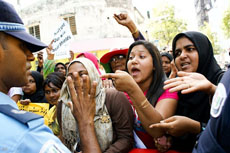
Dr Shaheed’s report on Iran reveals six-fold increase in executions since 2003

UN Special Rapporteur on Iran and former Maldives Foreign Minister, Dr Ahmed Shaheed, has released an explosive report on human rights abuses in Iran.

Dr Shaheed, who was appointed Special Rapporteur in June 2011, reported that Iran had executed 670 people last year, 81 percent of them for minor drug offences that did not justify capital punishment under international law. 20 people were executed for offences against Islam, Dr Shaheed found, while a further 15 are awaiting death sentences for adultery.

Of these executions 421 were announced publicly, while 249 were performed in ‘secret’. Dr Shaheed expressed particular concern about the surge in executions in the last three months of 2011, from 200 in mid-September 2011 to over 600 by the end of the year – a six-fold increase on 2003.

Despite drug offences being the most frequently-cited reason for executions, Dr Shaheed told a press conference that there were “strong indications” that the arrests were political and drug charges added later.

Dr Shaheed found the Iran had not only executed more citizens per capita than any other country in the world, but had also detained the most number of journalists. 42 were current imprisoned, while a further 150 had fled since the 2009 election for fear of persecution. Journalists were also reportedly barred from appearing at their trials and were often informed of their sentences in prison.

The Iranian government refused to allow Dr Shaheed to visit the country in his capacity as UN Special Rapporteur, describing him as “incompetent”. The report relied heavily on first-hand testimonies, “the preponderance of which presents a pattern of systemic violations of fundamental human rights,” it noted.

Head of Iran’s the parliamentary commission on human rights, Zohreh Elahian, said the report was based on “politically tainted objectives and politicisation.”

“As was clear in Ahmed Shaheed’s draft document, the report is biased and serves political objectives since he had visited a number of European states and had meetings with the opposition and anti-revolution forces living abroad,” Elahian said.

Iranian MP Alaeddin Boroujerdi told media that Dr Shaheed was “a US agent”.

“From the first day that Mr Ahmed Shaheed was appointed as the UN [human rights] rapporteur, we suspected he was a US agent; but after he published a few reports [on the rights situation in Iran], we became certain he had been sent on mission by the Americans,” Boroujerdi said.

Dr Shaheed’s mandate for the post was narrowly approved in a UN resolution despite the opposition of Cuba, China and Russia. He told journalists he hoped the mandate would be extended.

“One of the most important aspects of this mandate is its capacity to give voice to those that believe themselves to be silenced by fear and lack of recourse,” he said.

Likes(0)Dislikes(0)

Government shuts down ‘Second Chance’ program for inmate rehabilitation

Home Minister Dr Mohamed Jameel Ahmed announced that the government intends to shut down the Second Chance Program, alleging that the former administration had used the program “to release unqualified criminals under political influence and without any clear procedure “.

Speaking at a press conference on Sunday, the Home Minister alleged the program was politically influenced and claimed that it was set up in violation of the parole system and the Maldivian laws.

He claimed that several inmates who did not qualify for social re-integration were released during the program based on a list approved by then-President Office.

The “uncontrolled release of criminals” over the recent years had threatened the public safety, Jameel further alleged.

“The [incarcerated] criminals have been released without any control in the past days to a level public safety has been threatened. Those criminals were released by sidelining the Maldivian laws,” Jameel claimed.

According to him, a total of 1879 criminals were incarcerated for various offenses during Nasheed’s term, but only 621 are currently remaining in prisons while 1258 have been released with no clear procedure.

Therefore, he said that the program will be shut down and all its responsibilities will be tasked to the Parole Board and Clemency Board, which will be re-formed in the coming week.

However, both boards have been criticised over the years for being “slow and ineffective”.

“All hope lost”

In an interview to Minivan News following the government’s announcement to shut down the program, former Manager of the Second Chance initiative, Aishath Rasheed said that the Parole and Clemency board “does not have the technical expertise to continue the program”.

“I was a member of the parole board. Both boards exist as mere names. Some members do go for the meetings but have to go back home because the meetings cannot be held due to lack of quorum,” Rasheed said. “Because of the lack of attendance, the efforts to reintegrate the  inmates back into the society were severely delayed”.

She highlighted that a majority of the prison population were young people incarcerated for small drug offences and that the “long jail terms were destroying their lives”.

Therefore she explained that the Second Chance Program was set up by the deposed President Mohamed Nasheed in September 2011 to expedite the re-integration of former inmates incarcerated for drug offences back into the society.

According to the UNDP report, “Prison Assessment and Proposed Rehabilitation and Reintegration of Offenders Report“, published last year, 66 percent of all prisoners in the Maldives at the time of report were in jail for drug use or possession, often small quantities, while the majority were males under 30 years of age with education below O-levels.

“With the inception of the program a second opportunity was given to the young inmates by providing employment assistance, counselling for substance abuse, mentoring and other services to help to reduce recidivism,” Rasheed said.

“But with the shutting down of the program that opportunity is lost now. Those inmates and their parents had high hopes. But all hope is lost now,” said Rasheed, who was also a member at the parole board.

She further noted that several parents of inmates have called her up since she was dismissed from the position.

“We had finished training 50 inmates and they were ready to be released when this happened. Their parents are now calling up to ask me what will happen to them. I don’t have an answer to that,” she said.

She requested the government continue the second chance program, insisting that the program was “politics free”.

“There was absolutely no politics. Nobody instructed us on whom to release,” added Rasheed.

All 439 inmates released were thoroughly evaluated and approved by the courts while any former inmate found to have violated the terms of the release were sent back to the prison to complete their jail term.

During the chaotic events of February 7, Rasheed said a group of rogue security personnel involved in the mutiny against Nasheed’s government stormed into the Second Chance office inside the Ghazee Building and gassed the office.

“Four policemen and two MNDF officers into the office that morning and shouted at us to go upstairs. One of our project managers, who sits in a wheel chair, asked them how she could go upstairs when there was no lift. The policemen left but came back later and ordered us to leave again. They shouted that ‘this office is a big nuisance’ and sprayed some sort of gas and left,” Rasheed recalled.

Likes(0)Dislikes(0)

Leaked footage from police HQ suggests opposition was prepared to use “military force” on Feb 7

Local television station Raaje TV aired a video clip on Sunday showing senior then-opposition figures inside police headquarters on February 7, prior to the resignation of former President Mohamed Nasheed.

In the video, Jumhooree Party (JP) leader Gasim Ibrahim makes a comment thanking Allah that former president Mohamed Nasheed resigned before the use of military force. Minivan News is currently seeking to obtain the unedited footage.

In the Raajje TV clip, Gasim first says, “that we are saved from this cruel regime…” Rajje TV then repeats the frame of Gasim saying, “that this ended without using the military, Allah [rest is unclear]”.

Raajje TV alleges the clip suggests Gasim was ready to resort to military force had Nasheed refused to resign. Minivan News was unable to reach Gasim at the time of press.

Dhivehi Rayyithunge Party (DRP) leader Ahmed Thasmeen Ali, shown standing directly in front of Gasim at the time, told Minivan News that he does not recollect Gasim’s statement. “It was very loud,” Thasmeen said.

The video clip depicts former opposition leaders at the time celebrating inside the police head quarters, exchanging hugs, and shouting “Allah Akbar” and “Thank Allah” shortly before Nasheed’s public television resignation of February 7.

Maldivian Democratic Party (MDP) spokesperson Hamid Abdul Gafoor said he believed the video is proof of “Gasim’s blatant complicity in the coup d’état.” He also raised questions over the presence of opposition leaders inside the police HQ on February 7, while Nasheed remained held-up inside the military barracks.

Raajje TV introduces the video showing former opposition leaders in the crowd gathered at the Republic Square. Ahmed Nihan, Progressive Party of the Maldives’ (PPM) parliament member, then calls upon all political party leaders present to come to the Police HQ entrance.

According to Raaje Tv’s timeline of the video, inside the Police HQ, current Police Commissioner, Abdulla Riyaz tells the gathered group — which includes Thasmeen, Dhivehi Qaumee Party (DQP) leader and current presidential advisor Dr Hassan Saeed, current Home Minister Dr Mohamed Jameel, the Islamic Ministry’s State Minister Mohamed Didi, new Deputy Commissioner of Police Hussein Waheed, current Foreign Minister Dr Abdul Samad, current Minister of State for Tourism, Arts and Culture Ahmed Shameem, Fonadhoo MP Ali Saleem, and the Adhaalath Party’s Asadullah Shafee — that he has now shared the mutinying police’s demands with the opposition leaders and asks them to give the police a response.

Raajje TV reporter notes that the deputy police commissioner Hussein Waheed had previously said he was not present at the Republican Square at the time of the mutiny. Abdulla Riyaz had said Waheed had been awarded the position after an interview process.

The reporter says that Gasim then praised the police for mutinying. However, this was not clear to Minivan News from the video.

The video then cuts to the former opposition leaders celebrating on receiving the news that Nasheed would resign. The group starts shouting “Allah Akbar.” Hassan Saeed then asks, “Are you sure? Confirmed?” to which an unknown voice replies, “Yeah.”

A second leaked video clip presents a clearer picture of Nasheed’s frenzied efforts to mobilise the military to stop the police mutiny. Nasheed, his foreign minister Ahmed Naseem, and his defense minister Tholhath Ibrahim Kaleyfaanu order the soldiers to leave the barracks and put down the police mutiny.

“The entire nation is being destroyed, and you are doing nothing, citing command and what not…” Nasheed angrily tells the soldiers.

Raajje TV’s footage of inside police headquarters on February 7:

New footage of Nasheed’s last moments as President inside the MNDF base:

Likes(1)Dislikes(0)

Police use pepper spray to disperse MDP protesters gathered near Hiriya School

Maldives police used tear gas to disperse the MDP protesters that gathered near Hiriya School this morning to protest against President Dr Mohamed Waheed Hassan, who visited the school to inaugurate the “Clean Energy for Male” project.

The President officiated over the opening of the school’s solar panel system and chatted with members of staff.

Japanese Ambassador to the Maldives Nobuhito Hobo signed the scheme over to the school, and the system was connected to the grid. The project is the first phase of a US$11 million project to set a precedent for the use of solar panels on rooftops in Male’. Panels have been installed on the President’s Office, the youth centre, Hiriya school and Thaajuddheen school.

Protesters gathered near the school at about 11:00am and surrounded the police barricades, which had been set up blocking all routes to the school entrance.

Women were at the front of the protest while there were men behind them. Some of the women sat on the street during the protesters.

The protest exploded with shouting as President Waheed arrived and was escorted into the premises with the help of the police, who forced back the protesters to allow for Dr Waheed’s arrival.

It was reported that some of the protesters went past the police barricades before the being forced back to the original line of protesters.

Tear gas was used to disperse the crowd after they started spraying water at police.

A witness who was present at the protests told Minivan News that the police had also used tear gas on the women who had sat down in the street.

“At first they [police] came towards the women sitting down and told them to leave the premises and to go behind the barricades but the women refused. Then they tried by force to send them away and after the women started refusing, they sprayed pepper spray,” the witness said.

The witness added that the pepper spray had been used at close proximity.

In spite of this, there were no serious injuries to the protesters although both the police and the protesters received minor wounds.

Police spokesperson Sub-Inspector Ahmed Shiyam said that the protesters had thrown water and other objects towards the police, and said that a female police officer was hit by an object thrown by the protesters.

“The protesters threw stones and other objects towards police and one of our female officers got hit in the head. The protesters used abusive language towards the police and some of the even spat on the officers.” Shiyam said.

Shiyam said that the police used tear gas when the protesters began throwing things at them. “We used tear gas only to control the crowd when they began throwing things at us,” he claimed.

Shiyam also said that the police did not arrest any of the protesters despite them breaking through the police barricades.

President Waheed left the premises at about 12:15pm after waving at the crowd. MDP spokesman Hamid Abdul Ghafoor alleged the wave was “a clenched fist”, signifying Waheed’s growing impatience with such incidents.

A teacher from the school disputed this version of events, remembering the President “waving nicely” as he left.

Ghafoor compared this event with the disruption of the Japanese embassy’s tsunami anniversary event at the Nasandhura Palace Hotel last night.

“It doesn’t matter what time of day [it is], people just assemble. They are not necessarily coming from the [MDP] rally point. It is because they just dislike him. It is very grassroots, not just MDP,” said Ghafoor.

“As time goes by, the opinion of the coup leaders is that people will settle. But I feel they are getting more unsettled and anger is being expressed. Disillusionment is turning to anger.”

Likes(0)Dislikes(1)

Anti-government crowds disrupt Japanese tsunami ceremony

Anti-government crowds disrupted a ceremony marking the anniversary of the Japanese tsunami in Male’ on Sunday night.

The ceremony was held at Nasandhura Palace Hotel. A member of the Japanese embassy’s diplomatic staff said that 100 guests were expected, adding that it would have been more were it not for the current “security” concerns in the country.

The capital has seen nightly protests since the end of last year. This period of unrest has seen marches, police brutality, and a controversial change of President.

The ceremony began with the Maldivian and the Japanese national anthems followed by a minute’s silence, before the Japanese ambassador to the Maldives, Ambassador Nobuhito, gave a brief speech.

Nobuhito cited the reasons for the ceremony as being condolences for those lost, gratitude for the help received and to give reassurance of Japan’s recovery from the tsunami’s destruction. Following the tsunami, the Maldives donated 86,400 tins of tuna to Japan, which has been one of the country’s major aid partners.

Outside, hundreds of anti-government demonstrators gathered at the gates of the Nasandhura Palace Hotel.

President Dr Mohamed Waheed’s newly appointed Minister of Foreign Affairs, Dr Abdul Samad Abdulla, spoke about how the 2004 tsunami had brought the people of the Maldives together.

“Gayoom removed some charges against detained opposition members to unite the country,” Dr Samad claimed.

Many in the room seemed distracted, turning their attention towards the raised voices that could now be heard outside.

Dr Samad rounded off his speech by suggesting that it was more than just adversity that united the Maldivian and Japanese nations, it was a mutual commitment to human rights, to the rule of law, and to democracy.

Outside, this commitment was being questioned. Riot police rounded on the crowd, visors down, shields at the ready. Some people in the crowd shouted “baaghee (traitor) Waheed”.

Refreshments were barely touched before an announcement was made that the reception was now ending.

Leaving the hotel and walking a little way down the road towards the crowd, Minivan News asked a passing soldier why the people were there. The soldier smiled and said simply, “They think the government is not the government.”

A young man on the other side of the police barricade grinned and said, with similar poignancy, “Nice Maldives, huh?”

Meanwhile

Once the more prominent guests had safely left the area, the security forces began to recede back towards their headquarters.

Simultaneously, the MDP camp by the Tsunami monument was silent as former President Mohamed Nasheed fielded questions from the Women’s Wing, or ‘Women’s Spirit’ of the party.

The atmosphere here was one of stark contrast to the disorder and tension outside the Nasandhura Palace Hotel.

The scene at Raalhugandu resembled that of a traditional conference. Rows of seated women faced Nasheed, whose head table contained a panel of the MDPs prominent female members.

The discussions were observed by thousands of MDP loyalists who listened in near silence as the women’s concerns were aired.

MDP Spokesperson Hamid Abdul Ghafoor said that the event was an attempt at a new “creative form of direct action.”

Japan is also providing 250 million yen (US$3million) as foreign aid to the Maldives government to purchase industrial products produced in the affected areas of Japan, to accelerate the economic progress of those areas.

The agreement was signed between the two countries today at the Maldives Foreign Ministry.

According to a statement released by the ministry, the purchased equipments will be utilised in the health, education sectors and at the Maldives Polytechnic and Male’ Health Corporation.

Likes(3)Dislikes(0)

MDP accuses state media of “blatant propaganda” in letter to Maldives Broadcasting Commission

The MDP intends to lodge a complaint against the current practices of the Maldives Broadcasting Corporation’s (MBC) state media outlets, Television Maldives (TVM), and the radio station, Voice of Maldives (VOM).

In a letter, the MDP accused the MBC of violating the agreements mandated by the Public Broadcasting Services (PBS) Act of August 2010 by producing biased content and not giving adequate exposure to all political groups.

TVM and VOM were, the MDP argued, “being blatantly used as propaganda outlets of the coup regime, while the ongoing peaceful political activities of the MDP are being sidelined with little regard to the MBC’s mandate and the nation’s laws under which the MBC is functional.”

“State media airwaves are being clogged incessantly with interviews, views, opinions, and press conferences detailing the regime’s vision by regime loyalist political parties,” MDP alleged.

“On March 6, MDP’s request to buy airtime to broadcast a crucial press conference by Maldives’ first democratically elected President Mohamed Nasheed was met with silence.”

The MDP also accused the group of allowing politicians from the Dhivehi Quamee Party (DQP) and Jumhooree Party (JP) unfettered access to TVM studios and editing booths in contravention of its independent credentials.

JP MP Abbas Adil Riza, named in the letter as one of the MPs seen at TVM, strongly denied the accusation. He was unaware of the complaint and said he did not wish to see the letter. Also named in the letter are the JP’s Ali Hashim and the DQP’s Adbulla Ameen.

The letter reads “MBC is legally bound and mandated to ensure impartiality and independence in its role as a public service provider”.

“According to Article 2 (c) of the Maldives Broadcasting Act the MBC must facilitate nationwide, equitable, and acceptable transmission and broadcasting. According to Article 3 of the Broadcasting Act the MBC is an independent commission of the State.”

The timing of this complaint appears to be related to the Corporation’s failure to respond to MDP requests for media coverage of a speech by former President Mohamed Nasheed on March 6. Copies of the letter were sent to the MBC as well as to the independent media watchdog the Media Council of the Maldives (MMC) on March 7.

The MMC’s duties as prescribed in the Maldives Media Council Bill, is to preserve media freedom and promote ethical practices, as well as to investigate any complaints filed.

Minivan News itself experienced difficulty when trying to contact the MBC for comment on the issues raised by the MDP.

After a group of police, military and opposition supporters stormed the state broadcaster on February 7, shortly after an assault on the military base in Republic Square, President Dr Mohamed Waheed Hassan’s government rebranded MNBC as TVM – the broadcaster’s title under former President Maumoon Abdul Gayoom’s administration.

MNBC was established by Nasheed to run the state media, removing its employees from the jurisdiction of the Civil Service Commission (CSC). In 2010 the then-opposition majority parliament created MBC and demanded the transfer of MNBC’s assets to the new body, which the Nasheed’s government refused to do, alleging political partiality on behalf of the MBC board. Days after the events of February 7, TVM was handed to MBC by the new government.

After this takeover, Chairman of MBC Ibrahim Umar Manik expressed his commitment to run the state media with “impartiality” and within legal bounds.

“As stated in the law, we will operate the two stations as a public broadcaster by bringing independent news, information and programs,” Manik claimed.

Maldives Media Council

President of the Maldives Media Council Mohamed Nazeef said he was not yet aware of the MDP complaint although he stated that he would “be very interested” if it were to come to his attention.

His desk is the first place such complaints go to when received, at which point it is standard practice for the Council to attempt a resolution before the official investigative procedures are initiated.

A member of the Council’s Secretariat said no official complaints had been received in recent weeks although there had been a slight increase in the number of people making informal complaints in person.

Discussing the current condition of public media in the country, Nazeef said that he had “noticed an improvement” in the weeks since the Nasheed administration ended.

“[Public Broadcasters] can’t do the same thing as before. They have to give equal time to all political parties,” Nazeef said.

He said he believed that there was little difference between the Gayoom and the Nasheed eras, in terms of media impartiality.

“Television Maldives was same before [under Nasheed] as it had been for thirty years under Gayoom, apart from 2007 and 2008, when it was a little more lenient,” he said.

The most pressing concerns, in the opinion of the Council President, are the lack of social programming and need for better education in the sector. A typical area mentioned as being in need of improvement was investigative journalism.

“This is where the media fails in the past twenty years,” Nazeef continued, “most people are trained for private broadcasting.”

Nazeef recently discussed these issues with the United Nations Development Programme (UNDP) which advocates a robust media as the key to sustaining democracy.

Likes(3)Dislikes(0)

Shaviyani Milandhoo MP alleges Dr Waheed carried PPM’s agenda to islands

MP for Shaviyani atoll Milandhoo constituency, Ali Riza, has alleged that President Mohamed Waheed Hassan’s recent trip to eight islands of Shaviyani Atoll was a trip not to meet the people but merely carried the “agenda” of former president Maumoon Abdul Gayyoom’s party Progressive Party of Maldives (PPM) for the next presidential elections.

“Waheed, knowingly or unknowingly, is carrying out PPM’s mandate for the next presidential elections,” alleged Riza.

Riza stated that around 200 to 300 hundred police had been deployed in the islands during Waheed’s tour.

“For instance, Feevah in Shaviyani Atoll has a population of around 960 people and were 200 police officers deployed there. Some of them came with Waheed while others had been already sent prior to the visit,” Riza said.

Riza said that police had blocked the protesters while the president was on the islands, claiming they had “caged the protesters” during Waheed’s visit.

Riza also claimed that police had entered one of the houses in Feevah without a court warrant where the protesters had been protesting, and tried to “tape” a protester.

He also said that one of the protesters was hand cuffed when the protests began to heat up, however Dr Waheed’s Press Secretary Massood Imad denied the allegation.

MP Riza questioned why the president during his visit to the atoll did not visit the island of Milandhoo, which is the island with the highest population in the atoll and a stronghold support base of former president Nasheed’s Maldivian Democratic Party (MDP).

“Waheed roamed throughout the atoll but why didn’t he visit Milandhoo, the largest populated island?” questioned Riza.

“It is clear that because he did not visited Milandhoo that this was a political trip to see how much support he has. I think this trip is to get better pictures of him. The pictures that went out to the media during his visit to Addu were not very pleasant so this might be an attempt to show off his popularity,” suggested Riza.

Riza also alleged that Waheed was not actually running the government, and was acting “like a puppet” of former president Maumoon Abdul Gayyoom.

“Waheed is just the face of this government. Abdulla Yameen Abdul Gayoom is running the government the way he wishes,” Riza alleged.

Riza also denied Waheed’s claims that former president Nasheed had done little to fulfil his presidential pledges in the atoll.

“Nasheed during his tenure provided the island of Funadhoo with a 250 KW generator to resolve the electricity failures that the island was facing. The renovation of Funadhoo harbour was started during his term. The sewerage system had been completed.”

“Harbour developments in Noomaraa, Narudhoo and Komandoo have been initiated and some of them were handed over to Works Corporation while the others have been contracted,” Riza said

However, Press Secretary Imad brushed off the allegations saying that President Waheed’s visit was solely to observe the development projects going on in the islands.

Imad admitted there were protesters but said the government welcomed their protests.

“There were protesters, and we do welcome peaceful protests. There was no issue about it,” he said.

“I think they were the same people going to all the islands to protests. I saw the similar faces in different islands,” he claimed.

Imad also gave the justification for not visiting the island of Milandhoo, stating that the government had time constraints. “We were on a very busy and tight schedule. We couldn’t visit Milandhoo because of that and not for a political reason.”

However, Imad reiterated that president Waheed would visit Milandhoo “very soo”n.

Likes(0)Dislikes(0)

President Waheed concludes trip to eight islands of Shavyani Atoll

President Dr Mohamed Waheed Hassan has concluded a trip to visit the islands of Shavyani Atoll today. Waheed visited eight islands of the atoll, including Feevah, Foakaidoo, Funadhoo, Narudhoo, Maroshi, Lhaimagu, Maa’ungoodhoo and the island of Kommandoo.

Minivan News understands that groups of Maldivian Democratic Party (MDP) protesters met Dr Waheed at all islands apart Foakaidhoo.

During his visits to the islands, the new president checked on the ongoing development projects in the islands and met with the people. President Waheed began his tour from the island Feevah, last Thursday.

During his visit to Feevah, Waheed reaffirmed to the islanders his commitment to take all necessary measures “to protect and safeguard the people”.

Speaking to the people of Foakaidoo, Waheed said that he would work to restore calm and peace in the country. Waheed also said that he assumed office to bring the much needed political stability and progress to the country.

He also announced that his government would establish a new ministry addressing issues related to women, children and human rights, and acknowledged that a number of women were unpaid for their work in cleaning or the general upkeep of their islands. He promised his government would pay all the wages owed to such women.

Waheed in during his visit to the island of Funadhoo inaugurated the Funadhoo Powerhouse Development Project by laying the foundation for the extension of the powerhouse.

On Narudhoo, he urged school principals, supervisors and teachers to refrain from politicising the education system, and appealed to them stay away from getting caught up in politics.

In his address to the people of Maroshi, Waheed called on the people of the Maldives,to have faith and respect for the state institutions, in order for the country to maintain its nationhood.

He also claimed that there was “a small minority” who did not accept the judiciary, the armed forces, the police, or the leaders of the country, and that they were “only trying to create division and disorder among the people.”

Waheed in his meetings with the islanders on Lhaimagu, assured that his administration would treat all citizens equally, as opposed to the policy of the previous government.

He said that his government includes all major political parties and that this government was a national unity government. He also expressed regret that former president Nasheed’s Maldivian Democratic Party (MDP) chose not to be part of the unity government which had the backing of majority of the people. Instead of joining the government, he said, former President Nasheed was trying to “come back to power through force”

While addressing the people of Kommandoo, Waheed said that he would “remain steadfast in fulfilling the responsibilities under the Constitution and under the mandate given by people’s votes”.

President Waheed concluded his trip after visiting the island of Maaun’goodhoo. Speaking to the people of Maaun’goodhoo, he said that today we are all under the shade of our dignified red, green and white flag, putting forth a front of unity for the future of our country, regardless of the political parties we belong to.

During this visits, supporters of former president Mohamed Nasheed had protested against Waheed and claimed that his government came to power and called for an early elections. However, speaking to Minivan News, Press Secretary of the President’s Office, Masood Imad said that there were “very few” protesters, who were “not an issue” for President Waheed.

President Mohamed Waheen Hassan arrives on Komandoo:

Likes(0)Dislikes(0)

Women’s Day march ends in confrontation

A march to celebrate International Women’s Day ended in confrontations with police on Thursday night in Male.

After the march’s intended route past the Presidential Palace and the People’s Majlis was blocked by police barricades, a Maldivian Democratic Party (MDP) contingent refused to disperse.

Around 200 women staged a sit down protest outside the Majeediyya School until well into the evening, with a further 100 outside the nearby Bank of Maldives (BML) main branch.

Banners calling for the resignation of President Dr Mohamed Waheed Hassan, and banners in support of former President Mohamed Nasheed were held aloft. Over loudspeakers, the voices of protesters denounced the police for blocking what they insisted was a legal right of way.

Police Sub-Inspector Ahmed Shiyam stated that the area around the Police Headquarters, the Presidential Palace, and the Maldives National Defence Force (MNDF) Headquarters were protected against such demonstrations.

Regulations dating from previous administrations prohibit the entry of large groups of people into the area in question, reported Shiyam. An opposition protest outside MNDF headquarters, assisted by elements of the police, led to the resignation of former President Mohamed Nasheed, allegedly “under duress”.

People were able to move freely into and out of the area, from multiple locations, past solitary watchmen on the eastern sides of the security zone.

Noorban Fahmy of the MDP Women’s Wing assisted in organising the sit-down protest on the outskirts of the security zone: “We were marching in protest of violence against women and in celebration of International Women’s Day,” she said.

Fahmy insisted that this was the predominant aim of the initial march which was attended by women of all political affiliations.

Gender issues in the Maldives

Domestic violence is a well-documented issue in the Maldives. In 2010, a ground-breaking study conducted by the Ministry of Gender and Family reported that 1 in 3 women between the ages of 15-49 had suffered some form of physical or sexual violence during their lifetime.

Whilst acknowledging that these levels are relatively low by global standards, the report drew strong associations between such violence and mental, and physical (including reproductive) ill-health.

The issue of violence against women and the recent political unrest were combined earlier in the week as security forces turned high powered hoses on women who had gathered outside the President’s Palace on March 6.

The drenched women, who demonstrated within the prohibited security zone, were then forcibly removed by security personnel. No such incidents were reported on Thursday.

Thursday’s protesters were accompanied by some men “for the women’s security”, Fahmy told Minivan News. The area immediately in front of the police cordon outside of the People’s Majlis was reserved for women exclusively during the sit-down.

In order to maintain the spirit of the Women’s Day march, men were politely requested to stand back. After this part of the protest ended and the women headed back to the Raalhugandu area, some men remained to talk to the security representatives manning the cordon.

It has been reported that at this stage, around nine in the evening, students from Majeediyya School emerged to complain about the noise, arguing their right to an undisrupted education.

The disapproval of the students has been disputed by an eye witness, as has the likelihood of their presence in the building at such a late hour.

The women’s MDP supporters eventually relented, returning to the MDP camp in the Raalhugandu area at around 8:30pm after a brief demonstration outside the headquarters of Villa Television (VTV) where they chanted ‘traitor TV’ to staff members.

The VTV station is part of the Villa Group, the Maldives’ largest private company, owned by Jumhooree Party MP Gasim Ibrahim. The Jumhooree Party formed a prominent component of the December 23 coalition which lobbied for the removal of former President Mohamed Nasheed.

Likes(3)Dislikes(0)