Opposition meets Vice President, pledges allegiance and urges him to take control of executive

The ‘December 23 alliance’ of eight political parties and a coalition of NGOs met Vice President Dr Mohamed Waheed Hassan at his official residence, Hilaaleege, at 1:00am last night, pledging allegiance and urging him to assume control of the executive.

The meeting followed the 14th consecutive night of opposition-led protests against the government’s ongoing detention of Chief Judge of the Criminal Court, Abdulla Mohamed, after the judicial watchdog obeyed a Civil Court injunction to halt its investigation of the judge.

Last night’s protest started outside Reefside on Orchid Magu, during which protesters reportedly threw black ink at riot police.

Police pushed back the crowd around 10:15pm, dividing them up in the process, but the protest continued in the area and protesters were seen eating rice pudding. An MNBC One cameraman was reportedly hit on the head and was rushed to hospital in a police ambulance.

The steering committee of the protests then gathered for a meeting at the Dhivehi Rayithunge Party (DRP) office around 11.15pm. The meeting was attended by Progressive Party of the Maldives (PPM) Deputy Leader Umar Naseer, Dhivehi Rayyithunge Party (DRP) Deputy Leader Ahmed Mohamed, Dhivehi Qaumee Party (DQP) Secretary General Abdulla Ameen, Adhaalath Party President Sheikh Imran Abdulla, Jumhooree Party (JP) Secretary General Fuad Gasim, NGO coalition chairman Sheikh Ibrahim Didi and a representative of Dr Waheed’s Gaumee Ihthihaad Party (GIP).

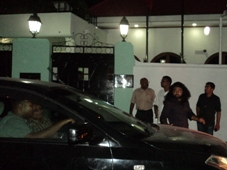
The party leaders emerged from the DRP office around 12.45am and headed towards the VP’s official residence, next door to the Justice building. Opposition supporters were gathered in the area when they arrived.
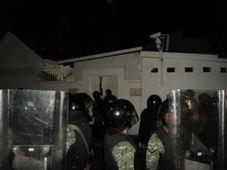
Maldives National Defence Force (MNDF) officers with shields soon arrived and cordoned off the area. At 1:40am officers entered the Vice President’s residence through the back door and a few minutes later Naseer and the rest of the party leaders came out of the building.

They then headed to the Jumhooree Party (JP) office for a press conference. A team of MNBC reporters were refused entry.

According to local media, the opposition leaders asked for a meeting with the Vice President because of the government’s “destruction” of the judiciary and “the President’s declaration that he would not hold the 2013 presidential election.”

An audio clip of President Mohamed Nasheed vowing to ensure a fair judiciary before the 2013 presidential election was leaked to local media yesterday.

In the recording Nasheed is heard to say: “Freedom of expression and an independent and fair judiciary in this country – I will not go for the election after these five years without doing these two things.”

Several local media outlets reported the comment as a threat from the President not to hold elections unless the judiciary was reformed. The President’s Office yesterday said the statement was a promising to reform the judiciary before the conclusion of the President’s first term in office: “He has no intention of calling off any elections.”

After last night’s meeting in Hilaaleege, Umar Naseer said all the parties in the opposition alliance have agreed to “pledge support to the Vice President.”

Speaking to DhiTV after the meeting, Naseer said the members of the alliance decided to meet the VP to discuss the current situation.

“After these discussions we are now calling upon the nation’s security forces, on behalf of our ‘December 23 alliance’ of all the opposition parties in the country as well as the NGO coalition, to immediately pledge their allegiance to the VP,” Naseer said.

“I repeat, all members of the December 23 alliance are now calling on the security forces to immediately pledge allegiance to Vice President Dr Mohamed Waheed Hassan Manik and, as Mohamed Nasheed has violated the constitution, to not obey any of his orders and to pledge allegiance to the Vice President.”

Dr Waheed had assured the party leaders he would “take any legal responsibility he had to within the bounds of the law”, Naseer stated, and was “ready to take over the duties specified in the constitution.”

The stand of the ‘December 23 alliance’ was that President Mohamed Nasheed has “lost his legal status”, DhiTV reported.
President Mohamed Nasheed’s Press Secretary Mohamed Zuhair told Minivan News today that the Vice President “has not said anything to cause a loss of confidence in him by the government. He was very careful in his statement, which was that he would undertake his duties as stipulated in the Constitution. Had the protesters gone to meet with [Fisheries Minister] Dr Ibrahim Didi or [MDP MP] Reeko Moosa they would have said the same thing.”

The protesters claimed to represent 13 political parties and 21 NGOs, Zuhair said, “but all the rallies have seen the involvement of no more than 300-400 people. It is very disproportionate.”

“I think the protests are slowing down and now they are trying to save face – pledging allegiance to the Vice President is the same as pledging allegiance to the government. The VP is working in cabinet today – there is no rift. This is a non-story,” he maintained.

The government was not concerned about Dr Waheed’s late night meeting with opposition leaders, as letting the protesters into his house “was the polite thing to do,” Zuhair said.

He also dismissed opposition claims that there was anti-government sentiment brewing in the security forces.

“The security forces have shown themselves to be a disciplined and absolutely professional force loyal to he government. There is no cause for any concern,” Zuhair said.

Legally, President Nasheed can only be impeached with a two-thirds (51) majority in the 77 member parliament. The combined opposition parties can marshal 36 members to the MDP’s 35 – without considering the six independents – so a decision to impeach would require the unlikely cooperation of at least nine ruling party MPs.

Dr Waheed was not responding to calls at time of press. However in a blog post on January 21 regarding the government’s detention of Abdulla Mohamed, he said he was “ashamed and totally devastated by the fact that this is happening in a government in which I am the elected the Vice President.”

He subsequently gave a press conference in which he requested the Judicial Service Commission (JSC) suspend Criminal Court Judge Abdulla Mohamed from the bench while complaints against him remain outstanding, “because as you can see [keeping him on the bench during questioning] has created more disruption than we all had bargained for.”

The JSC this week told parliament that it is unable to take action against the judge after he filed an injunction in the Civil Court halting the investigation.

Aishath Velezinee, former president’s member at the JSC, argues that “if the judicial watchdog can be overruled by a judge sitting in some court somewhere, then the JSC is dysfunctional. But that’s what has been happening,” she asserted.

Likes(0)Dislikes(0)

MNBC cable severed during live telecast of parliament committee session

A camera cable of state broadcaster Maldives National Broadcasting Corporation (MNBC) was cut off during a live telecast this afternoon of parliament’s Independent Institutions Committee’s questioning of members of the Human Rights Commission of Maldives (HRCM).

The severed cable briefly interrupted MNBC’s live coverage and brought the meeting to a halt with vociferous objections from ruling party MPs.

When the meeting resumed, MPs of the ruling Maldivian Democratic Party (MDP) alleged that the cable was severed by Progressive Party of Maldives (PPM) MP Ilham Ahmed.

The opposition MP for Gemanafushi was not responding at time of press.

MNBC One meanwhile reported that its journalists at parliament witnessed Ilham cut off the cable while other media outlets have reported that the MP was heard asking a DhiTV cameraman to identify the MNBC cables.

Following the incident, Independent MP Mohamed ‘Kutti’ Nasheed, chair of the committee, apologised to HRCM members for the disruption and explained that as Speaker Abdulla Shahid was at a Judicial Service Commission (JSC) meeting at the time, he had asked the military officers in charge of parliament security to “freeze CCTV footage of the whole premise for the past hour.”

Nasheed added that he had “formally lodged a complaint” with the senior administrative staff for an investigation into the incident.

However MDP MP Ali Waheed interjected that according to security personnel “all the cameras at the area where the cable was were not functioning.”

Cameras at the corridor and near the stairs leading up to the committee room were turned off, Waheed claimed.

Waheed alleged that PPM MPs Ilham and Abdul Muhsin Hameed were responsible, noting that the DhiTV reporter confirmed that the opposition MPs inquired after the MNBC cable.

MDP MP Hamid Abdul Gafoor proposed adjourning the committee meeting until the matter could be investigated and “the security situation here can be updated.”

Nasheed concurred that the meeting could not be continued in light of the “seriousness of the problems we faced today” and concluded the session.

The MDP parliamentary group has meanwhile filed the case with police this evening.

In November last year, an MNBC journalist accused PPM MP Ahmed Mahlouf of assault during a live telecast of the National Security Committee.

A number of MNBC reporters were also attacked during nightly opposition protests of the past two weeks.

Likes(0)Dislikes(0)

Parliament’s National Security Committee to summon Home Minister and Defence Minister

Yesterday the Parliament’s National Security Committee has decided to summon Home Minister Hassan Afeef and Defence Minister Thalhath Ibrahim and Home Minister Hassan Afeef to clarify some information following the protests in Male’ every night after the military detained Chief Judge of the Criminal Court Abdulla Mohamed.

The issue was presented to the National Security Committee by Maldivian Democratic Party (MDP) MP for Manadhoo Mohamed Thoriq.

Former Judicial Service Commission (JSC) members Aishath Velizinee and Dhivehi Rayithunge Party (DRP) MP Dr Afrasheem Ali will also be summoned regarding the issue.

Yesterday a closed door meeting of the Parliament’s Security Services Committee was also held. No information about the meeting was provided by parliament except for the MPs that were present at the meeting.

Parliament said the meeting attendees were Jumhooree Party (JP) Leader and MP ‘Burma’ Gasim Ibrahim, MDP Chairperson and MP Moosa Manik, MDP MP Eva Abdulla, MDP MP Ahmed Sameer, MDP MP Ibrahim Mohamed Solih, MP for Guraidhoo Constituency MP Ibrahim Riza, Dhivehi Qaumee Party (DQP) MP Riyaz Rasheed, MP for Kimbidhoo Constituency Moosa Zameer, DRP MP Ali Azim and MDP Vice President and MP Alhan Fahmy.

A meeting of Parliament’s Independent Commissions Committee regarding the detention of Judge Abdulla was also held yesterday, following which the MPs decided to summon members of the Human Rights Commission of the Maldives (HRCM) today.

The Committee also decided to summon the Judicial Service Commission (JSC) and Prosecutor General (PG) to the committee.

Criminal Court Chief Judge Abdulla Mohamed was arrested by the Maldives National Defence Force (MNDF) on the evening of Monday, January 16, in compliance with a police request after the judge had his police summons overturned in the High Court.

After his arrest, the High Court issued several warrants to produce Judge Abdulla to the court. The MNDF has not responded to the requests.

The judicial crisis remains at an impasse after the JSC reiterated that it was unable to continue investigating Judge Abdulla Mohamed because of a Civil Court injunction filed by the judge.  The government has sought international legal assistance to resolve the matter.

Likes(0)Dislikes(0)

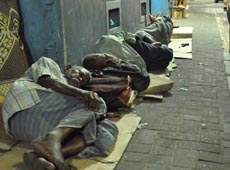
Elderly being forced out of family homes to live on streets

I was riding home around midnight after buying a handful of hot spicy short eats in the drizzling rain, when I spotted what seemed like a human body lying on the pavement of a street near the local market in capital Male’

Curious, I asked my friend to stop the bike and walked closer to confirm my impression. Under a thin piece of ragged bed sheet – to my astonishment – lay a wrinkled old lady shivering herself to sleep.

That was the first encounter with Kadheeja Adam (or Shiraanee, as she prefers to be called), an elderly woman living alone on the streets of Male’.

For almost five years, she says, her home has been the streets surrounding the market. She survives on handouts from the local vendors, and occasional offerings from sympathetic passersby. She showers in the pay toilets around the block. Dressed modestly in dirty and frayed clothes, she keeps her few belongings tucked closely to her as she sleeps on the sheltered corner of a storehouse gate near the market.

Shiraanee says recently some of those clothes were mistakenly taken away as trash by the municipal officials one night, but she is happy because her favorite tin full of areca nuts was not taken.

“I don’t have anywhere else to go,” Shiraanee replies bluntly each time I inquire why she is living on the streets.

Judging by her impaired vision, frail face and emerging grey hair, she appears to be in her 50s or 60s. But the most telling sign of age is her deteriorating mental capability.

Shiraanee says her house on Kandumaavaidhoo island of Haa Dhaalu Atoll was destroyed in the 2004 tsunami, forcing her to seek refuge in relatives’ homes – where she was never wanted.

“I moved from island to island. Stayed with some relatives and people I know. But nobody wanted me. So I came to Male’ on a ferry to live with my daughter,” Shiraanee said.

Shiraanee claims her daughter Aminath lives in Male’ with her husband and kids, and that she was planning to live with her. “But there was no space for me.”

When asked if she moved out or was abandoned by her daughter, Shiraanee does not respond. She claims not to know where her daughter lives anymore.

“I don’t know where she lives. They moved to a new house people say. She used to come ask for money before. Not anymore,” she said.

A few local vendors at the market who spoke to Minivan News said that it was rumored that Shiraanee is very stubborn, and moved out on her own to live on the street. I asked why.

“How do we know?” they responded. “There are so many people who are living on the streets nowadays.”

Distressing but true, Shiraanee happens to be just one among the growing number of “homeless” in Male’ – an upsetting trend which is quietly being “accepted” as a part of the society, despite the fact that maltreatment of the elderly is illegal and also considered to be among the greatest sins in Islam.

To the local fishermen and vendors at the market area lines of beggars, mostly old people of both genders, is a common annoyance.

No less than 10 people sit near the market to beg everyday from dawn, scattering away at nightfall.

Market vendors say many beggars have families or houses in the capital. “I really don’t understand why they are living like this. Some of them even refuse to go when their children come to get them,” said one vendor.

But he acknowledged that an unfortunate few like Shiraanee who have nowhere else to go spend their nights on the streets, in open parks or hidden in empty buildings – at the mercy of the cold nights and hooligans.

Some beggars claim being robbed or harassed by boys on the street.

“I have not been attacked,” Shiraane said. “When I give them some money they go away.”

One beggar said a Male’ shop owner used to pay him some small sum to sleep next to the shop and keep the burglars away.

“I get some cash or free stuff sometimes when I sleep there [near the shop]. But the shopkeeper hired a watchman later. So I beg near the market during the day and sleep in the fisherman’s park,” the 70 year-old man said.

Police are apparently “useless” when it comes to resolving the situation.

During the two nights I sat with Shiraanee listening to her story, policemen patrolling the area came to question what I was doing out there. So I responded with questions pretending to be a concerned citizen: “Why don’t you question the woman sleeping on the street? Shouldn’t you do something about this?”

The policemen said that it was a “common” problem and that they have requested the people not to sleep on the roads.

“Some of them [people living on streets] come from islands. So we identify them we take them to boats and ask them to go back. But the next day we see them here [in the market] again,” one policeman explained. “There is nothing we can do. We can’t keep them under our custody. So we refer the case to the ministry.”

However, the absence of an effective initiative to address the queue of beggars or old people living on Male’s streets indicates that the plight of homeless people is far from a resolution.

As opposed to most countries providing shelters for the needy, Maldives does not have any existing shelters or elderly care centers – therefore, hope that homeless will find a safe place to live seems bleak.

The government-operated “Home for People with Special Needs” on Guraidhoo island of Kaafu Atoll rarely accepts the destitute elderly; authorities have repeatedly pointed out that the facility – which is already under-equipped and cramped – is meant for the disabled, rather than the homeless.

Last year, the cabinet approved a resolution to allow private parties to develop residential home for the elderly under the Public-Private Partnership (PPP) scheme, but progress remains unclear.

At a time when social issues such as sexual abuse, gender discrimination and drugs make headlines, and abandoned babies elicit public outrage, should not the misery of the abandoned elderly receive equal attention?

Or must we wait until the night when a passerby finds the dead body of a homeless man or woman lying cold in the street?

Likes(0)Dislikes(0)

Protests slow at start of third week

Opposition protests in the capital city of Male’ appear to be deflating as they stretch into their third week of late-night stand-offs with riot police.

While opposition-led crowds continue to congregate outside the Maldives Monetary Authority (MMA) building, some bearing posters reading: “No one knows where the judge is” and “We want democracy”, the action has been pushed back towards the fish market by the sudden construction of a ferry terminal by Male’ City Council in the area used for the nightly gathering.

Minivan News understands that fishermen sleeping on the docked boats opposite the MMA had complained to the council about the nightly clashes between police and opposition demonstrators.

Protesters also appear to be voluntarily dispersing at earlier hours. Speaking last night to Minivan News, protest regulars said “a few speeches” were made near the fish market, but that they had drawn to a close well before midnight. Whereas last week opposition supporters had waited until midnight before advancing on police forces, last night the gathering had thinned out by 11:30pm with no reported confrontation with authorities.

Members of opposition parties have protested the “unlawful” detention of Criminal Court Chief Judge Abdulla Mohamed since he was arrested by the military on January 16, after he attempted to block his own police summons. He is currently being detained at a military training facility in Girifushi, his whereabouts and wellbeing established during a visit two weeks ago by the Human Rights Commission of the Maldives (HRCM).

In response, the government applied for international legal assistance to resolve its stand-off with the judiciary, which it claims is unsuited to its duties and dysfunctional. Among its grievances are the former Supreme Court’s 2010 decision to tenure itself, allegations of corruption within the courts, and the Civil Court’s 2011 ruling against the Judicial Service Commission’s (JSC) investigation of the judge.

While meetings and statements are made by day, opposition protesters have agitated by night, injuring several policemen as well as journalists. A targeted attack outside state television station Maldives National Broadcasting Corporation (MNBC) left one videographer with a broken hand. The Maldives Journalist Association (MJA) as well as the government have condemned the attacks, and security forces are maintaining surveillance of the station. Government homes and property have also been vandalised during the exchanges.

Violence is unusual for Male’, despite the often heated political rhetoric at such gatherings. Both opposition and ruling party activists have accused the other side of deploying paid thugs to create unrest and disrupt the other’s gatherings, while local gangs are known to be employed by various political figures, accepting payments for scare tactics.

Over the weekend Dhiyana Saeed, formerly SAARC Secretary General, called for President Mohamed Nasheed to be impeached. Last evening she was removed from Republic Square by police officials for protesting in an unauthorised area. It was the second time in four days that Saeed had attempted to protest in that area and had refused to comply with police orders.

Police officials emphasised that Saeed “was not arrested, and has been released from police charge.”

Saeed did not respond to phone calls at time of press.

Although protest activities appear moderately subdued, a habit seems to be developing. When asked if there were further plans for achieving their goal, one protester near the fish market simply said, “we will continue the protest here, every night.”

Still, as midnight approached most citizens in the area headed off on their motorbikes while others walked home.

Meanwhile, activities at the ruling Maldivian Democratic Party (MDP) camp near MNBC, last week a protest target, have also calmed.

While ruling  party supporters awaited the arrival of an estimated 40 opposition members who were supposedly approaching the area, a film was screened in which four young people’s relationship was used to illustrate that MDP members could not be bought by the opposition Progressive Party of Maldives (PPM), viewers explained.

When police forces established road blocks around the area at midnight, half of the crowd gathered outside the camp dispersed from the area, sensing trouble. As a group of opposition protesters appeared at one end of the blockade, onlookers cautioned Minivan News to be wary of thrown objects. However no confrontation developed and the protesters quickly moved on.

MDP members watching the film outside the party camp meanwhile peered down the road from their stationary bikes to observe any possible commotion, shrugged their shoulders when nothing occurred, joked amongst themselves and returned to watching the movie.

The protests – which have typically consisting of 200-400 people – now represent one of the longest running demonstrations over a single issue since the new government was elected in 2008.

Howver the opposition-led demonstrations are effectively an extension of last year’s anti-government protest to defend Islam, none have drawn crowds comparable to those who appeared at the December 23 rally.

Likes(2)Dislikes(0)

Nasheed vows “independent and fair judiciary” before end of first term, in leaked audio

An audio clip of President Mohamed Nasheed vowing to ensure a fair judiciary before the 2013 presidential election has been leaked to local media.

The audio was reportedly one of several recorded during a meeting with the Maldives National Defence Force (MNDF).

“Freedom of expression and an independent and fair judiciary in this country – I will not go for the election after these five years without doing these two things,” Nasheed is heard to say.

He added that according to Home Minister Hassan Afeef, “the entire criminal justice system of this country is being destroyed because of a single judge.”

Chief Judge of the Criminal Court Abdulla Mohamed, who was detained on January 16 by the MNDF after he sought a High Court injunction to prevent a police summons, “will not retain his place on the bench under this government even if he is released [from Girifushi].”

“I will tell the army very clearly that [Abdulla Mohamed] will not get closer than 100 meters to the courthouse,” Nasheed said.

In another leaked clip, Nasheed argues that judges were not appointed lawfully and their verdicts and judgments were therefore suspect.

Several local media outlets reported Nasheed’s comments as a threat from the President not to hold elections unless the judiciary was reformed.

President Nasheed’s Press Secretary Mohamed Zuhair was not responding to calls at time of press.

“The opposition is twisting what the President said,” responded a source in the President’s Office. “He was promising to reform the judiciary before the conclusion of his first term in office – he has no intention of calling off any elections.”

The Maldives is currently in the throes of a judicial crisis, after Chief Judge Abdulla Mohamed scuttled an investigation by the judicial watchdog into his alleged misconduct by applying for a Civil Court injunction to halt the process. The Judicial Services Commission (JSC) yesterday argued in parliament that it had no option but to obey the ruling of a body it was tasked with overseeing.

That investigation concerned politically bias comments made on DhiTV, which an unreleased JSC report states violated the judge’s Code of Conduct.

The government has presented a bevy of allegations against the judge, listing 14 cases of obstruction of police duty including withholding warrants for up to four days, ordering police to conduct unlawful investigations and disregarding decisions by higher courts, “deliberately” holding up cases involving opposition figures, barring media from corruption trials, ordering the release of suspects detained for serious crimes “without a single hearing”, and maintaining “suspicious ties” with family members of convicts sentenced for dangerous crimes.

The judge also released a murder suspect “in the name of holding ministers accountable”, who went on to kill another victim.

Earlier allegations, forwarded to former President Maumoon Abdul Gayoom in 2005 by then Attorney General Dr Hassan Saeed, included allegations of misogyny, sexual deviancy, and throwing out an assault case despite the confession of the accused.

In one instance, Dr Saeed told Gayoom, the Chief Judge made two underage victims of sexual assault act out the assault “in the presence of the perpetrator and the rest of the court.”

The judge remains in detention and the government is appealing to the international community for independent and authoritative legal assistance to resolve the impasse and reform the judiciary. Meanwhile, opposition supporters have held two weeks of nightly protests calling for the judge’s release.

No organisation has yet stepped forward, however a UN spokesperson from the Office of the High Commissioner for Human Rights over the weekend encouraged the government to “release the judge from custody or charge him with a crime.”

The matter has also been raised in the UK Parliament’s House of Commons by Conservative Party MP for Salisbury, John Glen.

“Although the judiciary is constitutionally independent, sitting judges are underqualified, often corrupt and hostile to the democratically elected regime,” Glen stated.

Leader of the House of Commons, George Young, responded that Under-Secretary of State for Foreign and Commonwealth Affairs, Alistair Burt, was “in touch with the Maldives President to see whether we can resolve the impasse. The high commission in Colombo is also engaged. We want to help the Maldives to make progress towards democratic reform in the direction that John Glen outlines.”

Likes(2)Dislikes(0)

Land plots awarded under Veshi Fahi program

Fifteen land plots were awarded today to Maldivian citizens qualifying for housing under Category A of the Veshi Fahi Male’ housing program, a government initiative to decongest the capital Male’ by expanding residential and industrial infrastructure to surrounding islands.

The plots are part of a 250 land plot package currently being awarded to applicants, along with 1000 newly constructed flats with a capacity of 7,000. Although the 21,000 applications for the housing program exceed the government’s initial pledge to house 10,000 people by 2016, Veshi Fahi program officials indicate that the government steering committee is considering adding an extra 100 plots to the program.

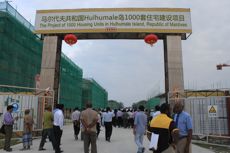
Speaking at today’s inaugural ceremony on Hulhumale’, President Mohamed Nasheed pledged to provide housing to all applicants. “In the Maldives every citizen should be have the option of living in whichever part of the Maldives he or she wishes,” he said.

Connecting today’s event with the ongoing judicial crisis which has gripped the country since January 16, the President observed that “national development involves all parts of a system.” Veshi Fahi Program Director “Sarangu” Adam Manik elaborated that the housing project’s success leans heavily on a robust judiciary.

“What we need is a proper judiciary to interpret land and housing contracts,” he told Minivan News. “If a judge does not have the proper education, degree and qualifications to interpret such contracts as well as the law, how can the system work?”

Affordable housing is one of the five pledges which form the backbone of the ruling Maldivian Democratic Party (MDP) manifesto, along with pledges for a nation-wide transport system, affordable living costs, affordable quality healthcare, and the prevention of drugs and narcotics trafficking.

On January 1 2012, all Maldivian citizens became eligible for free health care. Ferry systems have gradually improved transportation and communication within atolls as well, while the southern island of Fuvahmulah opened a new airport last year.

In July 2011, the President awarded documents of guarantee to the recipients of ten flats on Hulhumale’.

Male’ is the most densely populated city in the world with approximately 50,000 people per square kilometre, eclipsing Mumbai. Approximately one-third of the national population of 350,000 live on the capital island. Manik claims the pressure is already being released.

Launched in November 2010, the Veshi Fahi program aims to combine the development of Malé, Vilingili, Guli Falhu, Thilafushi, Hulhumalé and Malé International Airport. Under the program, applicants are categorised according to need: those living in extremely overcrowded conditions, those with land in Male but an interest in living in Hulhumale’, and those interested in housing in any of the nearby islands.

Under the program Male’ residents are asked to trade their land on the capital island for land in the nearby developing suburb- allowing Male’ City Council to develop areas of Male’ for community needs such as parking, dust bins and small parks. However, given the dire conditions of some Male’ housing units 3,000 new units will be constructed on the capital.

“We are very much on track,” Manik said. “Some projects are even ahead of schedule, such as this one,” he added, gesturing to the construction site where the basic structures of 1,000 flats have already been raised by Chinese and Bangladeshi laborers.

“By 2016 there will be no problems with shelter on Male,” he claimed.

As the housing issue dissipates, rent costs are expected to drop. Rent in Male’ currently rivals rates in New York in London, however officials expect half that sum on Hulhumale’ will give a person the same facilities and even more space than a flat on the capital island.

While people are expected to begin moving into the new housing on Hulhumale’ in July of this year, land plot recipients have two years from the date they receive the land title to construct their new home and move across the water.

“Many people can’t afford the move right away, so they need time to get loans and make plans. The concern is not that land will be left untouched, but rather that people need the time to connect the dots and establish their home,” said an official from the Veshi Fahi office, who requested anonymity.

Minivan News understands that recipients of the 250 land plots on Hulhumale’ will also receive housing loans from the Housing Development Corporation (HDC).

Meanwhile, the program’s rapid progress has encouraged more Male’ residents to apply for new housing.

“The previous government didn’t give people hope for these things,” said the official. “Now, people are seeing titles and deeds being awarded, they are seeing the flats go up- I think more are interested in applying during the second round.”

Likes(1)Dislikes(0)

MDP votes to hold “massive gathering” to show support for judicial reform

The Maldivian Democratic Party (MDP)’s National Council has decided to hold a massive gathering in Male’ calling for an independent judiciary and to show support for the actions taken by President Mohamed Nasheed in the detention of Chief Judge of the Criminal Court, Abdulla Mohamed.

A resolution was passed to the National Council by a council member which was then supported by ‘Sarangu’ Adam Manik, former Mayor of Male’ City.

The resolution also calls MDP to “stand up” against the protests held by the opposition parties, which have occurred every night for the past two weeks near the Maldives Monetary Authority (MMA) building.

MDP Secretary General Ahmed Shah today told Minivan News that the resolution was passed yesterday but that the date had not yet been fixed.

He said opposition political parties were “creating unrest in the country to obstruct government projects that are being conducted.”

‘’Only a few are turning up to those protests now,’’ he claimed.

Opposition political parties have been protesting every night following the detention of Abdulla Mohamed by the Maldives National Defence Force (MNDF), on the evening of January 16 in compliance with a police request. The judge had earlier sought a high court ruling to overturn his police summons.

The judge’s whereabouts were not revealed until January 18, and the MNDF has acknowledged receipt but not complied with Supreme Court orders to release the judge.

Meanwhile, a group of lawyers campaigning for the release of Abdulla Mohamed have requested the Supreme Court not hear any case related to Judge Abdulla before the court decided on the request made by the lawyers to issue a writ to free the judge.

Today the High Court issued a warrant for the third time to produce Judge Abdulla, in an appeal against the Civil Court injunction he sought to halt his investigation by the Judicial Service Commission (JSC).

The MNDF has not responded to any of the warrants issued.

Likes(1)Dislikes(0)

Civil Court injunction stops us taking action against Abdulla Mohamed: JSC

Judicial Service Commission (JSC) President Adam Mohamed has claimed the body is “impatient” to take action against the Criminal Court Chief Judge Abdullah Mohamed, and claimed that the only thing preventing the move is the Civil Court injunction filed by Abdulla Mohamed ordering the judicial watchdog not to take any action, until the court decided otherwise.

Adam Mohamed made the statements in response to questions asked at the Saturday’s meeting of parliament’s independent institutions committee where the JSC members, including opposition MP Gasim Ibrahim and Speaker of Parliament Abullah Shahid, were summoned to clarify the reason for delay in taking action against the judge.

In the committee meeting, broadcasted live, Mohamed restated that  it would be a “violation of law” to take any action against Chief Judge before the Civil Court injunction was overruled, stating that and the commission has to proceed within the legal bounds.

“If we take action against Judge Abdullah, we will be in violation of law. [Because] violating a ruling is violating the law. We are very cautious,” said Mohamed, the Supreme Court’s representative on the judicial watchdog.

“We are impatient to take action [against chief judge] within the legal bounds” he claimed, adding that the case had now been appealed in High court.

The civil court granted the injunction in November 2011 – on the judge’s request – during the 30 day period he was given to respond to the report completed by JSC in which was found guilty of violating the Judge’s Code of Conduct for making politically contentious statements on a local TV channel.

According to the JSC, a total of 11 complaints have been submitted against the judge.

While the JSC’s decision remains stalled due to the injunction, questions have been raised as to whether the civil court has the jurisdiction to rule against its own watchdog body.

Aishath Velezinee, former president’s member at the JSC, argues that “if the judicial watchdog can be overruled by a judge sitting in some court somewhere, then the JSC is dysfunctional. But that’s what has been happening,” she asserted.

While the injunction issued last November was appealed at the higher courts, JSC also cited that the commission does not consider that the civil court has authority to hear the case.

The JSC first appealed the case at Supreme Court, which instructed it to forward the matter to the high court.

The high court scheduled its first hearing on the case last Thursday, but was cancelled by the judge who decided the case cannot be heard in absence Judge Abdulla Mohamed, after the Maldives National Defence Force (MNDF) refused to produce him. He remains under MNDF custody on the training island of Girifushi.

The military arrested the judge on January 16 after he attempted to block his own police summons – subsequently all the courts , JSC, Prosecutor General Ahmed Muiz, and later Vice President Dr Mohamed Waheed called for his immediate release citing the arrest as unlawful.

President Mohamed Nasheed met with some of the JSC members at a meeting held at the president’s office on Sunday to discuss his concerns related to the judiciary, local media reported.

UN calls for judge’s release

Associated Press (AP) has meanwhile reported that the United Nations (UN) has called for the Maldives to release the judge from custody or charge him with a crime, as the  body considers a government request for help resolving a dispute with the country’s judiciary.

“While acknowledging the challenges Maldives faces in reforming and strengthening its judiciary, we believe that Judge Abdulla should either be treated with due process, meaning he should be properly charged moved from military detention, and brought before a court, or released,”  Ravina Shamdasani, a spokeswoman at the UN human rights office told AP on Saturday.

She also observed that the officials are still discussing how to respond to the request made by the Foreign Ministry last week, requesting international legal assistance.

The government has meanwhile listed 14 cases of obstruction of police duty by Judge Abdulla, including withholding warrants for up to four days, ordering police to conduct unlawful investigations and disregarding decisions by higher courts.

Afeef accused the judge of “deliberately” holding up cases involving opposition figures, and barring media from corruption trials.

Afeef said the judge also ordered the release of suspects detained for serious crimes “without a single hearing”, and maintained “suspicious ties” with family members of convicts sentenced for dangerous crimes.

The judge also released a murder suspect “in the name of holding ministers accountable”, who went on to kill another victim.

“We have been working to improve the judiciary since we came to power, but we have not succeeded,” said Foreign Minister Ahmed Naseem last week, calling for a delegation from the United Nations Human Rights Commission (OHCHR) to help resolve “an issue of national security.”

The first complaints were meanwhile filed against  Mohamed in July 2005 by the Attorney General at the time time Dr. Hassan Saeed, president of the minority opposition party, which is leading the call for judge’s release.

The allegations  included, misogyny, sexual deviancy, and throwing out an assault case despite the confession of the accused.

Meanwhile, group of lawyers have  sent a case to the International Criminal Court (ICC), appealing that the judge’s detention is an “enforced disappearance” under the ICC’s Rome Statute  – while opposition activists have  taken the fight to free the judge to the streets, as protests continue for a second week.

Likes(2)Dislikes(1)