Government withdraws amendment to abolish Foreign Investment Act

The government today withdrew at the preliminary stage a bill to abolish the Foreign Investment Act of 1979, one of 18 pieces of legislation proposed under its economic reform package currently before parliament.

Presenting the draft legislation in August, MP Alhan Fahmy of the ruling Maldivian Democratic Party (MDP) said the purpose of the bill was to remove restrictions and open the country to unhindered investment by foreign companies.

Alhan announced today that the ruling party decided to pull out the bill in light of parliament rejecting the proposed company law last week.

“It is not that our thinking and economic policy has changed at all,” he said, adding that all components of the reform package was necessary to achieve the government’s objectives.

Foreign direct investments were to be regulated under the proposed company law, which would have replaced the existing Companies Act enacted in 1996.

In a booklet issued to the media by the Dhivehi Rayyithunge Party (DRP) outlining concerns with the economic reforms, the main opposition party opposed the abolition of the Foreign Investment Act on the grounds that it protected domestic industries and small businesses.

The party noted that the proposed company law did not contain protectionist measures or special benefits for local businesses.

“Instead of abolishing the foreign investment law, it would be better to amend and modernise it to pave the way for foreign investments in the country,” it reads.

Moreover, the DRP “could not agree to sell the country’s remaining assets to the MDP’s friends” after “[losing control of] the country’s main gate, the international airport, the national telecom service, and Maldivian seas and shallows.”

During the preliminary debate in August, Kelaa MP Dr Abdulla Mausoom, recently appointed DRP parliamentary group deputy leader, accused the government of trying to turn the Maldives into the “money-laundering machine of the world” by deregulating or removing restrictions to foreign investments.

Other opposition MPs claimed that the bill was part of an agenda to “sell off state assets” and undermine national interests and sovereignty.

Likes(0)Dislikes(0)

Maldives to host 2013 World Tourism Day

The Maldives will host the 2013 World Tourism Day celebrations under the theme ‘Tourism and Water – Protecting our Common Future.’ The event is a function of the United Nations World Tourism Organisation, which chose the Maldives over contender Iran.

The decision was made during the 19th General Assembly in Gyeongju, South Korea, held from October 10 to 13. Tourism Minister Dr Mariyam Zulfa and Deputy Director General Moosa Zameer Hassan were among the 600 participants from member countries.

Tourism Ministry Deputy Director General, Moosa Zameer Hassan, said Iran conceded its bid for the event when the Maldives joined the running.

Tourism accounts for nearly 70 percent of the Maldives’ GDP indirectly, and 30 percent directly. Recent shifts in the global economy have brought a new wave of tourists from Asia, which has made the Maldives Conde Nast’s second-most popular tourist destination at a time of global recession.

Speaking at the opening ceremony of the VVIP Koimala Executive Lounge at Ibrahim Nasir International Airport (INIA), Tourism Minister Dr Zulfa said tourism should be at the center of Maldives socioeconomic development. “Because tourism, of course, is our number one industry, and everything we do should center around making the product even more perfect than it is today.”

Hassan said the event was highly relevant to the Maldives.

“Tourism and environment are closely related to the future of the Maldives,” he observed. Although the event is a still two years away, Hassan said the Maldives hoped to take the opportunity to “provide our viewpoint to the U. N. on these issues, and portray our country and its message for this theme to the world.”

Although Hassan could not provide specifics, he was confident that the Maldives’ message in 2013 “will be about supporting tourism and environment in order to protect the Maldives, improve the quality of life for local Maldivians, and benefit foreign visitors and investors.”

Various public and private groups have lately taken steps to merge tourism and environmentalism.

Maldives Game Fishing Association (MGFA) is moving forward with a tag-and-release game fishing competition, to be held November 9-12 in and around North and South Male’ and Vaavu atolls. MGFA Committee Member Tiffany Bond previously said the event would introduce a new sport for tourists and locals while promoting conservation-friendly methods. “In many ways, it’s another feather in the tourism hat,” she said.

World Tourism Day is set for September 27 of each year. Next year’s celebration will be hosted in Spain under the theme ‘Tourism and Sustainable Energy–Powering Sustainable Development.’

Hassan concluded with a reflection on the importance of hosting World Tourism Day in the same year as the next presidential election.

“Twenty-thirteen is going to be a big year for the Maldives. By hosting an international event like this, we will be in a positive position for moving forward,” he said.

Likes(1)Dislikes(0)

MDP MP calls out government on corruption charges

Ruling party Maldivian Democratic Party (MDP) MP Mohamed ‘Colonel’ Nasheed has said some government operations involve corrupt dealings and that the ruling party should clear up these failings before opposition parties make further accusations.

Nasheed is a member of the Public Accounts Committee, and the first MDP MP to publicly accuse the ruling party of corruption.

“The opposition is always linking MDP with corruption, but we also should acknowledge that corruption is bad in the system. We need to reform our system so that there’s no room for corruption,” Nasheed told Minivan News today.

Nasheed did not say if certain branches of government were culpable. He did, however, indicate that “there are some housekeeping problems within us, and we will deal with those things.”

Recently, the Anti-Corruption Commission (ACC) has been investigating the Disaster Management Center for delayed payments to Moreway Construction Company.

In August, the ACC requested Maldivian construction giant Heavy Load Pvt Ltd. to stop its reclamation operations at Thilafushi in August on suspicion of corruption.

Heavy Load is owned by MDP Chairperson and MP Moosa ‘Reeko’ Manik. The company and its shareholding politician have been regularly accused of corruption over the past year.

In September 2010, Heavy Load was awarded a US$21 million (Rf269.8 million) contract from Thilafushi Corporation Limited (TCL) to reclaim 130 hectares from Thilafushi lagoon. Heavy Load had submitted its proposal for the project to the National Planning Council in July, however the proposal had reportedly not been fully approved before TCL offered project finances and in August 2011 Heavy Load was asked to allow other companies to submit their bids.

Minivan News understands that the ACC was concerned about operations within TCL.

Currently, Heavy Load is responsible for reclaiming land on Hulhumale’ for a new terminal at Ibrahim Nasir International Airport (INIA). The project incurred a dispute with infrastructure company GMR, whose subsidiary GMR Airport Development Ltd. had allegedly received the project before it was awarded to Heavy Load.

When asked if his allegations of government corruption related to the Heavy Load affair earlier this year, Colonel said “it’s not fair for me to mention Heavy Load in the media.”

Colonel later elaborated on the ACC’s investigation of Heavy Load.

“I’m not saying there is or isn’t corruption in Heavy Load, it’s too early to say, but some investigations should be done. Because of the lack of transparency people might accuse the company of corruption, but accusations don’t mean that there really is corruption,” he said.

Accusations of corruption are nothing new to Moosa. In August, Moosa was accused of using party resources for “self-promotion”, and Colonel speculated that Moosa was preparing to place a bid for the 2013 presidential election.

In a long-standing feud with private broadcaster DhiTV, Moosa has been accused of alcohol possession and corrupt dealings with Heavy Load. In turn, he alleged that private broadcasting channels were inappropriately funded. The negative media attention prompted Colonel to call Moosa “a big liability” for the government.

“I’m not saying the accusations are true, but Moosa has not been able to prove his innocence,” he said at the time.

When asked today if his allegations of government corruption had any particular grounds, Colonel told Minivan News that he was “not picking a fight with anybody, it’s nothing personal.” He added that the ACC’s operations have improved since a new auditor general was appointed, and that the government’s system of check and balances would handle issue.

Reflecting on the reasons behind what he called an increase in corruption awareness, Colonel suggested that increased transparency “from the new constitution and reforms” has exposed a long-standing issue.

“The situation might not be worse than before, only the number of cases reported is higher,” he said.

Likes(0)Dislikes(0)

Compliance audit report flags corruption at DPRS

The Civil Service Commission (CSC) has flagged corrupt practices and a poor working environment in the compliance audit report of the Department of Penitentiary and Rehabilitation Services (DPRS) released last week.

The report was compiled between December 22, 2010 and January 10 this year to ascertain the level of compliance with civil service laws and regulations as well as the code of conduct. The DPRS report is the second compliance audit report to be made public following the Islamic Ministry’s report.

The report identified 46 problems in 16 areas that needed to be reformed, including alleged abuse of lower-ranked employees by senior officials, use of office vessels for personal use and salaries paid out to staff on holiday.

“We note that the department’s vehicles and sea vessels are used for personal purposes,” it reads. “The speedboat used at Maafushi jail sometimes comes to Male’, is not sent back for a whole day and is used to carry employees’ goods.”

Some employees meanwhile complained of sexual abuse, the report noted, “however nothing of the sort can be seen from the records. And we note that a mechanism to record such matters has not been established.”

Due to a lack of coordination between the human resources section and the budget section, the report found that salary payments were made to dismissed staff, employees on no-pay leave and employees with poor attendance.

The CSC noted that additional amounts paid out with the salary were deducted without “revealing details of the accounts and making the required amendments to the documents.”

“As a result, it is not possible to determine for what reason the amounts were deducted,” it states.

The report found that on occasion employees were not paid for overtime hours while senior employees filled out a slip to show that they arrived at the office on time after coming late.

Moreover, some employees at Maafushi jail were paid risk allowance after they were transferred to the main office at Male’. Conversely, employees transferred to the jail were not paid a risk allowance.

Employees also took longer than the one-hour lunch break during working hours and “going out to tea during official hours was common.” Some employees were paid salaries during official leave in violation of civil service regulations, it added.

The department “did not make adequate use” of over Rf400,000 allocated in the budget for training purposes.

“We note that employees are discriminated against in taking disciplinary measures,” the report observed, noting that records were not properly maintained.

The report also found that “a safe environment for staff has not been established at the Male’ jail.”

“The ladder that leads to the staff office is also used by inmates,” it noted.

DPRS staff and their responsibilities did not fit the administrative structure approved by the commission, it continued, and staff at Maafushi jail were also taking care of “administrative tasks, HR tasks, maintaining security at the jail, maintaining the jail office and cafeteria, carrying food, providing health treatment and performing as Imams at the staff mosque.”

Likes(0)Dislikes(0)

MDP primary winner loses party ticket over incomplete documentation

The winner of the ruling Maldivian Democratic Party’s (MDP) primary for the upcoming by-election of the vacant mid-Fuvahmulah atoll council seat, Shaffaf Naseer, has lost the party ticket after failing to submit an ID card original before the 3pm deadline yesterday.

Shaffaf won the primary election that took place on October 9 with 112 votes followed by Mohamed Abdulla Didi with 97 votes. In lieu of not fielding a candidate, the runner-up was registered at the Elections Commission (EC) on Sunday as the MDP candidate.

MDP Secretary General Hassan Shah told Minivan News today that Shaffaf contacted him from Fuvahmulah on Thursday and requested assistance with completing the documentation.

After collecting a stamped document from the Department of Judicial Administration around 2pm yesterday, Shah said he discovered that Shaffaf’s ID card original was missing from the documents when he went to file them with the EC.

According to the application form (page 11, bullet point 3), the form should be submitted with the original ID card of the candidate.

Shaffaf had sent his ID card on a flight that landed “10 minutes before [the 3pm deadline].” Shah explained that he did not believe the person delivering the card could make it to the EC from the airport before the deadline elapsed.

The second-placed candidate was meanwhile “monitoring the situation very closely” and was prepared with the required documentation.

“My thinking was that the party should not lose the opportunity to compete in the election,” Shah said, adding that the application form was handed in “seconds before the EC closed.”

If the last minute decision had not been made, Shah argued that the party would not have had a candidate in the by-election scheduled for November 19.

“They [the EC] had already rejected one of our candidates for a by-election because he didn’t submit an ID card original,” he said.

The former mid-Fuvahmulah atoll councillor, Hassan Saeed, also a member of the MDP, lost his seat after the Supreme Court ruled earlier this month that he had a decreed debt.

The EC announced yesterday that three candidates have filed applications for the mid-Fuvahmulah by-election, including one MDP candidate, one opposition Dhivehi Rayyithunge Party (DRP) candidate and one Independent candidate.

Primary winner

Speaking to Minivan News today, Shaffaf Naseer criticised the party’s administrative staff and senior leaders for not providing adequate assistance with his application.

“It is not at the last minute that the party should know that the ID card original is missing,” he said.

Shaffaf however praised MDP Secretary General Shah for “working very hard” this week to complete the documentation.

“But when it came to him it was too late,” he added. “He was very helpful and cooperative. But I didn’t get any cooperation from the party officials before that.”

After winning the primary and returning to his home island, Shaffaf said he was assured by senior members of MDP that the party would handle the application process.

“So I was busy preparing my campaign and meeting family members, relatives and supporters,” he said. “Our forecasts show that I would have won easily.”

Shaffaf particularly objected to the party not providing him with a signed resolution confirming his candidacy: “They didn’t monitor the situation or check the documents to verify them,” he said. “There should be principles, rules and procedures to follow in everything.”

If the party had informed him of the requirement of the ID card original, said Shaffaf, he would have flown to Male’ during the weekend.

“If they submitted my forms with the Elections Commission and got rejected, I would have accepted it,” he continued. “But they could have waited 15 minutes [past the 3pm deadline] for the person delivering my ID card to get there.”

As a result of the incident, Shaffaf said, MDP members in Fuvahmulah were “divided, confused and fed up.”

Shaffaf called on senior leaders of the party to “investigate what happened and take action against those responsible.”

“I believe the party leadership has to come to Fuvahmulah now and explain how this happened,” he said, adding that the move would be necessary to unite members ahead of the by-election.

Shaffaf said he hoped that the party would strengthen its internal mechanisms and administrative functions as a result of the incident.

The ruling party has strong support in the mid-Fuvahmulah constituency, which is represented in parliament by MDP MP Shifaq Mufeed ‘Histo’.

While he was “disappointed” with the incident as “this should not happen in the largest and most exemplary democratic party in the country,” Shaffaf said he would back the MDP candidate and support the campaign.

However, he added, the voters in Fuvahmulah were independent-minded and he “could not influence how they vote.”

Shaffaf insisted that he did not wish to pursue the matter any further or cause internal disputes in the party.

“I was among the first people from Fuvahmulah to sign for MDP and I will remain a member of the party,” he said.

Likes(1)Dislikes(0)

DRP accuses PPM of using cash incentives and development funding to poach members

Spokesperson and Deputy Leader of the Dhivehi Rayithunge Party (DRP), Ibrahim ‘Mavota’ Shareef, has alleged that the breakaway opposition party of former President Maumoon Abdul Gayoom has been offering cash incentives and development funds to island groups, in a bid to persuade them to join the Progressive Party of the Maldives (PPM).

“There are many social clubs in the Maldives with the purposes of developing islands. Many have been offered cash incentives and funds for development activities if members join the party. Even individual members have been offered,” said Shareef, who has made similar claims to local media this week.

PPM Spokesperson Ahmed Mahlouf was not responding to refute the allegations at time of press.

“We’re not about to file a court case, but this is happening on a wide scale. If the clubs involved need funding, members are inclined to accept. We couldn’t afford to lodge so many cases,” Shareef said, when asked if the party had any evidence to back the claims.

Prior to the PPM’s inaugural convention on October 15, the EC verified and approved the membership forms of 3,019 party members.

Several thousand people attended the convention at Dharubaaruge, including at least one prominent ruling Maldivian Democratic Party (MDP) activist.

The 971 delegates present elected Gayoom interim leader unopposed, while his half-brother MP Abdulla Yameen was elected acting parliamentary group leader.

Yameen’s party, the People’s Alliance (PA), recently split from the main opposition DRP which remains under leadership of Ahmed Thasmeen Ali. The relationship between the PPM, formerly known as the Z-DRP faction of the opposition, and the DRP leadership remains strained.

Shareef expressed surprise at the large numbers of people who attended the convention, and acknowledged that support for Gayoom’s party had the potential to affect the DRP’s membership base.

“This was a 30 year regime and we have to accept that there are pockets of support everywhere. During Gayoom’s time he did a lot a lot of work and has many supporters, and we have to recognise this,” Shareef said, but questioned the PPM’s “ability to work together as a party.”

“I don’t see any future for PPM. They are saying that 99 percent of [DRP members] are joining the party but we don’t see any such thing happening. At the same time there are a lot of people who have remained steadfast and believe the DRP has a future, and that the leadership has the experience and qualifications to run the country,” Shareef said.

The breakaway faction consisted of Gayoom’s immediate family and “former DRP members who failed in elections while they were in the DRP,” Shareef said. “PPM is a family enterprise, promoting a private hidden agenda in the name of the national interest.”

Gayoom had capitalised on growing dissatisfaction with the government, Shareef contended.

“At the grassroots level, people are very unhappy, and the swing voters have been moving away from the government. This is why Gayoom chose now to form his new party. In 2008-2009, and even midway through 2010, there was no political space.”

The division was as much ideological as it was acrimonious, Shareef explained.

“Many people do not believe the DRP is able to hold the government accountable, because we do not create violence or street protests. Many people think the opposition should make the country ungovernable, even the media and opinion leaders. I’m not sure if they understand it themselves, but it makes it very dangerous, as it risks the whole society falling and becoming a failed state,” Shareef said.

“We believe we are a responsible opposition and we oppose the government’s polices where they are wrong, and support them when they are right. There is nothing personal and we are not out for revenge, and we do not see the ruling party as personal enemies.

“Gayoom’s family and his inner circle view them as personal enemies and are out for revenge, using chaos and anarchy to try and stop the government from doing any work. We are clear we want a stable government, and to change it through elections, but the immediate family of Gayoom has a different idea. They want street action, so that every day the government is under pressure, while we voted for a presidential system of government that gives the President a free hand to run the country [while he is elected].”

Beyond the poaching of its member base, the DRP faced new financial challenges with the departure of the former President, Shareef said.

“Finance is a great challenge. The current DRP leadership is not as rich as PPM’s top leadership. It presents a challenge, but I like to believe money is not everything.”

Road to 2013

Shareef was a founding member of the MDP, Deputy Parliamentary Group Leader in Nasheed’s shadow cabinet, then later a deputy to Gayoom, and now a deputy to Thasmeen.

With the split in the opposition, and the collapse of all the MDP’s coalition agreements, Shareef predicted that “given current trends” the 2013 presidential election would effectively be a replay of the 2008 election in which Nasheed won power in a run-off election against the incumbent Gayoom, due to the support of coalition partners.

The MDP would need to gain 51 percent of the vote in the first round to secure a clean win, while “none of the opposition parties will secure enough votes to reach the 51 percent mark,” Shareef said. “Meanwhile the MDP has chased away all its coalition partners, and they cannot now turn around and say ‘We can work together’, because nobody will believe them.”

Faced with a run-off, the disparate opposition groups would temporarily unify over the common ground of ousting the MDP, Shareef predicted, giving power to the largest opposition party.

“Look at the last three elections. In the first round of the 2008 Presidential election Gayoom got 40 percent, while the rest of the then opposition got 60 percent. In the second round the opposition totaled 54 percent. The MDP lost ground in the parliamentary elections, and the majority of the islands voted for the DRP in the local council elections,” he claimed.

“The incumbent government has the resources of the state to get votes, and can get at least 20-30 percent just by being in power. At present trends, the 2013 will be a replay of 2008, and as things stand now, whoever is in opposition will go to the second round. But we need a leader who is not out to take revenge.”

Likes(0)Dislikes(0)

Kulhudhufushi islanders protest plans to sell reclaimed land

A group of islanders on Kulhudhufushi in Haa Dhaal Atoll gathered outside the island council office this morning to protest plans to sell plots of land from the reclaimed area of the island.

The protest was organised in response to the Kulhudhufushi Development Corporation putting up 20 plots of reclaimed land for sale through a bidding process. Plots measuring 1,000 square feet were to be sold at a rate of Rf300 per square foot.

Speaking to Minivan News, Ibrahim Ahmed, 43, a resident of Kulhudhufushi who participated in the protest said that islanders gathered outside the council office at 8:00am this morning and were met with police officers in riot gear.

“We prepared a petition or a letter expressing our concerns with the plans to sell land and were going to submit it to the chair of the island council,” he explained.

The gathering was peaceful until two protesters attempted to enter the council office, he continued, alleging that police used force and pepper spray to disperse the crowd.

“They used pepper spray without any warning and took away people in handcuffs,” he claimed, adding that police used disproportionate force against the protesters.

“It was a completely peaceful gathering before that,” he added. “But that was how it turned into a protest.”

The islanders then met with Council Chair Jamsheed Mohamed, who asked for a three-day period to discuss with the relevant government ministries.

The ruling Maldivian Democratic Party (MDP) made a clean sweep of the seven-member Kulhudhufushi island council. The island is the largest population hub north of Male’.

Ibrahim said the MDP councillor assured the protestors in writing that the council would seek to find a solution in the next three days.

The Kulhudhufushi resident explained that the main concern of the protesters was the decision to register the reclaimed plots under the Kulhudhufushi Development Corporation.

“We want that land to be registered under the council,” he said. “We don’t mind if it leased for 99 years, but selling the plots is completely unacceptable to the people of this island.”

Islanders were not consulted before the land use plan for the reclaimed area was drawn up, Ibrahim said, adding that the people of Kulhudhufushi would prefer the area to be used for industrial or business purposes.

Meanwhile, opposition Dhivehi Rayyithunge Party (DRP) MP Dr Abdulla Mausoom, the party’s deputy parliamentary group leader, held a press conference this afternoon and called on the government to “not test the people to see how much their blood will boil.”

The protest in Kulhudhufushi today was the result of the government’s failure to consult with the public before formulating policy, Mausoom argued.

Island development plans should “come from the people” and not from the central government, Mausoom said, adding that the government’s actions were defeating the purpose of the landmark Decentralisation Act.

Likes(0)Dislikes(0)

PPM approves party constitution, council and logo at inaugural convention

The incipient Progressive Party of Maldives (PPM) approved the party’s constitution, manifesto, interim council, leadership posts, logo and colour at its inaugural convention last night.

Party figurehead former President Maumoon Abdul Gayoom was elected acting leader while his half-brother MP Abdulla Yameen was elected parliamentary group leader.

Gayoom was the only candidate who stood for the post of party leader.

The convention took place at Dharubaaruge with 971 delegates and was assisted by officials of the Elections Commission (EC). A minimum of 300 participants were required for the inaugural meeting.

Large number of supporters queued outside Dharubaaruge before 8:00pm while registration difficulties caused a delay of almost two hours. As voting went on late into the night, the convention concluded shortly before 6:00am this morning.

Prior to the inaugural convention, the EC had verified and approved the membership forms of 3,019 party members.

The convention was chaired by former Speaker of Parliament ‘Seena’ Ahmed Zahir, who also served as Justice Minister in the previous government.

PPM logoA crescent and palm tree logo designed by Hussein Mazin and MP Ahmed Mahlouf was adopted with 751 votes while the colour magenta was chosen with 603 votes.

The senior members elected to the interim council were Umar Naseer (fromer Dhivehi Rayyithunge Party deputy leader), Mohamed Hussein Shareef ‘Mundhu’, Aishath Azima Shukoor (former Attorney General), Mohamed Waheed Ibrahim, Faris Maumoon, Aneesa Ahmed (former MP and minister), Ahmed ‘Maaz’ Saleem, Ibrahim Nazim, Rashida Yousuf (former minister), Dr Aishath Shiham (former minister), Ahmed Siddeeq, Dr Abdul Samad Abdulla, Mohamed Nimal, Asma Rasheed, Ibrahim Muaz Ali and Ahmed Naseem.

A provision in the party constitution required that at least four women be elected to the council.

Eleven MPs were meanwhile elected to the council through the parliamentary group. They were Abdulla Yameen (Mulaku), Ahmed Mahlouf (Galolhu South), Ahmed Nihan (Vili-Male’), Abdul Raheem Abdulla (Laamu Fonadhoo), Hamdhoon Hameed (Raa Inguraidhoo), Ilham Ahmed (Gemanafushi), Ahmed “Redwave” Saleem (Eydhafushi), Dr Afrashim Ali (Ungoofaru), Mohamed Mujthaz (Hanimaadhoo), Ali Arif (Vaikaradhoo) and Abdul Muhsin Hameed (Nilandhoo).

In his closing remarks at the end of the convention, former President Gayoom insisted that PPM “does not belong to a particular person.”

Former President Maumoon Abdul Gayoom enters the meeting to a standing ovation.

“PPM is not going to try to create opportunities in the political arena for a particular person or group,” he said. “PPM is being formed for the whole nation. It is being formed for the holy religion of Islam. This party will always serve Islam and the Dhivehi nation.”

Likes(0)Dislikes(0)

Airfrance to introduce scheduled flights to Maldives, says President

French flag carrier airline Airfrance is in the process of introducing scheduled flights to the Maldives in late 2012, President Mohamed Nasheed announced yesterday in his weekly radio address.

Delivering the radio address Friday morning shortly after his return from an official visit to France last week, President Nasheed said he met the Vice-President of Airfrance and was informed that preliminary preparations for the scheduled flights would take six months.

“Nevertheless, we expect that God willing an Airfrance scheduled flight will begin operations to the Maldives in Europe’s winter of 2012,” he said.

The government delegation also met with French tour operators to discuss ways to increase tourist arrivals from France, Nasheed added.

Prominent resort businessman and Independent MP Ahmed ‘Sun Travel’ Shiyam was part of the Maldives delegation.

“As you know, at the moment about 40,000 tourists from France visit the Maldives [annually],” Nasheed said. “Our aim is to double that figure and undertake efforts to attract French tourists in the same numbers as British tourists come to the Maldives right now.”

Tourist arrivals reached a record high in 2010 with 791,917 arrivals, a 20 percent increase compared to 2009. Tourists from the United Kingdom accounted for 15 percent of the total arrivals at 118,961.

While arrivals from France were considerably lower than England or the UK as a whole, the French market grew by nine percent in 2010 from the previous year. Some 50,373 French tourists visited the Maldives in 2009.

The Maldives meanwhile signed the Paris-Nairobi Initiative during the visit, Nasheed continued, which would facilitate French assistance for renewable energy programmes and adaptation measures for beach erosion.

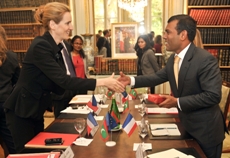
Nathalie Kosciusko-Morizet, the French Minister of Ecology, Sustainable Development, Transport and Housing.President Nasheed signed the accord on behalf of the Maldives at a meeting with Nathalie Kosciusko-Morizet, the French Minister of Ecology, Sustainable Development, Transport and Housing.

The Maldivian delegation also met with senior officials of the Agence Française de Développement (AFD), a French bilateral development finance institution, who “gave the green light” for more water and sewerage projects in addition to the sewerage projects AFD has undertaken in Gaaf Dhaal Thinadhoo and Laamu Gan.

“Additionally, good discussions took place with the French Foreign Minister,” Nasheed continued. “He welcomed our standing together with France on the issue of Libya. I thanked the French government on behalf of the Maldivian people for their efforts to help the people of Libya.”

Likes(0)Dislikes(0)