Opposition parties condemn “dangerous” MDP protest against judiciary

Opposition parties have strongly condemned a protest launched by the ruling Maldivian Democratic Party (MDP) against the judiciary and Supreme Court last week, warning of “dangerous” consequences for the nation.

At a press conference today, Dhivehi Rayyithunge Party (DRP) Deputy Leader Ibrahim ‘Mavota’ Shareef argued that with its campaign against the judiciary the ruling party was risking the Maldives becoming “a failed state.”

“We are starting to see in our country scenes similar to what we saw in countries like Rwanda and Uganda which became failed states, plunged into unrest and bloodshed,” he said.

If judges were accused of misconduct or corruption, said Shareef, complaints could be filed at the Judicial Service Commission (JSC), the oversight body for the judiciary.

“Trying to undermine the eminence and dignity of the whole judiciary cannot be seen as efforts to reform judges and put the courts back on the right track,” he contended.

The courts, police and Prosecutor General must take “legal action” against those who undermine the judiciary’s honour and prestige, Shareef said.

The DRP was “very concerned” with fears that the “whole system of justice in this country could fail,” he added.

Following the MDP’s national council approving a resolution to protest against the judiciary, DRP put out a joint press statement with its coalition partner Dhivehi Qaumee Party (DQP) condemning the planned protest as an attempt to “influence the judiciary, intimidate judges and bring the courts into disrepute.”

In response to the MDP protest, the newly-formed Progressive Party of Maldives (PPM) led by former President Maumoon Abdul Gayoom organised a demonstration at artificial beach Friday night to protest the MDP’s “intimidation of judges” and vowed to defend the judiciary.

The religiously conservative Adhaalath Party meanwhile issued a press statement yesterday characterising the MDP protest as “a dangerous warning from the MDP to Maldivian citizens who are against its ideology.”

Adhaalath claimed that the “true purpose” of the MDP’s campaign was to “nullify Islamic shariah, introduce common law to the country and bring foreign judges into the Maldivian judiciary.”

Adhaalath also accused the ruling party of using “bribery, undue influence and intimidation” to threaten separation of powers and “bring all the powers of the state into the President’s fist.”

Echoing a criticism made by other opposition parties, Adhaalath criticised police for failing to protect the former President’s residence. “This shows that the police as an institution is shackled by political influences,” the party said.

“Seven idiots”

In its statement, the Adhaalath Party called on the Supreme Court to take action against the President’s advisor Ibrahim ‘Ibra’ Ismail for saying at an MDP rally Friday night that the judiciary should be freed from “seven idiots” on the apex court.

Ibra recently filed a defamation case against the Supreme Court after it reprimanded him for calling on the public to “rise up and sort out the judges”.

In response to Ibra’s calls, the Supreme Court and the JSC demanded authorities investigate the former Male’ MP and chairman of the Special Majlis’ constitution drafting committee, claiming that “making such statements in a free, democratic society under lawful governance goes against the principles of civilisation.”

The Supreme Court subsequently issued a writ of prohibition and took over the case against it from the Civil Court, as a result of which, said Ibra, “I now have to go before the Supreme Court and say to them, ‘You have defamed me, now please decide in my favour.'”

Speaking at MDP Haruge on Friday night, Presidential Commission Spokesperson Abdulla Haseen noted that judges were not independent under the former government and had to follow instructions from the President or the Justice Minister on how to issue verdicts.

A majority of judges on the bench today were appointed by the former President and lacked educational qualifications to enforce the new constitution, he argued.

Haseen said the Presidential Commission was reluctant to send cases for prosecution as a number of cases against opposition MPs remained stalled at the Criminal Court for over two years.

MDP MP Mohamed Nazim said the party was powerless to prevent the contentious reappointment of judges without a parliamentary majority.

In August 2010, the JSC reappointed 160 of the judges appointed by the former government, despite a quarter of the bench possessing criminal records and many others with only primary school level education.

The Supreme Court meanwhile sent the President a letter claiming it had ruled itself tenure for life.

“The only thing we were able to do was [include a provision in the Judges Act] stating that lower court judges must obtain a diploma in seven years,” Nazim said.

Nazim accused the courts of partisan behaviour when it summoned Independent MP Ismail Abdul Hameed to court 45 minutes before a crucial vote on the Goods and Services Tax (GST) legislation. Hameed was found guilty of abuse of authority in his position as former director at the Male’ municipality and sentenced to one year’s banishment.

In his remarks, former Attorney General Dr Ahmed Ali Sawad observed that political parties neglected the development and modernisation of the judiciary during the reform movement that led to the adoption of a liberal constitution and multi-party democracy.

Criticism and civic action was necessary because of the current state of the judiciary and lack of public confidence in the institution, Sawad said, adding that criminalising persons who criticise the judiciary was contrary to “principles of democracy.”

The public should be able to criticise and comment upon court verdicts, individual judges and perceived failings of the judiciary, he insisted.

In May this year, the JSC abolished its Complaints Committee citing “efficiency”, with complaints against judges subsequently forwarded for review by the legal section and Commission Chair Adam Mohamed, a Supreme Court Justice.

Last year the JSC received 143 complaints concerning the conduct of judges. By its own statistics none were tabled in the commission, and only five were ever replied to. Chair of the former complaints commission, Aishath Velezinee, was meanwhile stabbed in the street in January this year.

Likes(0)Dislikes(0)

Police summon Gassan Maumoon for questioning

Police summoned Gassan Maumoon, son of former President Maumoon Abdul Gayoom, for questioning today concerning disturbances outside his residence Endherimaage on Thursday during a protest by the ruling Maldivian Democratic Party (MDP).

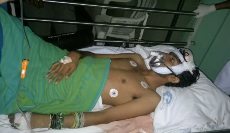
A 17-year-old boy was struck on the head with a wooden plank allegedly thrown from Endherimaage while protesters led by MDP MPs, councillors and senior members were marching by the former President’s residence.

Police Sub-Inspector Ahmed Shiyam told Minivan News today that Gassan was among a number of people police were questioning regarding Thursday’s events.

Police were investigating complaints of damage caused to the former President’s property as well as the injury caused to the 17-year-old, Shiyam explained.

Police had received information that suggests the wooden plank that injured the 17-year-old was hurled or dropped from the building, he said.

However, said Shiyam, police could not divulge further details at this stage of the investigation.

Minivan News journalists at the scene on Thursday observed gravel, stones, hot water and sharp metals raining down on the protesters from Endherimaage. A number of reporters at the scene were also hit by the pouring gravel.

MDP protest October 20Several MDP activists claimed that the wooden plank was hurled from the second floor balcony of Endherimaage. After the victim was rushed to hospital by MPs on the front line of the march, MDP activists clashed with Gayoom supporters blocking the entrance to Endherimaage and threw stones at the building, smashing a window on the first floor.

MP Ali Waheed, who defected to the ruling party in May, told state broadcaster MNBC that the boy was behind MP Alhan Fahmy when the object struck him straight on the head.

The 17-year-old, identified as Hussein Hassan, was rushed to the Indira Gandhi Memorial Hospital (IGMH) by the MPs on a passing pick-up, he said.

Speaking to MNBC One outside IGMH, Waheed displayed blood stains on his shirt resulting from the head injury caused by the impact.

Other eyewitnesses who spoke to the state broadcaster corroborated the MPs’ account of the incident.

The brother of the injured boy told Minivan News Thursday night that according to doctors “his skull was damaged and parts of the skull have gone inside his brain.”

The boy underwent surgery to remove wood particles from his brain.

IGMH media coordinator confirmed today that the boy was conscious and his “condition is now stable.”

The spokesperson refuted media reports that the boy’s left side was paralyzed. “His left side is very weakened, but that is not paralysis,” she explained.

A family member outside the ICU told Minivan News that the family was certain the object that struck Hussein Hassan “came from above.”

“Everyone who was there said that that was how it happened,” he said.

Right to remain silent

Gassan Maumoon meanwhile told reporters outside police headquarters this afternoon that he exercised the right to remain silent after “it appeared from some of their questions that they were accusing me.”

Gassan was accompanied by the former President’s lawyer Mohamed Waheed Ibrahim ‘Wadde’ and former Attorney General Aishath Azima Shukoor.

The former President’s newly-formed Progressive Party of Maldives (PPM) held a protest at artificial beach last night in response to the ruling party’s “intimidation of judges.”

Hundreds of supporters participated in the protest, where they called for the resignation of Chief of Defence Forces Moosa Jaleel and Police Commissioner Ahmed Faseeh for failing to provide security to the former President.

Asked by MP Ilham Ahmed if they should march to the presidential residence Muleeage, the protesters unanimously supported the notion.

PPM Interim Council Member Umar Naseer – former deputy leader of the Dhivehi Rayyithunge Party – however announced around 10:45pm that the protest march was to be cancelled after police sent a summons to Gassan.

Meanwhile, after text messages were circulated on Friday claiming the PPM was preparing to attack and “smash Haruge [MDP camp],” a large number of ruling party supporters gathered at Haruge for a hastily arranged rally at 9pm last night.

Speakers at the rally, including Presidential Commission Spokesperson Abdulla Haseen, President’s Advisor Ibrahim ‘Ibra’ Ismail, MP Ahmed Easa and former Attorney General Dr Ahmed Ali Sawad, severely criticised the judiciary for lack of competence and integrity.

An egg was thrown into Haruge during Ibra’s speech.

In an interview with private broadcaster DhiTV shortly after Thursday’s protest turned violent, Gayoom claimed that damage was caused to his residence and adjoining houses in “a terrorist attack” orchestrated by the government.

“They came with their activists and attacked my home,” Gayoom said. “They attacked nearby houses as well.”

Moosa Jaleel and Ahmed Faseeh should “personally bear responsibility” for the damage to his residence because riot police were not present to intercede, the PPM figurehead said.

Appearing on private broadcaster VTV later that night, Gayoom said he would file criminal complaints with police, the Prosecutor General and pursue civil action against the protesters.

Likes(0)Dislikes(0)

Addu Hubasaana 2011 Arts, Crafts and Food festival boosts local entrepreneurs

Minister for Economic Development Mahmood Razee inaugurated the Hubasaana 2011 Arts, Crafts and Food festival in Maradhoo Feydhoo of Addu City on Thursday, October 20. The festival, which was organized by Ministry for Economic Development (MED), will be a platform for Small and Medium Enterprises (SME).

The fair, which runs through October 22, is the culmination of a yearlong pilot project for developing local products that was conducted in the South and North of Maldives.

“The festival will showcase authentic high quality Maldivian products,” said Hamza Imad, MED’s international consultant for the project. In addition to the display of local products ranging from handicraft and woodwork to food produce, there will also be demonstrations of the making of regional delicacies like bondi (a sweet made of coconut) and kudhi gulha (fried short eat).

“The project will be expanded to other areas of Maldives next year,” said Imad.

Over 50 SMEs of nearby atolls GA, Gdh, and Fuvamulah are participating in the three-day festival, along with Addu City. Hubasaana 2011 will also be held in Hanimadhoo of Hdh atoll in early December. The event will enable SMEs from the northern atolls of HA, Hdh, Shaviyani to participate and promote their products.

Aishath Raniya Sobir, Monitoring and Evaluation Consultant for MED’s Private Sector Development Project said two Business Development Service Centers (BDSC) were set up last year in Hithadhoo of Addu City and Kulhudufushi of Hdh, to facilitate the project’s operations.

The centers provided business trainings in planning, marketing, start-up plans and technical expertise to over 5000 people from the project’s target atolls. Raniya said participants share the cost of training with MED “so that they can take ownership of this.”

Hobbies to businesses

The trainings were an important outlet for a thriving talent pool. “The islanders are very enthusiastic and talented, and a lot of time the people who came for the trainings had already been doing some handiwork as a hobby,” said Raniya.

One such person is Addu City housewife, Mariyam Naazly.

Naazly had attended various handiwork courses over the years. During a fabric painting course, Addu’s BDSC consultant gave a talk on start-up business cooperatives. Naazly said the talk motivated her to become an entrepreneur.

Joined by 10 other attendees of the course, Naazly formed the Addu Arts and Crafts Cooperative Society (AACCS), of which she is the president. The cooperative creates handicraft, like baskets of eekle broom, coconut art, bracelets from nuts found in trees and decorative items from empty rice sacks among others.

Today, Naazly’s hands are full. “We have been producing products for this fair over the past days, and we also have an order to produce 300 brooches for the Feydhoo Maradhoo schools prize giving day.”

Naazly is excited at the prospect of selling AACCS products to the resort representatives and shop owners that will come to the fair. But showing her products to fellow islanders is just as thrilling. “This is all so new here, people don’t even know what a cooperative is, I hope this fair will give us exposure and let people see the things we create.”

Discussion among islanders has innovated the crafts market.

“A participant brought a lions head done in from a pillow case, and we oriented them towards making things that exist in Maldives,” said Imad. The result was a totally new product on the market: a stuffed replica of Maldivian marine life including eels and sharks, that can be taken home as a souvenir.

The cooperative’s first workshop was held in a friend’s sitting room. Now, they share a workspace along with another cooperative provided by the BDSC. “I am also attending marketing classes at the center, for the first time I can actually make a living out of all the things I have learned,” said Naazly.

The BDSC is providing a unique professional opportunity for women, the majority of whom don’t work in the Maldives’ lucrative tourism sector due to social and religious expectations. Of the BSDC trainees, 40% have been women.

Hurdles and Opportunities

In a country that creates very little, starting a project like this had not been easy, stakeholders said. Imad and Raniya said bureaucracy and administrative work had proved to be very difficult in the initial phases. “We had to go for a change of mindset on the way people do business,” says Raniya.

But change can be a difficult lesson. “Market needs, tourist needs, we had to teach people to take this into account,” explained Raniya. Speaking of a popular Maldivian snack common in most cafes, Imad identified customer control of food as a new concept. “We can do frozen short eats, so that a person can grill it or fry it when they want to eat it,” said Imad.

A total of 60 new businesses have been started via this project, including set up of businesses and cooperatives for agriculture, arts, crafts, hydroponics, aqua culture, food processing and packaging, wood carving and goat rearing.

PADI open water certificates have enjoyed new popularity–80 locals signed up for the course. “The demand was overwhelming and we couldn’t accommodate everyone,” said IMAD. “We asked the participants to bear 20% of the costs while the government bore 80%.” Maldivians with PADI training is expected to be a huge asset to the mid-market tourism envisaged by the government.

Meanwhile, barriers between locals and resorts persist. “locals would complain that resorts had no interest in buying their product, while resorts would complain about the quality and consistency,” Raniya said.

To bridge that gap and achieve success, MED joined efforts with the Ministry of Agriculture, the Ministry of Tourism, UNDP and the International Fund for Agricultural Development (IFAD).

“We also had a lot of help from Women’s Entrepreneurs Association, especially its former president late Aiminath Arif,” said Rainya.

MED will provide ongoing support to the small businesses via the BDSC in each region according to Raniya. “We will help draw up contracts and facilitate talks between the businesses and buyers. We also have introduced a loan scheme of 3 million dollars, for which we have already identified 40 beneficiaries.”

A bill that has been submitted to parliament could end up giving a huge boost to the newborn SMEs and change the face of the souvenir market in Maldives, which is at the moment flooded with foreign products. “If the Micro, Small and Medium Enterprises Act is passed, within 3 years 50% of products in all souvenir shops should be local,” said Raniya.

‘Made in Maldives’ could become a common thing, enabling Naazly and dozens of others like her to make a profitable business. Imad said, “We want to see a day where Maldivian local delicacies, could be marketed like Swiss chocolate.”
_____________________________________________________________________

Hubasaana 2011 festival will be held Maradhoo Feydhoo Social Centre in Addu city on 20-22 Oct 2011, at the SAARC Summit in Addu City from 8-10 November, and in Hanimadhoo of Hdh Atoll from 1-3 December.

Likes(1)Dislikes(0)

MDP protest turns violent outside Gayoom’s residence

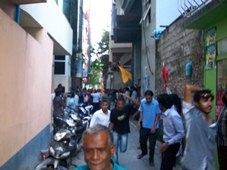
A protest launched by the ruling Maldivian Democratic Party (MDP) turned violent today after party activists clashed with supporters of former President Maumoon Abdul Gayoom in front of his residence Enderimaage, in the Maafanu ward of Male’.

MDP MPs and activists gathered outside the Supreme Court at 3pm this afternoon in anticipation of a verdict in a case filed by Umar Naseer – an interim council member of Gayoom’s Progressive Party of Maldives (PPM) – challenging the legitimacy of Thimarafushi MP Mohamed Musthafa’s candidacy on the grounds that he had a decreed debt.

Earlier in the day, the MDP national council conducted an emergency meeting and approved a resolution to launch a protest against the judiciary, claiming judges were unduly influenced by the former President and his half-brother MP Abdulla Yameen.

However a verdict was not delivered by the Supreme Court today, which said the hearing was called “to clarify a few points after reviewing the case.”

After Musthafa emerged from the hearing, the protesters marched towards Endherimaage, where violent clashes erupted between MDP activists and a few Gayoom supporters blocking the entrance to his residence.

The clashes occurred after a large piece of wood allegedly thrown from Endherimaage struck a 17-year-old demonstrator or bystander, who was immediately rushed to hospital on a passing pick-up.

Minivan News journalists at the scene observed gravel, rocks, hot water and sharp metal raining down on protesters from the top floors or terrace of Endherimaage.

Several activists claimed they saw Gassan Maumoon, former President Gayoom’s son, throw stones and pour boiling hot water on the protesters.

MDP activists meanwhile threw large stones at Endhirmaage and attempted to break down the door.

Some windows of the house were smashed while a car parked outside was damaged.

The 17-year-old is currently undergoing surgery at the Intensive Care Unit (ICU) at the Indira Gandhi Memorial Hospital (IGMH). A number of MDP MPs and senior members are waiting at the hospital.

MP Ali Waheed told state broadcaster MNBC that the boy was behind MP Alhan Fahmy when the piece of wood struck him straight on the head.

MNBC One showed blood stains on the MPs’ shirt, which Ali Waheed said resulted from the injury to the boy. The state broadcaster also reported that other people at the area were hurt from falling objects.

Speaking to Minivan News outside IGMH, the brother of the injured boy said that according to doctors “his skull was damaged and parts of the skull have gone inside his brain.”

“He was hit in the right side of his head and the left side of his body is now paralysed,” the relative said.

Doctors could not predict how long the surgery would take, he added.

”The doctors said the surgery was to remove the particles from inside his brain,” he said.

Some of the MDP supporters outside the hospital claimed the boy was hit by a wooden door hurled from the terrace of Endherimaage by Gassan Maumoom.

Police spokesman Sub-Inspector Ahmed Shiyam confirmed to Minivan News that police were investigating reports that the object was thrown from the Endherimaage building.

“We are questioning the witnesses to try and determine how this happened,” Shiyam said.

“This is a very serious issue. Because of this there might be other problems and we do not want there to be political violence.”

Meanwhile in an interview with private broadcaster DhiTV this evening, Gayoom condemned the protest and claimed the violence was organised by the government.

Gayoom said he saw senior MDP members such as Male’ City Mayor ‘Maizan’ Ali Manik and Executive Services Secretary at the President’s Office Mohamed Ziyad. Minivan News also observed Ziyad and Maizan Alibe at the protest.

“They came with their activists and attacked my home,” Gayoom said. “They attacked nearby houses as well.”

As riot police were not at the scene to intercede, said Gayoom, Chief of Defence Forces Moosa Jaleel and Police Commissioner Ahmed Faseeh should “personally bear responsibility” for the damage.

Gayoom said he would inform foreign governments of today’s events.

Likes(0)Dislikes(0)

Libyan rebels confirm death of President Muammar Gaddafi

The Libyan National Transition Council (NTC) has confirmed the death of Libyan President Muammar Gaddafi.

The NTC told several news sources, including Reuters and Al Jazeera, that Gaddafi had died of  wounds sustained during his capture near his hometown of Sirte, which has been besieged by the rebels for several months, and his body taken to a secure location.

Pictures that appeared to be of the bloodied body of the former dictator were initially published on Al Jazeera. His death was subsequently confirmed by the leaders of several countries, including UK Prime Minister David Cameron.

NTC official Abdel Majid Mlegta told news agency Reuters that the NATO warplanes had attacked the convoy in which Gaddafi was attempting to flee.

An NTC fighter in Sirte meanwhile told Reuters that he had seen Gaddafi shot after he was cornered and captured in a tunnel near a roadway.

“He (Gaddafi) was also hit in his head,” Mlegta  told Reuters. “There was a lot of firing against his group and he died.”

Gaddafi’s spokesperson Moussa Ibrahim was captured by the NTC near Sirte, while the chief of Gaddafi’s armed forces, Abu Bakr Younus Jabr, was reported killed in the fighting.

Following the announcement of Gaddafi’s death by the NTC, celebrations broke out in the capital city of Tripoli and the rebel stronghold of Benghazi.

Colonel Gaddafi was only 27 when he took control of Libya after a military coup in 1969. His 42 years of power brought wealth to Libya, but his reign was also characterised by erratic policies and terrifying punishments, based on a political platform of socialism and Arab nationalism condensed in his ‘Little Green Book’.

Minivan News obtained a copy of Gaddafi’s ‘Little Green Book’, entitled “The Solution of the Problem of Democracy”, copies of which were reportedly gifted to a generation of Maldivian school students under former Maldivian President Maumoon Abdul Gayoom.

At the time of his death, Gadaffi was wanted by the International Criminal Court (ICC) for a systematic campaign of violence to try and put down a popular uprising, which led to Western military intervention.

Diplomatically, the Maldives was meanwhile among the first countries to formally recognise the NTC rebels as the sovereign representatives of the Libyan people, and helped organise several UN Human Rights Council resolutions that increased pressure on Gaddafi and legitimised Western military intervention.

“The Maldives took these steps because of our conviction that men such as Muammar Gadaffi should not be allowed to check, through violence, the recent march of democracy and human rights across the Muslim world – the Muslim Awakening,” said Maldives Foreign Minister Ahmed Naseem in August.

“For decades, the government of Muammar Gadaffi has ruled through a system of patronage, repression and fear. The Muslim Awakening brought hope that this system could be dismantled peacefully, through dialogue, reform and free and fair elections. However, instead Muammar Gadaffi chose to use his security forces to attack and kill civilians.

“With the imminent fall of Gadaffi, the Muslim Awakening lives on, and the Maldives looks forward to welcoming a new, democratic Libyan State into the international family of nations,” Naseem said.

Likes(0)Dislikes(0)

MDP calls for nationwide protest against judiciary

The ruling Maldivian Democratic Party (MDP) has held an emergency meeting and called for a nationwide protest against the country’s judiciary, starting at 3:30pm.

The party contends that the courts have been  prioritising cases filed against MDP members and delaying cases involving opposition figures. The protest coincides with the Supreme Court’s scheduled delivery of a verdict in a case filed against MDP MP Mohamed Musthafa, requesting his candidacy as an MP be invalidated.

The case against him was filed in July 2009 by then leader of the Islamic Democratic Party (IDP) Umar Naseer, shortly after Musthafa won the election for Thimarafushi constituency against former President Maumoon Abdul Gayoom’s son, Gassan Maumoon. Umar Naseer contended that Musthafa had a decreed debt dating back to 1997 that was not paid in accordance with a court ruling.

Today’s protest was proposed to the party’s National Council by MDP MP Mariya Ahmed, the party’s former chairperson.

MP and spokesperson for the party’s Parliamentary Group, Mohamed Shifaz, told Minivan News that the protest would start at the MDP’s Head Office and assemble near properties belonging to the judicial system.

Shifaz said there had been cases filed against opposition figures “held up in the courts for years.”

”Hearings in the corruption case against People’s Alliance MP and Deputy Speaker of parliament Ahmed Nazim were closed to journalists and the public, and the court has delaying the trial,” he claimed. ”But if this was a case against an MDP member they would hasten their work to conclude the case and sentence him.”

Shifaz said one of the most important thing MDP members “have always wanted was justice.”

”The judges are still trapped under the influence of [former President] Maumoon Abdul Gayoom, his half-brother Abdulla Yameen and the like,” Shifaz said, adding that there were cases against Gayoom and Yameen filed in the court by the Presidential Commission that had never come to trial.

The Judicial Services Commission (JSC), the watchdog body charged with overseeing the judiciary, in May this year abolished its Complaints Committee citing “efficiency”, with complaints against judges subsequently forwarded for review by the legal section and Commission head Adam Mohamed, a Supreme Court Judge.

Last year the JSC received 143 complaints concerning the conduct of judges. By its own statistics none were tabled in the commission, and only five were ever replied to. Chair of the former complaints commission, Aishath Velezinee, was meanwhile stabbed in the street in January this year.

The JSC also failed to table or even acknowledge receipt of a report on the judiciary produced by the International Commission of Jurists (ICJ), which questioned whether the JSC’s possessed the technical ability and knowledge to investigate complaints and hold the judiciary accountable, as well as its independence.

Shifaz today alleged that judges had been “blackmailed by the opposition”, and said that all the MDP MPs and senior officials, along with many supporters and citizens, would join the protest today.

”We have not really decided when to stop the protest. Members of the council have suggested continuing it until we achieve justice,” he said.

Former member of the Special Majlis Drafting Committee for the new Constitution, Ibrahim ‘Ibra’ Ismail, recently filed a defamation case against the Supreme Court after it reprimanded him for calling on the public to “rise up and sort out the judges”.

In response to Ibra’s calls, the Supreme Court and the Judicial Services Commission (JSC) demanded authorities investigate the former MP, claiming that “making such statements in a free, democratic society under lawful governance goes against the principles of civilisation”.

The Supreme Court subsequently issued a writ of prohibition and took over the case against it over from the Civil Court, and as a result, Ibra said, “I now have to go before the Supreme Court and say to them ‘You have defamed me, now please decide in my favour.’”

Speaking to Minivan News today, Ibra speculated that one possible reason for the Supreme Court’s decision to suddenly pursue the case against MP Mustafa “is because Gayoom’s new Progressive Party of the Maldives (PPM) wants to win the seat in a by-election.”

“Mustafa contested the seat against Gassan Maumoon, Gayoom’s son, and won by just a few votes,” Ibra noted. “They have high hopes for the seat.”

He also speculated that the Supreme Court’s actions could be an effort to divert attention from the public forum on judicial issues being held at the Social Centre in Male’ tonight at 8:30pm, “a red herring to divert public focus. [The forum] is where things will really happen.”

Regardless of its motivation, Ibra said, the Supreme Court’s behaviour “is all but an admission that they are operating on a political platform.”

Asked whether he was participating in the protest planned by the MDP against the judiciary, Ibra said he had “no idea what they’re up to. I surmise they are showing support for MP Mustafa. I am deliberately staying away from the political players on this issue. I want the civil community to come out on this, but I suspect senior political figures will now want to start making an appearance on the judicial issue.”

DRP Deputy Leader Ahmed Mohamed today told Minivan News that protesting against the courts and the judicial system was “unacceptable”.

”It should not be done. In the past MDP has done similiar things – once they locked the Supreme Court and Judicial Service Commission (JSC), and established a court of their own,” Mohamed contended. ”These kind of actions are clearly against the constitution.”

Likes(0)Dislikes(0)

Indian Prime Minister to be invited to address parliament

Parliament today unanimously approved a proposal to invite Indian Prime Minister Dr Manmohan Singh to address parliament during a maiden visit to the Maldives.

The proposal was put to a vote after an amendment to the rules of procedure was passed yesterday to allow foreign heads of state or heads of government to deliver speeches before parliament.

“The fact that [the invitation proposal] was passed with unanimous consent of all MPs who participated in the vote has shown our Majlis’ sincerity and desire to invite and welcome Indian Prime Minister Dr Manmohan Singh,” said Speaker Abdulla Shahid after the vote.

Shahid said he would work with parliamentary group leaders to “offer a warm welcome” to the Indian Prime Minister and sent the official invitation to the Indian government today.

During the debate on the proposal, MP Ibrahim Mohamed Solih, parliamentary group leader of the ruling Maldivian Democratic Party (MDP), said he was pleased that the Indian Prime Minister would become the first foreign head of state to address the Maldivian parliament.

MP Dr Abdulla Mausoom, deputy parliamentary group leader of the opposition Dhivehi Rayyithunge Party (DRP), said Dr Manmohan Singh’s address would benefit the fledgling democracy in the Maldives.

MP Abdulla Yameen, parliamentary group leader of the newly-formed Progressive Party of Maldives (PPM), observed that Dr Singh was an economist by profession and “what the Maldives needs the most today is to strengthen our democracy and economy.”

“I am sure he will highlight these two areas in his address,” Yameen said.

Meanwhile at today’s sitting, MPs voted 52-8 to approve the signing of a treaty between the Maldives and India on mutual legal assistance on criminal matters.

Likes(0)Dislikes(0)

CSC suspends five senior DPRS officials for disclosing information

The Civil Service Commission (CSC) has suspended five high-ranking officials of the Department of Penitentiary and Rehabilitation (DPRS), pending an investigation into alleged multiple violations of the Civil Service Act by disclosing official information at a press conference.

CSC Chair Mohamed Fahmy Hassan confirmed that the Home Ministry was informed of the decision today.

DPRS Director Saud Abdul Kareem, Deputy Director Hassan Waheed, Assistant Superintendent Mohamed Asif, Asseyri Jail Senior Prison Officer Mohamed Tholal and Maafushi Jail Senior Prison Officer Ibrahim Nashid organised a press conference in their “personal capacity” on Sunday at the Trader’s Hotel.

The senior officials reportedly defended State Minister for Home Affairs Mohamed ‘Monaza’ Naeem, who is currently in charge of the department. The DRPS officials refuted claims in a petition submitted to the Home Minister alleging misconduct and abuses of power by Naeem.

In the petition, which was not signed ostensibly over fears of job security, Naeem was accused of using state vehicles for personal use and accompanying government officials and MPs on visits to jails.

The DPRS senior staff however claimed that department employees were not involved in drafting or submitting the petition, suggesting a hidden agenda behind the petition.

Local media reported this week that a complaint had been filed at the Anti-Corruption Commission (ACC) alleging that Naeem did not sign the attendance books either during his time at North Central Province Office or currently at the DPRS.

Meanwhile at Sunday’s press conference, DPRS Director Saud also defended Naeem from serious issues flagged in a compliance audit report recently made public by the CSC. Saud argued that the problems identified in the report dated from before Naeem took over from former Director General Mohamed Rasheed.

Based on the findings of the compliance audit, Rasheed was given a three-month notice and suspended by the CSC pending an investigation.

The senior officials revealed at the press conference that complaints of corruption under Rasheed were lodged at the Human Rights Commission, CSC and ACC.

A day after the press conference, the CSC issued a press statement noting that according to article 28(b) of the Civil Service Act a civil servant could not disclose information about the office or its employees learned in his or her official capacity.

The statement noted that civil service regulations specified procedures for civil servants to file complaints of legal violations or abuse of authority at the CSC.

Moreover, clause 17(a) of the regulations “stated in clear language that employees could not attend to personal matters during official hours.”

“If an employee is dissatisfied regarding a matter in his area of work, it must be solved in the way the regulations specify,” the CSC statement reads.

In addition, clause 26(g) of the regulations states that civil servants shall not defend the interests of a political appointee.

The statement contended that the press conference, which took place during official hours, was held in violation of both the Civil Service Act and civil servant’s code of conduct as well as “principles of a democratic society”.

Likes(0)Dislikes(0)

Iran secretly executing hundreds of prisoners: Dr Ahmed Shaheed

The Iranian government has secretly executed hundreds of prisoners at the notorious Vakilabad prison in Mashhad, according to an interim report to the UN by Special Rapporteur on Iran, Dr Ahmed Shaheed.

Dr Shaheed was the former Maldivian Foreign Minister under both the current and former Presidents. As the Iranian government refused to allow him to visit the country in his capacity as UN Special Rapporteur, the report relies heavily on first-hand testimonies, “the preponderance of which presents a pattern of systemic violations of fundamental human rights.”

“The most urgent issues that have been brought to the attention of the Special Rapporteur include multifarious deficits in relation to the administration of justice, certain practices that amount to torture, cruel, or degrading treatment of detainees, the imposition of the death penalty in the absence of proper judicial safeguards, the status of women, the persecution of religious and ethnic minorities, and the erosion of civil and political rights, in particular, the harassment and intimidation of human rights defenders and civil society actors,” writes Dr Shaheed.

“Several personal interviews revealed that individuals were often held in solitary confinement for long periods during the investigative phases of their cases. All of those interviewed with regard to their detention reported the consistent use of blindfolds when being transferred from solitary confinement, as well as during their interrogations.”

Human rights defenders, civil society organisations and religious actors had been charged with offences including acting against national security, insulting the Supreme Leader and “spreading propaganda against the regime”, Dr Shaheed noted.

“The majority of reports also highlight exorbitant bail requirements, reportedly totalling between US$10,000 and US$500,000, to guarantee the appearance before the court of those arrested for activities pertaining to civil, political or human rights.”

The report goes on to detail interviews with dozens of victims of the Iranian regime, including lawyers, students, artists, journalists and environmentalists as well as political activists.

In his report, Dr Shaheed raises particular concern over the use of the death penalty in cases where due process was denied to the accused, especially within the prison system.

“Secret group executions inside prisons, which reportedly occur in alarmingly high numbers, are often carried out without the knowledge and presence of families and lawyers,” Dr Shaheed notes.

“Capital punishment was also applied to cases regarding Mohareb or ‘enmity against God’, rape, murder, immoral acts or acts against chastity and kidnapping,” he added.

The report concludes with an appeal to the Iranian government to allow Dr Shaheed to visit the country so as to “develop dialogue with the authorities and either substantiate or lay
to rest allegations of human rights violations committed within its sovereign territory.”

In July, Iran’s secretary general of the country’s ‘High Council for Human Rights dismissed “the western-engineered appointment” of Dr Shaheed as Special Rapporteur as ”an illegal measure,” according to the Tehran Times.

“Iran has no problem with the individual who has been appointed as the special rapporteur, but the appointment of a rapporteur on the human rights situation in Iran is unacceptable and Iran will not accept the decision,” Mohammad Javad Larijani was quoted as saying.

Dr Shaheed is to present his findings to the UN General Assembly on October 19.

Read Minivan News’ Q&A with Dr Shaheed following his appointment as Special Rapporteur

Likes(0)Dislikes(0)