Controversial Dutch convert to give religious lecture in the Maldives

Controversial Dutch convert Arnoud van Doorn, one of the people associated with distributing the anti-Islamic short film ‘Fitna’ is due to give a religious lecture in the Maldives, Minister of Islamic Affairs Dr Mohamed Shaheem has revealed

Van Doorn was formerly a politician with the far-right Dutch Freedom Party (PVV) and had assisted PVV leader Geert Wilders in distributing the short film ‘Fitna’, which argues that Islam promotes terrorism, anti-Semitism, and violence against women.

The film received international condemnation, being branded anti-Islamic by a number of organisations including the Muslim World League and the United Nations.

Speaking to Minivan News, Shaheem said today that van Doorn is due to give a lecture on his conversion to Islam sometime during this year, adding that “a man’s past cannot be questioned after he converts to Islam”.

Meanwhile, van Doorn tweeted his gratitude towards Dr Shaheem for the invitation.

Van Doorn – who now serves as the President of European Dawah Foundation – converted to Islam in 2013, performing the Hajj pilgrimage shortly afterwards. He has also apologised for his attempts at spreading hatred against Islam.

Meanwhile, Shaheem tweeted last week (January 2) that the majority of religious speakers invited to give out public sermons during 2015 would be brought in from Western countries.

Shaheem told Minivan News that such a decision was made because a lot of the Islam related issues are also prevalent in Western countries and because the “western scholars encourage practicing moderate Islam”.

Yesterday (January 3), US Islamic scholar Yasir Qadhi announced he will be visiting the Maldives, with the Islamic ministry confirming that he will be both lecturing and delivering the Friday sermon during March.

“I will be coming down to your beautiful islands in a few months insha Allah! I will be delivering some lectures in Male and giving the khutbah,” explained the Saudi-trained scholar via his Facebook page.

Qadhi – currently teaching in Memphis, Tennessee – has been described by the New York Times as “one of the most influential conservative clerics in American Islam”.

Recent months have also seen Canadian scholar Dr Bilal Phillips and Turkish author Harun Yahya travel to the Indian Ocean archipelago to deliver religious lectures.


Related to this story

US Islamic scholar Yasir Qadhi to visit Maldives

Muslim World League to establish Islamic Centre in Hulhumalé

Likes(2)Dislikes(0)

Adhaalath Party concerned that concerts are defying Islamic teachings

The Adhaalath Party is reported to have expressed concern at what it sees as “horrifying acts that defy Islamic teachings and social convention” taking place in the country.

“Entertainment activities and events are an important part of a society” read a statement obtained by Haveeru. “But these activities must abide by our religious and social traditions”.

The comments follow controversy surrounding the New Year’s eve ‘Tourist Arrival Countdown Show’, which eventually featured Indian artists ‘Salim-Sulaiman’ after Jamaican artist Sean Paul cancelled following an online death threat.

After Sean Paul’s late cancellation, Minister of Tourism Ahmed Adeeb revealed that a second show would be held on January 8, with an announcement made at the conclusion of Wednesday’s concert that US R&B artist Akon would be performing.

Following the online threats against Sean Paul – later denounced as a hoax by authorities – members of the Adhaalath Party, including the Islamic minister criticised the decision to invite the dancehall singer.

Haveeru have today reported that the party maintained it would not support such activities, urging the youth not to invest all their time in pleasure.

“If the youth are not kept from such decadence they will undoubtedly grow into people from whom neither their families nor the society can benefit,” Haveeru reported the party as saying. “This is the bitter truth”.

Minivan News was unable to obtain comment from the Adhaalath Party members contacted prior to publication.

US R&B singer Akon will appear in Malé on January 8

After safety assurances from police prior to Wednesday night’s concert, the event passed without incident, culminating in the announcement that the country had received a record 1.45 million tourists in 2014.

Plans to hold a concert featuring Akon were attempted in 2010, before the artist pulled out citing technical and security concerns.

In the run-up to the scheduled Akon concert, Islamic minister Dr Shaheem reported receiving a number of complaints about the explicit content of the singer’s lyrics.

Adhaalath Party member Shaheem last week said that bringing foreigners to hold shows coinciding with New Year’s eve – as well as the threats made – were “unacceptable”. Adeeb later told Minivan News that the concert had been discussed at cabinet level and that Shaheem’s comments were merely his personal opinion.

While jihadist group Bilad Al Sham denied being behind the YouTube video threatening Sean Paul’s life, the group did describe the concert as “filthy” and an “ideological attack”.

Meanwhile, local religious NGO Jamiyyathul Salaf said the state was “investing in destruction” by funding the show.

Adeeb, who has taken a lead in organising and promoting the event, has insisted that attempts to “give back to the youth” will not be obstructed, tweeting: “I will stand against extremism”, and “We will not give into threats”.

In his video message announcing his performance in Malé on January 8, Akon said he would appear after receiving Adeeb’s invite, joking that he had heard everyone was blaming the tourism minister for everything that goes wrong in the country while his 2007 hit ‘Sorry, Blame It on Me’ played in the background.


Related to this story

Jamiyyathul Salaf calls on government to cancel “sinful” Sean Paul concert

Online jihadists threaten Sean Paul with death ahead of New Year’s concert

Islamic Ministry expresses concern over Akon’s SuperFest

Likes(2)Dislikes(1)

Foreigners barred from cashier jobs as President promises work for Maldivians

Economic development minister Mohamed Saeed has told local media that it will be illegal to hire expatriate workers as cashiers from April 2015.

“A large percentage of the Maldivian youth is unemployed and looking for employment,” Saeed told Haveeru. “All they need is support and guidance”.

Saeed’s announcement closely follows comments made by President Abdulla Yameen yesterday noting that new economic opportunities were being created for Maldivians, not foreign workers.

“This is not to say anything of disrespect to any neighboring or foreign countries,” said the president. “But these jobs are created by the Maldives. Be it in the tourism industry, from hotel industry work to refrigerator work, these jobs are not created for foreigners, but for the Maldivian Youth.”

Yameen’s comments came during the graduation ceremony of the ‘Dhasvaaru 2014’ vocational training programme yesterday evening (December 30).

“The government’s current policy for strengthening the economy is working towards the theme ‘Maldivian work for Maldivians’. The economy is creating jobs, the economy is filling those jobs with Maldivians. This will result in a sound economy,” said the president.

Youth employment has been a major focus of the Yameen administration, which has pledged to create 94,000 new jobs during its five year term.

Economic development minister Saeed is reported to have told Haveeru today that authorities will stop issuing quotas to foreign workers for work as cashiers, after having received a number of complaints.

During yesterday evening’s ceremony, President Yameen reminded the graduates that their job security entirely depended on their work ethic, enthusiasm, and competence – noting that these qualities must be self taught.

“Even if you know how to do the work very well, even if you are very skilled, you will still have to develop proper work ethics on your own.”

Local youth-led NGO Democracy House states unemployment among the youth (aged 15-24) may be as high as 43 percent.

Youth employment

A recent Democracy House publication, however, highlighted a “disconnect” between the current school curriculum and life skills, noting that many were “not able to handle adult responsibilities after we leave school.”

While the government has established a youth unemployment register with 13,000 individuals, youth minister Mohamed Maleeh Jamal has reported receiving complaints from businesses about individuals failing to attend interviews and quitting jobs within a few weeks.

Earlier this month, Maldives Airports Company Ltd head Bandhu Ibrahim Saleem told a Majlis committee that difficulties with local staff had resulted in a dependence on foreign employees, and even military assistance, to keep the international airport running.

After being summoned to the government oversight committee regarding the company’s failure to replace foreign staff with local employees, Saleem informed MPs that 500 employees were currently on leave.

“We loaded and unloaded cargo three times with assistance of army personnel. I don’t think any of you know this. Our employee attendance is low. The process of letting go an employee, so complicated. The foreigners are there to bridge all this,” explained Saleem.

Shortly after his appointment as home minister late last year, Umar Naseer mooted the idea of national service for the country’s youth in order to instill discipline, as well as suggesting that many jobs carried out by foreign workers could be done by locals.

“There is no task too menial or lowly for a Maldivian,” said Naseer at the launch of a ‘Blues for Youth’ camp – organised by the police with the aim of preparing adolescents for the job market.

“None of the work currently being conducted by foreigners in this country is either lowly or dirty work. It is not something that we Maldivians cannot do,” said the home minister.

The 2014 census showed the expatriate population to be 58,683, although Minister of Defence Colonel (retired) Mohamed Nazim – who also heads the immigration department – has said the real figure is more likely to be double this amount.

As part of the government’s drive to reduce undocumented workers in the Maldives, Nazim’s department has deported or repatriated 7,962 undocumented foreign workers so far this year under a voluntary departure programme.


Related to this story

Democracy House launches #policy22 campaign calling for youth participation in policy-making

MACL chief says airport dependent on foreign workers

“There is no task too menial or lowly for a Maldivian”, says Home Minister

Likes(3)Dislikes(0)

Sean Paul cancels New Year’s appearance, citing security concerns

Jamaican dancehall artist Sean Paul has cancelled his appearance at tomorrow’s ‘Tourist Arrival Countdown’ show in Malé, citing safety concerns.

“Unfortunately, the world has reached a point where cyber threats must affect real life decisions,” read a message posted on the artists official facebook page this morning.

“With that said, due to safety concerns for my crew and the people of The Maldives attending the Tourist Arrival Countdown, it is with deep regret that I have come to the difficult decision to cancel my appearance.”

The cancellation follows the posting of an online death threat against the singer last week, as well as calls from religious groups within the country to stop the performance.

Tourism minister Ahmed Adeeb has told Minivan News that Sean Paul had decided to continue with the concert before pressure at home caused him to make the last minute decision to cancel.

“We discussed the situation with Sean Paul and he was convinced to come, but the Maldives is new to the Caribbean and he was under pressure from Jamaican media and from local fans,” explained Adeeb.

Adeeb revealed that the concert will go ahead, with organisers now planning to hold an additional show on January 8. He expressed regret at events but determination to hold a successful show.

“We will not give up and will make the best performance,” said Adeeb.

A tweet from the MP Ahmed Nihan early this morning showed that preparations for the show were continuing at the national stadium.

The organisers have joined the President’s Office and Adeeb in condemning attempts to defame the Maldives’ reputation in the international media.

President Abdulla Yameen had called on all Maldivians this week to leave aside political differences to assure a safe environment for visitors, while his office declared the threat to have been a hoax.

Concerns

Sean Paul, who was to appear at the free concert upon the invitation of Adeeb, thanked his Maldivian fans for their support and wished for their continued safety.

“I would like to extend my sincere appreciation to the Government and the people of the The Maldives for their invitation and wish for them peace,” read the statement.

A joint statement from the Maldives Police Services and the Maldives National Defence Force yesterday also called for citizens to refrain from inciting fear and damaging the country’s reputation.

“It is the responsibility of the national defense forces to ensure the protection of all officials and visitors to the Maldives. Also, it is the duty of these forces to safeguard individuals who visit the Maldives for business, investment and to participate in meetings and other activities,” read the statement.

“The Maldives’ economy is dependent on income generated through tourism. The defense forces will not hesitate to bring to a stop any action which might hinder the economic development of the country.”

Police are reported to have searched a house and questioned an individual in connection to the video after obtaining a warrant. Spokesmen were not responding to calls at the time of publication.

Former President Mohamed Nasheed – himself often accused of un-Islamic policies by then-opposition groups – has tweeted this morning about the show’s cancellation.

“The government is hypocritical. However, no good is going to come to the Maldives by halting the government organized new year’s show,” said the opposition party leader.

Following the video threat posted on Youtube last week (since removed), Islamic Minister Dr Mohamed Shaheem Ali Saeed tweeted in condemnation of both the threat and the concert itself.

“Bringing foreigners to hold shows coinciding with the New Year is unacceptable. Issuing death threats is also unacceptable.”

“Lessons have to be learnt from the past of those who committed acts challenging the Muslim culture,” read a second tweet.

Tourism minister Adeeb explained today that plans for the concert had been discussed at cabinet level, and that Shaheem’s tweets were his own personal opinion and not those of the Islamic ministry.

Local religious NGO Jamiyyathul Salaf has also condemned the concert, calling upon “all brothers and sisters to refrain from participating in such misleading actions, and to do whatever you are capable of doing, in whichever field you can, to ensure that such activities cannot be carried out”.

Local media also reported that NGO Jamiyyathul Bayan had appealed to all religious leaders to take a stand against such ‘haraam’ music shows.


Related to this story

Online jihadists threaten Sean Paul with death ahead of New Year’s concert

Sean Paul threat a hoax to create atmosphere of fear, says President’s Office

President Yameen warns of adverse impacts on tourism from threats against guests

Likes(1)Dislikes(0)

Over one third of Malé City Council staff transferred to Housing Ministry

The opposition dominated Malé City Council (MCC) has expressed concern after 377 of its employees were transferred to the Ministry of Housing and Infrastructure.

Malé City Mayor Mohamed Shihab has said that all council employees working in the road maintenance department had now been transferred to the housing ministry without any prior notification.

“The council received a letter from the President’s Office saying that cabinet had decided to transfer management of the the roads to the housing ministry,” said Shihab. “The letter also read that all public squares and parks would also be transferred to the Housing Ministry”.

A statement from the ministry earlier this month said that it had taken control of 13 plots of land formerly controlled by the council and transferred the majority of the council’s public services division staff to the ministry.

The council’s jurisdiction of the city’s roads was removed in November.

Deputy Mayor Shifa Mohamed said today that the council was given two hours to provide a list of all employees to the government after which 345 employees were transferred.

“Since then they have even started requesting that certain individuals be transferred,” said Shifa. “We are unsure as to how the wages of the transferred employees will be paid, whether it will be paid by the housing ministry or not.”

The council originally had 900 employees working under it, including migrant workers, the council explained.

Mayor Shihab said that the council has only been operating within the powers granted to it by the Decentralisation Act, adding that the current government has been persistently making its work difficult.

He explained that the council has decided to file a case at the Civil Court regarding the government’s stripping of its responsibilities, and the subsequent distribution to different government ministries.

Last month, nearly all services at the council came to a halt after police confiscated important documents and several hard drives, including the server system necessary for daily operation.

Police searched and confiscated the council’s office on the night of November 26 after a search warrant was requested from the Criminal Court regarding a corruption case against council staff.

However, the council denied the corruption allegations which alleged some staff had used documents sent by the housing ministry to gain unlawful advantages.

Speaking at the time, Maafannu Hulhangu constituency councillor Shamau Shareef said the incident was one of many intended to intimidate the council and to prevent it from providing the services to the people of Malé.

Shifa has previously suggested that the government was plotting to “destroy decentralisation” after the housing ministry seized numerous plots of land from the council including two parks, artificial beach, carnival area, south harbour area, Usfasgandu, Dharubaaruge, and land near the T-Jetty in May.

In October, she complained that poor allocation of funds for road development projects under the council was one of the main reasons behind the severe floodings on the western side of the capital island during heavy downpours. The council’s jurisdictions over the roads was subsequently removed.

October also saw masked individuals wielding machetes cut down over 30 council-owned areca palm trees along the capital’s main thoroughfare, Majeedhee Magu.

Meanwhile, former President Mohamed Nasheed alleged police involvement in the chopping down of the palm trees while naming several Special Operations officers after the council had requested that the public submit any information about the issue.


Related to this story

Malé City Council close to shut-down after police confiscate documents and server system

Malé City Council helpless as housing ministry takes over all land, public services staff

Can decentralisation take root in the Maldives?

Likes(3)Dislikes(0)

Building trust – Transparency Maldives calls for enhanced asset disclosure

Transparency Maldives’ 2013 Global Corruption Barometer Survey found 97 percent of respondents believed corruption was a problem in the public sector, while the 2013 Maldives Democracy Survey revealed an alarming lack of confidence in democratic institutions.

“Most striking of all, however, are the remarkably high levels of cynicism of the public. Maldivians are far more cynical than publics in other comparable countries,” concluded the ‘Democracy at the Crossroads’ report.

A position paper released by the anti-corruption NGO last week, however, suggests a way to repair the country’s threadbare trust in its public figures through an enhanced asset disclosure regime.

“Asset declaration generally requires a certain category of public officials—also identified as ‘politically exposed persons’ to describe individuals entrusted with prominent public functions—to disclose their financial and business interests,” explains TM’s paper.

TM note that an effective asset disclosure system can detect corruption, demonstrate the government’s commitment to fight corruption, help make officials accountable, and – crucially – increase public trust.

The paper was produced after consultations with the Anti-Corruption Commission, the secretary general of the Majlis, and with then-Auditor General Niyaz Ibrahim.

Niyaz was replaced in October after amendments to the Audit Act were rushed through the Majlis just days after a report from his office implicated tourism minister Ahmed Adeeb in a US$6 million corruption scandal.

The same report also noted that Adeeb had failed to disclose his assets – as required under Article 138 of the Constitution – since his appointment to the post in 2012.

Hobbled system

Although Adeeb has denied the allegations and since pledged to release his financial statement to the media, TM Advocacy and Communications Manager Aiman Rasheed feels the incident provides a perfect example of why asset disclosure is essential.

“I believe that it is a right for the public to know the truth regarding the allegations of corruption against Minister for Tourism Adeeb. Asset disclosure is a mechanism to put to rest baseless allegations and to hold to account perpetrators of corruption.”

Rasheed noted that, under the current asset disclosure system, it is impossible to either prove or disprove whether such charges are politically motivated attempts at defamation – as Adeeb has claimed.

“In addition to the already hobbled asset declaration system, the absence of a verification mechanism means allegations of corruption—in particular, those concerning misappropriation of funds and illicit enrichment—are not investigated,” read the position paper.

TM argue that various systemic deficits are hindering the effectiveness of the current constitutional provisions.

Members of the Majlis – perceived as the most corrupt institution in the 2013 corruption barometer – have previously told Minivan News of their support for asset disclosure, with some reservations.

While all MPs asked about the practice in a series of interviews prior to this year’s Majlis elections backed the system, some suggested the disclosure of family members’ assets and of individuals’ net wealth to be too invasive.

Former MP Abdulla Mausoom – who did not stand for re-election – also suggested that full public disclosure may reduce the quality of MPs, suggesting that voters may be reluctant to select less wealthy individuals.

A number of MPs suggested an alternative system whereby additional income gained after entering the Majlis be used to gauge any potentially illegal enrichment.

Recommendations

While the Constitution requires the president and cabinet, MPs, and judges to submit annual declarations to the auditor general, the Majlis, and the Judicial Services Commission, respectively, the subsequent information is not available to the public.

The former auditor general told TM that a lack of punitive measures for those failing to submit information rendered the system ineffective.

TM noted that the current system does not require the submission of assets for spouses and children of public officials “which makes cases of illicit enrichment and conflicts of interest invisible and harder to detect.”

“Moreover, the disclosure of business and activities outside the jurisdiction of Maldives, and details of substantial gifts or benefits are also not a requirement in the current system,” stated the paper.

Furthermore, a number of high level officials are overlooked altogether by the current system, including the vice president, members of independent institutions, officials of state-owned companies and even the auditor general himself.

The position paper concluded with a number of recommendations including greater uniformity in current regulations as well as support for their implementation.

TM called for full public disclosure of assets, noting the positive impact on public perceptions of corruption in countries where the public could access such records.

It was also noted that an independent verification mechanism would identify conflicts of interest as well as reducing undue influence.

“Perceived corruption is lower in countries that verify officials’ statement than in countries that do not verify declaration content,” said the NGO – citing the 2006 Global Corruption Report of its sister organisation Transparency International.

The same report was also mentioned to suggest that sanctions for non-compliance would also enhance the public’s trust in their democratic institutions.

“Implementing an strong asset disclosure regime would show the state’s commitment to fight corruption and would give a strong message to public servants, a message of zero tolerance to corruption,” said Rasheed.

“We must do away with the culture of secrecy to prevent illicit enrichment, fraud, etc, and to do that, asset disclosure is key.”


Related to this story

Transparency Maldives reveals growing perception of corruption

Democracy survey reveals crisis of confidence in democratic institutions

Likes(2)Dislikes(0)

President Yameen warns of adverse impacts on tourism from threats against guests

President Abdulla Yameen has warned of adverse impacts on tourism from threats against tourists and urged Maldivians to leave aside political differences to assure a safe and secure environment for investors and tourists alike.

Yameen’s statement comes in the aftermath of a death threat issued against Jamaican dancehall artist Sean Paul who is scheduled to perform in Malé on New Year’s Eve.

“Even if such incidences do not actually disrupt the peace, if [guests] believe there is any danger, if they believe there is a threat, we are in effect pouring water into a bottomless container,” Yameen said in a speech in Addu City last night.

The President’s Office yesterday said that the online death threat against Sean Paul was a “local hoax” aimed at damaging the country’s reputation.

An investigation has revealed the threat is “designed to dissuade visitors, create an atmosphere of fear” and aimed “at tarnishing the longstanding reputation of the Maldives as a destination of peace, security, and tranquility,” the President’s Office said.

The video, which has since been removed, promised Sean Paul that “the world will see your burnt and blood drenched dead body,” should he perform in the Maldives.

Representatives of the singer are reported to be undecided about whether the performance is to go ahead.

The tourism ministry’s statistics have meanwhile revealed a 5.1 percent decline in tourist arrivals in November compared to the same month last year.

However, the Maldives welcomed 1.1 million arrivals by November’s end due to a strong growth in arrivals in the first half of the year. The figure amounts to a 7.9 percent increase in arrivals compared to 2013.

President Yameen said the government aims to bring the world’s wealthy to the Maldives and said Maldivians must find common ground with the government despite differences in political ideologies.

“With utmost sincerity, I note it will not be the same leaders ruling the country. Today it is me. Tomorrow it will be someone else. But Maldivians will continue to live on this land. This land must be peaceful,” he said.

Maldivians must not allow foreigners the opportunity to influence the country’s internal affairs, he continued.

“We must not call on foreign militants to come to the Maldives claiming the situation is bad in the Maldives,” he said.

The opposition Maldivian Democratic Party (MDP) has expressed concern over declining tourist arrivals at the onset of the peak tourist season in the Maldives, blaming the government for lack of a clear policy on tourism and ad-hoc decisions to levy additional tourism taxes.

Noting a seven percent decline in arrivals from European Union, a 22 percent decline from Eastern Europe, four percent from the United Kingdom, 24 percent from France, three percent from Italy, and a 13 percent decline from India in November, opposition leader and former President Mohamed Nasheed in a tweet said “the government’s policy will damage the industry”.

Tourists from the European Union made up 43.3 percent of arrivals while Chinese tourists made up 31.4 percent of arrivals. Russian arrivals declined by 31 percent this year due to the economic downturn in the country.

Nasheed said the threat against Sean Paul is the latest threat to artists by extremists in the country, arguing that “Government support for and refusal to prosecute them [extremists] will affect tourism.”


Related to this story

Sean Paul threat a hoax to create atmosphere of fear, says President’s Office

Expansion of economic activity in third quarter driven by tourism sector: MMA

Tourist arrivals register 10 percent growth in first three quarters of 2014

Likes(1)Dislikes(1)

Democracy House launches #policy22 campaign calling for youth participation in policy-making

Democracy House Maldives has launched its ‘#policy22’ campaign, highlighting the importance of youth participation in decision-making at the policy level.

The campaign – given its name in relation to the percentage of the Maldivian population classed as youth – seeks to create a platform where the youth’s concerns can be heard and acted upon by decision makers.

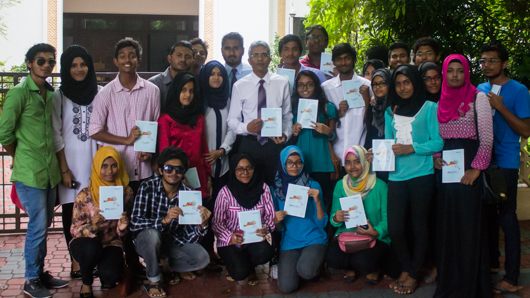
The youth-led NGO released a report titled ‘Youth Voices’ on December 25, with members of the youth community presenting the report to MPs outside the Majlis, and taking ‘selfies’ with those in support of the campaign.

Democracy House’s Dhumya Mohamed explained that the booklet contained concerns put forward by the youth through a number of consultations as well as including information from several reports on Maldivian youth.

“Over 40 individuals attended the last consultation. The most pressing issue brought forward by the youth was lack of opportunities to participate in policy level decision making,” said Dhumya.

The report notes that there is currently no culture of consultation with the youth despite making up such a significant proportion of the population. The report requests parliamentarians to get youth opinion during the legislative process and to ensure the freedom of expression guaranteed by the constitution.

Published last month, the booklet highlights additional problems brought forward during the consultations such as unemployment and the exploitation of youth in politics.

Youth unemployment

In the report, Democracy House expressed concern at the high youth unemployment rate, noting that there is little awareness and no proper enforcement of the Employment Act.

Suggestions to tackle the high rate of unemployment include utilising youth centers for youth leadership and capacity building programmes, and encouraging young entrepreneurs.

While speaking to Minivan News, Minister of Youth and Sports Mohamed Maleeh Jamal said that the government’s aim is to reduce unemployment to three or four percent in the next five years.

Maleeh pointed out that a youth unemployment register has been created and that there are 13,000 registered individuals within the system.

“We provide the database for organisations who are seeking recruits. However, we have received complaints of individuals not reporting to interviews, work, and also of quitting work within weeks,” said Maleeh.

Maleeh speculated that a significant percentage of youth unemployment is voluntary while stating that the government is running awareness campaigns and career guidance to increase the motivation of young people.

The #policy22 booklet noted a “disconnect” between the current school curriculum and life skills noting that many were “not able to handle adult responsibilities after we leave school.”

Democracy House states youth unemployment to be as high as 43 percent, though the International Labor Organization (ILO) estimates the figure to be at 30 percent. The current government has pledged to create 94,000 jobs during its term.

One request mentioned in the #policy22 booklet appears to be being addressed by the government, with President Abdulla Yameen launching the ‘Get Set – Maldives Youth Entrepreneurship Program’ last month. The scheme aims to provide MVR200 million (US$12.9 million) in loans to assist the development of small and medium sized enterprises.

Exploiting youth for political gain

The Democracy House report claimed that there is “misconduct and illegal activities” aimed at youth from the political arena such as “bribing and promises of advancement such as job opportunities, during campaigning”.

The report said that the youth is often used to gain numbers at political rallies and mobilised at political events “basically to make noise rather than do anything substantial”.

A 2012 assessment on gangs operating in Maldives said that many gangs receive income through exchanges with political actors or business people and that the exchange is usually in the form of money or sometimes alcohol.

The study read that gangs were given incentives to participate in political protests, start political riots, destroy property or injure a third party, and that money is often given to gangs to initiate a fight so as to divert media attention from a political issue.

Despite the strong youth platform of President Yameen’s election campaign, youth leaders have previously criticised the government for a failure to consult with youth groups when formulating policy.

Democracy House called for campaign activities to be better monitored, and candidates that go against political party and elections laws and regulations to be penalised.

Founded in 2008 the NGO aims to promote a culture of democratic ideals and values in the Maldives and amongst its people through educational initiatives.


Related to this story

Youth leaders critical as government assures youth issues are being addressed

Youth Minister promises employment to all youth by 2015

President Yameen launches MVR200 million ‘Maldives Youth Entrepreneurship Programme’

Likes(4)Dislikes(0)

Foreign Minister calls for greater resilience to climate change impacts

Minister of Foreign Affairs Dunya Maumoon has called on the Maldives to build individual and collective resilience to face rising seas and extreme weather events associated with climate change.

In a statement issued on Friday commemorating the tenth anniversary of the 2004 Indian Ocean Tsunami, Dunya said: “Floods and rising sea levels threaten the loss of our livelihoods, our homes, our cultures and our very existence.”

“The words of scientists that have for years warned of frequent natural disasters due to climate change, are undoubtedly proving to be true.”

The Maldives must take action at home to build resilience, and continue to urge other countries to do their part to combat climate change, Dunya said.

Although the Maldives has urged the international community to reach a strong and legally binding agreement to reduce carbon emissions, President Abdulla Yameen’s administration has begun exploring for oil in the Maldives.

In October, Fisheries Minister Mohamed Shainee said a research vessel has found hydrocarbon source rock in the Maldives.

December 26 is marked in the Maldives as National Day of Unity to celebrate the collective tsunami relief effort.

“What we saw that day was the true spirit of oneness, our common history and the bonds that bind us together like no other,” Dunya said.

At a ceremony to mark the tenth anniversary of the tsunami on Thursday, Housing Minister Dr Mohamed Muizz admitted government negligence in the delays in constructing permanent housing.

Muizz said the government has now completed a majority of the 338 remaining houses for families made homeless by the tsunami. He claimed there are no families living in temporary shelters at present.

The 338 houses include 41 on Thaa Atoll Madifushi, 87 on Gaaf Alif Dhaandhoo, 50 on Gaaf Alif Nilandhoo, 76 on Gaaf Alif Vilingili and 84 on Gaaf Alif Maamendhoo.

Only 51 houses remain unfinished. These include one house on Dhaandhoo, five on Nilandhoo, 12 on Villingili, and 33 on Maamendhoo.

Muizz said the government hopes to complete all houses by the end of 2014.

The housing projects in Thaa and Gaaf Alif atolls were initially commissioned to Maldivian company Vimla and an unnamed foreign company.

The government this year handed over the projects to the Maldives National Defense Forces (MNDF), state-owned Maldives Transport and Contracting Company, the Maldives Road Development Company, and several local companies.

The government is to give these families a grant of MVR 25,000 to buy furniture as they move into their new homes.

In his speech, Muizz also claimed the opposition had obstructed the construction of the permanent housing by vandalising buildings. He did not provide additional details.

President Yameen at the National Day of Unity function urged Maldivians to control negative emotions such as anger, hatred and envy in order to work towards sustainable unity.


Related to this story

“We do not want to be in Paris to get perished,” Maldives ambassador tells climate change convention

Maldives to begin oil exploration with assistance of research vessel

Maldivians could be among first climate refugees, warns Nasheed

Likes(2)Dislikes(0)