Immigration department suspends exit permit regulations indefinitely

The recently introduced exit permit scheme has been suspended indefinitely after complaints about the regulation, which requires foreign workers to obtain permission from their employers before leaving the country.

Immigration Information Officer Hassan Khaleel told Minivan News today that the regulation was suspended after several complaints from different organisations, including numerous airlines and NGOs.

“The exit permit issue has been suspended from today onwards. We will consider and address every single complaint received and look at the regulation from several perspectives before re-implementing,” he explained.

The regulation, which came to effect on October 19, required expatriate workers to present a form signed by their employer at airport immigration before leaving the country.

Speaking at the time, Khaleel explained that the introduction of the exit permit system came after requests from employers concerned at the number of expatriate workers leaving the country without their employer’s permission.

He added that the immigration department believed the new regulations might help lessen the illegal practice of withholding passports – which has been described as ‘rampant’ in the Maldives by the US State Department.

Local NGO Transparency Maldives (TM) expressed concern, however, that the exit permits would exacerbate the well-documented abuses within the immigration system.

Advocacy and communications manager at TM, Aiman Rasheed, said that the regulation might have the same effect of withholding the travel documents of the worker, leading to the “employer having control over the mobility of the worker”.

“While this is an infringement on the freedom of movement for workers, it also presents opportunities for perpetuation of bondage, trafficking, etc, by limiting movement of the worker,” said Aiman.

While exact figures are unavailable, the number of expatriate workers in the Maldives has been estimated to be as high as 200,000 – equivalent to two thirds of the local population.

Long viewed as a country with a poor record on combatting human trafficking, the Maldives was this year removed from the US State Department’s Trafficking in Persons (TIP) watchlist.

Exit permit systems are also operated in other nations with large numbers of expatriate workers – such as the UAE and Qatar, although Qatar announced earlier this year that it was to abolish the practice after pressure from human rights groups.

Likes(3)Dislikes(0)

Agreement signed with Russian authorities for cooperation in criminal cases

An agreement was signed today between Russia and Maldives for cooperation in criminal matters at a ceremony at Traders Hotel.

Visiting Russian Prosecutor General Yury Chaika – also Russian Justice Minister – signed on behalf of Russia while Prosecutor General Muhthaz Muhsin signed on behalf of the Maldivian government.

Details of the agreement have not yet been shared with the media.

Muhsin told local media that a Memorandum of Understanding (MoU) would also be signed today to facilitate training for Maldivian prosecutors in Russia and allow Russian prosecutors to work in the Maldives.

The agreements were arranged by former Prosecutor General Ahmed Muiz during his tenure – which ended twelve months ago, Muhsin added.

In August, a 25-year-old Russian woman caught smuggling 2kg of cocaine was deported before the conclusion of her trial at the Criminal Court, which had been stalled due to language barriers.

In July, the Russian Foreign Ministry had expressed outrage over the arrest of Roman Valerevich Seleznyov, 30, from the Ibrahim Nasir International Airport (INIA) and called it a “kidnapping” by the U.S. Secret Service.

Home Minister Umar Naseer later said the Maldivian government would have “acted differently” if the home ministry had been aware that the alleged hacker expelled on July 5 was the son of a Russian lawmaker.

Selezynov’s father Valery Seleznyov called on Russian authorities to impose economic sanctions on the Maldives and reportedly offered US$50,000 for evidence proving his son was detained by US intelligence agents.

US officials have maintained that Maldivian authorities acted under their own laws, expelling Seleznyov from the country before his subsequent arrest.

Seleznyov is accused of bank fraud, identity theft, and other cyber crimes. The US have described him as “one of the world’s most prolific traffickers of stolen financial information”.

Russia currently ranks fifth in terms of the number of tourist arrivals to Maldives, and is one of the fastest growing tourist markets in the world. More than 33,000 Russian tourists arrived during the first five months of 2014,

Likes(2)Dislikes(0)

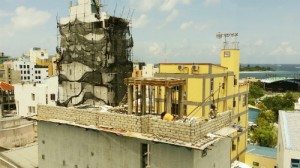
Majlis accepts legislation on building code

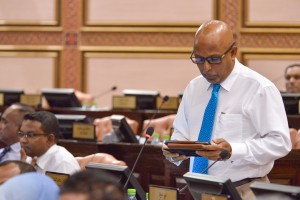
The People’s Majlis yesterday accepted for consideration a bill submitted on behalf of the government by Progressive Party of Maldives (PPM) MP Saudhulla Hilmy on building codes.

Presenting the 90-page draft legislation (Dhivehi) at yesterday’s sitting of parliament, Hilmy explained that the proposed law would establish a legal framework and set safety standards for the construction industry in the Maldives.

“One of the most important reasons for [submitting] this bill is because important measures are not taken due to the lack of a bill or law while many people have died or suffered serious harm in construction accidents,” the MP for Thinadhoo North said.

The submission of the bill was delayed due to changes made by ministers under successive governments, he added.

The bill proposes the formation of the ‘Maldives Building and Construction Authority’ to function under the Ministry of Housing and Infrastructure.

The authority would be tasked with formulating rules and regulations, setting standards, and ranking and registering contractors and industry professionals.

All MPs who spoke during the ensuing debate spoke in favour of the bill and noted the importance of introducing a Building Act.

However, several MPs argued that the building and construction authority should be an independent institution free from political influence.

Some MPs objected to contractors from the atolls having to travel to Malé to seek permits or licenses while others suggested that the law should incentivise or provide equal opportunity for small and medium-sized construction companies.

Opposition Maldivian Democratic Party (MDP) MP Mariya Ahmed Didi said the submission of important legislation drafted during the MDP’s three years in government were delayed due to the “coup on February 7, 2012.”

As a result of changing regulations and the lack of a comprehensive building code, Mariya said several of her constituents in the Manchangoalhi ward of Malé had requests for construction permits declined.

MDP MP Ahmed Nashid contended that fines specified in the bill were excessive and suggested revisions at the committee stage.

PPM MP Jameel Usman meanwhile noted that the bill includes provisions for incentivising the hiring of locals in the construction industry.

He suggested that the law should also specify a reasonable period for approving construction permits and recommended improvements by the committee.

Jumhooree Party (JP) Leader Gasim Ibrahim contended that the faults in the bill were too numerous to be rectified at the committee and said it should be withdrawn.

As audit reports were exposing “serious corruption and negligence” by government ministries, Gasim argued it would not be advisable to require approval and permits from the housing ministry.

Following the preliminary debate, the bill was accepted unanimously with 61 votes in favour and sent to the national development committee for further review.

Likes(3)Dislikes(0)

Government ordered to pay MVR349 million in damages for terminated transport contract

The Civil Court has ordered the Maldives government to pay MVR348,995,154.60 (US$22.5million) to Dheebaja Investment Pvt Ltd for the abrupt and unlawful termination of a contract to establish ferry services in four northern atolls.

The verdict, dated October 23, said President Dr Mohamed Waheed Hassan’s administration had terminated a contract with Dheebaja on 30 May 2013 claiming the company had failed to fulfill terms by suspending ferry services to Baa Atoll Fulhadhoo and Fehendhoo Islands.

The transport services contract had been signed under former President Mohamed Nasheed in February 2010. Dheebaja was to provide ferry services in Noonu, Raa, Baa and Lhaviyani Atolls in exchange for 47 plots of land to build ferry terminals and tourism development.

The Civil Court found that the Waheed administration’s termination of the contract was unlawful, stating the government had violated the contract first by failing to hand over promised plots of land to Dheebaja.

The court ordered the Maldives government to pay nearly MVR349 million in damages to Dheebaja for it’s unilateral decision to terminate contract with only five days of notice. The amount is to be paid back within six months.

The Maldives is also currently facing a potentially crippling payout to India’s GMR infrastructure for the abrupt and unlawful termination of a contract to develop Ibrahim Nasir International Airport.

President Waheed had declared the US$511 million contract “void ab initio” (invalid from the outset) in November 2012 and gave GMR a seven-day ultimatum to leave the country.

However, a Singaporean arbitration court in June declared the agreement to be “valid and binding” and said the government and Maldives Airports Company Pvt Ltd (MACL) are liable to GMR for damages.

The arbitration tribunal is in the process of determining a compensation figure. Although GMR had initially sought US$1.4 billion – a figure that exceeds the Maldives’ annual budget – government sources say the figure will be between US$300million and US$600million.

The World Bank in 2013 said the payout would place severe pressure on the country’s already critically low foreign reserves.

Since President Nasheed’s controversial ouster in 2012, President Waheed and incumbent President Abdulla Yameen’s administration have terminated or renegotiated several contracts signed under Nasheed.

The government, on October 22, terminated an agreement made with India based Tatva Global Renewable Energy to provide waste management services in Malé and renegotiated a housing contract with India’s TATA group.

The US$190 million housing project had been delayed for more than two years.

Indian companies blamed the government of creating “undue challenges” for political gain to derail their substantial investments in the Maldives in a 2012 report in India’s Business Standard.

Nasheed’s government had been ousted after months of a vitriolic nationalist and anti–India campaign.

Several of Yameen’s ministers also served in Waheed’s cabinet. They include Tourism Minister Ahmed Adeeb, Defense Minister Mohamed Nazim, Finance Minister Abdulla Jihad, Minister of Housing and Infrastructure Dr Mohamed Muizzu, and Minister of Islamic Affairs Dr Mohamed Shaheem Ali Saeed.

Incumbent Foreign Minister Dunya Maumoon served as Waheed’s State Minister for Foreign Affairs while Vice President Dr Mohamed Jameel Ahmed held the position of Home Minister.

Since assuming power, Yameen has strengthened trade and political ties with China and the Maldives is now a partner in China’s flagship Silk Route.

Likes(2)Dislikes(0)

Newly planted areca palms uprooted on housing ministry orders

Reporting by Ismail Humaam Hamid

The Maldives Road Development Corporation (MRDC) has uprooted three newly planted areca palms in Malé today on the Housing Ministry’s orders.

The opposition dominated Malé City Council (MCC) replanted three trees this morning after masked men – believed to be police officers – chopped down 30 palm trees in the early hours of October 24.

“Today we planted three trees near the Malé City Council. However, workers from MRDC uprooted the trees moments later. They said they were acting on orders from the Housing Ministry,” Malé City Mayor Mohamed Shihab told the press today.

The police refused to help despite repeated requests, but watched the trees being removed, the mayor said.

“We requested assistance from the police as per rights afforded to local councils in the Decentralisation Act. But the police on the scene refused to help us. We have decided to lodge a complaint at the Police Integrity Commission (PIC).”

The MCC will also file a court case against MRDC for its illegal actions, the council said, arguing that the MRDC must defer to the MCC and obtain permission from the council in matters concerning Malé City.

According to newspaper Haveeru, senior members of the ruling Progressive Party of the Maldives (PPM) believe the opposition Maldivian Democratic Party (MDP) use the areca palm trees for black magic to curse President Abdulla Yameen with ill health.

“[They] believe that [President Yameen’s] health worsens with every palm frond that falls off the areca palm trees. And that his health would worsen further with every tree that blossoms,” an anonymous government official was quoted as saying.

The MDP-dominated city council had planted the palm trees – donated by the Indian High Commission – in October 2011 as part of efforts to make the capital greener.

Meanwhile, former President Mohamed Nasheed alleged that masked Special Operations (SO) police officers in plain clothes chopped down the palm trees with machetes.

Patrolling police officers from the Maafanu police station arrested two of the perpetrators, Nasheed told the press last week, claiming that the suspects were handed over to the SO on the orders of a senior official from the SO command.

The pair were taken to the police Iskandhar Koshi barracks in an SO vehicle, he claimed.

Commissioner of Police Hussain Waheed held a press conference last week during which he denied police involvement in the incident, dismissing the opposition leader’s allegations as “baseless”.

Speaking to the press today, Deputy Mayor Shifa Mohamed accused the government of chopping down the areca palms.

“The government is involved in the chopping down of the trees. There were a lot of SO police officers in Malé that night. However, it is unclear whether they were trying to stop the vandalism or assisting in the crime,” she said.

The council said it will lodge a complaint over MRDC’s actions with the Local Government Authority, the Human Rights Commission of the Maldives, and international organisations.

Several areca palm trees were also uprooted during protests against the MDP government in January 2012.

Likes(1)Dislikes(0)

“Significant changes” brought to education sector, says minister

Education Minister Dr Aishath Shiham informed the press yesterday of “significant changes” brought to the education sector during the first year of the current administration, including introduction of Quran as a subject for grades one to seven, Arabic language in 20 schools, and vocational training.

“Historic work” has been done during the year under the ‘No Child Left Behind’ education policy, Dr Shiham said at yesterday’s press conference.

In addition to the science, business, and arts streams in secondary education, Dr Shiham said a new “vocational education stream” would be introduced next year.

A pilot programme has been conducted this year in eight schools in Malé with 188 students, and four schools in the atolls with 279 students, she said.

She noted that the ‘B-tech’ diploma level two certificate awarded for vocational training was of the same standard or qualification as the O’ Level certificate.

The number of students who fail O’ Levels – the pass rate for which was 46 percent in 2012 – and “get left behind” would be significantly reduced as a result, she added.

Moreover, 68 students from grades eight and nine were currently studying polytechnic courses for a level three certificate, she continued, which was also of the same standard as the O’ Level certificate.

The ‘Dhasvaaru’ programme launched this year meanwhile involved identifying disinterested or poor students, she explained, of which 180 students have started working in 30 private and government-owned companies.

Opposition concerns

In an open letter – signed by former education minister Dr Musthafa Luthfy – sent to the education ministry last week, the opposition Maldivian Democratic Party’s (MDP) education committee expressed concern with students allegedly being deprived of secondary education in favour of vocational training.

Under the new policy, the MDP noted that certain students are “labelled” as poor at grade eight and taught only Dhivehi, Islam, Mathematics, and English without a plan or approved curriculum.

“And after teaching these four subjects at school, students are to be sent to private parties in the name of teaching work,” the letter stated, noting the absence of a curriculum or syllabus for training the students.

The education committee also contended that singling out certain students for “second class” vocational education would become an obstacle in the future to conducting programmes for all secondary school students.

Moreover, the state’s “discrimination” among students would create problems for social equality, peace, and stability in the future, the letter added.

Offering a “narrow” education to selected students from age 14 onward would also prevent schools from providing remedial or special assistance to bring the students up to the average standard, the education committee argued.

The letter also noted that vocational training was not reserved for students with low grades under the new education curriculum framework.

“Achievements”

Education Minister Dr Shiham meanwhile referred to designating two schools – in Kulhudhufushi and Addu City – for Arabic medium instruction as a “very big achievement.”

Moreover, Dhivehi, Islam, and Quran were being taught to 417 Maldivian children in Sri Lanka while efforts were underway to provide the subjects to Maldivians residing in Trivandrum, India.

A volunteerism programme would also be conducted in all schools across the country next year, she continued, and life skills training has been offered in 180 schools this year after training 196 teachers.

Additionally, orientation programmes have been conducted to introduce civic education in 2015 and resource packs have been prepared.

Among other first year achievements listed in a document shared with the media yesterday included establishing five units in five islands for children with special needs and two early intervention centres in Kulhudhufushi and Fuvahmulah.

While MVR17 million (US$1.1 million) was spent this year to provide facilities such as furniture and computers to schools, 96 classrooms have been constructed and work was underway on constructing 128 further classrooms.

Additionally, MVR1.5 million (US$97,276) was spent to improve school laboratories and MVR1 million (US$64,850) was spent to purchase exercise equipment for schools.

Under an agreement signed with the health ministry in February, 5,792 grade one students have been screened so far and a child protection policy has been formulated.

While 16 school counsellors have completed a four-month online “solution focused brief therapy” course offered by the University of Wisconsin, a survey to assess physical and psychological health of students is expected to be completed on November 16.

More than 1,000 higher education opportunities have been offered this year as student loans and scholarships.

As part of preparations to roll out the new curriculum in 2015, 239 “curriculum ambassadors” and 1,820 principals and teachers have been trained.

Likes(1)Dislikes(0)

Maldives not obliged to consult neighbours before joining China’s Silk Route, says foreign minister

The Maldives, as an independent and sovereign nation, is not obliged to consult other countries before making foreign policy decisions, foreign minister Dunya Maumoon told the People’s Majlis today.

The foreign minister appeared in parliament to respond to a question tabled by opposition Maldivian Democratic Party (MDP) MP Ahmed Nashid concerning the Maldives’ participation in the Chinese ’21st Century Maritime Silk Route’ initiative.

President of the People’s Republic of China Xi Jingping has called on the Maldives “to get actively involved” in the creation of a maritime trade route linking China to the east coast of Africa and the Mediterranean.

Nashid, MP for Shaviyani Komandoo, asked whether neighbouring countries in the Indian Ocean were consulted before the decision was made.

“If we join this project, is it likely that the longstanding close relations we have with neighbouring countries could be adversely affected?” he asked.

In response, Dunya noted that the agreement signed with the British in 1965 to secure independence “states in clear language that the Maldives is not obliged to consult or seek consent or approval from any other nation to implement Maldivian foreign policy.”

Former Presidents Ibrahim Nasir and Maumoon Abdul Gayoom did not join any “military or political alliance” during the Cold War, she added, out of fear of losing the independence gained in 1965 as the Maldives would be obliged to consult major powers before making foreign policy decisions.

“We should all know that the interest of any foreign country should not take precedence over Maldivian national interest,” she said.

MDP MP Ibrahim Mohamed Didi – a retired brigadier general – asked whether relations with India could deteriorate if Chinese naval activity is conducted in a Maldivian port, which would threaten Indian “geopolitical interests”.

Dunya declined to answer citing national security concerns and advised raising the issue through parliamentary committees.

Asked if India has expressed concern with the decision, Dunya said the Indian government also welcomed the Silk Route initiative during Chinese President Xi’s visit to New Delhi in September.

Foreign policy

Dunya said President Abdulla Yameen’s foreign policy was based on Article 115(d) of the Constitution, which states that the president has a duty “to guarantee the independence and territorial integrity of the Maldives, and to promote respect for national sovereignty in the international community.”

The government decided to participate in the Silk Route initiative as it would promote national interest and benefit the Maldivian people through trade and commerce, she said.

Dunya referred to a joint communique issued during President Xi’s state visit in the Maldives in September, which declared that the Maldives “welcomes and supports the proposal put forward by China to build the 21st Century Maritime Silk Road, and is prepared to actively participate in relevant cooperation”.

Fostering ties with South Asian countries and ensuring national security was one of the most important aims of the government’s foreign policy, she continued, noting that Maldivian security was intertwined with Indian Ocean regional security.

The Maldives would consult all nations and work together to ensure regional security and stability, she assured.

Former President Mohamed Nasheed has criticised the decision to join the Silk Route initiative, contending that it would threaten Indian Ocean security and risk putting the Maldives in the middle of war or disputes between Asian powers.

China’s rising economic presence in the Indian Ocean region has stoked concerns in New Delhi that China is creating a “string of pearls” to encircle India, including Chinese investments in ports and other key projects in Sri Lanka and Pakistan.

Asked if closer ties with China would adversely impact relations with India or Japan, President Yameen told reporters upon returning from a visit to China in August that Sino-Maldives economic cooperation would not affect “the very friendly, close relations with India”.

“All these projects are also open to India and we are doing a lot of diplomatic work with India,” he said, referring to his administration’s decision not to sign a Status of Forces Agreement (SOFA) with the United States as an example of cooperation.

Likes(2)Dislikes(0)

Public debt to reach MVR31 billion by end of 2014, reveals finance minister

Public debt is expected to reach MVR31 billion (US$2 billion) or 67 percent of GDP at the end of 2014, Finance Minister Abdulla Jihad has revealed.

“Despite achieving economic progress, the Maldivian economy is fragile and the Maldives’ financial situation is not in the most appropriate state at present,” Jihad cautioned in his budget speech at parliament today.

“The main reason for this is the year on year increase of the budget deficit and the state’s debt because of expenditure being higher than state revenue in recent years,” he explained.

The country’s balance of payments worsened and foreign currency reserves dwindled as a result of both the persisting fiscal deficit as well as outflow of foreign currency, Jihad added.

He noted that the dramatic increase of expenditure on public sector wages, subsidies, and social security programmes was also responsible for the fiscal imbalances.

Expenditure on state employees in 2014 would reach MVR15.8 billion (US$1 billion), Jihad observed, while MVR3.2 billion (US$207 million) would have been spent on subsidies and social security benefits.

Out of every MVR100 collected as revenue or income, Jihad explained that MVR40 was spent on employees and MVR22 on social protection and subsidies.

Consequently, the government was facing serious difficulties in “managing the state’s cash flow and financing the budget” as well as securing loans for budget support, Jihad said.

The budget was mainly financed by selling and rolling over treasury bills (T-bills), he said, which involves repayment at high interest rates.

According to the central bank, the total outstanding stock of government securities was MVR13.6 billion (US$881 million) at the end of September.

The growth in government securities was contributed by the increase in the amount of T-bills issued by the government to manage its cash flow requirements,” reads the Maldives Monetary Authority’s (MMA) latest monthly economic review.

Targeting subsidies

In May, Jihad continued, the government ceased obtaining funds from the central bank to finance the budget and the inflation rate has remained low as a result.

The government has also decided to freeze hiring new employees in 2015 in favour of conducting training programmes and optimising productivity. The defence minister last week criticised civil servants, saying they were providing “poor service” to the public.

Parliament needed to pass legislation on the state’s wage policy for a lasting solution to discrepancies in pay among state institutions, Jihad suggested.

He also revealed plans to revise the electricity subsidy, which he said currently benefits the affluent more than the needy.

Targeting the electricity subsidy to low-income families or households would save 40 percent of the government’s expenditure on the subsidy, Jihad explained.

The government was also working on revising the Aasandha health insurance programme – expanded by the current government – to ensure sustainability, he added, in addition to plans to target food subsidies in 2015.

In May, MMA Governor Dr Azeema Adam called for “bold decisions” to ensure macroeconomic stability by reducing expenditure – “especially the un-targeted subsidies” – and increasing revenue.

The MMA had previously warned that shortfalls in revenue and overruns in expenditure could jeopardise the country’s debt sustainability.

The International Monetary Fund (IMF) has also recommended targeting subsidies to the poor.

“The electricity subsidy is one that goes to even the richest strata of society. Basic food subsidies are being enjoyed now by the resorts, and never mind the resorts, are being enjoyed by wealthy foreign visitors who stay at the resorts,” Dr Koshy Mathai, resident representative to Sri Lanka and Maldives, told MPs on the public accounts committee in February.

“That to us seems like a totally unnecessary policy.”

He added that “substantial savings” could be made from the budget by targeting subsidies to those most in need of assistance.

Despite the cost-cutting measures, Jihad cautioned today that the government’s recurrent expenditure could not be reduced while people reside in 188 geographically dispersed islands.

Providing services to small populations was difficult and costly, he observed, stressing the importance of formulating and implementing a population consolidation policy.

On plans to tackle the high rate of unemployment, Jihad noted that MVR332 million (US$20 million) was allocated in the 2015 budget for higher education programmes, with special emphasis on training doctors and health sector professionals.

The implementation of the government’s economic policy – with the introduction of special economic zones – would spur job creation and attract foreign investment, he added.

Jihad appealed for support from MPs for the government’s proposed revenue raising measures, warning that public services could be disrupted if anticipated revenue is not realised.

“The estimated budget for 2015 is a budget that lays the foundation to build the future of the current generation and future generations,” he said.

Likes(2)Dislikes(0)

Finance minister presents record MVR24.3 billion state budget to parliament

Finance Minister Abdulla Jihad submitted an estimated 2015 state budget of MVR24.3 billion (US$1.5 billion) for parliamentary approval today – 35 percent higher than this year’s record MVR17.96 billion (US$1.16 billion) budget.

“The estimated budget deficit for 2015 is MVR1.3 billion [US$84 million],” Jihad said in his budget speech at today’s sitting of parliament.

“This is 2.5 percent of GDP. The deficit is to be financed by MVR1.1 billion [US$71 million] estimated from foreign parties and MVR223 million [US$14 million] estimated from domestic finance.”

After expressing fears in August that the deficit for this year would spiral to MVR4 billion – or 10 percent of GDP, Jihad told MPs today that the 2014 deficit was expected to be just MVR1.6 billion (US$103 million) as a result of compromises by parliament to the government’s revenue raising measures.

Recurrent expenditure in 2015 is expected to be MVR15.8 billion (US$1 billion) or 65 percent of the budget, he explained.

Salaries and allowances for state employees accounts for 26 percent of the total budget, Jihad noted, followed by social security and welfare (13 percent) and administrative costs (8 percent).

Capital expenditure meanwhile accounts for 30 percent of the budget, Jihad continued, which includes MVR6.3 billion (US$408 million) for the Public Sector Investment Programme (PSIP) and loan repayment.

The forecast for government income or revenue is MVR21.5 billion (US$1.3 billion), Jihad said, including MVR13 billion (US$843 million) in tax revenue, MVR6.8 billion (US$440 million) in non-tax revenue, and MVR1.7 billion (US$110 million) in free aid.

Jihad noted that MVR3.4 billion (US$220 million) is anticipated from new revenue raising measures, which includes revisions of import duty rates from July onward, the introduction of a ‘green tax’, fees from investments to special economic zones, income from the home ownership programme, and leasing 10 islands for resort development.

Fund allocations

The MVR2.9 billion (US$188 million) allocated for the education sector is 32 percent higher than 2014, Jihad continued, which includes higher expenditure on scholarships, student loans, training programmes, financial assistance for pre-schools, and the cost of implementing the new national education curriculum.

The MVR2.1 billion (US$136 million) allocated for the health sector is 21 percent higher than 2014, Jihad noted, while MVR3.2 billion (US$207 million) was allocated for social security and subsidies provided by the National Social Protection Agency, including MVR1 billion (US$65 million) earmarked for the MVR5,000 (US$324) a month pension for the elderly and MVR750 million (US$48 million) for the unlimited Aasandha health insurance programme.

Some 52 programmes would be conducted to upgrade three hospitals to tertiary level and develop infrastructure in regional hospitals and island health centres, he noted.

While MVR90 million (US$5.8 million) was allocated for fisheries and agriculture, Jihad said MVR50 million (US$3.2 million) was allocated for providing financial assistance for small and medium-sized enterprises.

“As development of Maldivian youth is one of the most important pledges of this government, MVR300 million [US$19.4 million] has been budgeted to conduct different programmes aimed at youth,” Jihad said, which was 55 percent higher than 2014.

Funds have also been earmarked for the celebration of the 50th anniversary of independence, Jihad noted.

Notable PSIP projects include the development of the Ibrahim Nasir International Airport (INIA), the Malé-Hulhulé bridge project, the Indira Gandhi Memorial Hospital (IGMH) renovation project, water and sewerage projects for 66 islands, coastal protection for 22 islands, 23 new harbour construction projects and 38 ongoing harbour projects, and waste management projects in 105 islands.

Funds have also been allocated in the budget for a renewable energy project expected to commence next year, he added.

A total of MVR695 million (US$45 million) was earmarked for housing programmes, Jihad continued, which includes the construction 1,985 housing units in Hulhumalé.

In addition to a project to resolve flooding in the capital, Jihad said 15 road construction projects in other islands were included in the budget.

2014

While the projected deficit for 2014 was MVR1.3 billion, Jihad said the deficit at the end of the year would be MVR1.6 billion (US$103 million) as a result of compromises by parliament to the government’s revenue raising measures.

A proposed Tourism Goods and Services Tax hike was delayed from July to November while the reintroduction of the US$8 bed tax was delayed by a month.

While the finance ministry anticipated payments for resort lease extension fees in full, parliament revised the budget for the fees to be paid in instalments over 18 months.

Jihad meanwhile noted that the International Monetary Fund’s (IMF) global economic outlook released in October predicted economic growth in 2014 and 2015 after the recovering from the global financial crisis and recession of 2007 to 2012.

Accordingly, domestic economic growth in 2014 was expected to be 8.5 percent, Jihad said, while the forecast for 2015 is 10.5 percent – driven by tourism, telecommunications, and transport.

The tourism industry is expected to grow by 8 percent with 1.5 million tourist arrivals, he added, while the inflation rate has meanwhile remained steady at 1.4 percent as of September.

On the balance of payments, Jihad revealed that the current account deficit would reach US$290 million or 10 percent of GDP, although it is projected to decrease to US$215 in 2015.

The official reserve at the end of 2014 is expected to be US$445 million – projected to rise to US$460 million next year.

Likes(1)Dislikes(0)