Salaf to research and determine “the right president” for 2018

Religious NGO Jamiyyathul Salaf has issued a press statement calling on Maldivians to be patient while the NGO researches possible candidates that may run for the Presidential elections in 2018, and determine whether he is the right person to rule the country.

Salaf claimed that the presidential pledges candidates make during the campaigns are “nothing but poems”.

Salaf said that politicians and all the country’s democratic and irreligious systems had been unable to direct the Maldives towards a safe harbour.

‘’Those who are trying to change the laws concerning religion to destroy the country, have been granted more protection than Maldivian citizens,’’ Salaf said in the statement.

‘’We would like to announce that it is not something that Salaf will tolerate.’’

The NGO claimed that there were people in the Maldives challenging Islamic Sharia, criticising the religion of Islam and calling for the permitting of alcohol, homosexuality, and fornication.

‘’We are preparing for 2018. We will scan everyone that may run for the Presidential Elections and will advise the citizens about the right person,’’ said President of Salaf Sheikh Abdulla Bin Mohamed Ibrahim.

‘’We will form a committee and they will obtain information on figures who will run for the elections.’’

He said the NGO would  write letters to all political parties and request they inform Salaf about their presidential candidate and provide profiles, as well as information on the the services they have provided for Maldivians.

Likes(0)Dislikes(0)

Criminal Court orders MDP MP Adil be held in detention until trial concludes

The Criminal Court today granted the Prosecutor General (PG) permission to hold Maldivian Democratic Party (MDP) MP Hassan Adil in detention until his trial reaches conclusion.

The court has said that permission was granted upon a request made by the PG’s office today during the first hearing of the trial.

Police have alleged that Adil sexually abused a 13 year-old girl belonging to a family with whom he was close friends.

The Criminal Court said the court warrant to hold Adil under detention until the trial end was issued according to article 28 of Child Sex Offenders Special Provisions Act.

The Criminal Court issued a warrant for the arrest of Adil in April. His detention was subsequently extended, and then later reduced to house arrest.

Police concluded the investigation of Adil in May and forwarded the case to the PG.

As the trial concerns to a child, the Criminal Court has decided to conduct the trial closed to the public and journalists.

Article 73[c]2 of the constitution states that a member of the parliament will be disqualified if found guilty of a criminal offence that involves a prison sentence of more than twelve months.

Adil was formerly a member of the Dhivehi Qaumee Party (DQP) prior to joining the MDP last year.

Likes(0)Dislikes(0)

President’s Office encouraging unprofessional journalism, claims MMC

The Maldives Media Council (MMC) has accused the President’s Office of discouraging journalists from following the council’s rulings and code of conduct.

The MMC’s claims came after Press Secretary for the President’s Office Mohamed Zuhair told news outlet Sun Online that the government did not support any action against journalists of the Sun Media Group, after three journalists conducted an investigation into illegal prostitution in the Maldives.

The Media Council declared the standard of the written articles were unprofessional and that the articles indicated that the journalists may have been engaged in sexual activities with the prostitutes, and that their style of writing encouraged the activity. It referred the matter to the Prosecutor General.

However, Zuhair told the paper that the government did not consider the articles to be inappropriate, or containing words that indicated that the journalists might have involved themselves in any criminal offences.

In a press release issued by the MMC following the remarks made by the Press Secretary, the MMC accused the President’s Office of obstructing the council’s efforts to establish a culture in which journalists worked within a code of conduct.

The council said the executive was speaking in such a way that implied it could influence the work of the council, which was irresponsible.

‘’It makes the public and the media lose confidence in the legal duty of the council to set the media in the right direction,’’ said the Media Council in the statement. ‘’The remarks made by the Press Secretary were made in a way that it encouraged such writings, and was said without showing any respect to the Islamic principles, laws and the beliefs of an Islamic society.’’

The council also noted that it has declared that the articles were inconsistent with the Media Code of Ethics and that the editorial management of Sun had already apologised over it.

After Sun Magazine published series of articles sharing their experience with prostitutes working at spas and salons in Male’, the MMC pulled the magazines from circulation and forwarded the case to the Prosecutor General to file criminal charges against the paper.

Press Secretary for the President Mohamed Zuhair was not responding at time of press.

Likes(0)Dislikes(0)

Comment: The Israel hypocrisy

On Monday June 6 the Adhaalath Party released an ominous statement claiming that allowing the Israeli national carrier El Al to fly to the Maldives is “a threat” to the country’s economy and statehood.

Maldivian authorities have announced that the airline could begin operations in December this year.

In a valiant effort to shoulder the unwieldy burden of speaking for the 1400-year old Islamic faith, the Adhaalath Party has responded to the news by threatening “nationwide protests”, exhorting citizens “who love their religion” to join them.

It has become absurd theatre to watch the Mullah reach for the raw teats of the Arab-Israeli conflict, and milk the tragedy for all it is worth.

Hawks and doves

First, the facts – the world has overwhelmingly recognised the need for Palestinian statehood.

In his 2009 address to the Muslim world at Cairo, President Barack Obama reaffirmed US support for a two-state solution, recognising both parties as having “legitimate aspirations.”

In perhaps the most pro-Palestinian speech by a US President in history, Obama also asserted in a major speech last month that “the borders of Israel and Palestine should be based on the 1967 lines”, while also calling for full and phased withdrawal of Israeli military forces from Palestine.

Various polls show that a majority of Palestinians and Israelis support the idea of two states co-existing peacefully side-by-side.

Pope Benedict XVI, Bishop of Rome, and leader of the billion-strong Roman Catholic Church, has also thrown his weight behind the idea of Palestinian statehood. Celebrities, left-leaning Israeli parties, public intellectuals and several high-profile Jews and Jewish organisations around the world have also lent their support to the Palestinian cause.

Why, then, has this convoluted tangle remained unsolved for decades?

Perhaps the answer partly lies in the reactions to the US President’s conciliatory speech.

While Obama’s statements were well-received among Palestinian lobbyists, the right-wing militant Hamas wasted no time in heaping scorn on it. On the other side of the fence, within hours of the US government’s announcement that it “does not accept the legitimacy of continued Israeli settlements”, hawkish elements in the right-wing Israeli government announced the construction of 1500 more housing units in occupied Jerusalem.

Peace, unsurprisingly, is not welcome by those whose politics depend on division and hatred.

Selective outrage

The Adhaalath party has stated that “the government should not establish ties with oppressive states that violate international human rights conventions.”

Fair enough. But one must wonder why this magnanimous vision is not being applied uniformly to our ties with the rest of the world.

Why does this party not take the moral high-ground on our ties with China? After all, that country has, by numerous accounts, oppressed the people of Xinjiang and Tibet regions for over half a century.

During Chairman Mao’s infamous Great Leap Forward, between 200,000 and one million Tibetans – of whom Muslims form the largest minority – lost their lives. To this day, the Tibetan government operates in exile and their displaced populations have little hope of returning to their homeland.

Why does the Mullah not demand “nationwide” protests against the twice daily flights operating from India – a country that, according to Amnesty International and various other Human Rights NGOs – has continued to exercise brutal military control over Kashmir since 1947?

Apologists for the “boycott Israel” camp insist there is an as-yet-unexplained “difference” between the Palestinian situation and the rest of the world’s humanitarian crises.

Don’t the Kashmiris, who have been fighting for a homeland and self-representation in the most militarised region of the world for a full year longer than Palestinians, find equal sympathy in the heart of the otherwise easily outraged Mullah?

There are, after all, 1.5 million refugees from the vivisected remains of Muslim-populated Kashmir, according to the United Nations Commission on Human Rights.

Why should the mass-graves unearthed in Kashmir be less of a humanitarian catastrophe than Palestinians going without gasoline?

And why doesn’t the big-hearted Mullah condemn the Kashmiri Islamists as well? Surely, the murder and displacement of over 400,000 Kashmiri Hindus, which the US Congress declared an act of ethnic cleansing in 2006, qualifies as a crime against humanity?

Pray why haven’t the Mullah’s minions gathered outside the Turkish Embassy in Male’ with their pitchforks?

Surely, the Turkish government’s continued denial of justice for the genocide of hundreds of thousands of Armenians – by burning, poisoning, drowning and marching till exhaustion – counts as “violating Human Rights conventions”?

If the Mullah contends those wounds have been healed and forgiven by the passage of time, then perhaps he could also explain his meek silence over the ongoing genocide in Darfur – an area approximately the size of Spain.

Even the Sudanese authorities have officially admitted to a death toll of nearly 20,000 since 2003 – which outnumbers the total Palestinian deaths over the last three decades. Aid agencies on the ground in Darfur have estimated about 400,000 dead as a result of systematic ethnic cleansing, aided and funded by the Sudanese government.

A party that can issue swift press releases condemning the President’s dance moves can certainly spare a word of condemnation for the war crimes in neighboring Sri Lanka, and perhaps organise “nationwide” protests against their airlines as well.

The Maldives continues to maintain ties with undemocratic, repressive regimes throughout the Middle East.

Syria has killed over a thousand Muslims and erased the whereabouts of another ten thousand over the past two months.

Bahrain has ruthlessly cracked down on doctors and nurses attending to injured Muslim protesters.

Should we also reconsider our ties with Pakistan in the light of increasing evidence that points towards decades of sponsored terrorism that has cost numerous lives in bombings of Mosques and market places?

If the argument is that Palestine deserves a special consideration because of the holy sites present there, then the shouldn’t the esteemed Mullah be the first to demand that the Maldives cut off all ties with the Kingdom of Saudi Arabia – a nation that violates numerous International Human Rights conventions, and is widely alleged to have tortured thousands of its own citizens?

The answer in all these cases, one might reasonably expect, is an unreserved “No”.

Why then does the Mullah vent his spleen so selectively over just one nation – Israel – with a passion and vehemence that he denies for all the other inhuman atrocities taking place in the world?
What explains the Mullahs’ double standards in singling out just one nation – Israel – while maintaining healthy relations with the United States, Italy, England and Australia – all of whom have allegedly ‘wronged our Muslim brothers’ by participating in a global war on abstract concepts?

This two-faced approach towards foreign policy is patently dishonest, disingenuous, and riddled with bias. Genuine empathy and humanitarian compassion is unconditional and transcends all petty distinctions of race, ethnicity and artificial geographical boundaries.

In that context, what is being passed off as ‘humanitarian concern’ by the Adhaalath party, unfortunately, smacks of mere political opportunism.

Sovereign Republic or Arab Satellite state?

A nation is truly sovereign when its leaders have both the will and capacity to take independent decisions that places at its heart the best interests of its citizens.

A note-worthy example is India – the first non-Arab nation to establish diplomatic relations with the PLO, and well-known champion of the Palestinian cause, that nevertheless maintains strong defense and diplomatic ties with Israel.

An indicator of their successful foreign policy would be that despite being a severe critic of Israeli military misadventures in Lebanon and Gaza, India emerged on a 2009 poll conducted on behalf of the Israeli Foreign Ministry, as the most “pro-Israeli” nation in the world ahead of the US!

The sovereignty of Dhivehi Raajje is put under a cloud by those who place Arab priorities above the interests of Dhivehin.

The Maldives was the second nation – and the first Muslim nation – in the world to recognise the state of Israel. Israel became the first modern country to send an ambassador to the Maldives in 1965, during the reign of the Sultan Mohamed Farid.

When the Indian Ocean tsunami struck in 2004, Israel was among the first nations in the world to respond with emergency relief measures. Israeli Magen David Adom has provided training and support to Maldivian armed forces, police and fire departments.

Israeli medical volunteers from ‘Eye from Zion’ have conducted free treatment camps in the Maldives late last year, in a bid to strengthen friendly relations between the two nations.

However, just as with the Hamas and the Far-Right parties in Israel, Maldivian Islamist groups responded to the extended olive branch with claws and daggers.

If hostility seems insurmountable, it is because there are those who cannot stand the idea of peace.

Era of Peace and Dialogue

According to Maulana Jamil Ilyasi, who led an official delegation of the All India Organization of Imams and Mosques, a body representing over 500,000 Imams across India, to Israel in August 2007, “The time for violence has come to an end, and the era of peace and dialogue between Muslims and Jews has begun”

The Senior Indian cleric also called upon Pakistan to recognize the Jewish state, saying “The Jews I have met here say that we are all children of Abraham, part of the same family… The Muslims in India should come and see things for themselves.”

According to Transport and Communications Minister Adil Saleem, 500 Maldivians have traveled to Israel this year – and history bears witness that people-to-people exchanges are the surest way of ensuring lasting peace and mutual understanding.

Those who willfully spurn all attempts at peace have no moral authority to complain about violence.

So when vested interests claim that an Israeli airline would threaten the country – it is a blatant attempt at fanning the fires of hostility.

This so-called “threat” to our statehood and economy comes only from those who seek to stoke baseless controversy for mere political drama.

All comment pieces are the sole view of the author and do not reflect the editorial policy of Minivan News. If you would like to write an opinion piece, please send proposals to [email protected].

Likes(1)Dislikes(0)

The Maldives’ first ‘fair trade’ shop opens in Male’

The exotic necklaces made out of coconut shells are showcased alongside coconut shell bangles. The top shelf is filled with pieces made of wood, vases, containers and objets d’art.

In Male’ where shops with brimming shelves is the norm, ‘Athamana’ sets itself apart. This is the first fair trade shop in Maldives, filled only with products made by Maldivians.

“We wanted to create an outlet for people who do handicraft in Maldives, to enable them to get a good price for their products, and introduce the concept of fair trade here,” says Fathimath Shafeega, country manager of the NGO Live & Learn.

The NGO works on protecting and providing education on environment and promotes sustainable development with a fair trade culture. Their shop Athamana showcases traditional and new products created in Maldives.

Across the archipelago

Mixed within the range of traditional products like fine mats ‘Salavaai Kuna’ and lacquer ware, are innovative new products like virgin coconut oil and shoulder bags, and jewellary made from discarded denim items.

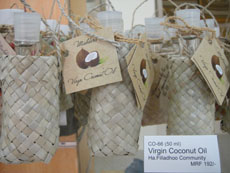
The virgin coconut oil produced on Filladhoo in Haa Alif Atoll is packaged in hand-woven baskets made out of screw pine leaves and comes in 50 and 120 ml bottles.

“Coconut oil is a new product that we are conducting in Filladhoo,” says Mohamed Moosa, vice-president of the island NGO ‘Ekuveringe Dhirun’ (ED).

The production of virgin coconut oil is a project in the northern islands organised by Live and Learn with funding from the Food and Agriculture Organisation of the United Nations and the cooperation of the local Ministry of Fisheries and Agriculture.

“We put out a notice, and from those interested we gave priority to people with low income to join this project,” says Moosa.

The team consists of 18 workers. Moosa explains that from the profit they make, 60 percent goes to the workers, while 30 percent is invested in developing the project and 10 percent is retained by ED.

“It provides a good income, and we already have two resort buyers, one of which is Bandos Island Resort.”

In the shop alongside each product the producer’s name is displayed, giving the item a personalised touch.

Virgin coconut oil produced in Haa Alif Atoll
More to come

In the near future the shop will have lotions and soaps, made from the byproducts of coconut oil. Other items to come include chilli sauce being produced on Veymandoo in Thaa Atoll from the fiery Maldivian chillli ‘githeyo mirus.’

There are challenges in making these ventures a success.

“We have issues of transport and the fact that most communities have not been very active in production before,” explains Shafeega. As most Maldivians tend to work individually, the issue of getting them grants has also arisen, as cooperatives are being registered for grants at the Ministry of Economics. “We are working on getting grants for individuals also.”

The Athamana shop also acts as a focal point for buyers, to enable the producers to have access to the retail market. Different buyers have shown interest.

“We have some buyers including high end resorts like Soneva Fushi,” says Shafeega. The shop receives orders and helps in delivering them. A lot of effort has gone in producing the Maldivian products on display, showcased in Live and Learn’s new Athamana shop.

The participation of society and businesses will be vital to make the first fair trade shop a success, and in enable the revival of traditional Maldivian products and the promotion of new ones.

Likes(1)Dislikes(0)

Four arrested for suspected involvement in illegal prostitution

Police have arrested two females and a male for alleged involvement in illegal prostitution inside a beauty salon in Addu City.

A police spokesperson confirmed that the three were arrested last night and that two females were from Thailand and the man was a Maldivian.

‘’They were arrested last night around 9:30pm during a special operation conducted following a report,’’ a police spokesperson said, confirming the arrests were made on Gan.

He declined to provide further information.

Local media reported that the owner of the beauty salon has also been arrested.

Addu Councilors Hussain Hilmee and Hussain Fahmy both said they did not have any additional information regarding the incident.

However, local media SunFM – which recently investigated illegal prostitution in the Maldives – reported that the three were arrested inside a salon in Addu while they were engaged in sexual activity.

The news outlet also reported that a 17 year-old girl was working as a receptionist at the salon.

Recently, the Maldives Media Council (MMC) called on the editors of Sun Online and Sun magazine to issue a public apology following the publication of a series of stories in which journalists wrote detailed and lurid accounts of their visit to an illegal brothel.

The Sun’s investigation of illegal prostitution in the Maldives revealed that ‘massage’ and medical treatment centers were being used a front for Male’s sex industry.

The Sun journalists who patronised the salons had ‘massages’ and reported that illegal prostitution was conducted widely and freely inside such places.

Some salons offered them group sex, while most provided a list of available girls with ‘special features’ for different prices.

Likes(0)Dislikes(0)

Tea shop closed by MFDA after live goat found in toilet

The Maldives Food and Drug Authority (MFDA) has shut down a number of well-known Male’ restaurants and tea shops for hygiene breaches.

One famous tea shop on Majeedhee Magu, ‘Faseyha Point’, was closed after inspectors found a live goat tied up inside the teashop’s toilet.

MFDA said the tea shop’s hygiene condition was very poor.

Well known restaurants West Park and Raaveriya in Maafannu have also been closed in the MFDA’s hygiene crackdown, after both failed to meet the authority’s standards.

Media Coordinator of MFDA Jameela Mohamed told Minivan News that the authority shut down West Park because cats were roaming around in the service area.

‘’The restaurant’s kitchen door is always open and cats will enter the kitchen,’’ she said.

Jameela said the Raaveriya restaurant had house flies in the kitchen and lizards in their storeroom.

‘’So far we have checked 82 places and eight have been shutdown,’’ Jameela said.

Both Raaveriya Restaurant and West Park are often used as caters for celebrating wedding parties, birthdays and other such events.

Manager of West Park, Abdulla Gadhir, told newspaper Haveeru that cats do not enter the kitchen area of the restaurant.

He told the paper that there were two cats that lived in the fishing area right next to the restaurant.

Manager of Raaveriya, Ahmed Shareef told the paper that the restaurant sprayed insecticide weekly to terminate houseflies and other insects.

Director General of MFDA Shareefa Adam recently told Minivan News that any premises that were shut down could reapply to open again once they had corrected issues raised with their business.

Shareefa said the MFDA were using “basic” minimum hygiene standards such as cleanliness and preventing foreign materials from getting into food when inspecting the food outlets.

Likes(0)Dislikes(0)

Dhaka Embassy to issue Maldives work visas pre-arrival in trafficking reduction effort

Bangladeshi nationals will be issued work visas by the Maldives High Commission in the national capital of Dhaka, in an attempt to address booming numbers of workers arriving in the country.

Immigration Controller Abdulla Shahid told Minivan News that Bangladeshi workers would require additional documents verified and issued in Bangladesh before their work visas and ID cards could be issued in the Maldives.

Following the cabinet decision to implement the changes on Tuesday (June 7), Minivan News understands that the government will outline the particulars of the new system during a press conference early next week.

Newspaper Haveeru reported that the decision would also include a programme to identify and deport illegal workers currently in the country.

Shahid has previously estimated that the number of expatriate workers in the Maldives would reach 100,000 in June – a third of the population. The government has no figures, but estimates that up to half that number may be illegal.

The high percentage of foreign workers relative to the Maldives’ foreign currency income has forced the government to confront the country’s heavy reliance on expatriate labour as part of wider economic reforms.

recent report by economics lecturer and Assistant Manger of the Maldives Monetary Authority (MMA)’s Monetary policy and Research Division, Ibrahim Ameer, estimated that each expatriate worker was remitting US$100 per month to their families back home.

Ameer estimated that this was draining the country of US$8 million in foreign currency every month – in comparison, a greater amount than the country was earning from the Tourism GST.

Stopping traffic

Former Bangladeshi High Commissioner Professor Selina Mohsin told Minivan News last year that 40 Bangladeshi nationals were arriving at reception daily, “having come to the Maldives and found they have nothing to do.”

In early 2010, as an experiment, Professor Mohsin stopped attesting work permit requests and observed that this hardly dented arrivals.

Under Maldivian law, foreign workers arriving in the Maldives must have a work permit issued by the Immigration Department. This is obtained through an employer or agent, who must first request a foreign worker quota from the Ministry of Trade and Human Resources.

“The Maldivian [side] gets into connection with the Bangladeshi brokers, gets a business permit from the Ministry of Human Resources, says they want to recruit and gets a quota for more workers than they require – if they require any at all – and then ask a Bangladeshi counterpart to bring in the workers,” Professor Mohsin said in an earlier interview with Minivan News, explaining that brokers would then charge individual workers between up to US$4000 to arrange their employment in the Maldives.

In many cases the family home and land was sold or mortgaged to raise this fee, split two-thirds in favour of the Maldivian broker.

One application that arrived on her desk – approved by the Ministry of Human Resources – was a request for 1800 workers for an unspecified construction project.

“Those people would have come [to Male’] had I not checked. Had I not done it, 1800 people would have sold their homes and become delinquent in the Maldives. This did not bother a Maldivian broker. Hell is not good enough for the people who are doing this,” Professor Mohsin told Minivan News at the time.

One broker investigated last year by Bangladeshi authorities was thought to be involved in a labour trafficking operation to the Maldives worth upwards of US$3.6 million.

Shahid acknowledged that the forging of documents in both the Immigration Department and the Human Resources Ministry was the subject of an ongoing police investigation.

The new requirements would not impact the Maldives’ policy of issuing tourist visas on arrival, he said, as this was already policed by requiring visitors to have a pre-existing hotel reservation.

Meanwhile, immigration authorities today arrested three people for attempting to leave the country on fake passports, including a Malaysian man, a Chinese woman and her 18 year old son.

Haveeru reported that the Malayisan man was believed to have arranged false Taiwanese passports for the other two passengers that were arrested.

Police said the matter was a suspected case of human trafficking.

Likes(3)Dislikes(0)

MJA concerned over recent attacks on journalists

The Maldives Journalists Association (MJA) has expressed concern over recent attack on two journalists, and has alleged that such attacks are increasing.

The association said it had reports that a journalist from newspaper ‘Dhiislam’ was attacked when he attended a show held at Thajudheen School.

‘’He was physically attacked and he was forced to delete the photos he took,’’ the MJA said in a press release. ‘’It is unacceptable and we condemn it.’’

MJA said Youth TV’s assistant manager Ibrahim Muaz was dismissed from his job, which it said was due to “a political issue.”

It also called everyone to provide opportunity for the conduct of independent journalism in the Maldives.

Muaz was dismissed after he allegedly leaked a picture of Maldivian Democratic Party (MDP) parliamentary group’s leader and MP ‘Reeko’ Moosa Manik sitting inside the Maldives National Broadcasting Corporation (MNBC)’s library going through the archives of videos of former President Maumoon Abdul Gayoom.

The picture was leaked to local news outlet ‘Sun online’ and a source told the paper that Moosa visits the MNBC library very often and takes speeches and video clips of Gayoom and senior officials of the former government to the president’s office.

Sun online that time reported that in the picture Moosa was viewing the interview given by former president following the death of Evan Naseem in 2003, who died inside Maafushi Jail.

However, MNBC told the media that the dismissal of Muaz was not related to the leaked pictures of Moosa.

Likes(0)Dislikes(0)