Vice president says children must not be harmed in the name of Islam and culture

Vice President Dr Mohamed Jameel Ahmed has stated that truly loving a child is to refrain from inflicting physical harm on the child in the name religion and culture, and from committing sexual harassment against children on the pretext of providing an Islamic upbringing.

Speaking at an event held in the National Art Gallery on Monday (October 15) to inaugurate the Minstry of Law and Gender’s new programmes, Jameel emphasised the importance of protecting the rights of children.

The new programmes focus on providing services for women, children, the elderly and people with special needs.

Jameel described the ministry’s programme as an effort to establish Maldives as the country in the region in which most fundamental rights are protected.

He went on to say that it is imperative that children are not discriminated based on their gender, and that they are not deprived of any educational opportunities or health benefits, local media reports.

Jameel opined that those who need social protection should not be perceived as a burden on the state, before using examples from Islamic history to demonstrate how society benefits from these people.

The gender ministry’s programme includes the release of two books regarding internet safety, the introduction of a domestic violence database, formulation of regulations for the establishment of day care centres, and home care services for the elderly.

Additionally, employment letters were also handed over to two persons with special needs. The two job placements are at Fenaka Corporation and Island Aviation Services.

Likes(3)Dislikes(0)

Three persons injured in Kulhudhuhfushi bike accident

A speeding motorcycle hit two pedestrians yesterday night (October 14) near the jetty in the island of Kulhudhuhfushi in Haa Dhaalu Atoll.

Both the pedestrians and the driver are currently receiving medical attention in the island’s hospital. While further details of injuries sustained have not been made public, police assured that none of the victims are in critical condition.

According to the police, the driver was 20-year-old male, while the pedestrians were women aged 52 and 57-years-old.

Likes(1)Dislikes(0)

Youth ministry moves Youth Day to November 17

Minister of Youth and Sports Mohamed Maleeh Jamaal has announced that Youth Day will now be marked on November 17 each year, instead of March 13.

Maleeh said the reasons for the change would be revealed during the Youth Awards ceremony next month, saying only that “November 17 is a very special day”.

November 17 coincides with the day incumbent President Abdulla Yameen took oath of office and assumed responsibilities of the head of state.

Since assuming office, Yameen has spoken often of the importance of youth development, pledging to turn the Malé suburb of Hulhumalé into ayouth city of 50,000 with modern sports facilities and light industries.

The Youth Awards Ceremony will take place on the newly assigned Youth Day during an event held at the Dharubaaruge convention centre.

“This time, we have included a special category that was previously not included. That is the field of voluntary work,” Maleeh told the press yesterday (October 14).

“We have seen such voluntary work being done in the recent Eid celebrations, in various government organised events and in the work of various clubs and organisations. Therefore, we have included this in this year’s awards’ marking criteria.”

Likes(1)Dislikes(0)

Home minister and pro-government MPs discuss legislative steps to curb gang activity

Home Minister Umar Naseer has begun meetings with pro-government MPs about necessary amendments to the laws in the initiative to inhibit gang-related criminal activity.

Naseer met with parliamentarians from ruling Progressive Party of Maldives (PPM) in Muleeaage yesterday (October 14), as well as meeting with Jumhooree Party parliamentarians at their main campaign offices.

The proposed changes include amendments to the act on stopping gang-related crimes and to laws prohibiting the carrying of sharp weapons as well as a temporary act on stopping gang activity, Naseer told local media.

“The delay in tackling gang related crimes is a deep concern even of parliamentarians. We have now had the chance to confer with them and see what their thoughts on the matter are,” Naseer said.

“Reactions from parliamentarians of both Jumhooree Party and Progressive Party of Maldives were positive to my recommendations. At the moment, I cannot share further details of the suggested changes,” Umar Naseer told Minivan News today.

Earlier in the week, however, Naseer explained to local media some of the changes he proposed to bring to these acts.

Changes include the introduction of “soft curfews” on identified gang members, changes in the process of completing an investigation, in taking the matter to court, and in the completion of criminal cases in court.

“The problem is the period between these two regimes. After police concludes an investigation and the case is sent to court, it sometimes takes from 2 to 3 to even 10 years before the court presides over the case,” he is quoted as saying.

Naseer has previously spoken of concerns about the lack of cooperation between police and the Criminal Court.

On August 4, Naseer stated in parliament that a “special police operation” was ongoing to curb gang violence in the capital following a spate of violent assaults in recent days.

He went on to suggest that the problem was exacerbated by insufficient police resources, revisions being required for certain laws, and drug trafficking.

Special efforts from police resulted in the dismantling of ‘gang huts’ around the capital, before President Abdulla Yameen called a halt to the process, announcing that the government would instead seek more comprehensive solutions to the issue.

Following his unsuccessful campaign in the 2013 PPM presidential primary, Umar Naseer accused fellow candidate Yameen of having links to criminal gangs and the drug trade. Since being appointed home minister, however, Naseer has retracted these accusations.

The home minister announced in September that the police had identified about 30 gangs, with 50 gang leaders and 500 gang members operating in the country, especially on the streets of Malé.

He added that 13 of these 30 gangs can be considered as “highly dangerous”.

He said at the time that the government is planning an ‘attack’ to address the increase in gang related crimes – including assault, murder, and drug offences.

The issue of gang violence has become increasingly prominent in recent years, with stabbings and intimidation of journalists covering these crimes becoming commonplace.

A series of attacks on the offices and homes of journalists and MPs last month prompted concern from the EU at the level of gang activity in the country, while a private investigation into the disappearance of Minivan News journalist Ahmed Rilwan suggested radicalised gangs may have been involved.

2012 study of the Maldives’ gang culture by the Asia Foundation revealed that “political and business elites” exploit gangs to carry out a range of illegal activities including the suppression of opponents and carrying out tasks to help maintain popularity or divert media attention from political issues.

Likes(2)Dislikes(0)

Former MDP MP sues state for MVR4.2 million for illegal jail term

Former opposition MP Hamid Abdul Ghafoor is seeking MVR4.2 million (US$270,967) in compensation for an “illegal” Criminal Court issued jail sentence in October 2013.

Criminal Court Chief Judge Abdulla Mohamed had sentenced the former Maldivian Democratic Party (MDP) MP in absentia for contempt of court when he refused to attend court on charges for refusal to provide urine.

The High Court overturned the six-month sentence in December 2013.

Hamid had contended he was not obliged to attend hearings as that the Criminal Court had repeatedly scheduled trial during People’s Majllis work hours, against privileges afforded to MPs in the Parliamentary Privileges and Powers Act.

“I am standing up for justice, and to a host of illegal administrative procedures and processes that have been used to harass me, deprive me of campaigning for my seat and physical harm for which I am now getting treatment,” Hamid told Minivan News today.

The refusal to provide urine charges are still standing, but Hamid has criticised the judiciary for allowing Judge Abdulla to continue overseeing the case even after he had unfairly sentenced Hamid to jail.

Hamid lost the MDP primaries for the Malé seat in January.

President Abdulla Yameen in 2011 successfully sought MVR244,00 (US$15,742) for his unlawful military detention on the presidential retreat in 2010. He was an MP at the time.

Contempt of court

The Prosecutor General charged Hamid with refusal to provide urine, alcohol possession and cannabis trafficking after his arrest in a November 2012 police raid on a private picnic island.

Former MP Abdulla Jabir and former President Mohamed Nasheed’s Special Envoy Ibrahim Hussein Zaki were also arrested at the time. All three have alleged the police severely brutalised them during the raid.

In the run up to November’s presidential elections, the Criminal Court expedited hearings into Hamid’s refusal to provide urine case. The charges carry a one-year jail term under Maldivian law.

Hamid accused Judge Abdulla Mohamed of a personal vendetta against him at the time.

Following the sentence, Hamid took refuge inside the Majlis premises for four weeks, and only left after newly elected President Abdulla Yameen assured him he would not be arrested and allowed to stay in his own residence.

However, shortly after Hamid left the Majlis, the Supreme Court struck down the article barring courts from holding trials against MPs during Majlis hours.

The next day, Hamid was taken to jail. Two days later, three High Court judges overturned the Criminal Court’s sentence stating an MP could not be summoned to court during Majlis hours as per the Parliamentary Powers and Privileges Act of the time.

Hamid’s failure to attend court was justified and as such the Criminal Court had no grounds to sentence him for contempt of court, the High Court said.

The Criminal Court has since cleared Jabir and Hamid of alcohol possession, and the PG has now withdrawn charges of cannabis possession.

Jabir was however sentenced to a year in jail in February for refusal to provide urine, but President Abdulla Yameen pardoned him in July.

Hamid is also being charged for a second time for alleged refusal to provide urine following a separate arrest in July 2012 after he had crossed a police barricade during a protest.

The PG had also charged him with disobedience to order in the same case, but has now withdrawn the charges.

Hamid has been summoned to Criminal Court tomorrow to answer both counts of refusal to provide urine.

Likes(1)Dislikes(0)

Women against drugs to provide vocational training for recovering addicts

Local drug prevention and rehabilitation NGO Society for Woman Against Drugs (SWAD) has today initiated a programme to provide vocational training for recovering female addicts in the Maldives.

This programme – conducted in collaboration with the German embassy to Sri Lanka and the Maldives – was launched today at the SWAD vocational training center by chief guests Ambassador Dr Juergen Morhard and Home Minister Umar Naseer.

Speaking at the ceremony, Umar Naseer thanked Dr Morhard for the generous contribution which has allowed the NGO to buy the necessary materials as well as noting his appreciation for SWAD’s extraordinary contribution to the fight against drugs.

“I am sure that every country is struggling in this fight against drugs and so is Maldives, but I am very hopeful that we will see progress in this fight with initiatives such as this vocational training by SWAD,” said Naseer.

In his speech, Dr Morhard stated that drug abuse and trade is the harsh reality of the current world from downtown Berlin to the beautiful beaches of the Maldives, and thanked SWAD for stepping up against drugs in the Maldives.

Speaking to Minivan News after the ceremony, SWAD Chairperson Fathimath Afiya said the aim of the training center is to provide skill building opportunities for recovering addicts in order to make the transition back into society easier.

“Participants will be taught a wide variety of skills such as sewing and carpet weaving which could be marketed towards tourists which would enable the participants to earn an income in a society where there is a lot of stigma towards former drug addicts preventing them from obtaining work,” said Afiya.

The NGO plans to make the project self-sustainable using the income generated by the sales of the goods and has aspirations to have the whole programme run by recovering addicts in the future.

A national drug use survey published in 2012 by the United Nations Office on Drugs and Crime reported that 48 percent of drug users in the Maldives feel they are neglected and perceived as outcasts by the local community.

The stigmatisation of drug addicts leads to the creation of a cycle of addiction with recovering addicts relapsing back into drug abuse as an escape from perceived ‘disgrace’ they have brought upon themselves and their families.

Work done by NGOs such as SWAD and Journey – a support NGO for recovering addicts – seeks to break the the addiction cycle with recovering addicts having opportunities to successfully reintegrate into the society as useful and contributing citizens.

The UNODC survey reported that there were 7,496 drug users in the Maldives between the age of 15 and 64 in the Maldives and that 48% of drug users in the capital Malé were between the ages of 15 and 19 years.

Likes(1)Dislikes(0)

HRCM repeats calls for clean water at special needs centre

The Human Rights Commission of Maldives (HRCM) has asked the government to address problems in the water and sewerage system Guraidhoo’s Centre for People with Special Needs.

The directive calls upon the ministry to immediately introduce temporary facilities which will provide clean water for basic needs, and requests detailed plans for dealing with the facility’s water and sewerage problems by October 19.

The centre, in Kaafu atoll, is the only facility for Maldivians suffering from mental disabilities and currently falls under the remit of the Ministry of Law and Gender.

The commission states that the government has failed to take action despite repeated appeals from the HRCM over the past 5 years.

Today’s directive was released based on observations made by a team from the commission which visited the centre on September 16.

The HRCM revealed in a statement that tests conducted on the water used for sanitation purposes in the centre showed a high presence of e-coli bacteria, in contravention of World Health Organisation (WHO) approved standards.

Doctors who joined the observation team suggested that using the water could lead to diarrhoea, skin diseases, and urine infections among other ailments.

The statement further noted that medical records from the centre showed a large number of patients were already suffering from skin diseases.

The HRCM stated that it had been repeatedly calling on the government to solve the issues regarding the water supply of since 2009. A report released that year stated that approximately MVR9,000 (US$583) was spent each week on purchasing bottled water for drinking purposes alone.

While Tuesday’s statement calls on the government to provide clean drinking water, it does not specify whether the centre was continuing to supply mineral water to residents.

The commission also conducted tests on the water in 2011, after complaints it had a foul smell. Three of four samples taken from the centre proved to be below WHO approval standards.

Minister of State for Law and Gender Dr Hala Hameed was not responding to calls at the time of press, while an official of the Ministry of Law and Gender who requested to be unnamed declined from commenting on the matter.

The Ministry of Law and Gender has the mandate to oversee all government functions related to families, children, women, people with special needs, and human rights.

The Malé Water and Sewerage Company last year signed an agreement with Kandooma resort to provide a 30 tonne water plant to nearby Guraidhoo as part of a MVR1.5 million (US$97,600) investment.

Likes(2)Dislikes(0)

Defense Minister hands over 300 military housing units, pledges 300 more

Defense Minister Mohamed Nazim has handed over 300 housing units to soldiers and pledged to build 300 additional units in a bid to improve military welfare.

“These 300 flats are the beginning of improvements to military welfare. We have planned to begin a similar project next year,” Nazim said at a special ceremony at the military headquarters on Sunday (October 12) .

Noting that most of the 3000 strong Maldives National Defense Force (MNDF) are from the atolls, Nazim said providing housing and establishing gym facilities in the northern, central, and southern commands are his top priorities.

The minister revealed new plans to commercialise military services, including services at the Uthuru Thilafalhu naval base and the services of the MNDF’s Electrical and Mechanical Engineers (EME) unit.

The Uthuru Thila Falhu naval base, currently under construction, includes a dockyard, slipway, warehouse, and bunkering facilities and is an “initiative to end military dependence for welfare on state budget”, Nazim said.

“Through SIWEC we will open up these facilities to the public, and this venture will become the means for funds for military welfare.”

SIWEC or Sifainge Welfare Company is a joint venture company established in 2012 by MNDF’s cooperative society SIFCO and the government to invest in and operate businesses.

SIWEC is currently developing the military training island at Thamburudhoo into a boutique surf hotel to generate funds for military welfare.

SIFCO meanwhile provides catering services, military shops with subsidised goods and runs the military hospital Senahiya.

The commercialisation of military hospital services to the public will allow SIFCO to provide loans to soldiers through its profits, Nazim said.

He went on to reveal plans to construct new accommodation blocks, a new mosque, and a sauna within the military headquarters at Bandaara Koshi as well as the renovation of the defense building.

The Coastguard Marine Corps Composite Training Center that would “revolutionise” military training will be completed in early January, Nazim also said.

Late last year, the defence minister announced a new strategic action plan for the force which involved the introduction of an MNDF TV station – Addana TV (Shield TV), and the upgrading of Senahiya hospital, as well as measures to secure independent sources of revenue.

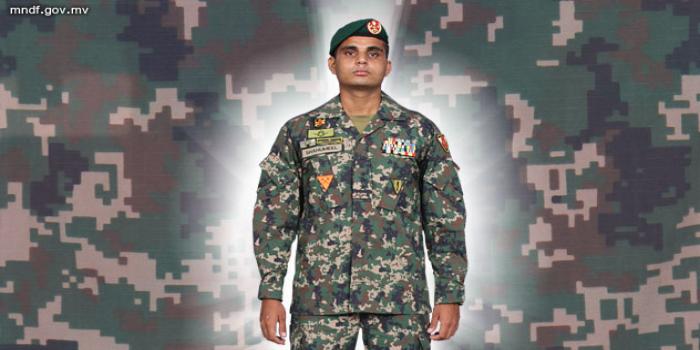
In addition to handover of flats, the MNDF has this week unveiled its new digital camouflage uniform, The new digital pattern would provide tactical advantages in war and is designed from a temperature sensitive special fabric.

“I believe soldiers must improve their military proficiency as they start to wear this advanced uniform,” Nazim said.

The minister called on the military to remain steadfast to Islam, maintain military discipline and warned of “harsh action” against any soldiers who violated military codes.

He praised the MNDF’s involvement in peacetime activities such as in the construction of futsal fields in the Maldives atolls and in the construction of the Malé – Hulhumalé bridge replica.

There are four upcoming military exercises within the year with India, Sri Lankan and American soldiers, he noted, adding that the Defense Ministry is looking into purchasing tools to increase operational capabilities such as fast interceptor vessels, ROVs, drones, and rapid intervention vehicles.

Likes(1)Dislikes(0)

INIA installs thermal cameras to prevent Ebola

Ibrahim Nasir International Airport has strengthened measures against Ebola carrying travelers by installing thermal cameras to identify travelers with high body temperature which is one symptoms of Ebola.

In an unveiling of the cameras held at the airport today, State Minister for Health Dr Aishath Rameela said that the travelers with high fevers would be identified using the cameras and would be taken to specialised screening booths.

The travelers who are suspected of having Ebola after the screening will be quarantined in a special isolation room until doctors from Hulhumalé hospital arrive and transport them for further examination.

Dr Rameela also said that thermal cameras are planned to be installed in the other two international airports in the Maldives.

Earlier this week the government announced that no travellers from the countries worst affected by the Ebola crisis would be permitted entry to the Maldives. Additionally, anyone having travelled to one of these countries must now wait until the 21 day incubation period has elapsed before being granted a visa.

Likes(1)Dislikes(0)